
A complete issue · 32 pages · 1903
Life — August 6, 1903
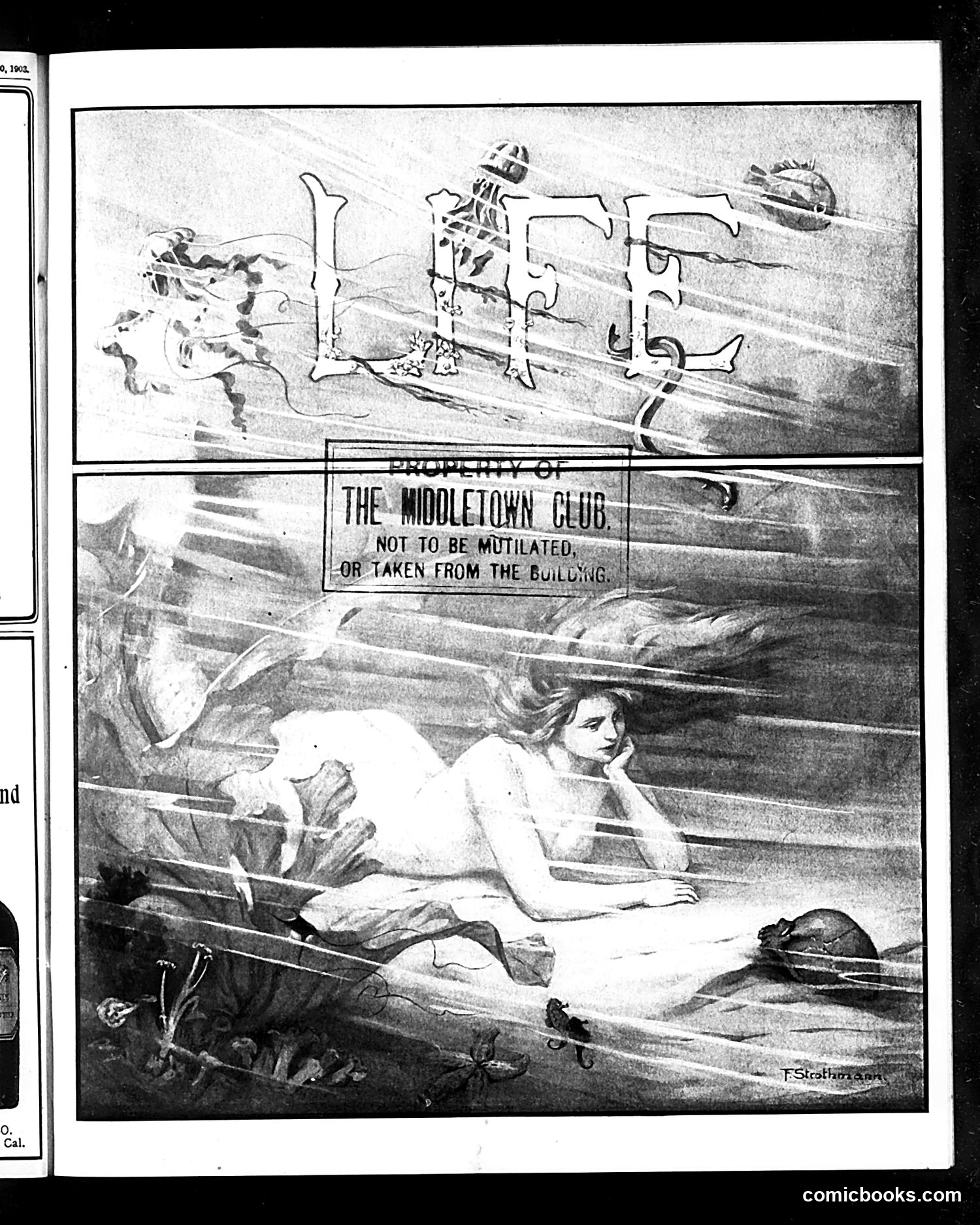
This page contains two panels depicting the "Life" mascot (the cherub figure at top) and a classical mermaid figure below. The text warns: "PROPERTY OF THE MIDDLETOWN CLUB / NOT TO BE MUTILATED, OR TAKEN FROM THE BUILDING." The satire appears to mock the Middletown Club's proprietary claims over the artwork—specifically the classical female nude depicted as a mermaid. By showing the figure literally trapped or confined ("property"), the cartoon satirizes the club's possessiveness of the decoration, treating an artistic work as chattel to be secured against theft or damage. The humor targets either the club's pretensions, the absurdity of over-protecting artwork, or wealthy institutions' control of cultural objects. Without additional context about the specific Middletown Club or contemporary disputes, the precise target remains somewhat unclear.
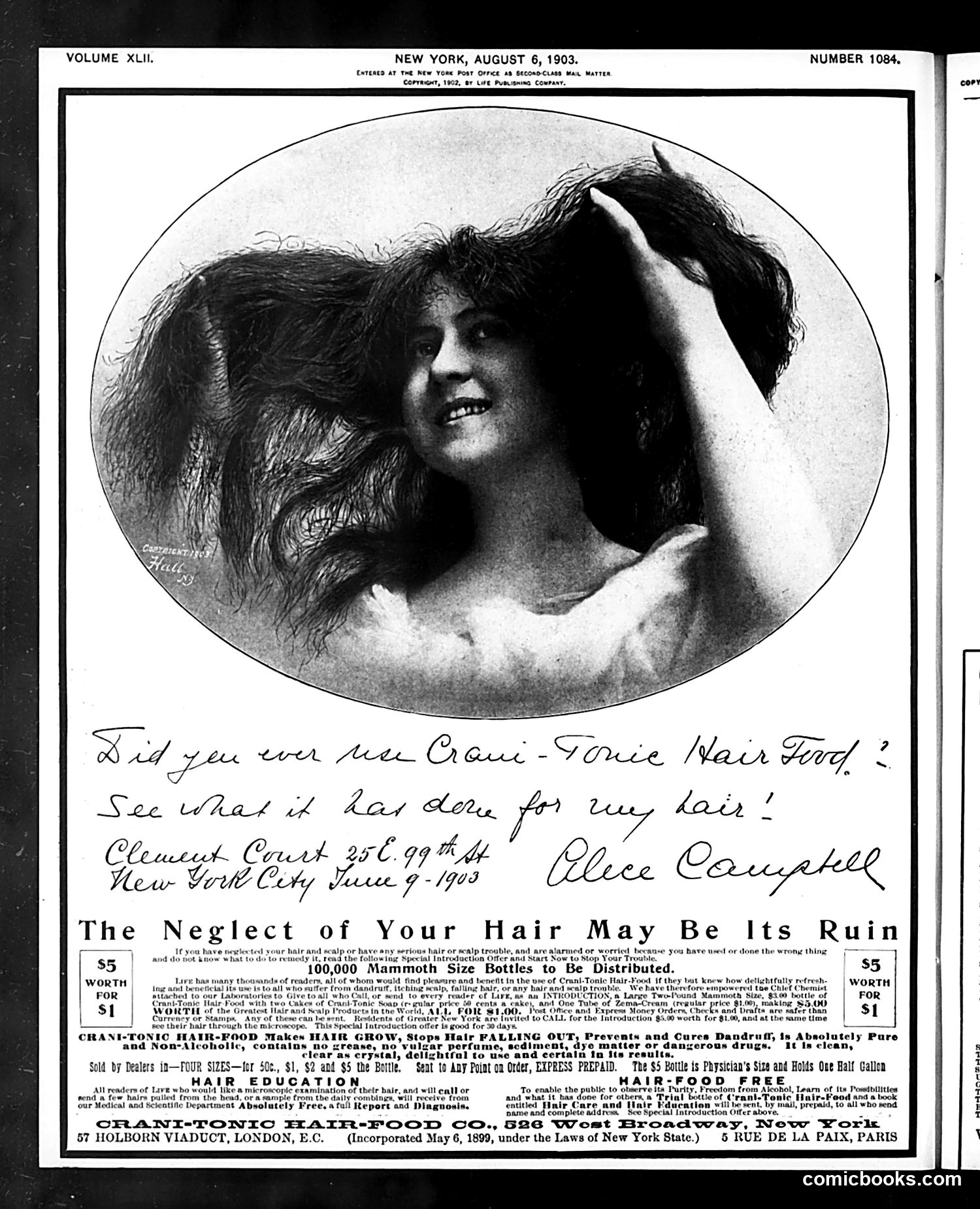
This page is primarily a **hair product advertisement**, not political satire. The oval portrait shows a woman with voluminous long hair, captioned with a handwritten testimonial from "Alice Campbell" asking "Did you ever see Crank-Tonic Hair Food?" The advertisement emphasizes hair growth and health, warning that "The Neglect of Your Hair May Be Its Ruin." The bulk of the page advertises "Crant-Tonic Hair-Food" manufactured by the Orantonnic Hair-Food Co. of London and New York, claiming it cures dandruff, stops hair loss, and promotes growth. The ad includes pricing ($5 worth for $1) and testimonial claims. This reflects early 1900s consumer culture and beauty standards rather than political commentary. Life magazine's satirical focus appears limited to this issue's content.
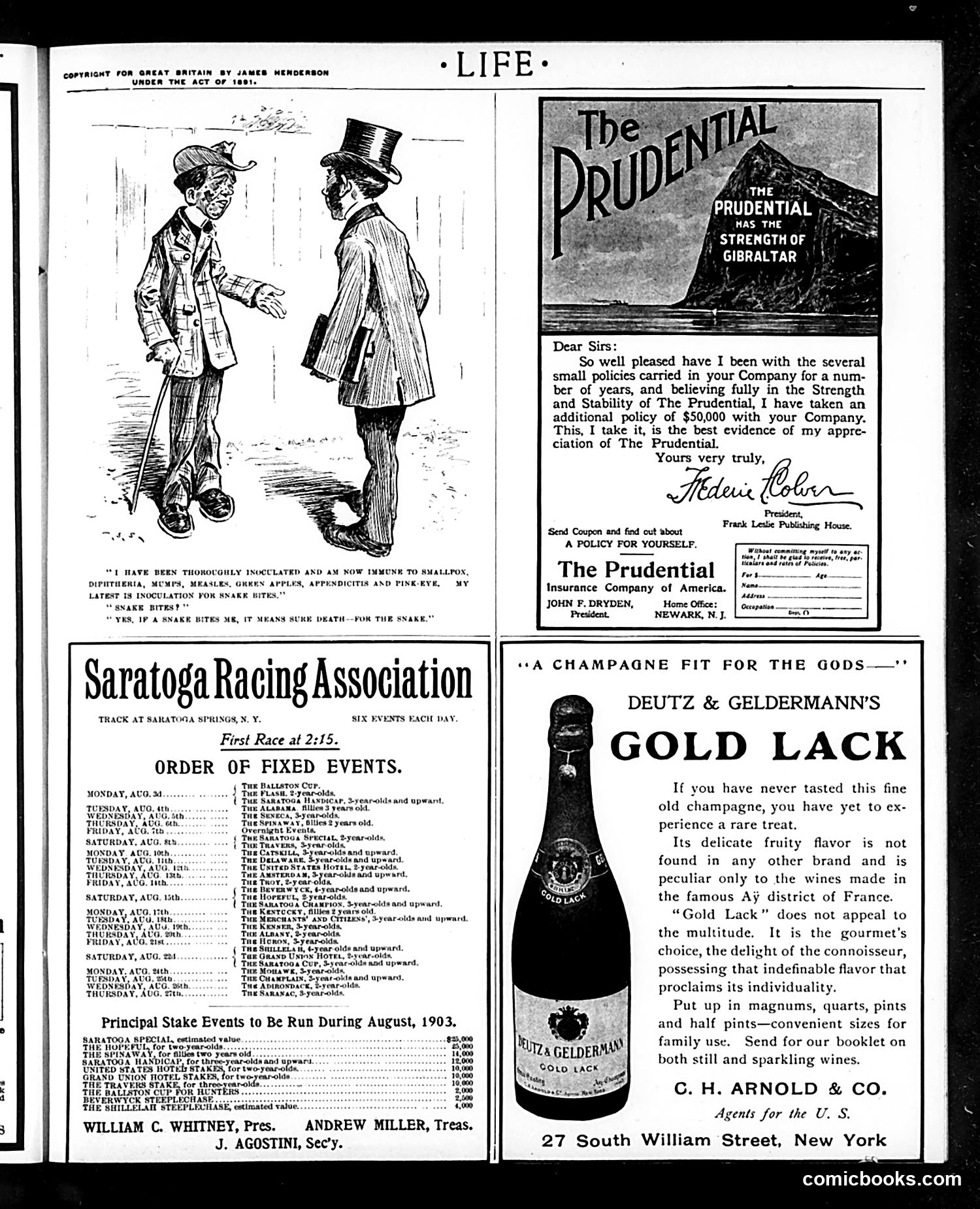
The main cartoon (top left) depicts two men in Victorian dress discussing smallpox vaccination. One says he's been "thoroughly inoculated" against smallpox, diphtheria, measles, and other diseases, with his "latest inoculation for snake bites." The other responds that snake bites mean "sure death—for the snake." **The joke:** This satirizes the contemporary craze for vaccinations and medical inoculations. By claiming immunity to snake bites (absurd, since vaccines don't work that way), the cartoon mocks people who place excessive faith in medical science's expanding promises. It's also a joke about the vaccinated man being so protected that *he'd* be dangerous to a snake. The page is otherwise filled with advertisements (Prudential Insurance, Saratoga Racing, Champagne) and racing schedules, typical of Life magazine's mixed content.
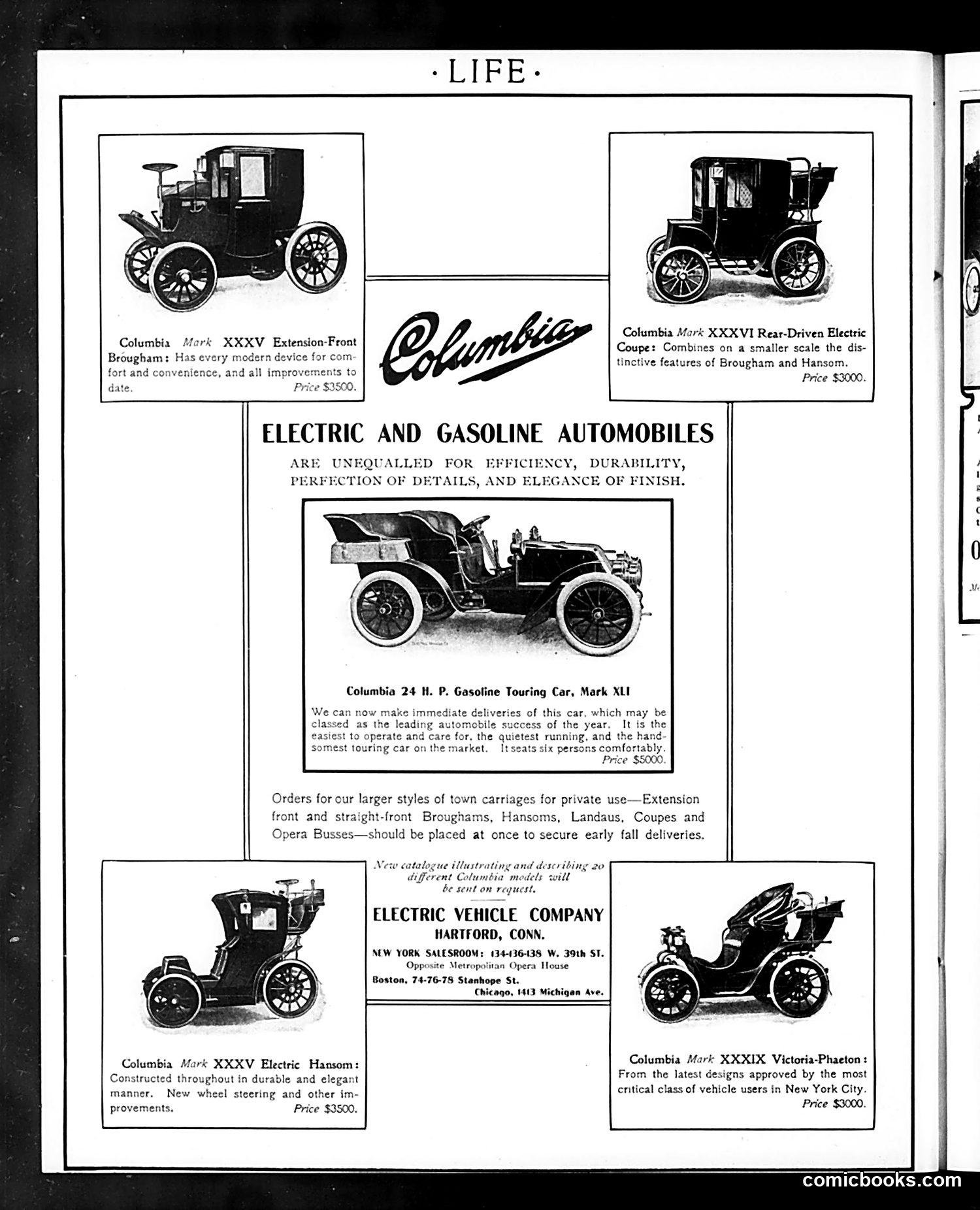
This page is **not a political cartoon or satire** — it's a straightforward **advertisement** for Columbia automobiles, published in *Life* magazine. The content showcases five Columbia vehicle models (electric and gasoline-powered): the Mark XXXV Extension-Front Brougham, Mark XXXVI Rear-Driven Electric Coupe, the 24 H.P. gasoline Touring Car (Mark XLI), the Mark XXXV Electric Hansom, and the Mark XXXIX Victoria-Phaeton. The advertisement emphasizes Columbia's quality and efficiency. Notably, it highlights both **electric and gasoline options**, reflecting the early 1900s automotive market when electric vehicles were still viable competitors to gas-powered cars. The ad targets affluent buyers seeking luxury town carriages and touring vehicles, with prices ranging from $3,000 to $5,000.
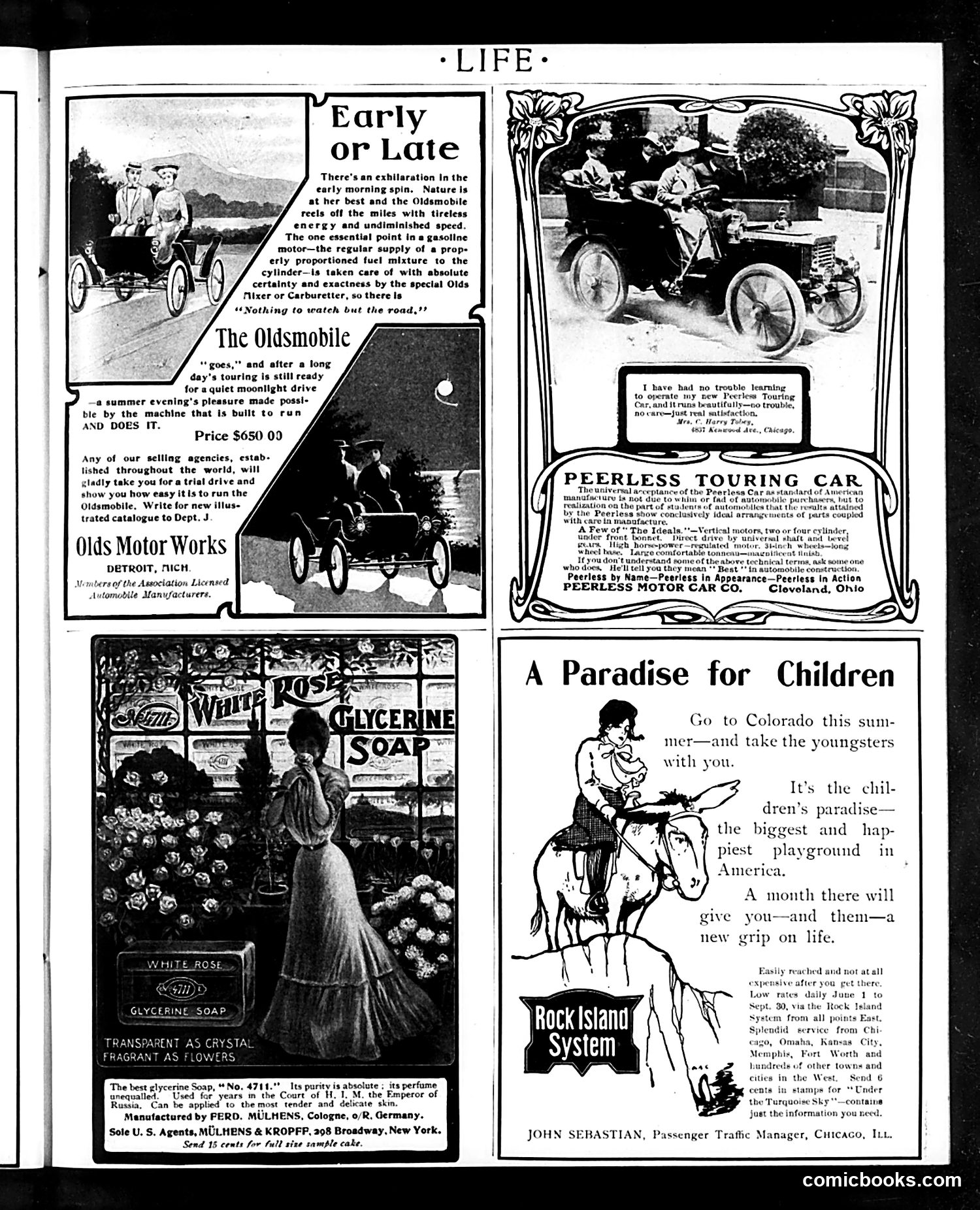
This page is primarily **advertising**, not satirical content. It contains four advertisements from the early 1900s: 1. **Oldsmobile** ("Early or Late"): Promotes the car's reliability and speed, priced at $650. 2. **Peerless Touring Car**: Highlights the vehicle's advanced features and ease of operation. 3. **White Rose Glycerine Soap**: Features a woman at a shop window, emphasizing the product's purity and fragrance. 4. **Rock Island System (railroad)**: Advertises Colorado as "a Paradise for Children," promoting family travel with low rates and splendid service. There is no political satire or caricature present. The page reflects early-20th-century consumer culture, showcasing emerging automobile technology and leisure travel as aspirational lifestyle products for middle-class Americans.
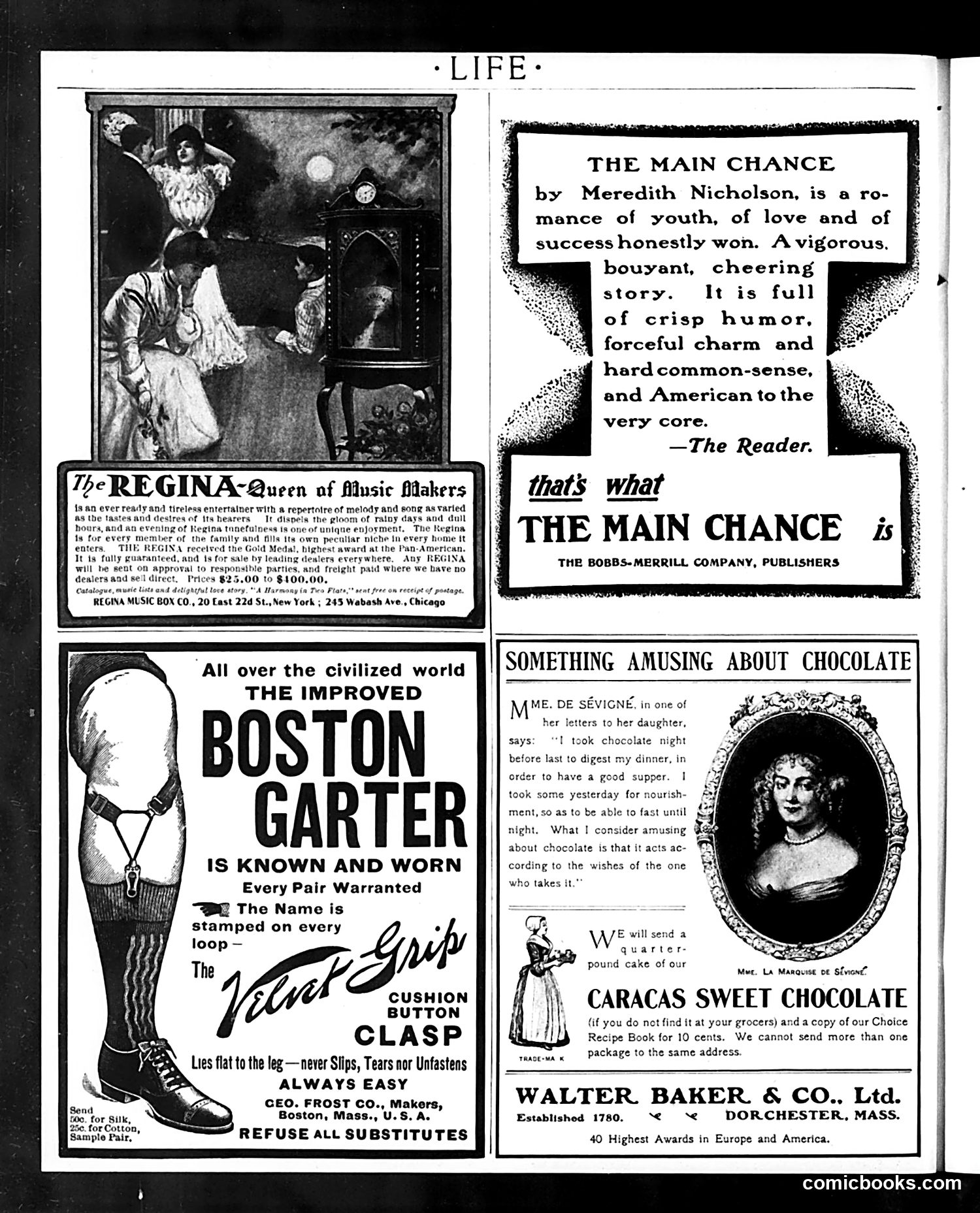
This page is primarily **advertising rather than satire or political commentary**. The main content consists of four commercial advertisements: 1. **"The Regina - Queen of Music Makers"** - a phonograph advertisement 2. **"The Main Chance"** - a book advertisement by Meredith Nicholson, described as a romance about love and success 3. **"Boston Garter"** - a men's garter/suspender advertisement emphasizing durability 4. **"Caracas Sweet Chocolate"** - a chocolate product advertisement featuring a portrait, with a humorous anecdote about chocolate as digestive aid There is no discernible political cartoon or satire on this page. The humor present is incidental to product marketing—such as the chocolate advertisement's domestic anecdote. This appears to be a typical early 20th-century *Life* magazine advertising section.
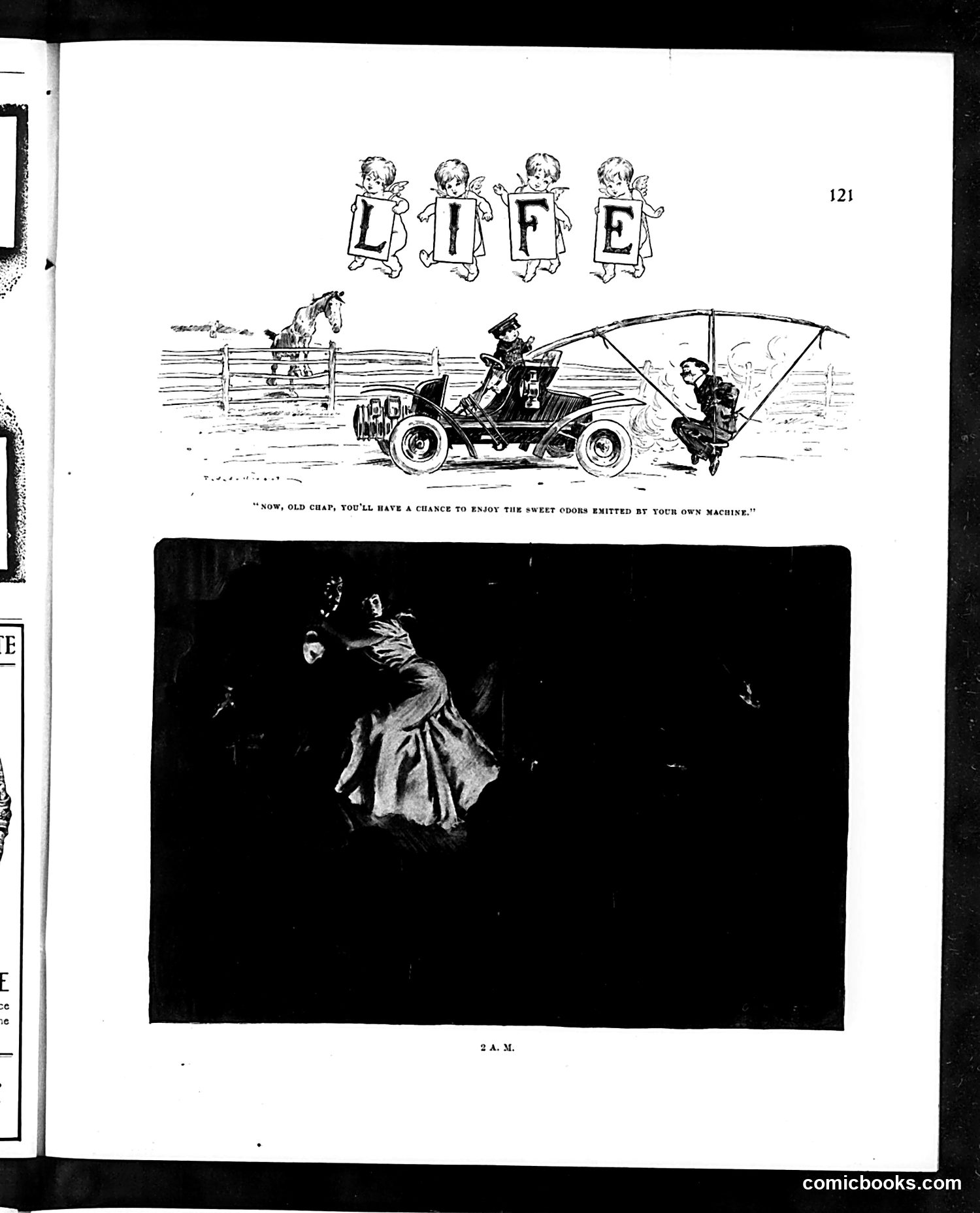
The page contains two illustrations separated by the heading "LIFE." **Top cartoon:** Four cherubs hold letters spelling "LIFE." Below, a chauffeur-driven automobile approaches a man fishing under an umbrella. The caption reads: "Now, old chap, you'll have a chance to enjoy the sweet odors emitted by your own machine." This is satire about early automobiles' notorious exhaust fumes and unpleasant smells. The joke mocks the irony that as cars become more common, even those seeking peaceful rural escapes (like the fisherman) will be surrounded by automotive pollution. It reflects early 20th-century anxieties about industrialization's environmental impact on traditional leisure activities. **Bottom image:** Labeled "2 A.M.," showing a silhouetted figure in what appears to be a bedroom or intimate scene. The context and meaning are unclear from the visible information.
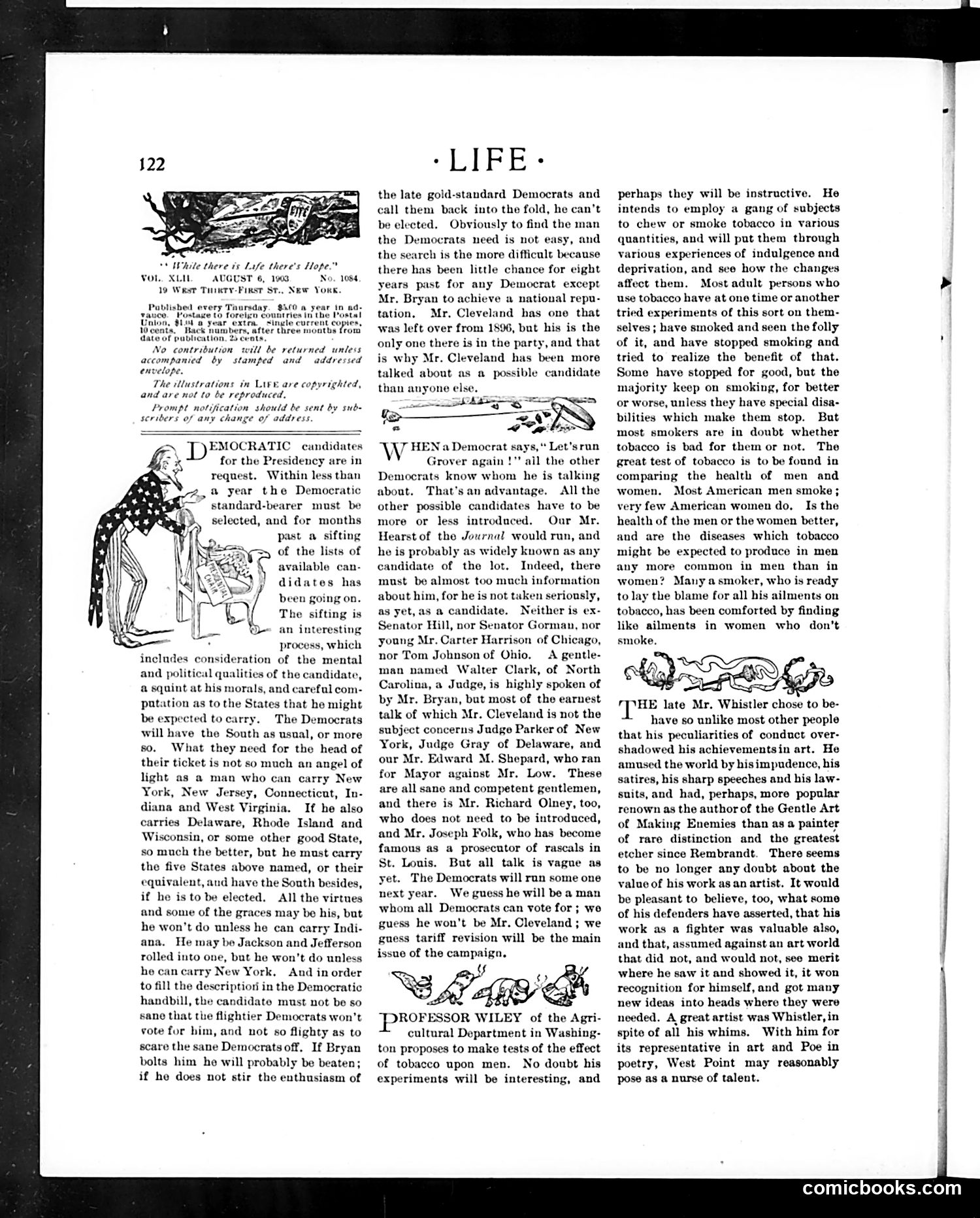
This page contains political commentary about the 1884 Democratic presidential race. The left cartoon depicts a skeletal "Democratic candidate" being examined—a visual metaphor for the party's difficulty finding a viable nominee. The text discusses potential candidates like Grover Cleveland, noting his advantage as someone already known to the public, versus lesser-known alternatives like Judge Parker, Senator Hill, and others requiring introduction. The right section discusses Professor Wiley's proposed tobacco experiments testing effects on men, and contrasts this with the late artist James McNeill Whistler's legacy. The satire criticizes Democratic vulnerability—they need an established figure like Cleveland to compete effectively, yet even he faces skepticism about winning support.
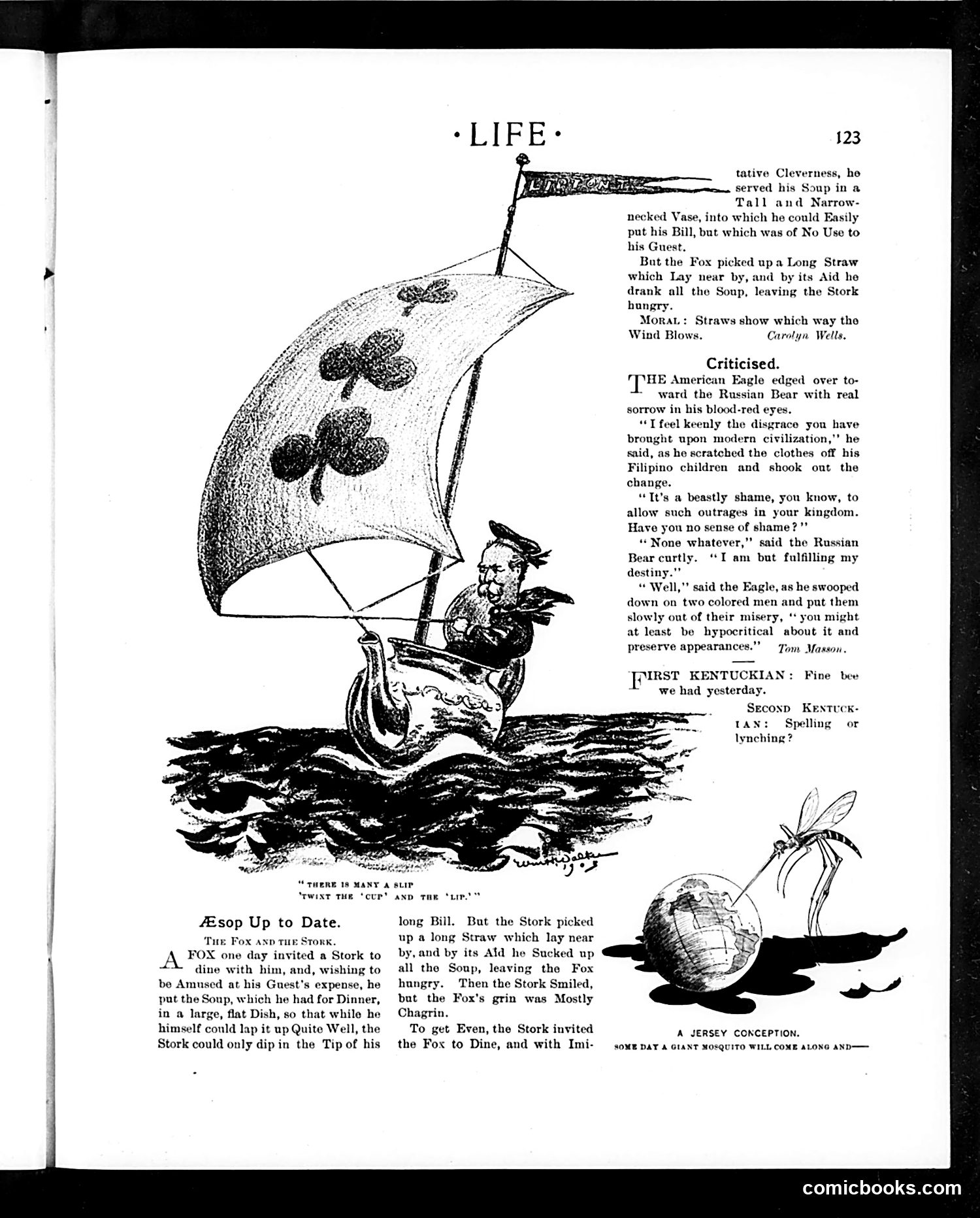
This page contains two satirical pieces: **"Aesop Up to Date"** (main cartoon): A fox and stork fable retelling. The fox serves soup in a shallow dish the stork cannot eat from, then the stork serves soup in a tall, narrow vase the fox cannot access. The moral criticizes tit-for-tat revenge as ultimately pointless. **"Criticised"** (text piece): An American Eagle confronts a Russian Bear about mistreating Filipino children. The Eagle lectures on civilization while hypocritically defending its own colonial violence against "colored men." This appears to satirize American imperialism and moral hypocrisy regarding the Philippines conflict (likely early 1900s). Both pieces use animal characters to critique political behavior and colonial attitudes.
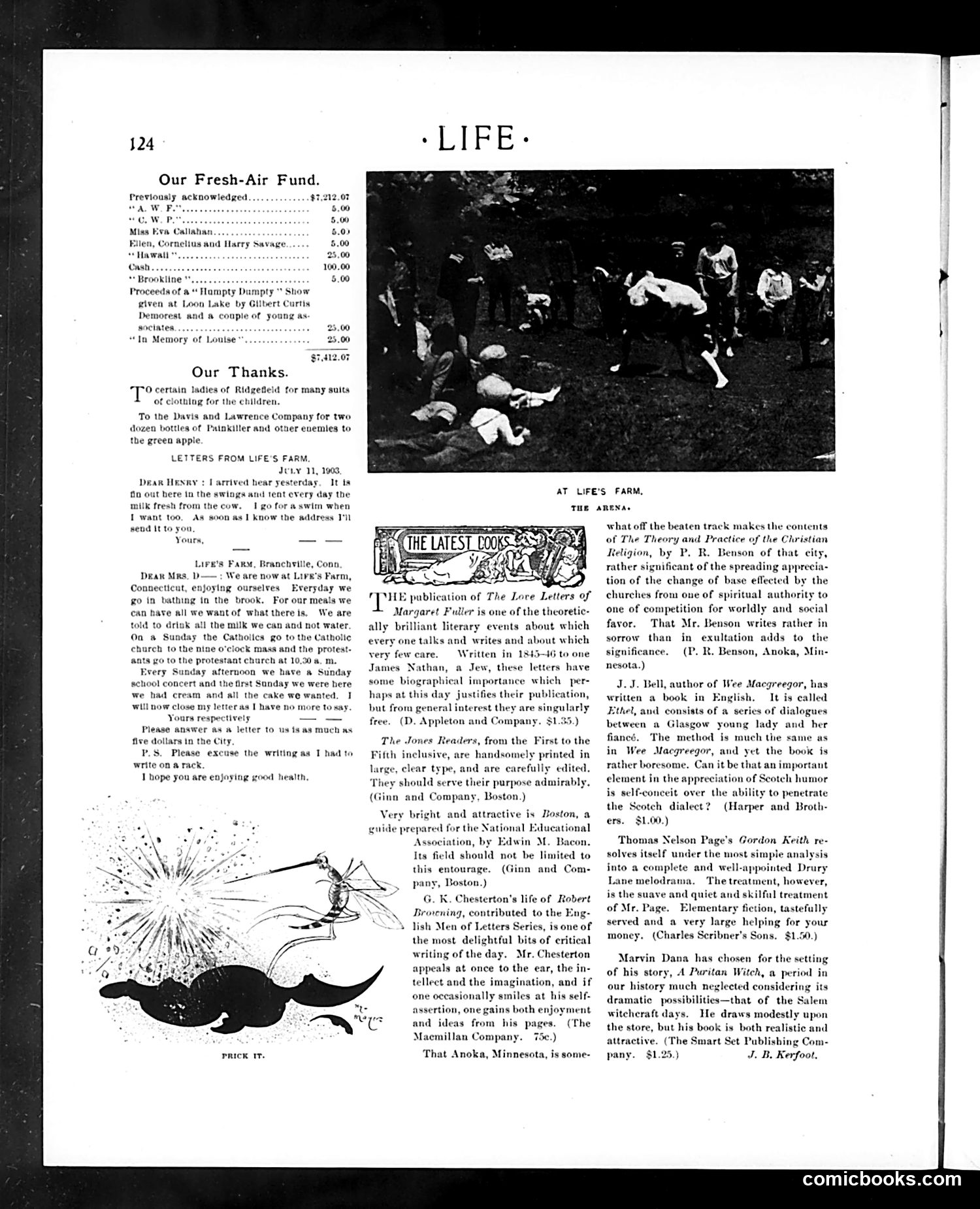
This page contains a "Fresh-Air Fund" fundraising section and book reviews, not political cartoons. The illustrated content includes: 1. **"At Life's Farm" photograph**: Shows children at an outdoor recreational facility, illustrating the Fresh-Air Fund's purpose of providing city children access to countryside activities. 2. **"Price It" cartoon**: A simple line drawing of what appears to be a person or figure in a humorous pose—the joke or meaning is unclear from the image alone. The page is primarily devoted to soliciting donations for children's clothing and other charitable contributions, plus literary reviews. The cartoons serve as visual breaks rather than conveying specific political or social satire. Without additional context about the referenced fund's history, the precise satirical intent remains unclear.
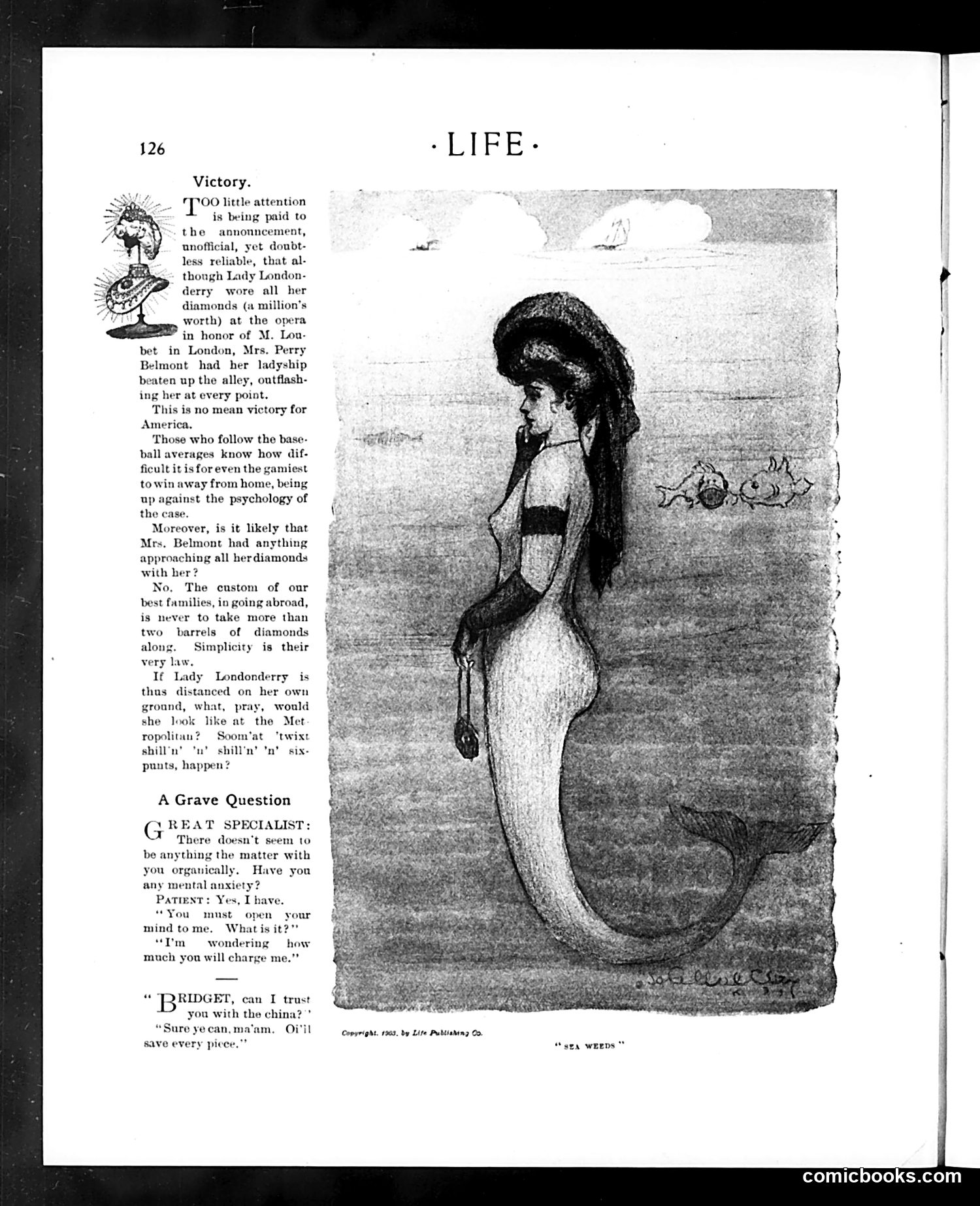
This page contains two separate pieces of humor: **"Victory"** (top) satirizes Lady Londonderry's extravagant display of diamonds at a London society event honoring M. Loubet. The text mockingly notes she wore "all her diamonds (a million's worth)" and contrasts this with American modesty—"our best families" abroad carry only two barrels of diamonds, following "simplicity." **"A Grave Question"** (bottom) is a brief doctor-patient joke: a specialist finds nothing organically wrong with an anxious patient, prompting the patient to ask the doctor's fee—with the implication that worry about cost will replace the original anxiety. The accompanying illustration labeled **"Sea Weeds"** shows a woman in classical pose, likely decorative rather than directly related to either text piece.
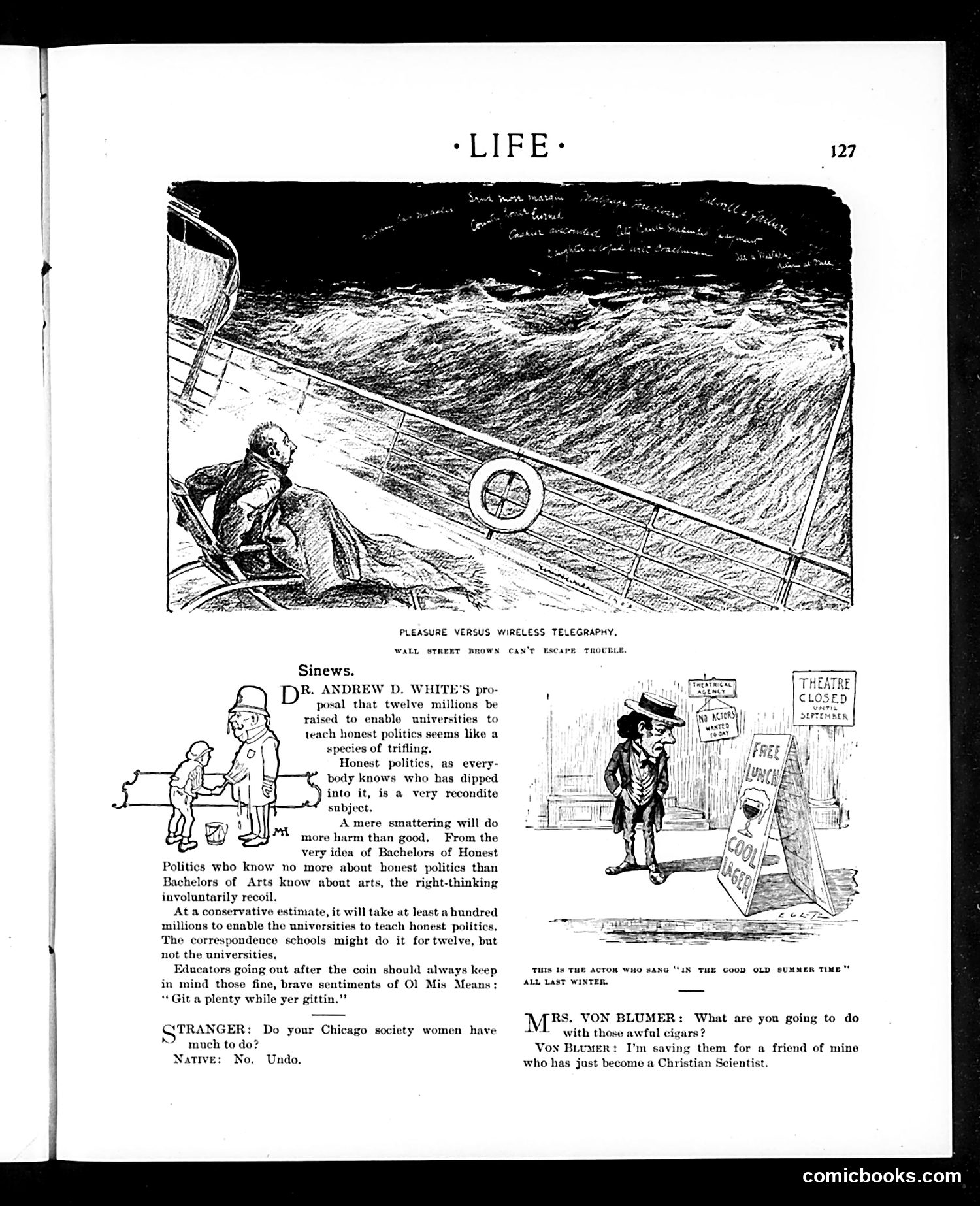
This page contains multiple satirical pieces targeting American society circa early 1900s. **Top cartoon:** Shows Wall Street financiers unable to escape wireless telegraphy's reach—mocking how new technology intrudes on even the wealthy's leisure. **"Sinews" section:** Mocks Andrew D. White's proposal to teach "honest politics" at universities for $12 million. The satire's point: honest politics is either impossible or so complex that universities cannot teach it—and if they could teach something so trivial, correspondence schools could do it cheaper. The quote "Git a plenty while yer gittin'" suggests politicians' actual ethos contradicts academic idealism. **Chicago women joke:** A play on "undo"—society women's main activity is undoing/unraveling social conventions or their husbands' work. **Von Blumer exchange:** Jokes that cigars suit Christian Scientists (who reject material comfort/medicine), so she's saving awful cigars as a "gift" for her newly converted friend—subtle mockery of Christian Science as an extreme belief system.
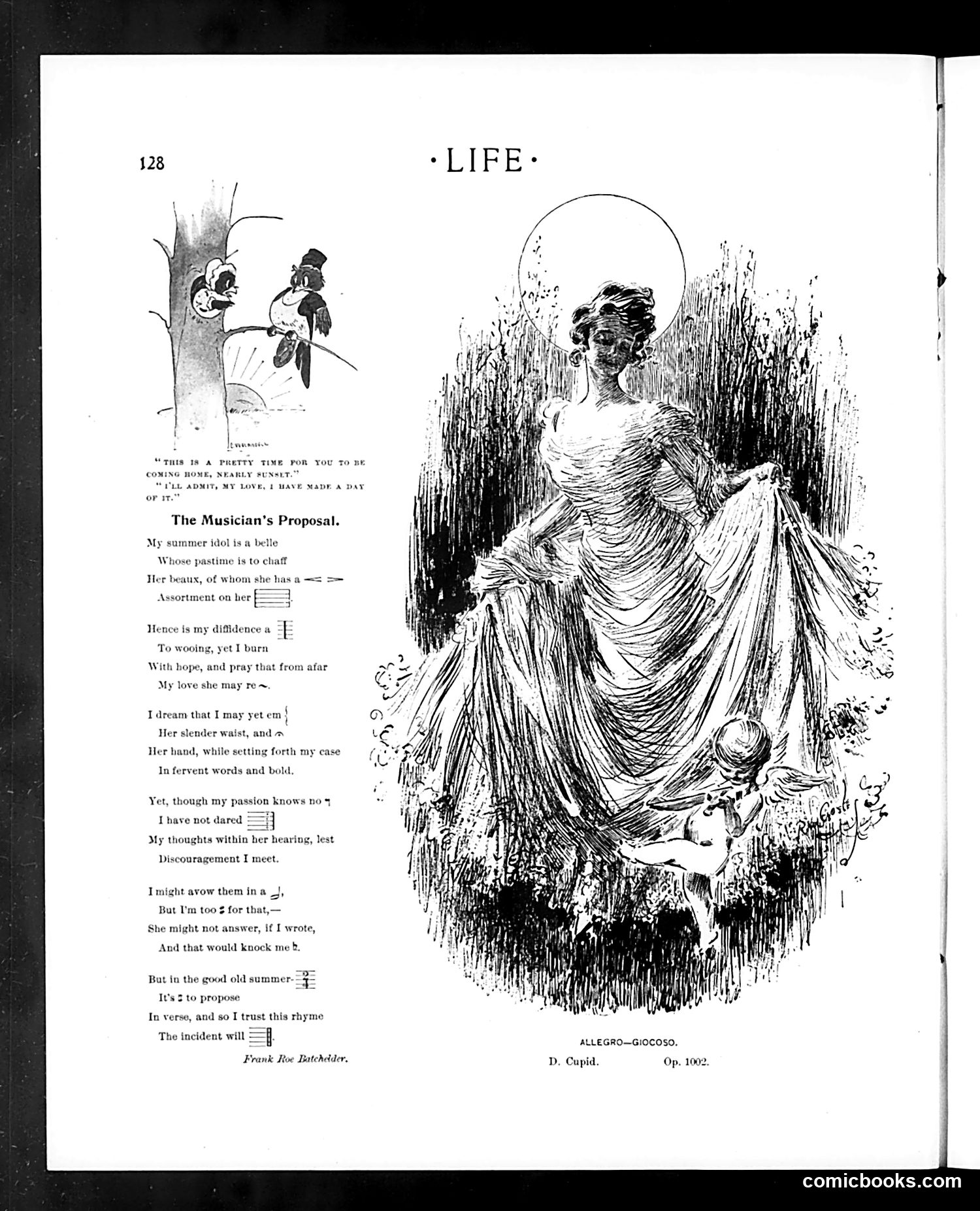
This page presents a humorous poem by Frank Roe Batchelder about a timid musician attempting to court a woman. The text uses musical notation symbols as visual puns filling blank spaces—a clever conceit matching the musical theme. The poem satirizes Victorian courtship conventions: the speaker is paralyzed by indecision, afraid to declare his feelings directly, worried about rejection, and ultimately settling on expressing his love through verse (the poem itself) as the safest approach. The accompanying illustration shows a woman in classical dress in a romantic landscape setting—the idealized "summer idol" of his affections. The humor targets masculine hesitation and the elaborate social rituals surrounding romance in the era. The musical attribution to "D. Cupid" (the Roman god of love) is a playful signature. This reflects Life magazine's typical satirical treatment of upper-class romantic anxieties and social pretension.
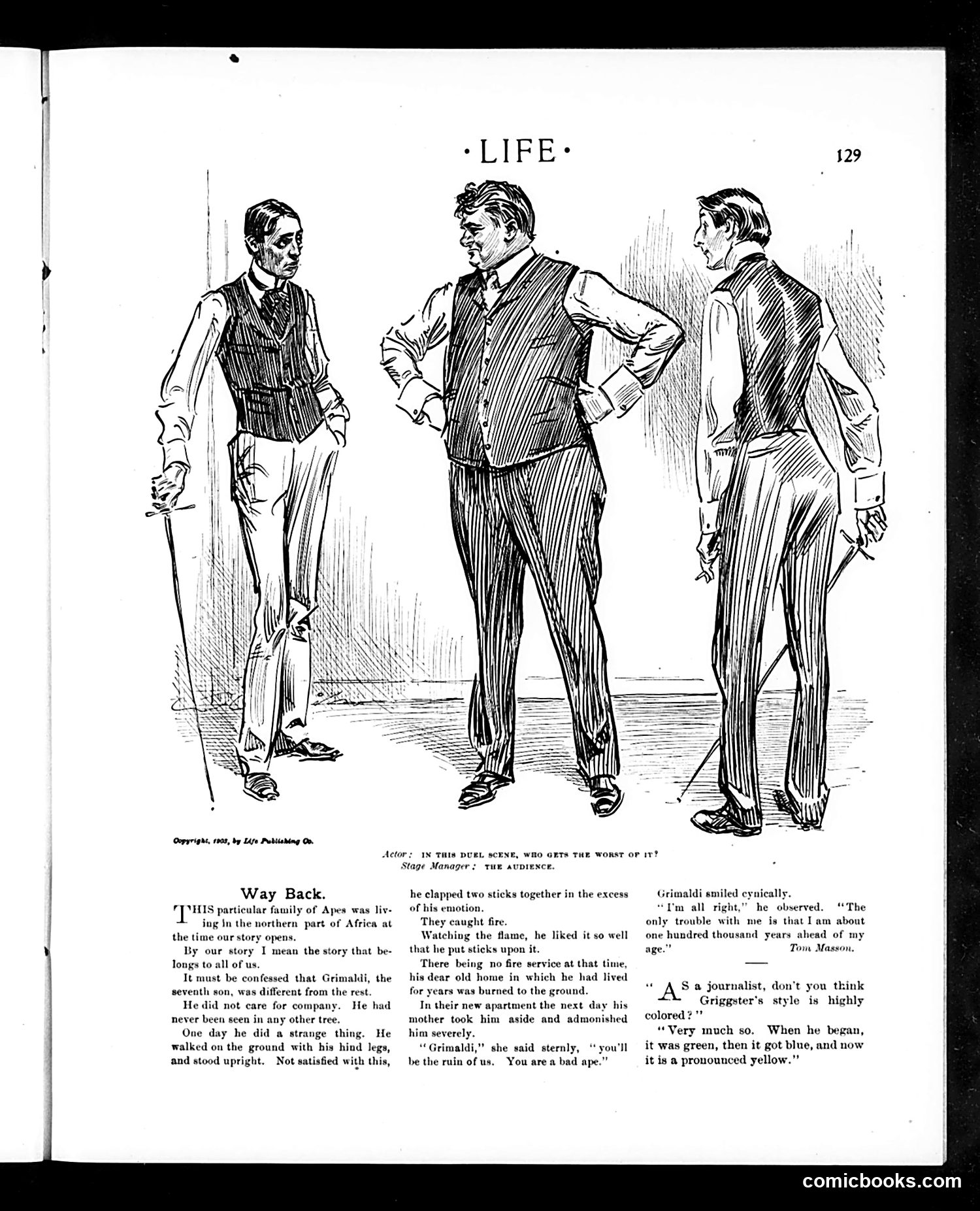
This 1905 *Life* magazine page contains two separate satirical pieces: **"Way Back"** (main cartoon): A humorous evolution narrative. The ape Grimaldi discovers fire by walking upright and striking sticks together—accidentally burning down his home. His mother scolds him, but he smugly responds that he's "one hundred thousand years ahead of my age." The satire mocks both evolutionary theory and the arrogant "man of progress" who causes destruction while congratulating himself for advancement. Tom Masson (credited) uses this to critique blind faith in technological progress. **"In This Duel Scene"** (smaller piece): A theater joke. When asked who "gets the worst of it" in a stage duel, the Stage Manager responds by describing how a theater critic's (Griggster's) writing style has progressively worsened—shifting from green to blue to "pronounced yellow." This lampoons sensationalist or poorly-written theater criticism, using color metaphorically to suggest declining quality. Both pieces exemplify *Life*'s tradition of satirizing contemporary pretensions and follies.
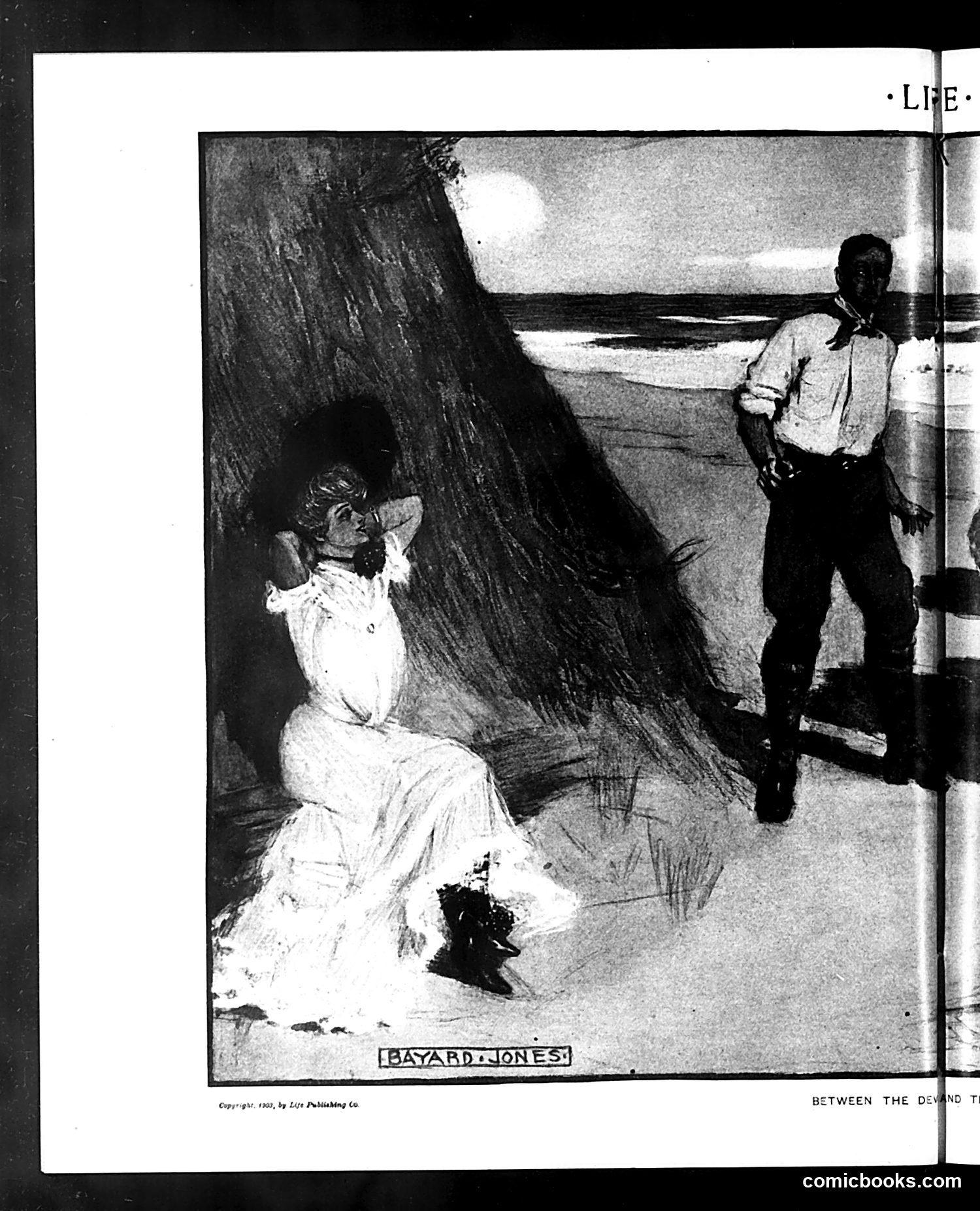
This Life magazine cartoon depicts a woman in white seated beneath a large dark tree, appearing distressed or contemplative. A man stands nearby observing the scene. The title "Between the Devil" (text is cut off) suggests a moral or romantic dilemma. The cartoon likely satirizes a woman caught in an uncomfortable social or romantic situation. The tree's dark, looming presence and the woman's posture suggest entrapment or difficult circumstances. Without the complete caption, the specific reference is unclear, but the composition implies commentary on women's limited choices or constrained social positions in early 1900s America. The artistic style—detailed cross-hatching and dramatic lighting—was typical of Life's satirical illustrations from this period.
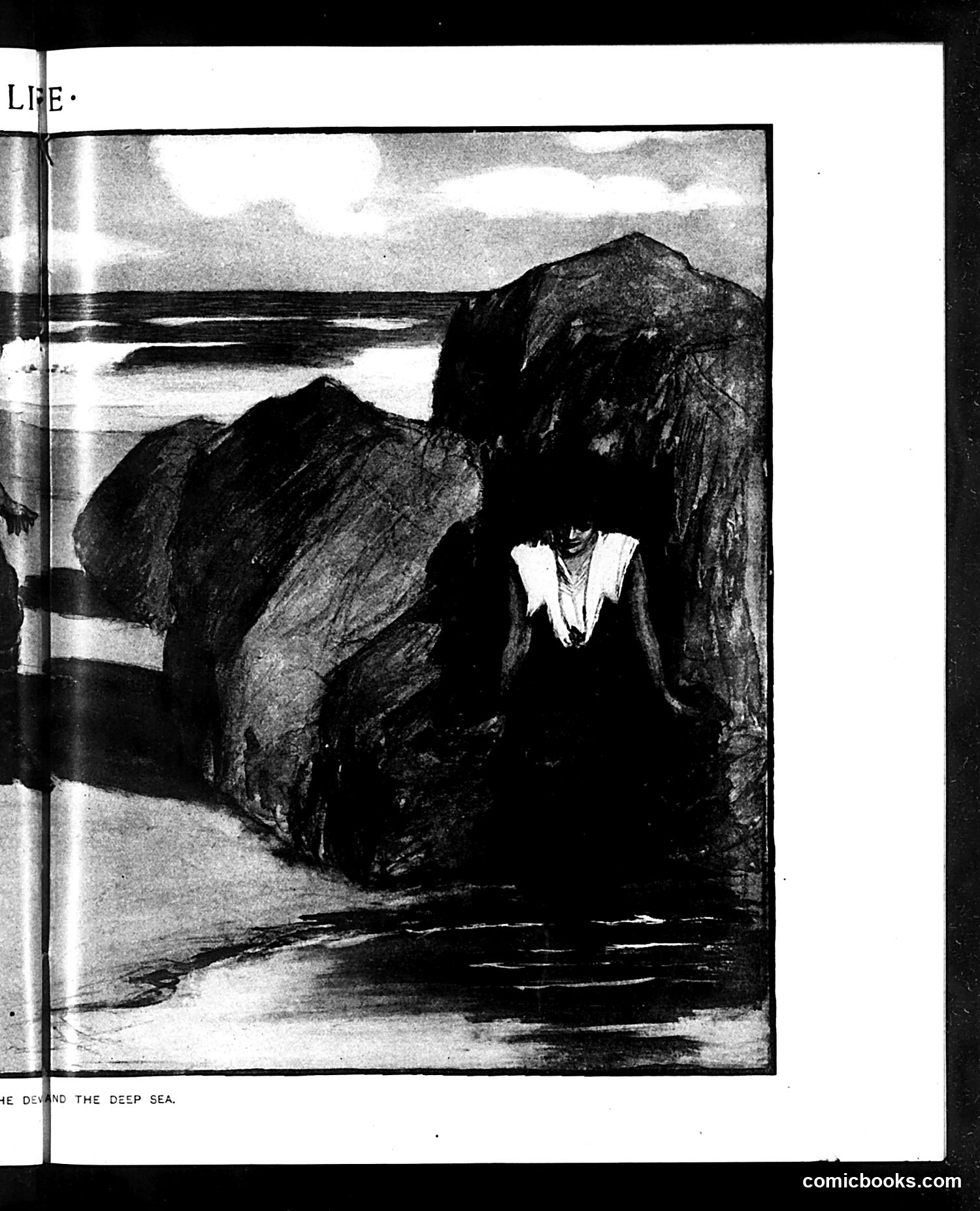
This appears to be an illustration from Life magazine depicting a figure in dark clothing standing among large rocks by the sea. The visible text fragment reads "HE DEVAND THE DEEP SEA" (likely "HE DEFIED THE DEEP SEA" with OCR error). The image shows a woman in a white collar against dark garments, positioned dramatically among jagged coastal rocks with water visible in the background. This appears to be illustrative rather than satirical—likely accompanying a serialized story or adventure narrative rather than political commentary. Without the complete text, caption, or article title visible, I cannot definitively identify the specific story being illustrated or its satirical intent. The style suggests early-to-mid 20th century melodramatic illustration common in Life magazine's fiction accompaniments.
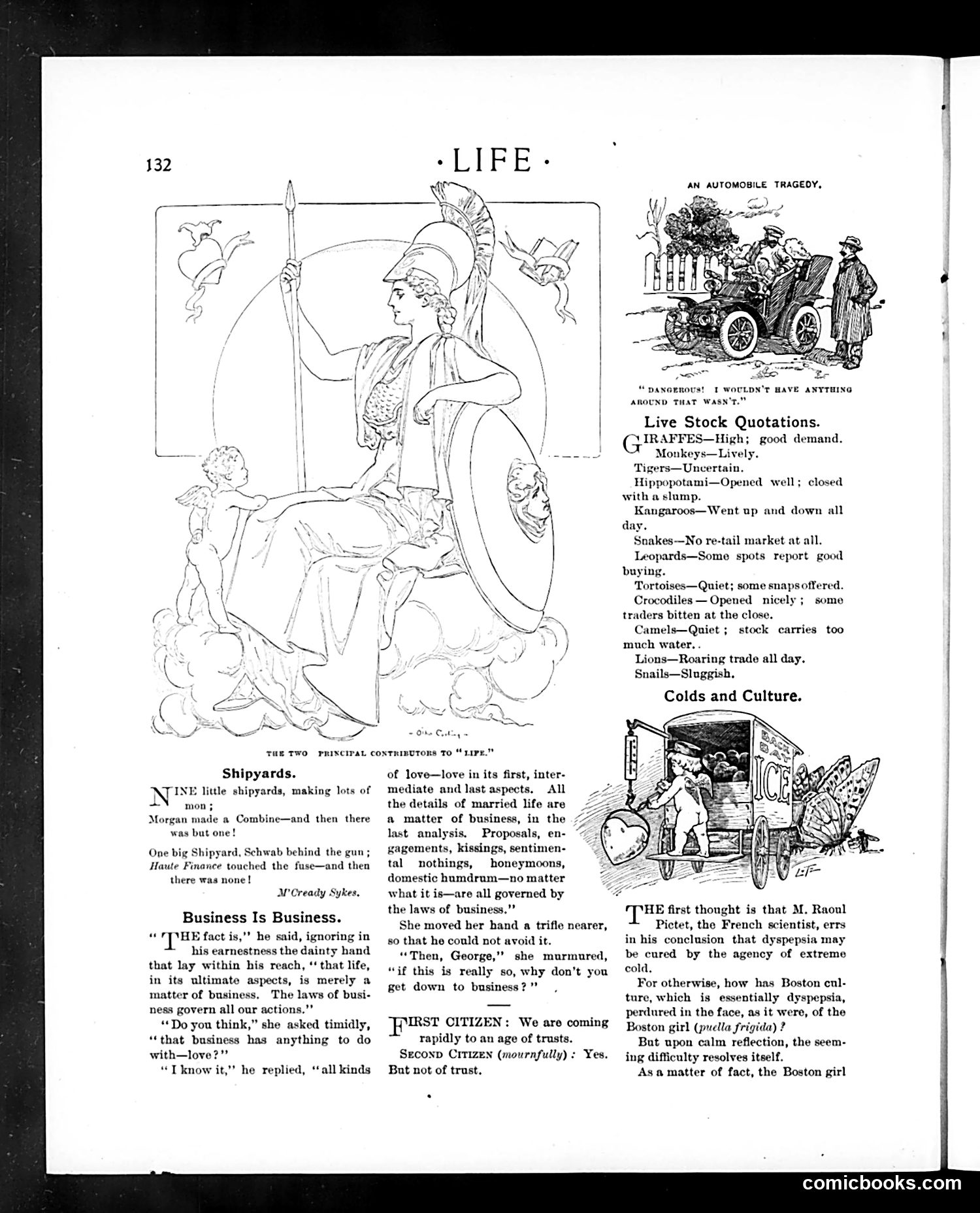
This page from the satirical magazine *Life* contains several distinct pieces mocking early 1900s American society: **"The Two Principal Contributors to Life"** satirizes J.P. Morgan's monopolistic control of shipbuilding. The poem suggests Morgan created a combine (trust), leaving one shipyard under Schwab's control—then even that disappeared, mocking how financial manipulation destroyed competition. **"Business Is Business"** is a romantic comedy sketch where a man, treating courtship as pure business transaction, misses obvious romantic advances. The woman's final line—"why don't you get down to business?"—is a sexual innuendo he fails to recognize, satirizing rigid businessman mentality. **The dialogue on trusts** cynically contrasts the "age of trusts" (monopolies) with lack of "trust" (confidence), reflecting public anxiety about corporate consolidation. The **"Live Stock Quotations"** pun on stock market language applied to animals (snakes have "no re-tail market"), mocking financial jargon. **"Colds and Culture"** makes a joke about Boston culture being essentially dyspeptic (diseased/sour), and the "Boston girl" being "frigida" (cold)—a regional stereotype about aristocratic New England reserve.
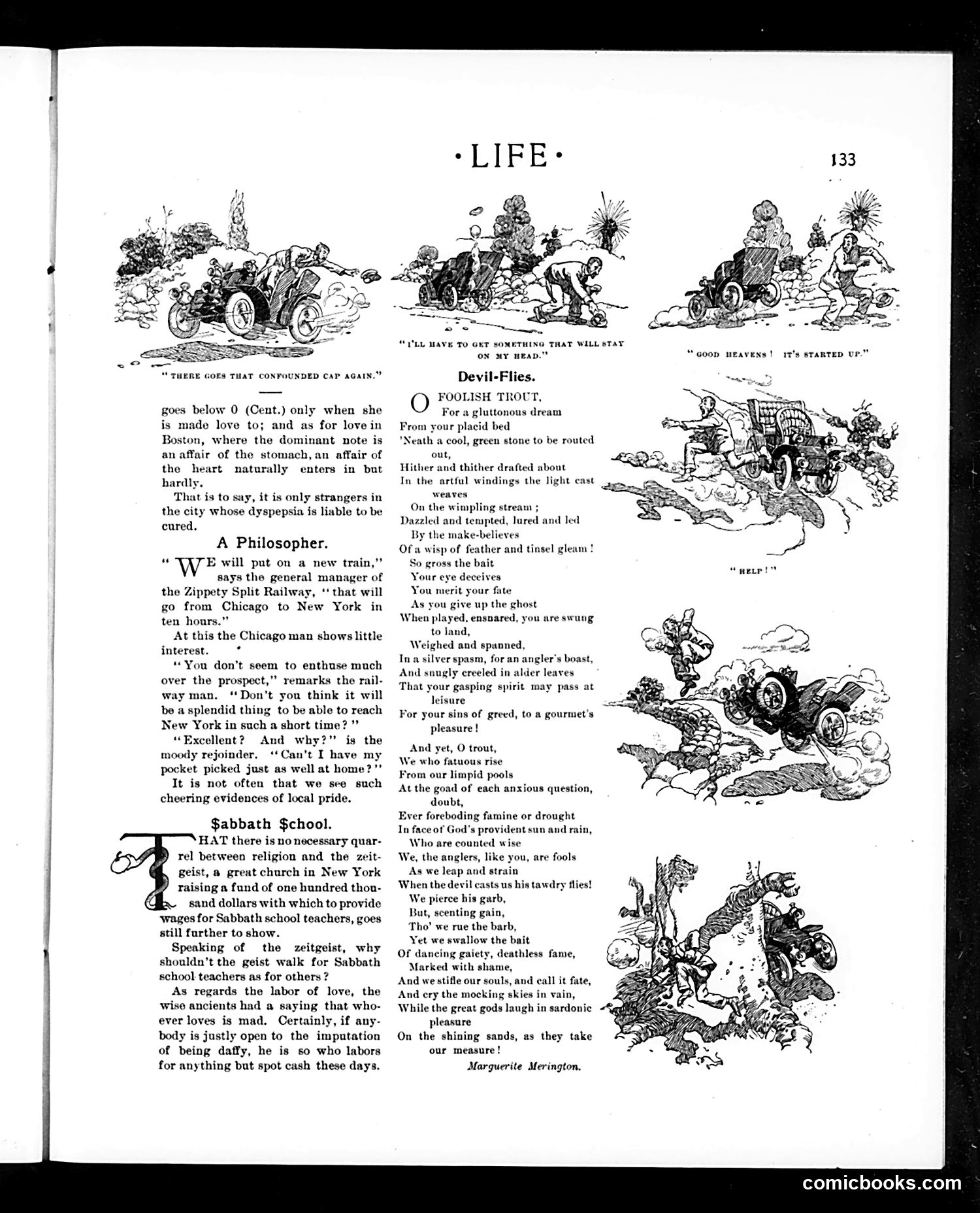
This page contains three distinct satirical pieces mocking American society circa early 1900s: **"A Philosopher"** ridicules a Chicago man's cynicism about progress. When a railway manager boasts of a ten-hour Chicago-to-New York train, the man dismissively asks why he'd care—he'll just get his pocket picked at home anyway. The joke satirizes both urban crime and lack of civic pride. **"Sabbath School"** mocks the disconnect between religious ideals and modern capitalism. A church raises funds paying teachers for Sabbath instruction, yet the piece argues anyone working for non-monetary reward in contemporary times is "daffy." It's sarcastic commentary on underpaid religious education labor. **"Devil-Flies"** (a poem by Marguerite Merington) draws a metaphor between fish seduced by fishing lures and humans chasing false promises of wealth and fame. The trout and anglers alike are "fools" pursuing illusions—wealth, status, and "dancing gaiety"—while ignoring mortality and spiritual consequence. The accompanying cartoons show chaotic auto accidents, emphasizing modern dangers and social disorder.
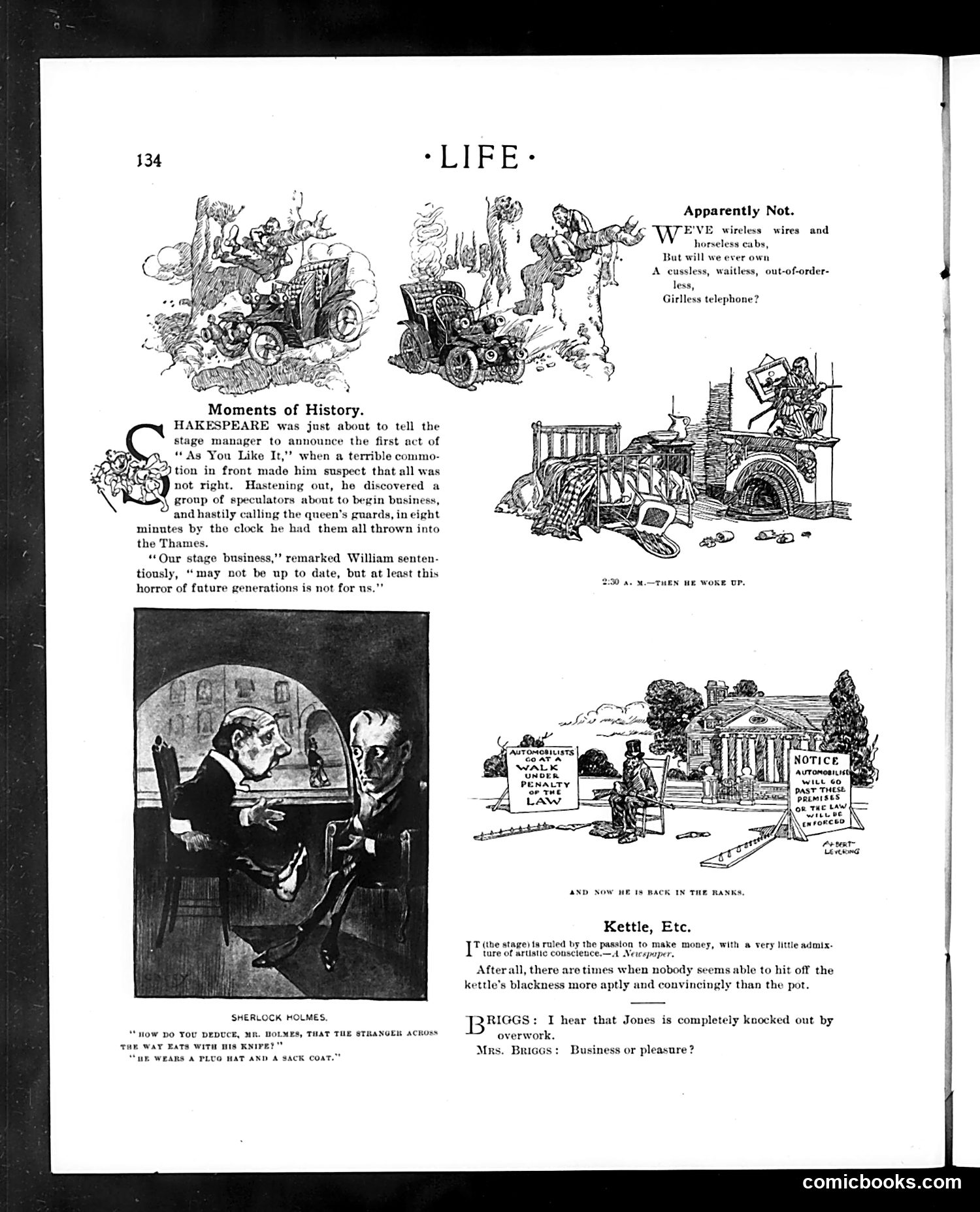
This page contains multiple satirical pieces targeting early 1900s social issues: **"Apparently Not"** mocks the telephone industry's failure to eliminate annoying features—operators, wrong numbers, delays—despite technological advancement. **"Moments of History"** is a dream sequence where Shakespeare violently ejects financial speculators from his theater, then wakes up. The satire criticizes commercialism in theater: the accompanying quote suggests stage productions are driven by "passion to make money, with very little artistic conscience." The irony is that Shakespeare's dream-action is impossible in modern times. **"And Now He is Back in the Ranks"** depicts an automobilist hitting a pedestrian near a "No Trespassing" sign on an estate—satirizing how wealthy drivers evade consequences through property rights. **"Kettle, Etc."** and the Sherlock Holmes fragment are brief joke items about hypocrisy and deduction. The page overall critiques commercialism, corruption, and inequality in Edwardian America.
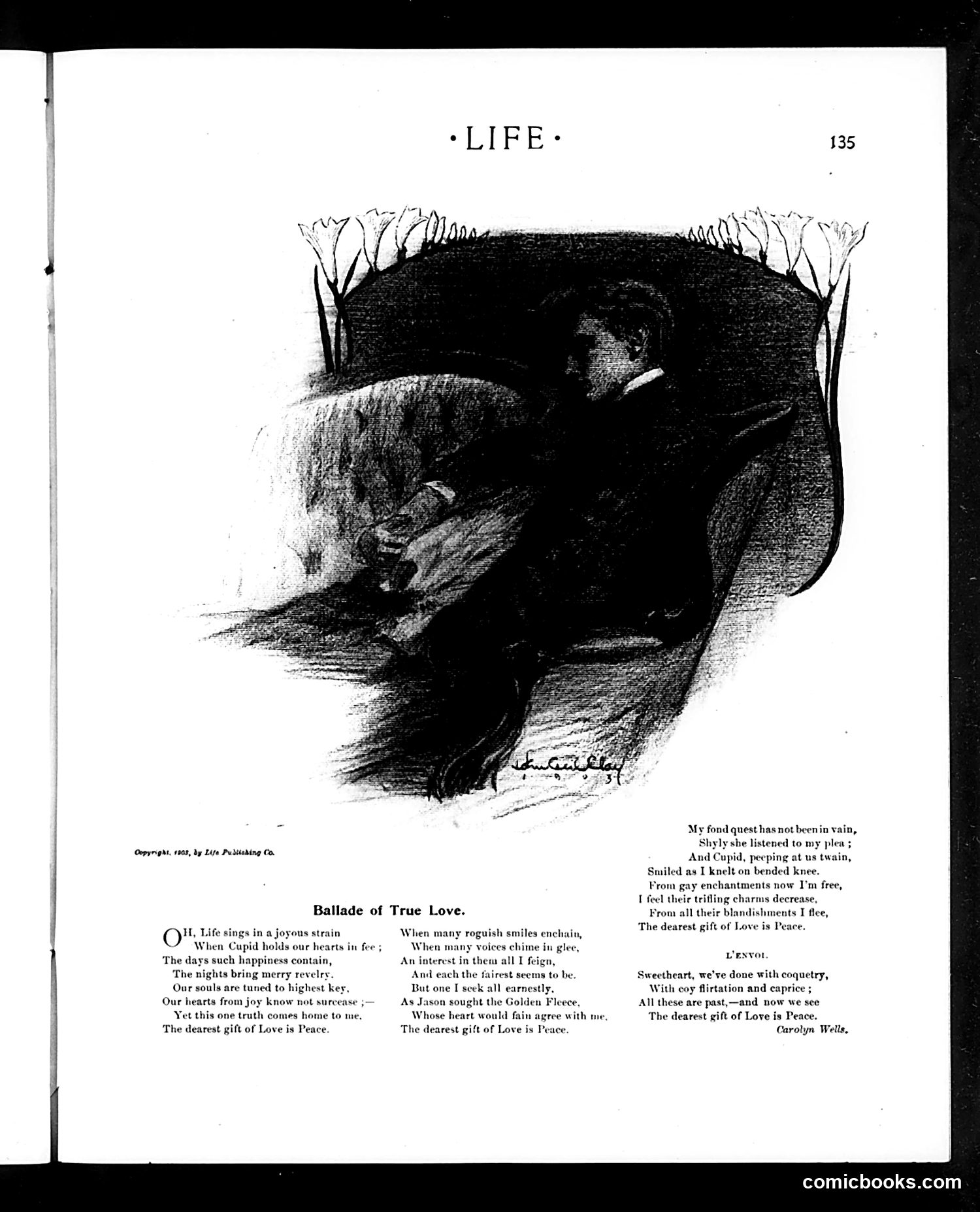
This page features a romantic poem rather than political satire. The illustration shows a couple in an intimate moment—a man kneeling beside a woman on a couch or bed, rendered in soft charcoal. The "Ballad of True Love" by Carolyn Wells celebrates romantic love's culmination in peaceful domesticity. The poem progresses from Cupid's playful enchantments through earnest courtship to the speaker's ultimate realization that true love's greatest gift is **peace**—not passion or excitement, but calm companionship. This reflects early 20th-century sentimental literature valorizing marriage as life's highest achievement. The repeated refrain "The dearest gift of Love is Peace" emphasizes stability and contentment over romantic fireworks, appealing to Life's middle-class readership. The tone is sincere rather than satirical, positioning enduring marital peace as the ultimate romantic ideal.
This is a **literary and humor page** from *Life* magazine, not primarily political satire. It contains: 1. **"A Ballade of a Mirror of Louis Quinze"** — A poem about an ornate 18th-century French mirror, reflecting on vanity and courtship among French aristocracy. It's a nostalgic, literary piece rather than topical satire. 2. **"Mascagni at Rehearsal"** — An anecdote about composer Pietro Mascagni conducting his opera "Iris" (1898), losing patience with an incompetent singer, and sarcastically telling him to "try singing it on the key" — a joke about the performer's poor musicianship. 3. **Two brief humorous stories**: one about a stuttering cowboy's crude pickup line, another about a clergyman confused by naming a girl "Shady Bower." The page is **primarily literary entertainment and light humor**, not political commentary. The advertisements below (Wilson Whiskey, Hunter Rye) are typical period ads. This represents *Life*'s early focus as a sophisticated, humor-oriented publication for educated readers rather than hard-hitting satire.
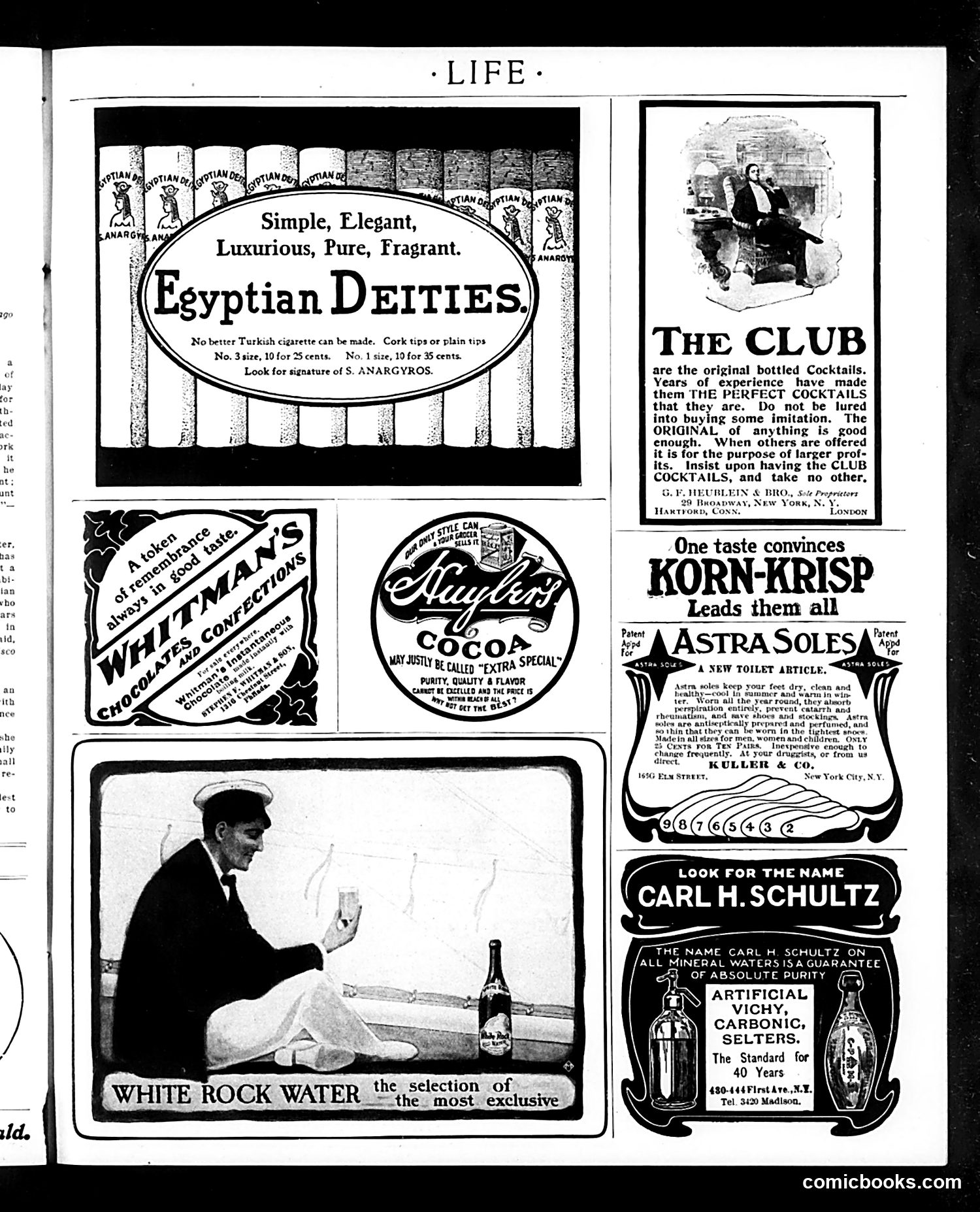
This is primarily an **advertising page**, not a political cartoon. It contains multiple product advertisements from the early 20th century, including: - **Egyptian Deities cigarettes** (Turkish cigarettes with cork tips) - **Whitman's chocolates** - **Saylor's cocoa** - **The Club cocktails** (bottled cocktails) - **Korn-Krisp** (a breakfast cereal or food product) - **Astra Soles** (shoe articles) - **Carl H. Schultz mineral waters** (artificial vichy and seltzer) - **White Rock Water** The page reflects early 1900s consumer culture and marketing strategies. Notable is the emphasis on products being "original," "pure," and the "standard"—suggesting market competition where brands fought imitation products. The gentleman examining White Rock Water and the well-dressed figures in other ads appeal to aspirational middle-class consumers. There is no political satire visible; this is straightforward product promotion typical of Life magazine's revenue model.
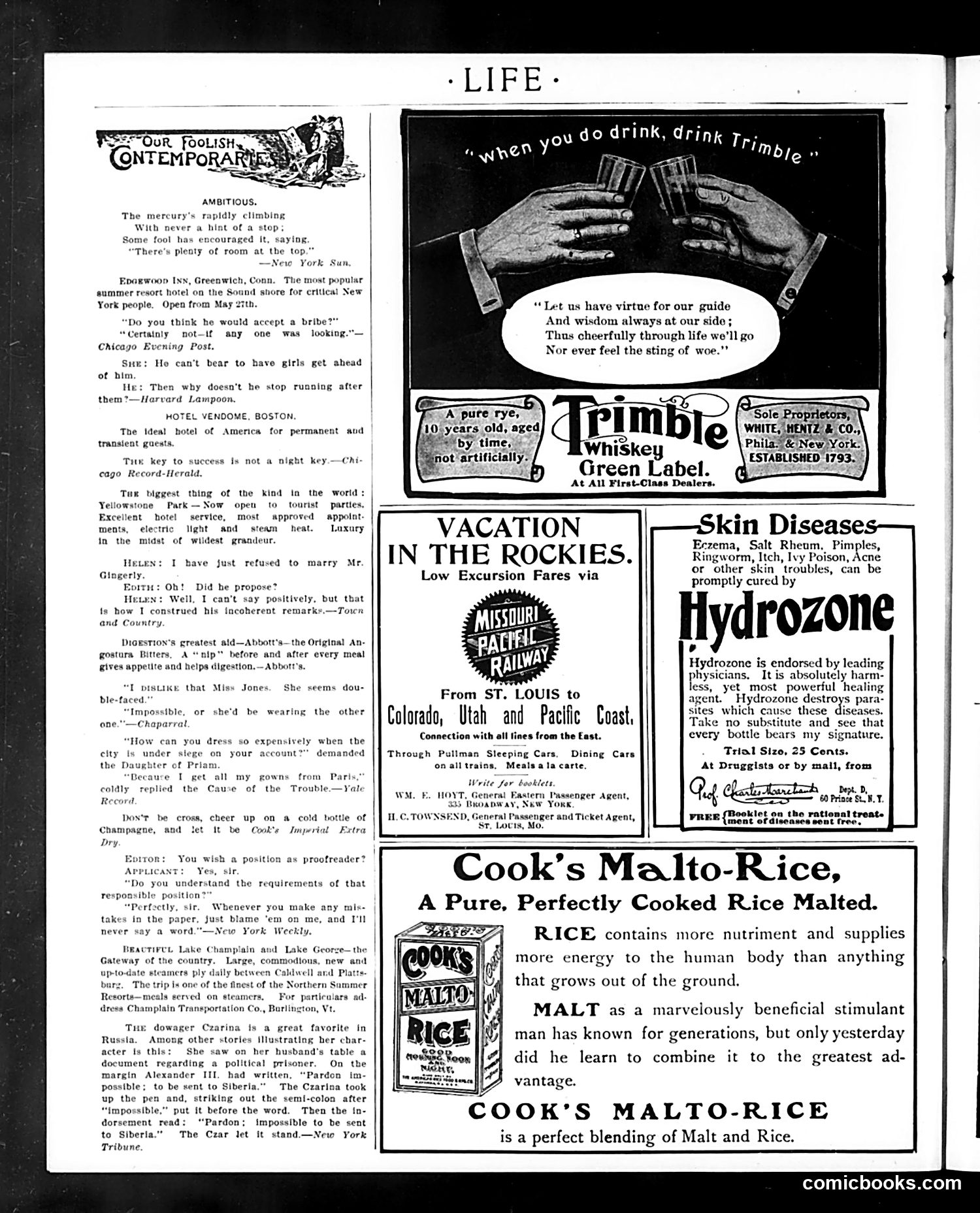
This page from Life magazine is primarily **advertising with brief satirical commentary** rather than political cartoons. The top section contains short, humorous observations about contemporary life—typical of Life's format. These include jokes about ambition ("there's plenty of room at the top"), gender relations, and social awkwardness. The humor is gentle, drawing from newspapers and magazines of the era. The **major content** consists of advertisements: Trimble Whiskey, Missouri Pacific Railway vacation fares, Hydrozone skin treatment, and Cook's Malto-Rice. One notable detail: the **Dowager Czarina anecdote** (bottom left) describes Czarina Maria Feodorovna supposedly saving a political prisoner by removing a semicolon from Czar Alexander III's death sentence—a humorous tale illustrating wit over authority. This appears as editorial filler rather than satirical commentary. The page reflects early 1900s sensibilities: leisurely travel, patent medicine remedies presented as scientific breakthroughs, and gender stereotypes treated as light comedy.
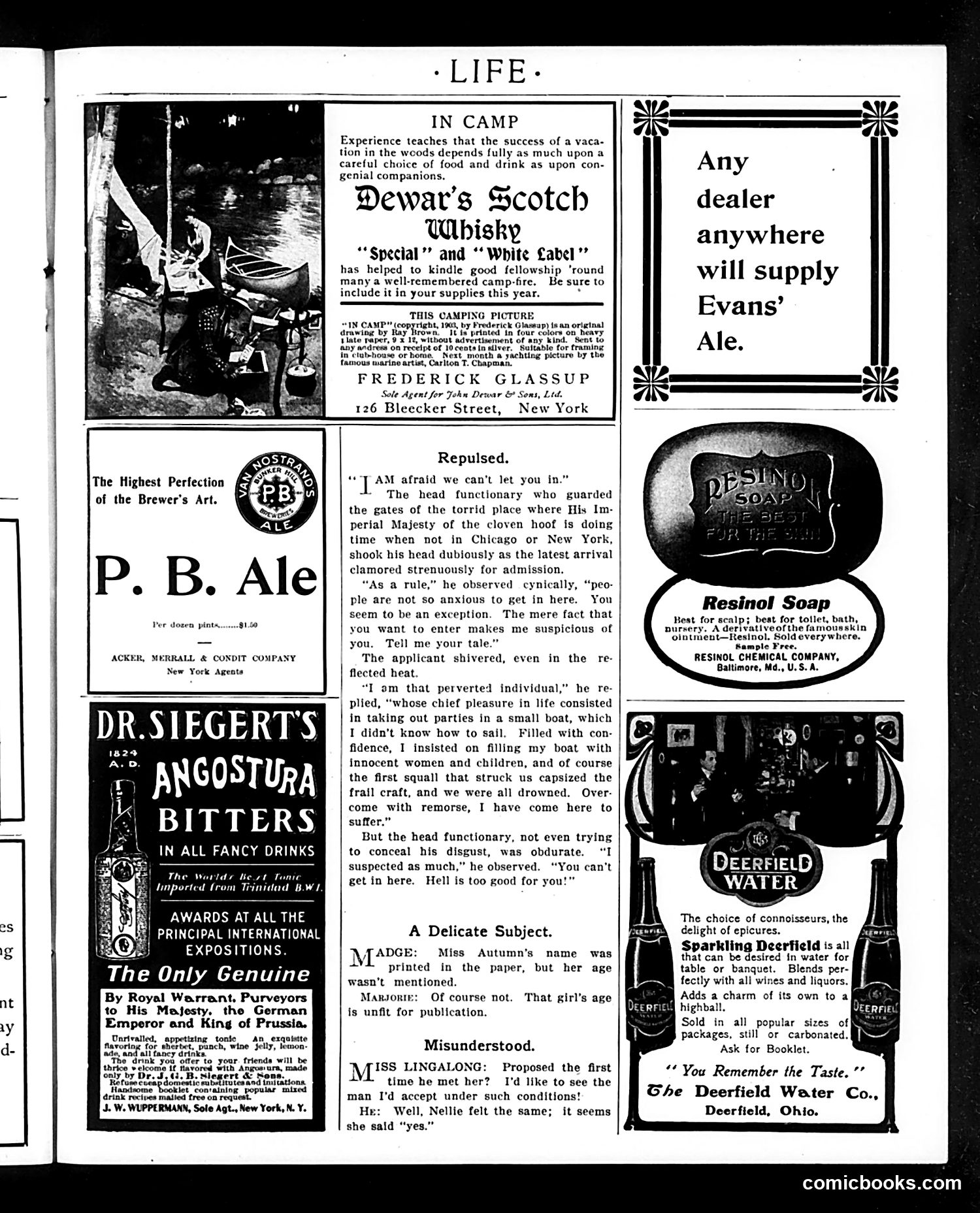
This page is primarily **advertising**, with a brief humorous story ("Repulsed") as filler content. The main narrative joke concerns a man trying to enter Hell. The devil's gatekeeper refuses him, explaining that Hell has standards—even damnation has limits. The man's crime: he recklessly capsized a boat full of innocent women and children through sheer incompetence while boating, causing their deaths. The punchline is that Hell's administrator considers him *too morally reprehensible* to admit, deeming him unworthy even of eternal punishment. The satire targets arrogance and incompetence, particularly wealthy men who undertake dangerous activities without proper skill or judgment, endangering others. The irony—that Hell itself rejects someone as irredeemable—amplifies the moral condemnation. The page otherwise consists of period advertisements for alcohol (whisky, ale, bitters), soap, and water—typical commercial content for early 20th-century magazines.
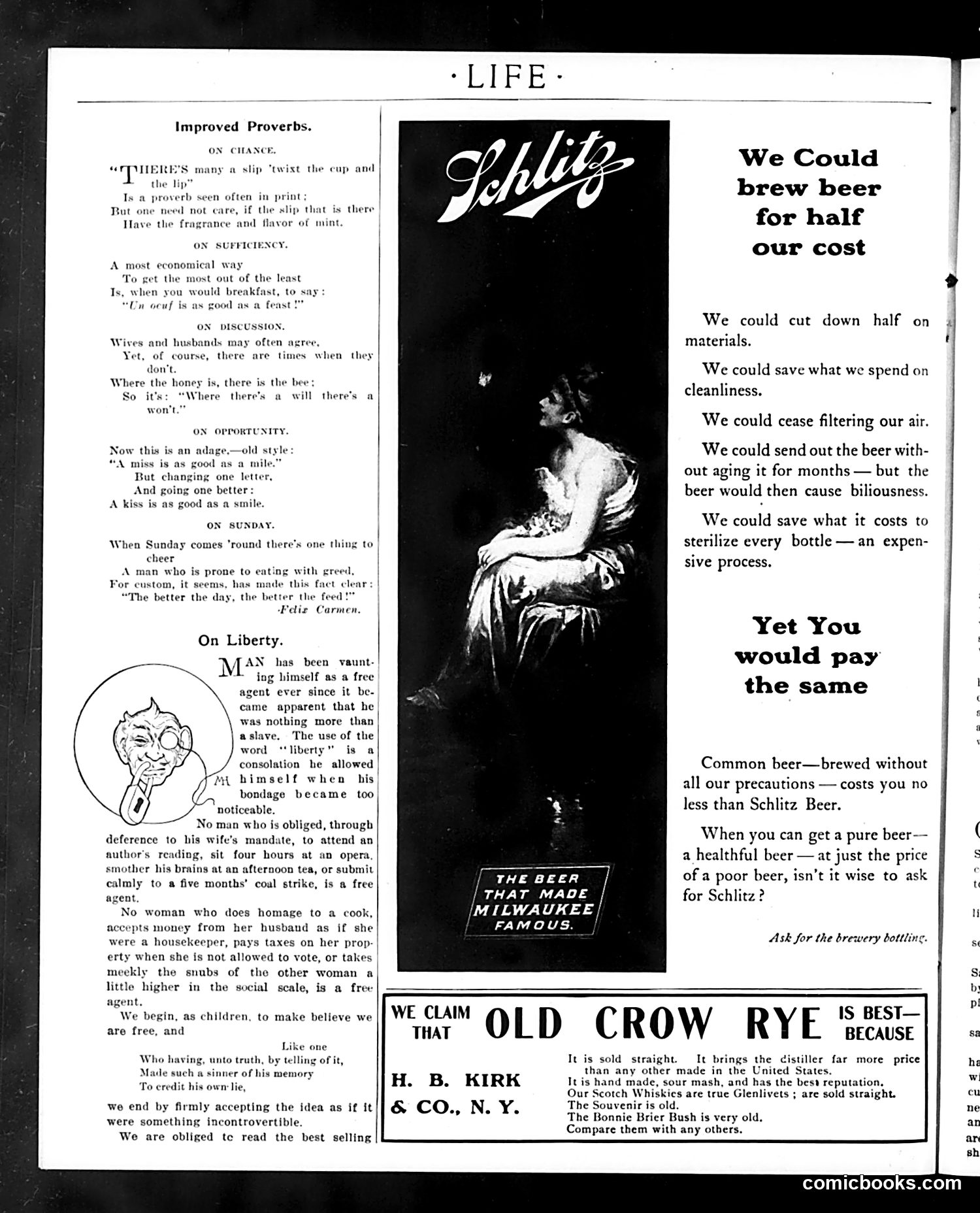
This page combines satirical "Improved Proverbs" with period advertisements. **The Satire:** The left column rewrites familiar proverbs with humorous twists—playing on words and social commentary. For example, "A miss is as good as a mile" becomes "A kiss is as good as a smile," and a lengthy essay on "Liberty" sardonically argues that modern people (particularly wives and women) aren't actually free agents despite claiming liberty—they're bound by social obligations, lack voting rights, and financial independence. **The Advertisements:** The Schlitz beer ad (center/right) argues that despite potential cost-cutting measures, consumers pay the same price for superior quality and safety standards. The Old Crow Rye and H.B. Kirk whiskey ads below emphasize craftsmanship and heritage. **Historical Context:** This appears pre-1920 (women lacked federal voting rights until 1920), making the Liberty essay's complaints about disenfranchisement timely social criticism wrapped in humor—typical of Life's satirical approach to gender inequality and consumer culture.
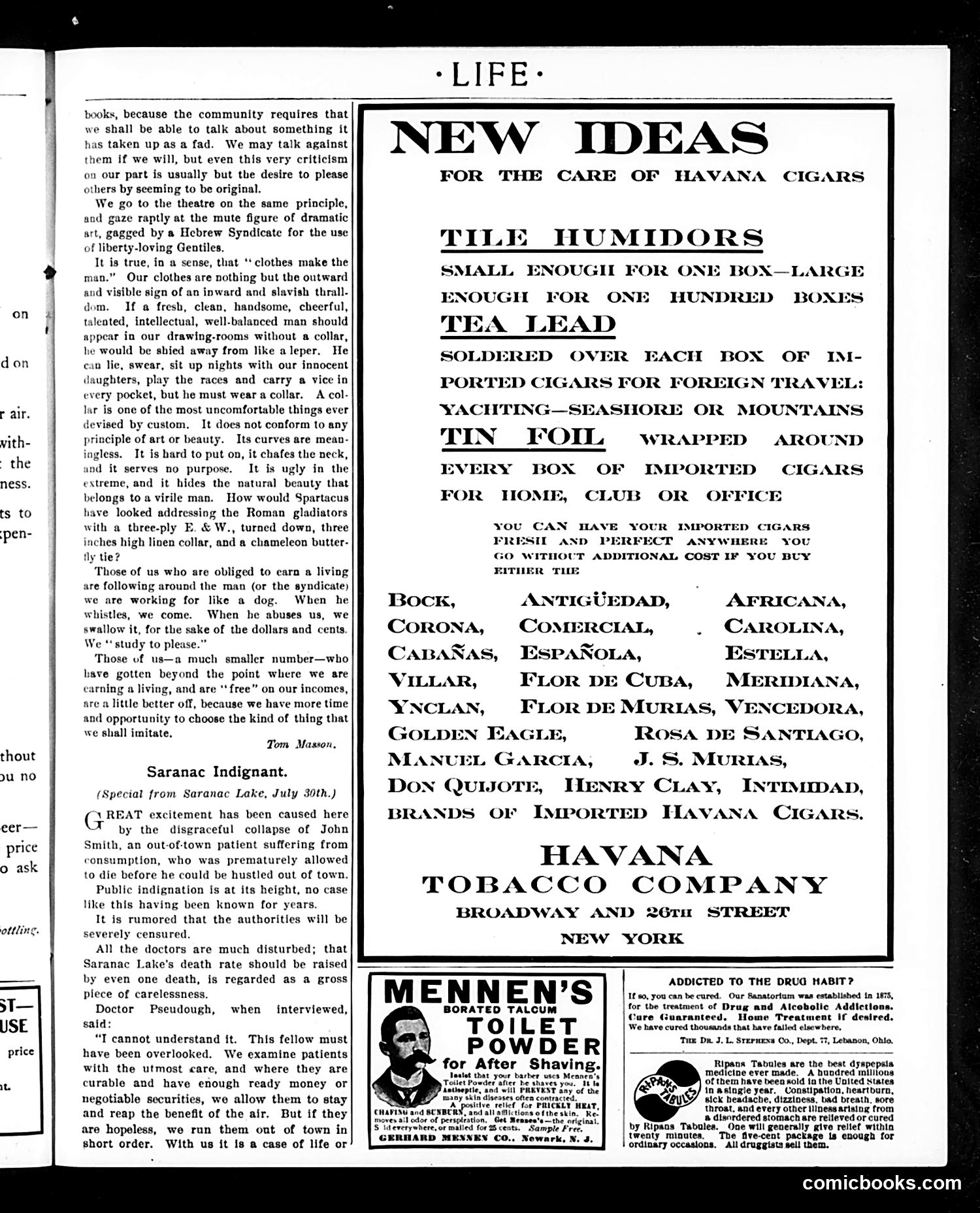
This page primarily contains **advertisements and satirical commentary** rather than political cartoons. The main content includes: 1. **"Saranac Indignant"** — A satirical piece mocking Saranac Lake's tuberculosis sanatorium industry. The satire suggests the town's doctors deliberately expel dying patients to maintain a low mortality rate and protect the resort's reputation, treating human lives as business liabilities. 2. **Heavy advertising** — Two-thirds of the page advertises Havana cigars (Havana Tobacco Company) and Mennen's talcum powder for post-shaving use. The "Hebrew Syndicate" reference in the article text reflects period antisemitism, likely referring to theatrical control — common stereotype of the era. The overall tone criticizes societal hypocrisy: people follow fashion and social convention blindly, and profit-driven institutions (like health resorts) prioritize money over ethics. The advertisements themselves reinforce this critique of consumer culture.
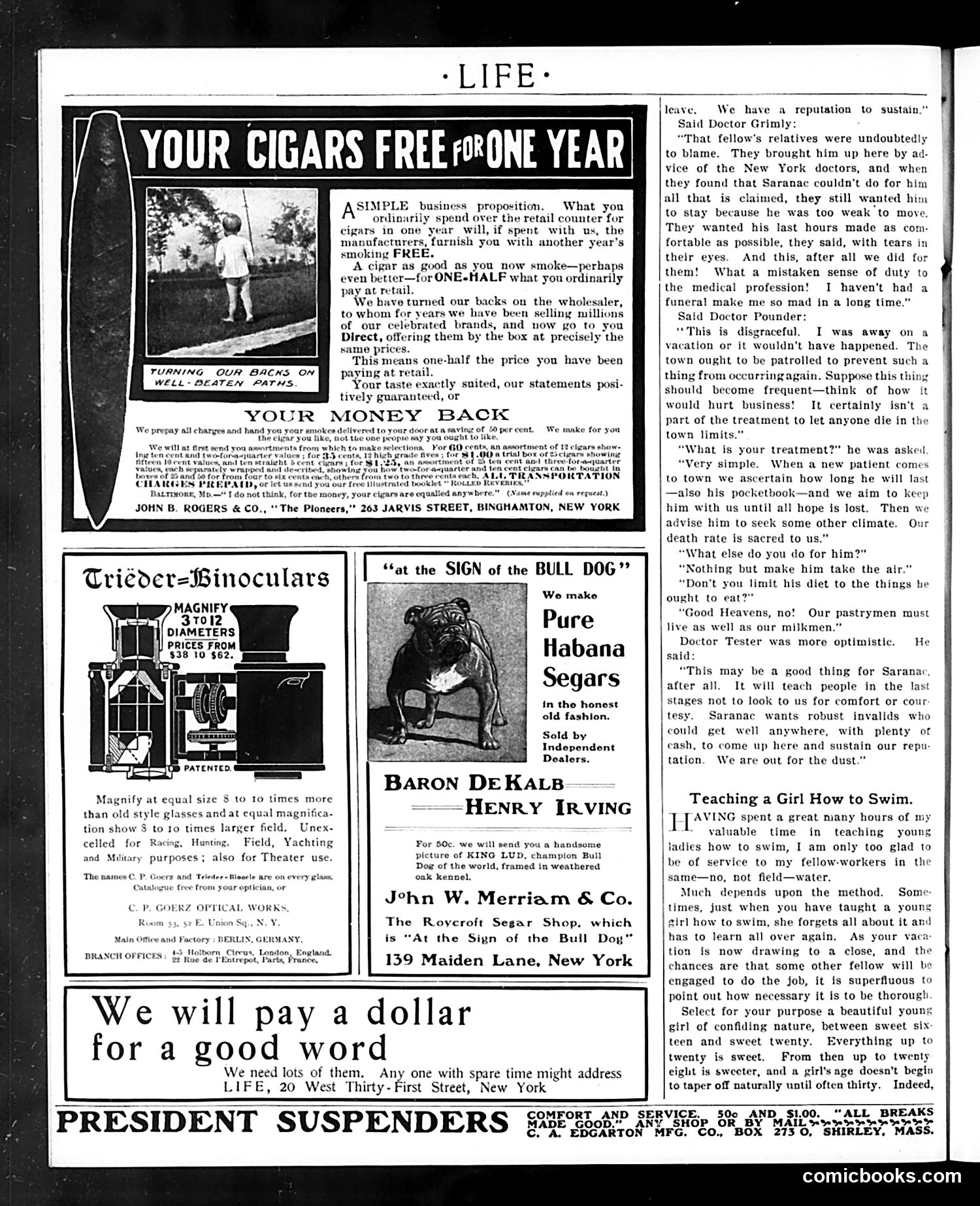
This page combines advertisements with satirical editorial content critiquing medical tourism practices at Saranac Lake, a famous tuberculosis treatment destination. **The Satire:** The right column contains dialogue between doctors discussing a patient who died in their town. The satire mocks how resort physicians prioritized profit over patient welfare—deliberately prolonging stays to exhaust patients' money, then dismissing them when death approached to protect their "death rate" statistics. The doctors cynically discuss how patient deaths hurt "business" and boast of taking no dietary precautions, only requiring "air." **The Context:** Saranac Lake, New York was a major TB sanatorium in this era. Patients (often wealthy) traveled there seeking cure, enriching local doctors. The satire exposes how financial incentives corrupted medical ethics. **Advertisements:** The page features cigar, binoculars, and tobacco product ads—typical period revenue sources for *Life* magazine.
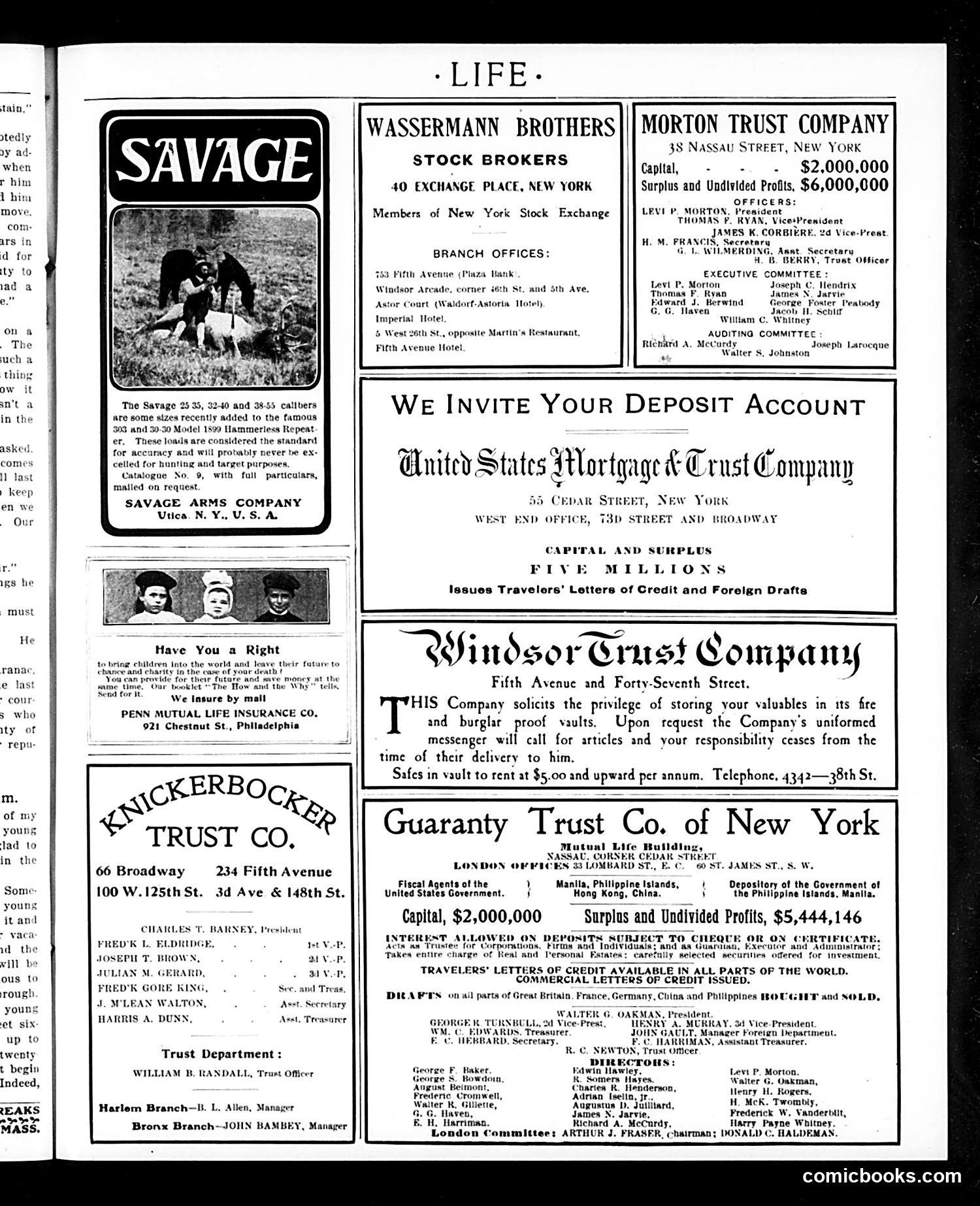
This page is almost entirely **advertising**, with no visible cartoons or satirical content. It contains financial and business advertisements from Life magazine, featuring: - The Savage Arms Company promoting firearms - Multiple trust companies and financial institutions (Wassermann Brothers, Morton Trust Company, United States Mortgage & Trust Company, Windsor Trust Company, Knickerbocker Trust Co., and Guaranty Trust Co. of New York) - A life insurance advertisement from Penn Mutual The ads reflect early-1900s American financial and industrial enterprise, targeting wealthy individuals seeking investment services, vault storage, and insurance. The presence of prominent names like Levi P. Morton and names of wealthy industrialists on boards suggests these were elite institutions serving Manhattan's financial sector. There is no satirical commentary visible on this particular page—it serves as a straightforward financial directory and advertising medium.
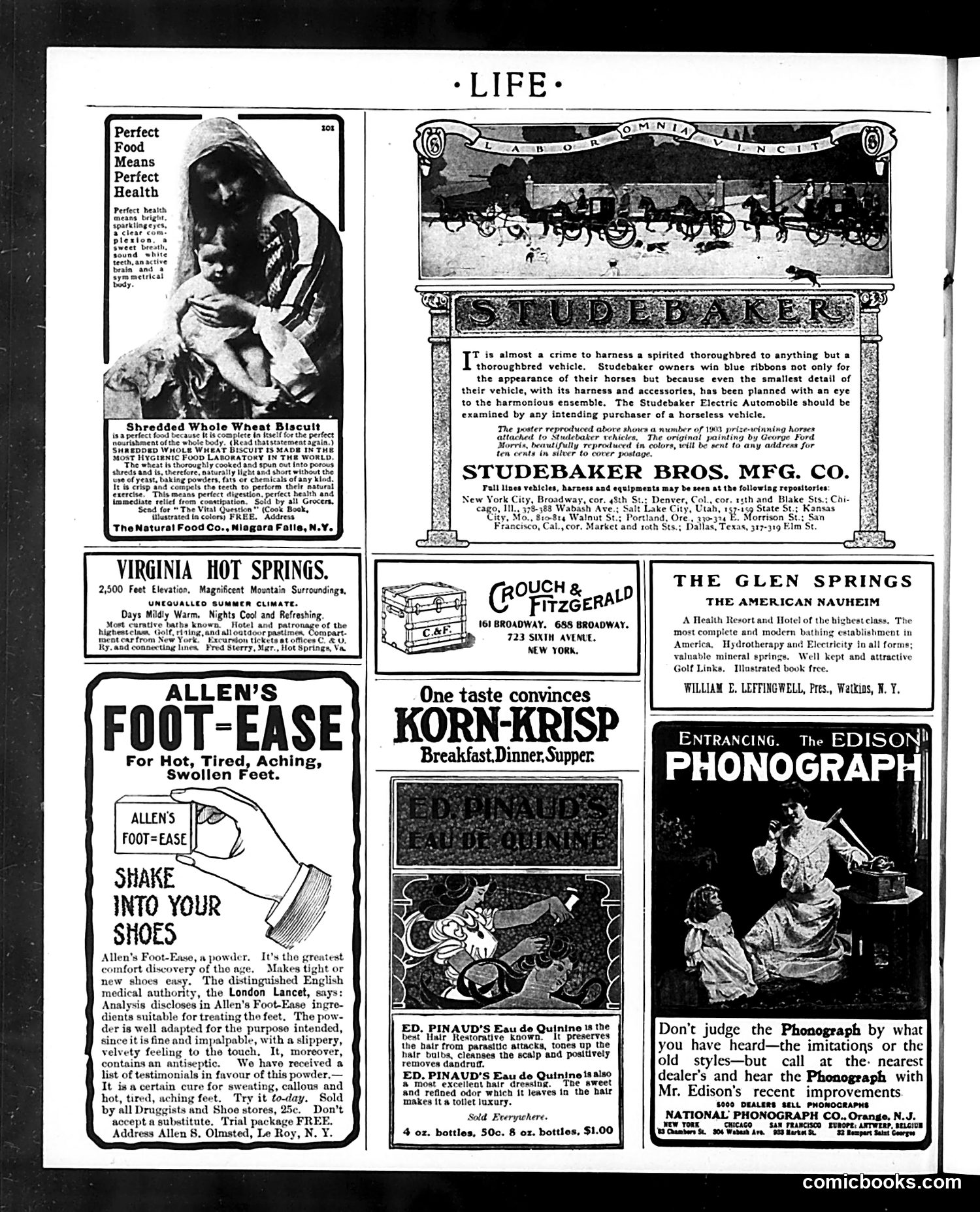
This is primarily an **advertising page** from Life magazine, not a satirical cartoon page. The content consists of vintage product advertisements from the early 1900s. **Key advertisements visible:** - **Studebaker automobiles**: The main feature emphasizes the quality of their "horseless vehicles" by showing prize-winning horses—a clever marketing angle appealing to affluent buyers who appreciated fine equipment. - **Health resorts** (Virginia Hot Springs, Glen Springs): Typical of the era's wellness tourism promoting mineral springs and hydrotherapy. - **Allen's Foot-Ease powder**: A common remedy for foot discomfort, reflecting pre-modern podiatry practices. - **Korn-Krisp breakfast cereal** and **ED. Pinaud's hair tonic**: Standard consumer goods. - **Edison Phonograph**: Emphasizes Edison's recent technological improvements to his competing audio device. The page reflects early-20th-century consumer culture, targeting middle-to-upper-class readers with products addressing health, transportation, and modern conveniences. There is **no political satire** present.
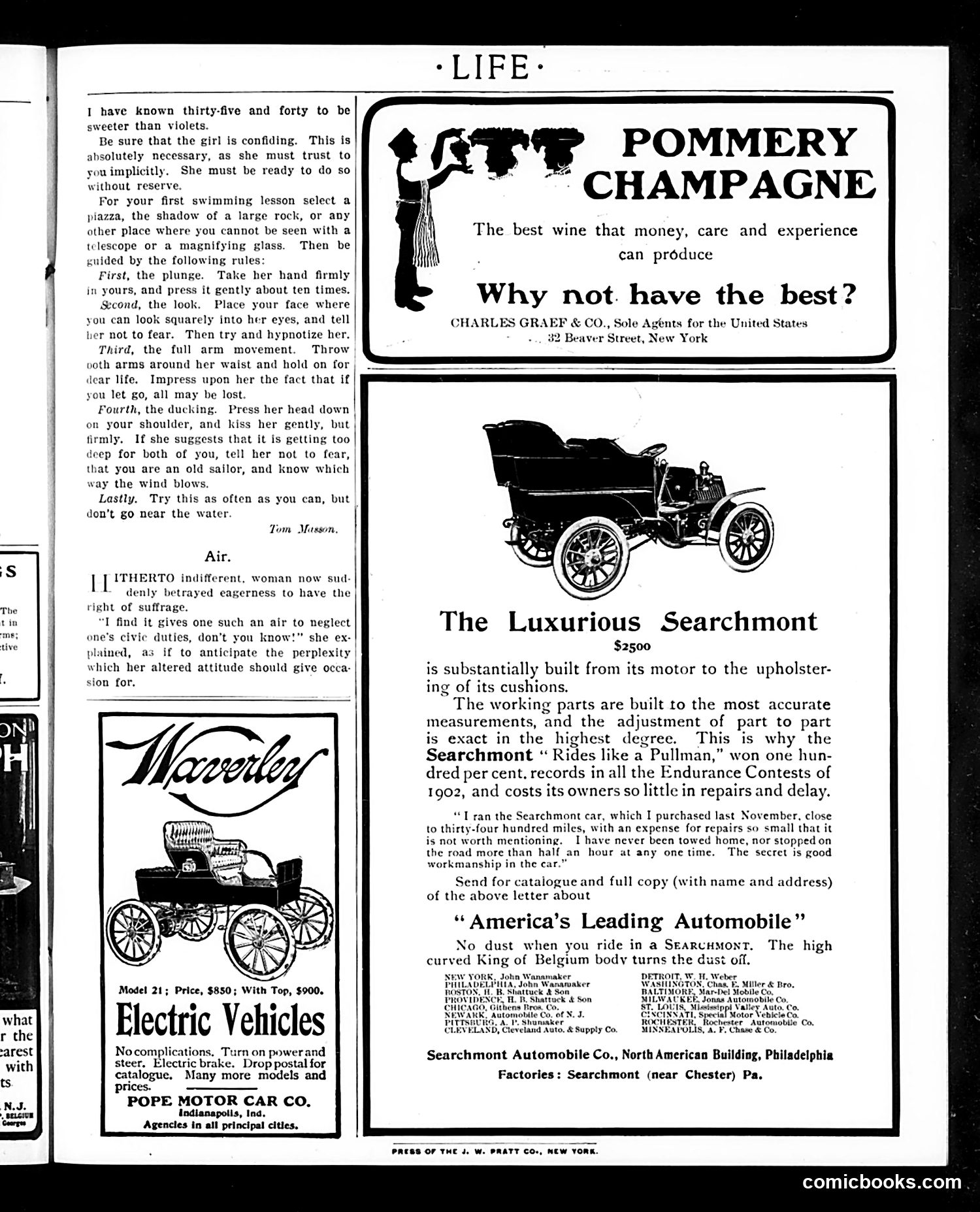
This page mixes satire with period advertising, typical of early 1900s Life magazine. **The Main Satire (left side):** Tom Masson's humorous piece mocks courtship rituals of the era by presenting absurd "swimming lesson" instructions that are actually seduction techniques—pressing hands, hypnotizing, holding close, kissing under the guise of teaching. The final line ("don't go near the water") reveals the joke: the entire exercise is a pretense for romantic contact, not actual swimming instruction. **Secondary Joke:** A brief item about women's suffrage satirizes a woman claiming indifference to voting rights is now fashionable—mocking those who adopt political positions for social cache rather than conviction. **The Advertisements:** The page features vintage car and electric vehicle ads (Pope Motor Car, Searchmont), plus Pommery Champagne—standard period advertising with no satirical content. The page reflects early-1900s attitudes toward gender relations and courtship that modern readers would find uncomfortable; Life presented this as gentle humor reflecting contemporary social norms.
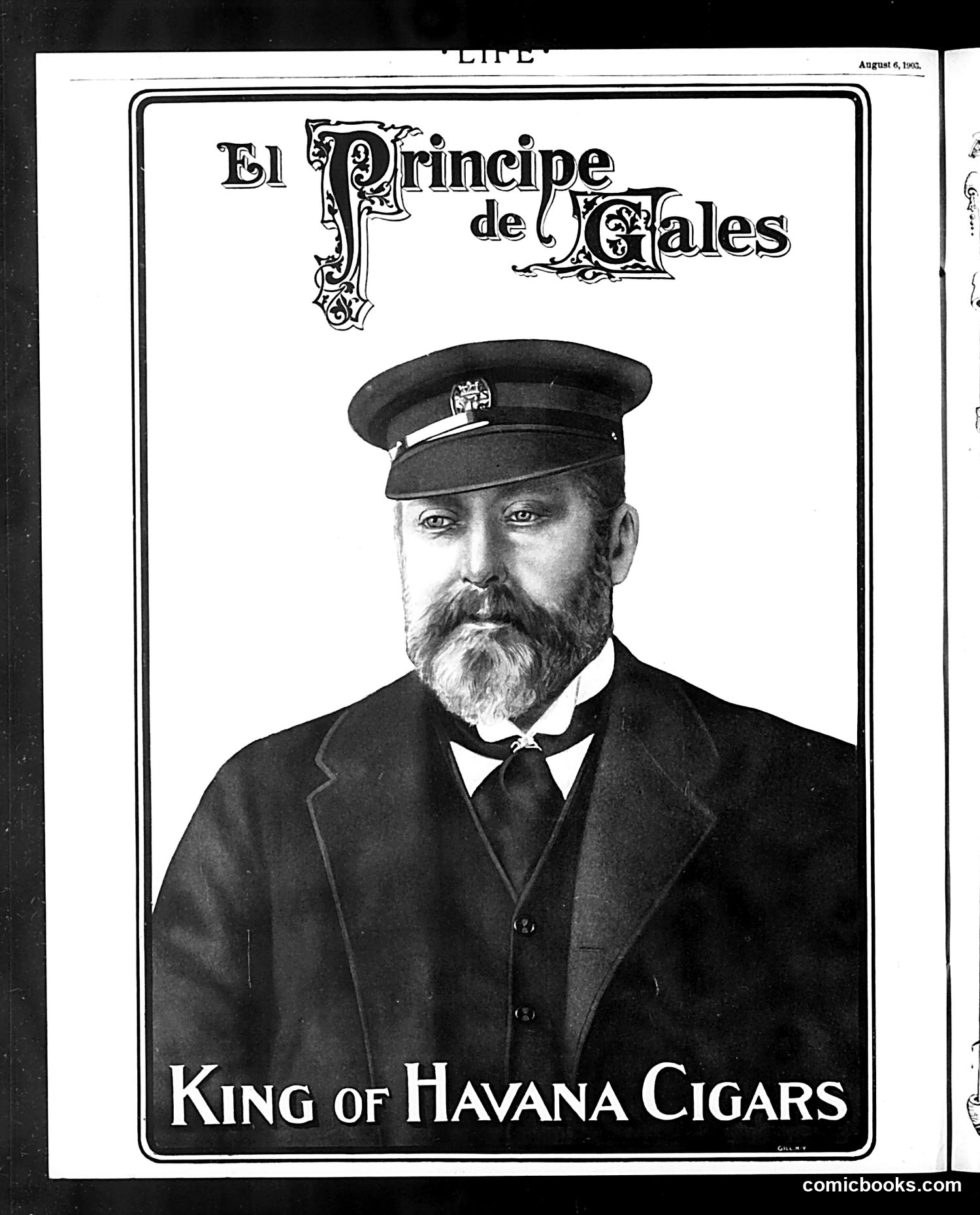
This appears to be a **title page or advertisement** rather than a political cartoon. It features a formal portrait of a bearded man in naval or military uniform with the ornate Spanish title "El Príncipe de Gales" (The Prince of Wales). The caption reads "KING OF HAVANA CIGARS," suggesting this is a **cigar brand advertisement** using a royal title as marketing. The juxtaposition of "Prince of Wales" with "King of Havana Cigars" is humorous—elevating the cigar product to mock-regal status. Without additional context, the identity of the portrayed figure remains unclear. The page likely appeared in *Life* magazine's advertising section, using satirical branding typical of early 1900s tobacco marketing.