
Life, 1903-08-06 · page 8 of 32
Life — August 6, 1903 — page 8: what you’re looking at
What you’re looking at
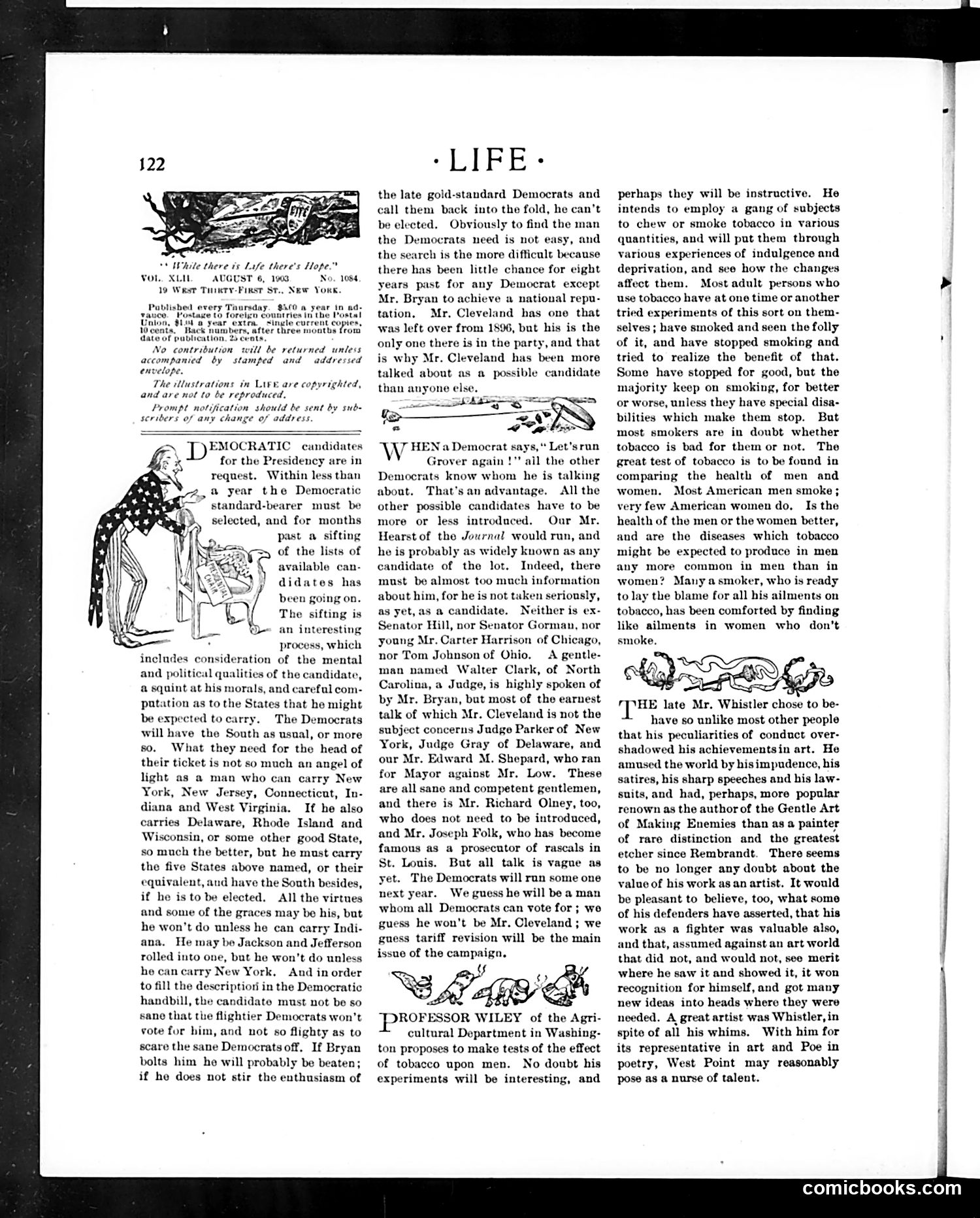
This page contains political commentary about the 1884 Democratic presidential race. The left cartoon depicts a skeletal "Democratic candidate" being examined—a visual metaphor for the party's difficulty finding a viable nominee. The text discusses potential candidates like Grover Cleveland, noting his advantage as someone already known to the public, versus lesser-known alternatives like Judge Parker, Senator Hill, and others requiring introduction. The right section discusses Professor Wiley's proposed tobacco experiments testing effects on men, and contrasts this with the late artist James McNeill Whistler's legacy. The satire criticizes Democratic vulnerability—they need an established figure like Cleveland to compete effectively, yet even he faces skepticism about winning support.
📄 Transcribed text from this page (OCR, searchable)
Machine-transcribed from the original scan — historical spelling and the odd misread are preserved.
+! White there VoL. XLIL AUG 19 West Tin: No. 1086 ished every Thursday. $400 a year in ad- Postage to foreign countries in the Postal ingle current copies, after three months from ‘ats, No contribution accompanied by envelope. The illustrations in Live are copyrighted, and are not to be reproduced, Prompt notification should be sent by sub- seribers of any change of address. will be returned unless stamped and addressed =~ T )EMOCRATIC candidates for the Presidency are in request. Within less than 2, & year the Democratic standard-bearer must be selected, and for months past o sifting of the lists of available can- ) didates has been going on. The sifting is an interesting process, which includes consideration of the mental and political qualities of the candidate, a squint at his morals, and careful com- patation as to the States that he might be expected to carry. The Democrats will have the South as usual, or more so. What they need for the head of their ticket is not so much an angel of light as a man who can carry New York, New Jersey, Connecticut, In- diana and West Virginia. If he also carries Delaware, Rhode Island and Wisconsin, or some other good State, so much the better, but he mast carry the five States above named, or their equivalent, aud have the South besides, if he is to be elected. All the virtues and some of the graces may be his, but he won't do unless he can carry Indi- ana. He may be Jackson and Jefferson rolled into one, but he won't do unless he can carry New York. And in order to fill the description in the Democratic oe S, handbill, the candidate must not be so sane that the flightier Democrats won't vote fur him, and not so flighty as to scare the sane Democratsoff. If Bryan bolts him he will probably be beaten; if he does not stir the enthusiasm of -LIFE- the late gold-standard Democrats and call them back into the fold, he can't be elected. Obviously to find the man the Democrats need is not easy, and the search is the more difficult because there has been little chance for eight years past for any Democrat except Mr. Bryan to achieve a national repu- tation, Mr, Cleveland has one that was left over from 1896, but his is the only one there is in the party, and that is why Mr. Cleveland has been more talked about as a possible candidate than anyone else, %—___—_——“a¢ a ee bi WW HEN a Democrat says," Let'sran Grover again !" all the other Democrats know whom he is talking about. That's an advantage. All the other possible candidates have to be more or less introduced. Our Mr. Hearst of the Journal would run, and he is probably as widely known as any candidate of the lot. Indeed, there must be almost too much information about him, for he is not taken seriously, as yet,as a candidate. Neither is ex- Senator Hill, nor Senator Gorman, nor young Mr. Carter Harrison of Chicago, nor Tom Johnson of Ohio, A gentle- man named Walter Clark, of North Carolina, a Judge, is highly spoken of by Mr. Bryan, but most of the earnest talk of which Mr. Cleveland is not the subject concerns Judge Parker of New York, Judge Gray of Delaware, and our Mr. Edward M. Shepard, who ran for Mayor against Mr. Low. These are all sane and competent gentlemen, and there is Mr. Richard Olney, too, who does not need to be introduced, and Mr. Joseph Folk, who has become famous as a prosecutor of rascals in St. Louis. But all talk is vague as yet. The Democrats will ran some one next year. We guess he will be a man whom all Democrats can vote for ; we guess he won't be Mr. Cleveland ; we guess tariff revision will be the main issue of the campaign, WPA DROFESSOR WILEY of the Agri- cultural Department in Washing- ton proposes to make tests of the effect of tobacco upon men. No doubt his experiments will be interesting, and He perhaps they will be instructive. intends to employ a gang of subjects to chew or smoke tobacco in various quantities, and will put them through various experiences of indulgence and deprivation, and see how the changes affect them. Most adult persons who use tobacco have at one time or another tried experiments of this sort on them- selves ; have smoked and seen the folly of it, and have stopped smoking and tried to realize the benefit of that. Some have stopped for good, but the majority keep on smoking, for better or worse, unless they have special disa- bilities which make them stop. But most smokers are in doubt whether tobacco is bad for them or not. The great test of tobacco is to be found in comparing the health of men and women, Most American men smoke ; very few American women do, Is the health of the men or the women better, and are the diseases which tobacco might be expected to produce in men any more common in men than in women? Many asmoker, who is ready to lay the blame for all his ailments on tobacco, has been comforted by finding like ailments in women who don't smoke. 4) (k = 4 ‘THE late Mr. Whistler chose to be- have so unlike most other people that his peculiarities of conduct over- shadowed his achievementsin art. He amused the world by his impudence, his satires, his sharp speeches and his law- suits, and had, perhaps, more popular renown as the author of the Gentle Art of Making Enemies than as a painter of rare distinction and the greatest etcher since Rembrandt. There seems to be no longer any doubt about the value of his work as an artist. It would be pleasant to believe, too, what some of his defenders have asserted, that his work as a fighter was valuable also, and that, assumed against an art world that did not, and would not, see merit where he saw it and showed it, it won recognition for himself, and got many new ideas into heads where they were needed. A great artist was Whistler, in spite of all his whims. With him for its representative in art and Poe in poetry, West Point may reasonably pose as a nurse of talent. comicbooks.com