
Life, 1903-08-06 · page 18 of 32
Life — August 6, 1903 — page 18: what you’re looking at
What you’re looking at
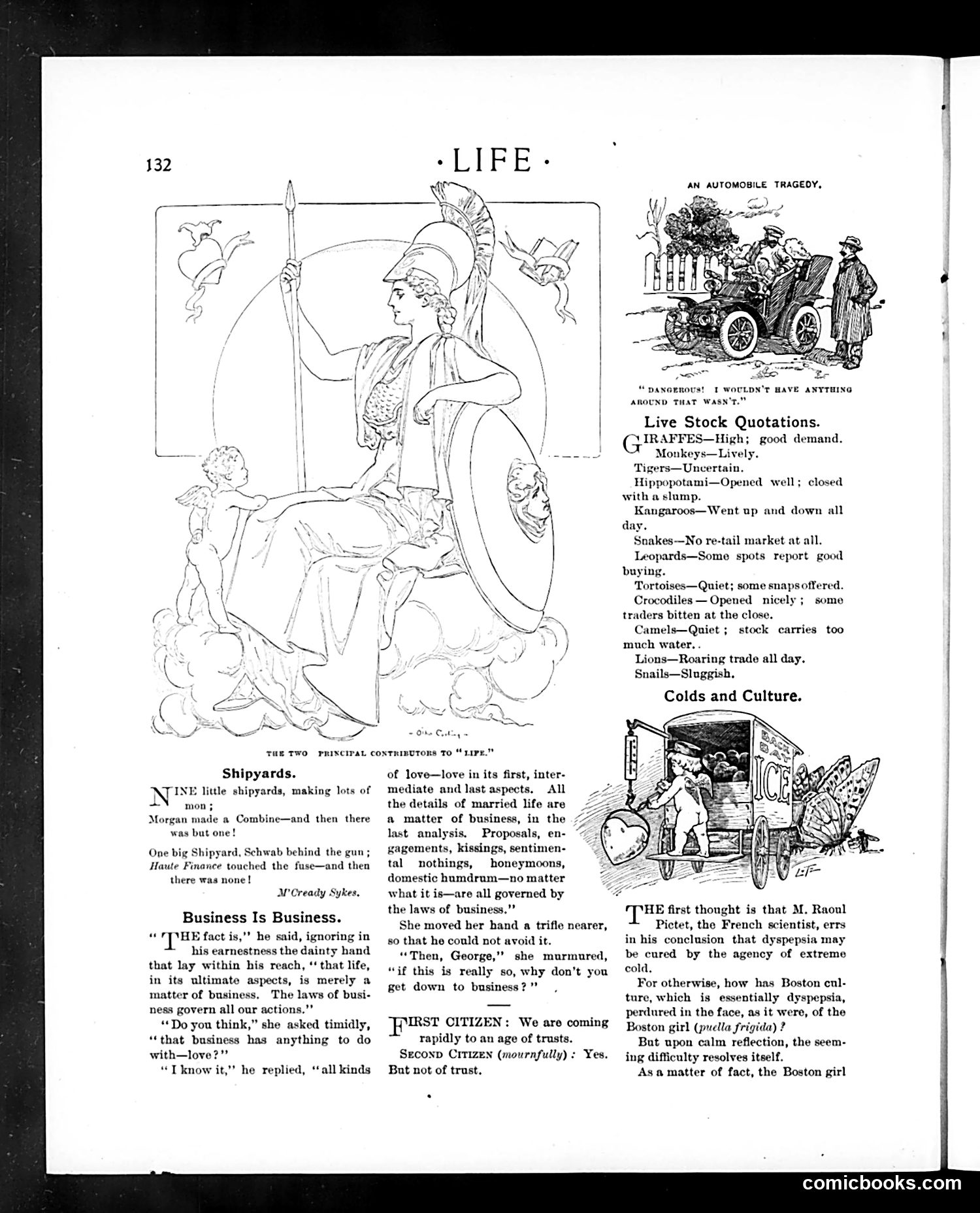
This page from the satirical magazine *Life* contains several distinct pieces mocking early 1900s American society: **"The Two Principal Contributors to Life"** satirizes J.P. Morgan's monopolistic control of shipbuilding. The poem suggests Morgan created a combine (trust), leaving one shipyard under Schwab's control—then even that disappeared, mocking how financial manipulation destroyed competition. **"Business Is Business"** is a romantic comedy sketch where a man, treating courtship as pure business transaction, misses obvious romantic advances. The woman's final line—"why don't you get down to business?"—is a sexual innuendo he fails to recognize, satirizing rigid businessman mentality. **The dialogue on trusts** cynically contrasts the "age of trusts" (monopolies) with lack of "trust" (confidence), reflecting public anxiety about corporate consolidation. The **"Live Stock Quotations"** pun on stock market language applied to animals (snakes have "no re-tail market"), mocking financial jargon. **"Colds and Culture"** makes a joke about Boston culture being essentially dyspeptic (diseased/sour), and the "Boston girl" being "frigida" (cold)—a regional stereotype about aristocratic New England reserve.
📄 Transcribed text from this page (OCR, searchable)
Machine-transcribed from the original scan — historical spelling and the odd misread are preserved.
THE TWO FRIXCIPAL contRIBUTORS To “LIFE.” Shipyards. NB little shipyards, making lots of ~N mon; Morgan made a Combine—and then there was but one! One big Shipyard, Schwab behind the gun ; Haute Finance touched the fuse—and then there was none! MCready Sykes, Business Is Business. wy ‘TRE fact is,"’ he said, ignoring in his earnestness the dainty hand that lay within his reach, ‘that life, in its ultimate aspects, is merely a matter of business, The laws of busi- ness govern all our actions.’” “*Do you think,” she asked timidly, “that business has anything to do with—lor ” “T know it,” he replied, ‘all kinds = ihe Costing = of love—love in its first, inter- mediate and last aspects. All the details of married life are a matter of business, in the / last analysis, Proposals, en- “ kissings, sentimen- tal nothings, honeymoons, domestic hamdrum—no matter what it is—are all governed by the laws of business.’’ She moved her hand a trifle nearer, so that he could not avoid it. “Then, George,” she murmured, “if this is really so, why don’t you get down to business?” IRST CITIZEN: We are coming rapidly to an age of trusts. Srconp Crtizen (mournfully): Yes. But not of trust. AN AUTOMOBILE TRAGEDY, 1 WOULDN'T HAVE ANYTHING AROUND THAT WASN'T. Live Stock Quotations. XIRAFFES—High; good demand. Monkeys—Lively. Tigers—Uncertain. Hippopotami—Opened well; closed with a slump. Kangaroos—Went up and down all day. Snakes—No re-tail market at all. Leopards—Some spots report good buying. Tortoises—Quiet; some snaps offered. Crocodiles — Opened nicely ; some traders bitten at the close. Camels—Quiet ; stock carries too much water. . Lions—Roaring trade all day. Snails—Sluggish, Colds and Culture. THE first thought is that M. Raoul Pictet, the French scientist, errs in his conclusion that dyspepsia may be cured by the agency of extreme cold, For otherwise, how has Boston cul- ture, which is essentially dyspepsia, perdured in the face, as it were, of the Boston girl (puella frigida) ? But upon calm reflection, the seem- ing difficulty resolves itself. Asa matter of fact, the Boston girl comicbooks.com