
A complete issue · 20 pages · 1903
Life — July 9, 1903
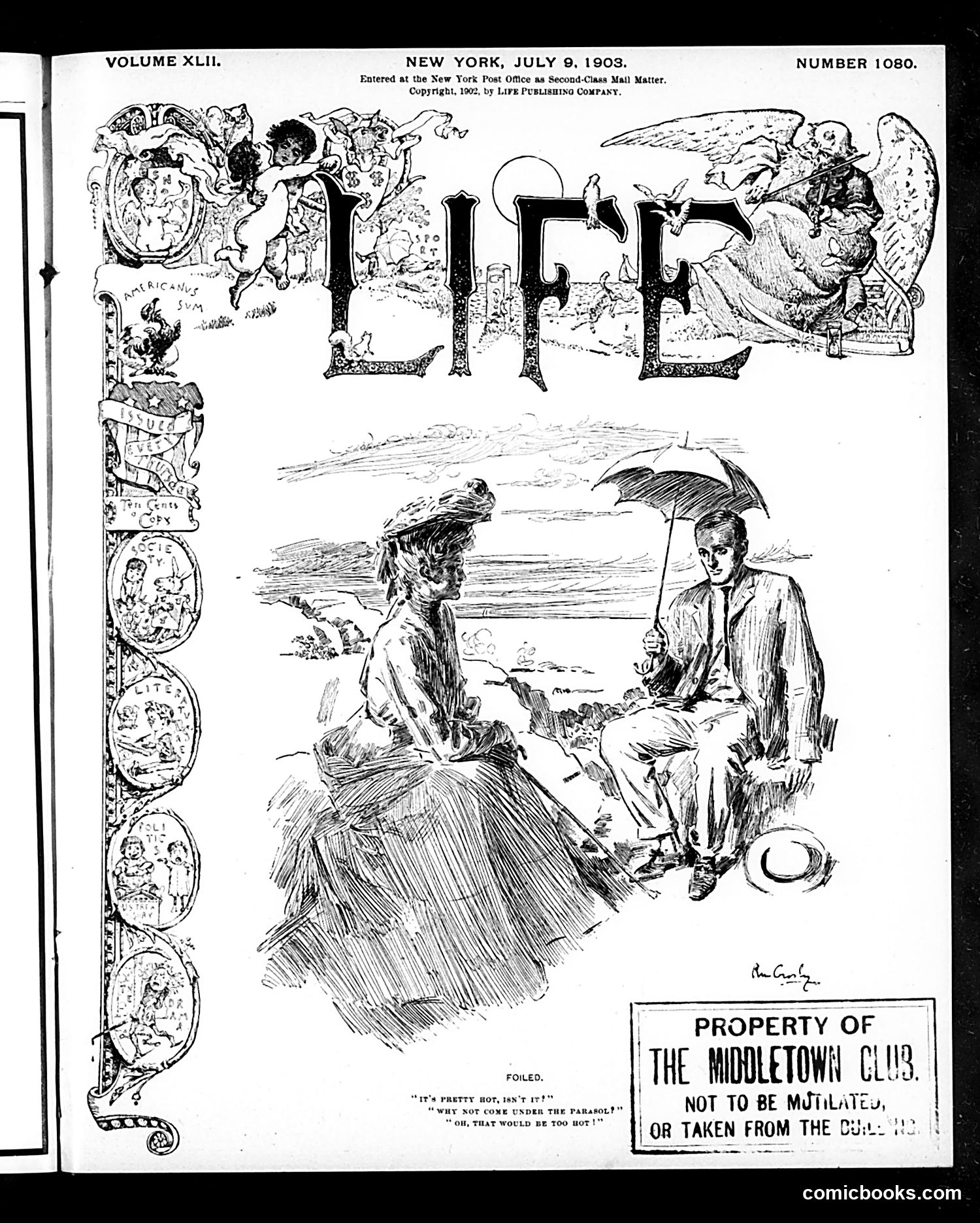
This page features a single cartoon titled "Foiled," depicting two figures on a beach. A woman sits holding a parasol while a man beside her holds an umbrella. The caption reads: "It's pretty hot, isn't it?" / "Why not come under the parasol?" / "Oh, that would be too hot!" The joke plays on Victorian-era social propriety and romance. The man's suggestion that they share the woman's parasol is a flirtation, but she rejects it—claiming it would be "too hot," likely a double entendre about both physical proximity and the impropriety of such close contact between unmarried people. The humor derives from the tension between romantic desire and social convention that governed acceptable behavior between men and women during the Edwardian period.
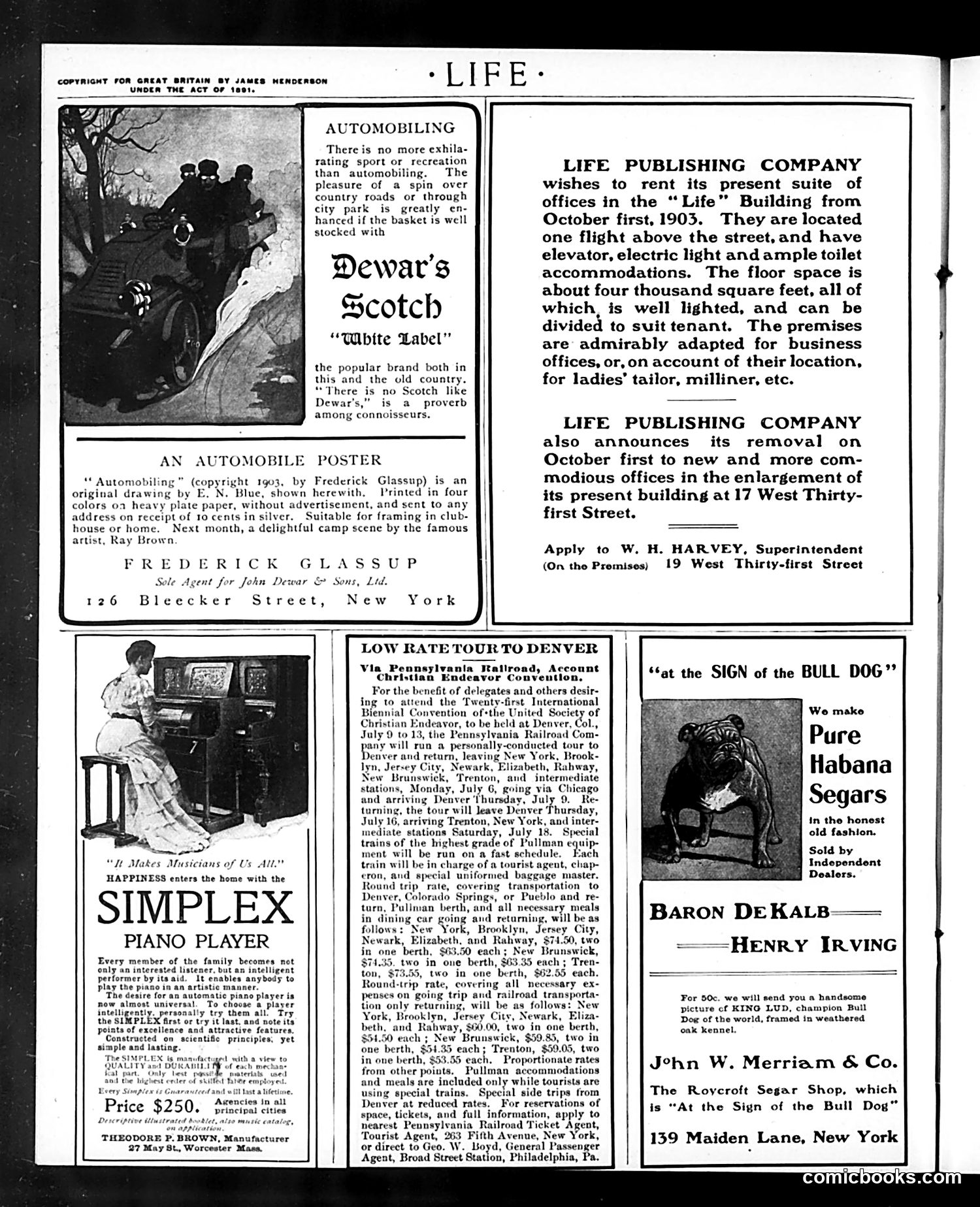
This page is primarily **advertising and business notices** from circa 1903, not political satire. The main content includes: - **Dewar's Scotch Whisky ad** featuring an automobile poster by artist Frederick Glassup - **Simplex Piano Player ad** emphasizing home entertainment and family enjoyment - **Life Publishing Company announcements** about office relocations - **Pennsylvania Railroad tour advertisement** for the Christian Endeavor Convention in Denver - **Cigar and tobacco ads** (Baron de Kalb, "Bull Dog" brand) The "automobile poster" image shows figures in an early motorcar, but it's primarily a commercial advertisement rather than satire. The content reflects early 1900s consumer culture and business expansion, with no apparent political commentary or satirical intent on this particular page.
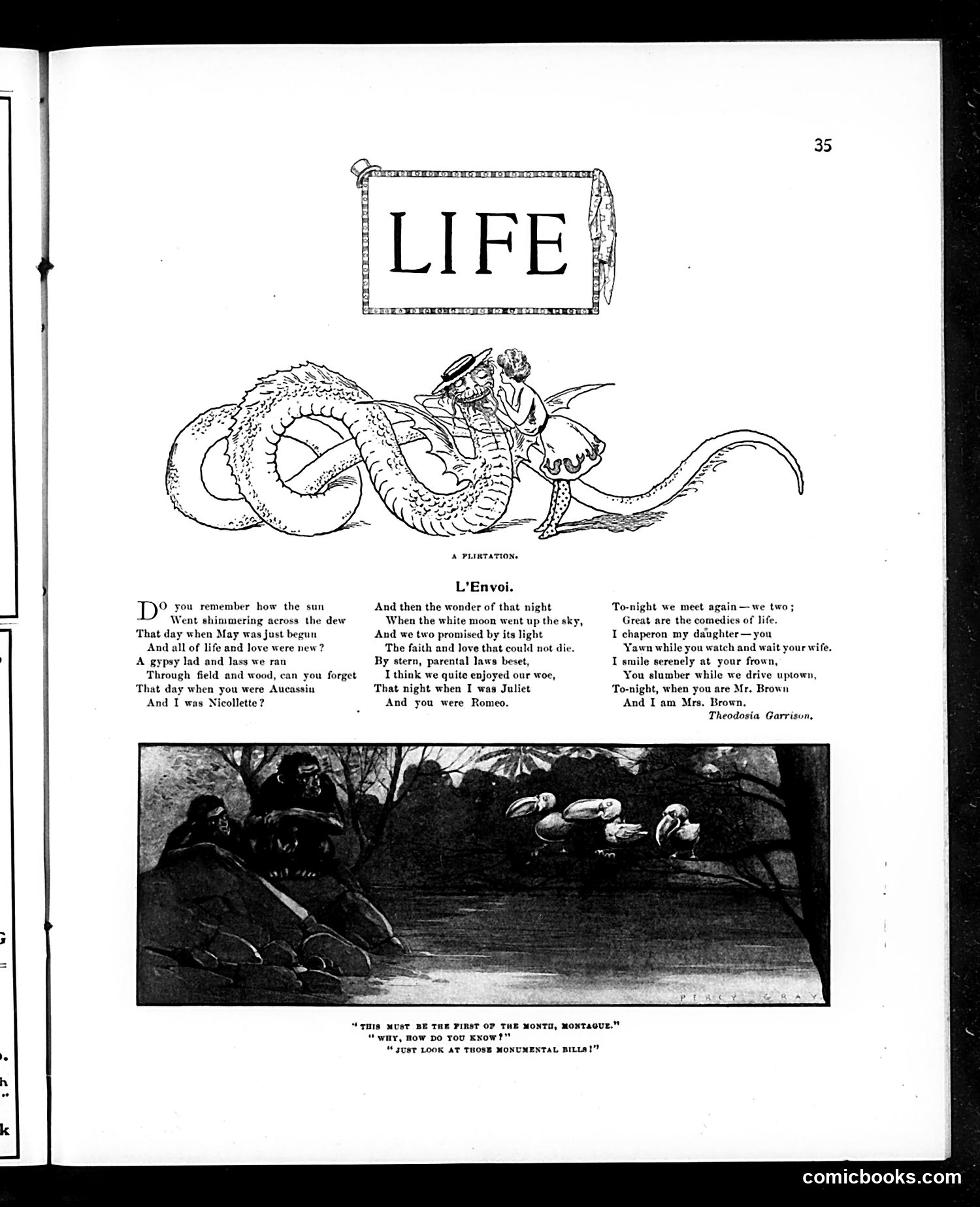
This page features romantic/sentimental content rather than political satire. The header "LIFE" frames the material, followed by an illustration of a couple with an elaborate dragon or serpent creature—labeled "A FLIRTATION"—appearing whimsical rather than satirical. The poem "L'Envoi" by Theodosia Garrison is nostalgic, referencing Romeo and Juliet and asking a woman to remember past romantic moments ("when you were Juliet / And you were Romeo"). The photograph below depicts what appears to be a theatrical scene by water, showing figures in dramatic poses, with caption text referencing "The North, Montague" and "monumental hills"—clearly referencing Shakespeare's *Romeo and Juliet* (the feuding Montague/Capulet families). The page is fundamentally **literary and romantic in nature**, celebrating classical love narratives rather than offering political commentary.
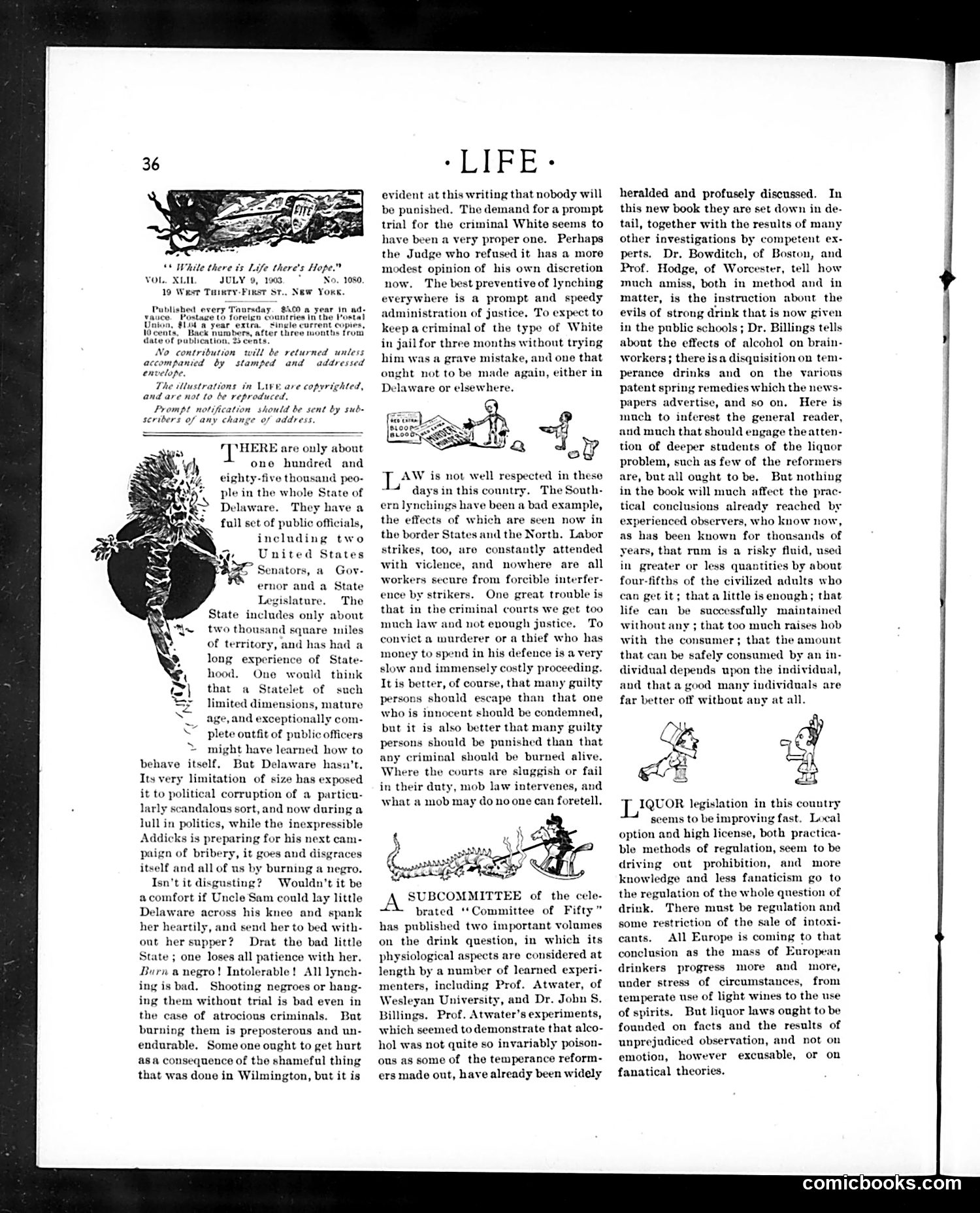
This page contains editorial commentary rather than political cartoons. The text discusses criminal justice reform, particularly criticizing Delaware's handling of capital punishment and mob violence. The small illustrations appear to be decorative vignettes rather than satirical cartoons—showing figures in various poses but without clear political targets. The main editorial argues that lynching represents failed justice, that courts are too lenient on wealthy defendants, and that liquor legislation requires better regulation based on scientific evidence rather than temperance fanaticism. The author references work by Professor Atwater at Wesleyan University regarding alcohol's physiological effects. The page advocates for balanced legal reform: punishing the guilty while protecting the innocent, and regulating alcohol through evidence-based policy rather than emotion-driven prohibition.
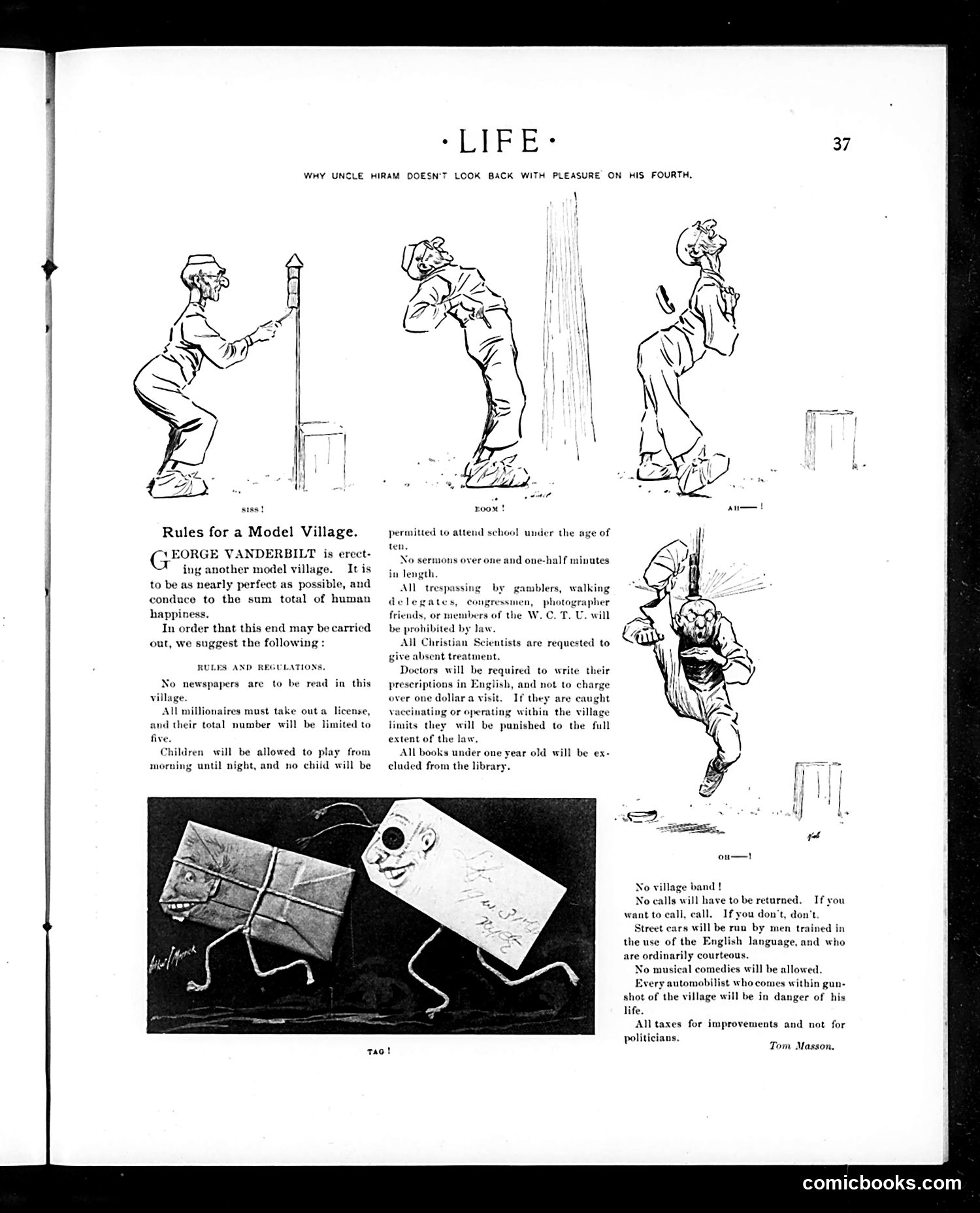
This page satirizes a fictional "Model Village" proposed by George Vanderbilt with absurdly restrictive rules. The top cartoons show Uncle Hiram experiencing Fourth of July disasters—apparently the village bans fireworks and celebrations entirely. The accompanying text lists humorous mock regulations: no newspapers, millionaires need licenses, children can play only certain hours, sermons limited to 90 seconds, doctors must write prescriptions in English, and automobiles are banned as dangerous. The "Tao!" cartoon shows personified envelopes (representing mail/communication) tied together—likely mocking the village's communication restrictions. The satire targets wealthy industrialists' paternalistic control over workers' towns, suggesting Vanderbilt's actual model communities imposed excessive rules limiting residents' freedoms and pleasures. Tom Mason is credited as author.
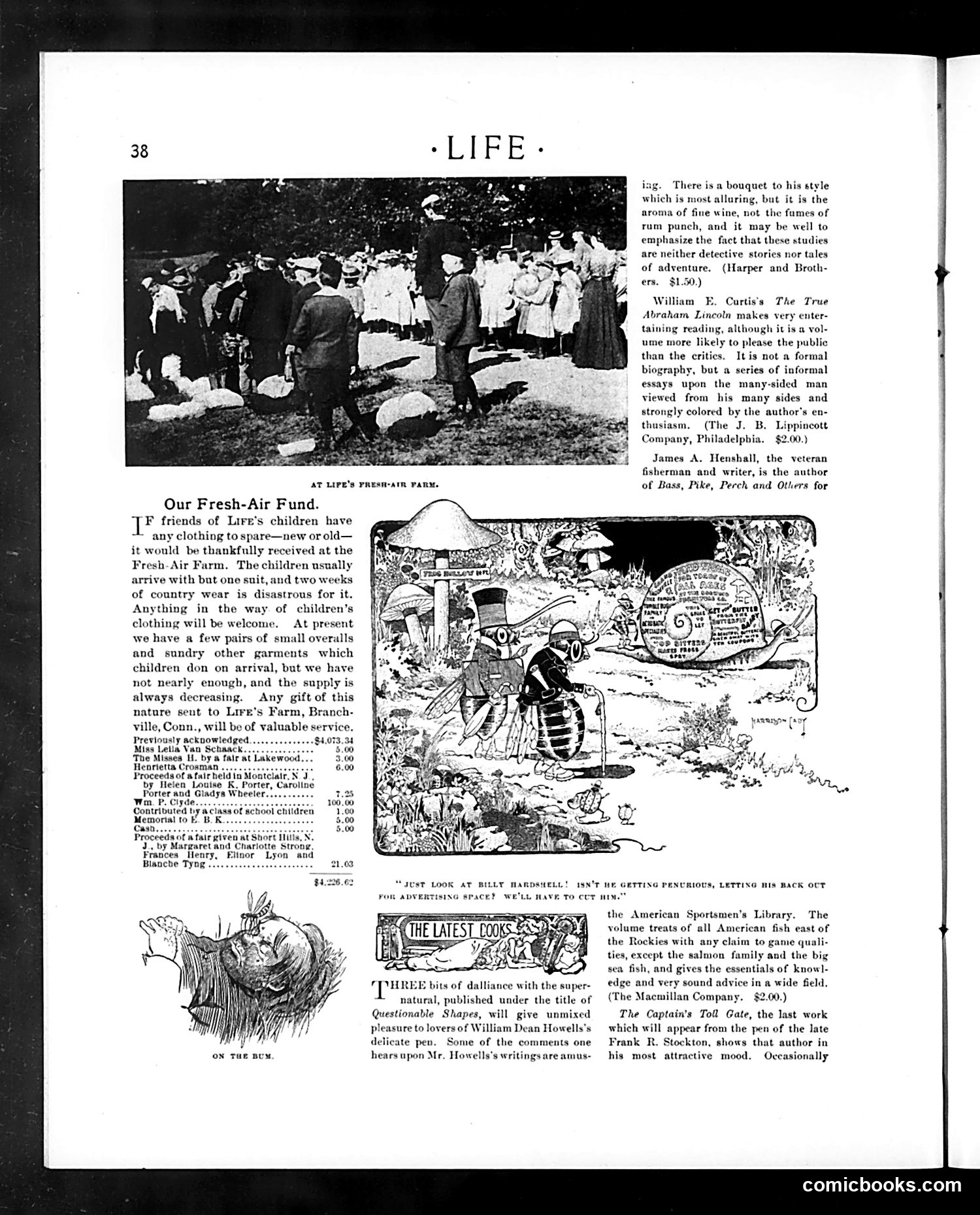
**Main Content:** This page features "Our Fresh-Air Fund," a charitable appeal for children's clothing donations. The top photograph shows a group gathering at Life's Fresh-Air Farm in Pleasantville, Connecticut. **The Cartoon:** The large illustrated panel depicts an oversized bee or insect character speaking with a man. The caption reads: "JUST LOOK AT BILL HARDSWELL, ISN'T HE GETTING PENURIOUS, LETTING HIS BACK OUT FOR ADVERTISING SPACE? WE'LL HAVE TO CUT HIM." This appears to be satirizing commercial sponsorship and advertising practices—specifically mocking someone (Hardswell) for literally renting their back for advertisements, suggesting desperation or loss of dignity for money. The humor relies on visual absurdity and commentary about advertising excess. The page also includes book reviews and advertisements typical of Life's editorial approach.
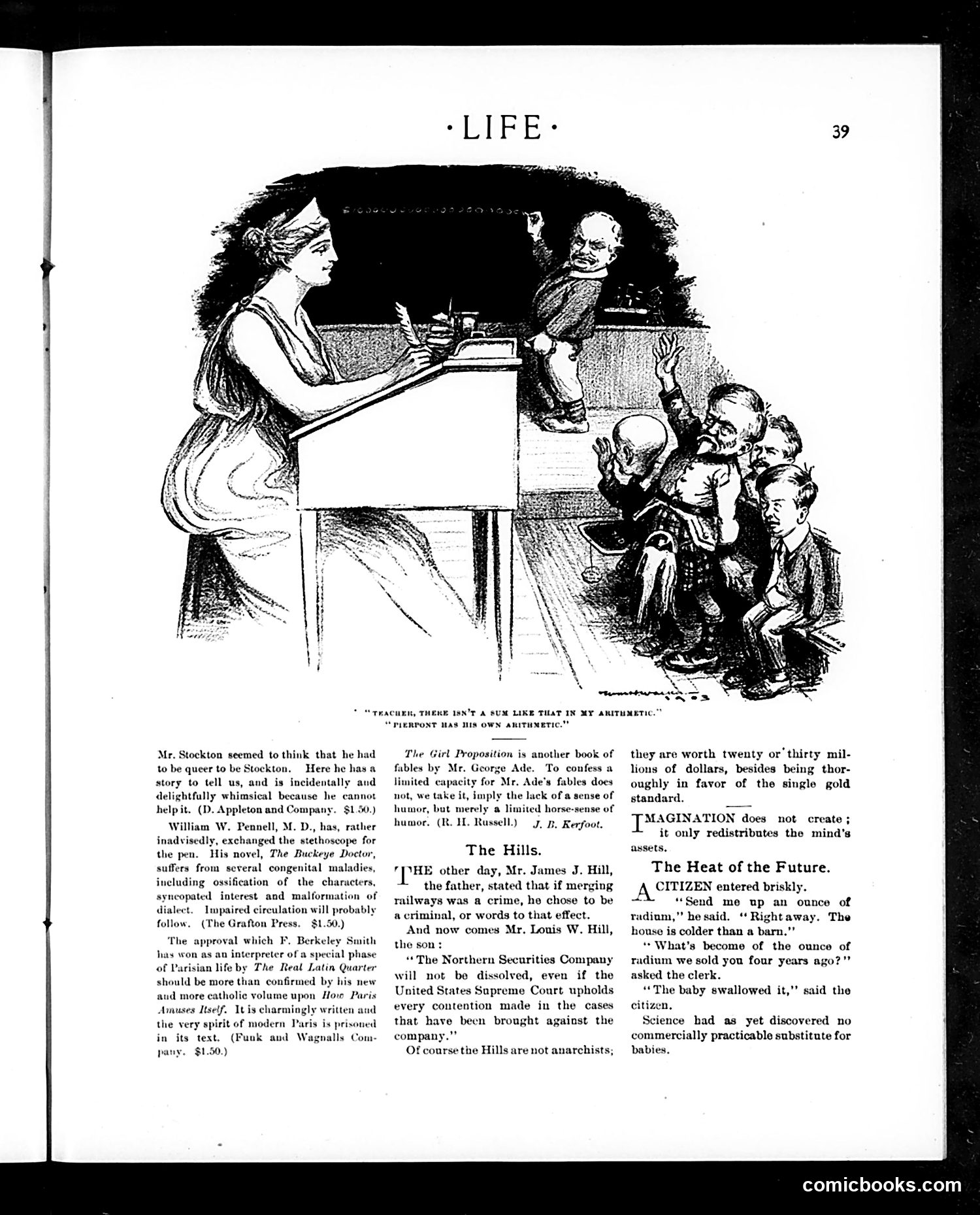
The main cartoon depicts a schoolteacher instructing children, with the caption mocking arithmetic instruction: "Teacher, there isn't a sum like that in my arithmetic!" / "Pierpont has his own arithmetic." This satirizes **J.P. Morgan** (the wealthy industrialist), suggesting he operated by different financial rules than ordinary people—a common criticism of the Gilded Age wealthy. The joke implies Morgan manipulated numbers and business practices to his advantage, beyond normal legal/ethical constraints. Below, brief articles discuss book reviews and "The Hills"—a story about the Hill family's involvement in railroad crimes and the emerging radium industry. The "Heat of the Future" section mocks radium's commercial hype, noting science hadn't yet found practical uses beyond marketing to consumers. The page satirizes both industrial corruption and pseudoscientific commercialism of the early 20th century.
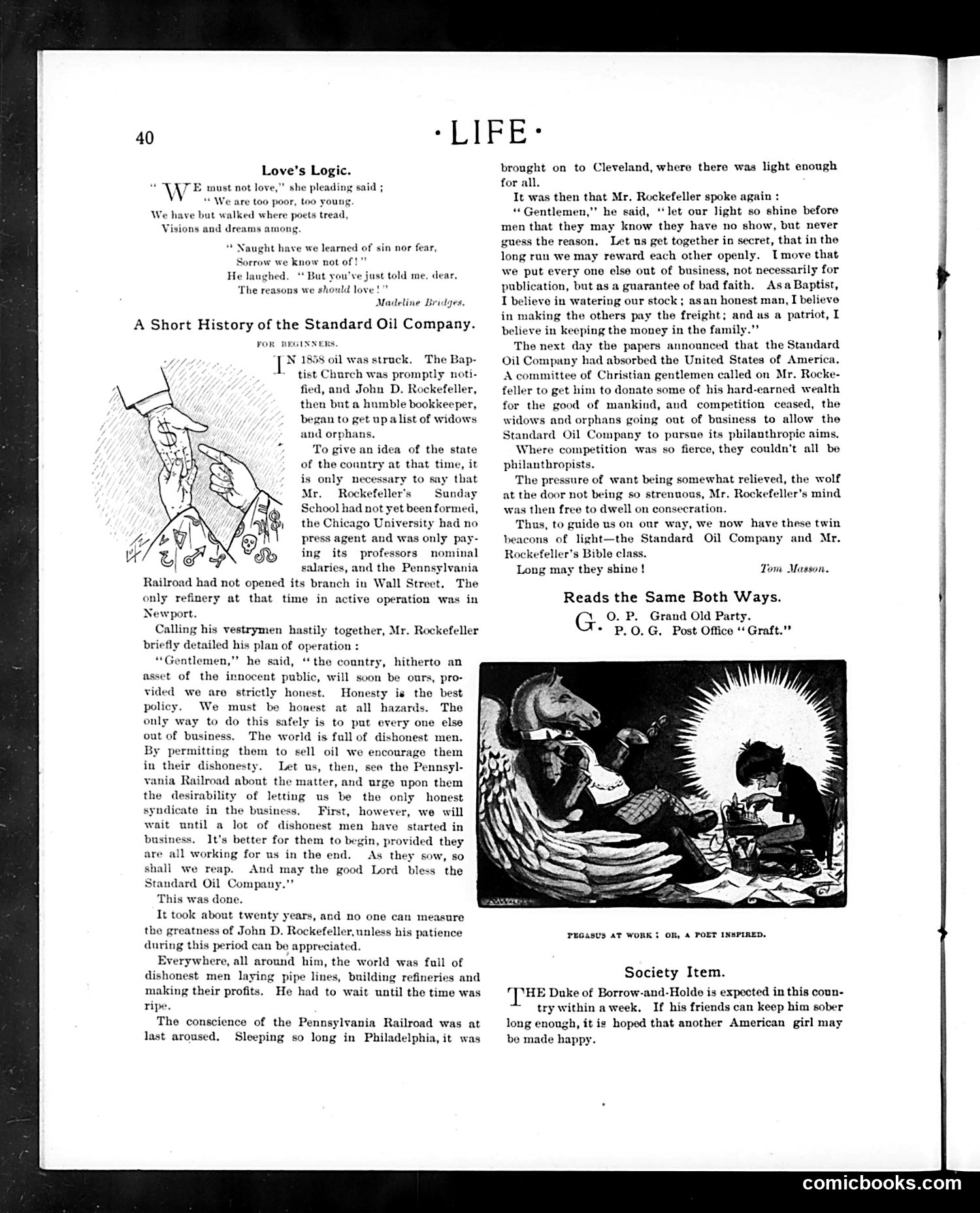
This page's main illustration, titled "Pegasus at Work; or, A Poet Inspired," depicts a winged horse (Pegasus, the mythological symbol of poetic inspiration) appearing to a figure hunched over writing at a desk, with dramatic light radiating behind the horse. The satire likely mocks romantic notions of artistic inspiration—suggesting the contrast between the grandiose mythological ideal of poetic genius versus the mundane reality of a writer laboring at their desk. The cartoon probably critiques either pretentious poets who invoke lofty inspiration, or conversely, the harsh commercial demands placed on writers in the real world. The surrounding text discusses John D. Rockefeller and Standard Oil, unrelated to the cartoon's content.
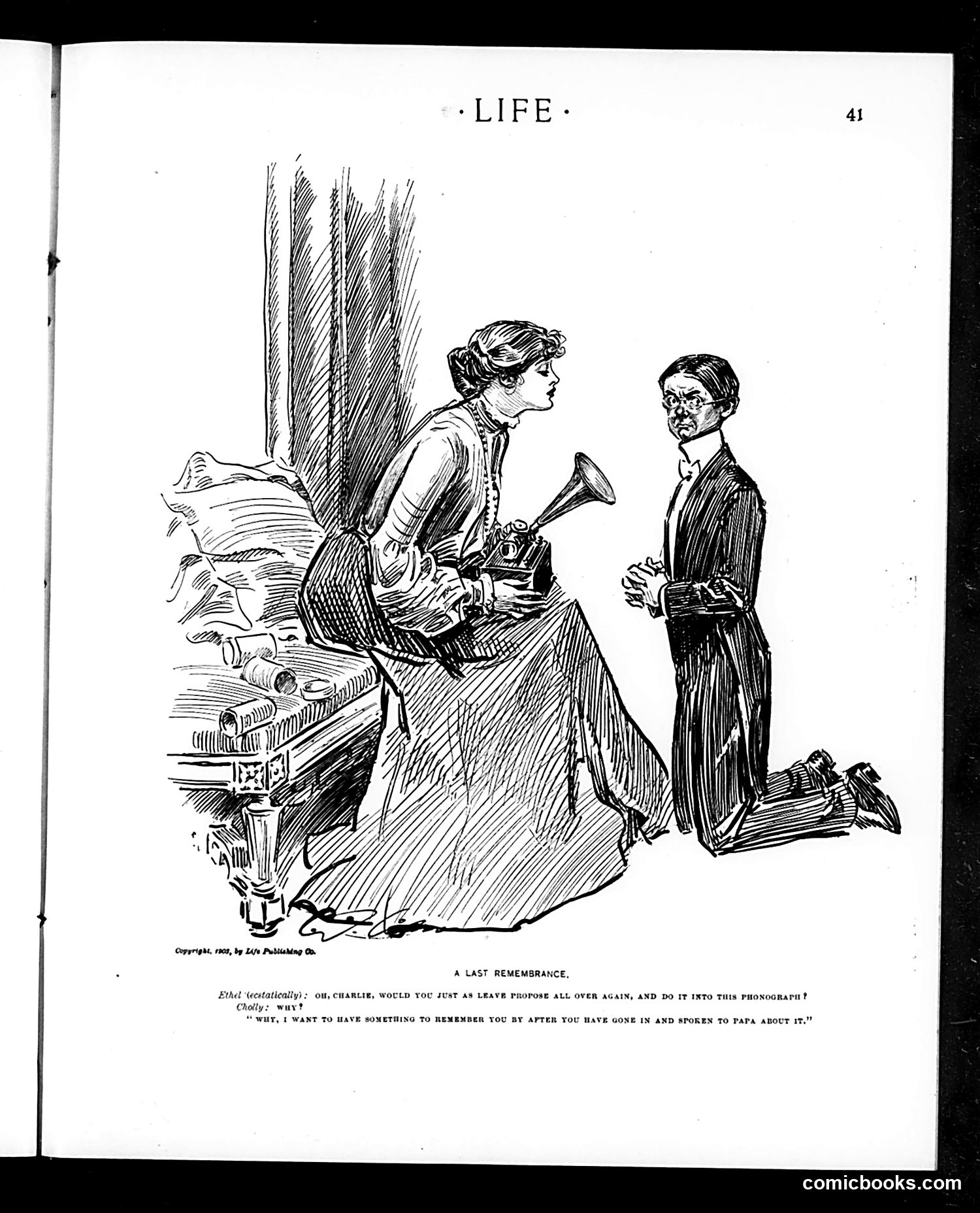
This cartoon depicts a domestic scene where a woman sits at a desk with papers and documents while a man kneels before her holding what appears to be a phonograph horn. The caption indicates the woman (Ethel) is asking the man (Charlie) to record a message—presumably so she'll have something to remember him by after he leaves and tells their father about their relationship. The satire centers on a young couple's secret romance and the awkward social conventions of the era. The man's anxious kneeling posture and the woman's matter-of-fact request suggest relationship anxiety: she wants phonographic proof of his affection before he faces parental disapproval. The humor lies in this early-1900s technological solution to romantic documentation—using a phonograph as a love memento.
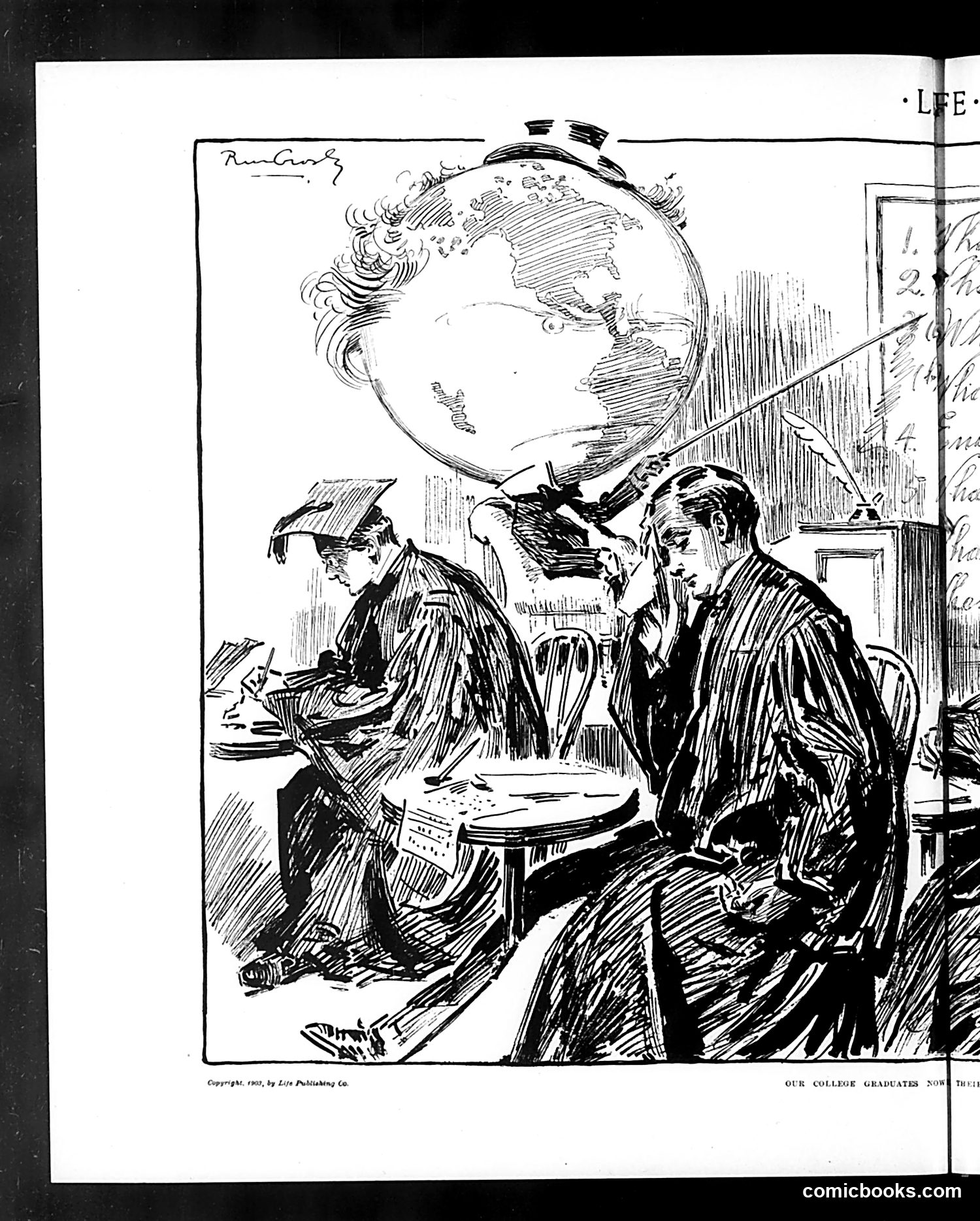
This is a satirical cartoon from *Life* magazine (copyright 1903, per the footer). The image depicts three men in academic regalia examining a large globe, apparently representing "college graduates" based on the partial caption visible ("OUR COLLEGE GRADUATES NOW"). The satire appears to target the limitations or pretensions of college education. The graduates, dressed formally in their academic gowns, study the globe with what seems like exaggerated seriousness, yet their expressions and body language suggest confusion or uncertainty about the world itself. The cartoon likely mocks the gap between theoretical academic training and practical understanding of global affairs—a critique suggesting that despite their credentials, these educated men remain disconnected from actual worldly knowledge. The artist's signature appears in the upper left corner.
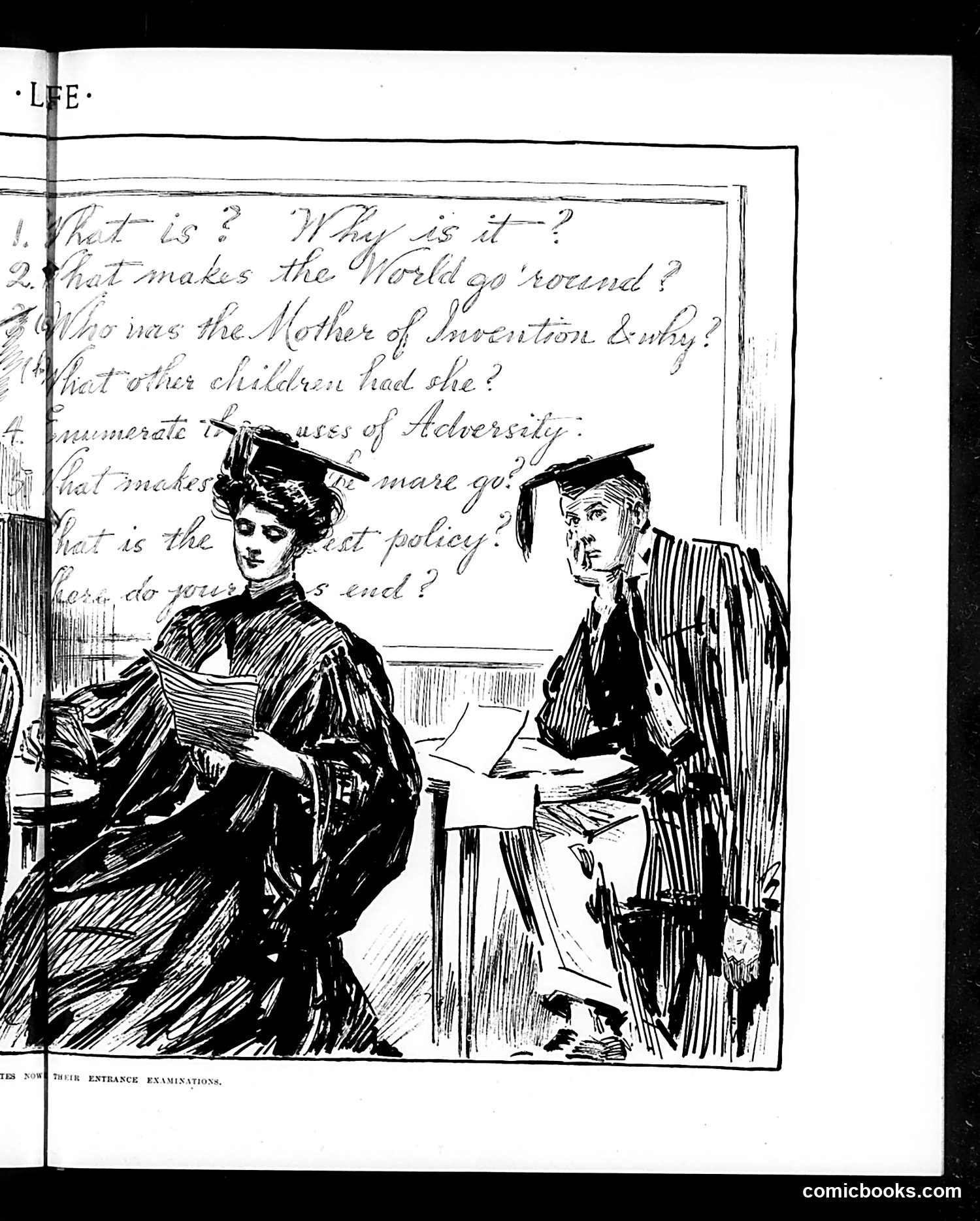
This cartoon satirizes entrance examinations, likely for university or professional admission. Two figures wearing academic mortarboards sit at a table—one appearing to be an examiner (right) looking skeptical, the other a female candidate (left). The handwritten questions on the blackboard behind them are deliberately absurd and unanswerable: "What is it?", "Who was the Mother of Invention & why?", "Enumerate 3 guesses of Adversity," and similar nonsensical prompts. The satire mocks the arbitrary, illogical nature of entrance exams—suggesting they test nothing meaningful. The woman's composed expression contrasts with the examiner's bewildered look, implying even examiners don't understand their own impossible questions. This critiques the examination system itself as fundamentally flawed.
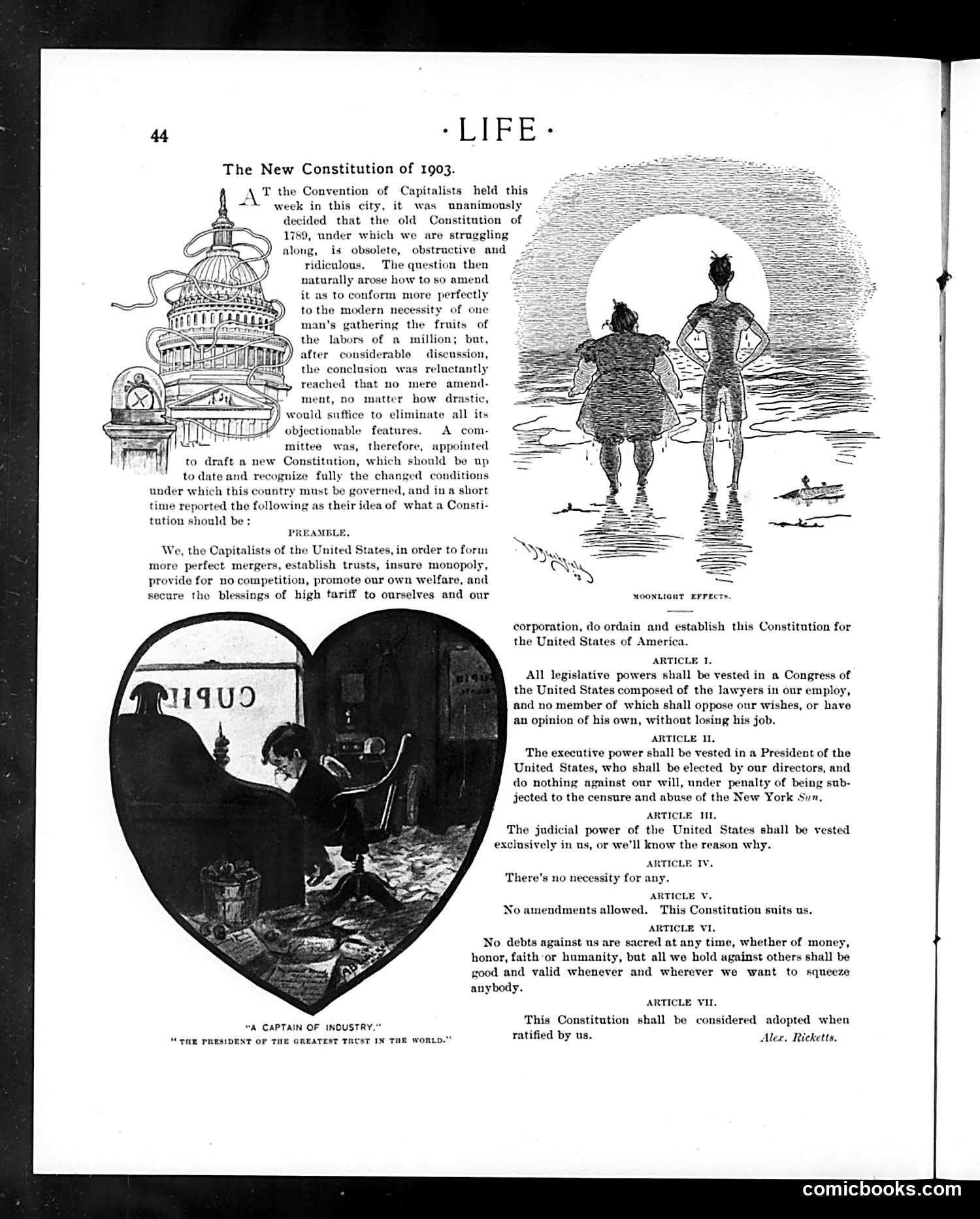
This satirical piece mocks a "Capitalists' Convention" that proposed rewriting the 1789 Constitution to serve corporate interests. The preamble parodies the original, replacing "We the People" with "We, the Capitalists of the United States," explicitly stating goals like forming "trusts, insure monopoly, provide for no competition." The articles are absurdist satire—vesting all power in Congress (composed of lawyers in capitalists' employ), preventing presidential opposition, and making the Constitution unamendable. The heart-shaped illustration labeled "A Captain of Industry" shows a wealthy man in his counting house, captioned "The President of the Greatest Trust in the World"—identifying monopoly capitalists as the true rulers. The "Moonlight Effects" illustration shows figures gazing toward a moon, suggesting naive workers unaware of their exploitation.
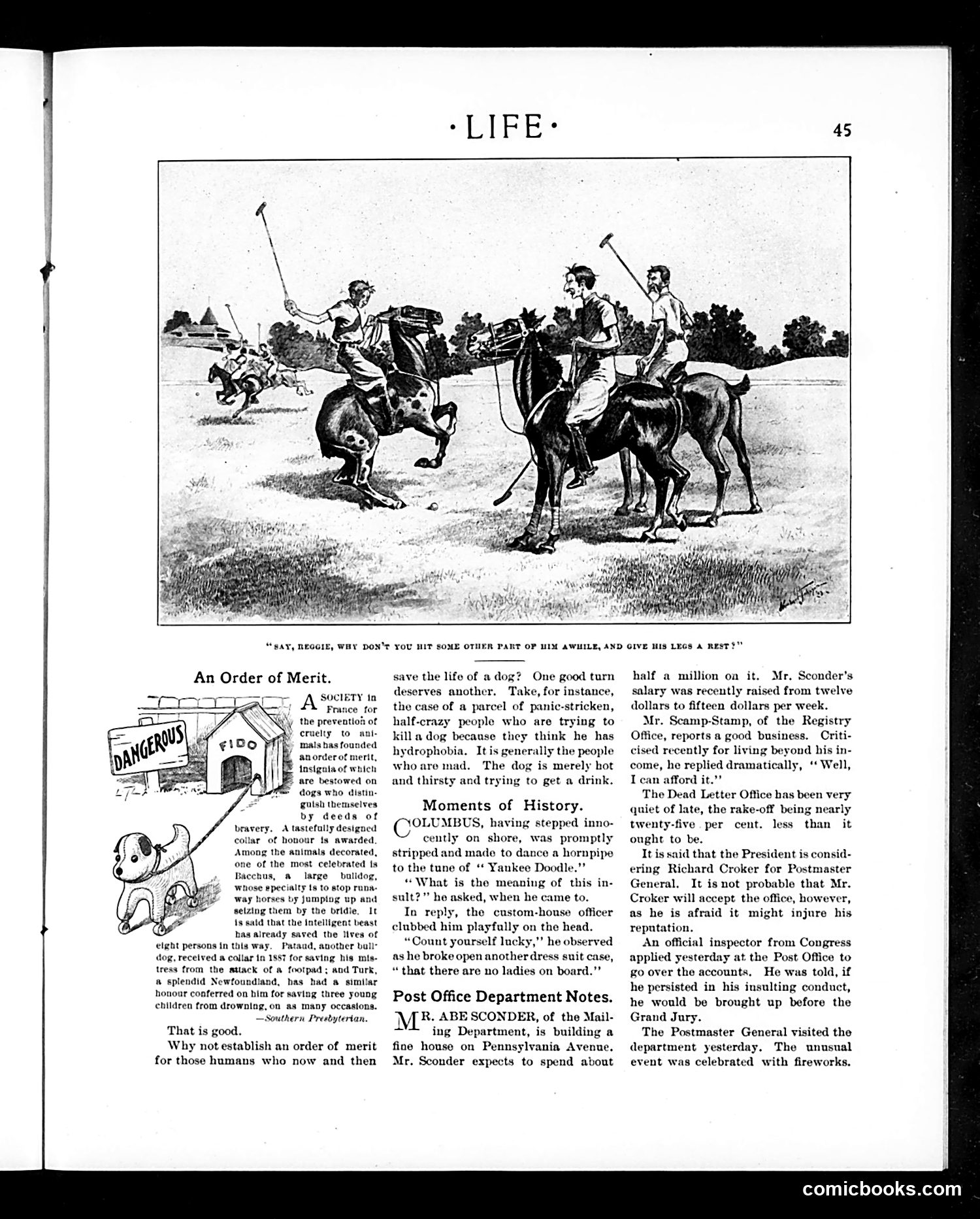
The page contains multiple satirical pieces targeting American institutions: **Top cartoon:** Depicts polo players, illustrating the article "An Order of Merit," which praises French dogs decorated for heroic acts (saving lives, stopping runaway horses). The accompanying editorial sarcastically suggests America should establish similar honors—but for *humans* who save dogs' lives, since Americans are more likely to lynch a hot, thirsty dog out of unfounded rabies panic than show it mercy. **"Moments of History":** A brief absurdist joke depicting Columbus being stripped, humiliated, and robbed by customs officials upon landing—a dark satire on American bureaucratic corruption and lawlessness. **"Post Office Department Notes":** Biting satire of postal service corruption. Officials like "Abe Sconder" and "Scamp-Stamp" live lavishly on minimal government salaries through graft ("rake-offs"), while a Congressional inspector is threatened with prosecution for auditing accounts. The suggestion that political boss Richard Croker might become Postmaster General mocks the spoils system. The page satirizes institutional hypocrisy: Americans value animal welfare while tolerating rampant government theft.
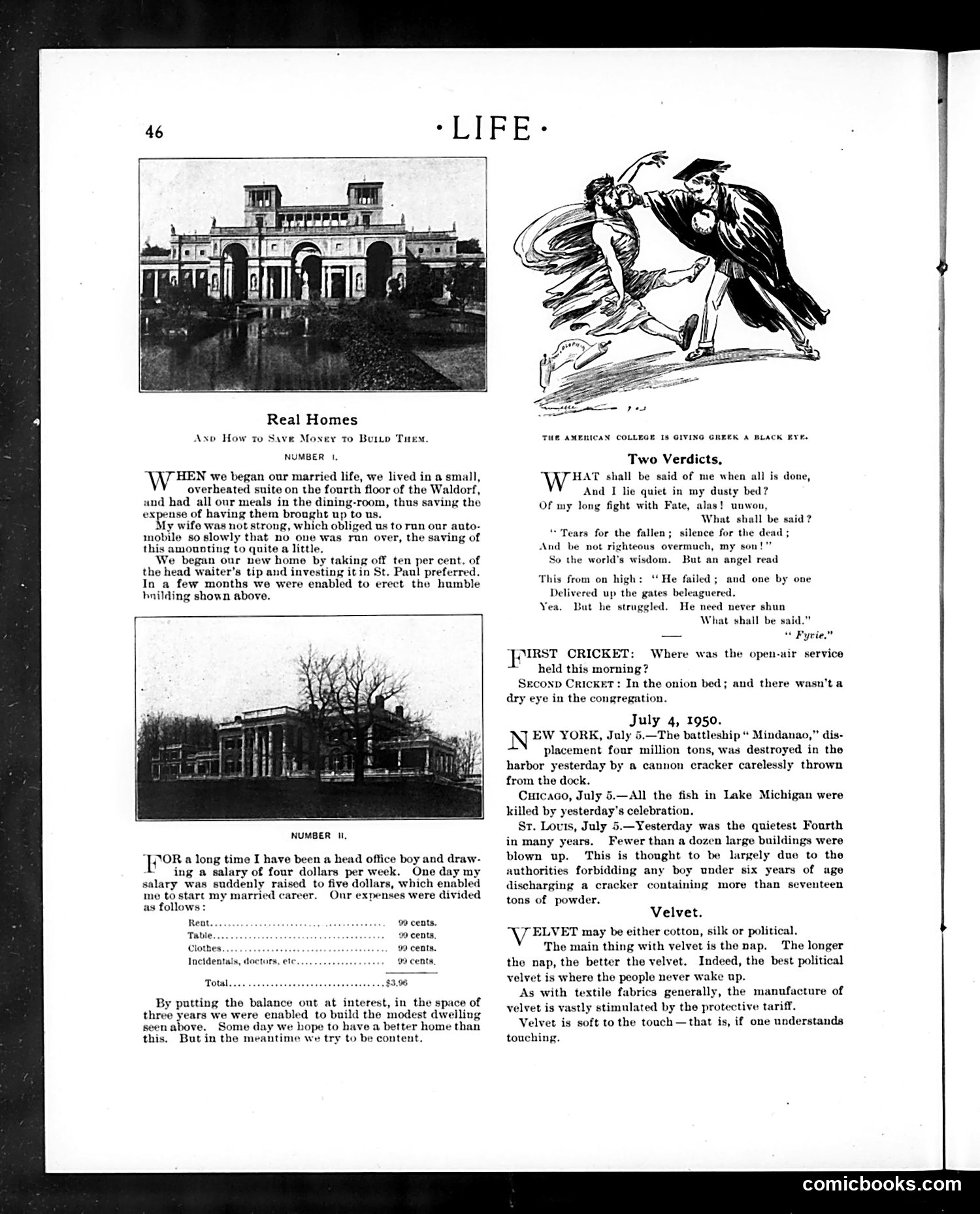
This page mixes practical advice with political satire. The "Real Homes" articles humorously chronicle how working-class people (a hotel worker, an office boy earning $5/week) accumulated wealth through extreme penny-pinching—saving 10% of tips, spending only $3.96 weekly—to build modest houses. The satire lies in presenting these meager savings as triumph. The illustrated cartoon shows a man being struck by a woman—likely referencing tensions in American college life and Greek organizations, though the specific context appears unclear from the caption alone. The brief "Two Verdicts" poem presents contrasting judgments on failure: worldly cynicism versus divine compassion for struggle. The humor pieces mock Fourth of July excess (a battleship destroyed by a firecracker, fish killed by celebration noise), and the final section on "Velvet" offers punning commentary on political complacency—the best political velvet keeps people unaware ("never wake up"). The overall tone is satirical commentary on American consumer culture, social mobility, and political apathy circa 1950.
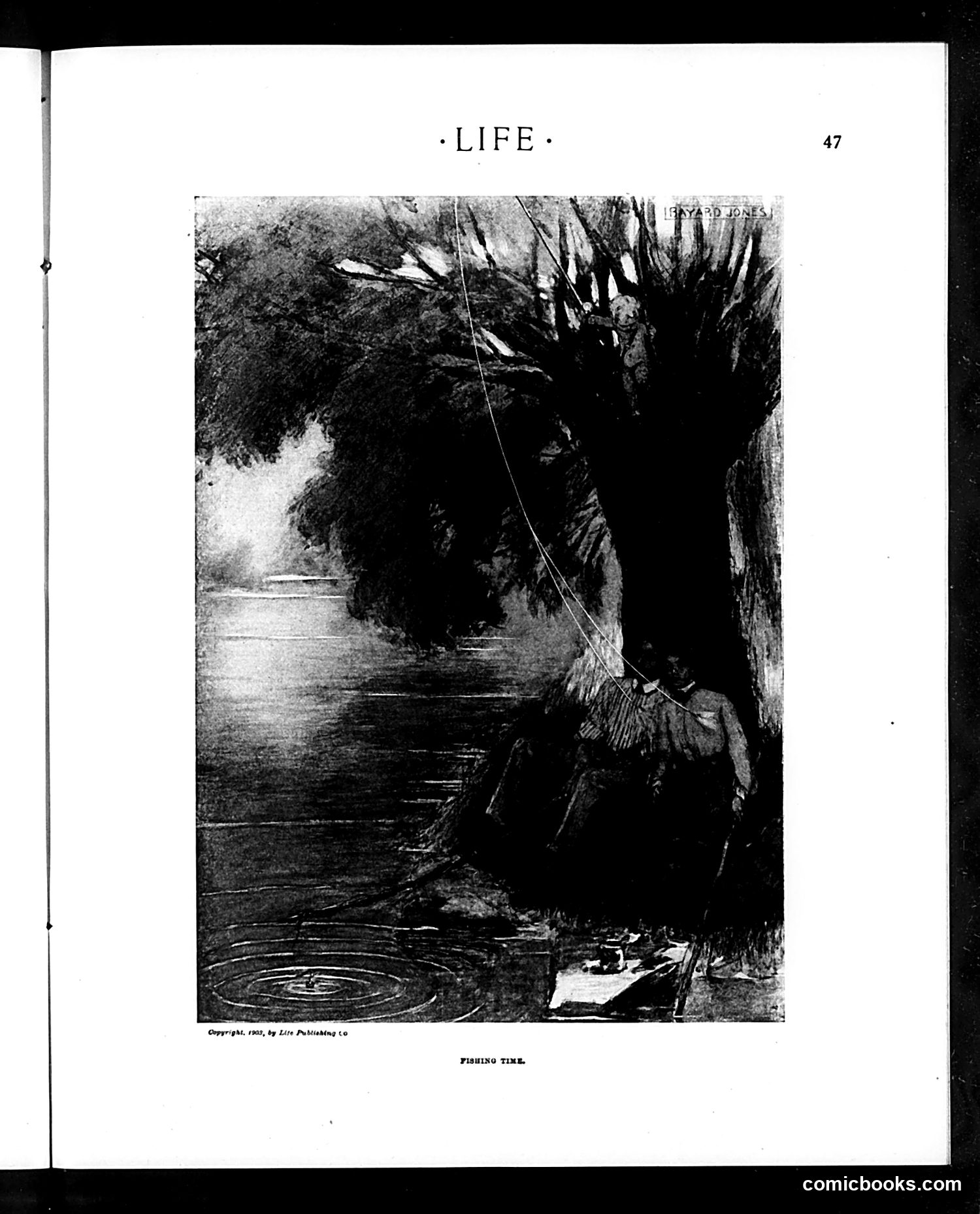
This page from *Life* magazine features a black and white illustration titled "Fishing Time," credited to artist Edward Jones (visible in upper right). The image depicts a figure fishing by a stream or pond, surrounded by dark foliage and overhanging branches. Without additional context or OCR text identifying specific figures or political references, the image appears to be a straightforward genre scene rather than explicit political satire. The composition emphasizes mood and naturalistic detail. The title suggests themes of leisure or escape. To interpret any satirical or allegorical meaning—whether the fishing represents commentary on politicians, economics, or social conditions—would require supporting text or clearer visual caricature, which isn't evident here.
This page contains **primarily advertising and poetry**, not political cartoons requiring historical context. The main content includes: 1. **"The Newest Summer Girl"** — a light poem about a woman preparing for summer fashion, typical of the era's social commentary on changing women's styles. 2. **"The Tempest-Tossed Cup Racer"** — a humorous dialogue between ship's officers and crew preparing a boat for a yacht race, poking fun at the contrast between technical jargon (meteorology, calculations) and practical seamanship. 3. **A brief anecdote** about a man seeking a janitor position, only to discover the previous janitor drowned—a dark humor joke typical of the era. The page is dominated by **whiskey advertisements** (Wilson, Old Crow Rye, Hunter Whiskey), which was common in early 20th-century publications. No significant political satire or identifiable historical figures appear on this page.
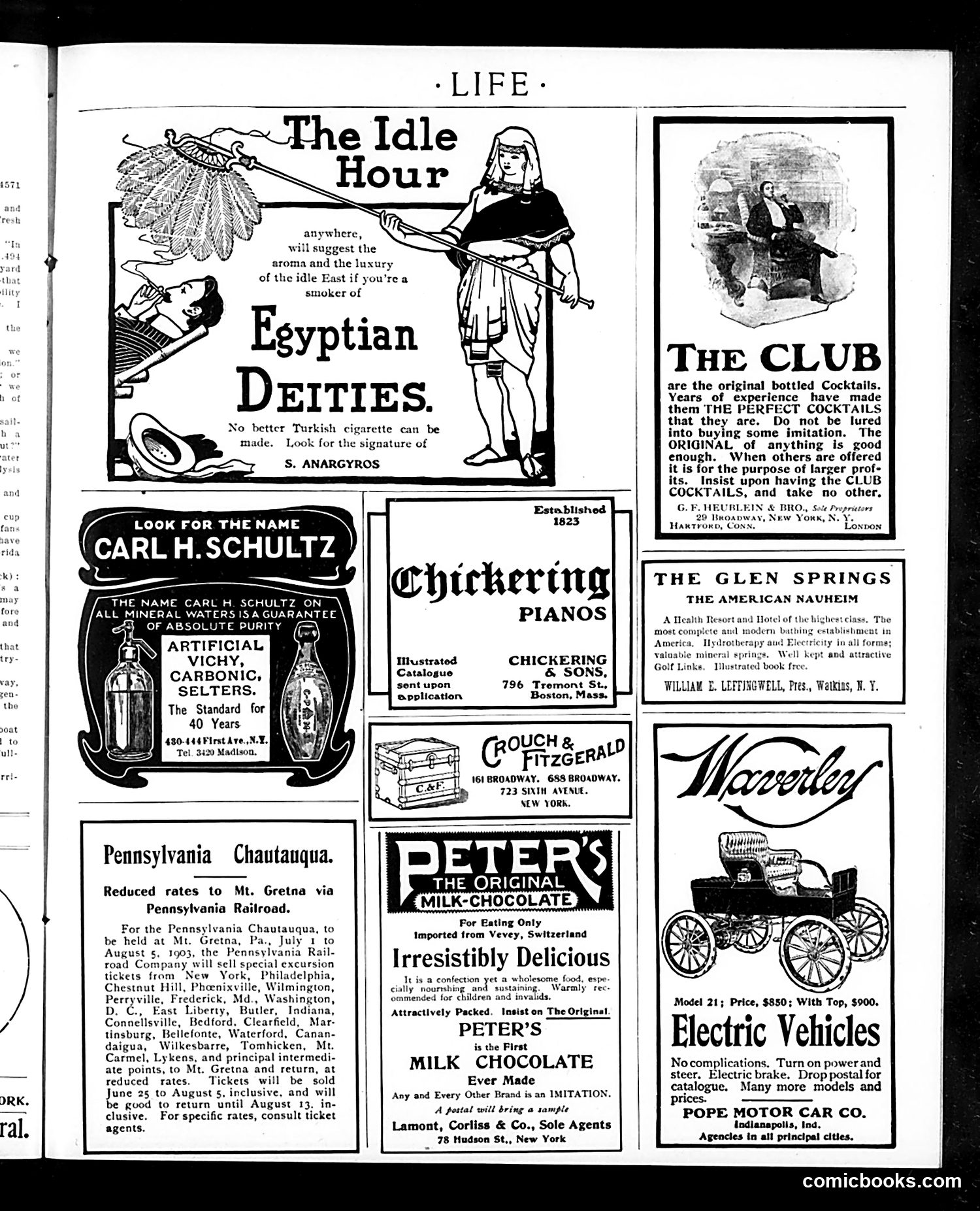
This page is primarily **advertising**, not political satire. The main cartoon advertises Egyptian Deities cigarettes by S. Anargyros, featuring an Egyptian figure reclining luxuriously while holding a fan—playing on Western fascination with "exotic" Oriental imagery popular in the early 1900s. The appeal targets smokers seeking leisure and sophistication through association with ancient Egypt's perceived decadence. The surrounding ads promote period luxuries: mineral waters, pianos, bottled cocktails, chocolate, electric vehicles, and resort hotels. These reflect Edwardian-era consumer culture and leisure activities for wealthy Americans. **No political satire is evident here.** This is a commercial page showcasing products marketed to affluent readers through appeals to luxury, health, and modernity—typical Life magazine advertising from circa 1903.
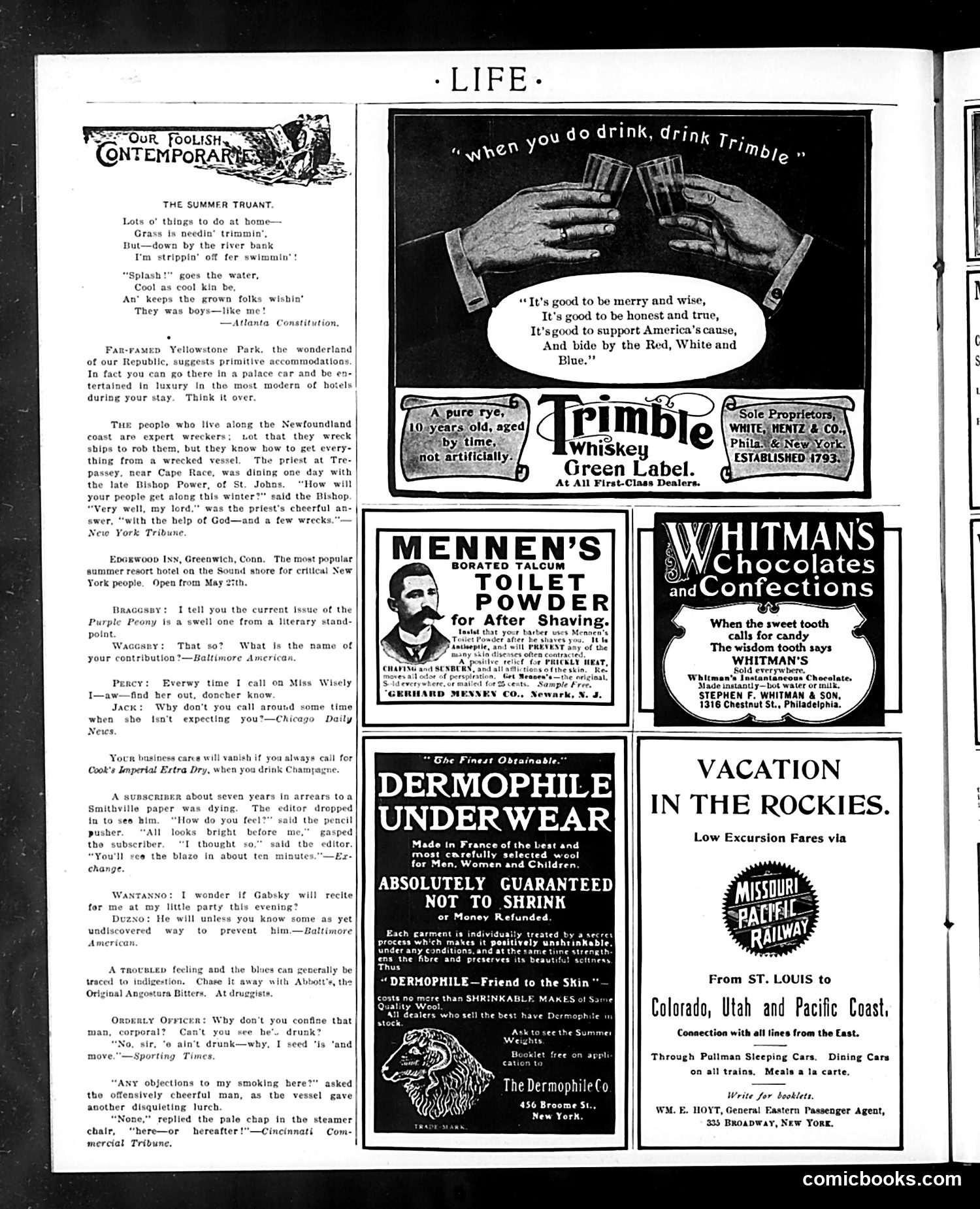
This page from *Life* magazine combines satirical humor with period advertisements (circa early 1900s). **The Cartoons:** "Our Foolish Contemporaries" features short humorous vignettes mocking everyday social situations: a boy playing truant to swim, tourists at Yellowstone Park, Newfoundlanders salvaging shipwrecks, and various comedic dialogues about courtship, drinking, and seasickness. The humor relies on wordplay, dialect, and gentle mockery of human nature rather than specific political targets. **The Advertisements:** The page includes vintage product ads: Trimble Whiskey (patriotic messaging), Mennen's talcum powder, Whitman's chocolates, Dermophile underwear (guaranteed not to shrink), and Missouri Pacific Railway vacation packages to the Rockies. **Social Context:** The advertisements reveal period values: personal grooming, patriotic consumption ("support America's cause"), luxury travel, and the novelty of guaranteed manufacturing standards. The humor reflects early-20th-century class attitudes and gender dynamics typical of *Life*'s middle-class readership.
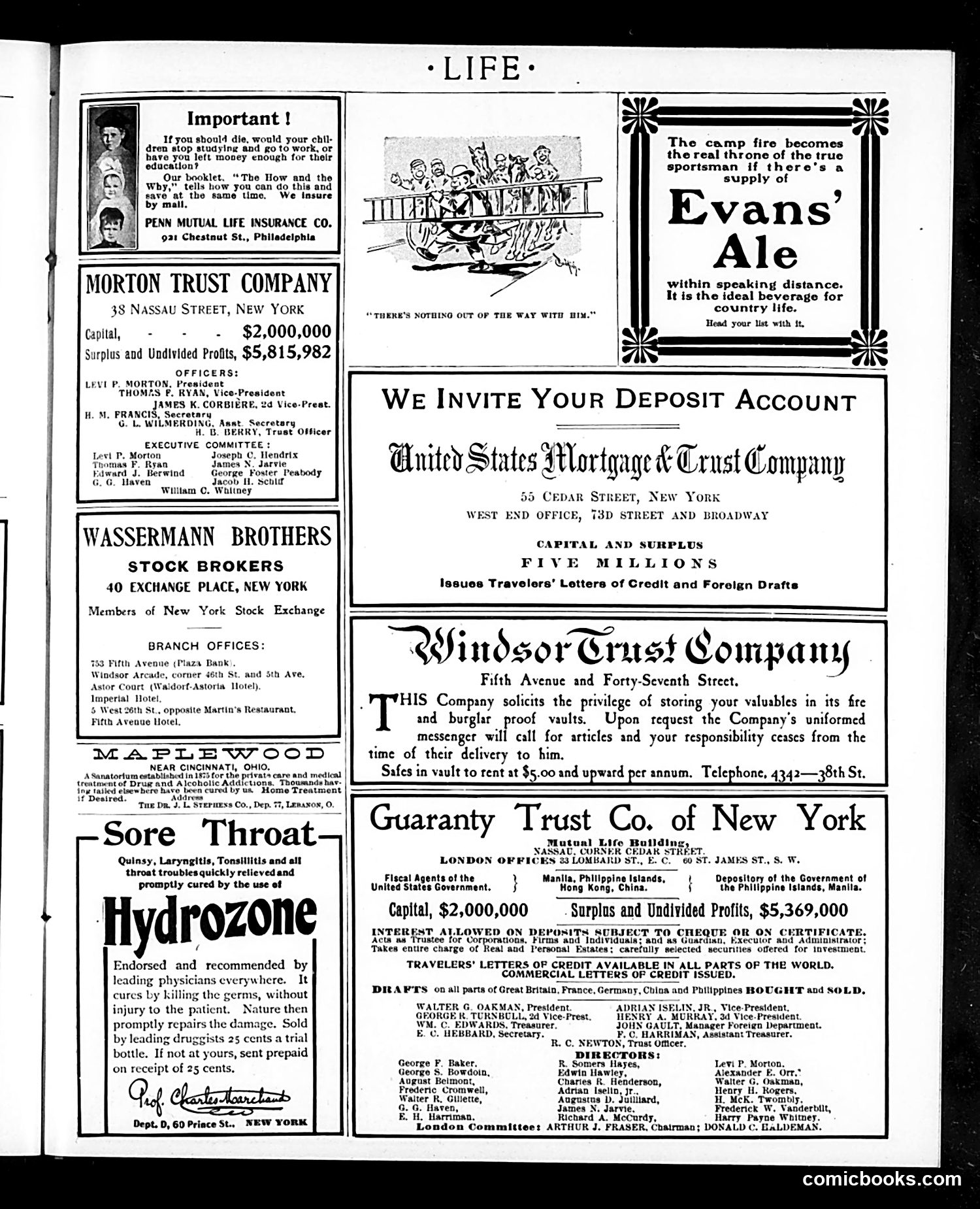
This page is primarily **financial advertisements** rather than satirical content. It displays bank, trust company, and investment service ads from early 20th-century New York institutions—Morton Trust Company, Wassermann Brothers (stockbrokers), United States Mortgage & Trust Company, Windsor Trust Company, and Guaranty Trust Co. The non-advertising content includes one cartoon captioned "There's Nothing Out of the Way With Him," depicting people in a boat, and advertisements for consumer products: Evans' Ale (a beverage marketed to outdoorsmen), Hydrozone (a throat remedy), and life insurance from Penn Mutual. **No clear political satire** is evident. The page reflects the era's financial services marketing and patent medicine advertising, which was common in American magazines before FDA regulation restricted health claims.
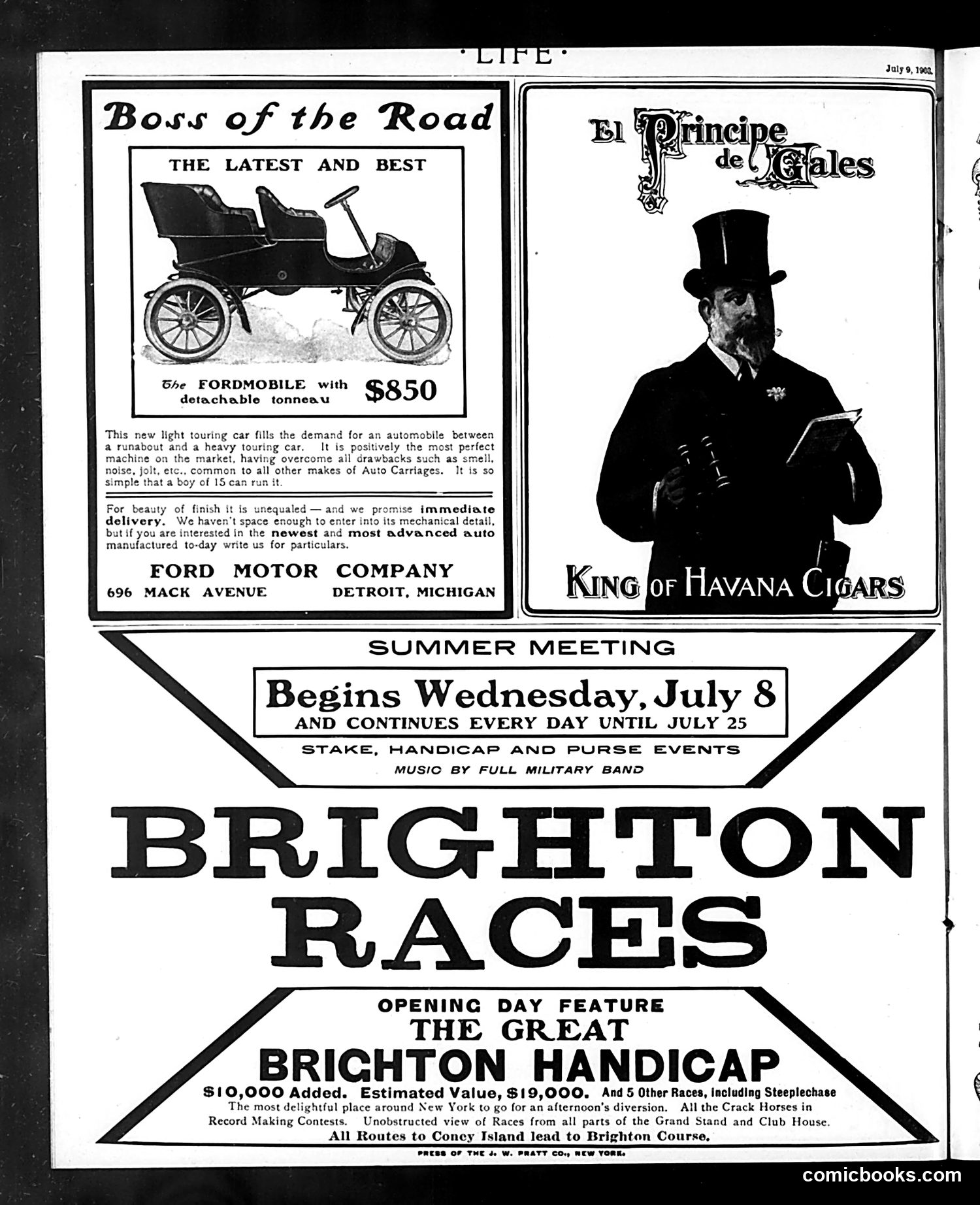
This is primarily an **advertising page**, not satirical content. It contains three advertisements: 1. **Ford Motor Company**: Promotes the Fordmobile touring car at $850, emphasizing it's so simple "a boy of 15 can run it"—highlighting the novelty of accessible automobiles in the early automotive era. 2. **King of Havana Cigars**: Features a gentleman in formal dress (top hat, coat) reading, using the aspirational "King of Havana" branding common for premium cigars of this period. 3. **Brighton Races**: Announces a summer horse-racing meeting near Coney Island, New York, featuring the "Great Brighton Handicap" with $10,000 added purse—reflecting horse racing's popularity as entertainment before automobiles fully displaced it. The page reflects early 1900s consumer culture: emerging car technology, luxury cigars, and established leisure activities.