
Life, 1903-07-09 · page 8 of 20
Life — July 9, 1903 — page 8: what you’re looking at
What you’re looking at
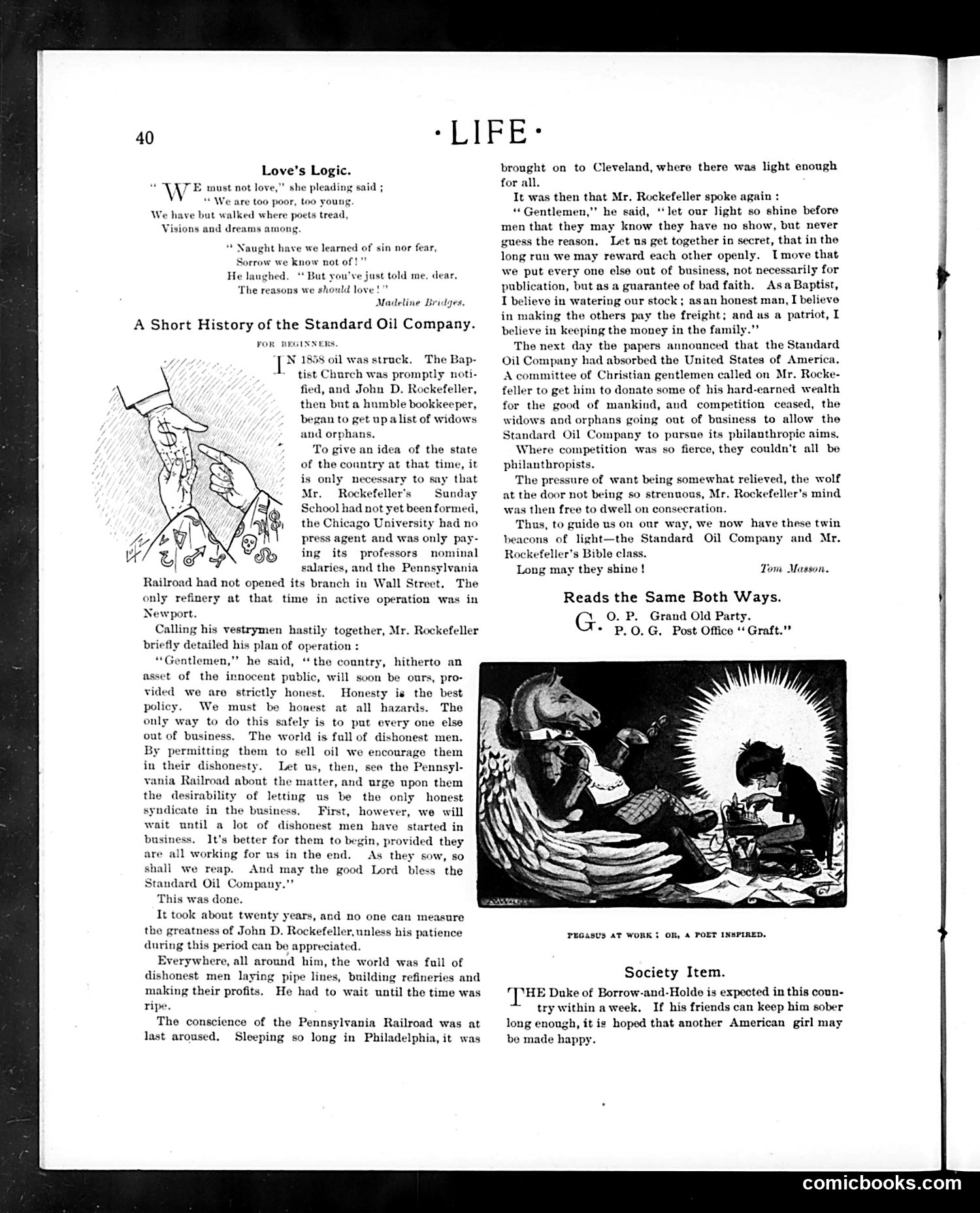
This page's main illustration, titled "Pegasus at Work; or, A Poet Inspired," depicts a winged horse (Pegasus, the mythological symbol of poetic inspiration) appearing to a figure hunched over writing at a desk, with dramatic light radiating behind the horse. The satire likely mocks romantic notions of artistic inspiration—suggesting the contrast between the grandiose mythological ideal of poetic genius versus the mundane reality of a writer laboring at their desk. The cartoon probably critiques either pretentious poets who invoke lofty inspiration, or conversely, the harsh commercial demands placed on writers in the real world. The surrounding text discusses John D. Rockefeller and Standard Oil, unrelated to the cartoon's content.
📄 Transcribed text from this page (OCR, searchable)
Machine-transcribed from the original scan — historical spelling and the odd misread are preserved.
40 LE Love’s Logic. “YATE must not love,” she pleading said ; “ We are too poor, too young. We have but walked where poets tread, Visions and dreams among. “* Naught have we learned of sin nor fear, Sorrow we know not of! He laughed ‘The reasons we should love * But you've just told me. dear, Madeline Brulges. A Short History of the Standard Oil Company. FOR BEGINNERS. 58 oil was struck. The Bap- tist Church was promptly noti- fied, and John D. Rockefeller, then but a humble bookkeeper, began to get up alist of widows and orphans. To give an idea of the state of the country at that time, it is only necessary to say that Mr. Rockefeller's Sunday School had not yet been formed, the Chicago University had no press agent and was only pay- ing its professors nominal salaries, and the Pennsylvania Railroad had not opened its branch in Wall Street. The only refinery at that time in active operation was in Newport. Calling his vestrymen hastily together, Mr. Rockefeller briefly detailed his plan of operation : “Gentlemen,” he said, ‘the country, hitherto an asset of the innocent public, will soon be ours, pro- vided we are strictly honest. Honesty is the best polic We must be honest at all hazards. The only way to do this safely is to put every one else out of business. The world is full of dishonest men. By permitting them to sell oil we encourage them in their dishonesty. Let us, then, see the Pennsyl- vania Railroad about the matter, and urge upon them the desirability of letting us be the only honest syndicate in the business, First, however, we will wait until a lot of dishonest men have started in business, It's better for them to begin, provided they are all working for us in the end. As they sow, so shall we reap. And may the good Lord bless the Standard Oil Company.” This was done. It took about twenty years, and no one can measure the greatness of John D. Rockefeller, unless his patience during this period can be appreciated. Everywhere, all around him, the world was fail of dishonest men laying pipe lines, building refineries and making their profits. He had to wait until the time was ripe. The conscience of the Pennsylvania Railroad was at last aroused. Sleeping so long in Philadelphia, it was brought on to Cleveland, where there was light enough for all. It was then that Mr. Rockefeller spoke again : “Gentlemen,” he said, “let our light so shine before men that they may know they have no show, but never guess the reason, Let us get together in secret, that in the long run we may reward each other openly. [move that we put every one else out of business, not necessarily for publication, but as a guarantee of bad faith. Asa Baptist, I believe in watering our stock; asan honest man, I believe in making the others pay the freight; and as a patriot, I believe in keeping the money in the family.” The next day the papers announced that the Standard Oil Company had absorbed the United States of America. A committee of Christian gentlemen called on Mr. Rocke- feller to get him to donate some of his hard-earned wealth for the good of mankind, and competition ceased, the widows and orphans going out of business to allow the Standard Oil Company to pursue its philanthropic aims. Where competition was so fierce, they couldn't all be philanthropists. The pressure of want being somewhat relieved, the wolf at the door not being so strenuous, Mr. Rockefeller'’s mind was then free to dwell on consecration. Thus, to guide us on our way, we now have these twin beacons of light—the Standard Oil Company and Mr. Rockefeller’s Bible class. Long may they shine! Tom Masson. Reads the Same Both Ways. O. P. Grand Old Party. * P.O.G. Post Office ‘‘ Graft.’” PEGASUS AT WORK} OR, 4 POET INSPIRED. Society Item. ‘THE Duke of Borrow-and-Holde is expected in this coun- try within aweek. If his friends can keep him sober long enough, it is hoped that another American girl may be made happy. comicbooks.com