
Life, 1903-07-09 · page 4 of 20
Life — July 9, 1903 — page 4: what you’re looking at
What you’re looking at
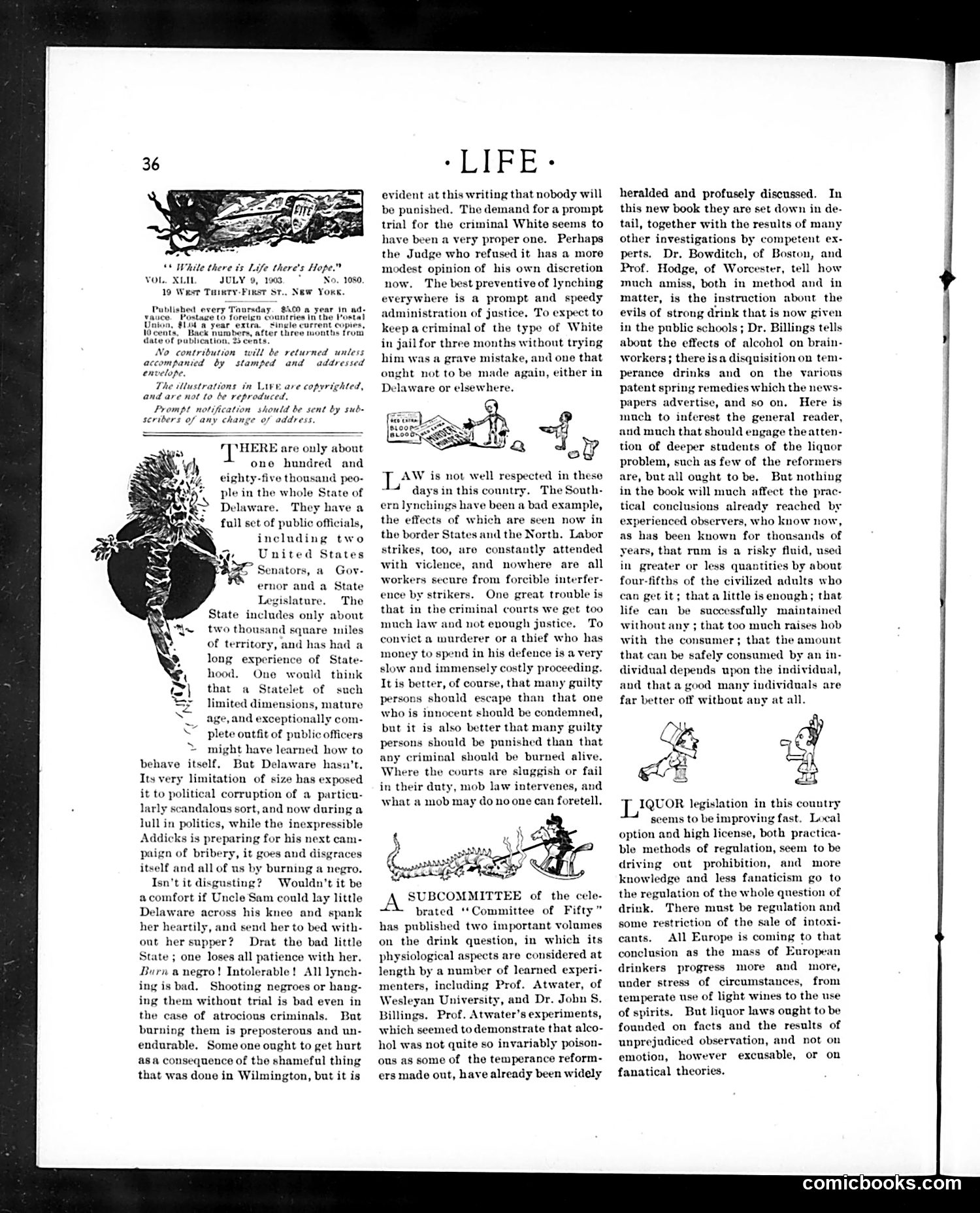
This page contains editorial commentary rather than political cartoons. The text discusses criminal justice reform, particularly criticizing Delaware's handling of capital punishment and mob violence. The small illustrations appear to be decorative vignettes rather than satirical cartoons—showing figures in various poses but without clear political targets. The main editorial argues that lynching represents failed justice, that courts are too lenient on wealthy defendants, and that liquor legislation requires better regulation based on scientific evidence rather than temperance fanaticism. The author references work by Professor Atwater at Wesleyan University regarding alcohol's physiological effects. The page advocates for balanced legal reform: punishing the guilty while protecting the innocent, and regulating alcohol through evidence-based policy rather than emotion-driven prohibition.
📄 Transcribed text from this page (OCR, searchable)
Machine-transcribed from the original scan — historical spelling and the odd misread are preserved.
“* While there is Life there's Hop VOL. XLIL JULY . . 19 West Tuimry-Finst St. N will be returned untess stamped and addressed No contribution accompanied by The illustrations in Live. are copyrighted, and are not to be reproduced. Prompt notification should be sent by sub= seribers of any change of address. [HERE are only about one hundred and eighty-five thousand peo- ple in the whole State of Delaware. They have a full set of public officials, including two Boe nites States 2 Senators, a Govy- Ey ernor and a State slature. The State includes only about two thousand square miles of territory, and has had a long experience of State- hood. One would think that a Statelet of such limited dimensions, mature age, and exceptionally com- plete outfit of public officers might have learned how to behave itself, But Delaware hasa’t. Its very limitation of size has exposed it to political corruption of a particu- y scandalous sort, and now during a. lull in politics, while the inexpressible Addicks is preparing for his next cam- paign of bribery, it goes and disgraces itself and all of us by burning a negro. Isn't it disgusting? Wouldn't it be acomfort if Uncle Sam could lay little Delaware across his knee and spank her heartily, and send her to bed with- out her supper? Drat the bad little State ; one loses all patience with her. Burn a negro! Intolerable! All lynch- ing is bad. Shooting negroes or hang- ing them without trial is bad even in the case of atrocious criminals. But burning them is preposterous and un- endurable. Some one ought to get hurt asa consequence of the shameful thing that was done in Wilmington, but it is *-LIFE: evident at this writing that nobody will be punished. The demand for a prompt trial for the criminal White seems to have been a very proper one. Perhaps the Judge who refused it has a more modest opinion of his own discretion now. The best preventive of lynching everywhere is a prompt and speedy administration of justice, To expect to keep acriminal of the type of White in jailfor three months without trying him was a grave mistake, and one that onght not to be made again, either in jaware or elsewhere. L not well respected in these “4 days in this country. The South- ern lynchings have been a bad example, the effects of which are seen now in the border States and the North. Labor strikes, too, ure constantly attended with viclence, and nowhere are all workers secure from forcible interfer- ence by strikers. One great trouble is that in the criminal courts we get too much law and not enough justice. To convict a wurderer or a thief who has money to spend in his defence is a very slow and immensely costly proceeding. It is better, of course, that many guilty persons should escape than that one who is innocent should be condemned, but it is also better that many guilty persons should be punished than that any criminal should be burned alive. Where the courts are sluggish or fail in their duty, mob law intervenes, and what a mob may do no one can foretell. A SUBCOMMITTEE of the cele- brated ‘Committee of Fifty has published two important volames on the drink question, in which its physiological aspects are considered at length by a number of learned experi- menters, including Prof. Atwater, of Wesleyan University, and Dr. Jobn S. Billings. Prof. Atwater’s experiments, which seemed to demonstrate that alco- hol was not quite so invariably poison- ous as some of the temperance reform- ers made out, have already been widely heralded and profusely discussed. In this new book they are set down in de- tail, together with the results of many other investigations by competent ex- perts. Dr. Bowditch, of Boston, and Prof. Hodge, of Worcester, tell how much amiss, both in method and in matter, is the instruction about the evils of strong drink that is now given in the public schools ; Dr. Billings tells about the effects of alcohol on brain- workers; there isa disquisition on tem- perance drinks and on the various patent spring remedies which the news- papers advertise, and so on. Here is much to interest the general reader, and much that should engage the atten- tion of deeper students of the liquor problem, such as few of the reformers are, butall ought tobe. But nothing in the book will much affect the prac- tical conclusions already reached by experienced observers, who know now, as has been known for thousands of years, that rum is a risky fluid, used in greater or less quantities by about four-fifths of the civilized adults who can getit; that a little isenough; that life can be successfully maintained without any ; that too much raises hob with the consumer; that the amount that can be safely consumed by an in- dividual depends upon the individual, and that a good many individuals are far better off without any at all. af L3900Rr legislation in this country seems to be improving fast. Local option and high license, both practica- ble methods of regulation, seem to be driving out prohibition, and more knowledge and less fanaticism go to the regulation of the whole question of drink. There must be regulation and some restriction of the sale of intoxi- eants. All Europe is coming to that conclusion as the mass of European drinkers progress more and more, under stress of circumstances, from temperate use of light wines to the use of spirits. But liquor laws ought to be founded on facts and the results of unprejudiced observation, and not on emotion, however excusable, or on fanatical theories. comicbooks.com