
A complete issue · 23 pages · 1903
Life — June 25, 1903
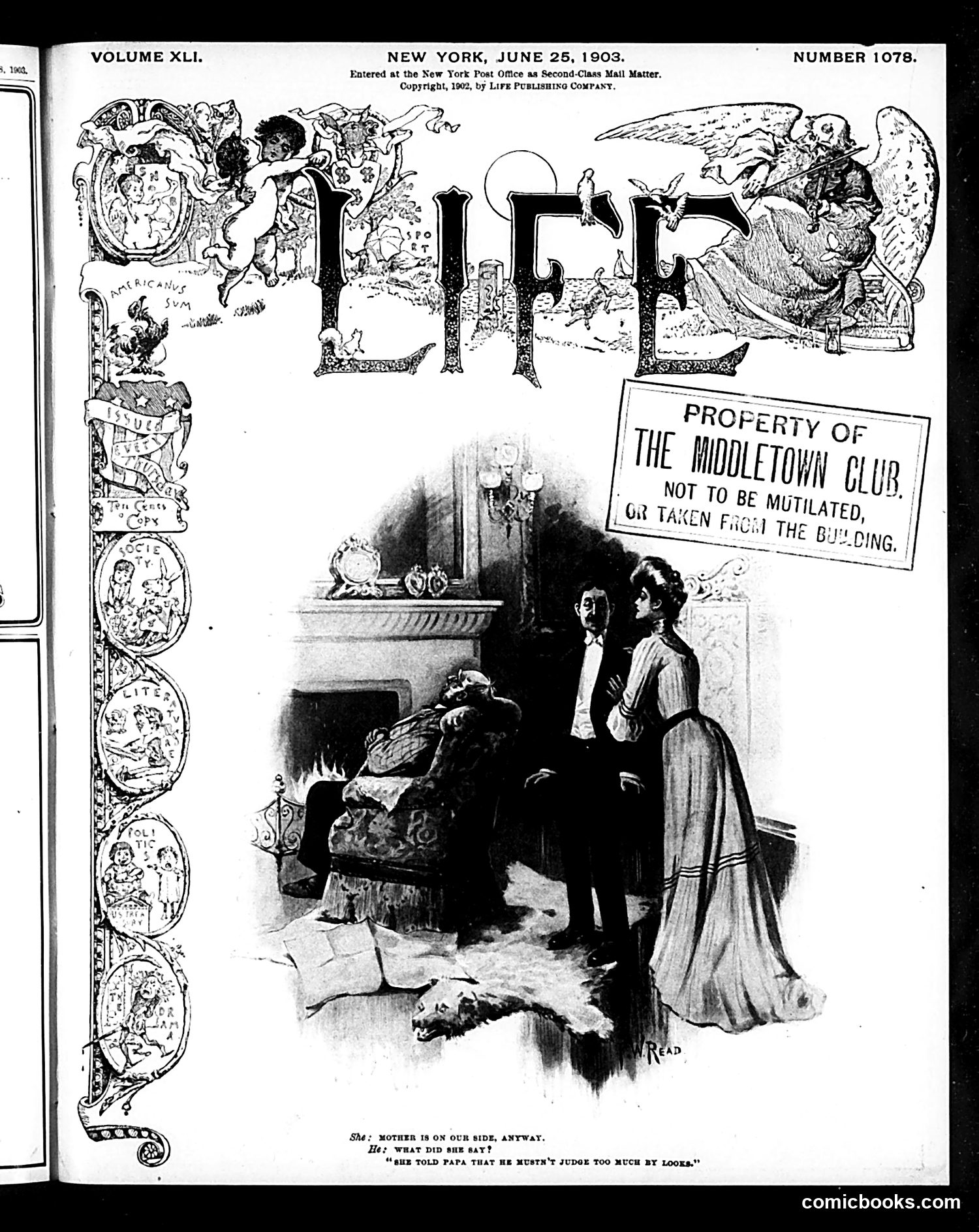
This page features a satirical illustration about the **Middletown Club**. The main cartoon shows a sophisticated domestic scene with a woman discovering what appears to be a dead rat near the fireplace, while two men stand nearby. The caption indicates the woman ("She") declares "Mother is on our side, anyway," to which one man replies about the rat: "She told papa that he mustn't judge too much by looks." The property notice warns the illustration is "Property of the Middletown Club" and warns against mutilation or removal from the building—a playful ownership marker typical of Life magazine's era. The satire appears to mock domestic pretensions or family dynamics, though the specific Middletown Club reference is unclear without additional historical context.
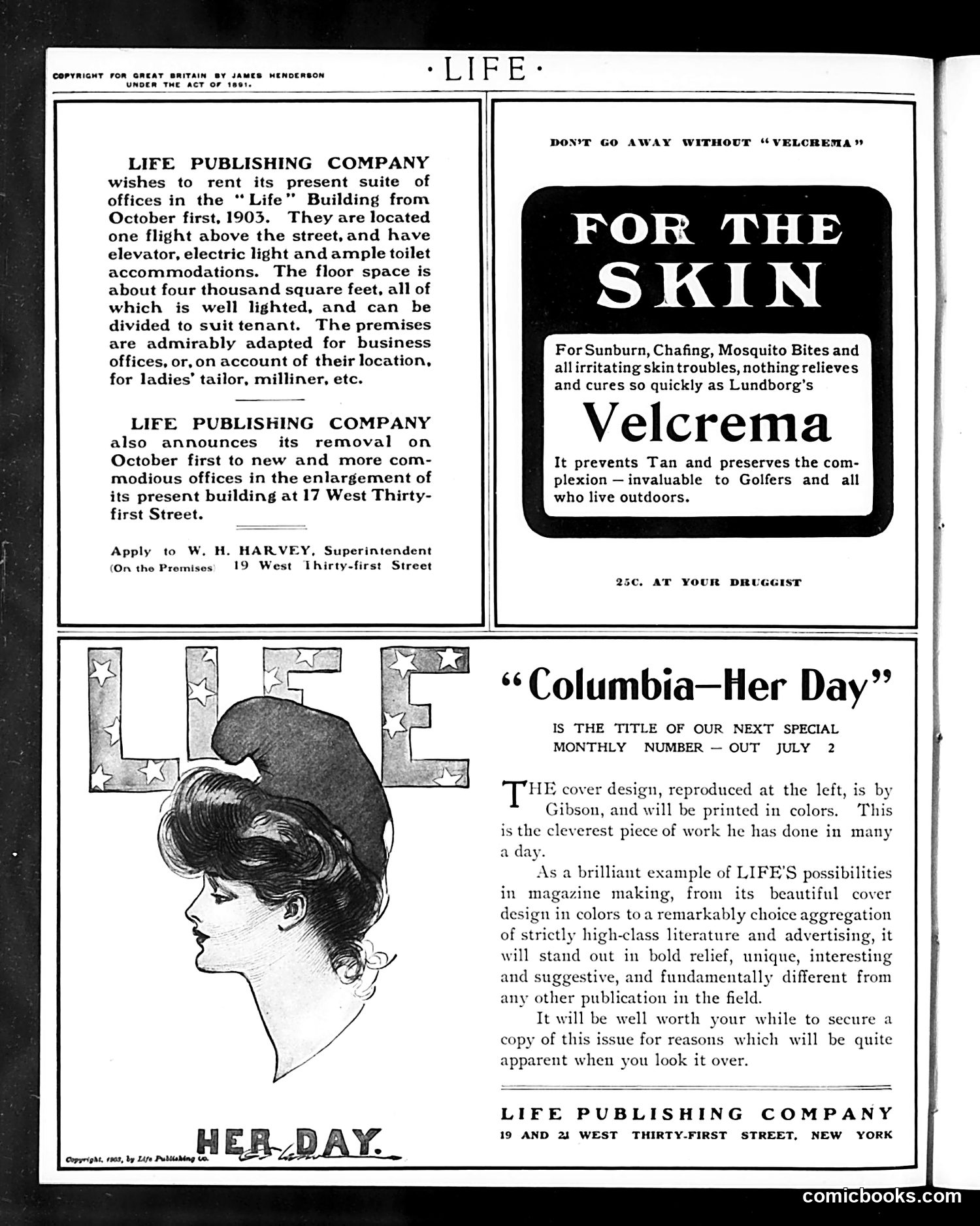
This page is primarily **advertising and corporate announcements** rather than satire or political commentary. The top sections contain: - A rental notice from Life Publishing Company advertising office space in the "Life Building" - An advertisement for "Velcrema," a skin care product marketed for sunburn, insect bites, and preventing tan (notably positioning tan-prevention as desirable for "Golfers and all who live outdoors") The bottom section announces an upcoming special issue titled **"Columbia—Her Day"** (July 2), featuring cover art by Gibson. The text promotes Life's magazine-making capabilities, emphasizing its high-quality color printing and literary content as distinguishing it from competitors. There is **no political cartoon or satire** on this page—it's a straightforward collection of advertisements and publishing announcements typical of early 1900s magazine content.
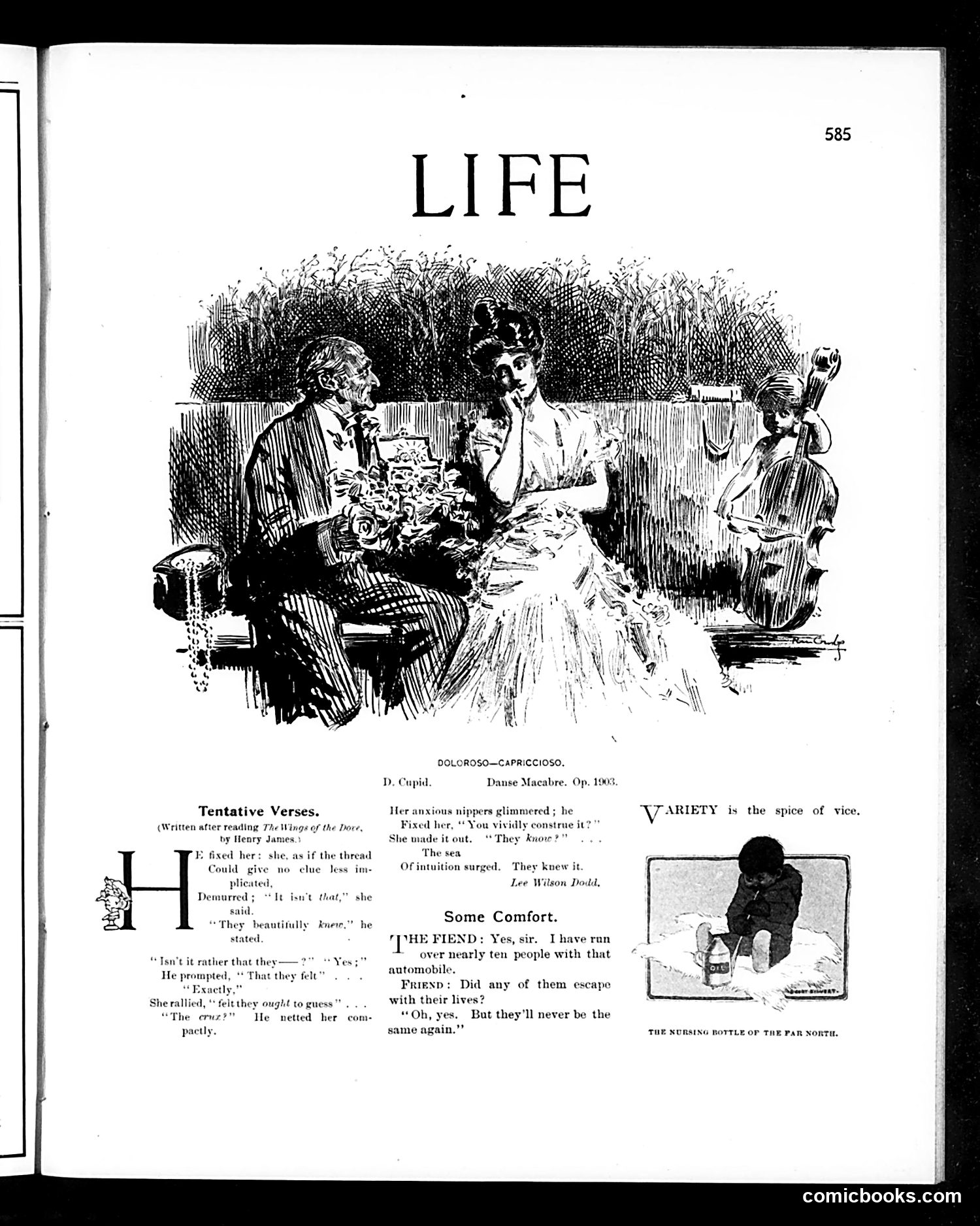
This page contains light satirical content rather than political commentary: **Top illustration** ("Doloroso-Capriccioso"): Shows a couple dining while a cellist performs. The caption references a Chopin composition, suggesting the humor lies in the musical performance accompaniment to their meal—likely satirizing pretentious dinner entertainment. **"Tentative Verses"**: A humorous poem by Henry James about a couple's awkward dinner conversation, featuring gentle marital satire about miscommunication ("It isn't *that*"). **"Some Comfort"**: A brief joke about an automobile accident survivor becoming reckless with future driving—dark humor about learning from experience. **Right illustration**: "The Nursing Bottle of the Far North" shows someone in Arctic conditions, likely satirizing contrasts between civilization and wilderness survival. The page emphasizes domestic humor and social situations rather than political critique.
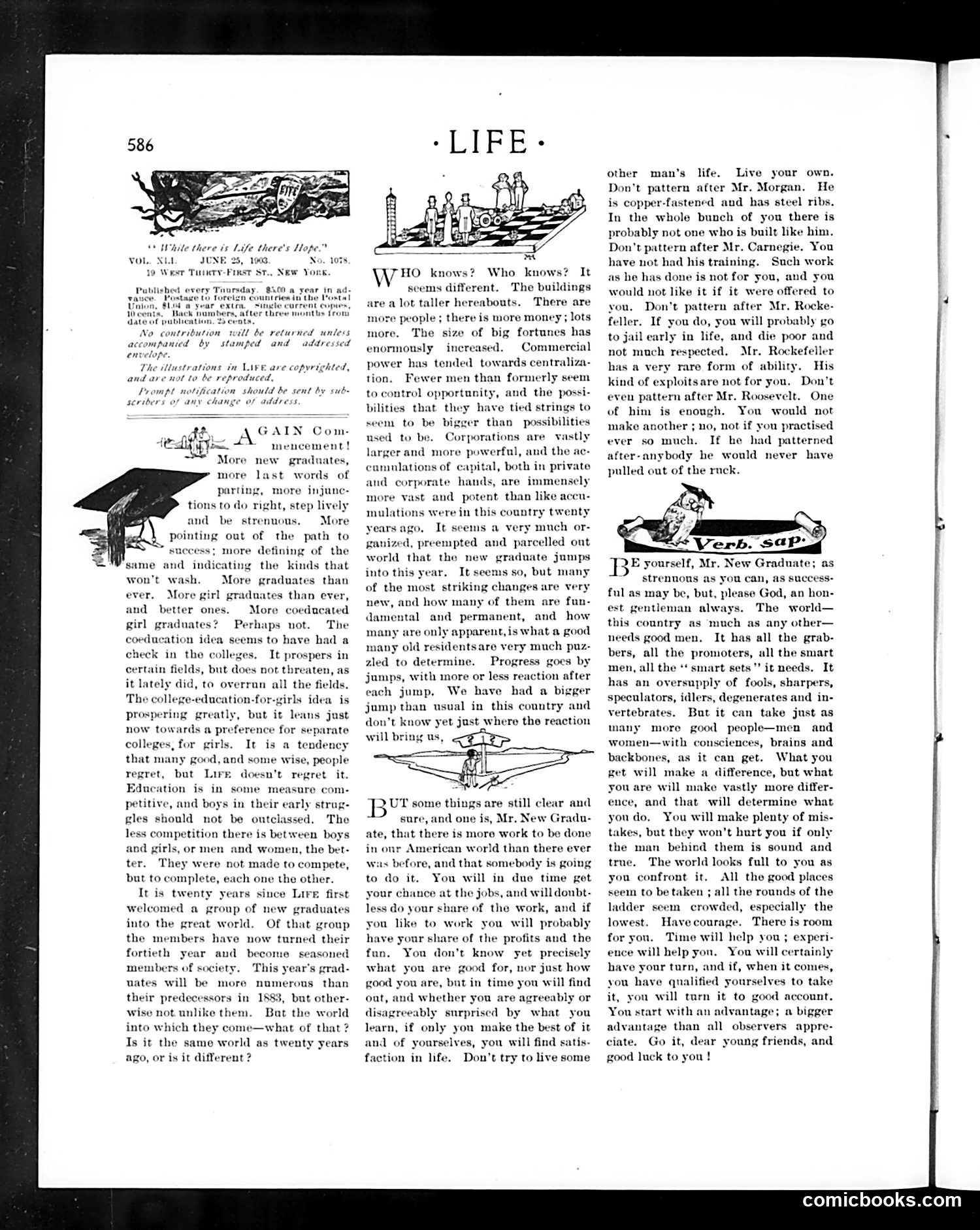
This page contains **advice to new college graduates** rather than political satire. The text encourages young graduates to be independent, work hard, and avoid blindly imitating successful figures like "Mr. Morgan" (likely J.P. Morgan, the prominent banker) or "Mr. Rockefeller." The small illustrations appear to be decorative dividers rather than satirical cartoons—showing a bird, a graduate cap, and other generic symbols. The central message warns graduates against patterns of imitation and urges them to build their own paths. It suggests the "world" has changed significantly in twenty years, presenting new opportunities and challenges. The tone is paternalistic advice rather than biting social commentary, typical of Life's editorializing in this era.
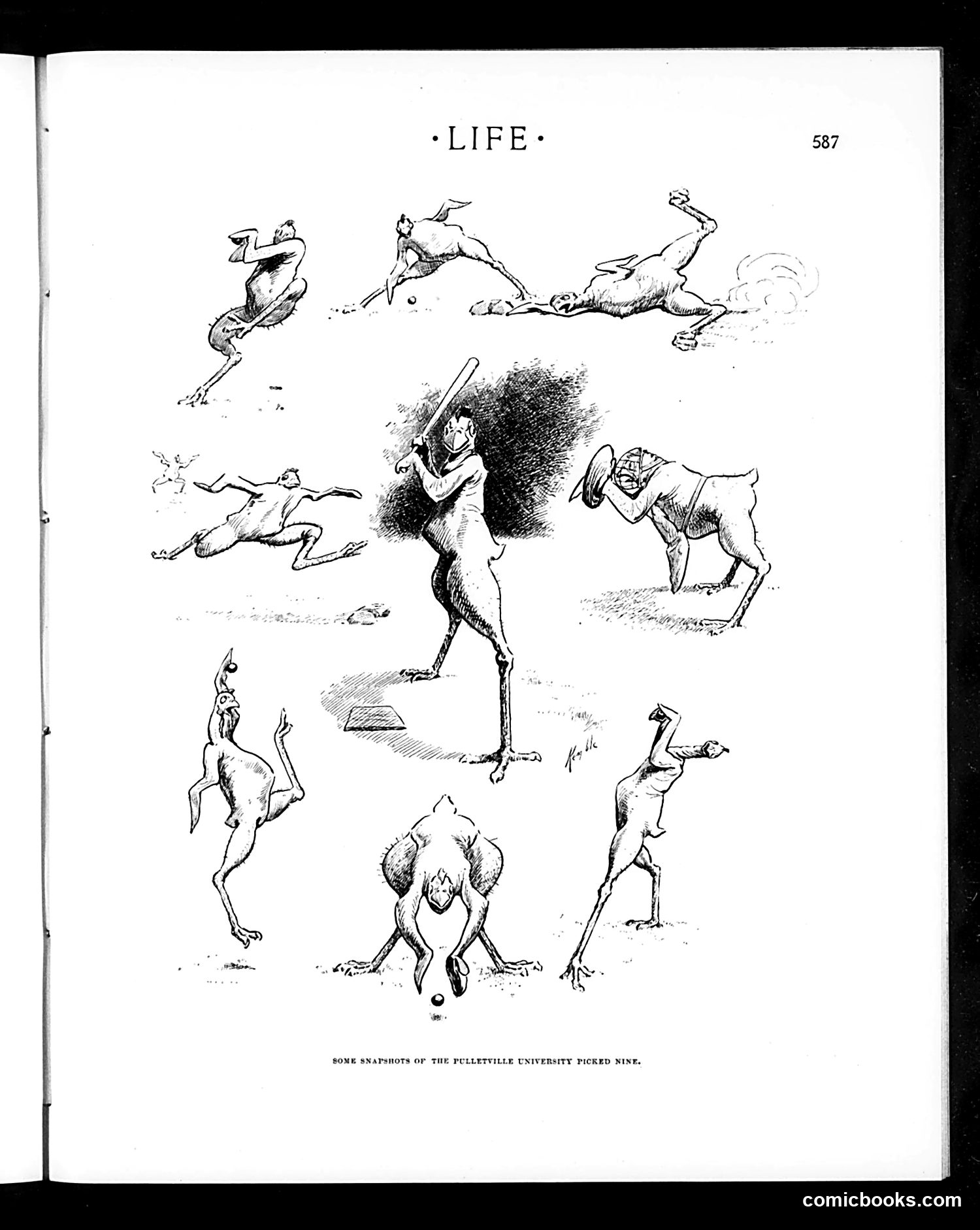
This page contains a series of humorous sketches titled "Some Snapshots of the Fullertile University Picked Nine" — a baseball team. The central figure appears to be a caricatured baseball player holding a bat, surrounded by various other figures in exaggerated poses suggesting athletic movements or mishaps. The satire seems to mock an actual university baseball team, likely from the early 1900s based on the art style. The term "Fullertile" appears to be a pun or invented name. The surrounding figures demonstrate poor athletic form or comical failures — slipping, falling, or performing absurd movements — suggesting the team's incompetence or lack of skill. The humor targets collegiate athletics and amateur sporting prowess through physical caricature and exaggeration.
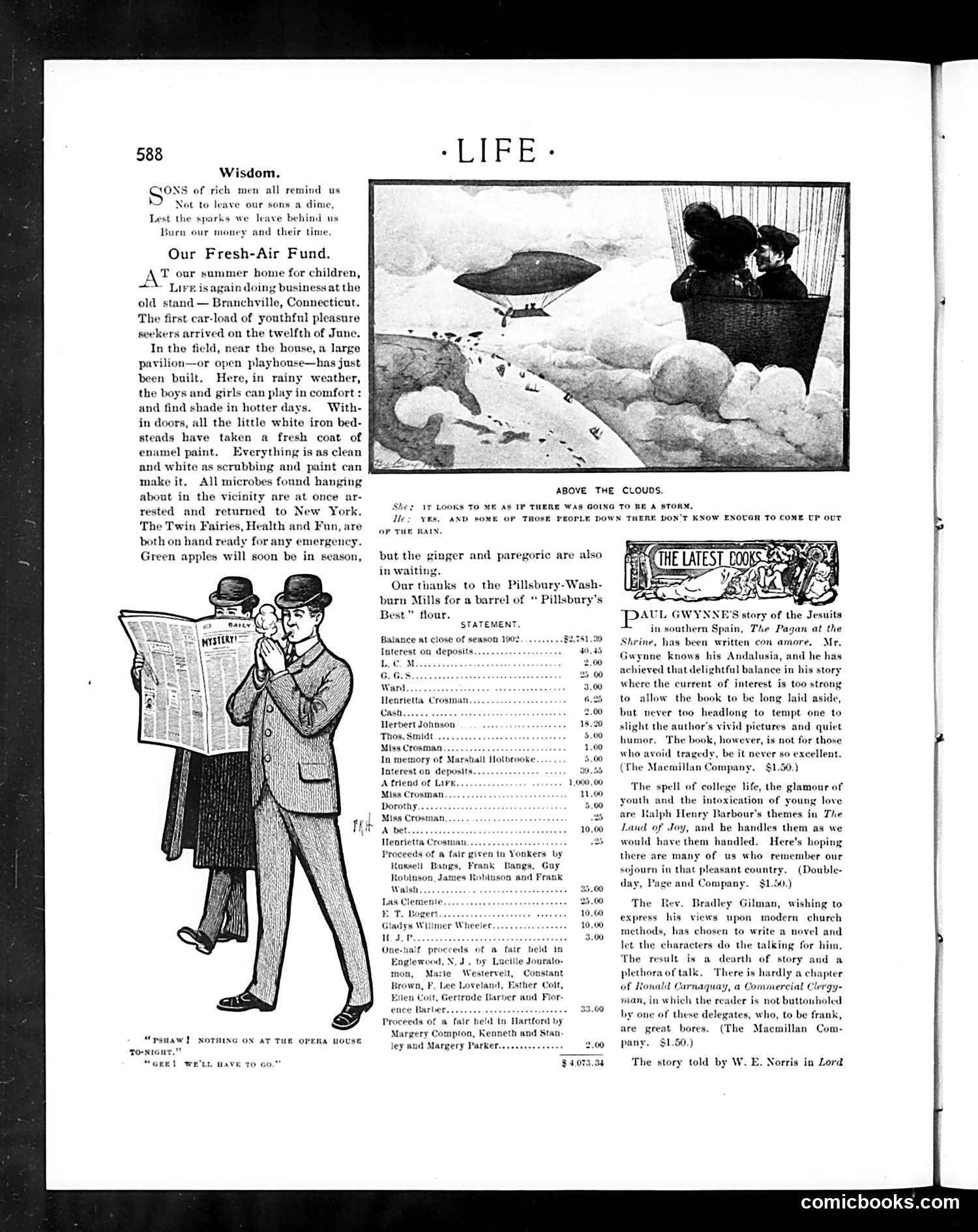
This page contains two distinct items: **Top cartoon ("Above the Clouds"):** Shows a hot-air balloon in stormy weather with passengers sheltering beneath an umbrella. The caption suggests it depicts literal storm preparation—people seeking shelter from rain while airborne. **Bottom cartoon ("I Draw! Nothing on at the Opera House Tonight"):** Two men in formal attire read a newspaper together. One says they have "nothing on" at the opera house, and the other responds "We'll have to go"—a visual pun playing on the double meaning of "nothing on" (no performance vs. wearing nothing/being undressed). This is a conventional joke format about miscommunication. The page also includes editorial content about a "Fresh-Air Fund" for children and book reviews, suggesting this is a general interest/satirical magazine page rather than focused political commentary.
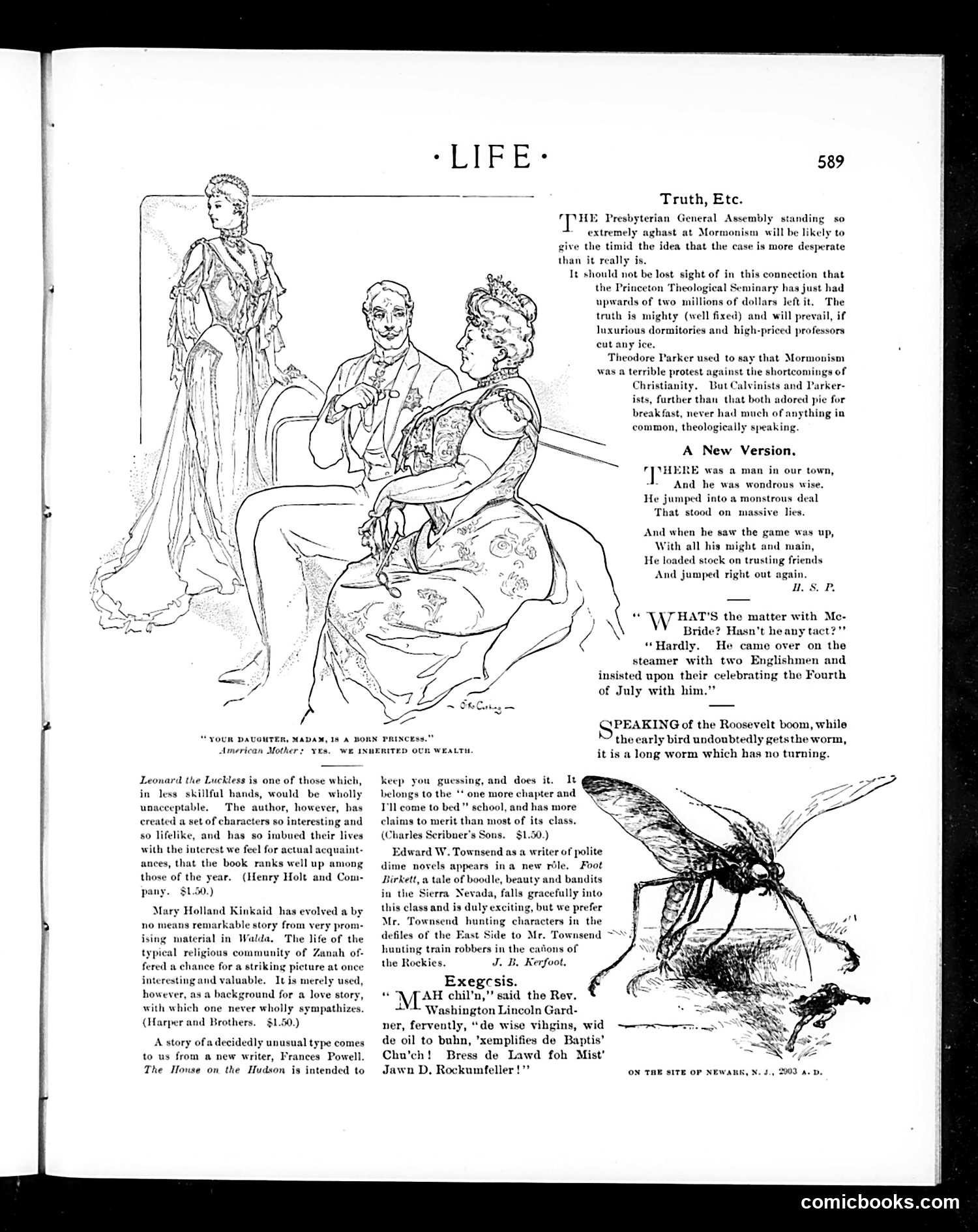
The main illustration depicts three elegantly dressed figures in what appears to be a social scene. The caption reads "Your Daughter, Madame, Is a Born Princess," suggesting commentary on class pretension or social aspiration. The page contains book reviews and literary commentary rather than political cartoons. The text discusses novels including *Leonard the Useless* and *The House on the Hudson*, offering satirical critique of their plots and characters. A small illustration of an insect appears in the lower right, accompanying text about "the Roosevelt boom" and a "long worm which has no turning"—likely a contemporary political reference, though the specific context is unclear without more historical information about Roosevelt-era politics. The overall tone is literary satire mixed with social observation.
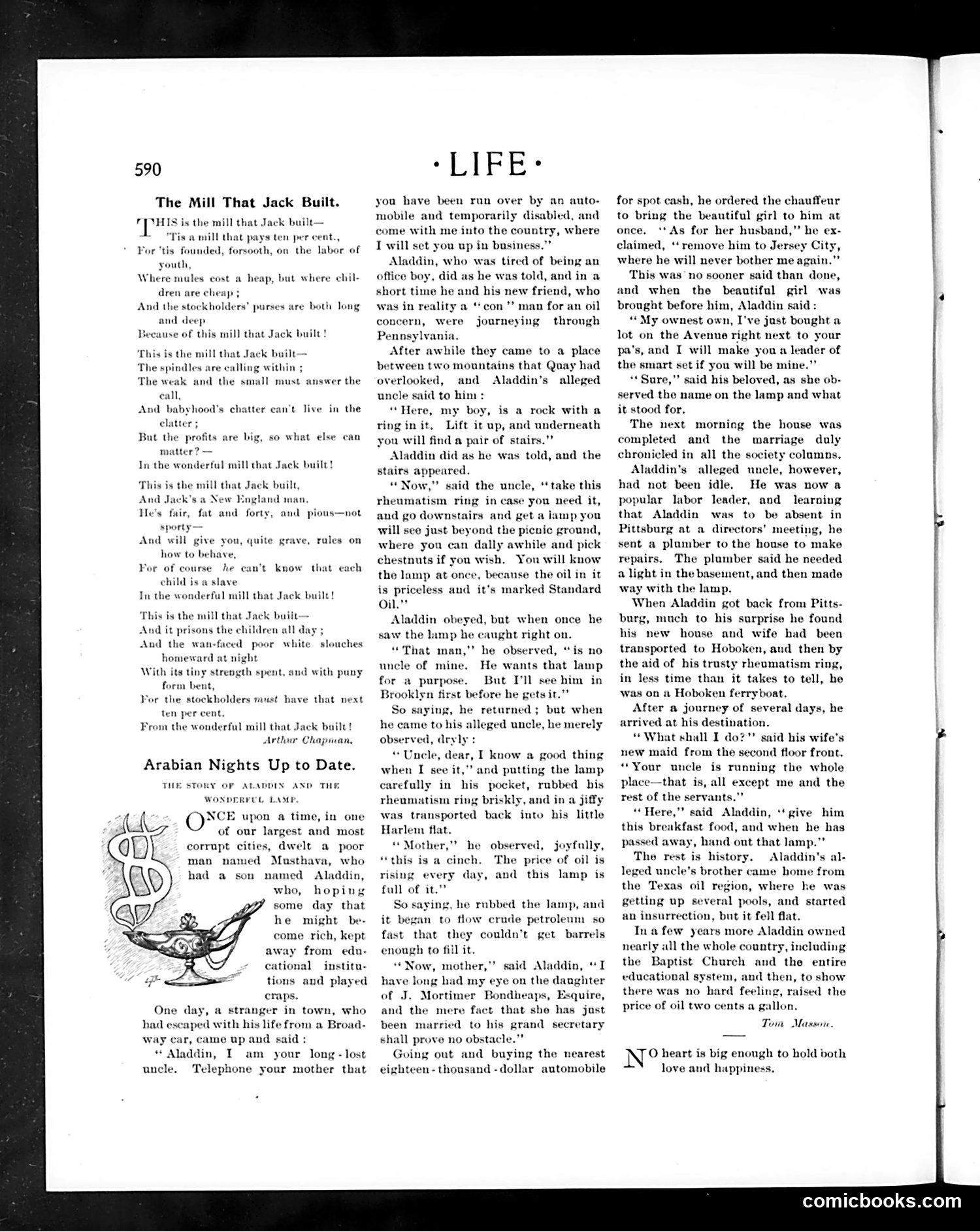
This page contains two distinct pieces: **"The Mill That Jack Built"** (left column): A humorous poem in the style of "The House That Jack Built," celebrating some industrial mill's accomplishments. It's celebratory rather than satirical, praising the structure's economic benefits. **"Arabian Nights Up to Date"** (main story): A satirical tale about a man named Aladdin who discovers an oil lamp in Pennsylvania. The story mocks nouveau-riche behavior—Aladdin uses the lamp's wishes to acquire wealth and marry well, but the satire targets his conspicuous consumption and social climbing. The magical lamp represents newly discovered oil wealth, and the narrative critiques how sudden riches transform people and society. The illustration shows a genie emerging from the lamp, emphasizing the "magical" nature of oil-fortune acquisition. The satirical point: mocking the pretensions and moral hazards of rapid industrialization and wealth accumulation in early 20th-century America.
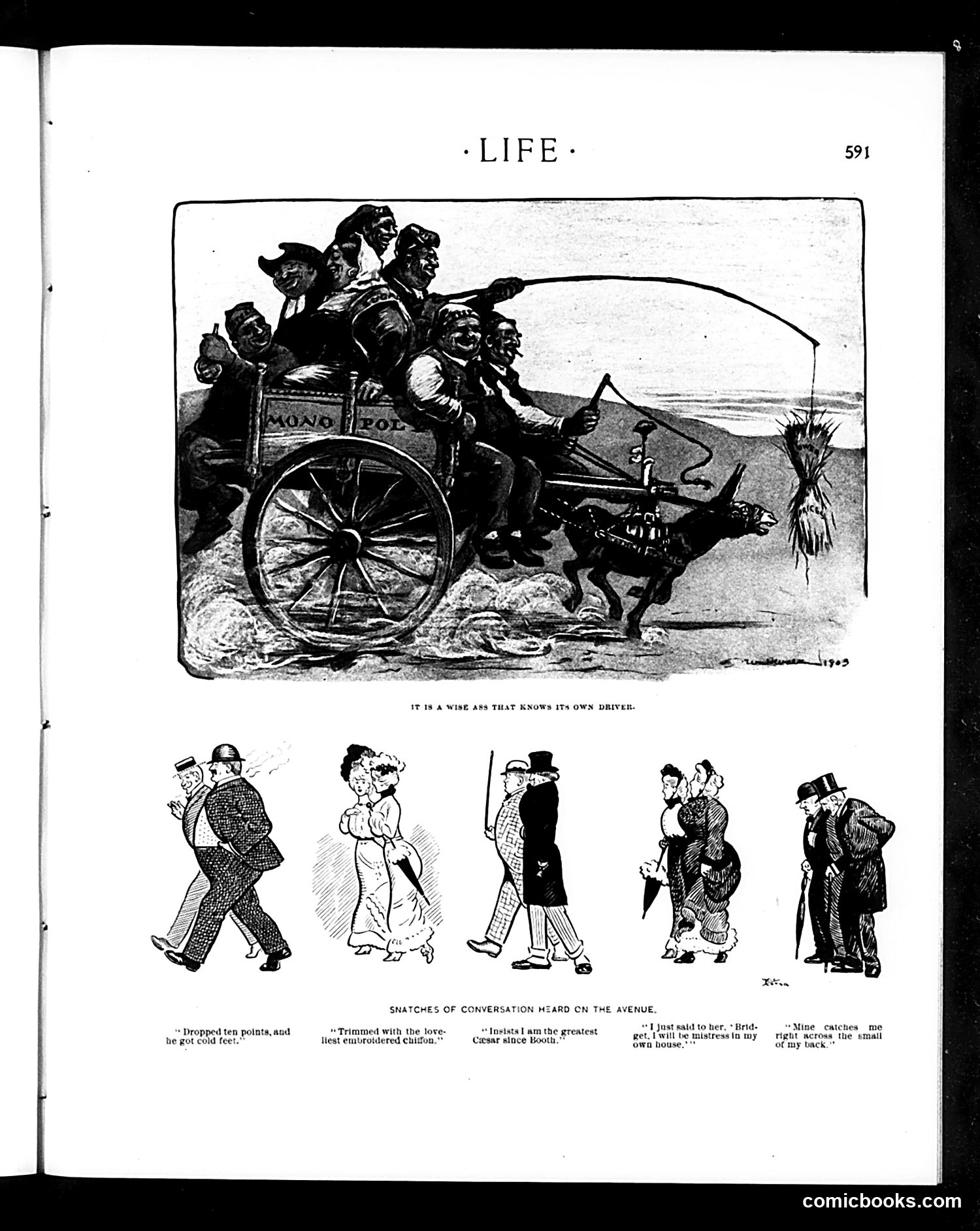
**Main Cartoon:** "It Is a Wise Ass That Knows Its Own Driver" A donkey pulls a cart overloaded with multiple figures representing different types or classes of people. The satire suggests that various social groups are being driven in the same direction without clarity about who actually controls the outcome—a commentary on political manipulation or social conformity where people don't recognize their leaders' identities or intentions. **Bottom Panel:** "Sketches of Conversation Heard on the Avenue" Five vignettes of street conversations featuring stock character types (businessmen, fashionable women, couples). The captions mock common social platitudes: "dropped ten points," "trimmed with love-liest embroidered cushion," "insists I am the greatest Caesar," etc. This satirizes empty urban small talk and pretentious social discourse.
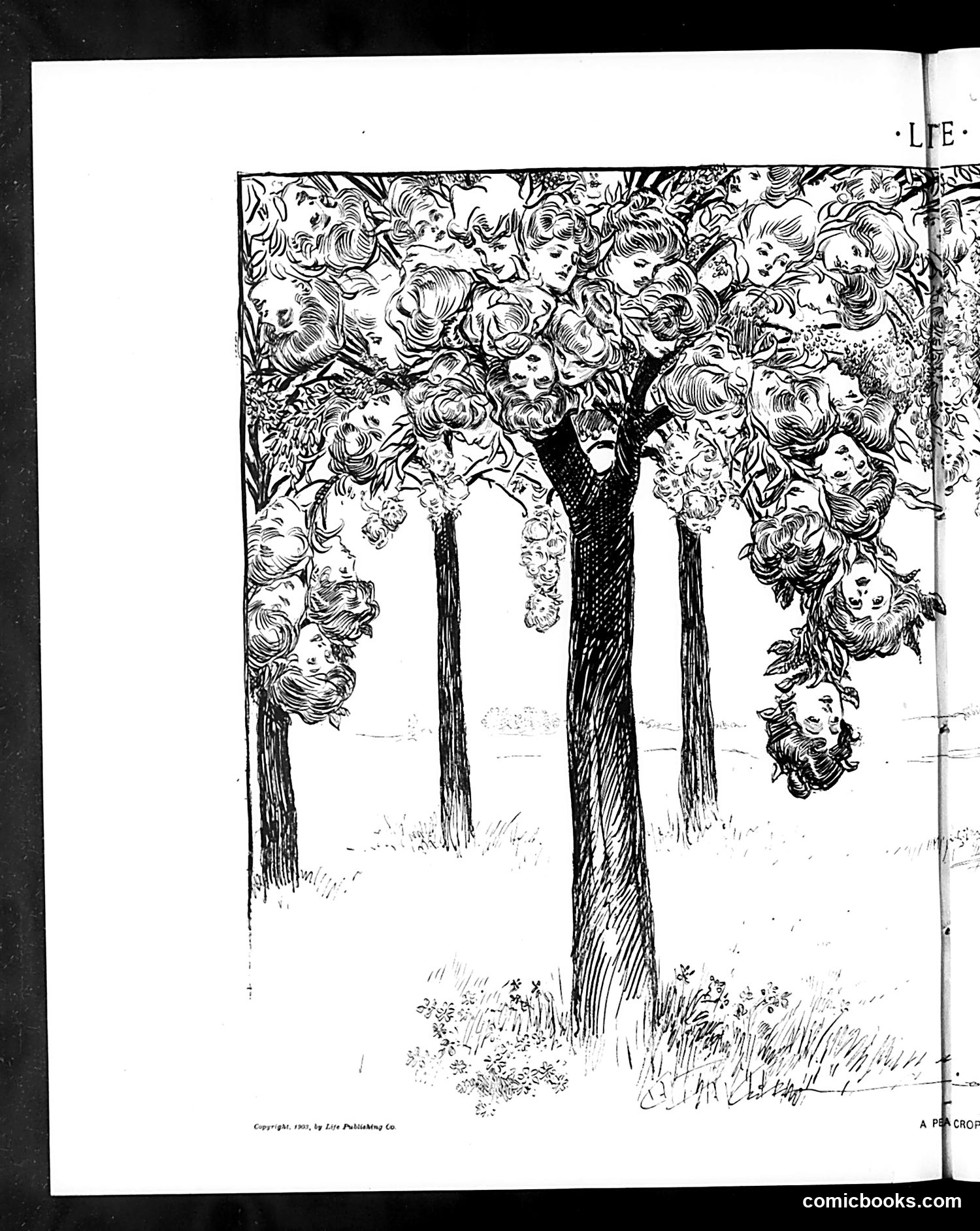
This is a surreal illustration showing multiple cherubic or angelic faces with curled hair emerging from tree branches and foliage, hanging like fruit or ornaments from the canopy. The style is distinctly whimsical and decorative rather than overtly political. Without additional context from the page's text or caption, the specific satirical meaning is unclear. The image could be commenting on themes of beauty, nature, innocence, or fertility—or it could be a darker commentary on something contemporary to Life magazine's publication period. The dreamlike quality and repetition of similar faces suggests satire about conformity, mass production, or idealization of a particular aesthetic ideal, but I cannot definitively identify the cartoon's intended target or message from the image alone. The copyright mark indicates this is from Life Publishing Co.
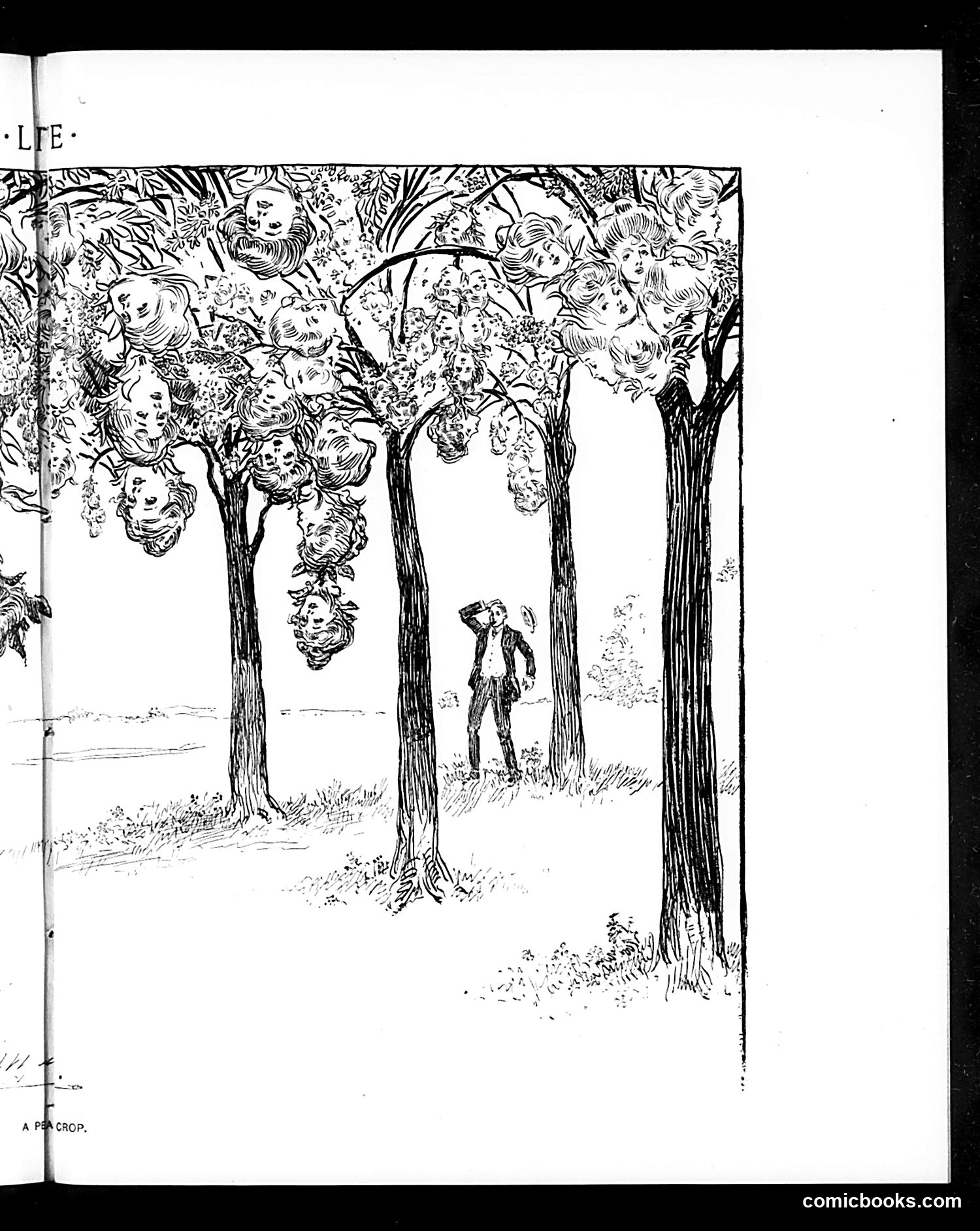
This page from *Life* magazine features a surreal illustration titled "LIFE" showing a forest scene with tall tree trunks and a solitary human figure standing in the center. The striking element is that the tree canopy consists entirely of human heads and faces rather than foliage. The cartoon appears to be a satirical commentary on human nature and society—suggesting that nature itself has become dominated by or composed of humanity. The isolated figure gazing upward at this disturbing landscape likely critiques either overpopulation, the dehumanizing aspects of modern society, or humanity's displacement of the natural world. Without additional context or visible artist attribution, the specific historical reference remains unclear, though the surrealist style suggests early-to-mid 20th century production.
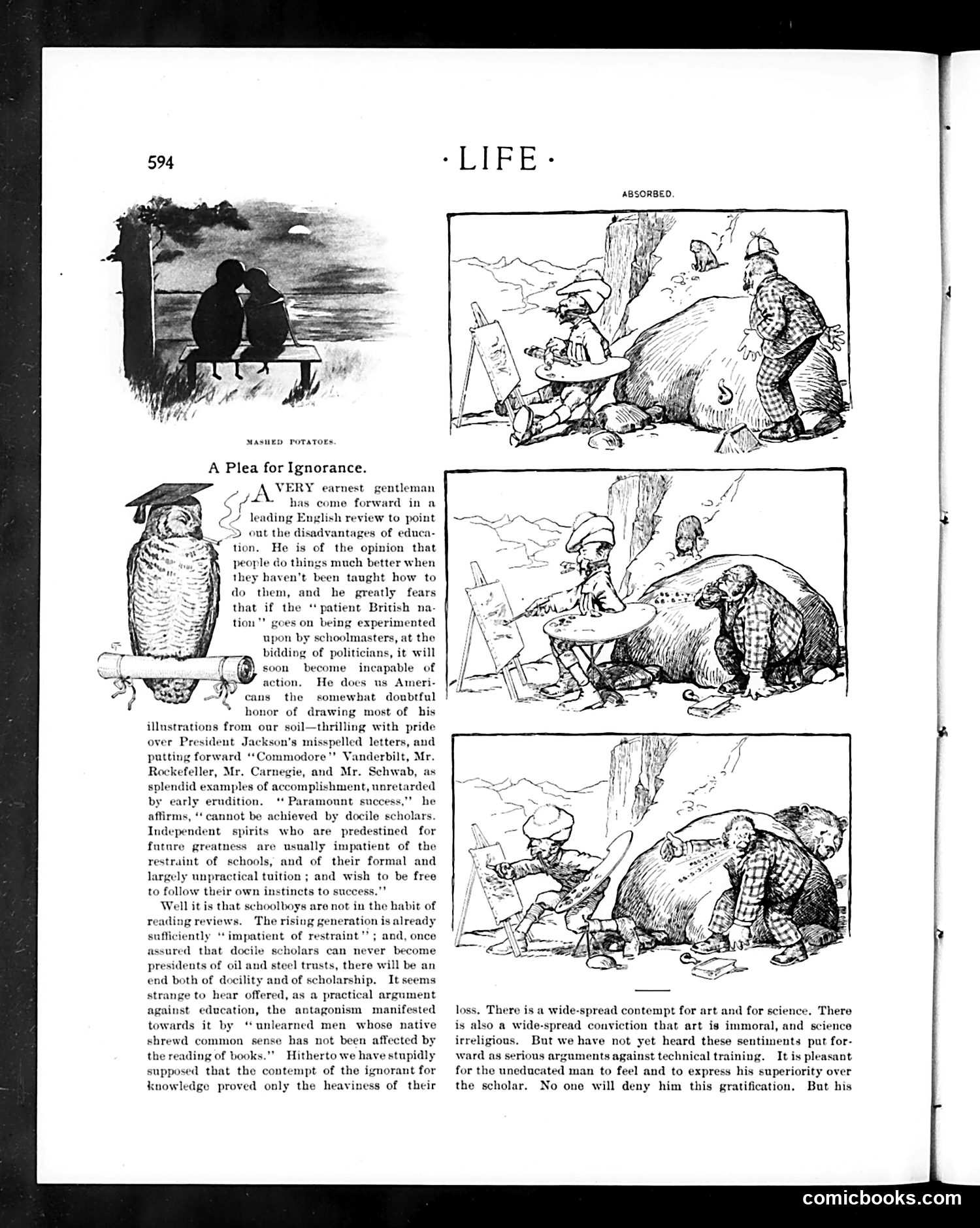
This satirical article argues that *uneducated* people accomplish more than educated ones. The author—identified as an "English reviewer"—claims education hinders practical success and that "docile scholars" cannot achieve greatness. The three comic panels labeled "ABSORBED" mock this argument by showing small figures frantically working on or around large potatoes/root vegetables, treating mundane agricultural tasks with exaggerated seriousness. The humor lies in the contrast: the text celebrates ignorance and dismissive "common sense," while the images show absorbed, earnest labor—suggesting that without proper education, people waste effort on trivial pursuits. The owl illustration (wearing mortarboard) likely represents educated wisdom being rejected. The satire targets anti-intellectual attitudes of the era.
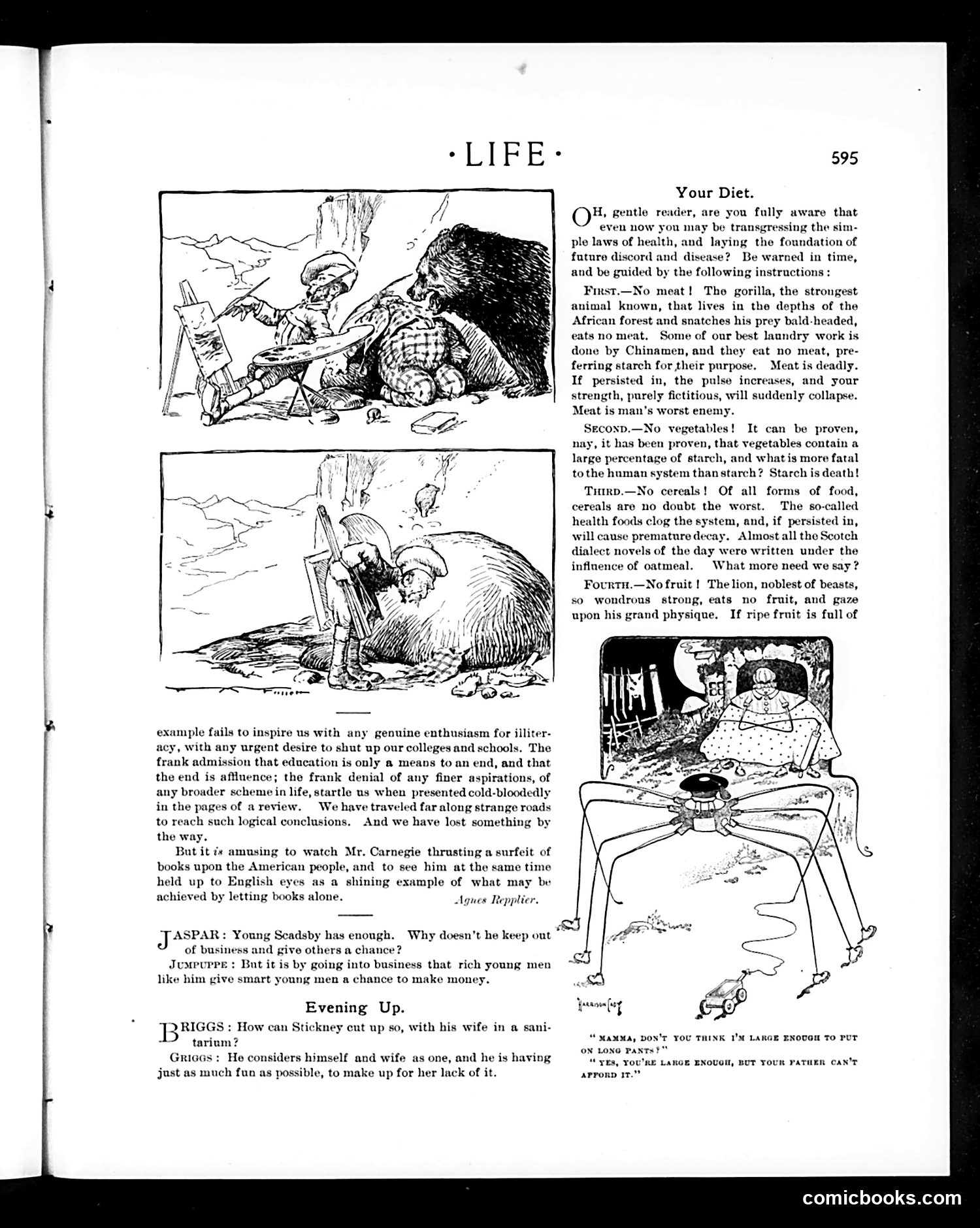
This page satirizes the era's proliferation of health fads and pseudoscientific dietary advice. The text mockingly prescribes four absurd dietary rules—no meat, vegetables, cereals, or fruit—each supported by laughable "evidence" (gorillas don't eat meat, therefore meat is deadly; starch causes Scottish dialect novels). The satire targets how dietary reformers cherry-picked animal examples and made sweeping health claims without real scientific basis. By proposing an impossible diet that eliminates essentially all food, the author exposes the logical absurdity of contemporary health movements. The accompanying illustrations show people suffering comically from following such advice, emphasizing the ridicule. This reflects late-19th/early-20th-century skepticism toward fad diets and wellness crusades that dominated popular culture—a phenomenon that apparently felt as pervasive and questionable then as today.
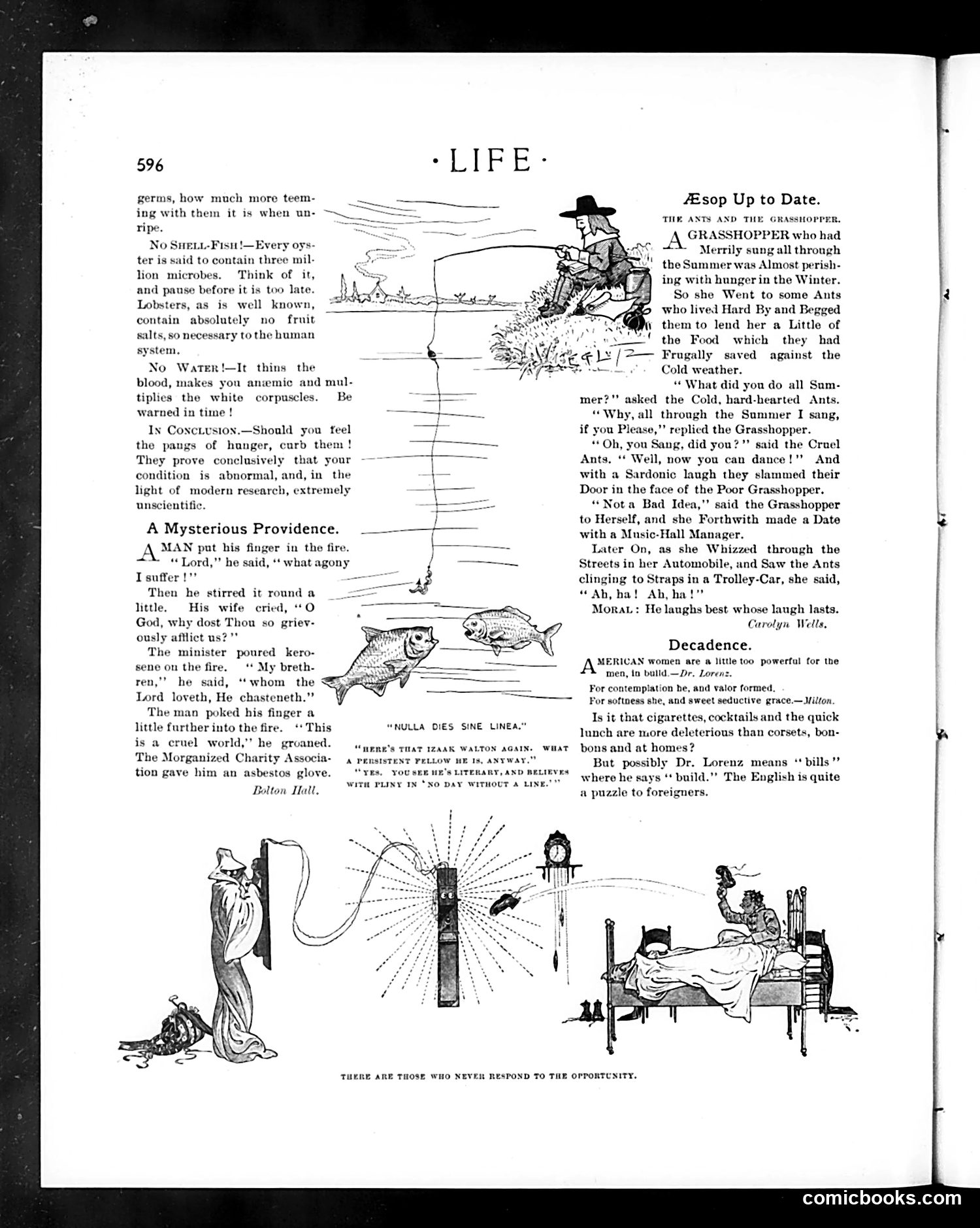
This Life magazine page contains several distinct satirical pieces: **"Aesop Up to Date"** (center-right): A modernized retelling of the classic fable. The grasshopper, now emblematic of carefree pleasure-seekers, sings through summer while industrious ants work. When winter arrives, the ants refuse charity—but the grasshopper survives by becoming a Music Hall performer and later rides past struggling ants on a trolley car in an automobile. The satire mocks both the original morality tale and contemporary class mobility: the grasshopper succeeds through entertainment and conspicuous consumption rather than honest labor, suggesting that the old virtues no longer apply in modern society. **"Decadence"** (lower right): Commentary on changing gender roles. It cites Dr. Lorenz claiming American women are "too powerful" and "too bold." The piece sarcastically questions whether modern women's habits (cigarettes, cocktails, quick lunches) are worse than traditional indulgences (corsets, bonbons), implying women have gained freedoms that alarm conservative observers. Both sections reflect early 20th-century anxieties about modernity, changing social values, and shifting gender dynamics.
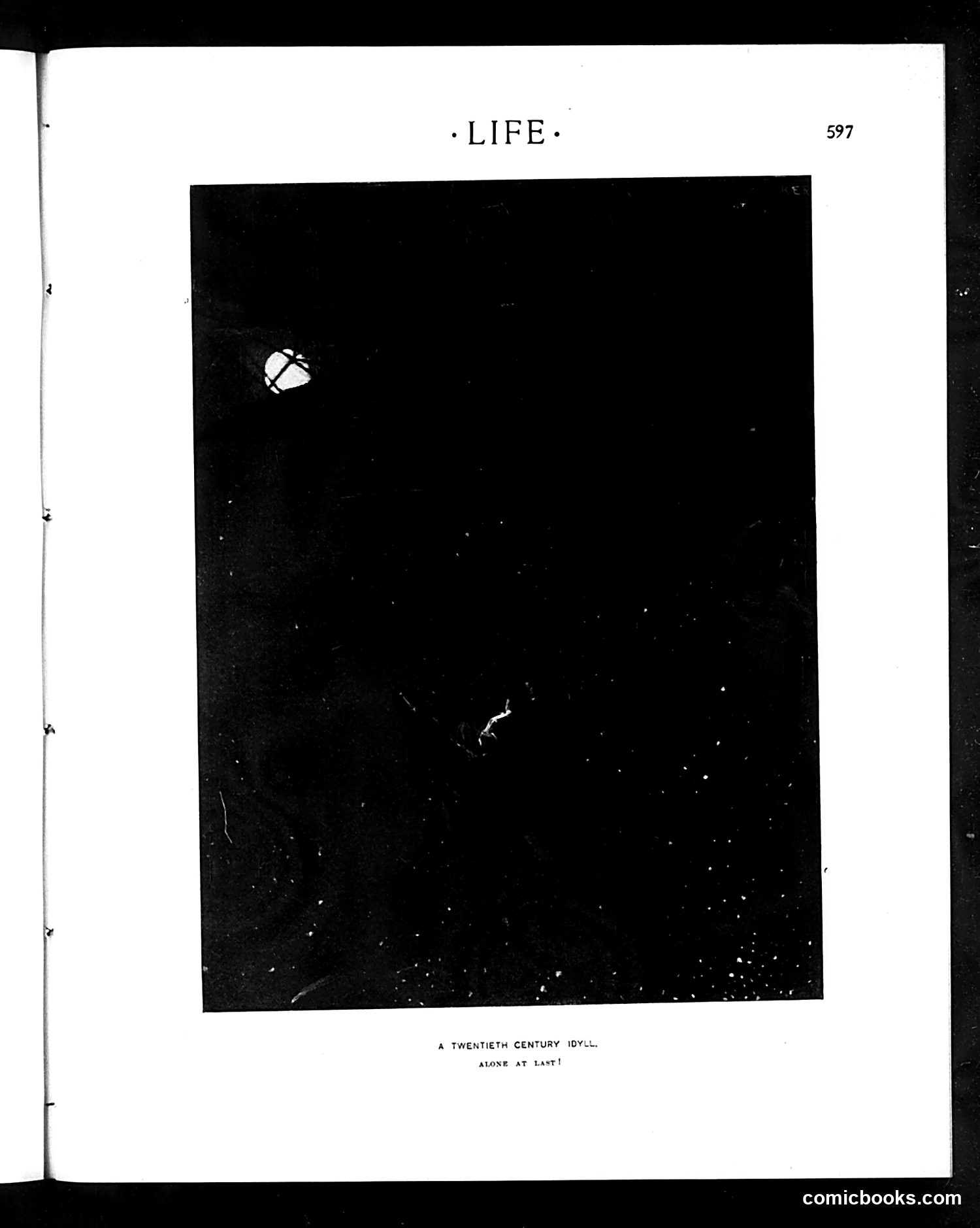
This appears to be a satirical illustration from Life magazine showing a nighttime scene with a bright moon or celestial body in the upper left corner, and what looks like a landscape or terrain below with scattered lights or stars. The caption "A Twentieth Century Idyll — Alone at Last!" suggests romantic satire. The term "idyll" typically refers to an idealized, peaceful romantic scene. However, the dark, sparse imagery and the emphasis on being "alone at last" appears to mock modern courtship or romance in the early 1900s — perhaps commenting on how difficult it had become to find privacy or genuine connection in an increasingly urbanized, industrial society. The lonely moon and minimal landscape may represent isolation despite technological progress, or the emptiness of contemporary relationships.
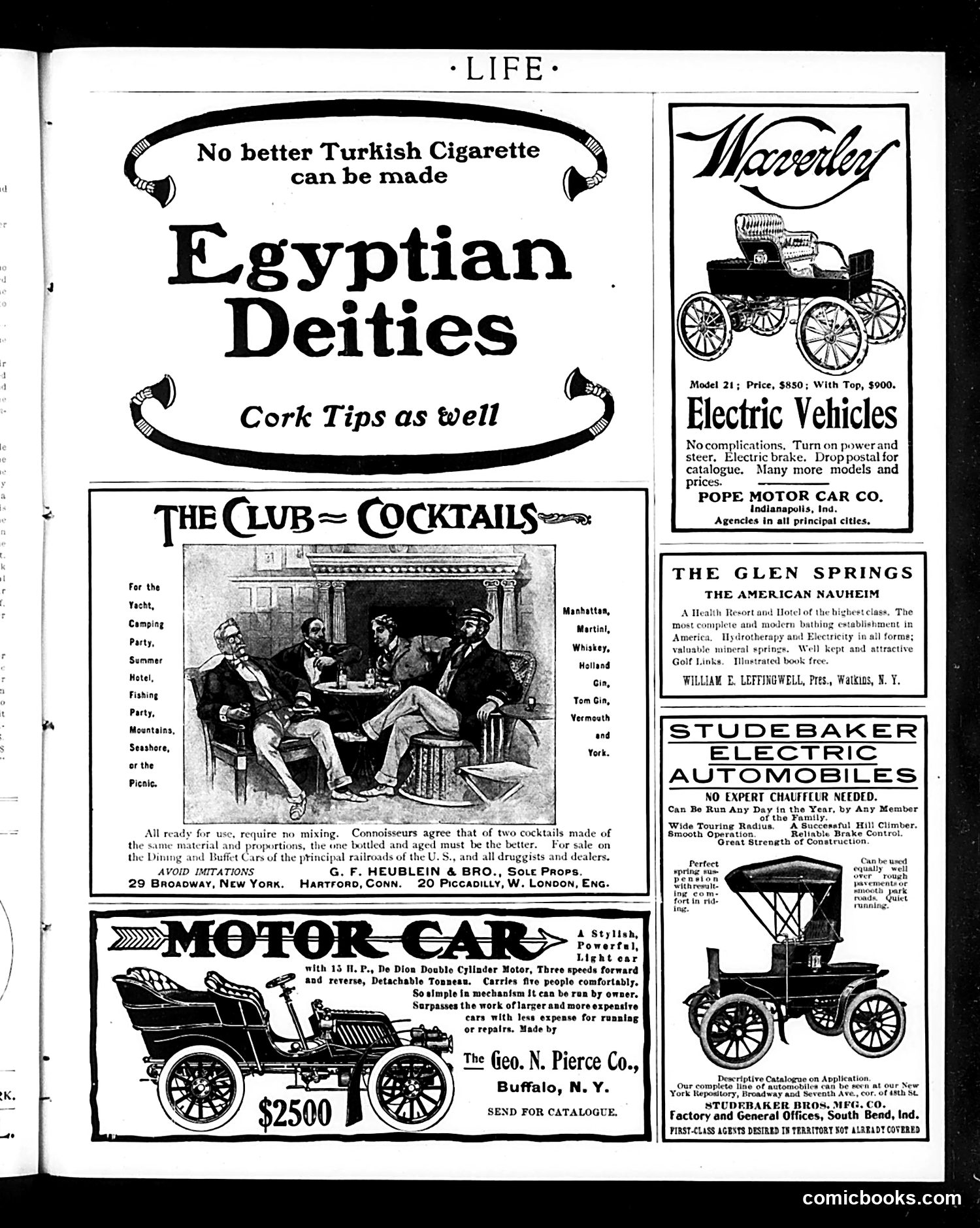
This page is **primarily advertising**, not satirical content. It dates to the early automobile era (likely 1900s based on vehicle designs and technology references). The main editorial content is "The Club Cocktails," a humorous illustration showing gentlemen mixing drinks for various occasions (yachting, camping, fishing). The joke relies on the period's fascination with pre-made, bottled cocktails as sophisticated novelties—Heublein & Bros. marketed their products as superior to homemade versions because they were "bottled and aged." The advertisements reflect emerging consumer goods of the era: **electric vehicles** (Pope Motor Car, Studebaker), **gasoline automobiles** (Geo. N. Pierce Co.), and **luxury services** (Glen Springs spa, Egyptian Deities cigarettes). No identifiable political figures or satirical targets appear. The page represents Life magazine's business model: combining light social humor with advertising to affluent readers interested in new technologies and leisurely pursuits.
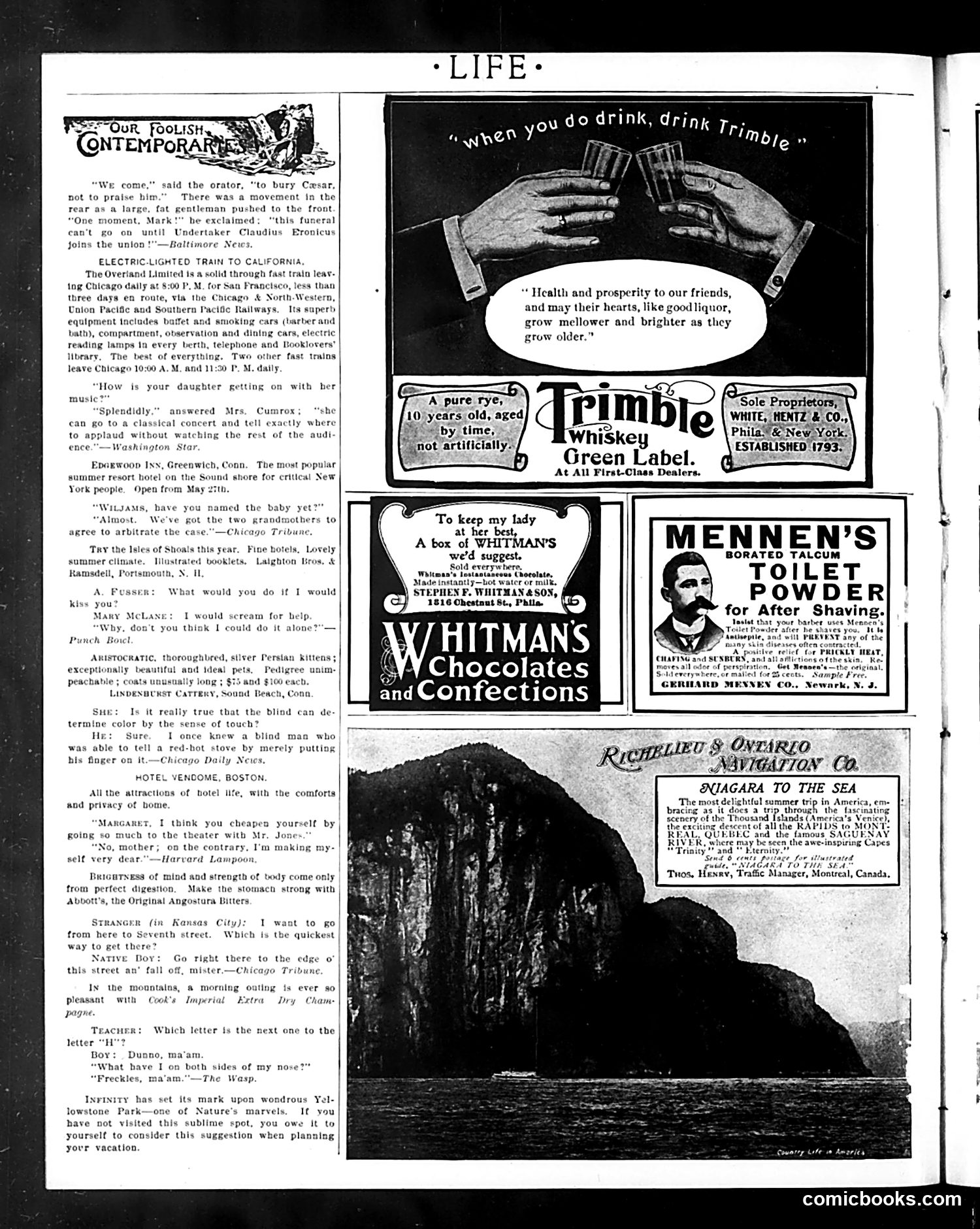
This is primarily an **advertising and humor page** from Life magazine, a satirical weekly. The page contains: **Main Content:** - Short humorous anecdotes and jokes (typical of Life's format), including workplace satire (an undertaker demanding union membership at a funeral) and domestic humor - Period advertisements for luxury goods: Trimble Whiskey, Whitman's Chocolates, Mennen's Talcum Powder, and travel services **Social Context for Modern Readers:** The jokes reflect early 20th-century concerns: labor unions (seen as disruptive), courtship conventions, servants' competence, and gender roles. The advertisements target affluent readers with premium products (Persian kittens, luxury train travel, fine chocolates). **No Political Cartoon:** Despite the header "Our Foolish Contemporaries," this page lacks the political satire one might expect. Instead, it's genteel humor aimed at educated, wealthy audiences—reflecting Life's position as a magazine for the American upper-middle class during this era.
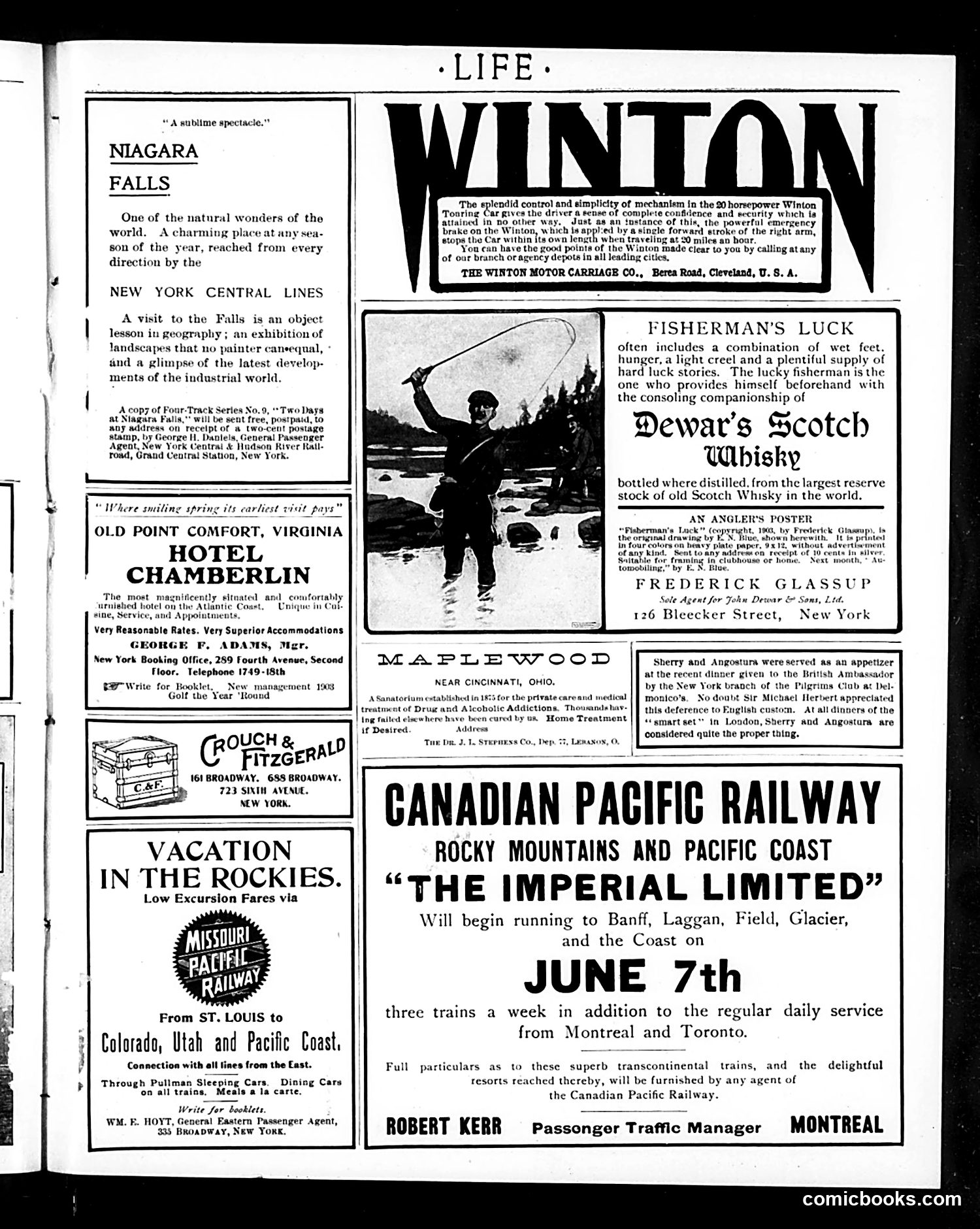
This page is **primarily advertising**, not satirical content. It's from an early 1900s issue of Life magazine. The only cartoon appears to be "An Angler's Poster" — a fishing scene illustration by E.N. Blue accompanying a Dewar's Scotch Whisky advertisement. The joke is mild: the ad humorously suggests that whisky is essential equipment for fishermen dealing with wet feet, hunger, and "hard luck stories." It's a lighthearted product placement playing on the stereotype of frustrated anglers. The rest of the page consists of travel and hotel advertisements (Niagara Falls, Hotel Chamberlin, Canadian Pacific Railway) and business notices (Winton automobiles, Maplewood sanitarium). These reflect early 20th-century consumer culture and leisure travel aimed at affluent readers. The references to "British Ambassador" and "Pilgrims Club" suggest upper-class social circles of the era. There is **no political satire** on this page.
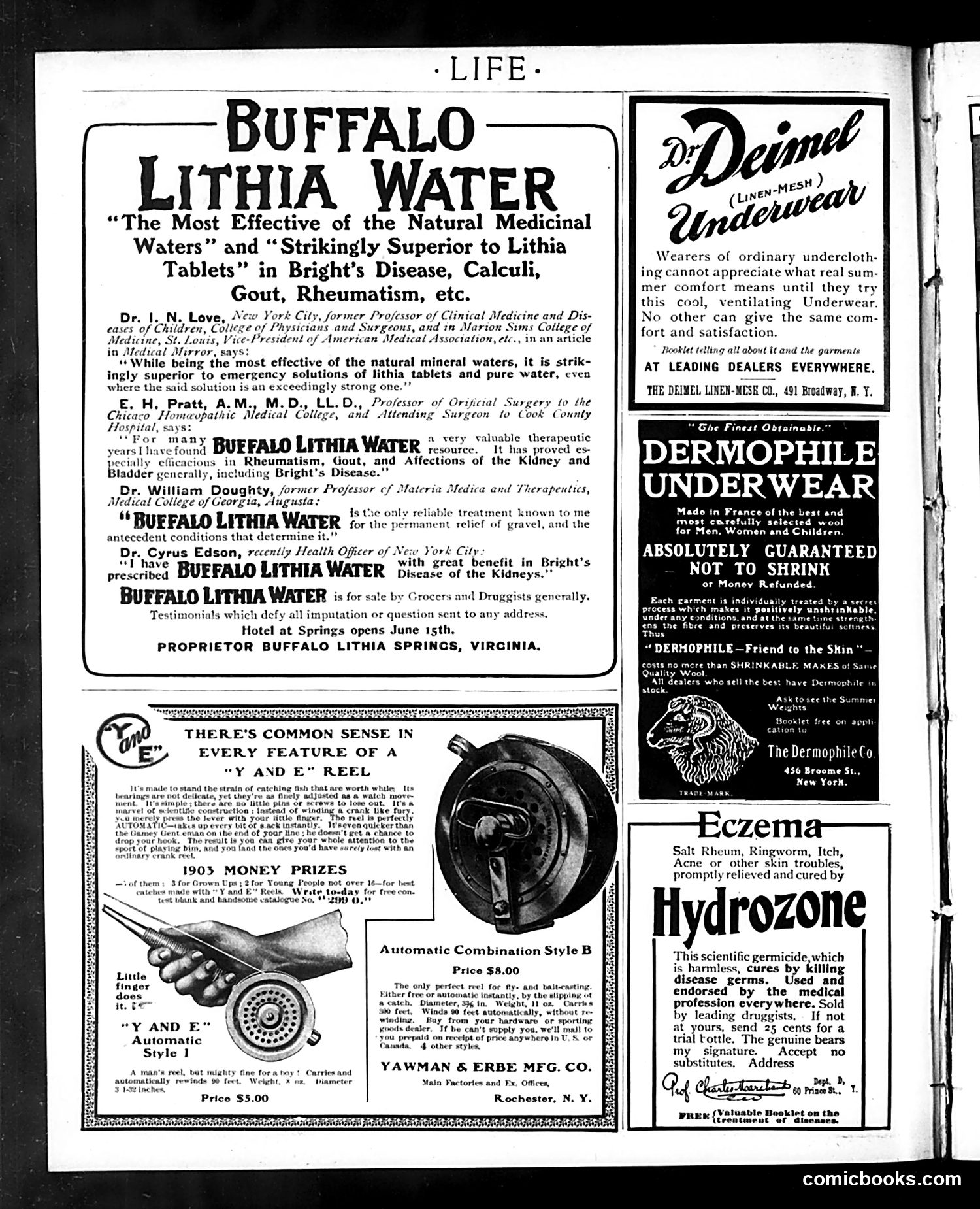
This page is primarily **advertisements**, not editorial or satirical content—typical for *Life* magazine of this era, which blended commerce with humor. The main advertisements include: **Buffalo Lithia Water** (left): Medical testimonials claiming this "natural medicinal water" cures kidney disease, gout, and rheumatism. Physicians including a former New York health officer endorse it. This represents patent medicines' golden age—products making dramatic health claims with doctor endorsements (many likely paid). **Fishing Reels** (center): A "Y and E" reel advertisement claiming "common sense" engineering with testimonials and prize competitions. **Underwear ads** (right): *Deimel* linen-mesh and *Dermophile* wool underwear competing for summer sales, emphasizing breathability and durability. **Hydrozone** (lower right): A "scientific germicide" for eczema and skin conditions. Modern readers should note: these unregulated medical claims would violate FDA standards today. The ads reveal early-1900s consumer culture and product marketing before modern advertising regulation existed.
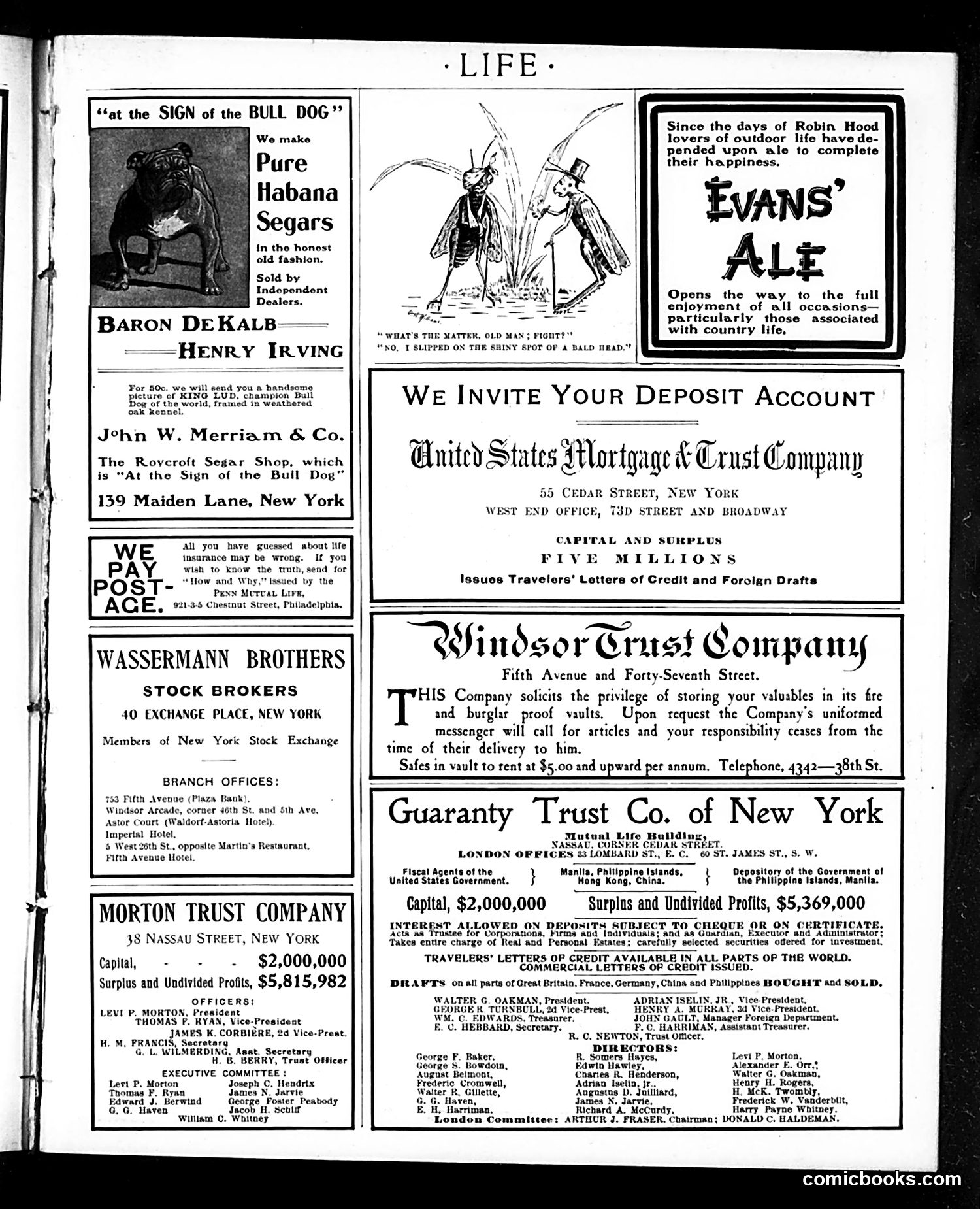
This page consists almost entirely of **financial services advertisements**, with one small **political cartoon** at the center. The cartoon shows two disheveled figures (possibly hobos or poor men), one asking the other "What's the matter, old man; fight?" The answer: "No, I slipped on the shiny spot of a bald head." This appears to be a joke playing on the phenomenon of bald spots being slippery—a slapstick-style gag typical of the era. **The broader page context**: This appears to be an early-20th-century *Life* magazine issue primarily showcasing ads for banks, trust companies, brokers, and insurance firms (Morton Trust Company, United States Mortgage & Trust Company, Guaranty Trust Co., Windsor Trust Company, etc.), along with product advertisements for cigars and ale. The single cartoon is incidental to what is essentially a **financial/commercial advertising page**, making it unclear what specific satirical or political point, if any, the magazine intended beyond basic humor about physical mishaps.
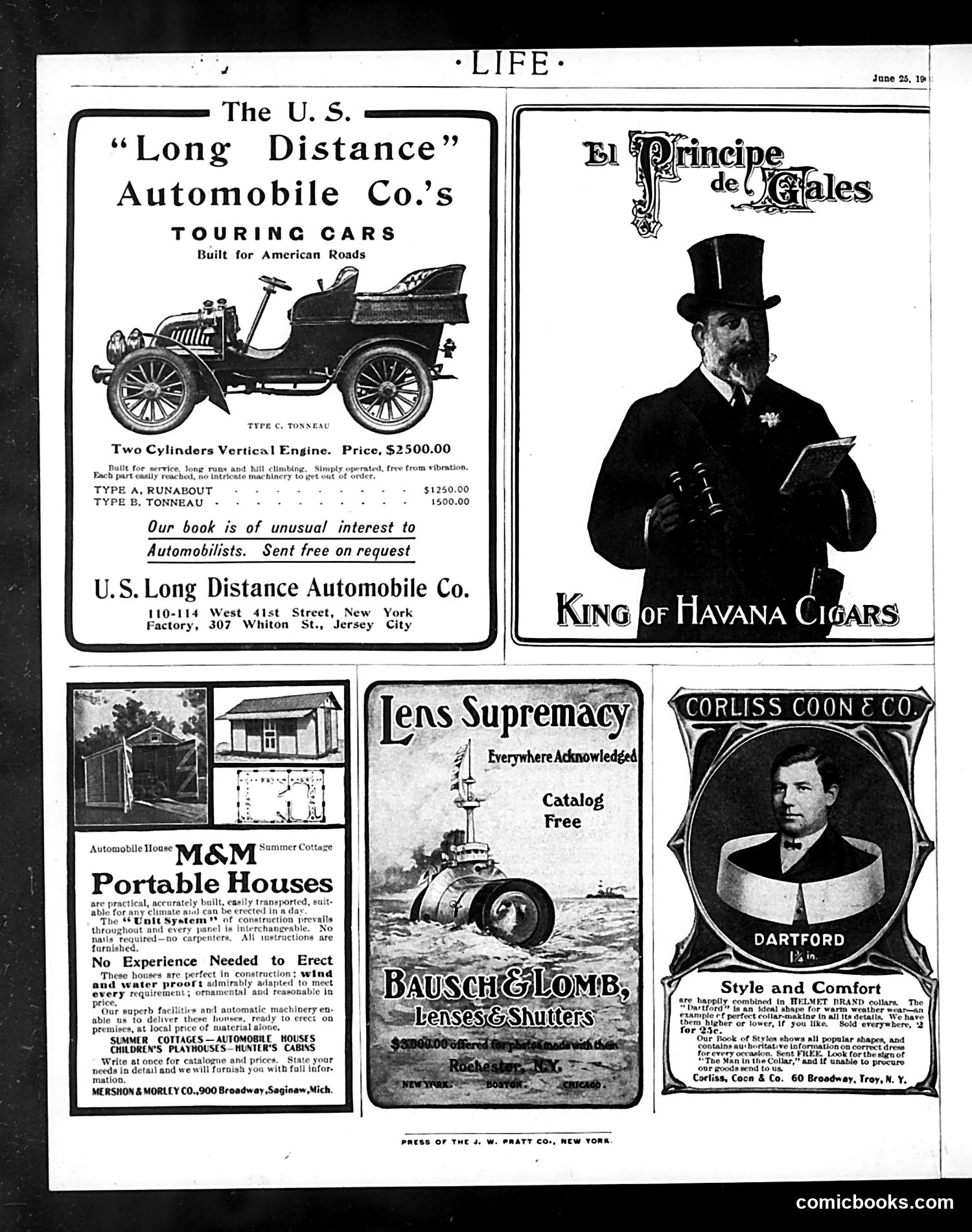
This is primarily an **advertising page**, not a political cartoon. It showcases early 1900s consumer products with no satirical content. The page features six advertisements: 1. **U.S. Long Distance Automobile Co.** — early automobiles priced $1,250-$2,500, marketed as "Built for American Roads" 2. **"El Príncipe de Gales" King of Havana Cigars** — features a distinguished gentleman in top hat; likely references the Prince of Wales as an aspirational figure 3. **M&M Portable Houses** — prefabricated structures for summer cottages and children's playhouses, requiring "no experience" to erect 4. **Lens Supremacy by Bausch & Lomb** — optical equipment advertisement 5. **Corliss Coon & Co.** — "Dartford" collar brand emphasizing "Style and Comfort" The page reflects Edwardian-era consumer culture: automobiles, leisure cottages, optical technology, and formal menswear. No satire is evident—these are straightforward product promotions typical of Life's advertising content circa 1910.
I can see this is a page from Life magazine (dated June 25, 19[??]), but the image quality and reproduction make it difficult to discern specific cartoon content or text clearly. The page appears to be mostly blank or very lightly printed, with some advertisements or illustrations visible along the left margin, though these are not legible enough for me to identify specific figures, caricatures, or political references with confidence. Without being able to read the actual content reliably, I cannot accurately explain what satire or jokes are present or identify who the figures represent. To provide accurate historical analysis as requested, I would need a clearer reproduction of this page.