
A complete issue · 22 pages · 1903
Life — May 28, 1903
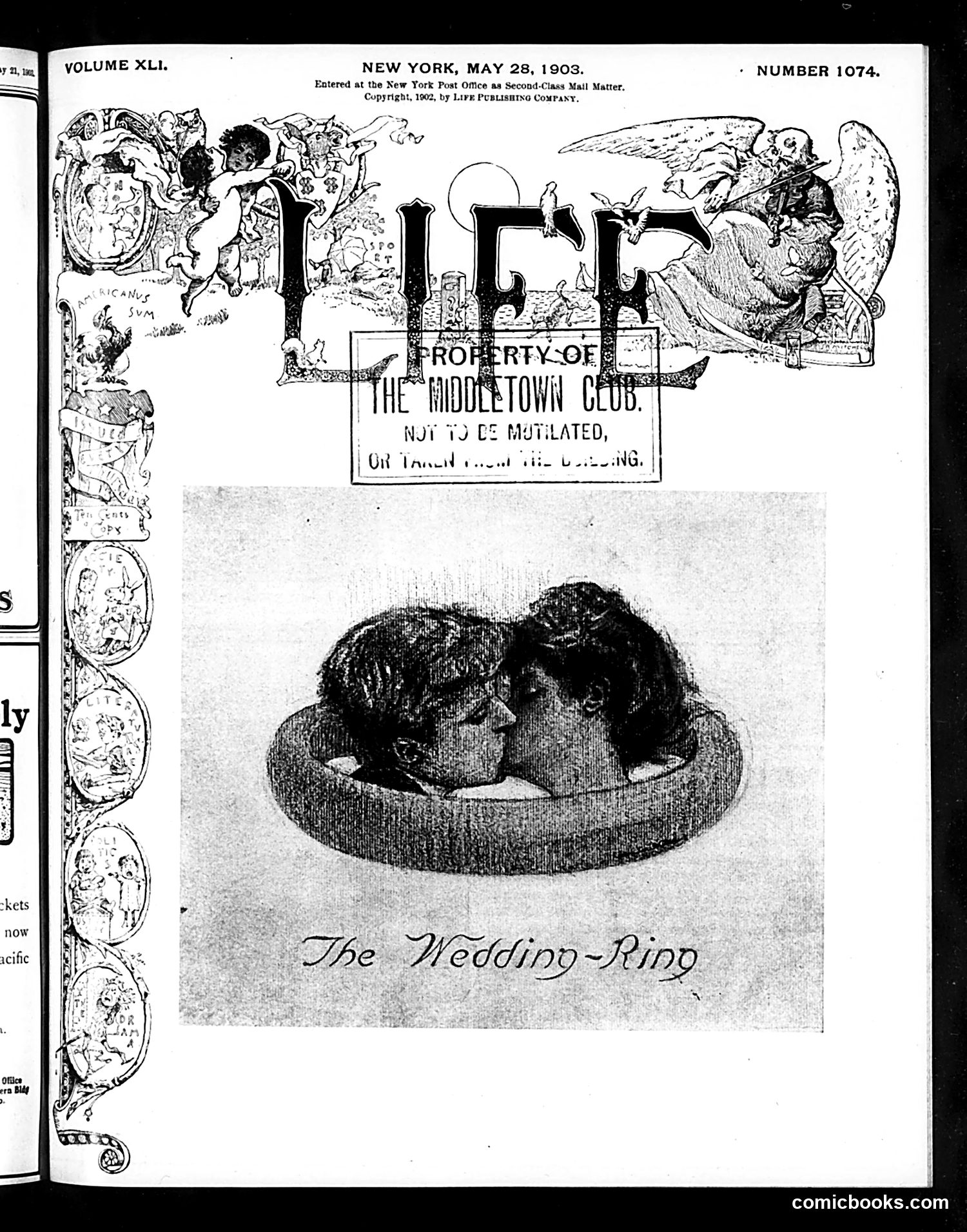
This page is the cover or title page for a serialized story or comic feature called "The Wedding-Ring," presented as "Property of the Middletown Club" with a note that it's "Not to be mutilated or taken from the building." The central image shows two male heads in profile sharing a wedding ring positioned between them in what appears to be a decorative oval setting. The satirical point likely concerns social commentary about marriage, possibly mocking either the institution of marriage itself or specific contemporary attitudes toward wedlock. The "property of the club" framing suggests this was meant as gentlemen's club humor—a form of satirical commentary typical of Life magazine's sophisticated audience. The exact social or political reference remains unclear without additional context about events or personalities of May 1903.
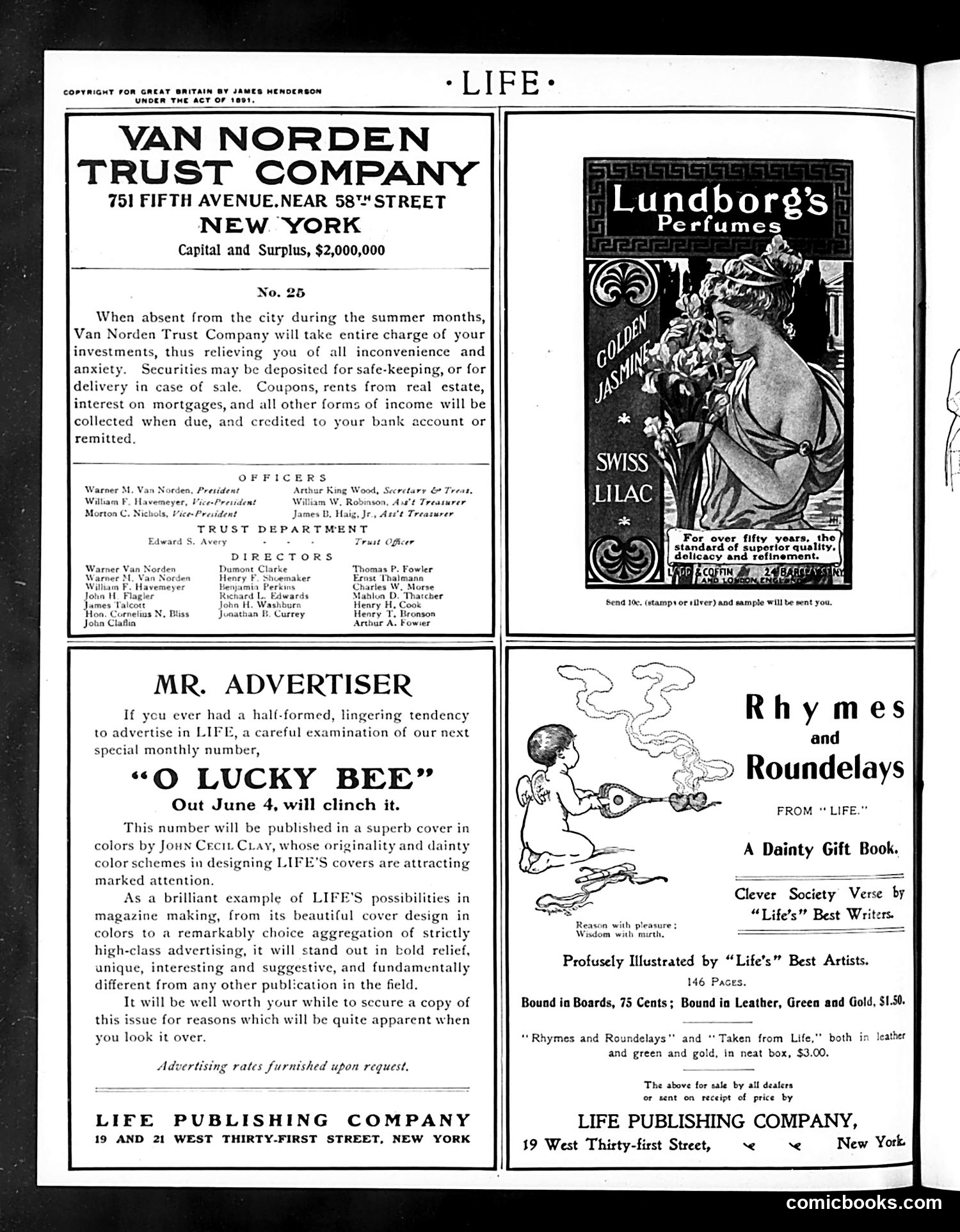
This page is **primarily advertising**, not political satire. It contains four advertisements: 1. **Van Norden Trust Company** (top left): A financial services ad offering investment management and security deposit services for wealthy clients during summer absences. 2. **Lundborg's Perfumes** (top right): A decorative ad for perfume featuring classical imagery ("Golden Jasmine," "Swiss Lilac"). 3. **"O Lucky Bee" promotion** (bottom left): Life Publishing Company promoting an upcoming June 4 issue with a special cover design by John Cecil Clay, emphasizing the magazine's high-quality advertising possibilities. 4. **"Rhymes and Roundelays"** (bottom right): A book advertisement featuring whimsical illustration and poetry, marketed as a gift book. The small cartoon on the page is merely decorative, accompanying a perfume ad. There is no political satire present.
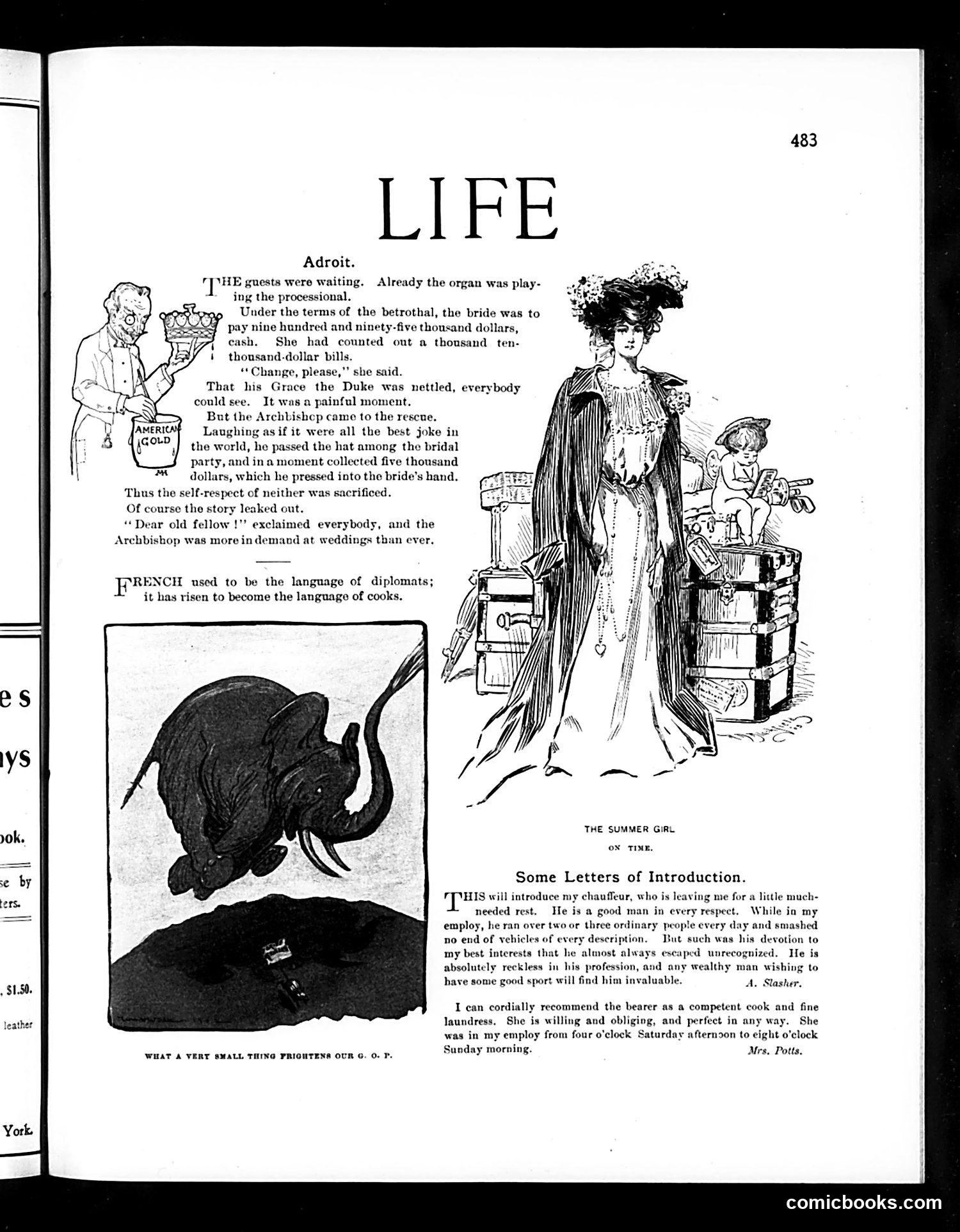
This page contains two distinct satirical pieces: **"Adroit" (top story):** A joke about a wedding where the Archbishop passes a hat during the ceremony to collect money for the bride's dowry—$995,000 total. The satire mocks the financial nature of upper-class marriages and suggests the Church opportunistically exploits such occasions. **"What a Very Small Thing Frightens Our G.O.P."** (bottom left): A cartoon depicting an elephant appearing startled or distressed, likely referencing the Republican Party's reaction to some contemporary political threat or event—the specific reference is unclear without additional context. The page also includes introductory letters recommending household staff, typical of Life's satirical social commentary on domestic service and class relations in early 20th-century America.
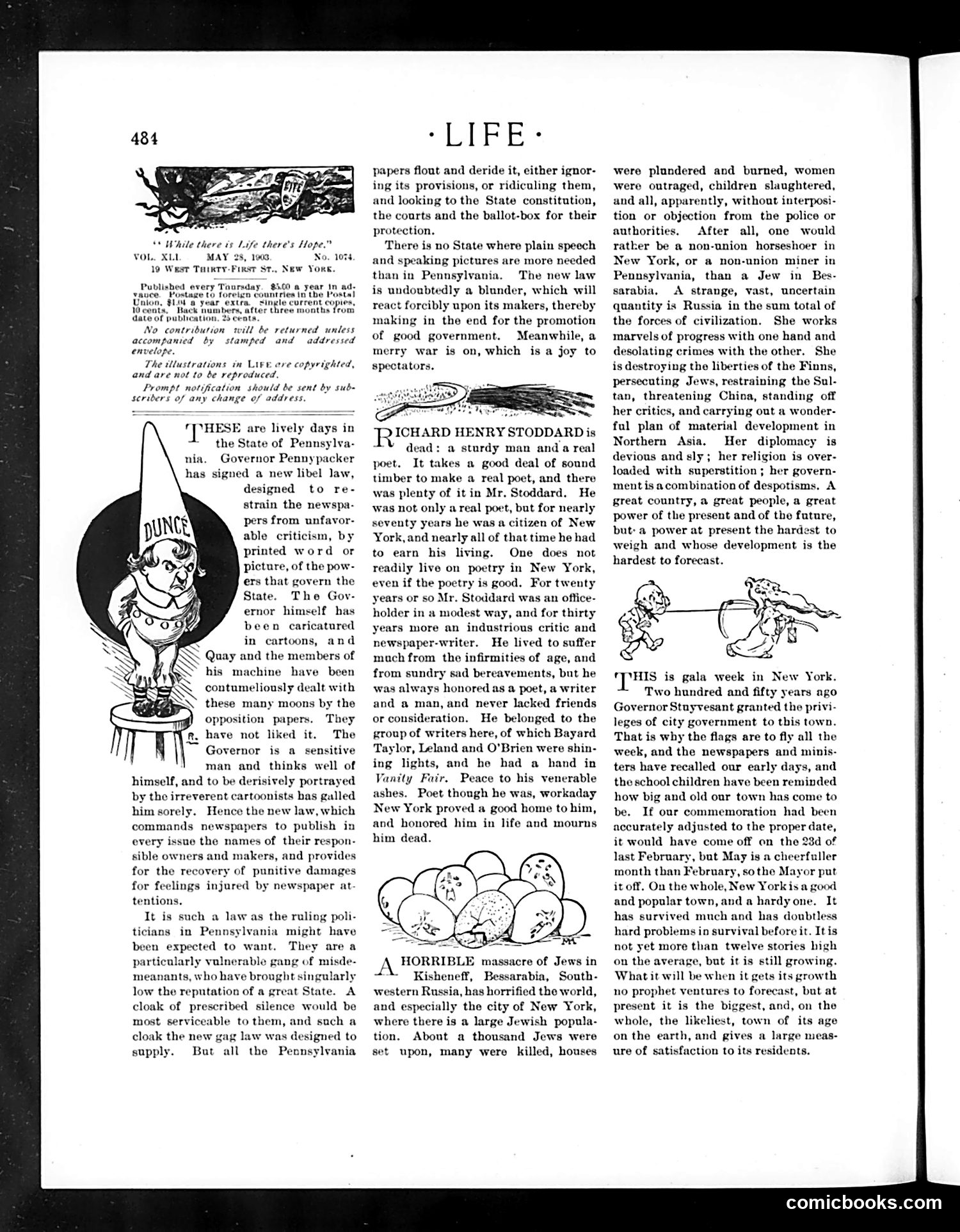
The main cartoon depicts **Governor Pennypucker of Pennsylvania** as a caricatured figure standing on a pedestal labeled "BUNCE" (slang for nonsense). The satire criticizes his new libel law designed to protect newspapers from criticism—a law the text calls "a blunder." The accompanying article about **Richard Henry Stoddard**, a deceased New York poet and critic, shifts to discussing Russia's pogroms against Jews in Kishineff (modern Kishinev). The piece notes how American newspapers and public figures could have commemorated the violence more formally, but political inconvenience caused postponement. Both pieces critique governmental overreach: Pennsylvania's libel law silencing press criticism, and Russia's violence against minorities—with America's muted response.
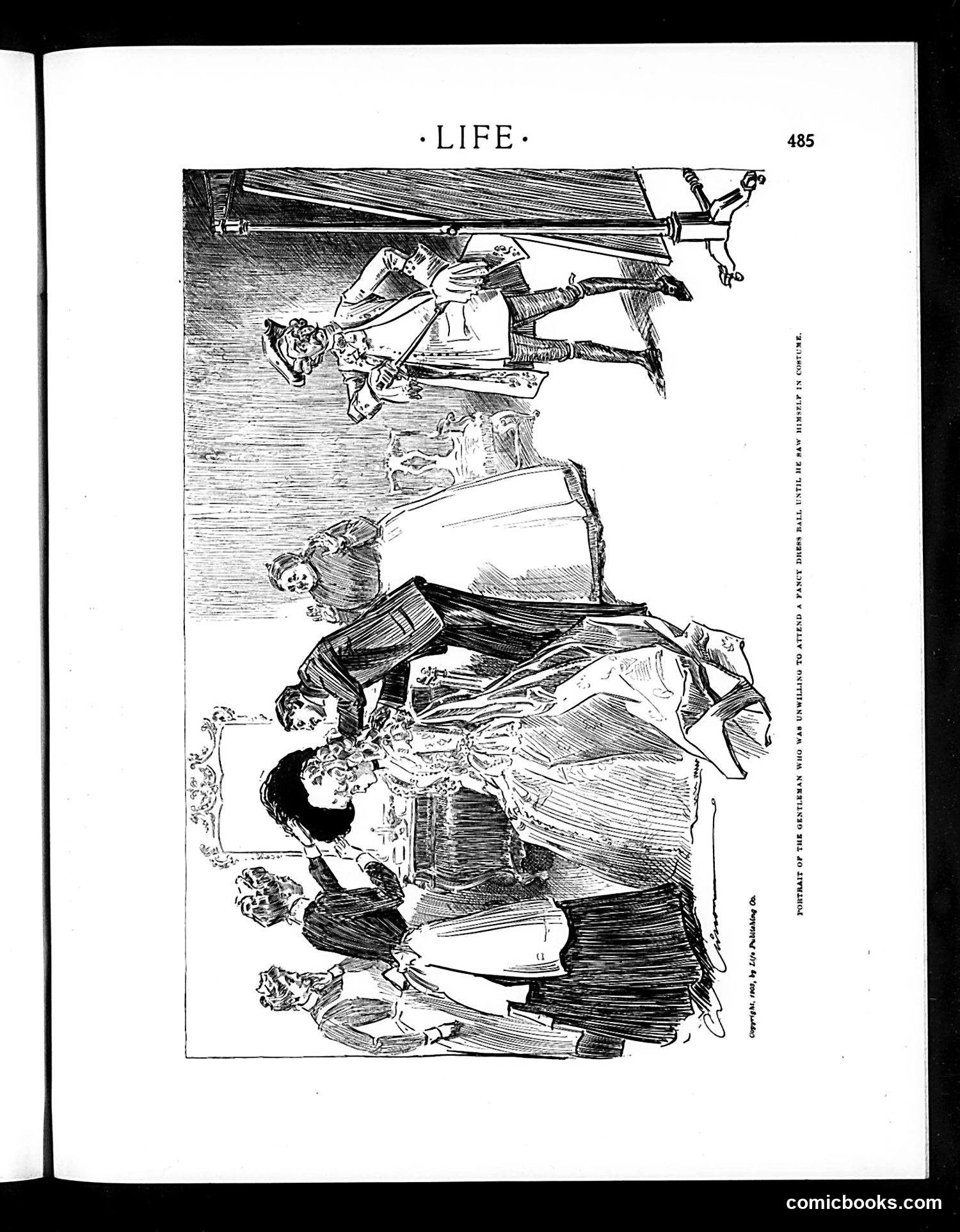
This page from *Life* magazine (page 485) contains a single illustration that appears rotated 90 degrees, requiring viewing sideways. The sketch depicts a social scene with multiple figures in formal dress, rendered in the magazine's characteristic satirical pen-and-ink style. The cartoon appears to satirize upper-class or high-society behavior, though the specific event or social commentary isn't entirely clear from this reproduction. The figures' exaggerated postures and expressions suggest mockery of pretension or affected mannerisms typical of *Life*'s satirical approach to American social life. Without clearer OCR text or additional context about the publication date, I cannot identify the specific figures or pinpoint what particular social trend or event this cartoon targets.
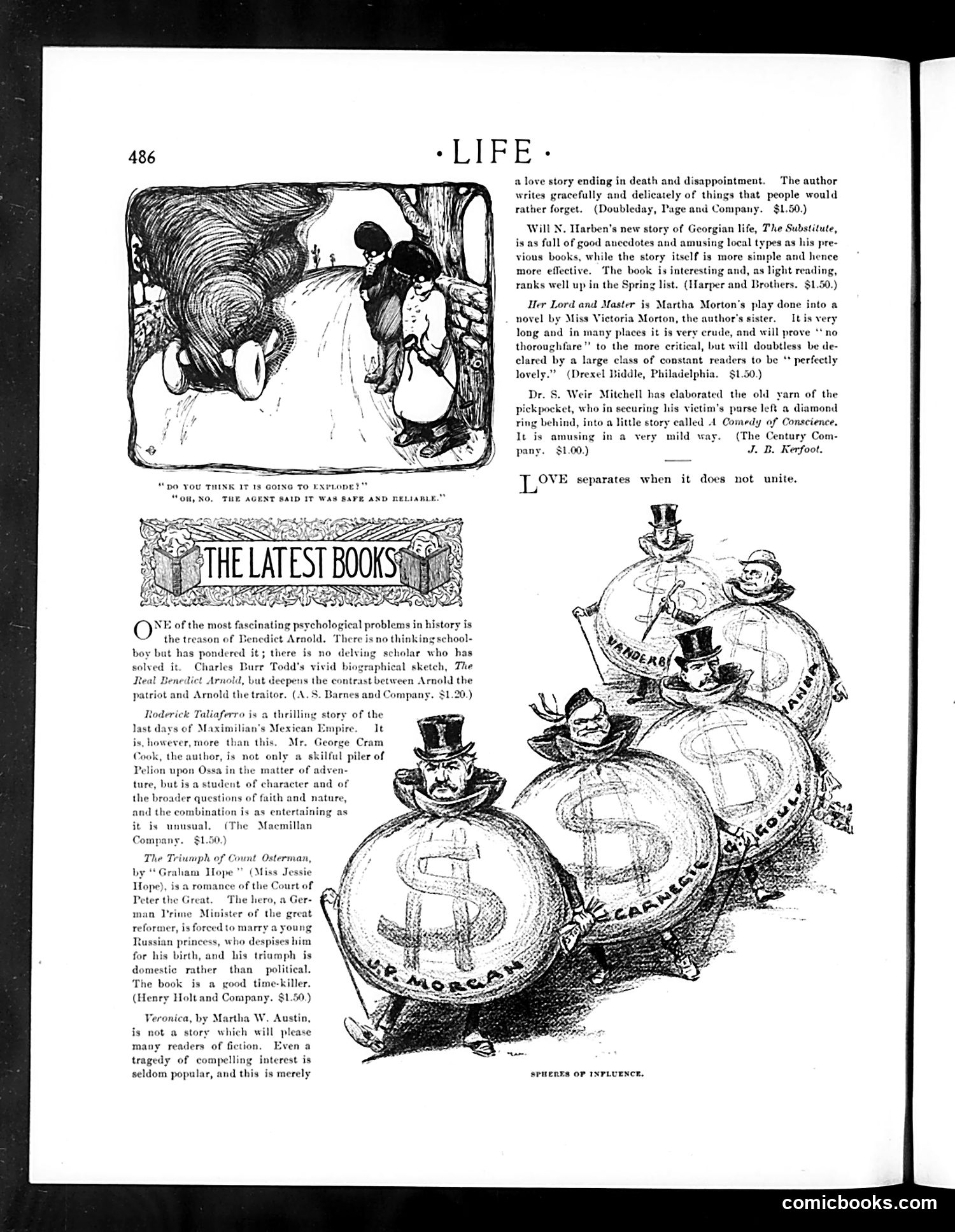
This page features book reviews rather than political satire. The upper illustration shows a domestic scene with the caption "Do you think it is going to explode?" - likely humorous commentary on marital tension in the reviewed novel. The lower cartoon, titled "Spheres of Influence," depicts three rotund figures in top hats sitting atop large spheres labeled with economic/political terms (text is too small to read clearly in the image). This appears to reference international power dynamics and economic control, possibly addressing imperialism or capitalist influence during the early 20th century. The figures likely represent different national or corporate interests competing for global dominance. The satirical point suggests how powerful entities manipulate world affairs from their positions of privilege.
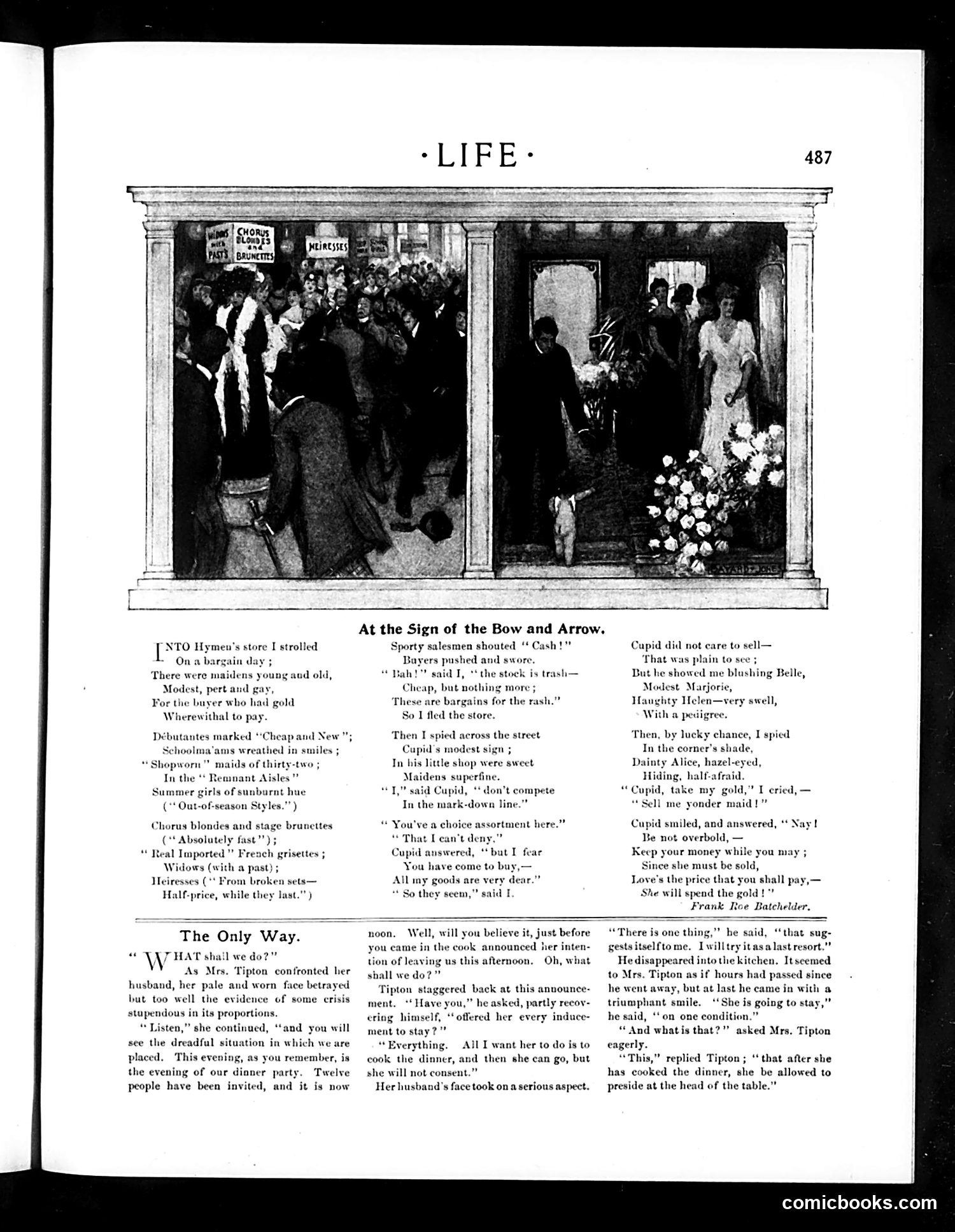
This illustration depicts a bustling retail scene—likely a department store or shop—crowded with well-dressed customers and salespeople. The poem accompanying it satirizes the commercialization of shopping and consumer culture, mocking both aggressive sales tactics ("Sporty salesmen shouted 'Cash!'") and the frivolous spending habits of upper-class women ("Summer girls of sunburnt hue," "Chorus blondes and stage brunettes"). The "Bow and Arrow" shop sign appears to be a generic establishment. The satire targets the materialism of the era—bargain-hunting crowds, manipulative salesmanship, and the social performance of conspicuous consumption. The illustration and verse together critique turn-of-the-century shopping culture as shallow and economically irrational.
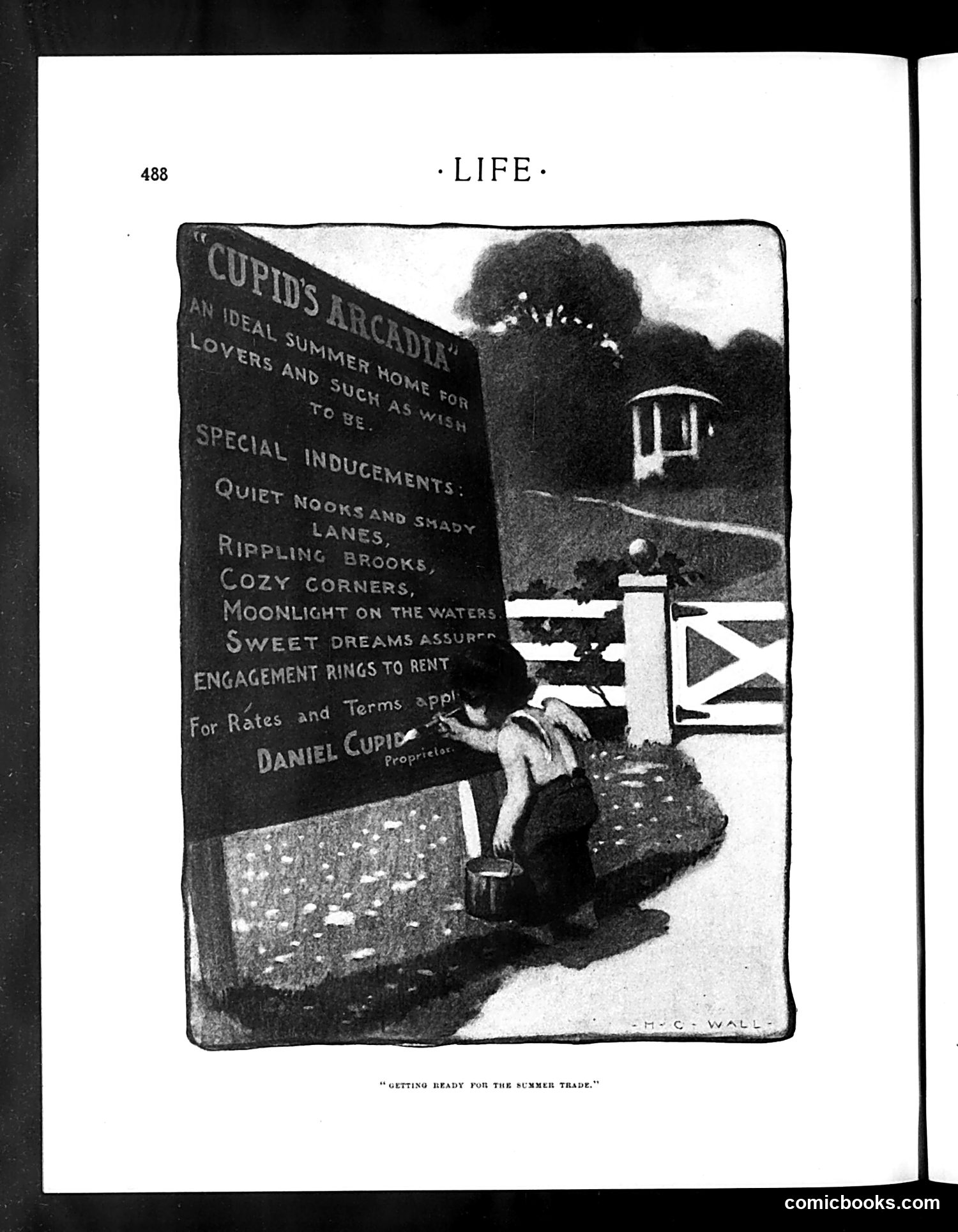
This is a satirical advertisement for "Cupid's Arcade," a recreational venue marketed as an ideal summer home for lovers. The copy humorously promises romantic amenities: quiet nooks, shady lanes, rippling brooks, cozy corners, and moonlight on the water. It offers "engagement rings to rent" — a comedic detail suggesting couples could try commitment before purchasing. The illustration, credited to H.C. Wall, shows a young couple reading the sign near a small gazebo-style structure. The satire targets the commercialization of romance in the early 20th century, mocking how businesses packaged and sold romantic experiences to courting couples. The mention of "engagement rings to rent" particularly satirizes consumer culture's attempt to monetize intimate relationships.
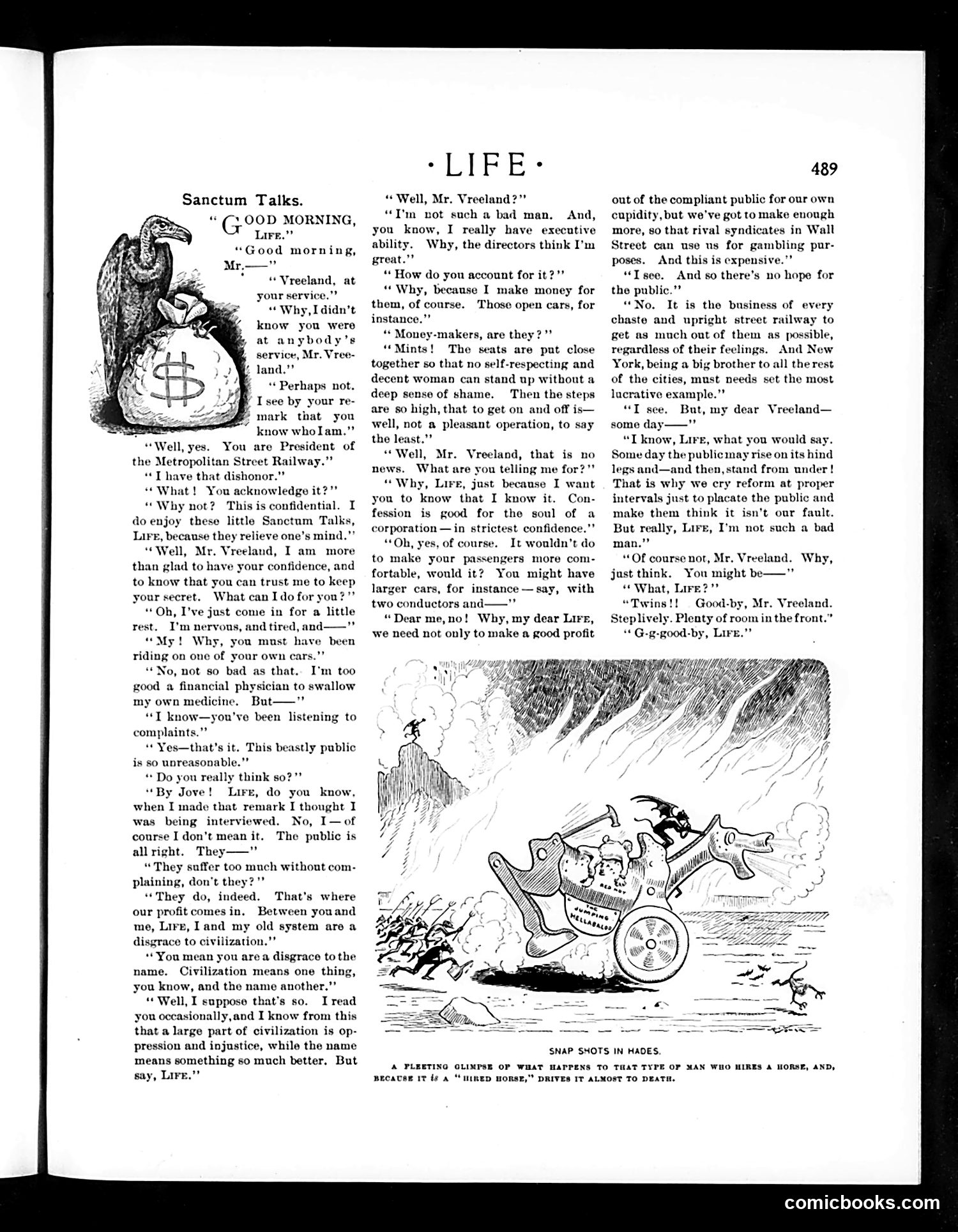
This page features a dialogue between "Mr. Vreeland" (President of the Metropolitan Street Railway) and "Life" (the magazine's editorial voice). The satire criticizes Vreeland for defending overcrowded, unsafe streetcars. The lower illustration, captioned "Snap Shots in Hades," depicts a chaotic horse-drawn streetcar careening dangerously—a visual pun on the "hired horse" driver losing control. The caption mocks how such vehicles nearly kill passengers. Life argues that Vreeland prioritizes profit over passenger safety and comfort. The dialogue reveals how transit companies dismissed public complaints about dangerous conditions, claiming reform would reduce earnings. The cartoon satirizes corporate negligence and indifference to worker and passenger welfare during the early automotive/transit era.
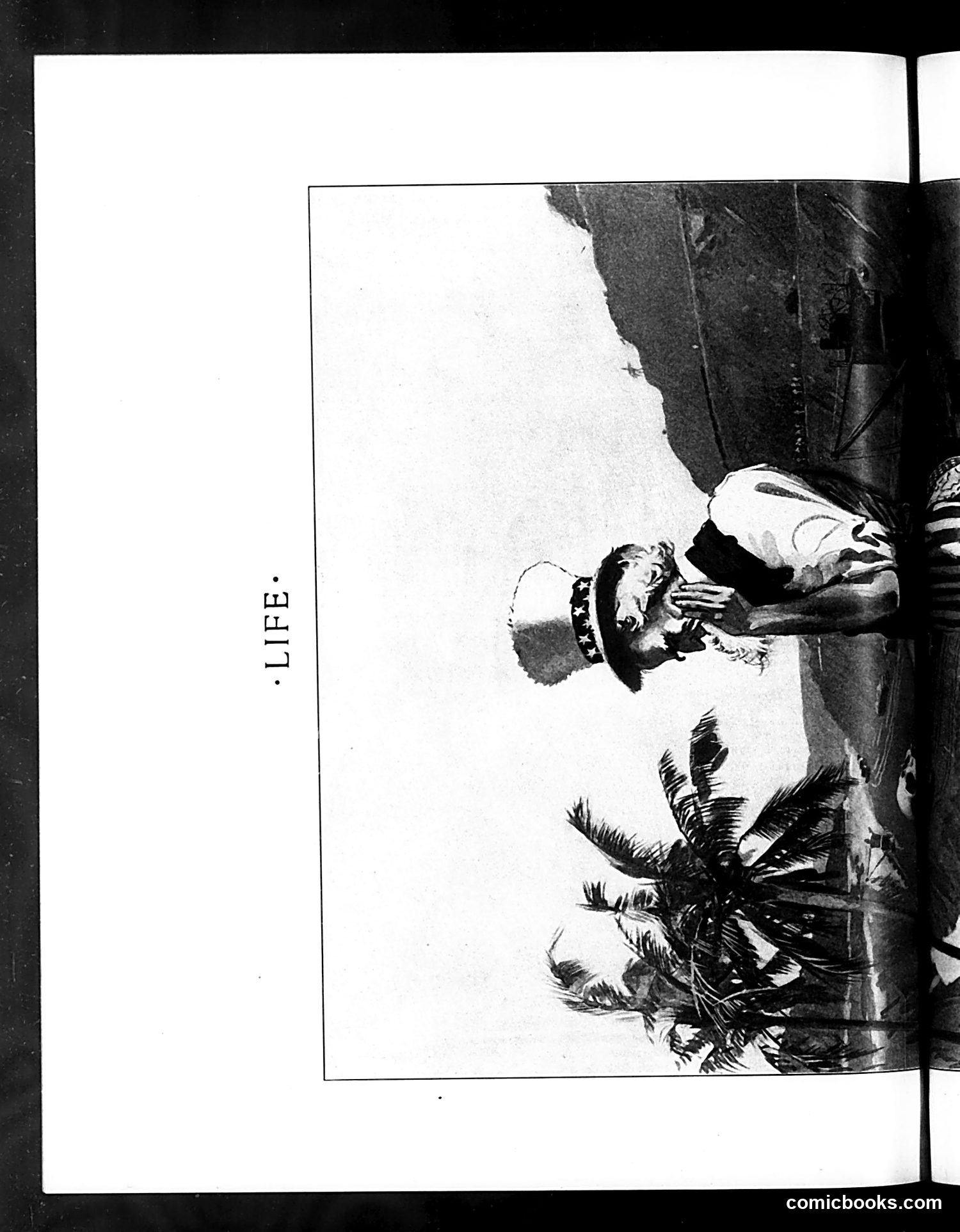
This appears to be a title page or section divider from *Life* magazine, marked simply "LIFE" in vertical text on the left side. The black and white photograph shows a figure wearing what appears to be formal or ceremonial dress with a distinctive hat, positioned against a tropical backdrop with palm fronds visible. However, without additional OCR text, visible captions, or dates on this page, I cannot definitively identify the specific figure, the political or social reference being made, or the satirical point intended. The formal dress and tropical setting suggest this may relate to colonial administration, diplomatic matters, or social commentary about wealth and status, but these remain unclear without supporting context or text from the original page.
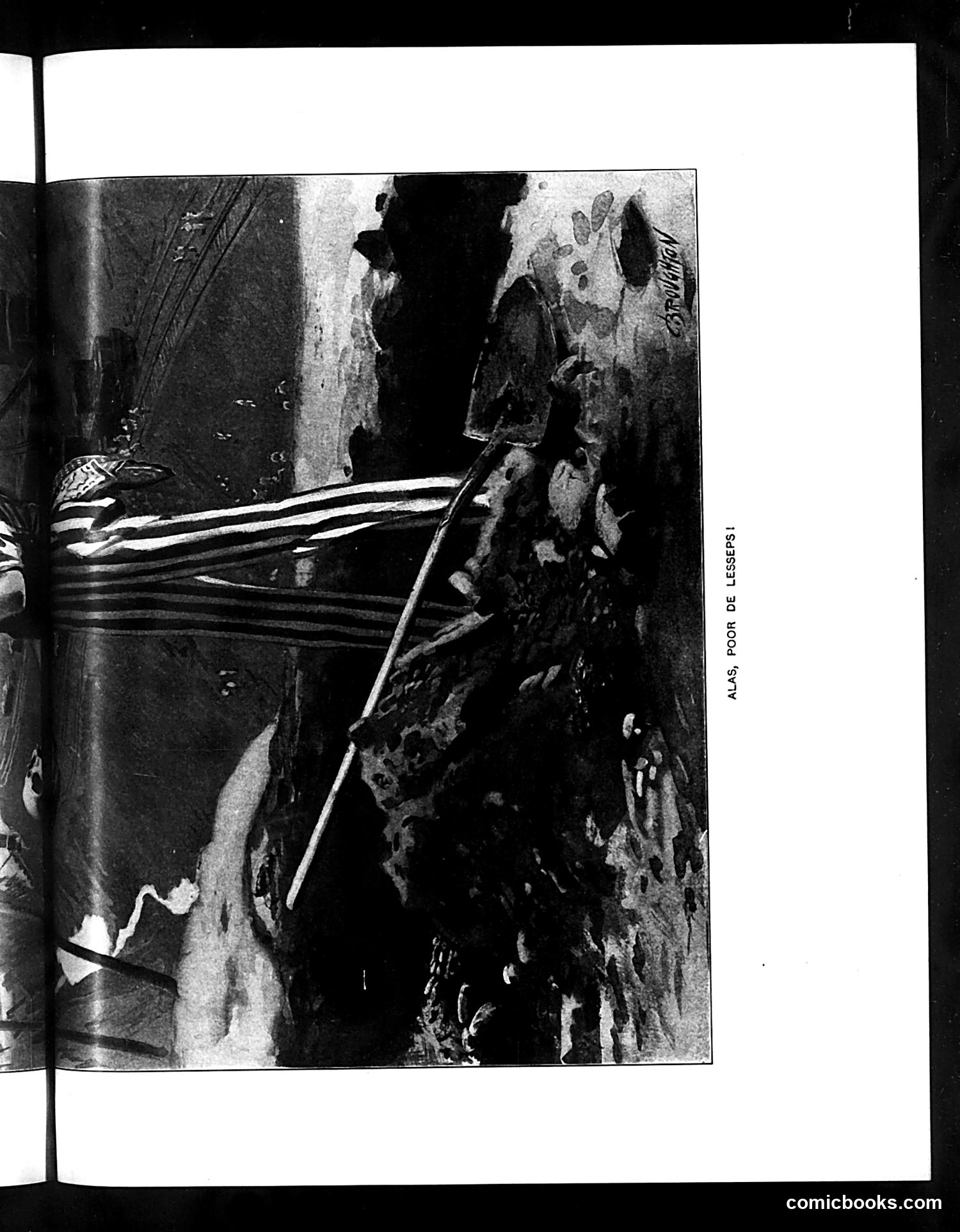
This page contains a black and white photograph labeled "ALAS, POOR DE LESSEPS!" The image appears to show a deteriorating statue or monument in an overgrown, neglected state, with vegetation and decay surrounding it. The caption references Ferdinand de Lesseps, the French engineer famous for designing the Suez Canal. The "alas, poor" phrasing echoes Shakespeare's *Hamlet*, suggesting a commentary on fallen greatness or decline. This likely refers to de Lesseps's failed attempt to build the Panama Canal in the 1880s—a project that cost thousands of lives and resulted in financial disaster and scandal. The photograph's focus on decay and abandonment emphasizes the ruin of his reputation and legacy following this catastrophic failure.
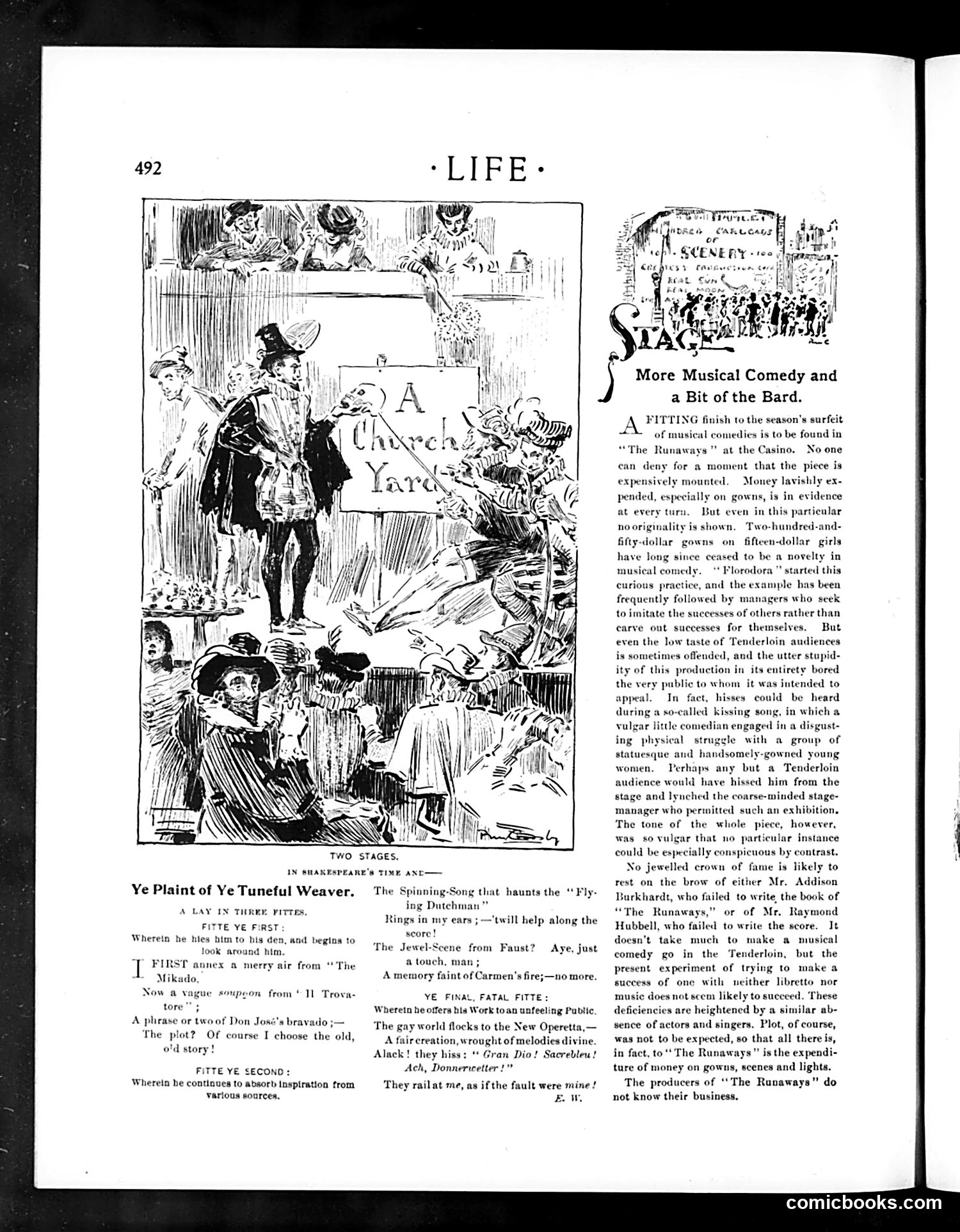
The left panel is a theatrical illustration titled "Ye Plaint of Ye Tuneful Weaver" in Shakespeare's style. It depicts a crowded theater scene with various characters in period costume, satirizing theatrical productions. The right panel, "More Musical Comedy and a Bit of the Bard," critiques contemporary musical comedies—specifically "The Runaways" at the Casino. The text mocks the genre's expensive productions, lavish costumes on poorly-paid chorus girls, and derivative plotting. It notes that even low-brow audiences find these shows boring, with their predictable "kissing songs" and physical comedy. The satire suggests producers blindly imitate successful formulas without understanding audience taste, resulting in expensively-mounted but artistically hollow entertainment. The overall message criticizes the musical comedy industry for prioritizing spectacle over substance and quality writing.
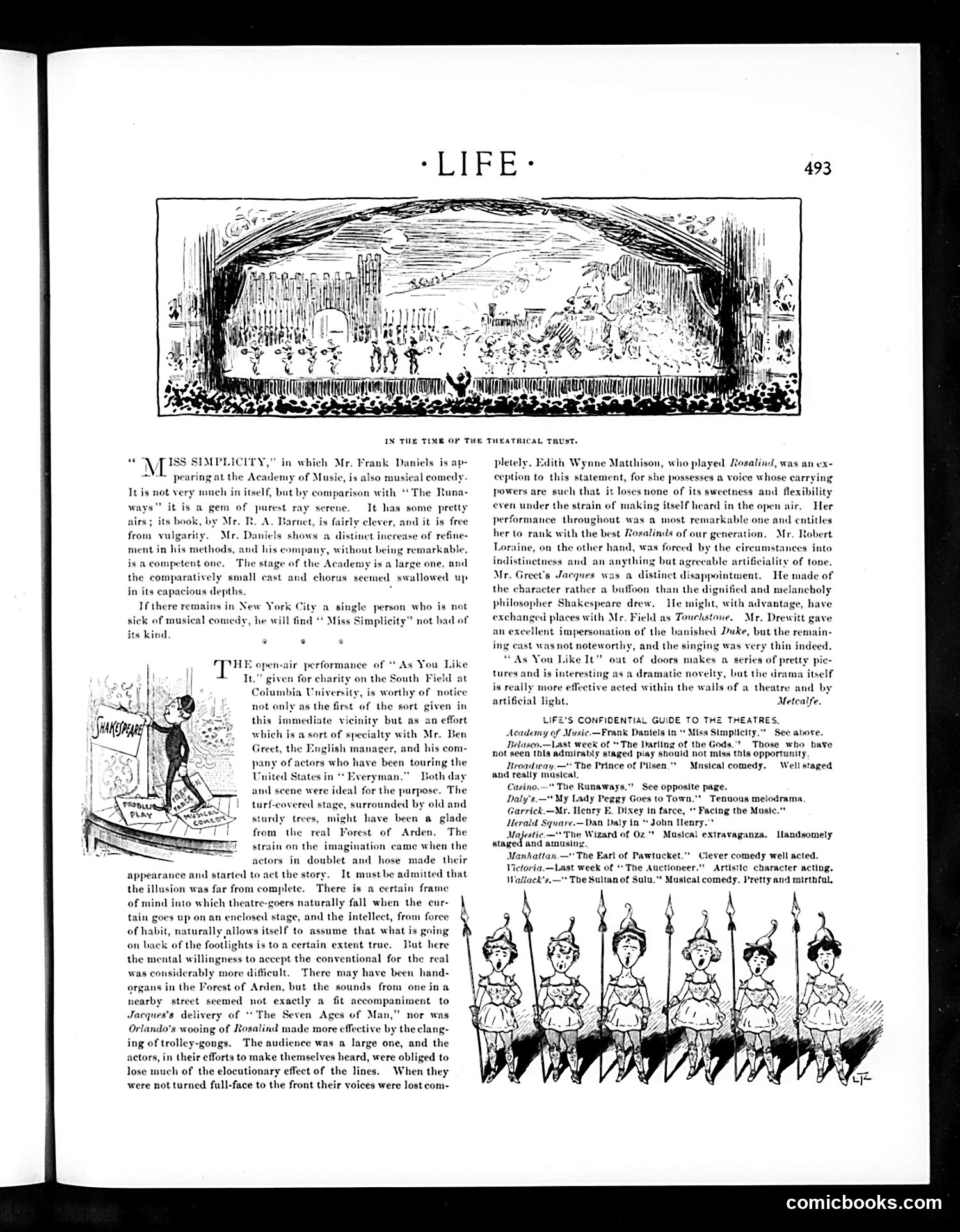
This page reviews theatrical productions during the era of the "Theatrical Trust"—a monopolistic cartel controlling American theater. The page critiques two productions: **"Miss Simplicity"** stars Frank Daniels at the Academy of Music. The review praises it as competent musical comedy, noting Daniels's refined performance, though the small cast seems dwarfed by the large stage. **"As You Like It"** was performed outdoors at Columbia University for charity. The reviewer admires the natural forest setting but criticizes the production's failures: street noise (trolley-gongs, hand-organs) undermined Shakespeare's dialogue, and most actors couldn't project adequately to outdoor audiences. Exception: Edith Wynne Matthison, whose powerful voice carried beautifully as Rosalind. Actor Robert Loraine suffered from poor acoustics, while reviewer "Metcalfe" found the production ultimately more effective indoors under theater lighting. The satirical point: outdoor Shakespeare exposes theater's artificiality—the "willing suspension of disbelief" fails without controlled stage conditions.
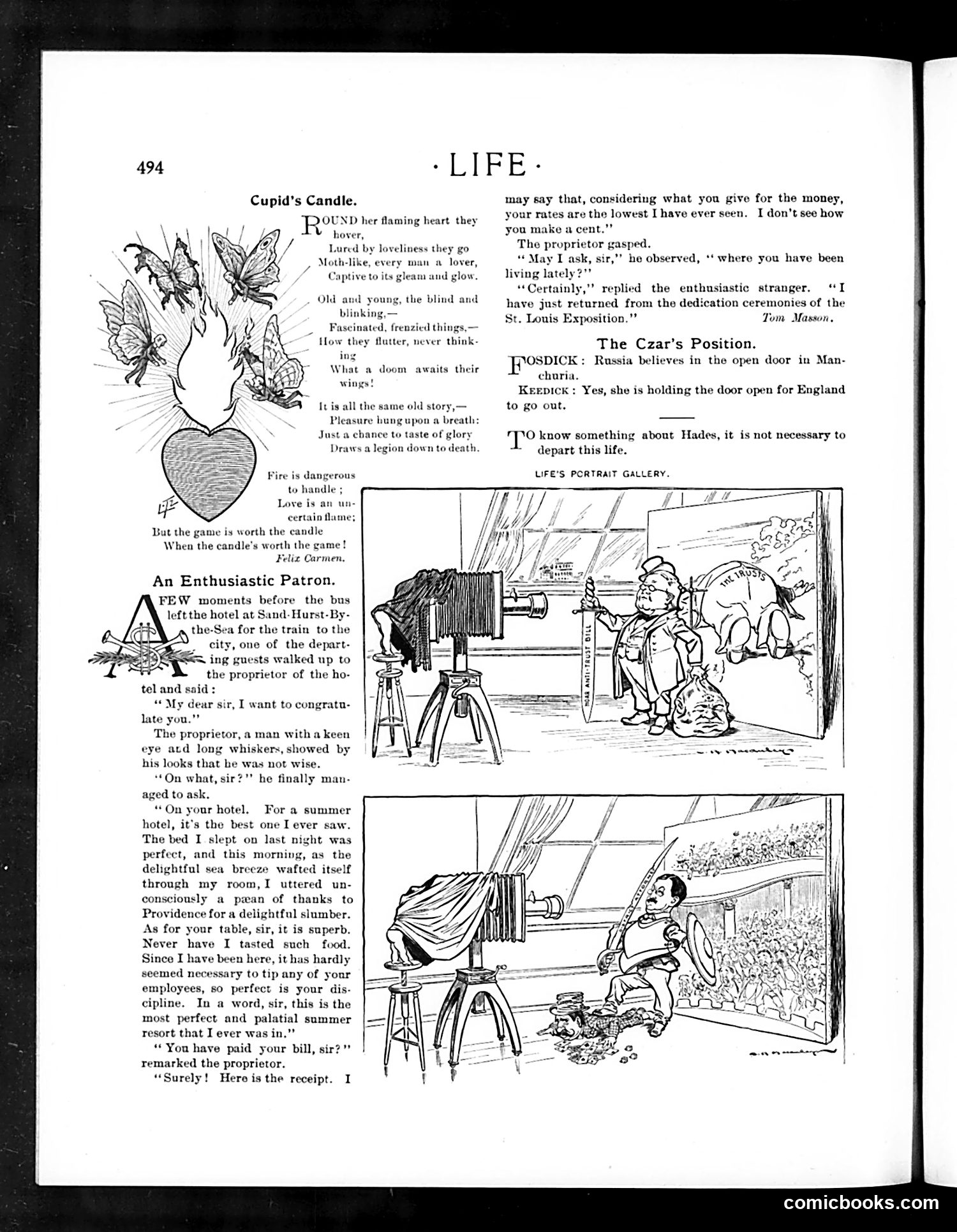
**"Cupid's Candle"** is a romantic poem about love's dangers, illustrated with butterflies around a flaming heart—standard sentimental fare from the era. **"An Enthusiastic Patron"** is a humorous anecdote about a hotel guest who effusively praises everything (bed, food, sea breeze, staff discipline) to the proprietor. The joke's punchline: when asked if he paid his bill, he says yes—but the proprietor's shocked reaction implies the guest's extreme cheapness has finally been revealed. Despite claiming the hotel is "perfect," his lavish compliments were likely insincere flattery to justify not tipping or spending generously. The satire mocks obsequious praise disconnected from actual patronage. **"The Czar's Position"** is a brief political joke referencing Russia's "open door" policy in Manchuria (early 1900s). The wordplay suggests Russia is holding the door open for England to exit—a dig at imperial rivalries and Russia's territorial ambitions framed as hospitality. **"Life's Portrait Gallery"** shows two sketched scenes (appears to be unrelated domestic/leisure vignettes).
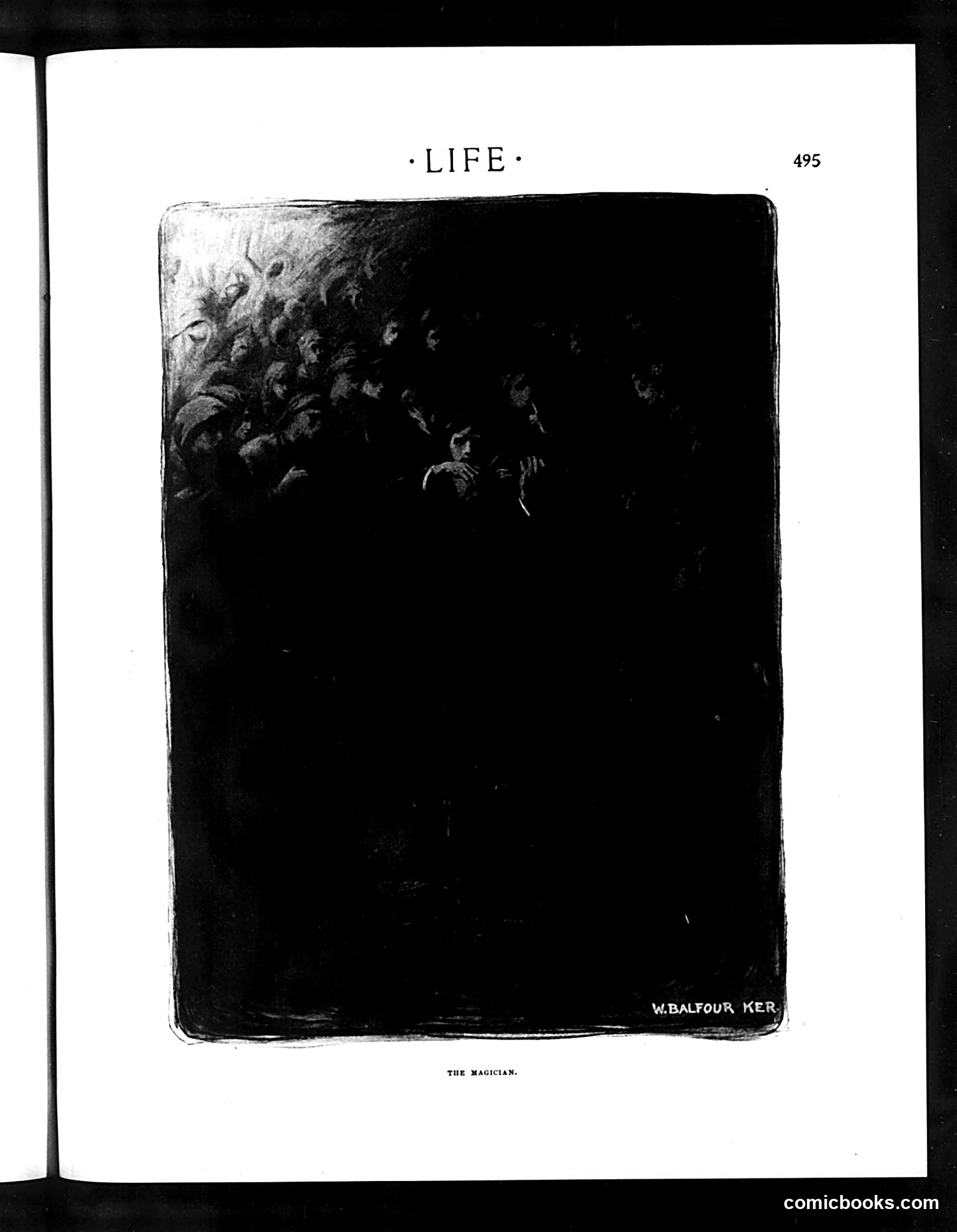
This dark, atmospheric illustration from *Life* magazine (page 495) depicts a mysterious figure performing magic before an audience rendered mostly in shadow. The title "The Magician" is ambiguous—likely a political or social satire, though the specific reference is unclear without additional context. The heavily shadowed composition and dramatic lighting suggest something sinister or deceptive. In early 20th-century *Life* magazine's satirical tradition, "magician" could metaphorically reference a political figure engaging in sleight-of-hand deception, or perhaps commentary on spiritualism/séance fraud, which was a common satirical target of the era. The specific identity of the figure caricatured and the exact reference remain unclear from the image alone.
This page contains a political cartoon titled "Me and My Friends" (credited to Chicago Tribune) that satirizes **labor disputes and class conflict** from the early 20th century. The cartoon depicts a wealthy industrialist (likely representing coal baron **George Baer**, referenced in the text) who resents workers and reformers interfering in business. The repeated refrain "Now, see what me and my friends / Do to you and your friends" threatens retaliation—specifically, raising prices during winter to punish the working class for: - Demanding higher wages - Criticizing business practices - Speaking against "divine rights" of capitalists **The satire's point**: The cartoon mocks the industrialist's vindictive response to legitimate worker grievances. Instead of accepting criticism or wage demands fairly, the rich use economic power to harm ordinary people through inflation—a parasitic counterattack framed as justified revenge. The other anecdotes on the page humorously illustrate exploitation and greed (travelers being cheated, bureaucratic corruption), reinforcing themes of **institutional dishonesty and class antagonism** typical of Progressive Era social commentary.
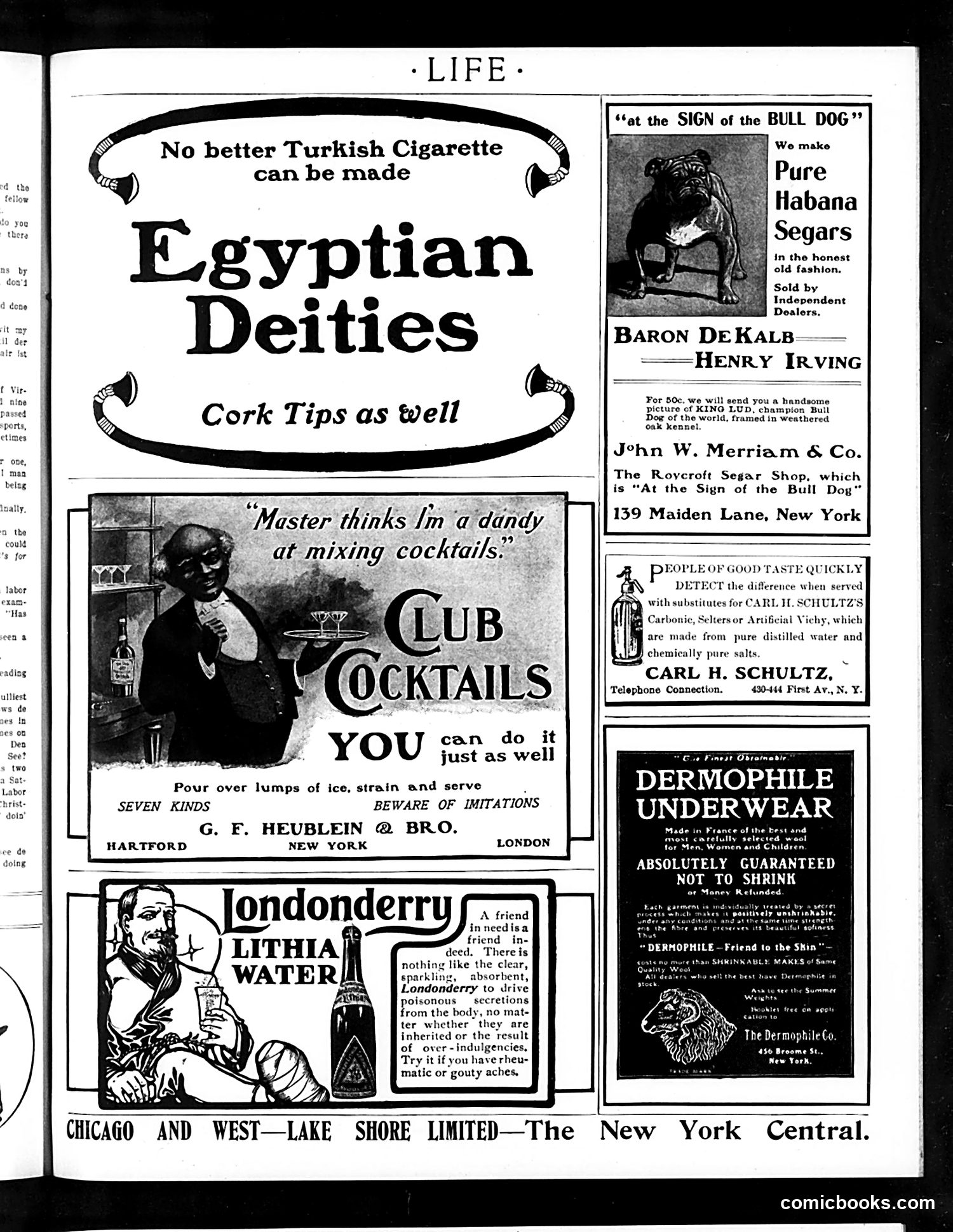
This is primarily a **page of advertisements** rather than editorial content or political satire. The ads promote various consumer products typical of the early 20th century: **Key Advertisements:** - **Egyptian Deities** cigarettes with cork tips - **Club Cocktails** by G.F. Heublein & Bro. (featuring a bartender figure mixing drinks) - **Londonderry Lithia Water** (a medicinal water claimed to treat gout and rheumatism) - **Pure Habana Segars** sold at the Roycroft Cigar Shop - **Carl H. Schultz's carbonated water** products - **Dermophile Underwear** (guaranteed not to shrink) **Historical Context for Modern Readers:** The ads reflect pre-Prohibition era drinking culture and the popularity of patent medicines and mineral waters marketed as health remedies. The use of racial stereotypes in some imagery (the bartender in Club Cocktails) and medical claims (lithia water) reflect advertising practices that would later be heavily regulated. There is no apparent satire or political commentary on this page—it's straightforward commercial advertising.
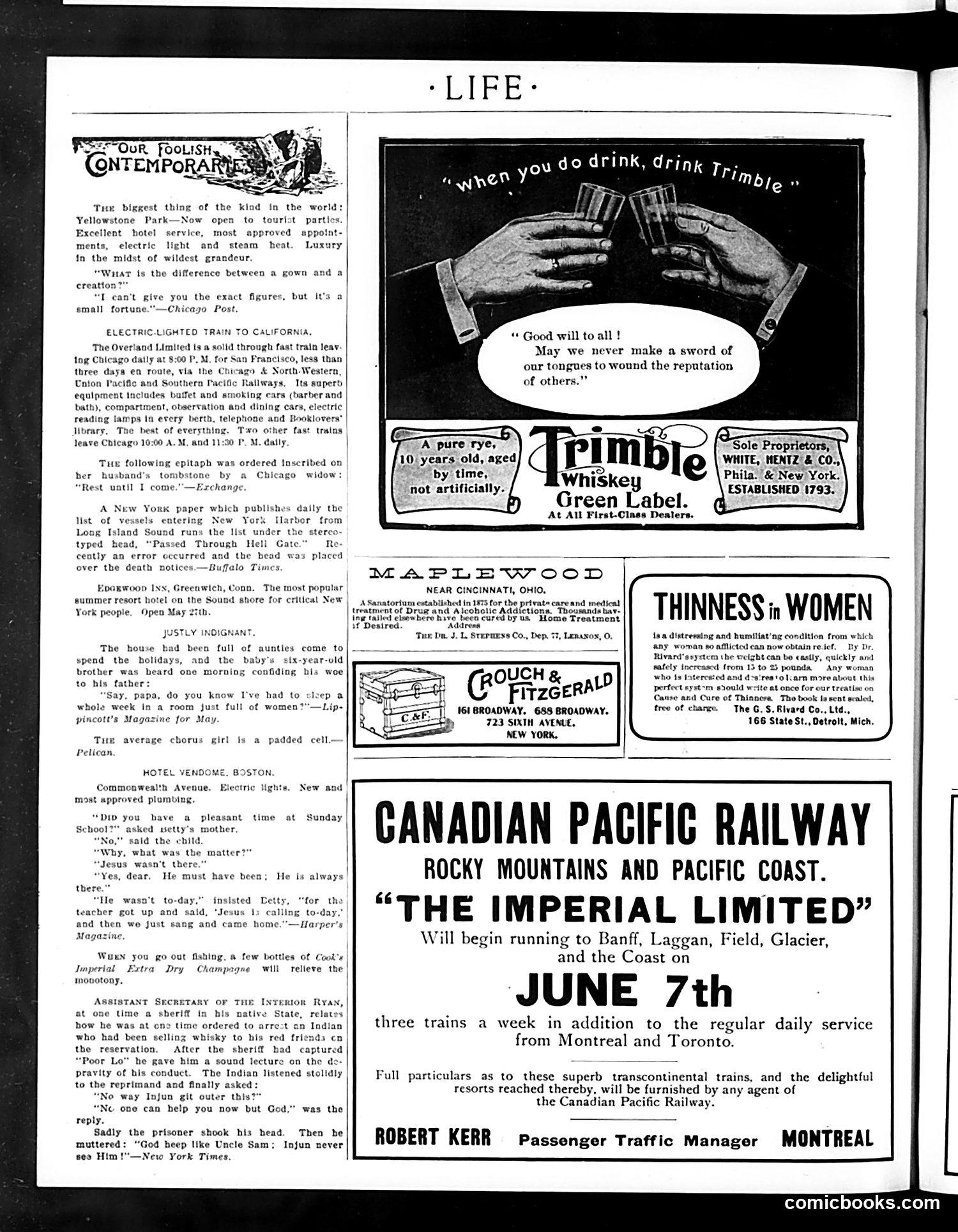
This page contains satirical commentary and advertisements typical of early-1900s Life magazine. The cartoon section ("Our Foolish Contemporaries") mocks contemporary absurdities: Yellowstone Park's popularity, the price difference between gowns and "creations," and a widow's irreverent tombstone inscription ("Rest until I come"). Anecdotes ridicule imprecise newspaper headlines and overcrowded households. One joke plays on gender: a child complaining about sleeping in a room full of aunts, and a chorus girl described as "a padded cell"—likely alluding to artificial enhancement of their figures. The bulk of the page comprises advertisements for luxury rail travel (Canadian Pacific's "Imperial Limited"), whiskey (Trimble Green Label), medical treatments (a sanitarium for addiction), and products targeting women's insecurities (Dr. Rivard's weight-gain system for "thinness in women"). The satire reflects early-20th-century concerns: conspicuous consumption, women's appearance anxieties, and substance abuse.
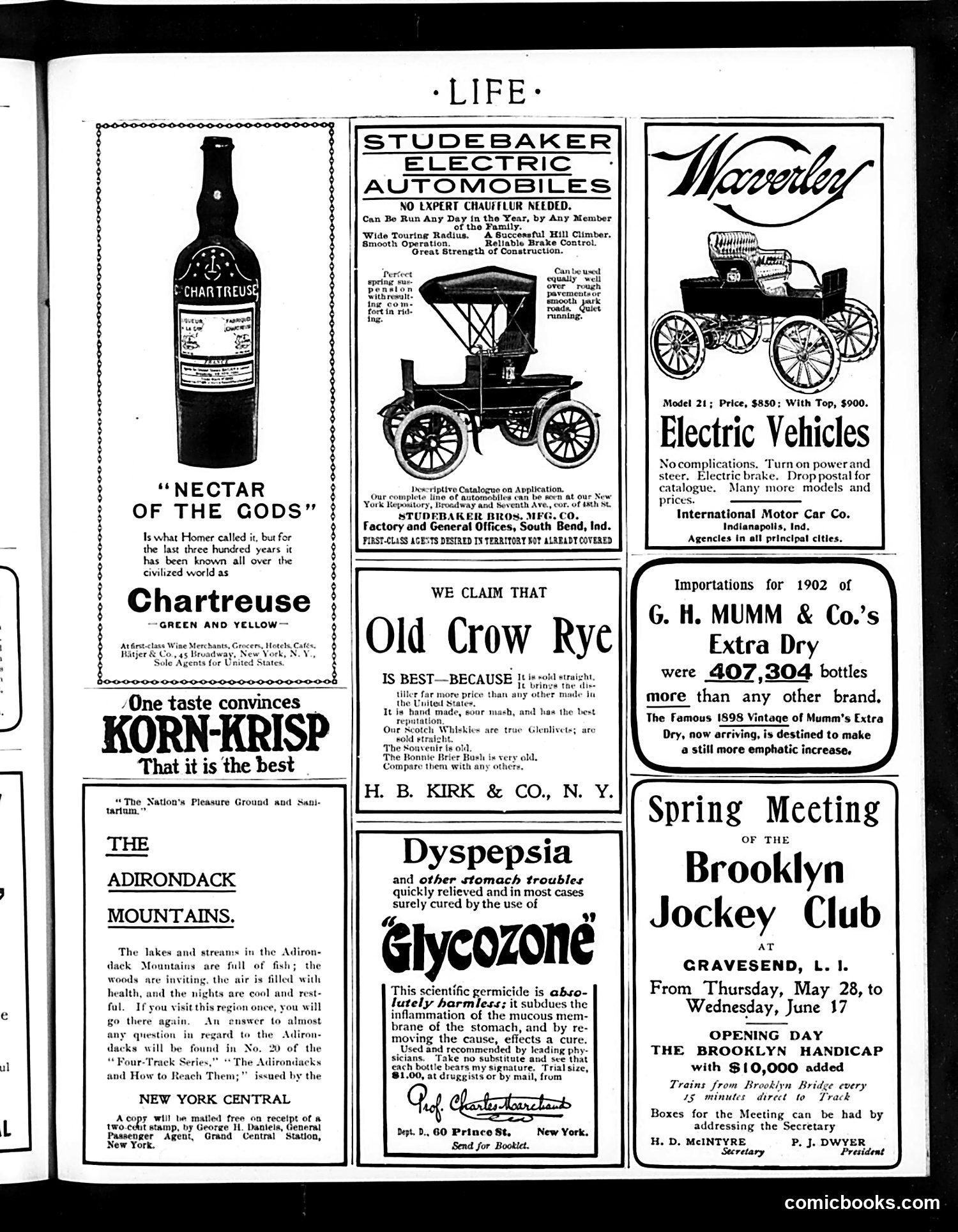
This is **not a political cartoon page** but rather a **full-page advertisement section** from Life magazine (circa early 1900s based on the 1902 Mumm's reference). The page contains product advertisements reflecting early 20th-century consumer goods: - **Chartreuse liqueur** marketed as "nectar of the gods" referencing classical literature - **Studebaker electric automobiles** emphasizing ease of use ("no expert chauffeur needed") - **Korn-Krisp cereal** - **Adirondack Mountains tourism** via New York Central Railroad - **Old Crow Rye whiskey** - **Glycozone** (a stomach remedy/germicide) - **Electric vehicles** by International Motor Car Co. - **G.H. Mumm champagne** boasting 1902 import statistics - **Brooklyn Jockey Club** horse racing event The page demonstrates early automotive innovation, patent medicines, luxury imports, and leisure activities targeting upper-class readers. There is no satire or political commentary—it's straightforward period advertising.
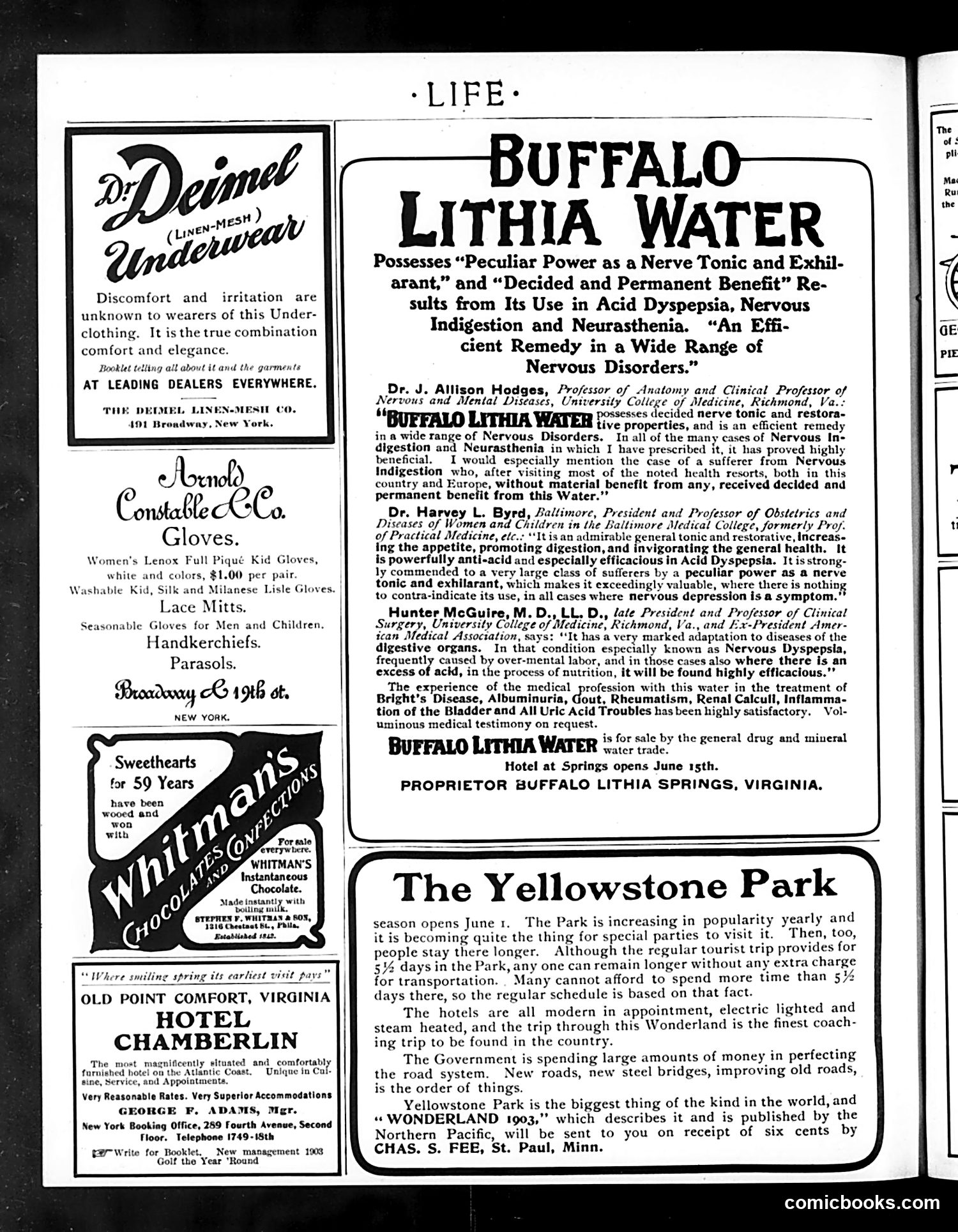
This page is primarily **advertising**, not political satire. It contains no cartoons or political commentary. The ads promote: 1. **Dr. Deimel Underwear** — linen-mesh clothing marketed for comfort 2. **Arnold Constable & Co.** — upscale gloves and accessories 3. **Whitman's Chocolates** — established confectionery brand 4. **Hotel Chamberlin** — Virginia resort 5. **Buffalo Lithia Water** — the dominant ad, claiming therapeutic benefits for nervous disorders, acid indigestion, and neurasthenia (a common Victorian diagnosis for exhaustion/anxiety) The lithia water advertisement is notable for featuring endorsements from legitimate-sounding doctors with institutional credentials, a common marketing tactic of the era. Modern readers should recognize this as **patent medicine advertising** — pseudoscientific health claims that predate FDA regulation of therapeutic products. The **Yellowstone Park** ad promotes the newly accessible national park as a tourist destination. This represents typical early-1900s *Life* magazine content: luxury goods and dubious health products marketed to affluent readers.
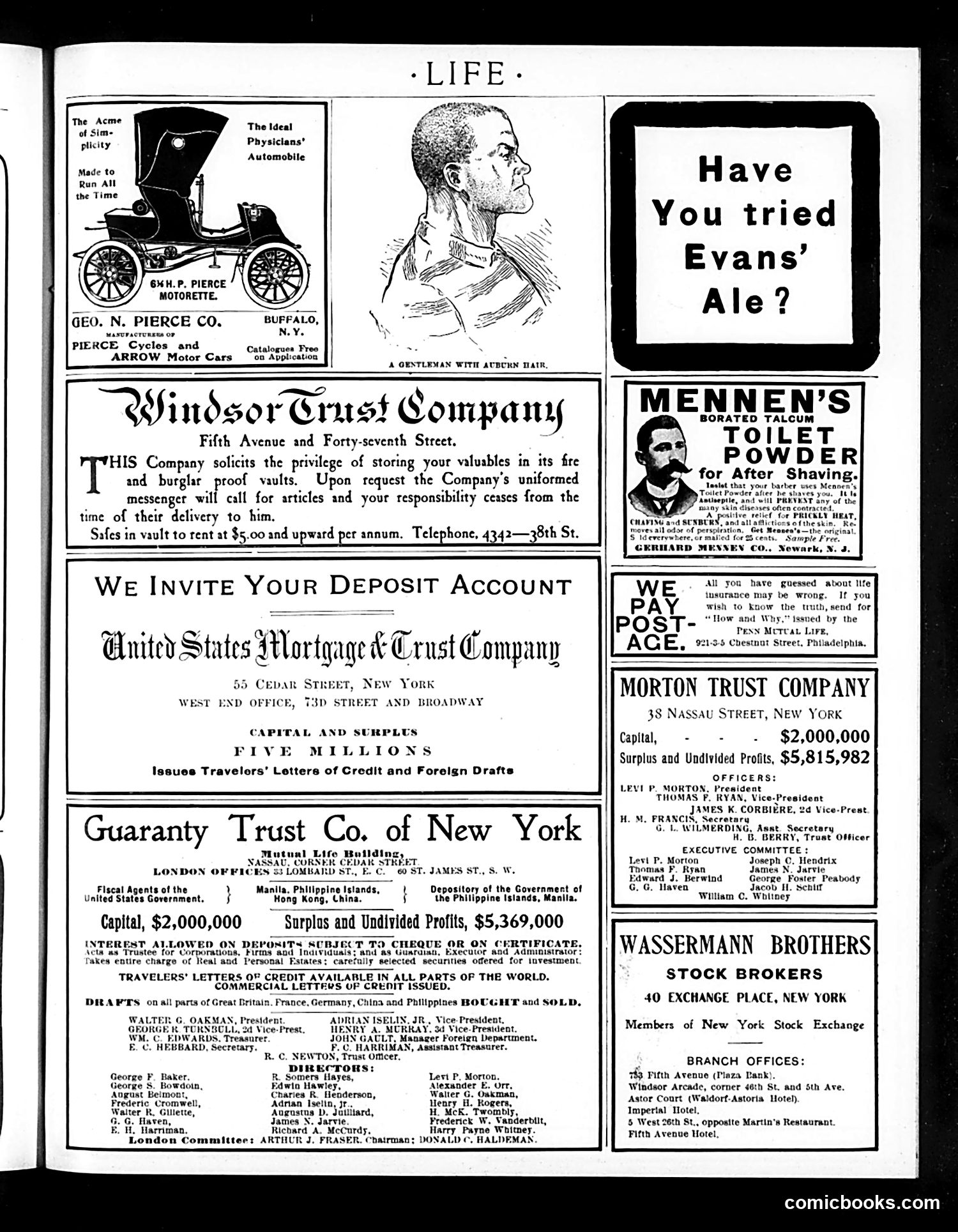
This is primarily a **financial services advertisement page** with minimal satirical content. The page features ads from major New York banks and trust companies (Windsor Trust, United States Mortgage & Trust, Guaranty Trust, Morton Trust) alongside consumer product advertisements. The only cartoon is a small portrait labeled "A GENTLEMAN WITH AUBURN HAIR"—likely a generic illustration rather than satire. The consumer ads (Pierce automobiles, Evans' Ale, Mennen's talcum powder, Penn Mutual Life Insurance) are straightforward marketing. The page reflects early 20th-century **upper-class American commerce**: trust companies competing for wealthy depositors' accounts, foreign banking services for international business, and lifestyle products for gentlemen. There is no identifiable political satire or social commentary visible—this appears to be a revenue-generating advertisement section, not editorial content from *Life* magazine's satirical side.
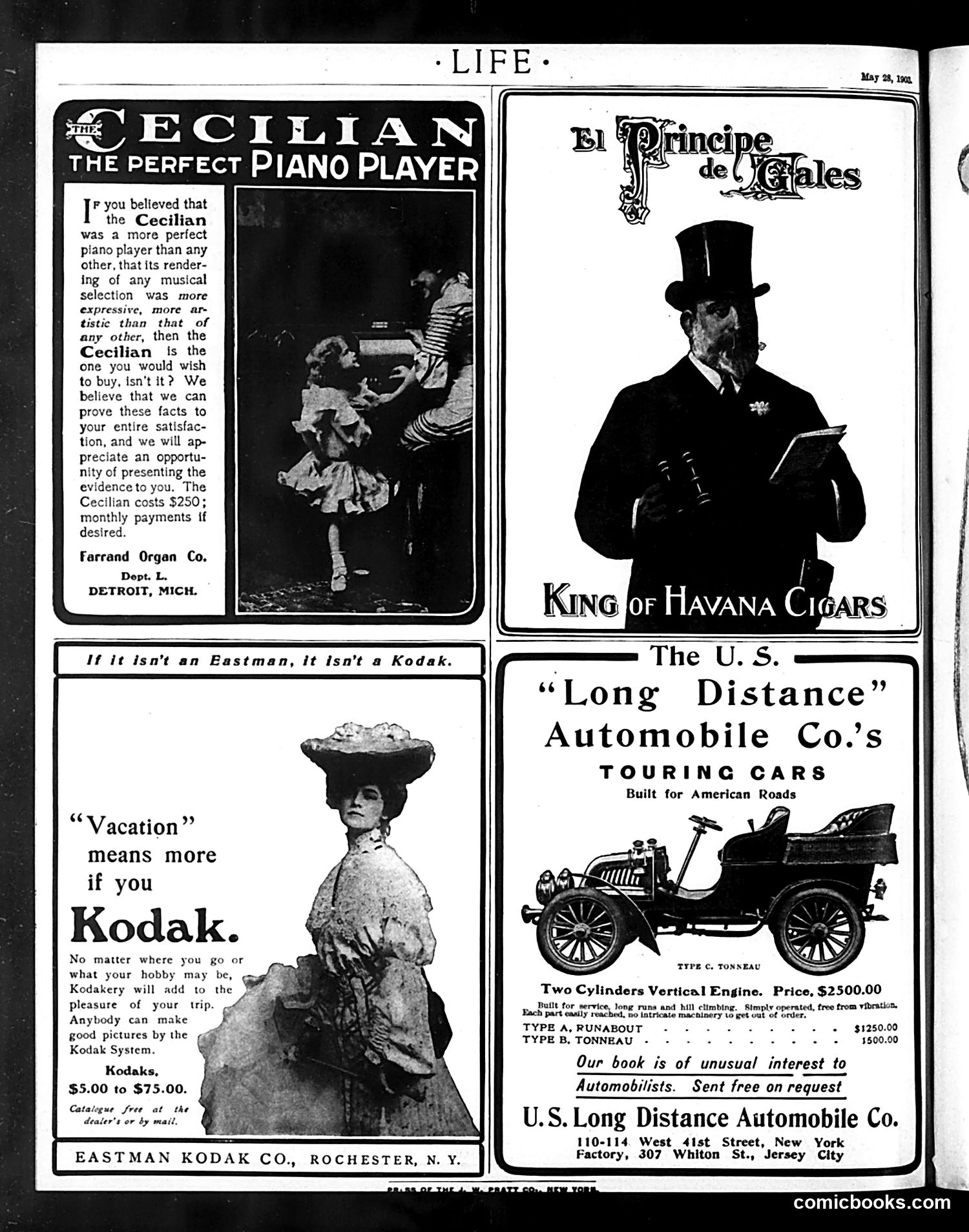
This page contains four advertisements typical of early 1900s consumer goods—no political cartoons or satire. The ads reflect the era's emerging consumer culture and technological optimism: **Cecilian Piano Player**: Promotes an automated player piano ($250), appealing to middle-class aspirations for culture and music without requiring skill. **El Príncipe de Gales Cigars**: Features a distinguished gentleman in top hat, marketing Cuban cigars as a luxury product for refined taste. **Kodak**: Uses the slogan "Vacation means more if you Kodak," pioneering photography as a leisure activity for ordinary people ($5-75 cameras). **U.S. Long Distance Automobile Co.**: Advertises touring cars ($1250-2500), emphasizing reliability for American roads during the automobile's early adoption phase. Collectively, these ads target affluent consumers eager to embrace new technologies and consumer goods as markers of modernity and status.