
Life, 1903-05-28 · page 16 of 22
Life — May 28, 1903 — page 16: what you’re looking at
What you’re looking at
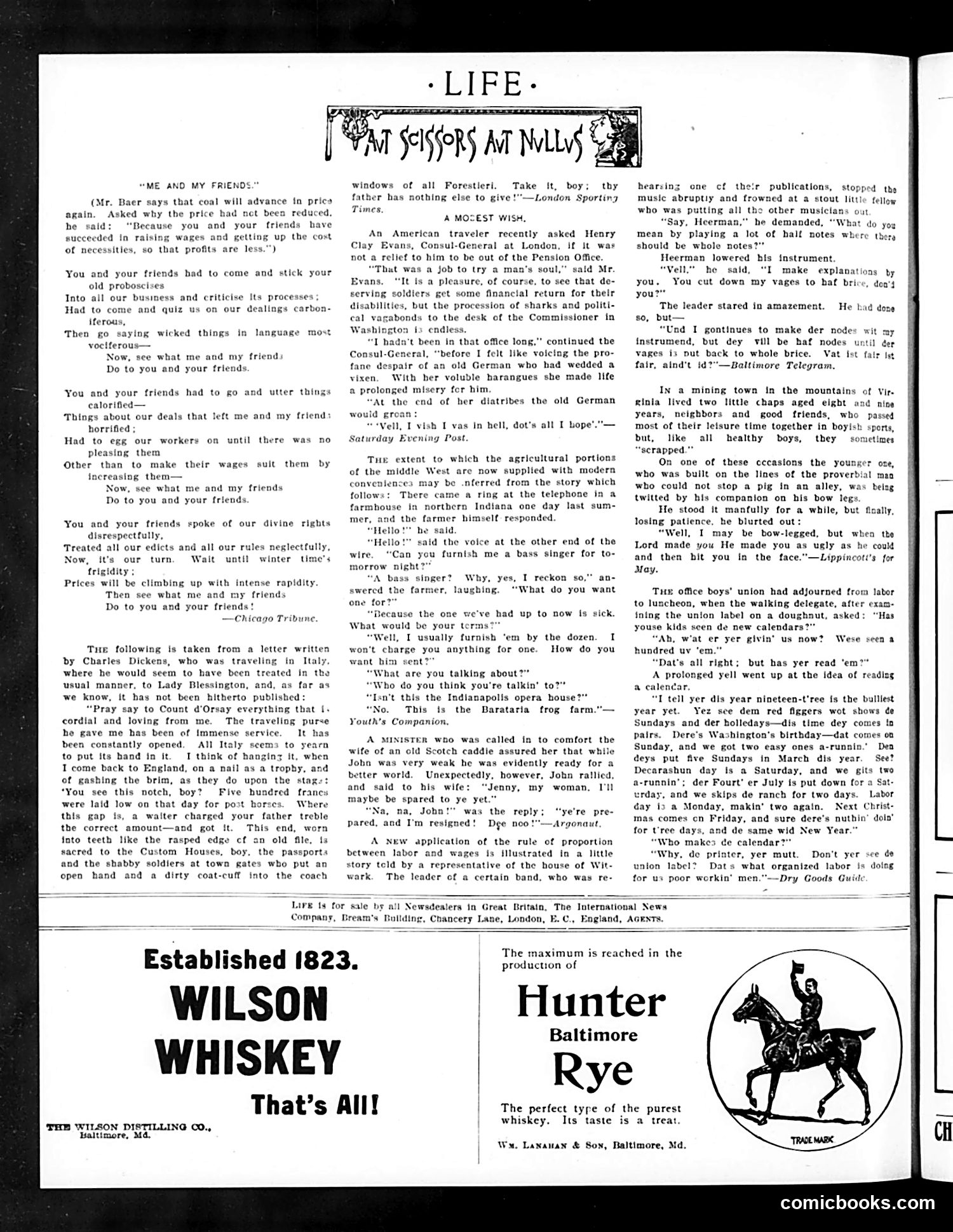
This page contains a political cartoon titled "Me and My Friends" (credited to Chicago Tribune) that satirizes **labor disputes and class conflict** from the early 20th century. The cartoon depicts a wealthy industrialist (likely representing coal baron **George Baer**, referenced in the text) who resents workers and reformers interfering in business. The repeated refrain "Now, see what me and my friends / Do to you and your friends" threatens retaliation—specifically, raising prices during winter to punish the working class for: - Demanding higher wages - Criticizing business practices - Speaking against "divine rights" of capitalists **The satire's point**: The cartoon mocks the industrialist's vindictive response to legitimate worker grievances. Instead of accepting criticism or wage demands fairly, the rich use economic power to harm ordinary people through inflation—a parasitic counterattack framed as justified revenge. The other anecdotes on the page humorously illustrate exploitation and greed (travelers being cheated, bureaucratic corruption), reinforcing themes of **institutional dishonesty and class antagonism** typical of Progressive Era social commentary.
📄 Transcribed text from this page (OCR, searchable)
Machine-transcribed from the original scan — historical spelling and the odd misread are preserved.
“ME ANO MY FRIENDS.” (Mr. Baer says that coal will advance tn prics again. Asked why the price had net been redu . he sald: “Because you and your friends have succeeded In raisi: wages and getting up the cost of necessities, so that profits are less.) You and your friends had to come and stick your old proboscises Into all our business and criticise Its processes Had to come and quiz us on our dealings carb iferous, go saying wicked things vociferous— Now, see what me and my friend Do to you and your friends ‘Then in language most You and your friends had to go and utter things calorified— Things about our deals that left me and m horrified ; to egg our workers pleasing them Other than to make increasing them— Now, see what me and my friends Do to you and your friends. y friends until there was no Had on their wages sult them by You and your friends spoke of our divine rights disrespectfully, Treated all our edicts and all our rules neglectfully, Now, It's our turn. Walt until winter ¢ frigidity ; Prices will be climbing up with intense rapidity. Then see what me and my friends Do to you and your friends! —Chicago Tribune Tue following is taken from a letter written by Charles Dickens, who was traveling in Italy, where he would scem to have been treated in the usual manner, to Lady Blessington, and, as far as {t bas not been hitherto published : “Pray say to Count d'Orsay everything that {. cordial and loving from me. The traveling purse he gave me has been of Immense service. It has deen constantly opened. All Italy scems to yearn to put its hand in it. I think of hanging it, when T come back to England, on a nail as a trophy, and of gashing the brim, as they do upon the sta *You see this notch, boy? Five bundred franc: were laid low on that day for post horses. Where this gap fs, a walter charged your father treble the correct amount—and got !t. This end, wo {nto teeth like the rasped edge cf an old file, ts sacred to the Custom Houses, boy, the passports and the shabby soldiers at town gates who put an open hand and a dirty coat-cuff into the coach Lire ts for sale bs all windows of all Forestleri. Take it, boy; father has nothing else to give !"—London Sport Bimes A MOZEST WISH. An American traveler recently asked Henry Clay Evans, Consul-General at London, if it war not a relief to him to be out of the Pension Office “That was a Job to try a man’s soul,” sald Mr. Evans, “It is a pleasure, of course, to see that de- serving soldiers get some financial return for thelr disabilities, but the procession of sharks and politi- cal vagabonds to the desk of the Commissioner in Washington is endless, “I hada't been In that office long,"* continued the Consul-General, “before I felt like voicing the pro- fane despair of an old German who had wedded a vixen, With ber voluble barangues she made life a prolonged misery for him “At the end of her diatribes the old German would groan: ell, I visb I vas In hell, dot’s all I bope’."— Saturday Evening Post. Tue extent to which the agricultural portions of the middle West are now supplied with modern conveniences may be .nferred from the story which follows: There came a ring at the telephone in a farmbouse jorthern Indiana one day last sum- mer, and the farmer himself responded. “Hello!” be said “Hello!” said the voice at the other end of the wire, “Can you furnish me a bass singer for to- morrow night “A bass singer? swered the fart one for?” “Deca he 0: What would be your t “Well, [ usually furnish ‘em by the dozen. won't charge you anything for one. How do you want him sent?” “What are you talking about “Who do you think you're talkin’ to?” “Isn't this the Indianapolis opera house?” This is the Barataria frog farm.”— Youth's Companion, I reckon so," an- What do you want Why, yes, laughing. e've had up to now Is sick. A MINISTER who was called in to comfort the wite of an old Scotch caddie assured her that while John was very weak he was evidently ready for a better world. Unexpectedly, however, Jobn rallied, and said to his wife: “Jenny, my woman, I'll maybe be spared to ye yet.” “Na, na, John! was the reply pared, and I'm resigned! Dge noo “ye're pre- —Argonaut A New application of the rule of proportion between labor and wages is illustrated in a little story told by a representative of the house of Wit- wark. The leader of a certain band, who was re- hearsing one cf their publications, stopped music abruptly and frowned at a stout litt) who was putting all tho other musicians out “Say, Heerman,” he demanded, “What do you mean by playing a lot of half notes wher: should be whole notes?” Heerman lowered bis instrument ell” ho sald, “I make explanations You cut down my vages to haf bri the fellow thera by you + doa'd you?" The leader stared in amazement. 80, but— “Und I gontinues to make der nodes wit my {nstrumend, but dey vill be haf nodes until der vages i3 put back to whole brice. Vat ist fair Ist fair, aind't id?"—Baltimore Telegram. He bad done In a mining town in the mountains of Vir- ginia lived two little chaps aged eight and nine years, neighbors and good friends, who passed most of their leisure time together in boyish sports, but, like all healthy boys, they sometimes “scrapped.” On one of these cccastons the younger ote, who was bullt on the lines of the proverbial maa who could not stop a pig in an alley, was being twitted by his companion on his bow legs. He stood it manfully for a while, but floally, losing patience, he blurted out: “Well, I may be bow-legged, but whea the Lord made you He made you as ugly as he could and then bit you in the face."—Lippincoti’s for May. Tu office boys’ union had adjourned from lator to luncheon, when the walking delegate, after exan- ining the union label on a doughnut, asked: “Has youse kids seen de new calendars?" ‘Ah, w'at er yer givin’ us now? hundred uy ‘em.” “Dat's all right; but has yer read ‘em?* A prolonged yell went up at the idea of readiag a calendar. “I tell yer dis year nineteen-t'ree {s the bulllest year yet. Yez see dem red figgers wot shows ¢e Sundays and der bolledays—dis time dey comes Io pairs. Dere’s Washington's birthday—dat comes on Sunday, and we got two easy ones a-runnin.’ Dea deys put five Sundays in March dis year. See? Decarashun day is a Saturday, and we gits two a-runnin’; der Fourt’ er July ts put down for a Sat- urday, and we skips de ranch for two days. Labor ay i> a Monday, makin’ two again. Next Christ- mas comes cn Friday, and sure dere’s nuthin’ dois’ for tree days, and de same wid New Year.” “Who makes de calendar?” “Why, de printer, yer mutt. Don’t yer see de union label? Dats what organized labor is doing for us poor workin’ men."——Dry Goods Guide Wese seen a ewsdealers in Great Britain, The International Companys, Bream’s Dullding, Chancery Lane, London, E.C., England, AGENTS. Established 1823. WILSON WHISKEY That’s All! THE WILSON DISTILLING ©O., Baltimore, Md. production of The maximum is reached in the Hunter Baltimore Rye whiskey. Its taste is The perfect type of the purest a treat. Wa. Lanauan & Son, Baltimore, Md. comicbooks.com