
Life, 1903-05-28 · page 12 of 22
Life — May 28, 1903 — page 12: what you’re looking at
What you’re looking at
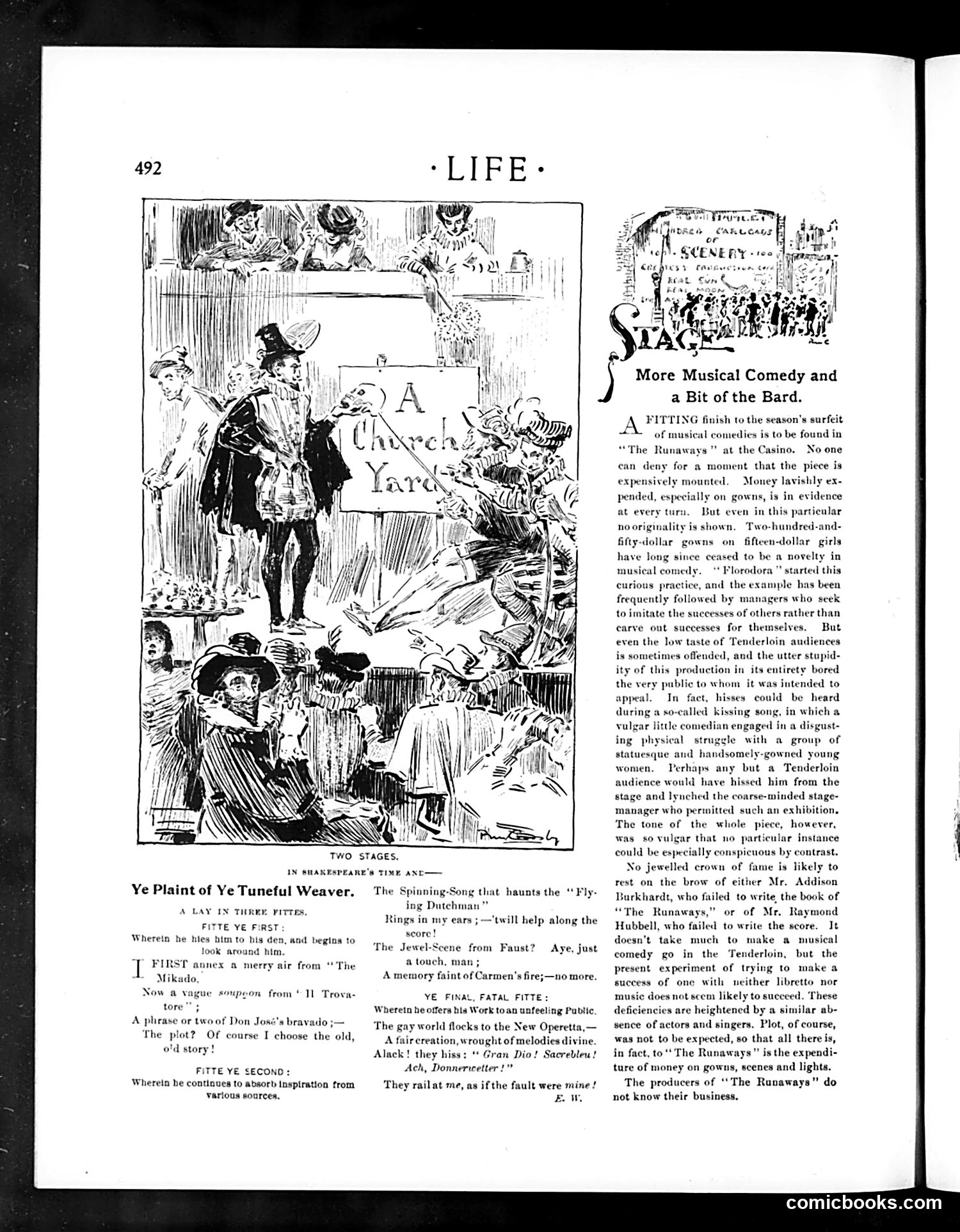
The left panel is a theatrical illustration titled "Ye Plaint of Ye Tuneful Weaver" in Shakespeare's style. It depicts a crowded theater scene with various characters in period costume, satirizing theatrical productions. The right panel, "More Musical Comedy and a Bit of the Bard," critiques contemporary musical comedies—specifically "The Runaways" at the Casino. The text mocks the genre's expensive productions, lavish costumes on poorly-paid chorus girls, and derivative plotting. It notes that even low-brow audiences find these shows boring, with their predictable "kissing songs" and physical comedy. The satire suggests producers blindly imitate successful formulas without understanding audience taste, resulting in expensively-mounted but artistically hollow entertainment. The overall message criticizes the musical comedy industry for prioritizing spectacle over substance and quality writing.
📄 Transcribed text from this page (OCR, searchable)
Machine-transcribed from the original scan — historical spelling and the odd misread are preserved.
“LIFE * TWO STAGES. IN SHAKESPEARE'S Tine AXE— Ye Plaint of Ye Tuneful Weaver. A LAY IN THR FITTE YE FIRST: Wherein he hies him to his den, and begins to look around him. FIRST annex a merry air from “The Mikado Now a vague soupgon from * Il Trova- tore”; PITTES. A phrase or twoof Don José's bravado ;— The plot? Of course I choose the old, old story! FITTE YE SECOND: ‘Wherein he continues to absorb Inspiration from Various sources, The Spinnin ing D Rings in my score! The Jewel-Scene from Faust? a touch, man; A memory faint of Carmen's fire; ears ; —'twill help along the Aye, just no more, YE FINAL, FATAL FITTE: Wheretn he offers hia Work toan unfeeling Public The gay world flocks to the New Operett A faircreation, wrought of melodies divine. Alack! they hiss: Gran Dio! Sacreblew! Ach, Donnerwetter !"" They railat me, as if the fault were mine! ZW. More Musical Comedy and a Bit of the Bard. A FIttix of music finish to the season's surfeit omedies is to be found in he Runaways" at the Casino. No one can deny for a moment that the piece is expensively mounted. Money lavishly ex- pended, especially on gowns, is in evidence at every turn. But even in this particular nooriginality is shown. Two-hundred-and- fifteen-dollar girls nce ceased to be a novelty in ** Florodora ™ started this fifty-dollar gowns on have long musical curious practice, and the example has been frequently followed by managers who seek to imitate the successes of others rather than carve out successes for themselves. But even the low taste of Tenderloin is sometimes offended, and the utter stupid- ity of this production in its entirety bored ery public to whom it was intended to isses could be heard vulgar little comedian engaged in a disgust- struggle with a group of statuesque and handsomely-gowned young women. Perhaps any but a Tenderloin audience would have hissed him from the stage and lynched the coarse-minded stage- manager who perinitted such an exhibition, The tone of the whole piece, however, ing physical was so vulgar that no part could be especially conspicuous by co No jewelled crown of fame is likely to rest on the brow of either Mr. Addison Burkhardt, who failed to write, the book of “The Runaways,” or of Mr. Raymond Hubbell, who failed to write the score. It doesn't take much to make a musical comedy go in the Tenderloin, but the present experiment of trying to make a success of one with neither libretto nor music does not scem likely to succeed. These deficiencies are heightened by a similar ab- sence of actors and singers. Plot, of course, was not to be expected, so that all there is, in fact, to The Runaways" is the expendi- ture of money on gowns, scenes and lights. The producers of ‘The Runaways” do not know their business, comicbooks.com