
A complete issue · 24 pages · 1903
Life — May 21, 1903
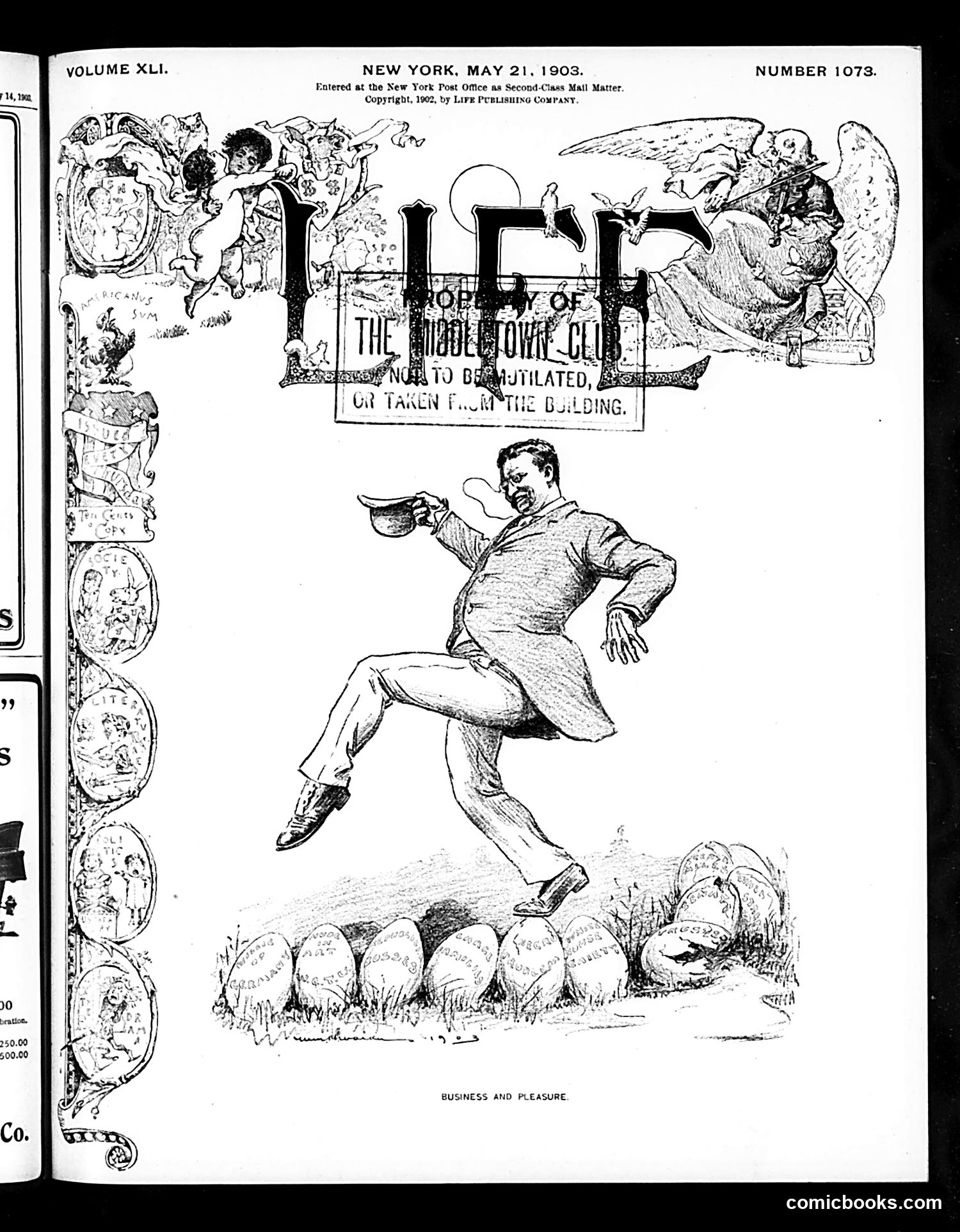
This page features "Life's" masthead and a cartoon titled "Business and Pleasure." The main illustration shows a well-dressed man energetically kicking what appear to be eggs or round objects while holding a bowl or cup, suggesting he's engaged in some form of vigorous activity. The sidebar contains decorative illustrations referencing classical or mythological scenes. Without clearer identification of the specific figure or the contemporary context of May 1903, the exact political or social target remains unclear. The cartoon's title suggests a commentary on balancing business obligations with leisure pursuits, possibly satirizing someone's approach to these competing interests. The energetic pose and somewhat undignified posture suggest mockery of the subject's behavior or priorities.
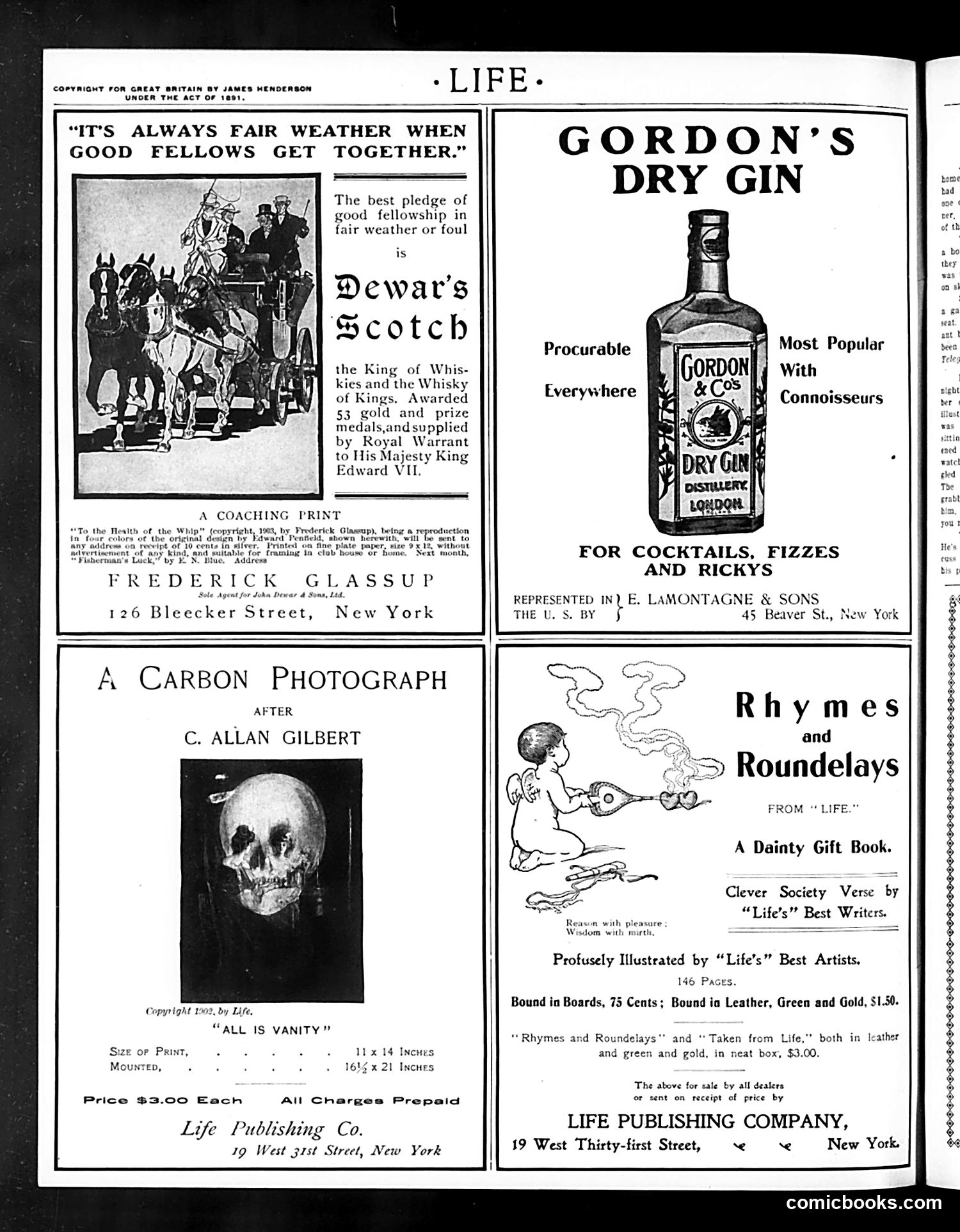
This page is primarily **advertising** rather than editorial content. The top-left features a Dewar's Scotch ad with a "coaching print" (vintage illustration) showing figures in a horse-drawn carriage, accompanying the slogan "It's Always Fair Weather When Good Fellows Get Together." Below that is a Frederick Glassup art print advertisement. The right side advertises Gordon's Dry Gin and a book titled "Rhymes and Roundelays" from Life Publishing Company. There is **no political cartoon or satire** on this page. The content consists entirely of commercial advertisements typical of early 20th-century magazines, where Life—though known for satirical editorial content elsewhere—carried substantial advertising revenue. The illustrations are generic lifestyle imagery meant to appeal to affluent readers.
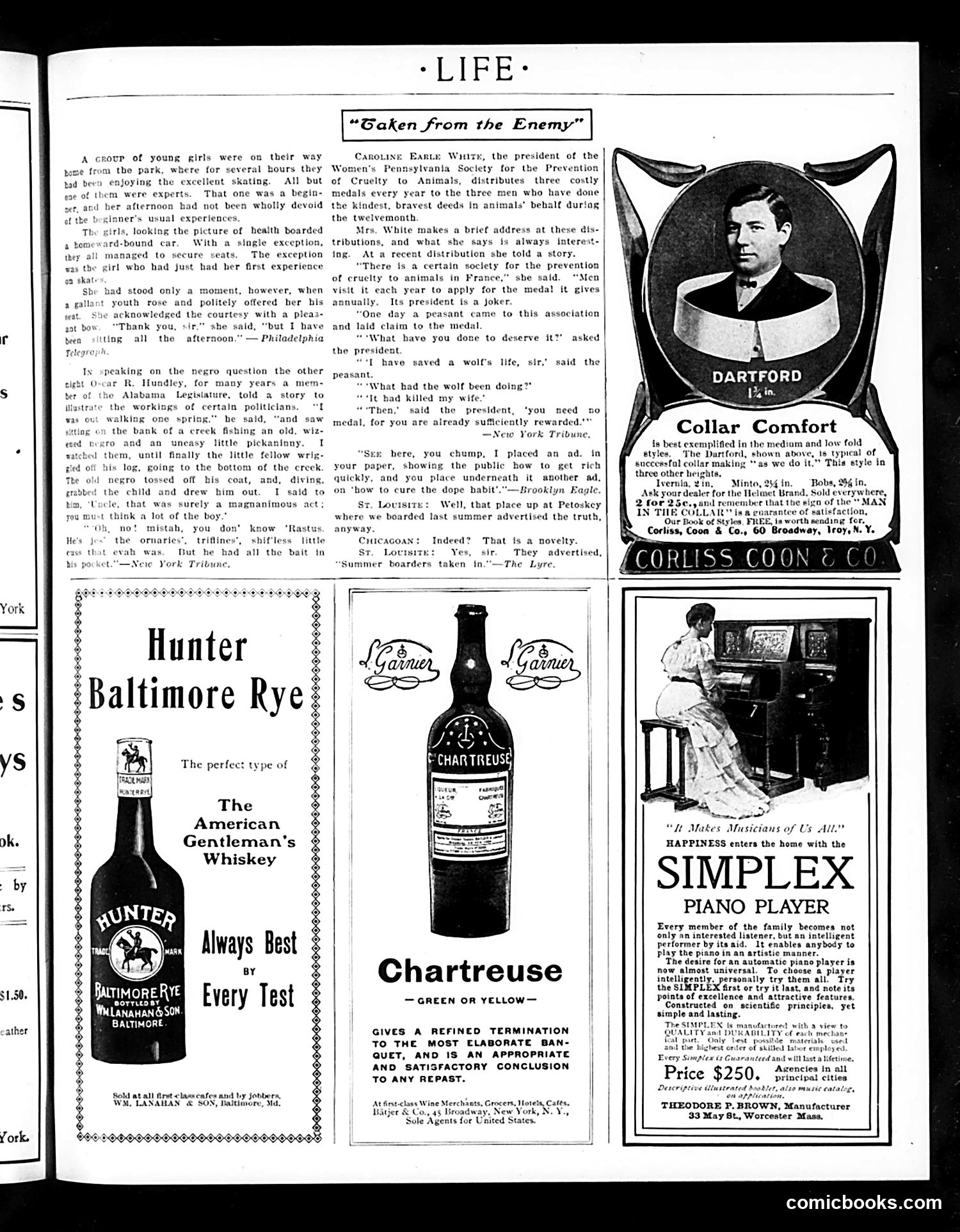
This page is primarily **advertising**, not editorial cartoons or satire. The main content consists of three product advertisements: 1. **Hunter Baltimore Rye** whiskey—positioned as "The American Gentleman's Whiskey" 2. **Chartreuse** liqueur (green or yellow varieties)—emphasizing refined taste 3. **Simplex Piano Player**—a mechanical piano device priced at $250 The upper portion contains a brief article titled "Taken from the Enemy" about Caroline Earle White and the Women's Pennsylvania Society for the Prevention of Cruelty to Animals, including an anecdote about deserving a medal. Given the heavy alcohol advertising alongside consumer goods, this appears to be from the pre-Prohibition era. The ads target affluent readers through appeals to gentility and sophistication rather than satire.
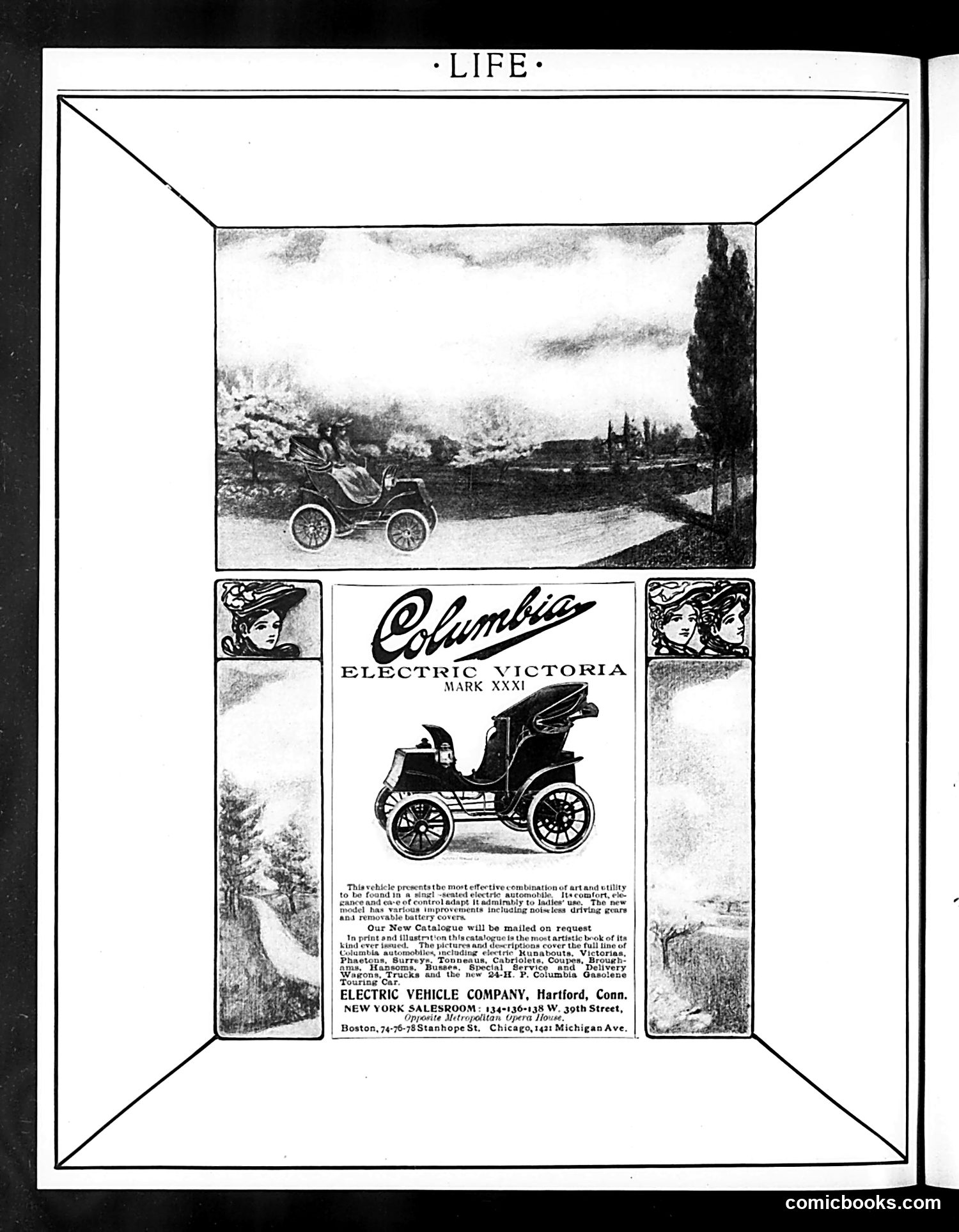
This page is primarily **advertising, not satire or political commentary**. It features a Columbia Electric Victoria automobile advertisement from the Electric Vehicle Company of Hartford, Connecticut. The ad showcases the vehicle as combining "art and utility," emphasizing its appeal to female drivers—note the elegant woman illustrated and the text noting "ease of control adapted it admirably to ladies' use." The scenic photograph at top depicts the car in a pastoral landscape, suggesting leisurely recreational driving. The decorative female head illustrations flanking the advertisement reflect early 1900s aesthetic conventions. This represents marketing strategy targeting affluent women as automobile consumers during the electric vehicle era, before gasoline engines dominated the market.
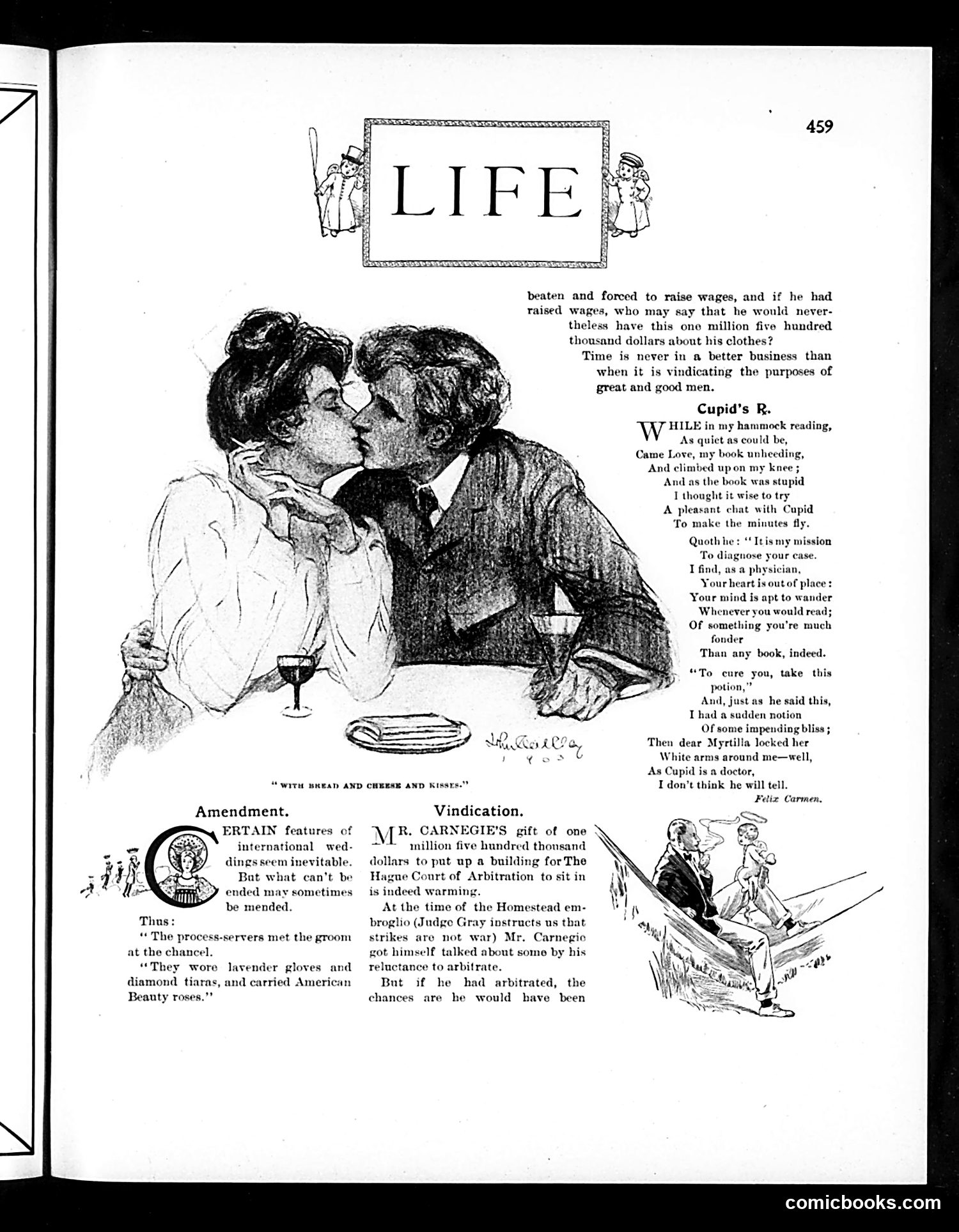
This page contains two satirical pieces about Andrew Carnegie's philanthropy and labor disputes. **"Cupid's R."** (top): A romantic poem mocking Carnegie's gift of $1.5 million for The Hague Court of Arbitration. The cartoon shows a couple kissing while reading—the joke being that Carnegie's arbitration court is more sentimental than practical. **"Amendment" and "Vindication"** (bottom): These sections critique Carnegie's labor record. The text notes that while Carnegie funds arbitration courts, he was reluctant to arbitrate his own labor disputes. The satire suggests his philanthropy appears designed to vindicate his reputation rather than address genuine worker grievances. The references to "process-servers," "lavender gloves," and "American Beauty roses" mock the disconnect between his wealth and his treatment of workers.
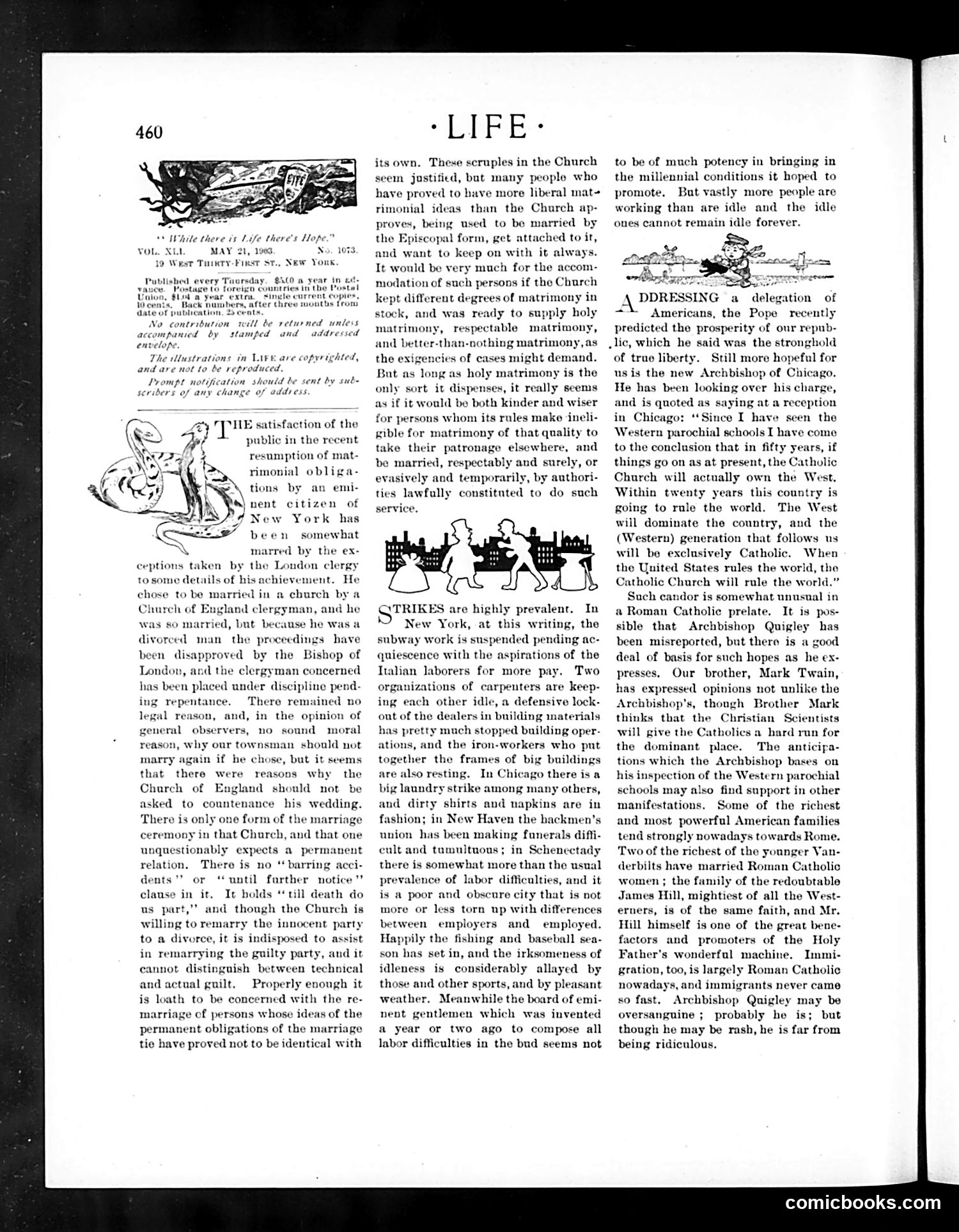
This page contains two distinct illustrations: 1. **Top left**: A decorative initial letter "W" featuring cherubs or putti in classical style—ornamental rather than satirical. 2. **Center**: A small cartoon labeled "STRIKES" showing simplified figures at what appears to be a table or negotiating scene, depicting labor unrest. The surrounding text discusses marriage, Church doctrine, and contemporary labor disputes in New York, Chicago, New Haven, and Schenectady. The article references strikes among carpenters, iron-workers, laundry workers, and other laborers demanding better pay and conditions. The "STRIKES" cartoon appears to satirize labor negotiations—showing workers in conflict with management. Given the 1903 date, this reflects the era's significant labor activism and industrial disputes that dominated American news.
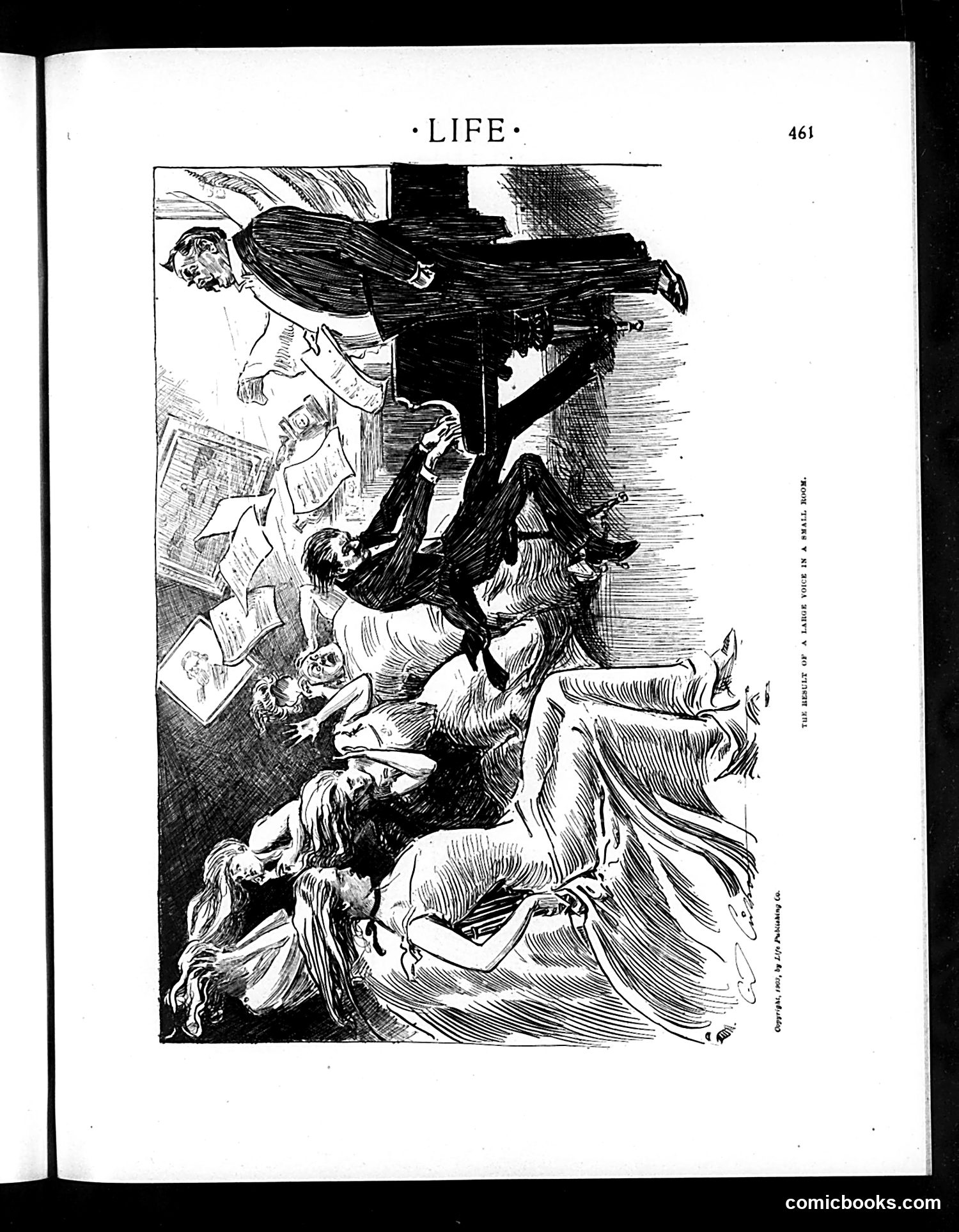
This page contains a single satirical illustration rendered in black and white. The cartoon depicts a figure in formal attire (appearing to be a wealthy or powerful person) lounging or reclining while being attended to by multiple women in classical or allegorical dress. The composition suggests indulgence and excess. The artwork uses classical allegorical figures—likely representing virtues, vices, or abstract concepts—to satirize the subject's lifestyle or character. The contrast between the formally-dressed central figure and the partially-draped attendants emphasizes themes of moral decay, luxury, or social hypocrisy common to Life magazine's satirical content. Without visible text identifying specific figures or dates, the exact political or social target remains unclear, though the general critique of elite excess and moral corruption is evident.
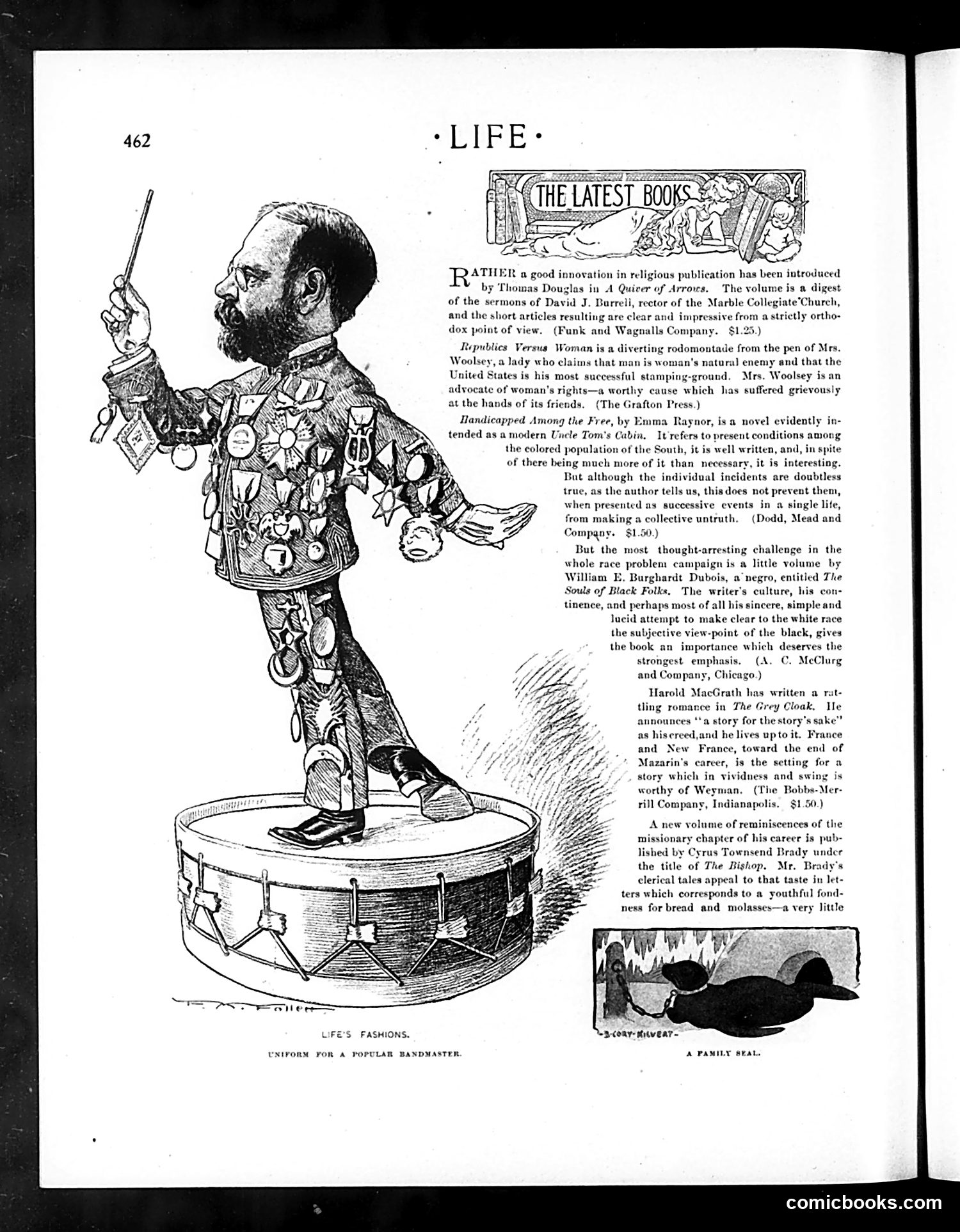
The main cartoon depicts a military figure standing on a drum, heavily decorated with medals and insignia across his uniform. He holds a conductor's baton aloft. The caption reads "Uniform for a Popular Bandmaster." This is satirical commentary on military pageantry and ostentation. The "bandmaster" appears to be a caricature mocking someone—likely a military or political leader of the era—who displays excessive decoration and ceremony. The joke equates serious military uniform with costume, suggesting the figure is more theatrical performer than substantive leader. The right column reviews recent books, including works on religious topics, race relations, and missionary narratives, indicating Life's editorial focus on social and moral issues of the period.
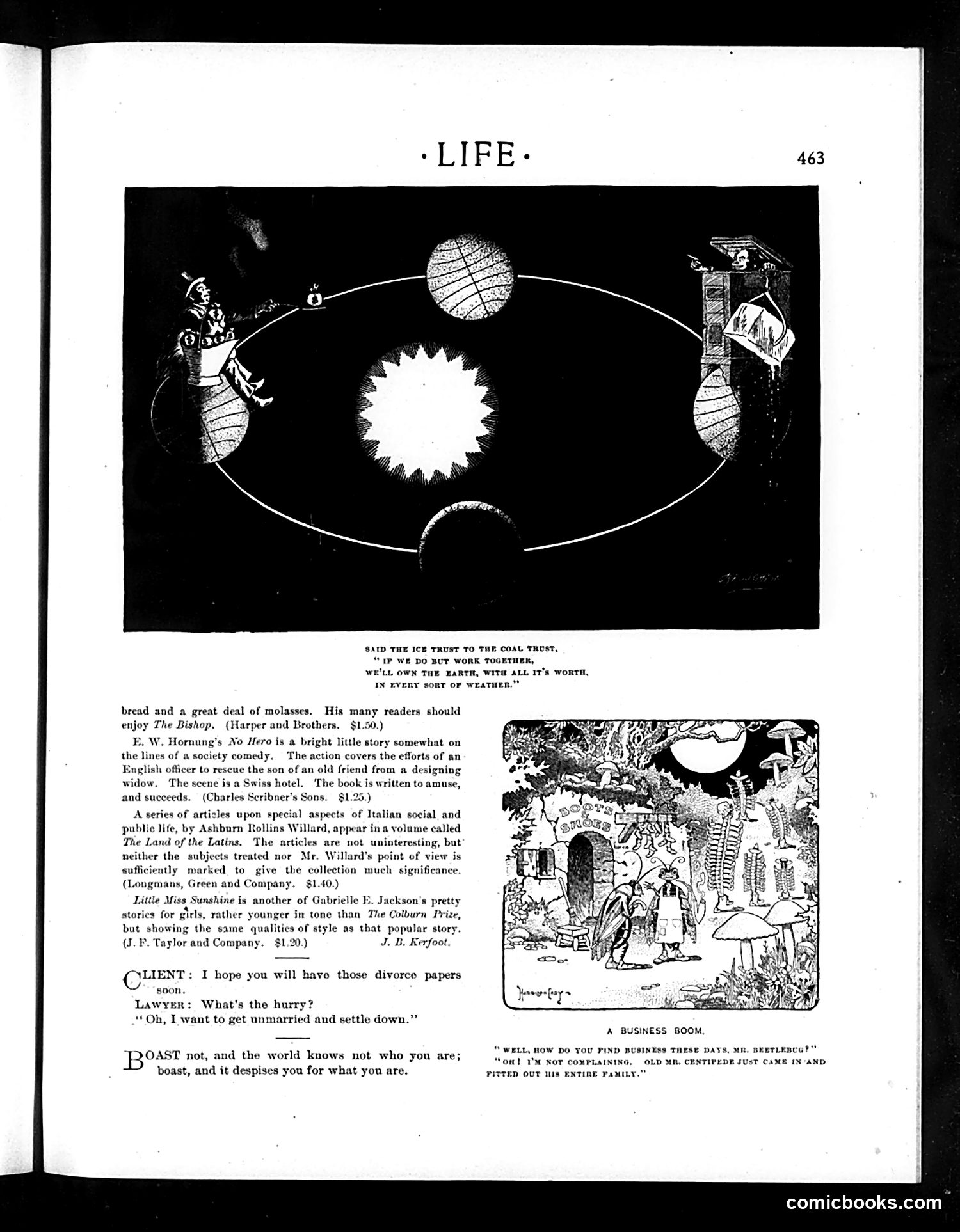
The top illustration depicts a satirical vision of labor cooperation: an Ice Trust representative and Coal Trust representative shake hands across Earth and celestial bodies, with the caption promising that if they "work together," they'll "own the earth, with all it's worth, in every sort of weather." The satire targets **monopolistic trusts** of the early 20th century—the Ice Trust and Coal Trust appear as coequal powers dividing global dominion. The cosmic scope emphasizes their perceived immense influence. Below, "A Business Boom" cartoon shows a businessman explaining economic success to a visitor, crediting an elderly man's recent inheritance dispersal as boosting local business—satire about how inherited wealth temporarily stimulates commerce rather than representing genuine economic health. The page also reviews books and includes witty aphorisms about boasting and divorce, typical of Life's satirical content.
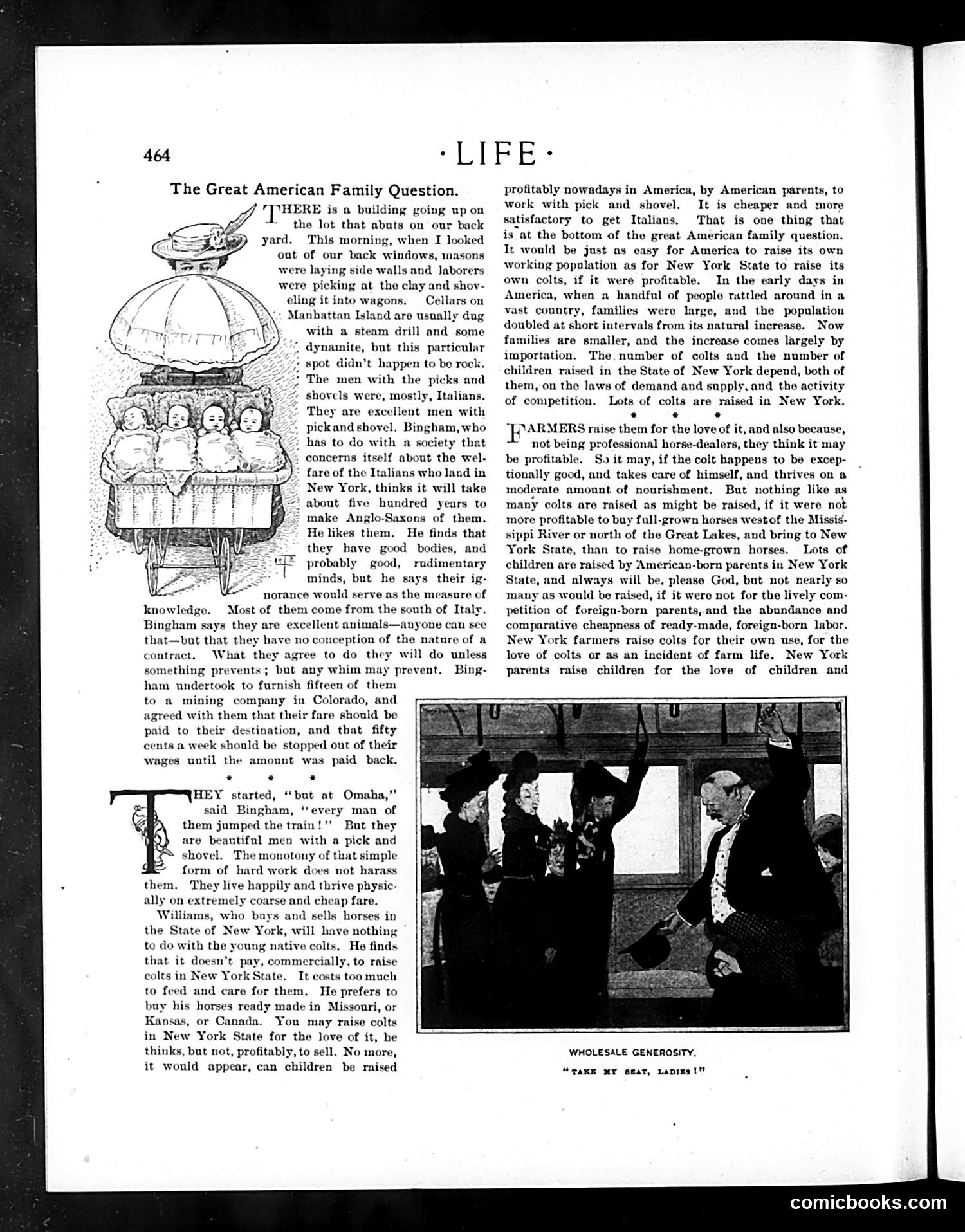
This satirical article contrasts two approaches to raising children in America. The left illustration depicts Italian immigrant laborers (referenced as excellent workers with "pick and shovel") carrying multiple children in a basket—satirizing large immigrant families and their working-class conditions. The article argues that wealthy American parents raise fewer children due to cost and competition, while immigrant families raise many children affordably. A person named Bingham claims that raising children in New York is unprofitable compared to importing foreign labor. The right photograph titled "Wholesale Generosity" shows what appears to be a crowded public transit scene, captioned "Take My Seat, Ladies!"—likely mocking either immigrant generosity or chaotic urban conditions. The piece critiques America's preference for cheap immigrant labor over supporting native-born population growth.
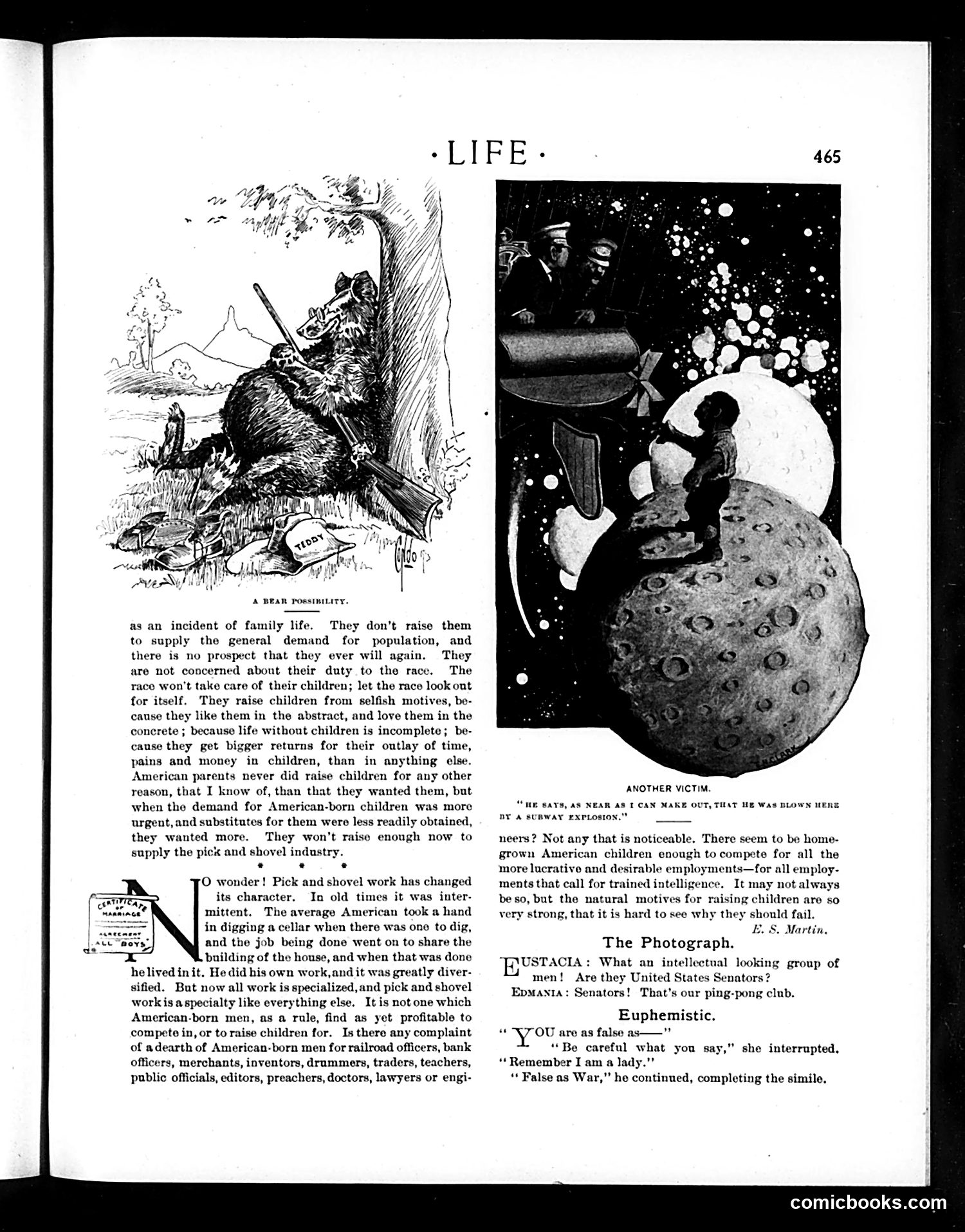
**Left illustration ("A Bear Possibility"):** A sketch showing a bear climbing a tree, seemingly threatening or approaching a human settlement below. This appears to be a humorous commentary on frontier life or wildlife dangers in America. **Right photograph ("Another Victim"):** A dramatic image captioned "He says, as near as we can make out, that he was blown here by a subway explosion." The photo shows what appears to be a person amid debris near a large spherical object (possibly the moon or a bomb), with onlookers visible above. The accompanying text discusses American child-rearing practices and family life, contrasting with the satirical title "Euphemistic." The overall page appears to mix frontier/nature humor with urban disaster commentary, typical of Life's satirical approach to American social issues.
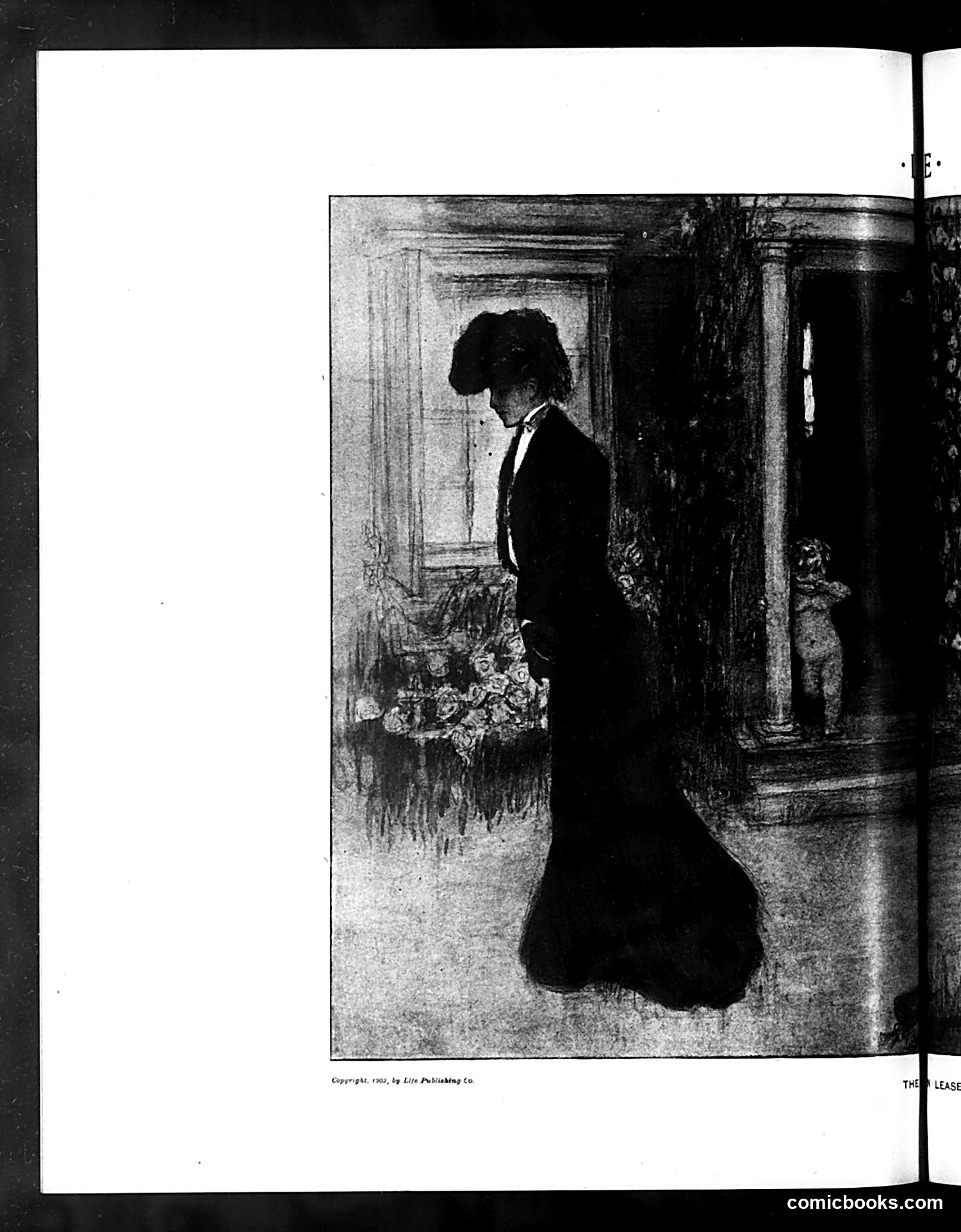
This appears to be an illustration from Life magazine showing a solitary figure in formal dark clothing standing in an ornate interior hallway or corridor. The figure is depicted from behind, gazing toward a window or light source ahead. Without visible text identifying the specific subject or context on this page, I cannot definitively explain what political or social satire this represents. The copyright notice credits "Life Publishing Co." (visible at bottom), but the OCR text provided contains only those credits, not explanatory captions. The artistic style and composition suggest introspection or longing, possibly commenting on isolation or contemplation, but identifying the specific figure, event, or satirical point would require additional contextual information not clearly visible in this image.
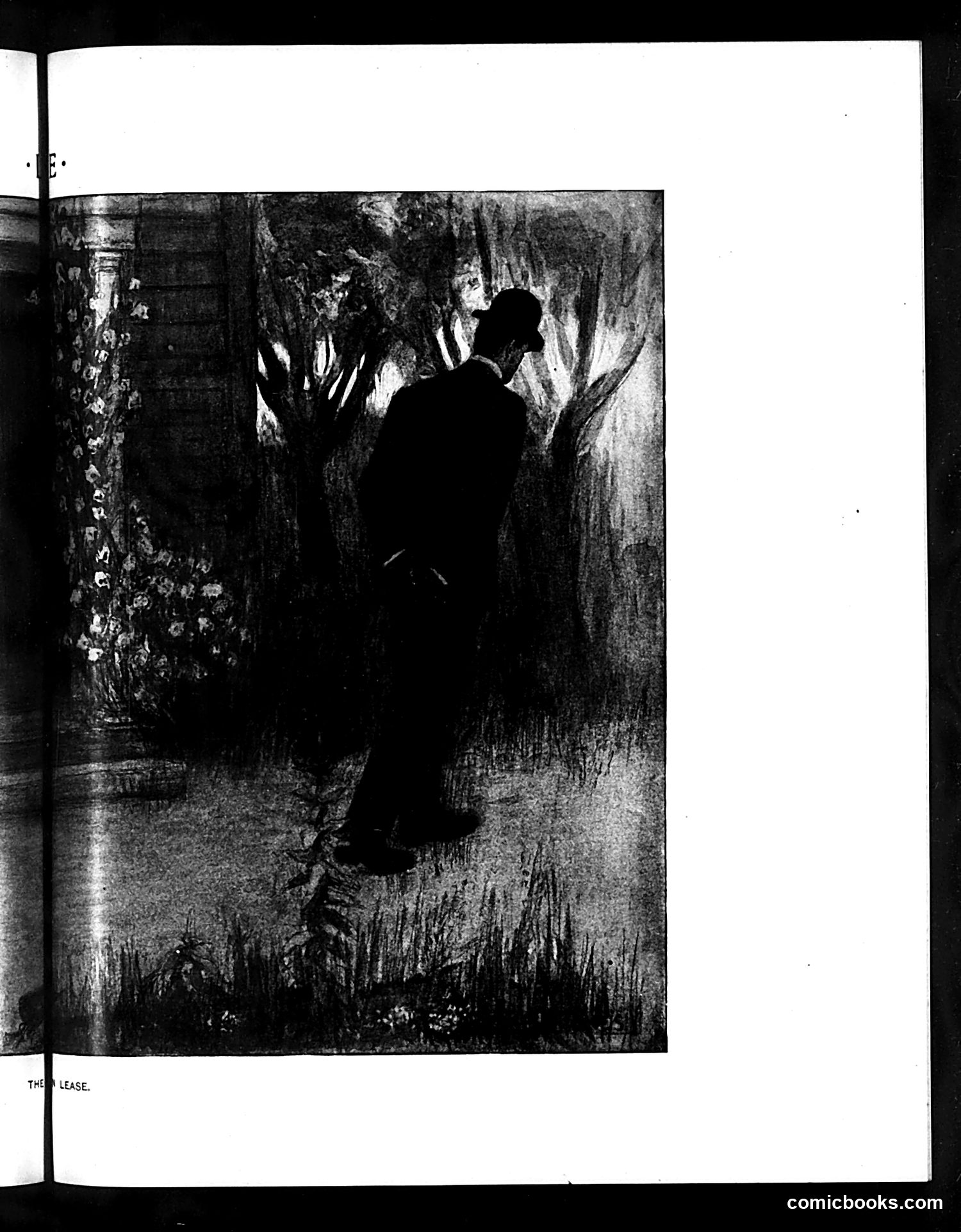
This page appears to be from an early issue of *Life* magazine and shows a silhouetted figure standing in what looks like a garden or natural setting with trees and vegetation. The figure is shown from behind in a contemplative pose. The OCR text only reads "comicbooks.com," which is a modern website attribution and not original text from the magazine. Without clearer text or caption visible on the page itself, I cannot definitively identify the specific political or social satire intended. The artistic style suggests this is a serious or melancholic illustration rather than humorous cartooning. Without legible original captions or context, I cannot accurately explain the cartoon's meaning or historical reference for a modern reader.
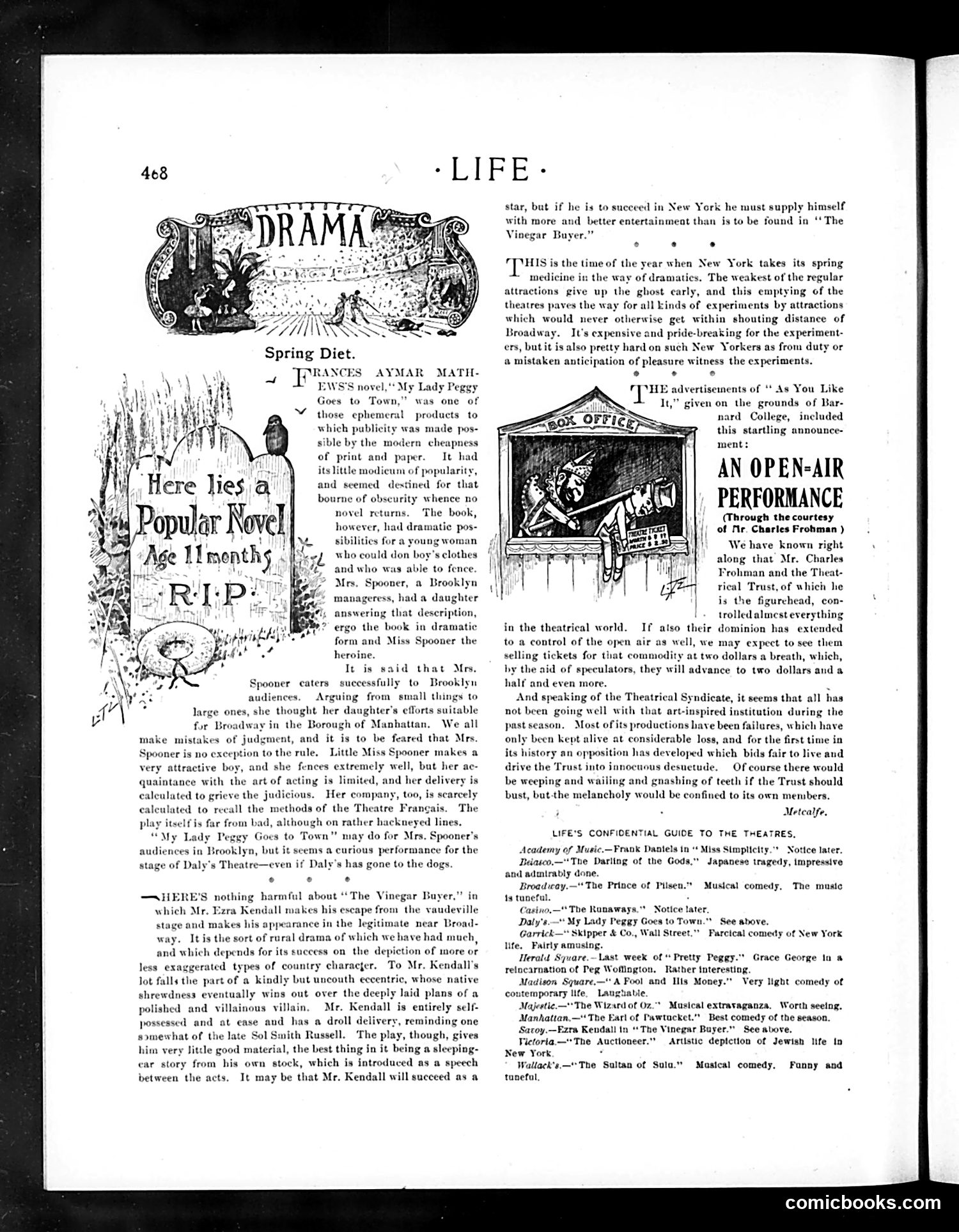
This page from *Life* magazine contains theatrical criticism and satire about spring theater season in New York. The main cartoon shows a gravestone for "Here lies a Popular Novel / Age 11 months"—mocking how quickly popular books become forgotten. The text critiques three theatrical productions: 1. **"My Lady Peggy Goes to Town"**: A dramatization of a now-obscure novel, featuring a young actress who "could don boy's clothes and fence" but lacks real acting ability. The critic dismisses it as suitable only for Brooklyn audiences, not Broadway. 2. **"The Vinegar Buyer"**: Stars a vaudeville performer (Mr. Kendall) attempting legitimate theater in a rural drama. The critic finds the material weak despite the actor's natural talent. 3. An **open-air production** of "As You Like It" at Barnard College—mocked for crediting Charles Frohman's theatrical monopoly ("the Theatrical Trust"), suggesting the Trust controls even outdoor performances and would commercialize them. The satire targets theatrical mediocrity and corporate theatrical monopolies during New York's spring theatrical season.
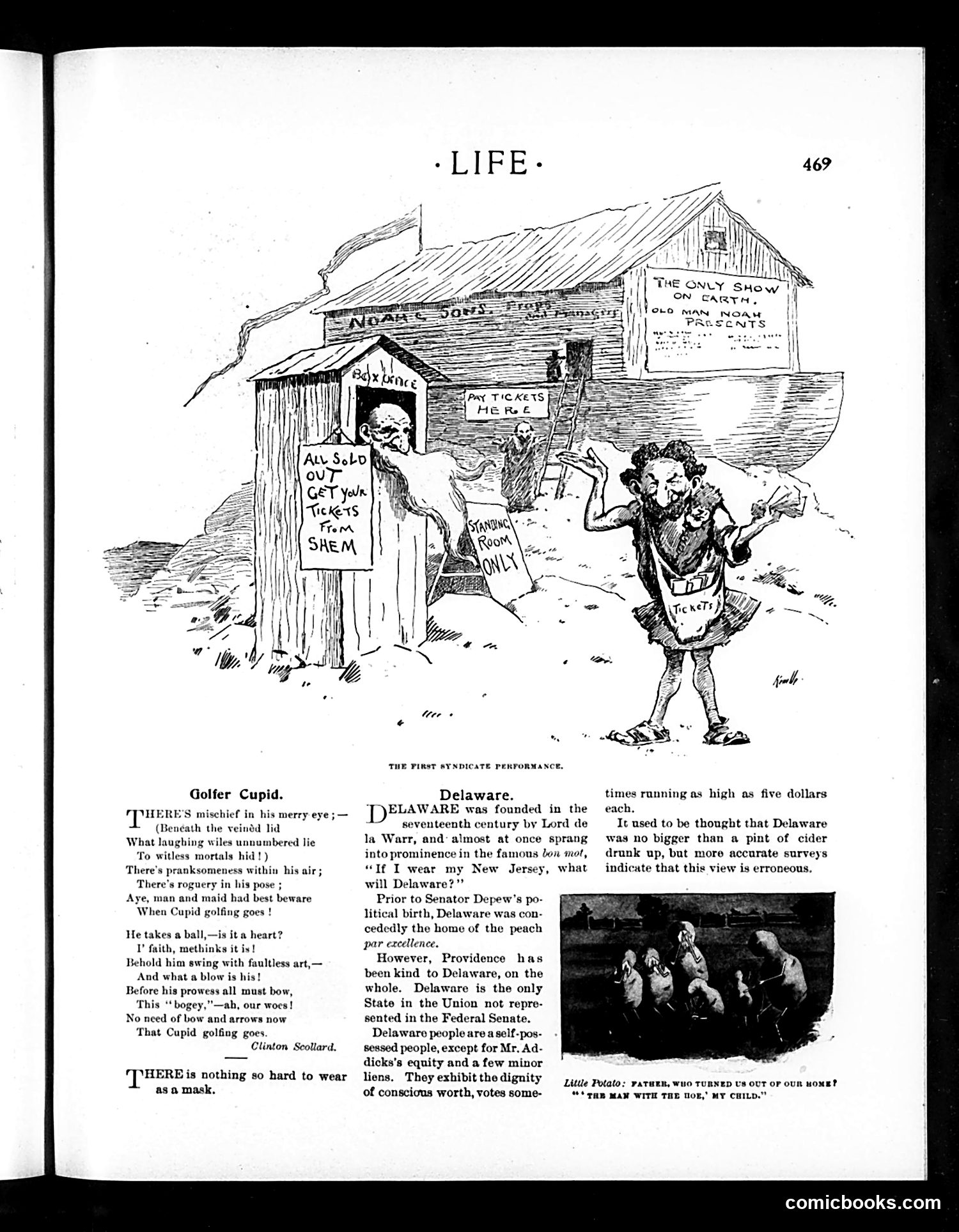
**Top Cartoon ("The First Syndicate Performance"):** A satirical takedown of a traveling circus or museum exhibit claiming to show "Noah's Ark" — likely a contemporary con artist's attraction. The ragged showman is hawking tickets to this fraudulent spectacle, while a shabby man in front complains he's been ejected. The title suggests this is the first performance of a "syndicate" (organized scheme), mocking both the charlatan promoter and gullible audiences willing to pay for obvious fakery. **"Golfer Cupid" Poem:** A light romantic verse playing on golf's popularity, imagining Cupid using golf clubs instead of arrows to strike lovers. **"Delaware" Section:** Satirizes Delaware's political irrelevance and poverty. The bon mot about "If I wear my New Jersey, what will Delaware?" is a dismissive pun. Text notes Delaware is the only U.S. state unrepresented in the Federal Senate (historically accurate), and references "Mr. Addicks's equity"—likely referring to disputed Delaware political claims. The bottom photo caption jokes bitterly about poverty and homelessness.
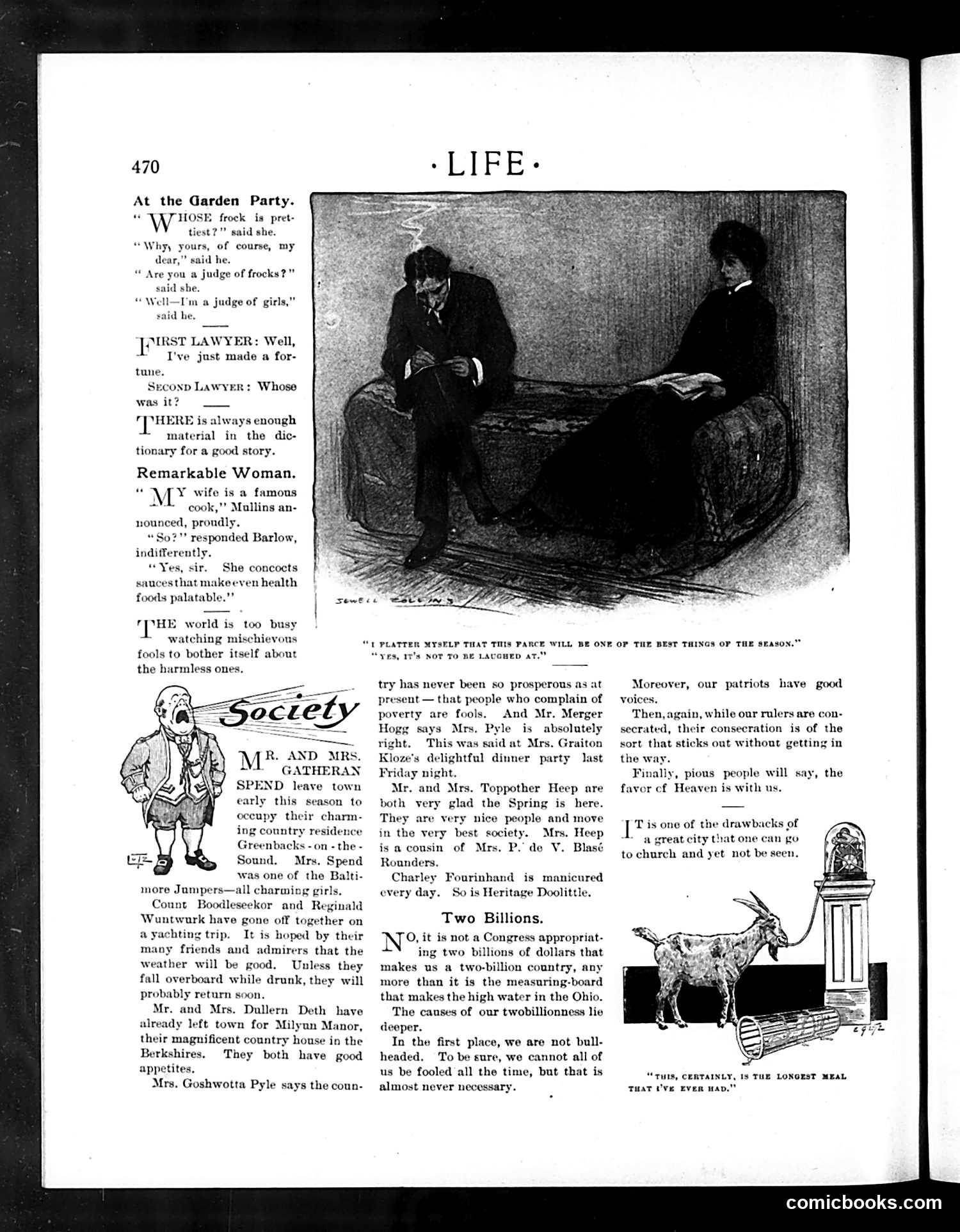
This page contains society gossip and satirical commentary typical of Life's humor section circa early 1900s. **Top cartoon:** Two men at a garden party discuss frocks (dresses). One claims to be "a judge of girls," implying shallow, flirtatious behavior masked as social refinement. The joke mocks pretentious male behavior at high-society events. **"Remarkable Woman"** section mocks a wife whose only accomplishment is cooking—specifically making inedible "health foods" palatable. It's satirizing limited female roles and the patronizing way husbands discuss wives. **Society column:** Lists absurdly-named wealthy people (Mr. Spendmore, Count Boodleseekor, "Merger Hogg") engaging in frivolous activities—yachting trips, country estates, manicures. The names are invented to mock the wealthy class's pretension and moral emptiness. **"Two Billions"** essay sarcastically celebrates American prosperity and virtue while implying the wealthy are foolish and their leaders are hypocritical. It's political critique wrapped in faux-patriotic language. The overall message: American high society is morally shallow, economically unequal, and worthy of ridicule.
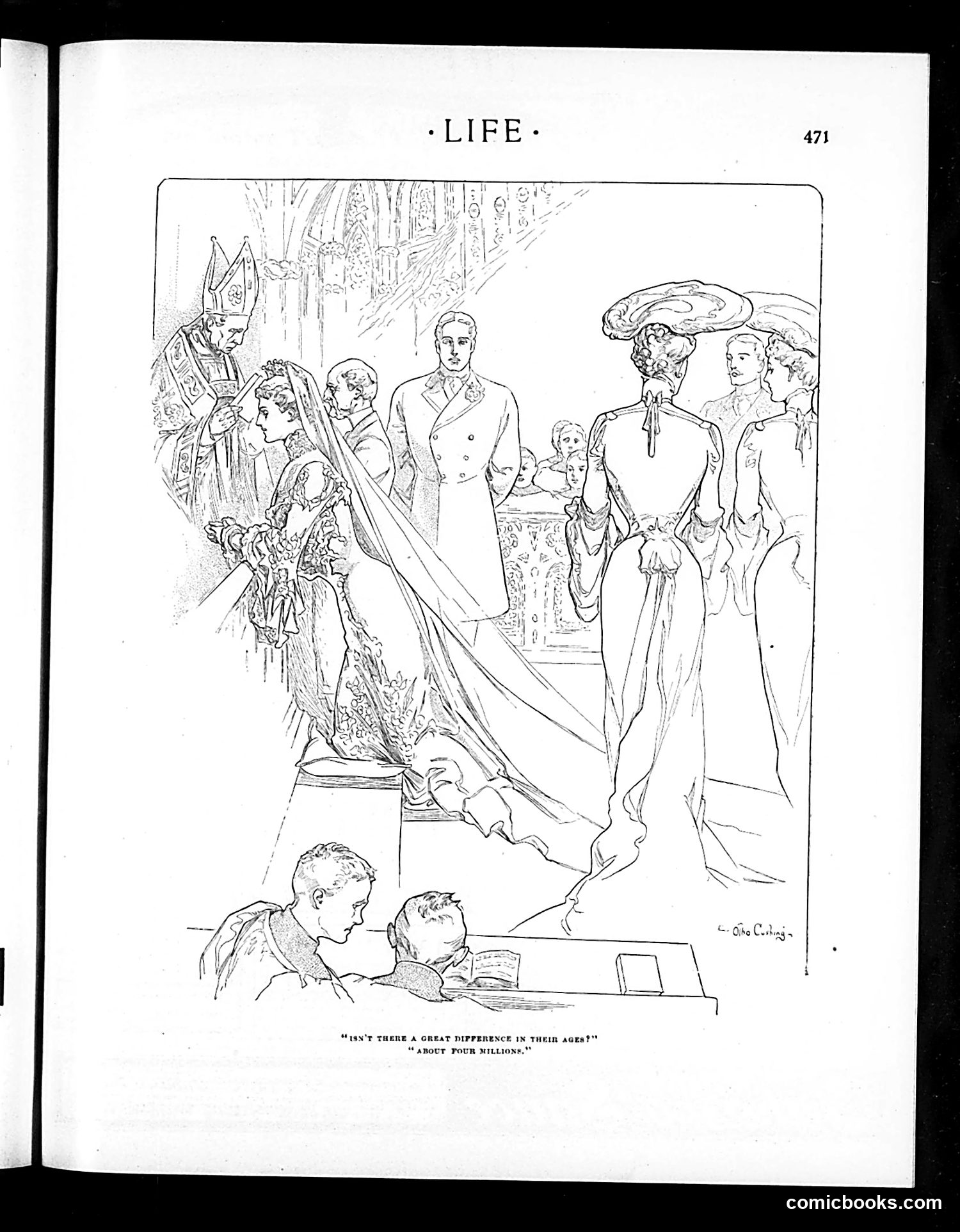
This is a single-panel cartoon satirizing wealth disparity. The scene depicts an elaborate formal or religious ceremony with elaborately dressed figures in the upper portion—including what appears to be a bishop or high-ranking clergyman on the left. In the lower foreground, two children sit observing, with one asking about the "great difference in their ages." The response, "about four millions," suggests the cartoon equates age difference with monetary wealth difference. The satire critiques how wealth creates such vast social divides that even age becomes secondary to financial status in determining one's position and role in society. The formal, ornate setting contrasts sharply with the children's humble vantage point, emphasizing class stratification.
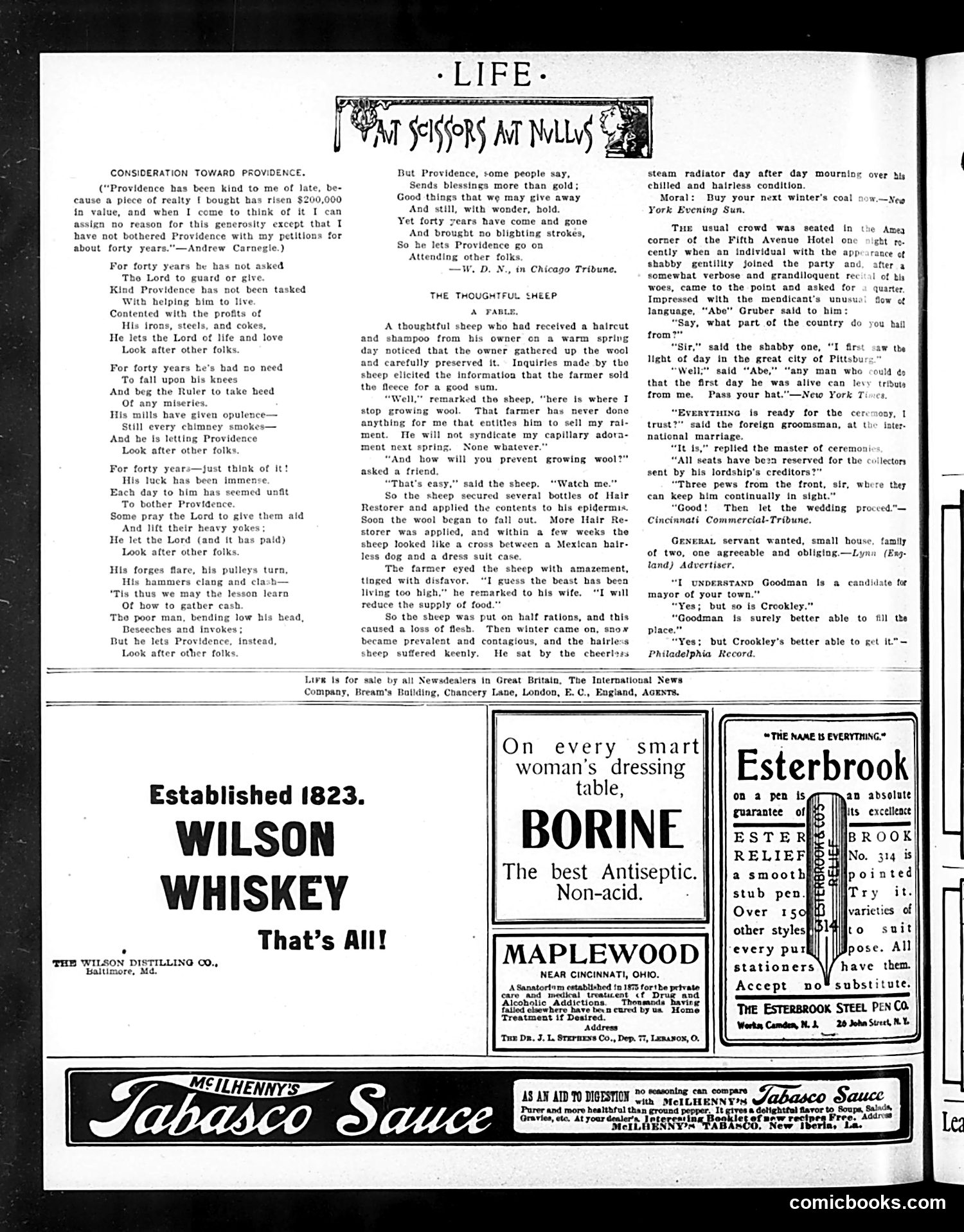
This page contains two satirical pieces targeting wealth and self-interest: **"Consideration Toward Providence"** mocks Andrew Carnegie (the steel magnate), whose real estate holdings appreciated $200,000. The poem criticizes his forty-year neglect of charitable giving or prayer, suggesting his wealth came from luck rather than merit or divine favor. The satire implies Carnegie should acknowledge Providence's role in his fortune by helping the poor, who actually do pray for assistance. **"The Thoughtful Sheep"** is an Aesop-style fable satirizing labor relations. A sheep, learning his wool is sold for profit, tries sabotaging his own wool growth using hair restorer. The farmer responds by cutting his food rations, and the sheep suffers terribly in winter. The moral: workers who resist exploitation end up worse off. This appears to critique both labor militancy and employer retaliation during the industrial era. Both pieces use humor to highlight economic inequality and the moral failures of the wealthy.
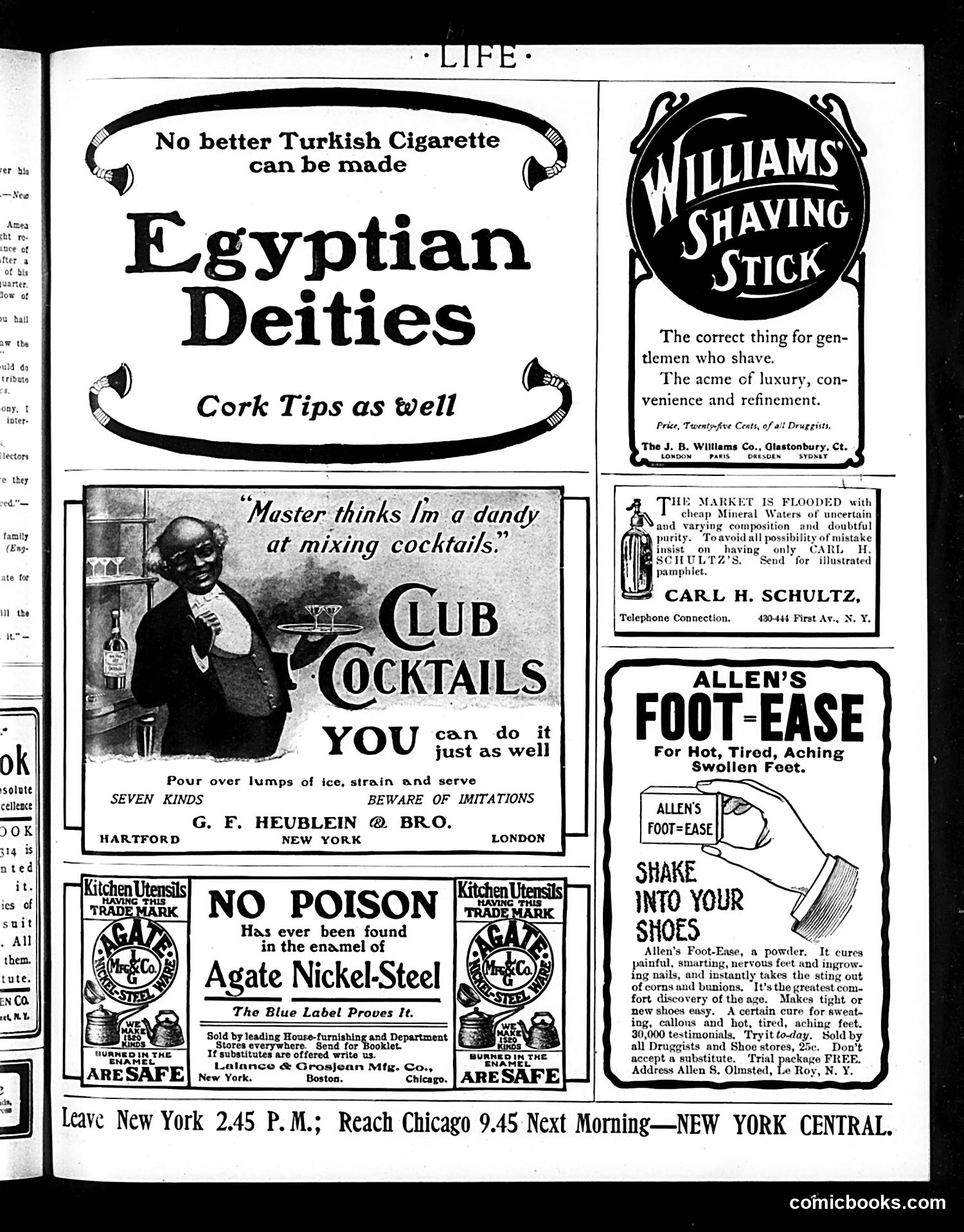
This page is **primarily advertisements**, not political satire or editorial cartoons. It showcases early 20th-century consumer products with period marketing claims now considered absurd or problematic. **Notable ads include:** - **Egyptian Deities cigarettes**: Appeals to exotic taste; the "Egyptian" branding reflects era's fascination with orientalism - **Club Cocktails**: Features a servant/bartender figure with the joke "Master thinks I'm a dandy at mixing cocktails"—reflecting class hierarchies and servant labor as entertainment - **Agate Nickel-Steel kitchenware**: Markets via safety ("No poison") - **Williams Shaving Stick**: Emphasizes luxury and "refinement" for gentlemen - **Allen's Foot-Ease**: Typical patent medicine promising miraculous cures for foot problems The page reflects early-1900s consumer culture, class assumptions, and unsubstantiated medical claims that would violate modern advertising standards. There is **no evident political cartoon or unified satirical message**—it's a straightforward advertising collection.
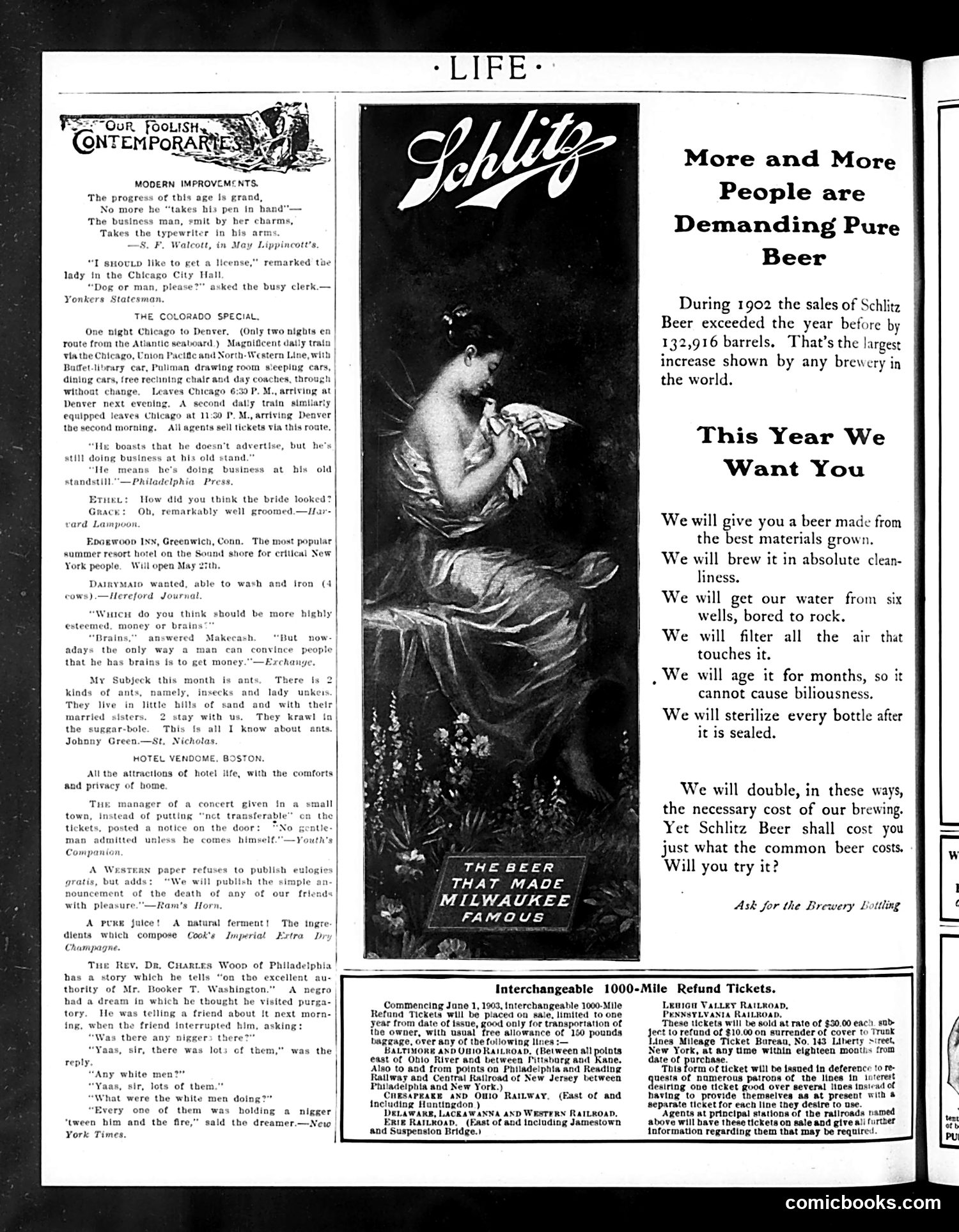
This page combines satirical commentary with advertising. The left side features "Our Foolish Contemporaries"—a humor column collecting witty excerpts mocking modern life. The jokes target contemporary absurdities: a woman seeking a dog-or-man license, confusion about progress and typewriters, and a racist anecdote (reflecting the deeply offensive humor standards of the era) about a Black man's dream. The dominant content is a **Schlitz Beer advertisement** featuring an allegorical female figure. The ad capitalizes on the 1902 sales surge (132,916 barrels) to promote purity—then a major selling point as consumers grew concerned about food safety and contamination. Schlitz promises filtered air, sterilized bottles, and pure water from rock wells, positioning premium quality as worth the higher cost. The bottom section advertises railroad refund tickets, typical of Life's mixed editorial-advertising format from this era.
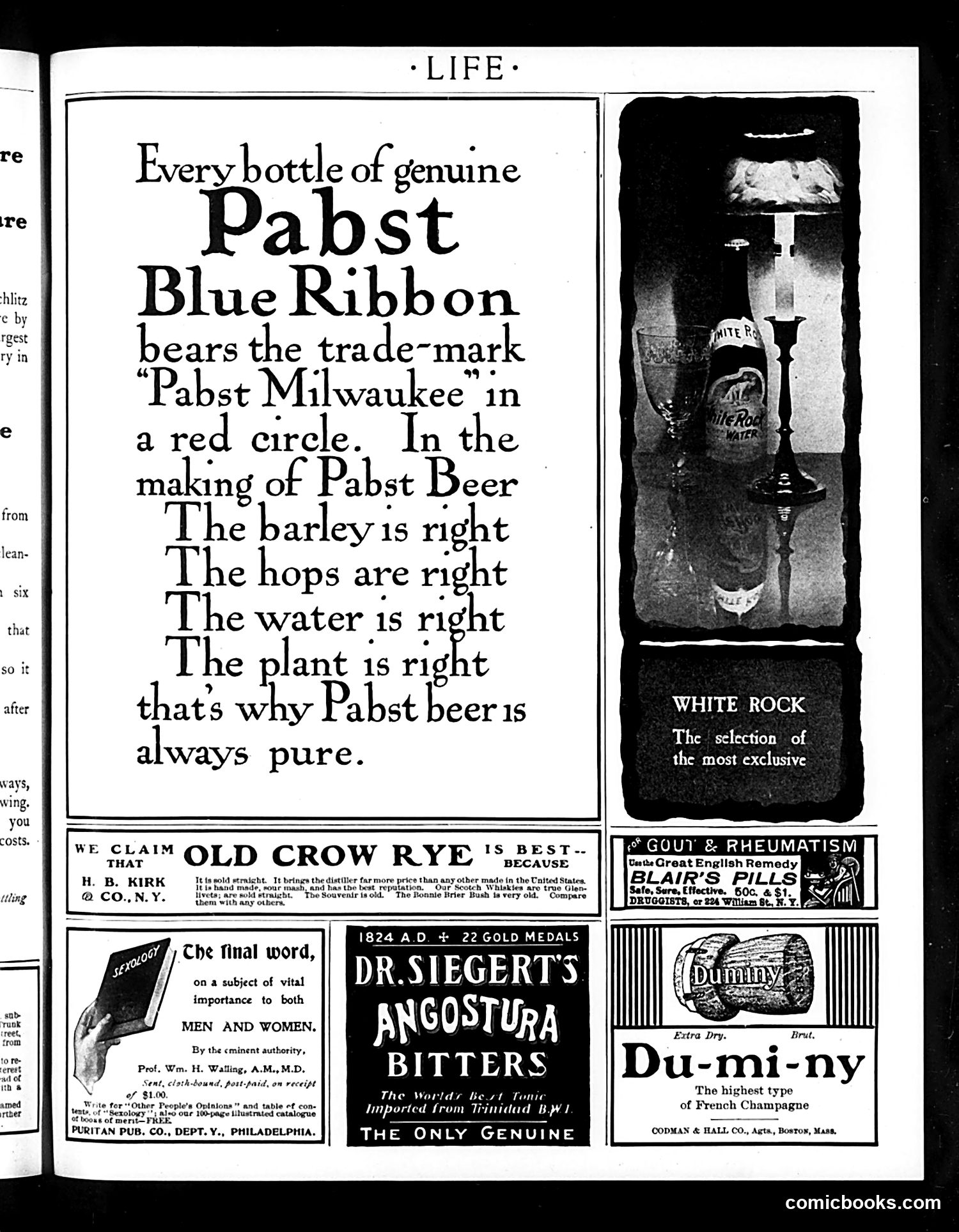
This is primarily an **advertisement page** from Life magazine, not a political cartoon. It contains five product ads typical of early 20th-century publications: 1. **Pabst Blue Ribbon beer** — emphasizes purity and quality ingredients (barley, hops, water, plant) 2. **White Rock** — a mineral water marketed as "exclusive" 3. **Old Crow Rye whiskey** — claims superiority 4. **Dr. Siegert's Angostura Bitters** — positioned as a medicinal tonic from Trinidad 5. **Du-mi-ny champagne** — marketed as "highest type" 6. A book advertisement for medical/health advice The page reflects **turn-of-the-century consumer culture**: alcohol and patent medicines were heavily advertised alongside health claims. Note the medical language ("tonic," "gout & rheumatism") — bitters and tonics were sold as cure-alls before strict FDA regulations. No satire or political commentary is present; this is straightforward period advertising.
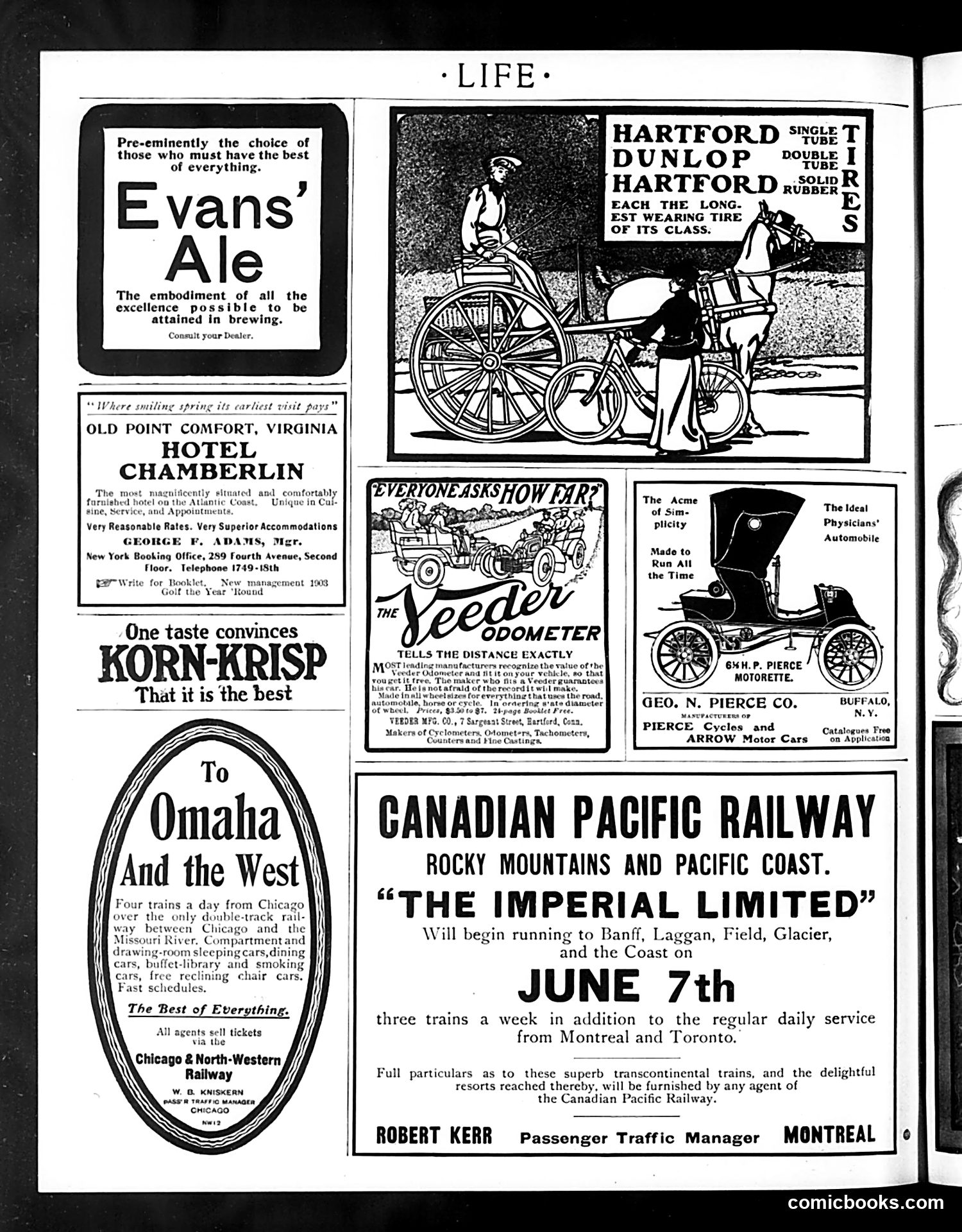
This is primarily a **advertising page**, not a political cartoon. The page dates to early 1900s (note "new management 1903" in the Hotel Chamberlin ad) and showcases luxury goods targeting wealthy Americans. The advertisements reflect **Gilded Age consumer culture**: Evans' Ale ("the choice of those who must have the best"), Hartford tires, the Hotel Chamberlin resort, and automobiles like the Pierce Motorette represent premium products for affluent customers. The slogan "The Best of Everything" appears repeatedly—capturing the era's conspicuous consumption. The only editorial cartoon is the **Needler Odometer ad**—a humorous illustration asking "Everyone asks how far?"—which is essentially comic advertising. The Canadian Pacific Railway ad announces "The Imperial Limited" train service, appealing to wealthy tourists seeking Rocky Mountain excursions. For modern readers: this page documents how early-1900s Life magazine funded itself through luxury advertising, not satire.
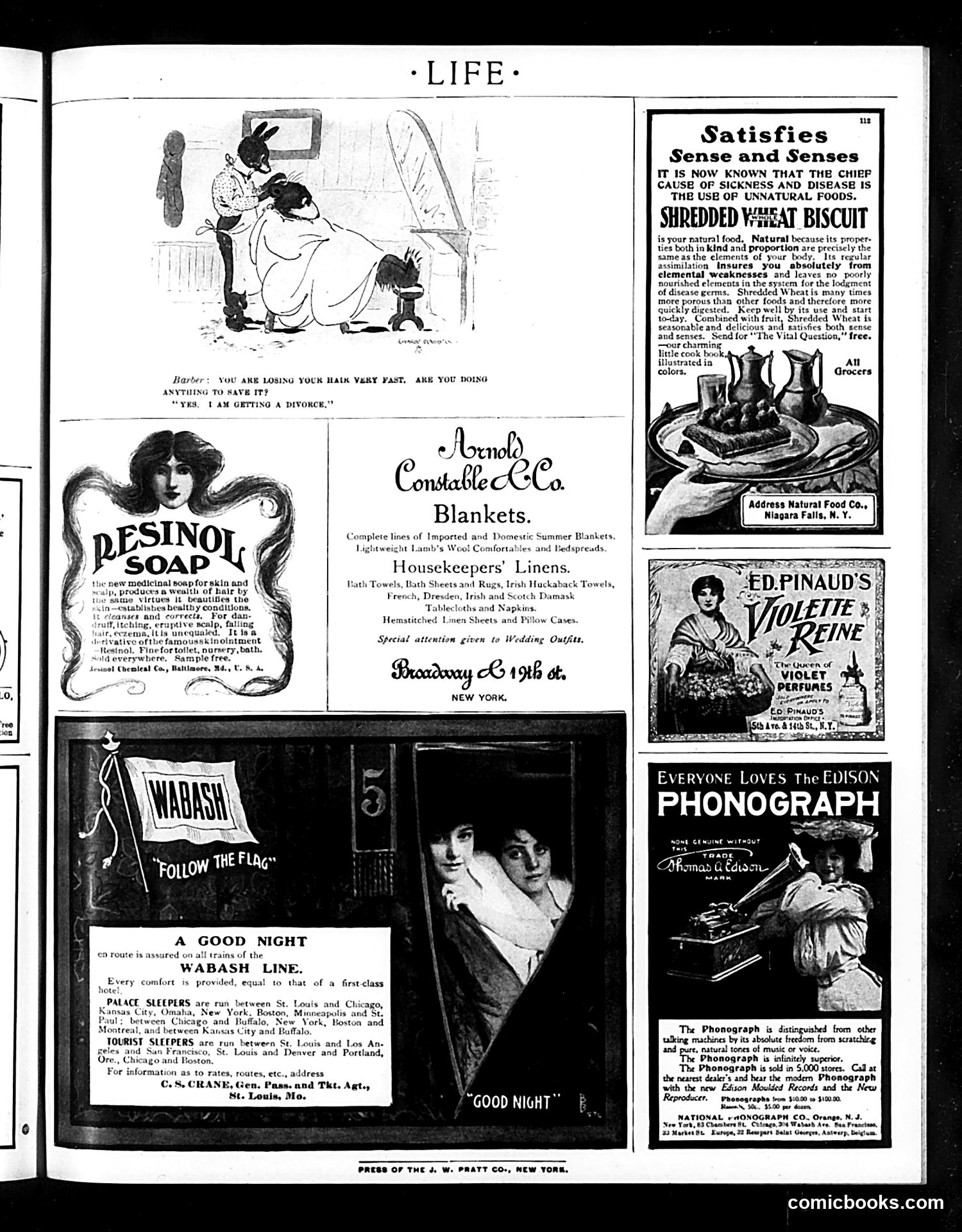
The single cartoon on this page shows a barber asking a customer why he's losing his hair so rapidly. The customer replies: "Yes, I am getting a divorce." The joke plays on the contemporary anxiety about hair loss and male baldness as a sign of aging or poor health. The punch line suggests that the stress and emotional turmoil of divorce proceedings is literally causing the man's hair to fall out—a common folk belief then (and somewhat now) that emotional distress affects physical appearance. The humor is straightforward domestic comedy: divorce was scandalous and stressful enough to literally make you bald. This assumes the reader finds both divorce and hair loss socially awkward topics worthy of satire. The rest of the page consists entirely of period advertisements for blankets, soap, railroads, food products, and Edison phonographs—typical of *Life* magazine's revenue model.
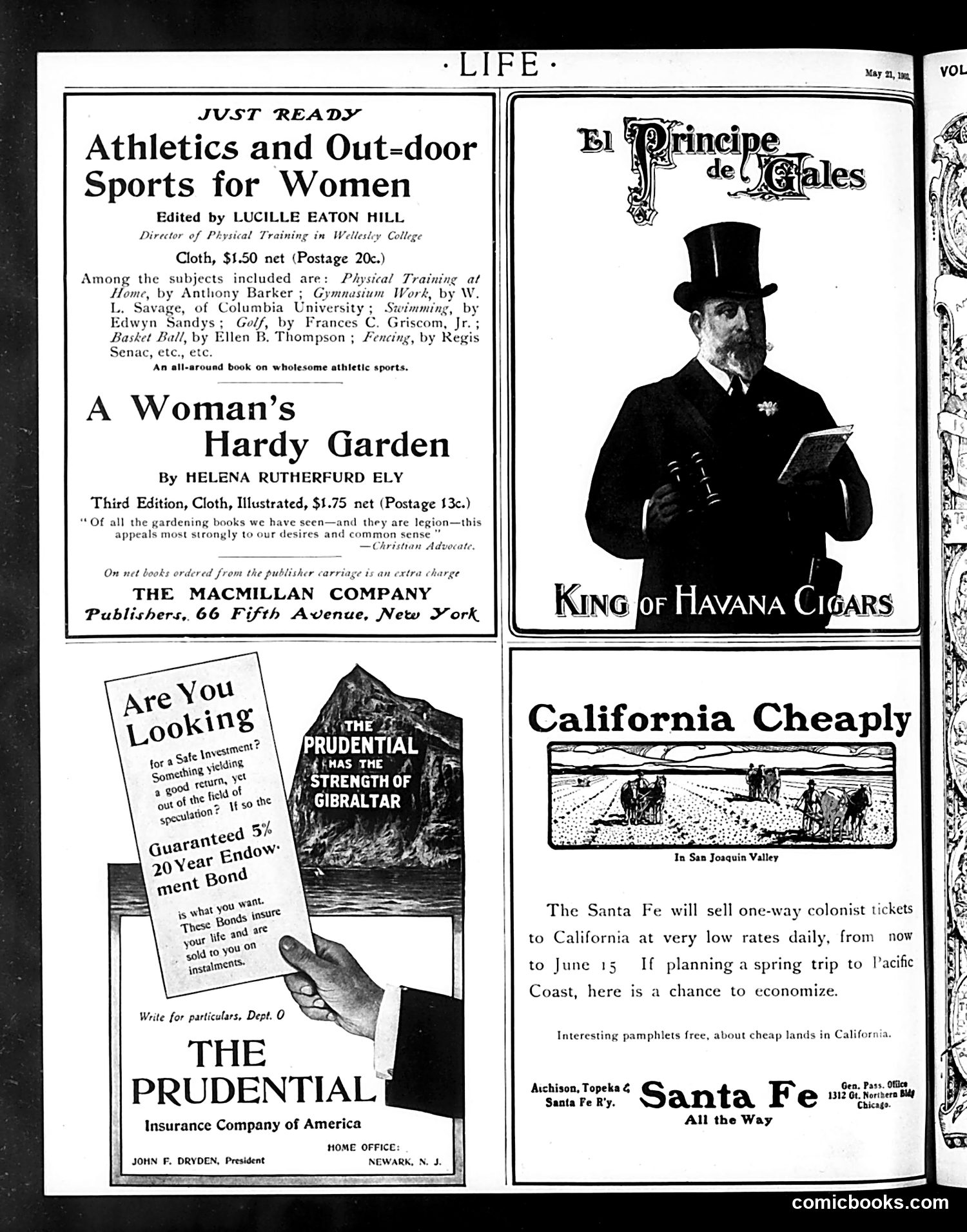
This page is primarily **advertising**, not satire or political commentary. It contains four distinct advertisements: 1. **Book advertisements** (left): promoting titles on women's athletics and gardening—reflecting early 1900s interest in women's physical fitness and domestic pursuits as respectable pursuits. 2. **"El Príncipe de Gales" / King of Havana Cigars** (top right): features a well-dressed gentleman in a top hat reading, marketed as a premium cigar brand with Spanish branding. 3. **Prudential Insurance Bond** (bottom left): promotes a guaranteed investment product with an image of a hand holding documents. 4. **Santa Fe Railway** (bottom right): advertises cheap colonist tickets to California, targeting potential settlers/migrants seeking affordable western land. The page reflects **early 20th-century consumer culture**: promoting women's education/health, luxury goods, financial security, and westward expansion. No political satire is apparent—this is straightforward commercial content typical of Life magazine's revenue model.