
Life, 1903-05-21 · page 10 of 24
Life — May 21, 1903 — page 10: what you’re looking at
What you’re looking at
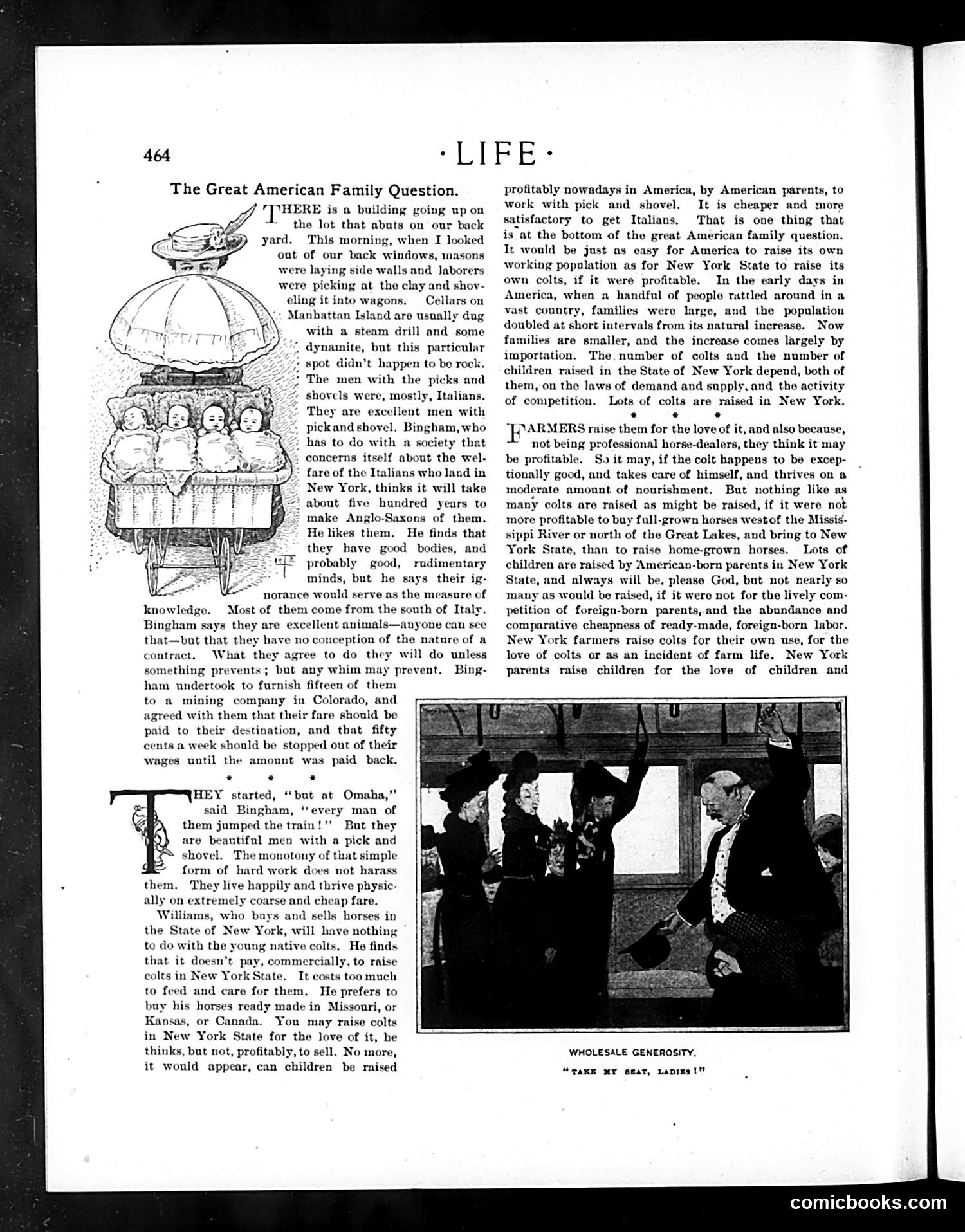
This satirical article contrasts two approaches to raising children in America. The left illustration depicts Italian immigrant laborers (referenced as excellent workers with "pick and shovel") carrying multiple children in a basket—satirizing large immigrant families and their working-class conditions. The article argues that wealthy American parents raise fewer children due to cost and competition, while immigrant families raise many children affordably. A person named Bingham claims that raising children in New York is unprofitable compared to importing foreign labor. The right photograph titled "Wholesale Generosity" shows what appears to be a crowded public transit scene, captioned "Take My Seat, Ladies!"—likely mocking either immigrant generosity or chaotic urban conditions. The piece critiques America's preference for cheap immigrant labor over supporting native-born population growth.
📄 Transcribed text from this page (OCR, searchable)
Machine-transcribed from the original scan — historical spelling and the odd misread are preserved.
464 The Great American Family Question. "THERE is a building going up on “the lot that abuts on our back yard. This morning, when I looked out of our back windows, masons were laying side walls and laborers y and shov- eling it into wagons, Cellars on Manhattan Island are usually dug with a steam drill and some < dynamite, but this particular spot didn’t happen to be rock. The men with the picks and > shovels were, mostly, Italians. * They are excellent men with + pickandshovel. Bingham, who ; has to do with a society that ; concerns itself about the wel- fare of the Italians who land in New York, thinks it will take ‘ about five hundred years to make Anglo-Saxons of them. - He likes them. He finds that they have good bodies, and probably good, rudimentary minds, but he says their ig- norance would serve as the measure of knowledge. Most of them come from the south of Italy. Bingham says they are excellent animals—anyone can see that—but that they have no conception of the nature of a contract. What they agree to do they will do unless something prevents ; but any whim may prevent. Bing- ham undertook to furnish fifteen of them “LIFE = profitably nowadays in America, by American parents, to work with pick and shovel. It is cheaper and more satisfactory to get Italians. That is one thing that is at the bottom of the great American family question. It would be just as easy for America to raise its own working population as for New York State to raise its own colts, if it were profitable. In the early days in America, when a handful of people rattled around in a vast country, families were large, and the population doubled at short intervals from its natural increase. Now families are smaller, and the increase comes largely by importation, The number of colts aud the number of children raised in the State of New York depend, both of them, on tho laws of demand and supply, and the activity of competition. Lots of colts are raised in New York. * . * EF ARMERS raise them for the love of it, and also because, not being professional horse-dealers, they think it may be profitable. So it may, if the colt happens to be excep- tionally good, and takes care of himself, and thrives on a moderate amount of nourishment. But nothing like as many colts are raised as might be raised, if it were not more profitable to buy full-grown horses westof the Missis- sippi River or north of the Great Lakes, and bring to New York State, than to raise home-grown horses. Lots of children are raised by American-born parents in New York State, and always will be, please God, but not nearly so many as would be raised, if it wero not for the lively com- petition of foreign-born parents, and the abundance and comparative cheapness of ready-made, foreign-born labor. New York farmers raise colts for their own use, for the love of colts or as an incident of farm life. New York parents raise children for the love of children and to a mining company in Colorado, and agreed with them that their fare should be paid to their destination, and that fifty cents a week should be stopped out of their wages until the amount was paid back. * * * HEY started, ‘but at Omaha,’’ said Bingham, “every man of them jumped the train!’’ But they are beautiful men with a pick and shovel. The monotony of that simple form of hard work does not harass They live happily and thrive physic- ally on extremely coarse and cheap fare. Williams, who buys and sells horses in the State of New York, will have nothing to do with the young native colts. He finds that it doesn’t pay, commercially, to raise colts in New York State. It costs too much to feed and care for them. He prefers to buy his horses ready made in Missouri, or Kansas, or Canada. You may raise colts them, in New York State for the love of it, he thinks, but not, profitably, to sell. No more, it would appear, can children be raised WHOLESALE GENEROSITY. “TAKE MY seat, Lapizs!” comicbooks.com