
Life, 1903-05-21 · page 6 of 24
Life — May 21, 1903 — page 6: what you’re looking at
What you’re looking at
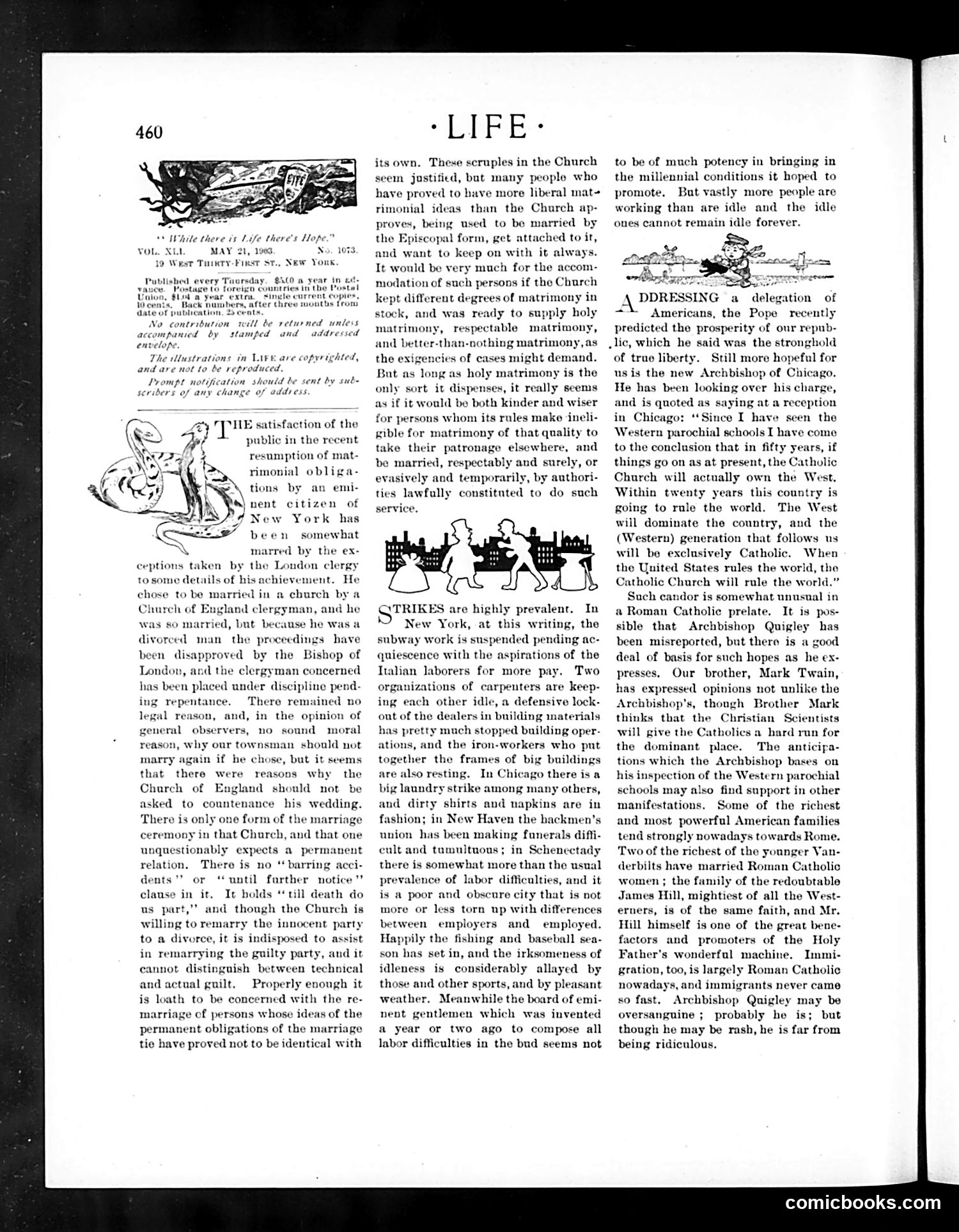
This page contains two distinct illustrations: 1. **Top left**: A decorative initial letter "W" featuring cherubs or putti in classical style—ornamental rather than satirical. 2. **Center**: A small cartoon labeled "STRIKES" showing simplified figures at what appears to be a table or negotiating scene, depicting labor unrest. The surrounding text discusses marriage, Church doctrine, and contemporary labor disputes in New York, Chicago, New Haven, and Schenectady. The article references strikes among carpenters, iron-workers, laundry workers, and other laborers demanding better pay and conditions. The "STRIKES" cartoon appears to satirize labor negotiations—showing workers in conflict with management. Given the 1903 date, this reflects the era's significant labor activism and industrial disputes that dominated American news.
📄 Transcribed text from this page (OCR, searchable)
Machine-transcribed from the original scan — historical spelling and the odd misread are preserved.
“* While there is Life there's Hope.” VoL. Xtl MAY 21, 1963. x 19 West Turety-Finst St., New Yous. $400 a year in ntries in the Hd y Tuorsday Union, $n a y u . Back nu date of pubheatios will be returned un stamped and addre No contribution accompanied by envelope The illustrations in Live are copyrighted, and are not to be reproduc Prompt notification seribers of any chang TIE satisfaction of the public in the recent { resumption of mat- / 12 rimonial obliga- KA tone by }nent citizen of *d Now York “ been 2» emi- somewhi marred by the e ceptions taken by the London clergy tosome details of his achievement. He chose to be married in a church by a Church of England clergyman, married, but bec divorced man was 8 use he was a the proceedings have been disapproved by the Bishop of London, and the clergyman concerned has been placed under discipline pend- ing repentance. Th legal rea sre remained no son, and, in the opinion of observers, no sound moral reason, why our townsman should not marry again if he chose, but it seems that there were reasons why the Church of England should not be asked to countenance his wedding. ‘There is only one form of the marriage ceremony in that Church, and that one unquestionably expec! permanent relation. There is no “barring acci- dents’ or ‘until farther notice” clause in it. It bolds ‘till death do us part,’’ and though the Church is willing to remarry the innocent party to a divorce, it is indisposed to assist in remarrying the guilty party, and it cannot distinguish between technical and actual guilt, Properly enough it is loath to be concerned with the re- marriage of persons whose ideas of the permanent obligations of the marriage tie have proved not to be identical with general “IE its own, These scruples in the Church seem justified, bat many people who have proved to have more liberal mat- rimonial ideas than the Church ap- proves, being used to be married by the Episcopal form, get attached to it, and want to keep on with it always. It would be very much for the accom- modation of such persons if the Church kept different degrees of matrimony in stock, and was ready to supply holy matrimony, respectable matrimony, and better-than-nothing matrimony, as the exigencies of cases might demand. But as long as holy matrimony is the only sort it dispenses, it really seems as if it would be both kinder and wiser for persons whom its rules make ineli- gible for matrimony of that quality to take their patronage elsewhere, and be married, respectably and surely, or evasively and temporarily, by authori- ties lawfully constituted to do such service, STRIKES are highly prevalent. In OO New York, at this writing, the subway work is suspended pending ac- quiescence with the aspirations of the Italian laborers for more p: Two organizations of carpenters are keep- ing each other idle, a defensive loc! out of the dealers in building materials has pretty much stopped building oper- ations, and the iron-workers who put together the frames of big buildings are also resting. In Chicago there is a big laundry strike among many others, and dirty shirts and napkins are in fashion; in New Haven the hackmen’s union has been making funerals diffi- cult and tumultuous; in Schenecta there is somewhat more than the usual prevalence of labor difficulties, and it is a poor and obscure city that is not more or less torn up with differences between employers and employed. Happily the fishing and baseball sea- son has set in, and the irksomeness of idleness is considerably allayed by those and other sports, and by pleasant weather, Meanwhile the board of emi- nent gentlemen which was invented a year or two ago to compose all labor difficulties in the bud seems not to be of much potency in bringing in the millennial conditions it hoped to promote. But vastly more people are working than are idle and the idle ones cannot remain idle forever. a delegation of Americans, the Pope recently predicted the prosperity of our repub- .lic, which he said was the stronghold of true liberty. Still more hopeful for us is the new Archbishop of Chicago. He has been looking over his charge, and is quoted as saying at a reception in Chicago: ‘Since I have seen the Western parochial schools I have come to the conclusion that in fifty years, if things go on as at present, the Catholic Church will actually own the West. Within twenty years this country is going to rule the world. The West will dominate the country, and the (Western) generation that follows us will be exclusively Catholic. When the United States rules the world, the Catholic Church will rule the world.” Such candor is somewhat unusual in a Roman Catholic prelate. It is pos- sible that Archbishop Quigley has been misreported, but there is a good deal of basis for such hopes as he ex- presses, Our brother, Mark Twain, has expressed opinions not unlike the Archbishop's, though Brother Mark thinks that the Christian Scientists will give the holies a hard run for the dominant place. The anticipa- tions which the Archbishop bases on his inspection of the Western parochial schools may also find support in other manifestations, Some of the richest and most powerful American families tend strongly nowadays towards Rome. Two of the richest of the younger Van- derbilts have married Roman Catholic women ; the family of the redoubtable James Hill, mightiest of all the West- erners, is of the same faith, and Mr. Hill himself is one of the great bene- factors and promoters of the Holy Father's wonderful machine. Immi- gration, too, is largely Roman Catholic nowadays, and immigrants never came so fast, Archbishop Quigley may be oversanguine ; probably he is; but though he may be rash, he is far from being ridiculous. comicbooks.com