
A complete issue · 20 pages · 1903
Life — April 30, 1903
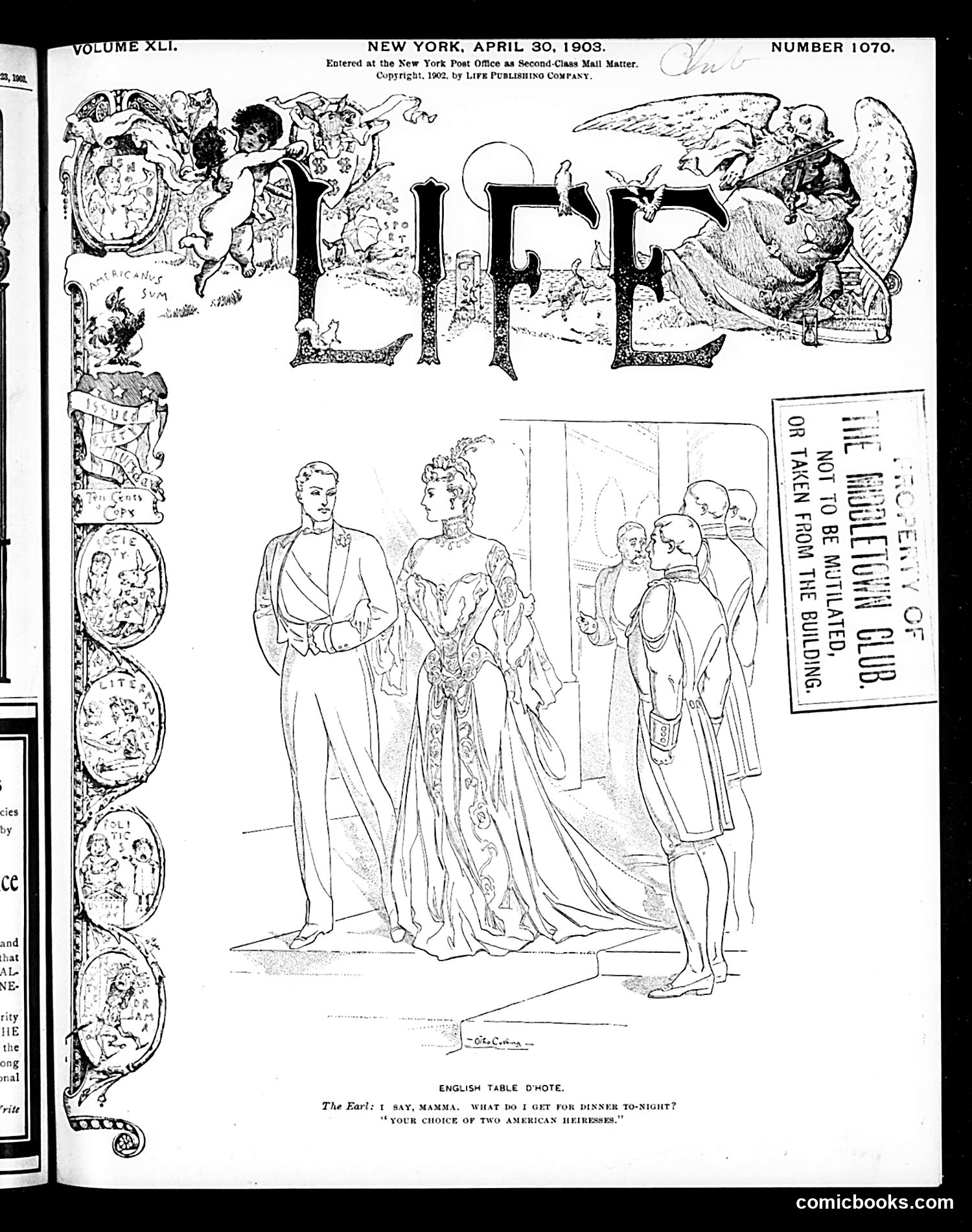
This page features a satirical cartoon about American high society and marriage. The caption reads: "The Earl: 'Say, Mamma, what do I get for dinner to-night?' 'Your choice of two American heiresses.'" The joke targets the common practice of wealthy European aristocrats—particularly impoverished British peers—marrying rich American heiresses for their fortunes. The "Earl" treats selecting a wife like choosing from a dinner menu, reducing marriage to a transactional commodity. The elaborate decorative borders with cherubs and classical motifs reinforce the pretense of aristocratic sophistication, while the crude commercial joke undermines that facade. This satirizes the era's "transatlantic marriages" phenomenon, where American wealth bought European titles—a practice Life's readers found both ridiculous and culturally troubling.
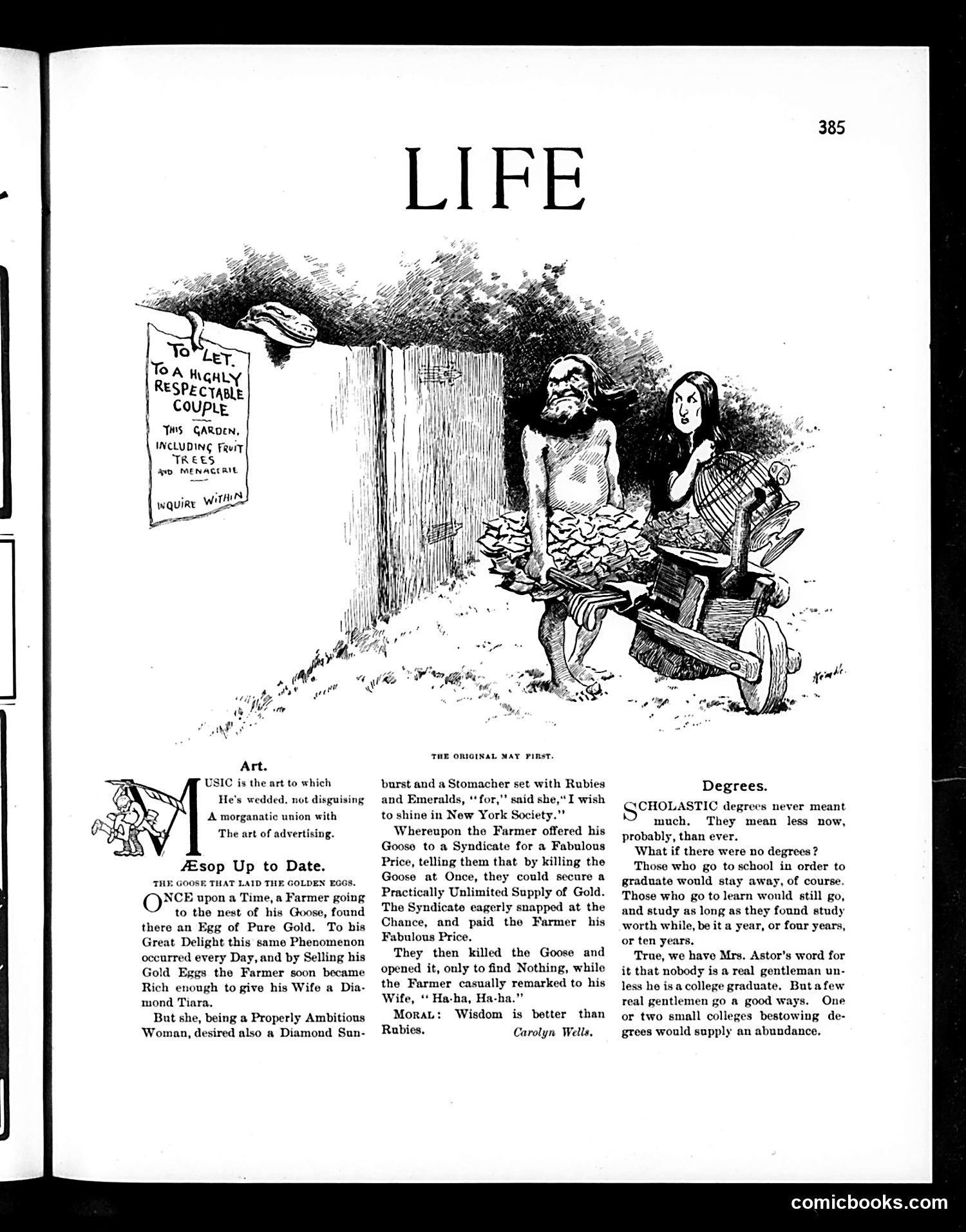
The main cartoon depicts a couple discovering a "Garden" labeled "To Let" with a sign reading "To a Highly Respectable Couple" and instructions to "Inquire Within." The couple appears to be a caveman-like figure and a woman in a cart, seemingly mocking primitive or lower-class people seeking respectable housing—the satire being the absurdity of such people being granted "respectable" accommodations. The accompanying text sections include fables and moral lessons. "Aesop Up to Date" tells of a farmer who kills a golden-egg-laying goose after a syndicate outsmarts him—commenting on greed and failed schemes. The "Degrees" section satirizes the value of college degrees, suggesting they're increasingly meaningless despite what institutions claim. The overall page mocks social pretension, class anxiety, and institutional claims of respectability.
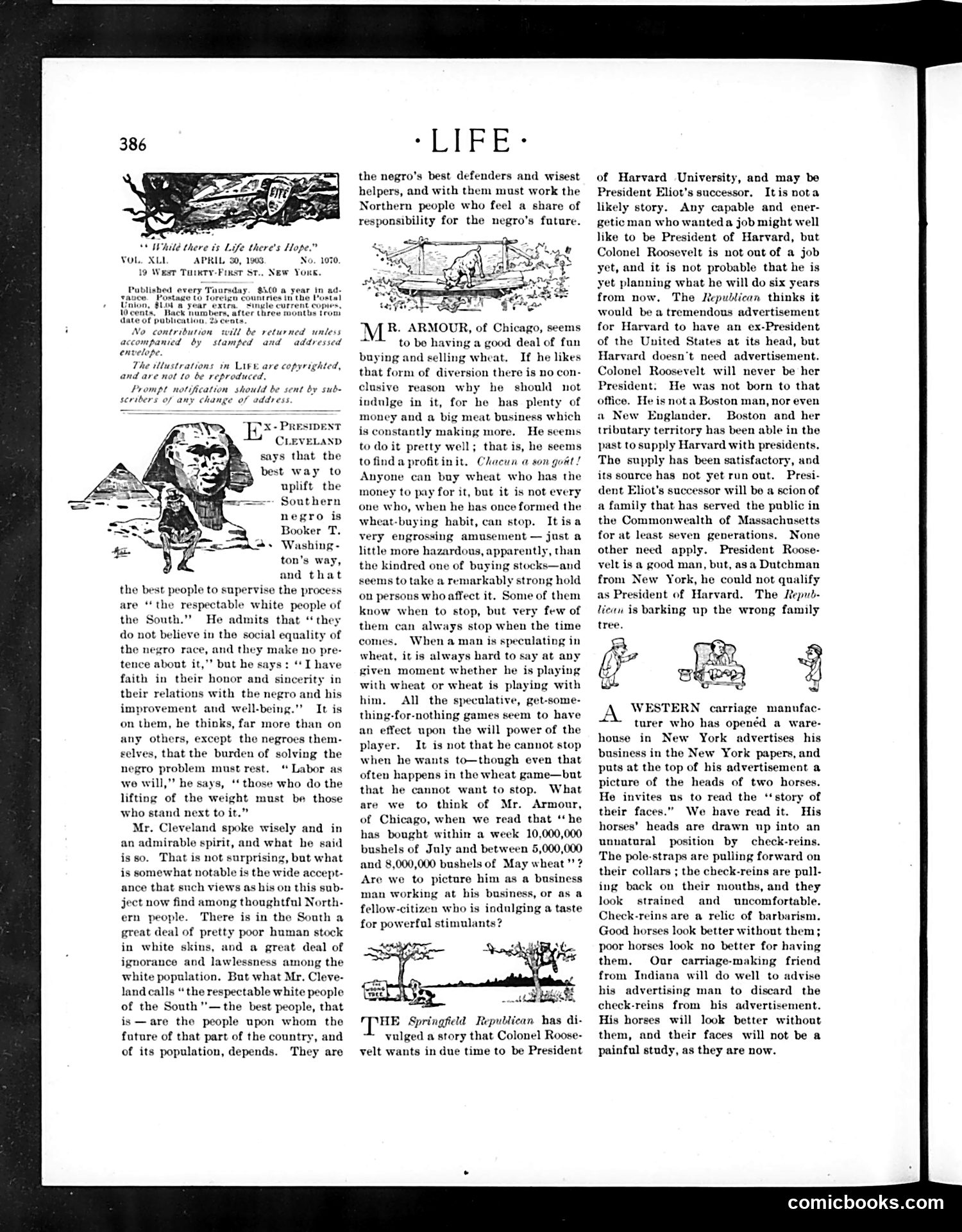
The page's main cartoon features **Ex-President Cleveland**, identified by the caption. The caricature depicts him with exaggerated facial features typical of early 1900s satirical art. The text criticizes Cleveland's views on the "negro problem," particularly his stance that Northern whites should bear responsibility for Black Americans' welfare and future. The satire mocks Cleveland's paternalistic attitude—portraying him as someone lecturing others on racial matters while maintaining patronizing views. The article also discusses **Colonel Roosevelt** (Theodore Roosevelt, the current president), contrasting his actual accomplishments with speculation about his political ambitions. The piece exemplifies Life's role as political satire commentary on contemporary debates about race, presidential authority, and Northern versus Southern race relations in the Progressive Era.
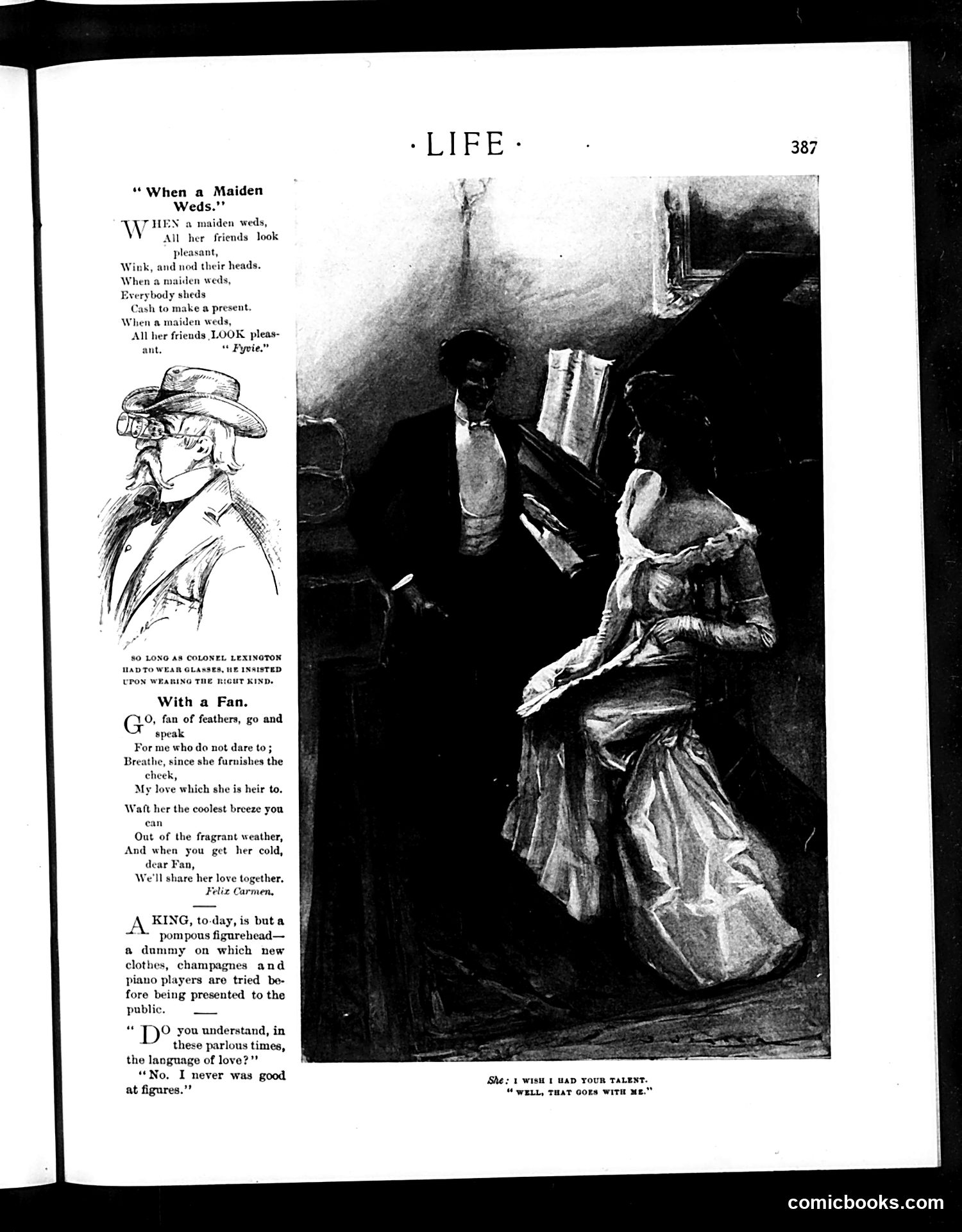
This page from *Life* magazine contains three separate satirical pieces: 1. **"When a Maiden Weds"**: A poem mocking the social dynamics surrounding weddings—friends appearing pleasant while envying the bride, and the expectation of gift-giving ("Cash to make a present"). 2. **"With a Fan"**: A romantic poem addressed to a fan-wielding woman, playing on Victorian courtship conventions and the symbolic language of fan use. 3. **"A King To-day"**: A prose satire on modern royalty, describing how contemporary "kings" are merely decorative figures—wealthy men displayed before society through clothes, champagne, and performance, with no real substance or understanding ("I never was good at figures"). The accompanying illustration depicts a woman at a piano, supporting the romantic/courtship themes throughout.
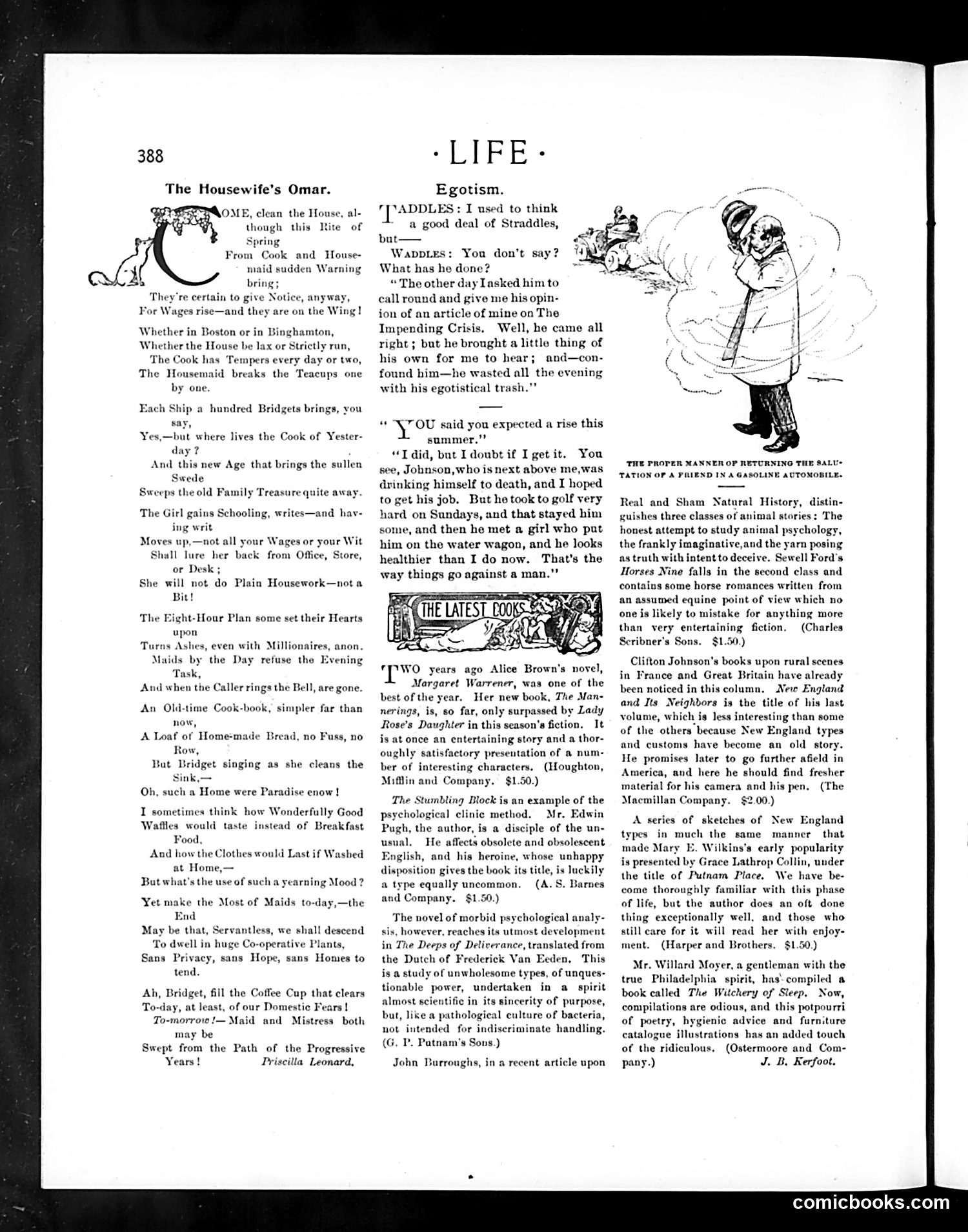
The page contains two distinct sections: **Left side ("The Housewife's Omar"):** A poem satirizing domestic labor, mocking the romantic poetry of Omar Khayyam by comparing it unfavorably to the unglamorous realities of housework—cooking, cleaning, managing servants, and enduring financial constraints. **Right side cartoon:** Titled "The Proper Manner of Returning the Salutation of a Friend in a Gasoline Automobile," the sketch depicts a woman in a car acknowledging an acquaintance on the street. The satire targets early automobile culture and the social awkwardness of greeting pedestrians from a moving vehicle—poking fun at how cars were changing social etiquette and interaction patterns in the early 20th century. Both pieces satirize mundane American life and social conventions of their era.
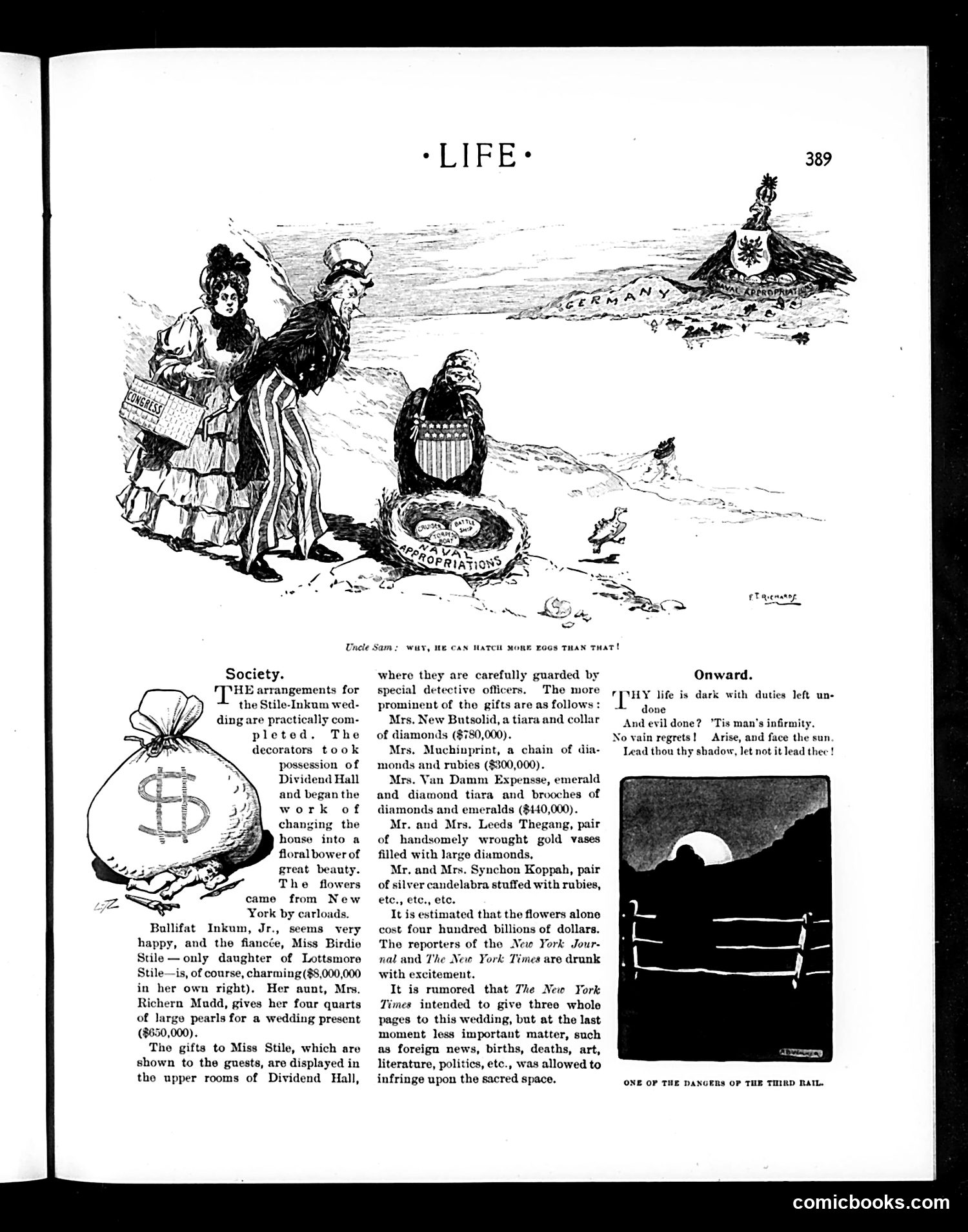
This page satirizes the extravagant wealth display of America's ultra-rich during the Gilded Age. The main cartoon depicts Uncle Sam observing a figure sitting on "Appropriations" (labeled as such), with the caption "Why, he can hatch more eggs than that!" The accompanying article describes an absurdly lavish wedding gift display for Miss Bridie Stile, including diamonds worth hundreds of millions of dollars given by wealthy families (the Vanderbilts, Astors, and others are named). The satire mocks: 1. Obscene plutocratic excess during an era of inequality 2. The concentration of wealth among industrial magnates 3. The frivolous use of enormous fortunes on luxury goods The cartoon suggests that such wealth-hoarding generates problems as readily as a nesting bird produces eggs—implying social instability from unchecked inequality.
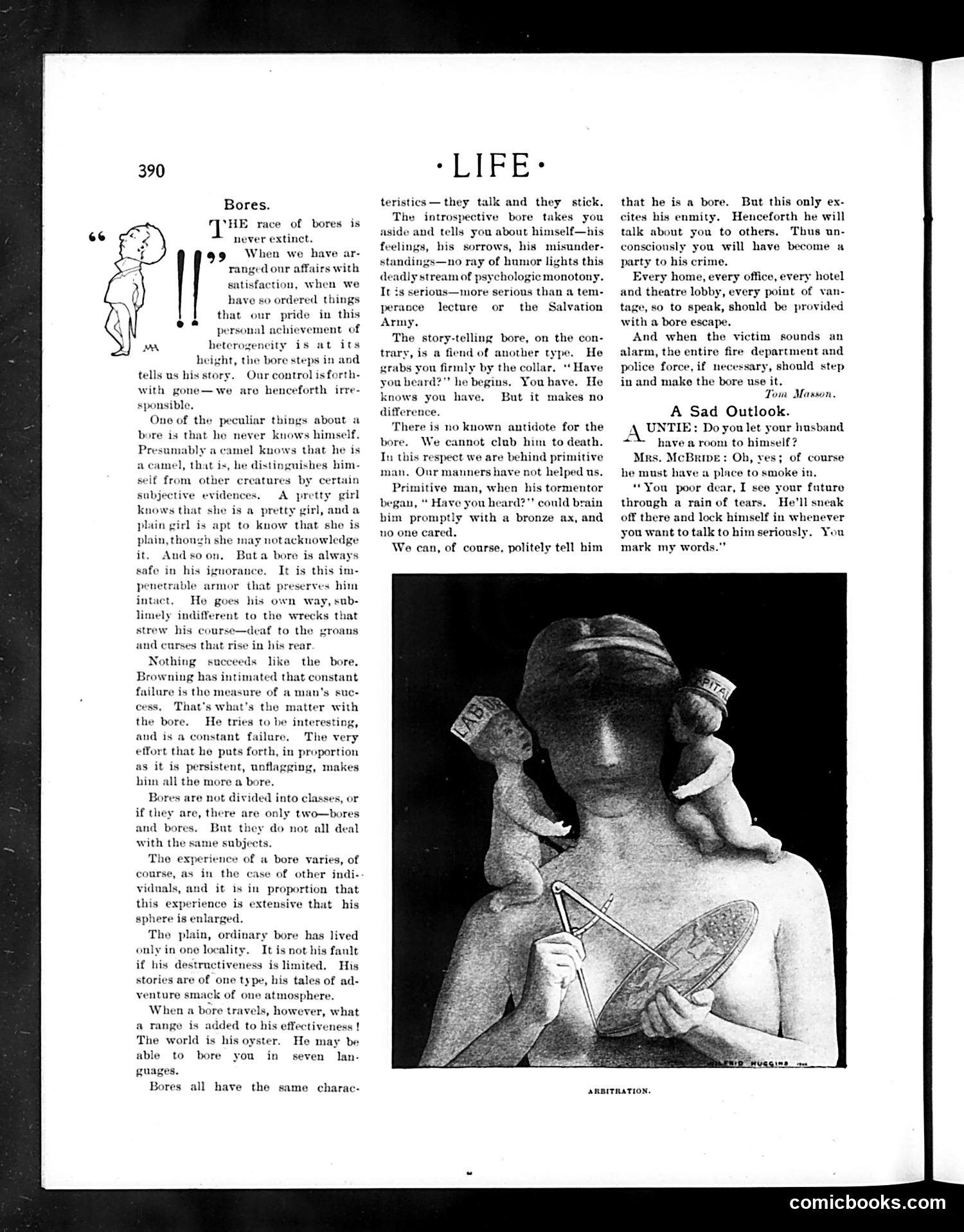
**Main Article: "Bores"** This satirical essay critiques the "introvert bore" — someone who monopolizes conversation with tedious personal details about their feelings and misfortunes, showing no humor or self-awareness. The piece distinguishes bores from other personality types, arguing that bores are uniquely persistent in their failures to entertain. It suggests that bore-ish behavior stems from lack of experience traveling or engaging with diverse subjects. **Cartoon: "Arbitration"** The illustration shows a boxer (appearing to be a professional fighter) examining his boxing gloves, labeled for what appears to be a specific match or bout. The caption "A Sad Outlook" and accompanying dialogue between "Auntie" and "Mrs. McBride" suggests the image relates to a boxer's uncertain future—likely commenting on boxing as a risky profession or an upcoming match with uncertain prospects.
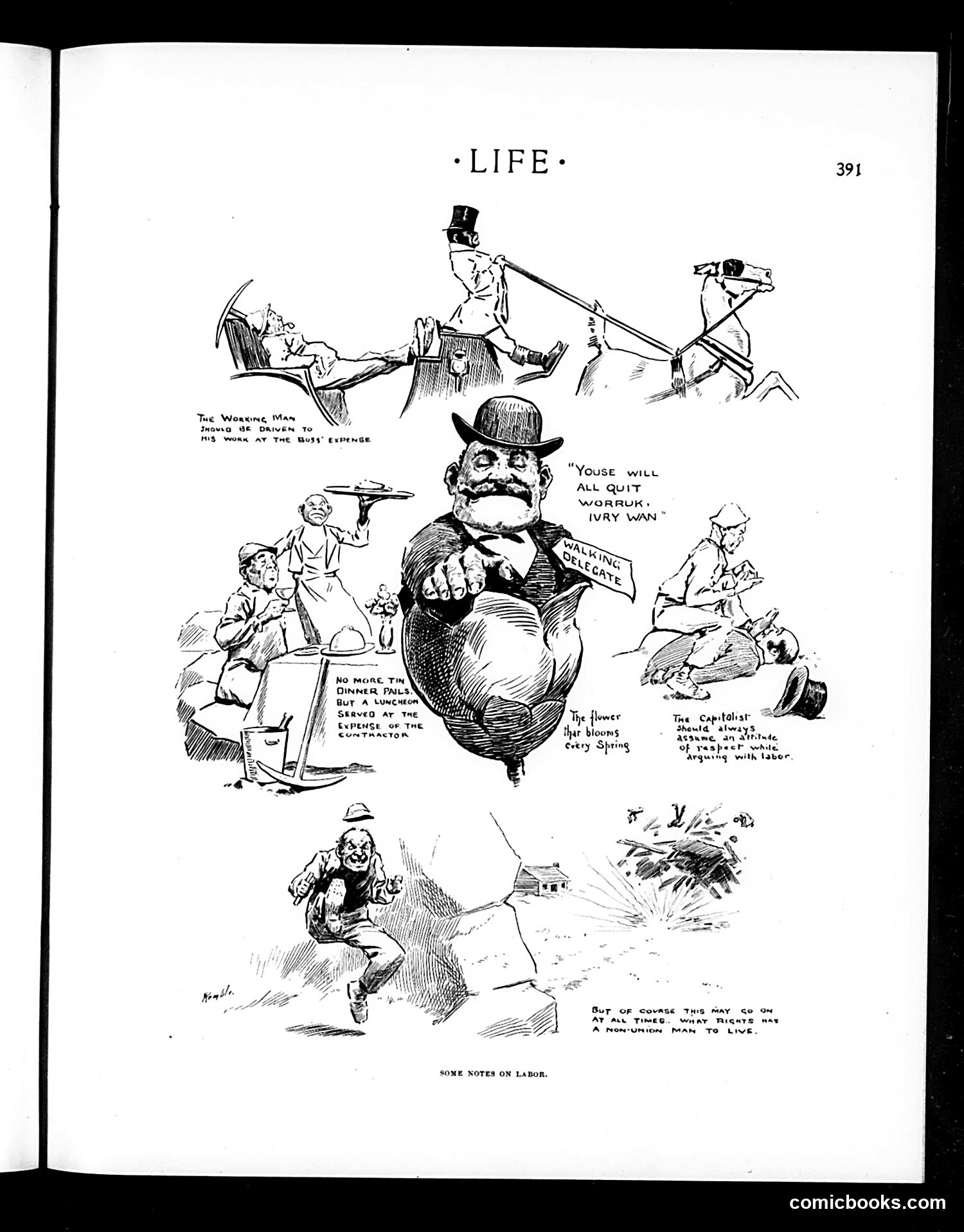
This page presents satirical commentary on labor issues, likely from the early 20th century. The central caricature depicts a wealthy capitalist figure with the speech bubble "You'll all quit work, ivory wan," apparently dismissing labor concerns. Surrounding vignettes critique working conditions and labor disputes: - Workers enduring poor meal conditions ("No more tin dinners...") - A wealthy figure driving workers to his wall at great expense - References to "The Flower That Blooms Every Spring" (unclear reference) - A capitalist "should also have a sense of responsibility when arguing with labor" - A final scene suggesting workers may seek alternative employment ("out of course this may go on all times...what bickens has a palm tree job to live") The satire mocks capitalist indifference to labor grievances while suggesting workers have limited leverage or alternatives.
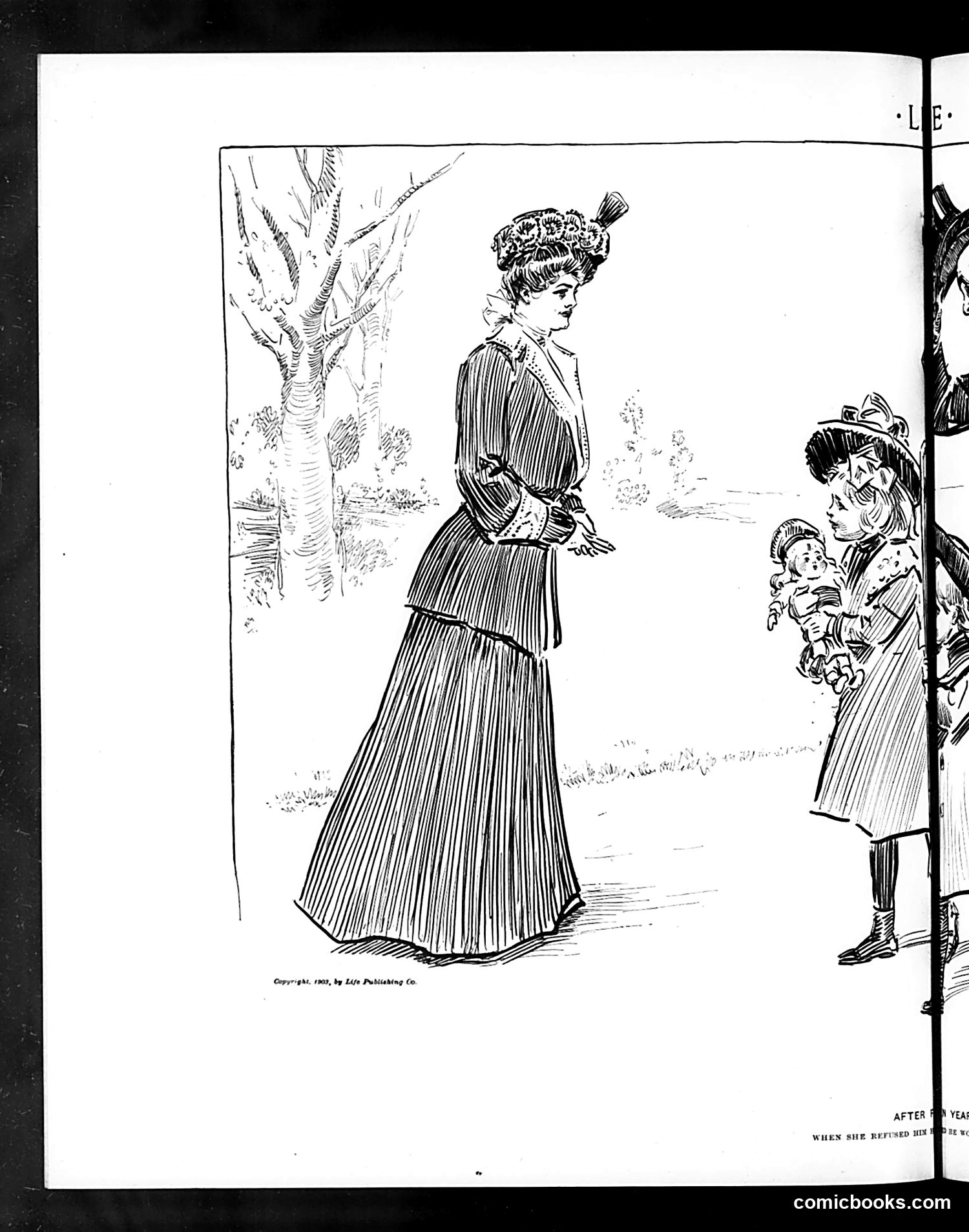
This appears to be an illustration from Life magazine (copyright 1903, per the visible text). The image shows a woman in Edwardian-era dress standing outdoors near a tree, with another figure holding a child visible on the right side. The caption at the bottom reads "AFTER TEN YEARS / WHEN SHE REFUSED HIS [text cut off]" — suggesting this depicts a narrative scene, likely romantic or social in nature, about a woman's refusal of a proposal or marriage offer and its consequences a decade later. However, **without the complete caption text visible**, the specific satire or social commentary cannot be definitively identified. The illustration style and composition suggest it's likely commentary on marriage, women's choices, or social consequences of romantic decisions — common Life magazine themes — but the exact point remains unclear from this partial page.
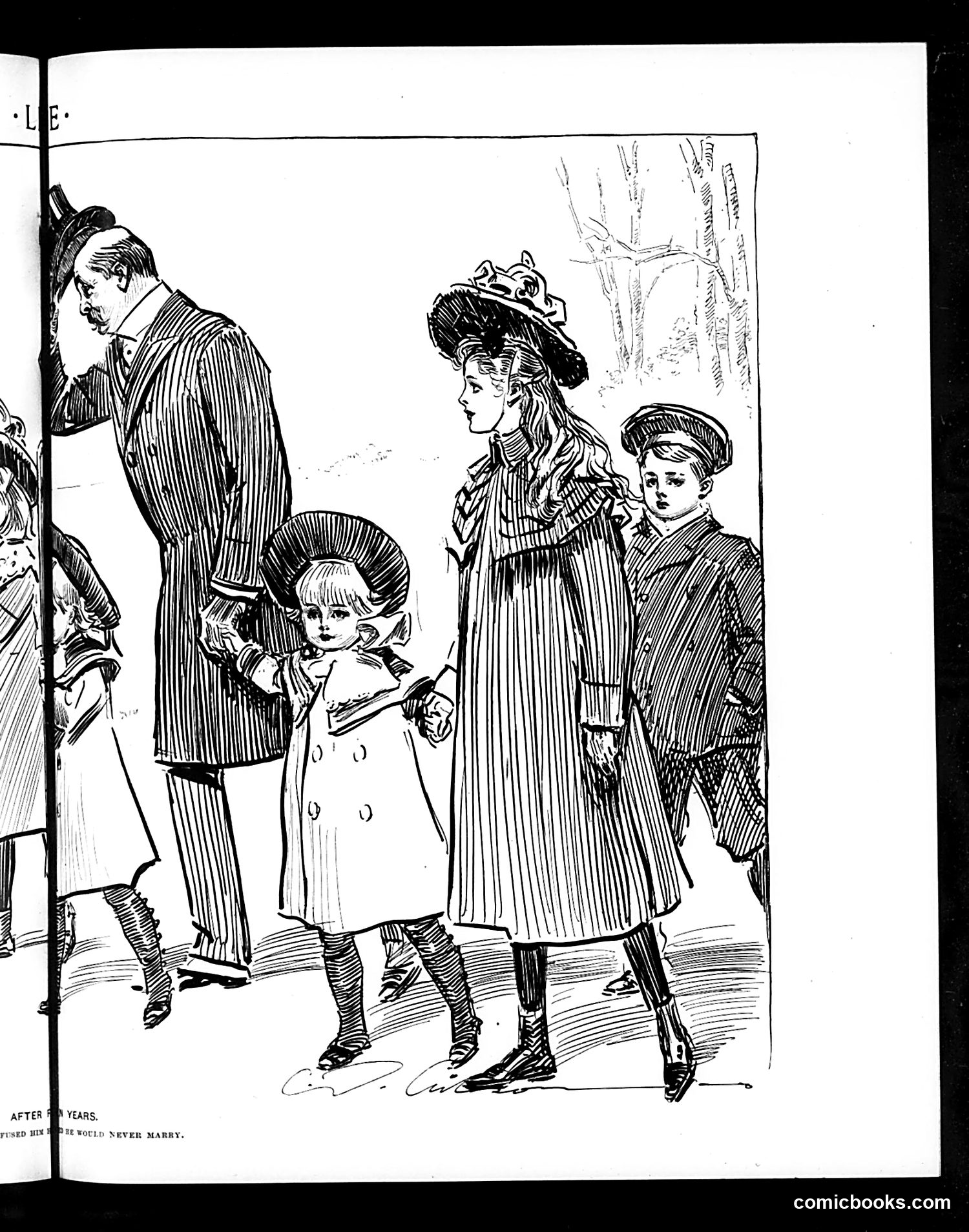
This appears to be a satirical illustration from Life magazine showing a domestic scene. The visible text fragment reads "AFTER 50 YEARS" and "HE WOULD NEVER MARRY," suggesting this cartoon comments on a long-term relationship or unmarried partnership. The image depicts a well-dressed man with a woman and two children in winter clothing, standing outdoors near bare trees. The composition and text imply social commentary about marriage, commitment, or family life—possibly mocking either a reluctant bachelor or critiquing societal expectations around marriage. Without the complete caption or publication date, the specific individuals or event being satirized remain unclear. The style and printing technique suggest late 19th or early 20th-century origin, typical of Life magazine's satirical content of that era.
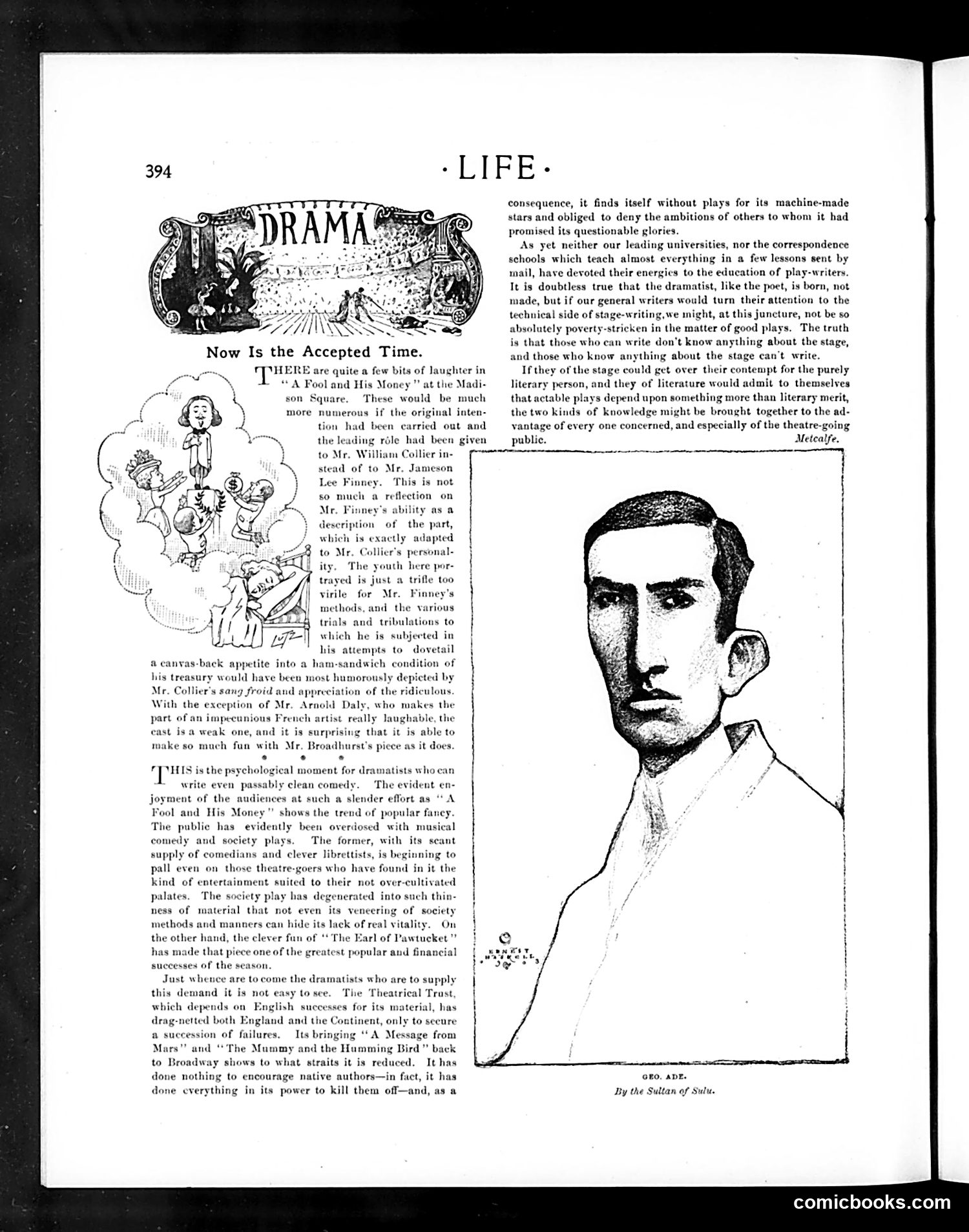
This page discusses theatrical comedy and dramaturgy. The left illustration depicts a comedic scene, likely from a play, showing exaggerated physical humor—people in chaotic poses. The right contains a portrait labeled "GEO. ADE. By the Sultan of Subs" (George Ade, a prominent American playwright and humorist of the early 1900s). The text critiques the state of American drama, arguing that successful playwrights lack technical stage knowledge, and that popular comedies have become thin or derivative. It mentions specific plays like "A Fool and His Money" and "The Earl of Pawtucket," praising some while lamenting that the Theatrical Trust monopoly has stifled innovation and native dramatic talent. The satire targets theatrical mediocrity and commercial theatrical monopolies limiting creative expression.
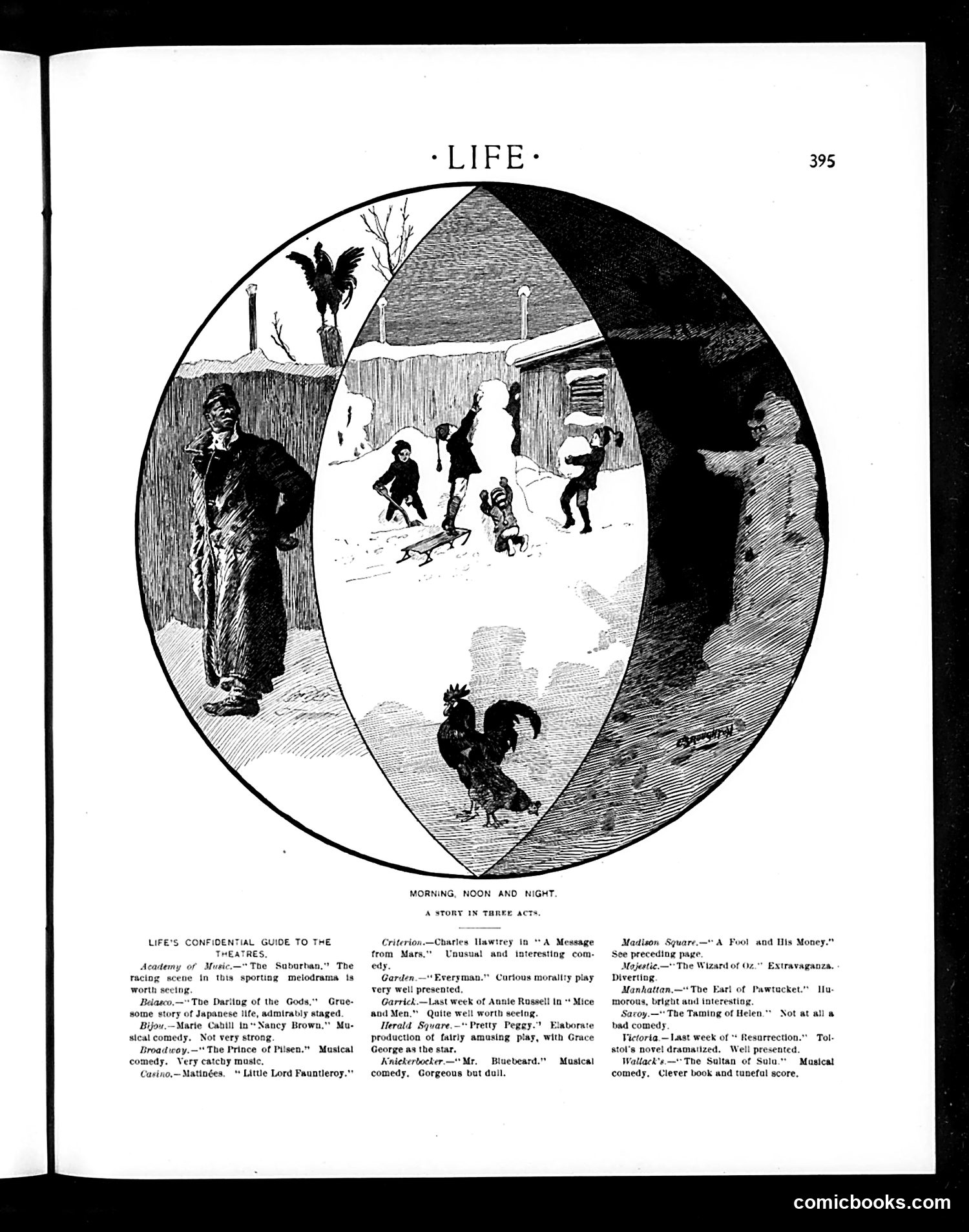
This page features a satirical illustration titled "Life" showing a circular vignette divided into three sections depicting daily urban life—morning, noon, and night. The scenes show working-class and street activity: figures in winter clothing, children playing in snow, a rooster, laundry, tenement housing. The page primarily functions as **theater criticism and listings** for contemporary Broadway productions (early 1900s, based on titles like "The Wizard of Oz" and "A Message from Mars"). The illustration serves as the magazine's header or introduction to its "Confidential Guide to the Theatres"—a humorous framing device suggesting contrast between ordinary people's daily struggles and the theatrical entertainment available to them. The satire is gentle: Life magazine positioned itself as a witty observer of both high culture (theater) and everyday urban reality.
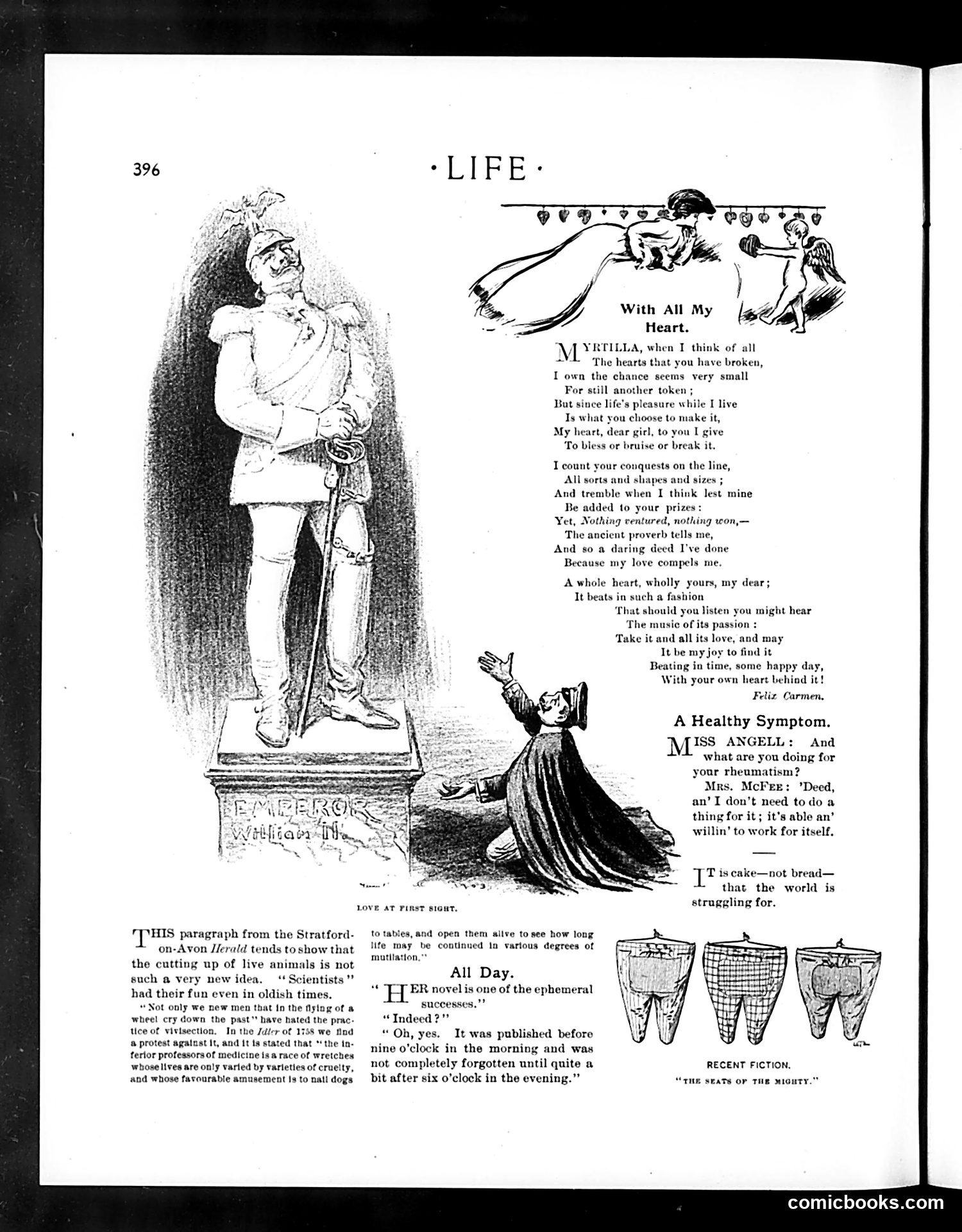
This page contains three distinct satirical pieces: **"Love at First Sight"** (left): A sketch mocking romantic melodrama, showing a kneeling woman before a statue of "Emperor Nero," satirizing overwrought courtship rituals and historical pretension. **"With All My Heart"** (center): A poem by Felix Carmen about giving one's heart to a woman, using romantic clichés ("whole heart, wholly yours") that Life likely presents ironically. **"A Healthy Symptom"** (bottom right): A brief comic dialogue where Mrs. McFee boasts her rheumatism is so vigorous it requires no treatment—satirizing either health quackery or Irish working-class resilience through humor. **Vivisection paragraph** (lower left): References a 1758 newspaper protest against medical professors conducting cruel animal experiments, suggesting this "scientific" cruelty is historically persistent, not modern. The page uses period humor conventions: romantic satire, Irish dialect comedy, and historical irony about scientific ethics.
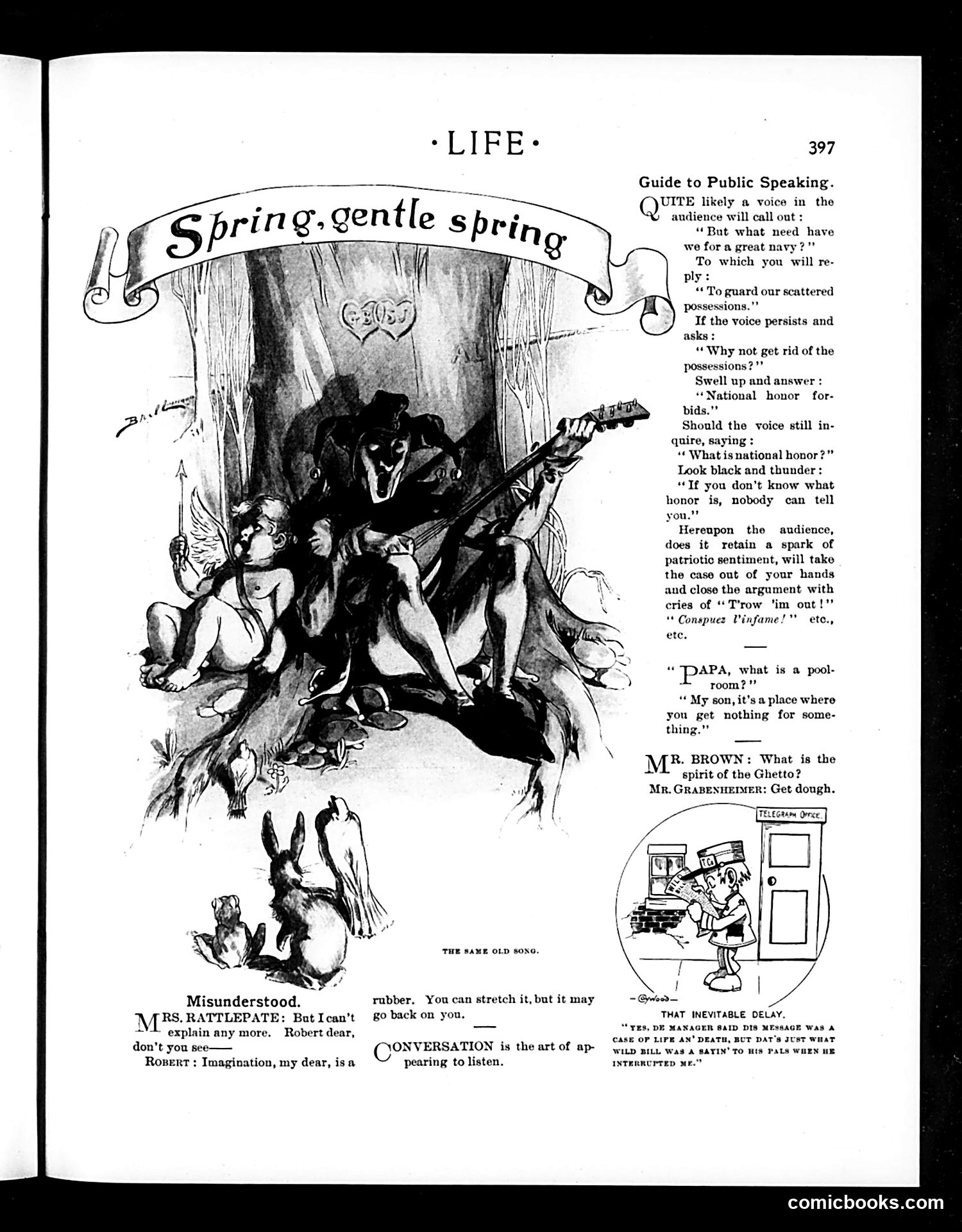
This page contains multiple satirical pieces mocking early 20th-century American society: **"Guide to Public Speaking"** ridicules nationalist rhetoric about naval expansion and imperialism. It satirizes how speakers deflect legitimate questions about maintaining overseas "possessions" (colonies) by invoking "national honor"—a hollow phrase that silences debate through patriotic appeals rather than reasoned argument. **"Misunderstood"** jokes about marital miscommunication, with a husband dismissing his wife's concerns by claiming "imagination" solves everything. **The pool-room and ghetto jokes** are period humor reflecting class and ethnic stereotypes common to Life's audience. **"That Inevitable Delay"** appears to mock telegraph office incompetence, suggesting operators prioritize trivial messages over genuine emergencies. The large illustration titled "Spring, gentle spring" remains visually unclear in meaning—possibly depicting mythological or allegorical figures, but the specific reference is uncertain from this image alone. Overall, the page exemplifies Life's role as satirical commentary on American politics, social pretense, and urban life.
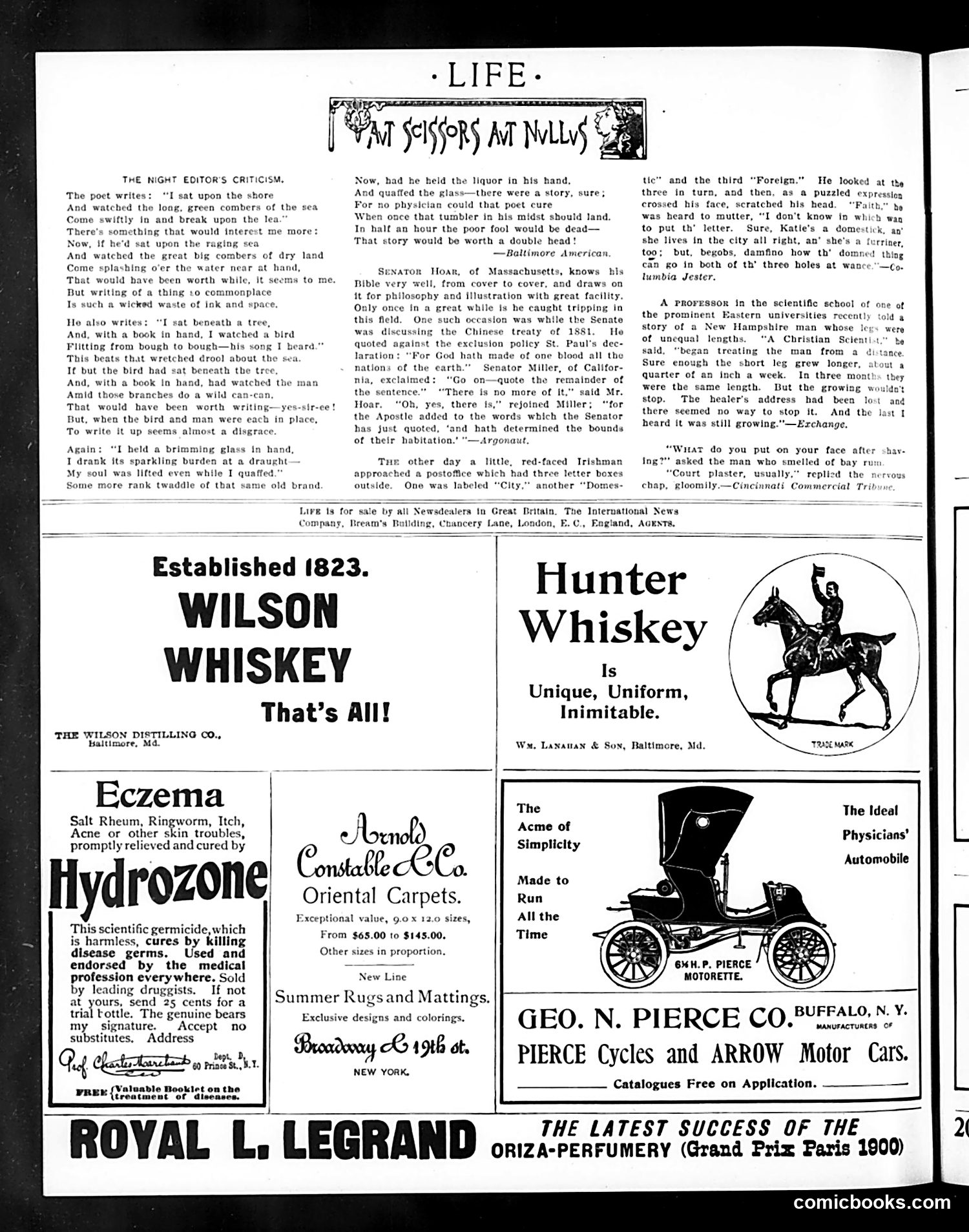
This is primarily a **satirical humor page from Life magazine**, not a political cartoon. The main content mocks pretentious poetry writing through "The Night Editor's Criticism"—a fictional editor brutally critiques a poet for writing about boring, ordinary subjects (sitting by the sea, watching birds) and suggests absurdly violent alternatives would be more interesting (the poet should watch a *wild* cat, or better yet, drink poison and die). The page also includes humorous anecdotes: Senator Hoar misquoting St. Paul about Chinese exclusion policy, and a story about a Christian Science healer who can't stop a patient's short leg from growing longer. The **lower half is advertising**: whiskey, carpets, automobiles, and medical remedies—typical for early 1900s magazines. These ads have no connection to the satire above. The satire relies on absurdist humor and gentle mockery of both bad poetry and human pretension, targeting Life's educated readership.
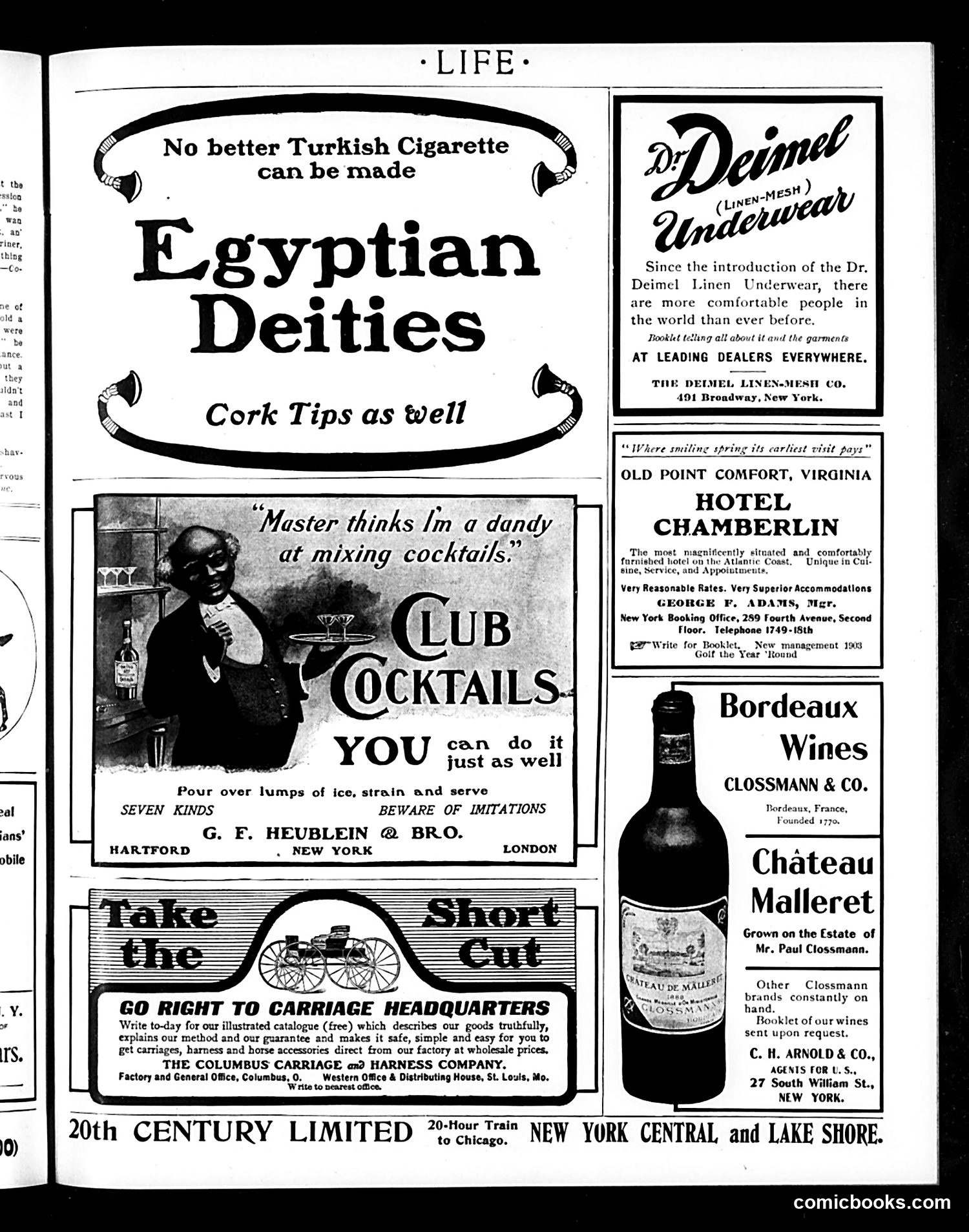
This is primarily an **advertisements page** rather than editorial content or political satire. The main items are product ads from circa 1903. The most notable visual element is a **Club Cocktails advertisement** featuring a Black servant figure with the caption "Master thinks I'm a dandy at mixing cocktails." This reflects deeply racist advertising conventions of the era, depicting a stereotyped servant character to promote the product. The ad promises cocktail recipes ("Seven Kinds") from G.F. Heublein & Bro. Other advertisements include: - **Egyptian Deities cigarettes** (Turkish variety with cork tips) - **Dr. Deimel underwear** - **Columbus Carriage and Harness Company** - **Hotel Chamberlin** in Virginia - **Château Malleret wines** from Bordeaux - **New York Central railroad** service The page represents early 20th-century commercial advertising standards, including now-offensive racial imagery normalized in that period. There is no editorial cartoon or political satire present.
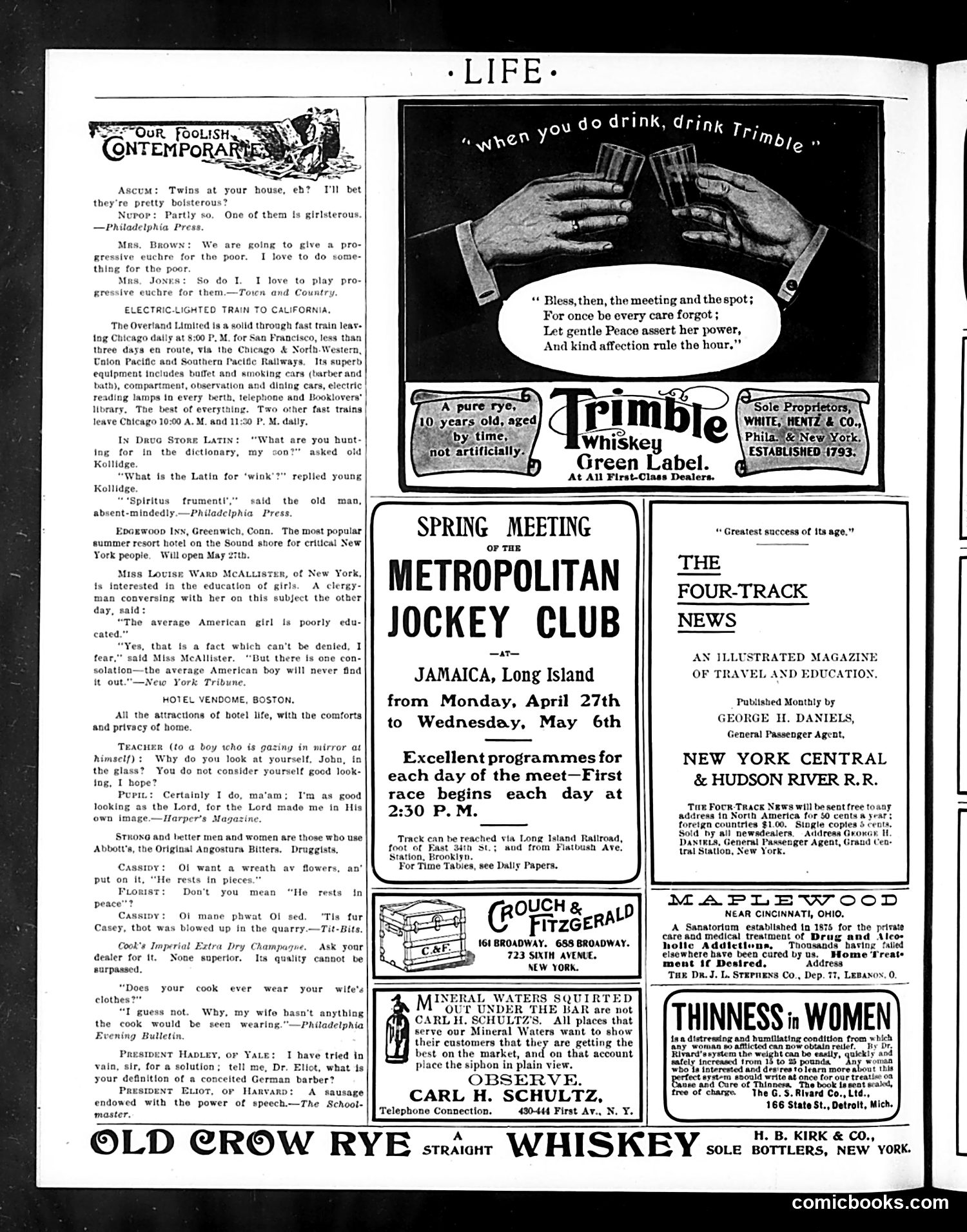
This page combines satirical humor pieces with period advertisements. The "Foolish Contemporaries" section presents brief jokes mocking social pretense: - A woman claims to organize progressive euchre "for the poor" but actually plays it for her own enjoyment - A girl is "poorly educated" but this won't matter because American boys won't notice - A servant boy claims divine justification for his vanity by saying God made him in His image The satire targets hypocrisy and self-delusion among the middle and upper classes—people performing charity or morality while pursuing selfish interests. The advertisements reflect early 1900s luxury travel (electric trains, resort hotels) and consumer goods (whiskey, mineral water, hair treatments). A "Thinness in Women" ad appears to address beauty standards of the era. The overall tone is gentle mockery of contemporary American manners and pretension, typical of *Life* magazine's satirical approach to social commentary.
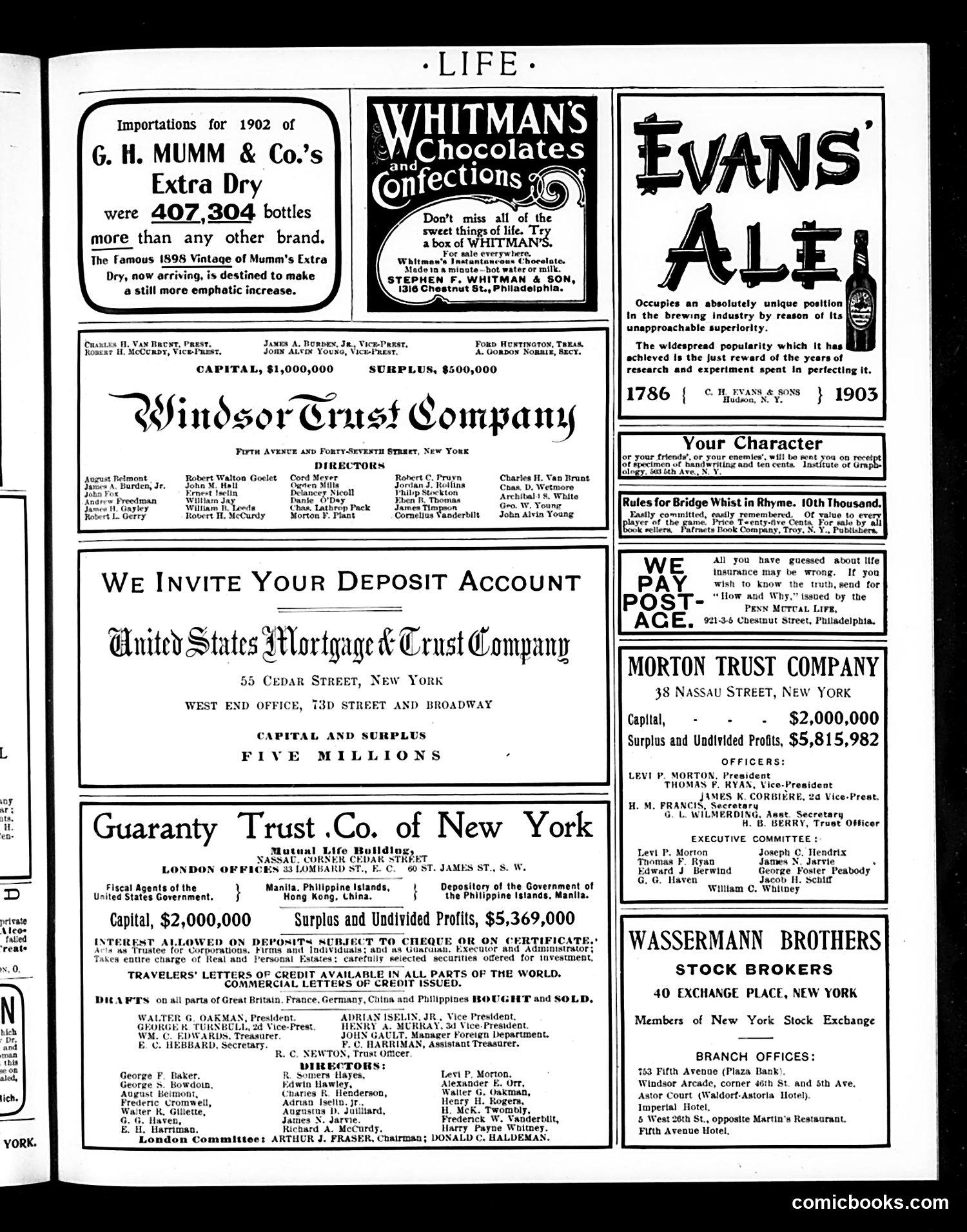
This page is primarily **advertising**, not satire or political commentary. It features financial institutions and luxury consumer brands targeting wealthy New York elites. The ads showcase: - **G.H. Mumm & Co.** champagne (imported luxury) - **Whitman's Chocolates** (premium confections) - **Evans Ale** (established 1786, positioned as superior) - Multiple **trust companies and banks** (Morton Trust, Guaranty Trust, United States Mortgage & Trust Company, Windsor Crust Company, Wassermann Brothers stock brokers) The page also includes a minor feature on **"Your Character"** — apparently a handwriting analysis service — and **bridge whist card game rules**. This represents the "Life" magazine's business model: satirical content funded by advertisements to wealthy readers. The ads themselves contain minor marketing humor ("Don't miss all of the sweet things of life"), but the page lacks sustained political cartoons or social satire. It's essentially a turn-of-the-century financial/luxury goods directory.
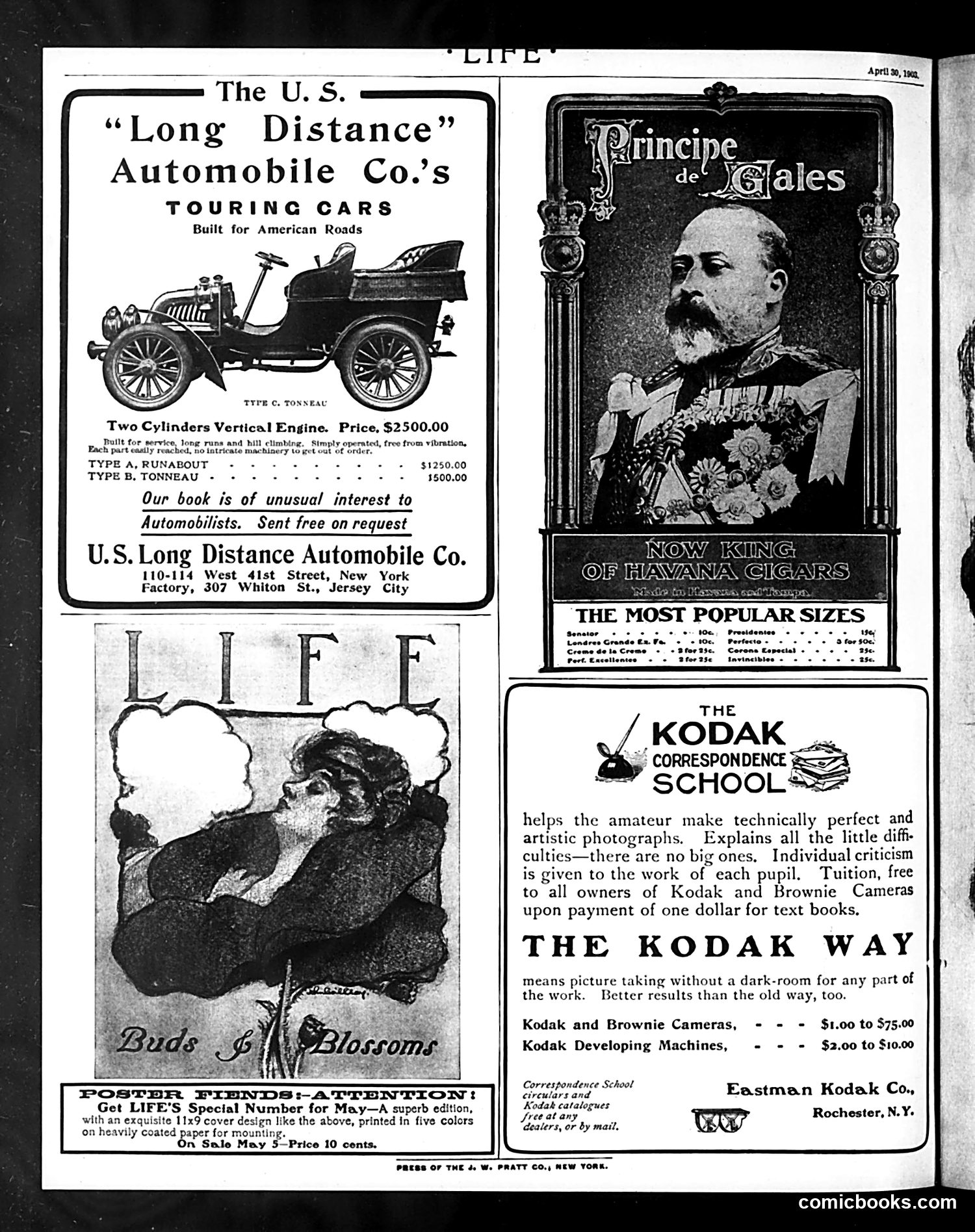
This is primarily an **advertising page** rather than satirical content. The page features four commercial advertisements: 1. **U.S. "Long Distance" Automobile Co.** - Promotes early touring cars ($1,250-$2,500), emphasizing reliability for American roads and simple operation—reflecting the novelty and skepticism surrounding automobiles in 1902. 2. **Principe de Gales Cigars** - Features a bearded military figure (appears to be European royalty based on the ornate frame and "Principe de Gales" title), advertising popular cigar sizes. 3. **"Buds & Blossoms"** - A decorative illustration advertising Life's special May issue, featuring an ornate design with two figures in profile. 4. **Kodak Correspondence School** - Promotes photography education and camera equipment, emphasizing the revolutionary "Kodak Way" of picture-taking without darkroom work—democratizing photography for amateurs. The page reflects early 1900s consumer culture, with emerging technologies (automobiles, accessible photography) marketed alongside luxury goods (cigars). No political satire is evident here.