
Life, 1903-04-30 · page 6 of 20
Life — April 30, 1903 — page 6: what you’re looking at
What you’re looking at
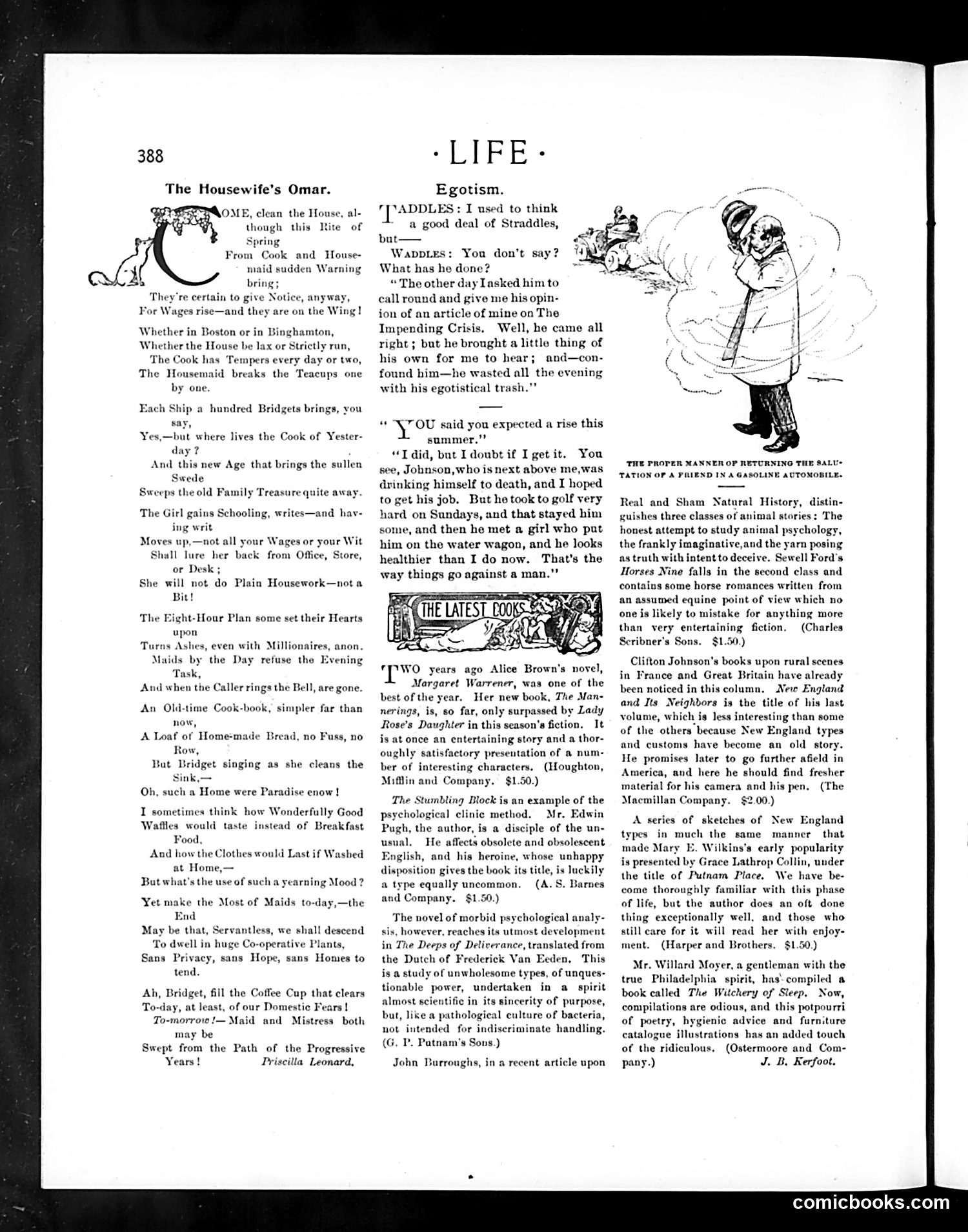
The page contains two distinct sections: **Left side ("The Housewife's Omar"):** A poem satirizing domestic labor, mocking the romantic poetry of Omar Khayyam by comparing it unfavorably to the unglamorous realities of housework—cooking, cleaning, managing servants, and enduring financial constraints. **Right side cartoon:** Titled "The Proper Manner of Returning the Salutation of a Friend in a Gasoline Automobile," the sketch depicts a woman in a car acknowledging an acquaintance on the street. The satire targets early automobile culture and the social awkwardness of greeting pedestrians from a moving vehicle—poking fun at how cars were changing social etiquette and interaction patterns in the early 20th century. Both pieces satirize mundane American life and social conventions of their era.
📄 Transcribed text from this page (OCR, searchable)
Machine-transcribed from the original scan — historical spelling and the odd misread are preserved.
388 The Housewife’s Omar. OME, clean the House, al- though this From Cook and House- maid sudden Warning Whether in Boston or in Binghamton, Whether the House be lax or Strictly run, The Cook has Tempers every day or two, The Housemaid breaks the Teacups one by one Each Ship a hundred Bridgets brings, you say .—but where lives the Cook of Yester- ? ; w Age that brings the sullen Sweeps the old Family Treasure quite away. ‘The Girl gains Schooling, writes—and hav- ing writ Moves up,—not all your Wages or your Wit Shall lure her back from Offic or De She will not do Plain Housework Bit! The Eight-Hour Plan some set their Hearts upon Turns Ashes, even with Millionaires, anon. Maids by the Day refuse the Evening Task, And when the Caller rings the Bell, are gone. An Old-time Cook-book, simpler far than A Loaf of Home-made Bread, no Fuss, no Row, But Bridget singing as she cleans the Sink,— Oh, such a Home were Paradise enow ! I sometimes think how Wonderfully Good Wailles would taste instead of Breakfast Food, And how the Clothes would Last if Washed at Home,— But what's the use of such a yearning Mood? Yet make the Most of Maids to-d nd —the May be that, Servantless, we shall descend To dwell in huge Co-operative Plants, Sans Privacy, sans Hope, sans Homes to tend. Ah, Bridget, fill the Coffee Cup that clears st, of our Domestic Fears! To-morrow !— Maid and Mistress both may be Swept from the Path of the Progressive Years! Priscilla Leonard, ‘LIFE Egotism. [ADDLES : I used to think a good deal of Straddles, bat—. Wappies: You don’t say? What has he done? “ The other day Lasked him to call round and give me his opin- ion of an article of mine on The Impending Cri: Well, he came all right; but he brought a little thing of his own for me to hear; and—con- found him—he wasted all the evening with his egotistical trash.’’ e you said you expected a rise this summer.”” “I did, but Idoubt if I get it. You see, Johnson, who is next above me,was drinking himself to death, and I hoped to get his job. But he took to golf very hard on Sundays, and that stayed him some, and then he met a girl who put him on the water wagon, and he looks healthier than I do now. That's the way things go against a man." Te years ago Alice Brown's novel, Margaret Warrener, was one of the best of the year. Her new book, The Man- nerings, is, so far, only surpassed by Lady Rose’s Daughter in this season's fiction. It is at once an entertaining story and a thor- oughly satisfactory presentation of a num- ber of interesting characters, (Houghton, Mifilin and Company. $1.50.) The Stumbling Block is an example of the psychological clinic method. Mr. Edwin Pugh, the author, is a disciple of the un- usual, He affects obsolete and obsolescent English, and his heroine, whose unhappy disposition gives the book its title, is luckily a type equally uncommon. (A. S. Barnes and Company. $1.50.) The novel of morbid psychological analy- sis, however, reaches its utmost development in The Deeps of Deliverance, translated from the Dutch of Frederick Van Eeden. This is a study of unwholesome types, of unques- tionable power, undertaken in a spirit almost scientific in its sincerity of purpose, but, like a pathological culture of bacteria, not intended for indiscriminate handling. (G. P. Patnam’s Sons.) John Burroughs, in a recent article upon ‘THE PROPER MANNER OF RETURNING THE SALU- TATION OF A PRIEND IN A GASOLINE AUTOMOBILE. Real and Sham Natural History, distin- guishes three classes of animal stories: The honest attempt to study animal psychology, the frankly imaginative,and the yarn posing as truth with intent to deceive. Sewell Ford's Horses Nine falls in the second class and contains some horse romances written from an assumed equine point of view which no one is likely to mistake for anything more than very entertaining fiction. (Charles Scribner's Sons. $1.50.) Clifton Johnson's books upon rural scenes in France and Great Britain have already been noticed in this column. New England and Its Neighbors is the title of his last volume, which ig less interesting than some of the others because New England types and customs have become an old _ stor; He promises later to go farther afield in America, and here he should find fresher material for his camera and his pen, (The Macmillan Company. $2.00.) A series of sketches of New England types in much the same manner that made Mary E. Wilkins's early popularity is presented by Grace Lathrop Collin, under the title of Putnam Place. We have be- come thoroughly familiar with this phase of life, but the author does an oft done thing exceptionally well, and those who still care for it will read her with enjoy- ment. (Harper and Brothers. $1.50.) Mr. Willard Moyer, a gentleman with the true Philadelphia spirit, has:compiled a book called The Witchery of Sleep. Now, compilations are odious, and this potpourri of poetry, hygienic advice and furniture catalogue illustrations has an added touch of the ridiculous. (Ostermoore and Com- pany.) J. B. Kerfoot. comicbooks.com