
Life, 1903-04-30 · page 4 of 20
Life — April 30, 1903 — page 4: what you’re looking at
What you’re looking at
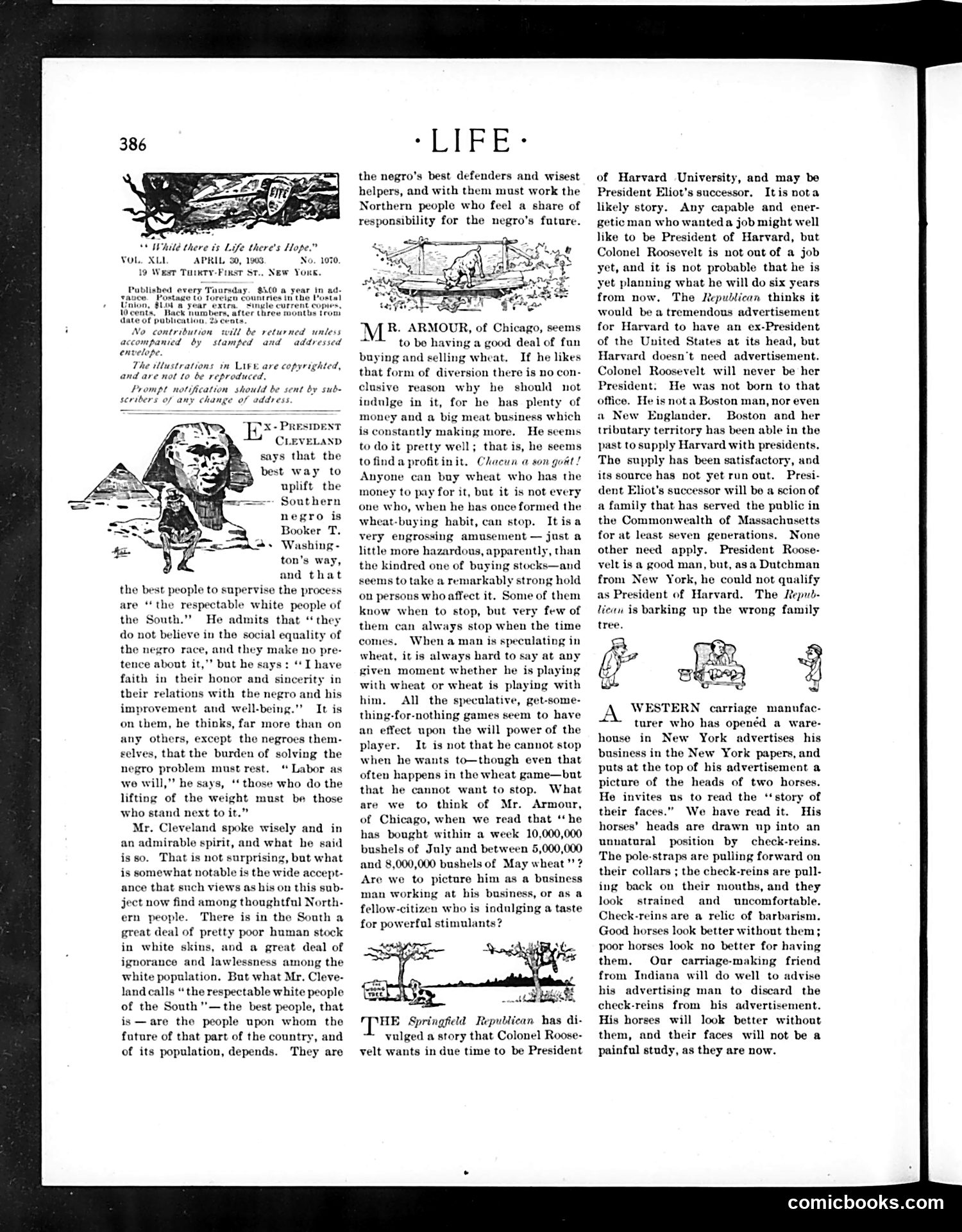
The page's main cartoon features **Ex-President Cleveland**, identified by the caption. The caricature depicts him with exaggerated facial features typical of early 1900s satirical art. The text criticizes Cleveland's views on the "negro problem," particularly his stance that Northern whites should bear responsibility for Black Americans' welfare and future. The satire mocks Cleveland's paternalistic attitude—portraying him as someone lecturing others on racial matters while maintaining patronizing views. The article also discusses **Colonel Roosevelt** (Theodore Roosevelt, the current president), contrasting his actual accomplishments with speculation about his political ambitions. The piece exemplifies Life's role as political satire commentary on contemporary debates about race, presidential authority, and Northern versus Southern race relations in the Progressive Era.
📄 Transcribed text from this page (OCR, searchable)
Machine-transcribed from the original scan — historical spelling and the odd misread are preserved.
“* While there ts Life there's Hope.” XL APRIL 30, 1908. No. 1970. 9 West Turkty-Finst St.. New You ull be returned untess stamped and addressed No contribution accompanied by envelope. The illustrations in Likt are copyright and are not to be reproduced, Prompt notification should be sent by sub- seribers of any change of address says that the best way to uplift the Southern negro is Booker T. Washing - ton's way, and that the best people to supervise the process are “the respectable white people of the South.” He admits that “they do not believe in the social equality of the negro race, and they make no pre- tence about it,” but he says: “I have faith in their honor and sincerity in their relations with the negro and his improvement and well-being.”’ It is on them, he thinks, far more than on any others, except the negroes them- selves, that the burden of solving the negro problem must rest. “ Labor as we will,” he says, ‘‘ those who do the lifting of the weight must be those who stand next to it.” Mr. Cleveland spoke wisely and in an admirable spirit, and what he said isso. That is not surprising, but what is somewhat notable is the wide accept- ance that such views as his on this sub- ject now find among thoughtful North- ern people. There is in the South a great deal of pretty poor human stock in white skins, and a great deal of ignorance and lawlessness among the white population. But what Mr. Cleve- land calls “ the respectable white people of the South "—the best people, that is—are the people upon whom the future of that part of the country, and of its population, depends. They are ‘LIFE the negro's best defenders and wisest helpers, and with them must work the Northern people who feel a share of responsibility for the negro’s future. R. ARMOUR, of Chicago, seems to be having a good deal of fan buying and selling wheat, If he likes that form of diversion there is no con- clusive reason why he should not indulge in it, for he bas plenty of money and a big meat business which is constantly making more. He s to do it pretty well; that is, he seems to finda profitinit. Chacun a@ son goat! Anyone can buy wheat who has the money to pay for it, but it is not every one who, when he has once formed the -buying habit, can stop. It isa very engrossing amusement — just a little more hazardous, apparently, than the kindred one of buying stocks—and seems to take a remarkably strong hold on persons who affect it. Some of them know when to stop, but very few of them can always stop when the time When a man is speculating in wheat, it is always hard to say at any given moment whether he is playing with wheat or wheat is playing with him. All the speculative, get-some- thing-for-nothing games seem to have an effect upon the will power of the player. It is not that he cannot stop when he wants to—though even that often happens in the wheat game—but that he cannot want to stop. What are we to think of Mr. Armour, of Chicago, when we read that ‘he has bought within a week 10,000,000 bushels of July and between 5,000,000 and 8,000,000 bushels of May wheat’? Are we to picture him as a business man working at his business, or as a fellow-citizen who is indulging a taste for powerfal stimulants? ems. comes. HE Springfield Republican has di- vulged a story that Colonel Roose- velt wants in due time to be President of Harvard University, and may be President Eliot's successor. Itis nota likely story. Any capable and ener- getic man who wanted a job might well like to be President of Harvard, but Colonel Roosevelt is not out of a job yet, and it is not probable that he is yet planning what he will do six years from now. The Republican thinks it would be a tremendous advertisement for Harvard to have an ex-President of the United States at its head, but Harvard doesn't need advertisement. Colonel Roosevelt will never be her President. He was not born to that office. He is not a Boston man, nor even a New Englander. Boston and her tributary territory has been able in the past to supply Harvard with presidents, The supply has been satisfactory, and its source has not yet runout. Presi- dent Eliot's successor will be a scion of a family that has served the public in the Commonwealth of Massachusetts for at least seven generations. None other need apply. President Roose- velt is a good man, but, asa Dutchman from New York, he could not qualify President of Harvard. The Repud- lican is barking up the wrong family tree. t= A WESTERN carriage manufac- turer who has openéd a ware- house in New York advertises his business in the New York papers, and puts at the top of his advertisement a picture of the heads of two horses. He invites us to read the “story of their faces.” We have read it. His horses’ heads are drawn up into an unnatural position by check-reins. The pole-straps are pulling forward on their collars ; the check-reins are pull- ing back on their mouths, and they look strained and uncomfortable. Check-reins are a relic of barbarism. Good horses look better without them ; poor horses look no better for having them, Onur carriage-making friend from Indiana will do well to advise his advertising man to discard the check-reins from his advertisement. His horses will look better without them, and their faces will not be a painful study, as they are now. comicbooks.com