
A complete issue · 22 pages · 1903
Life — April 9, 1903
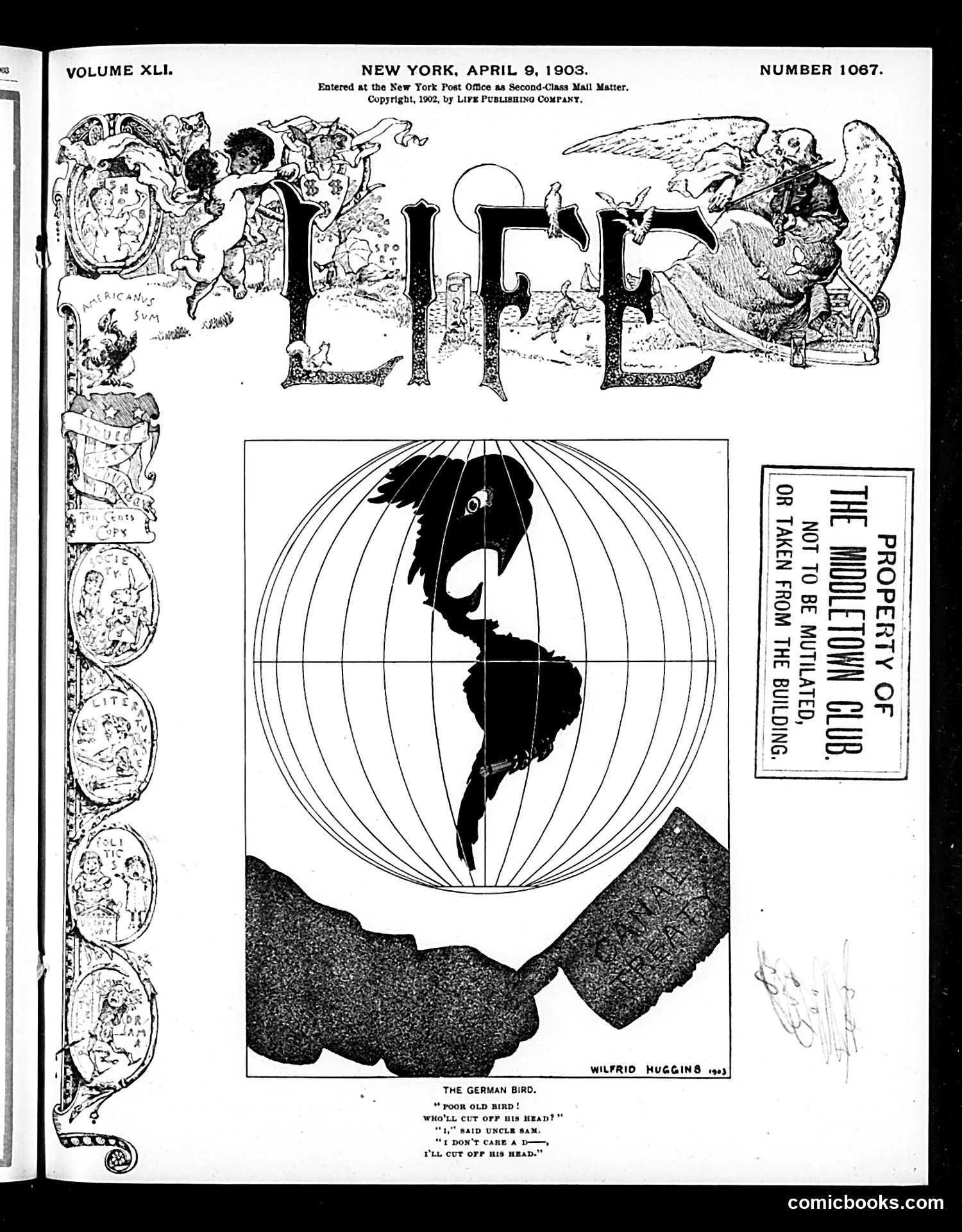
This political cartoon depicts Germany as an eagle trapped within a spherical cage made of curved lines (likely representing international alliances or diplomatic constraints). The accompanying verse mocks German imperial ambitions: "Poor old bird! / Wishes to spread his wings / But he can't," with a final threat: "I'll cut off his head." The satire targets **German expansionism under Kaiser Wilhelm II**, suggesting that despite Germany's military power and desire for global influence, European powers have contained it through diplomatic isolation or alliance systems. The bird imagery plays on German nationalism (the eagle as national symbol), while the cage represents the **balance of power** mechanisms keeping German hegemony in check. This reflects pre-World War I tensions over German militarism and colonial ambitions.
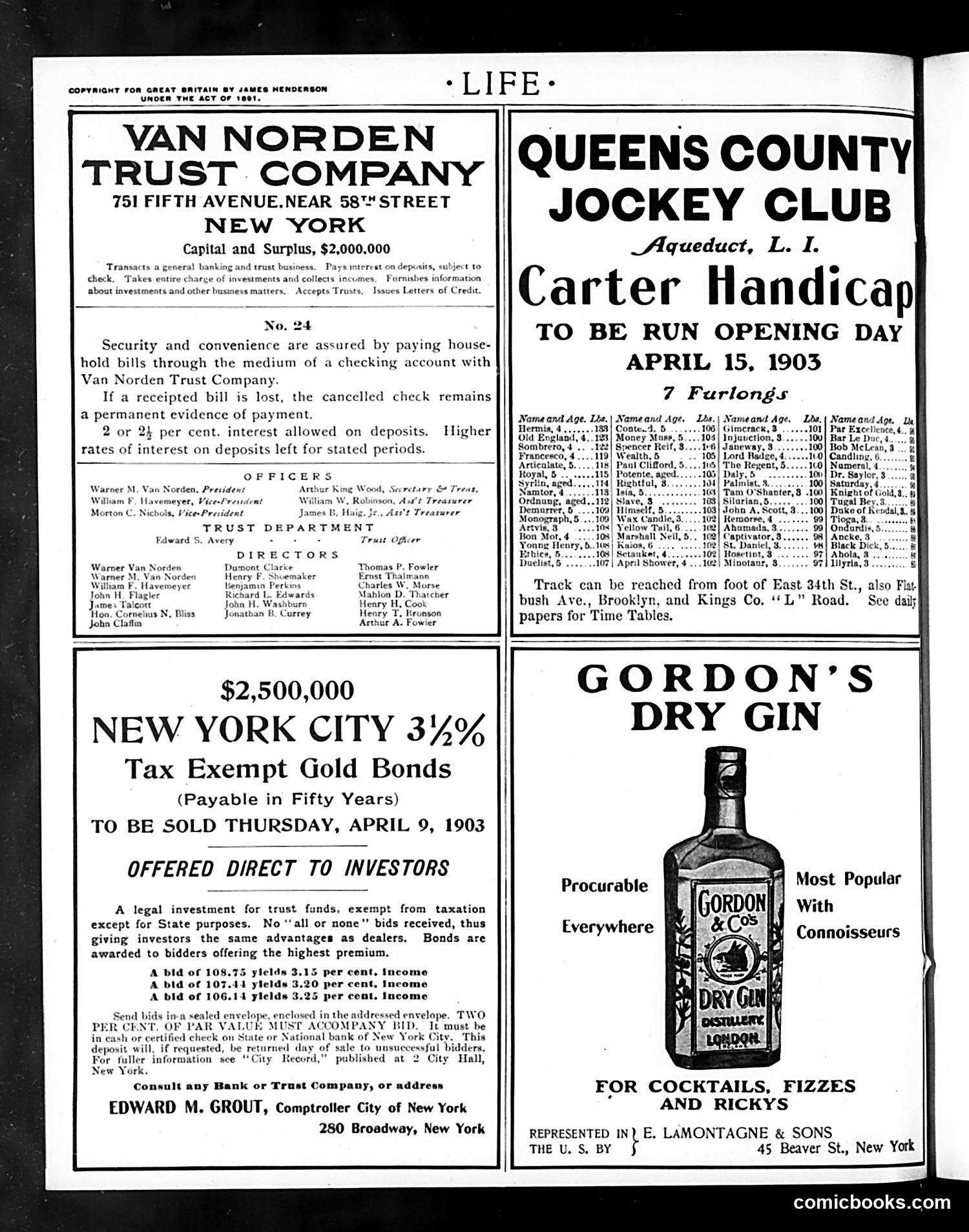
This page is **primarily advertisements**, not satire or political cartoons. It contains four ads from 1903: 1. **Van Norden Trust Company** — a New York financial institution offering checking accounts and interest-bearing deposits 2. **Queens County Jockey Club** — advertising the Carter Handicap horse race on April 15, 1903, at Aqueduct, Long Island 3. **New York City Tax Exempt Gold Bonds** — municipal bonds being sold to investors 4. **Gordon's Dry Gin** — a liquor advertisement emphasizing the product's popularity and availability There are no cartoons, caricatures, or satirical content visible. The page represents typical early 20th-century magazine advertising for financial services, entertainment, and consumer goods.
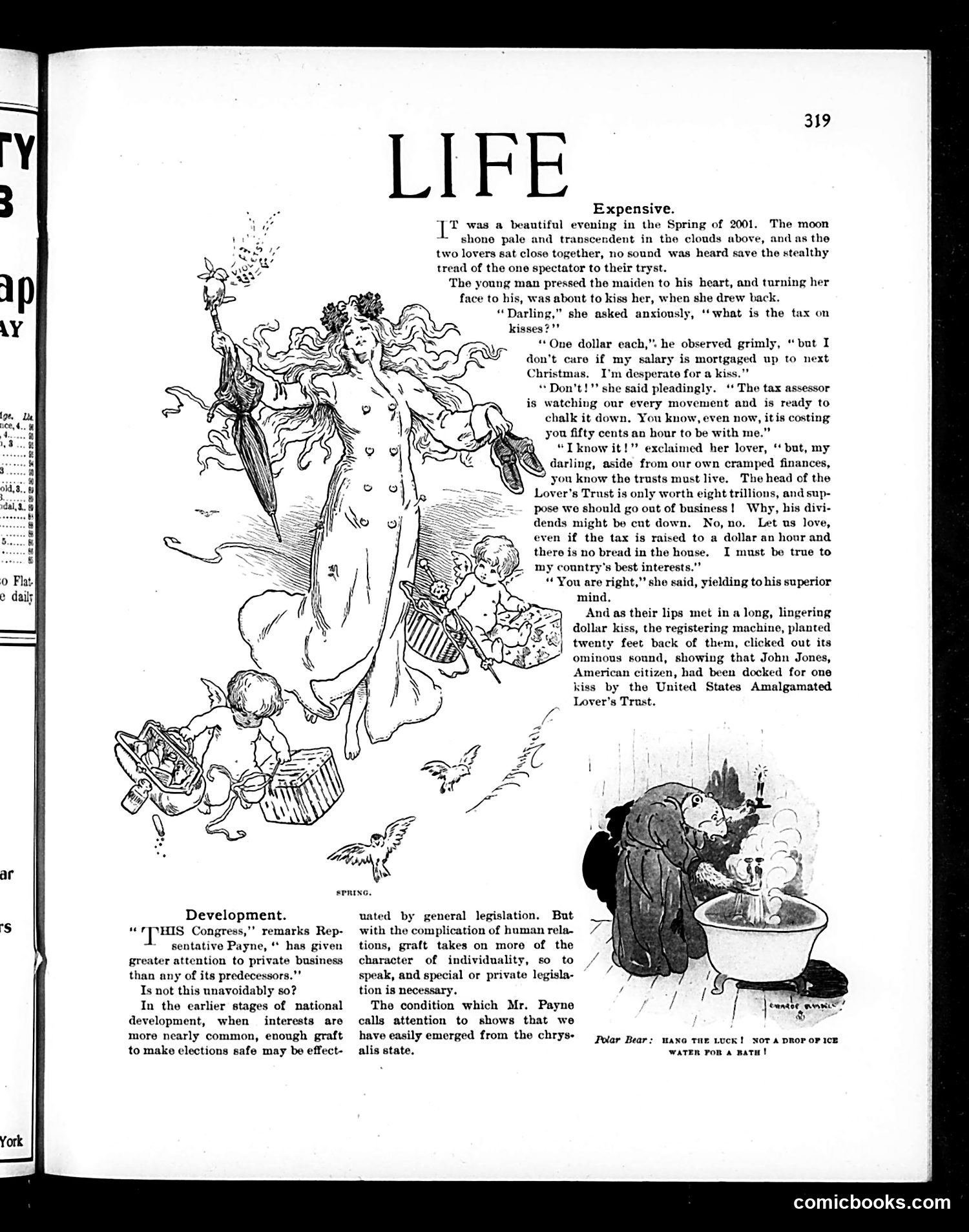
**"Expensive" cartoon (top):** A woman figure labeled "Love's Trust" is being taxed by a government "tax assessor," with cherubs and hearts scattered around. The satire mocks the taxation of romantic gestures—the young man must pay one dollar per kiss. The joke critiques government overreach into intimate private life, suggesting that even personal affection has become subject to state revenue collection. **"Development" section (bottom):** Discusses Representative Payne's remarks about private business receiving more congressional attention than predecessors. It argues that while common graft requires general legislation, human relations and special cases need individualized laws—suggesting the government's bureaucratic approach oversimplifies complex situations. **Lower cartoon:** Shows "Poor Bear" denied bathwater, likely commenting on resource scarcity or bureaucratic restrictions.
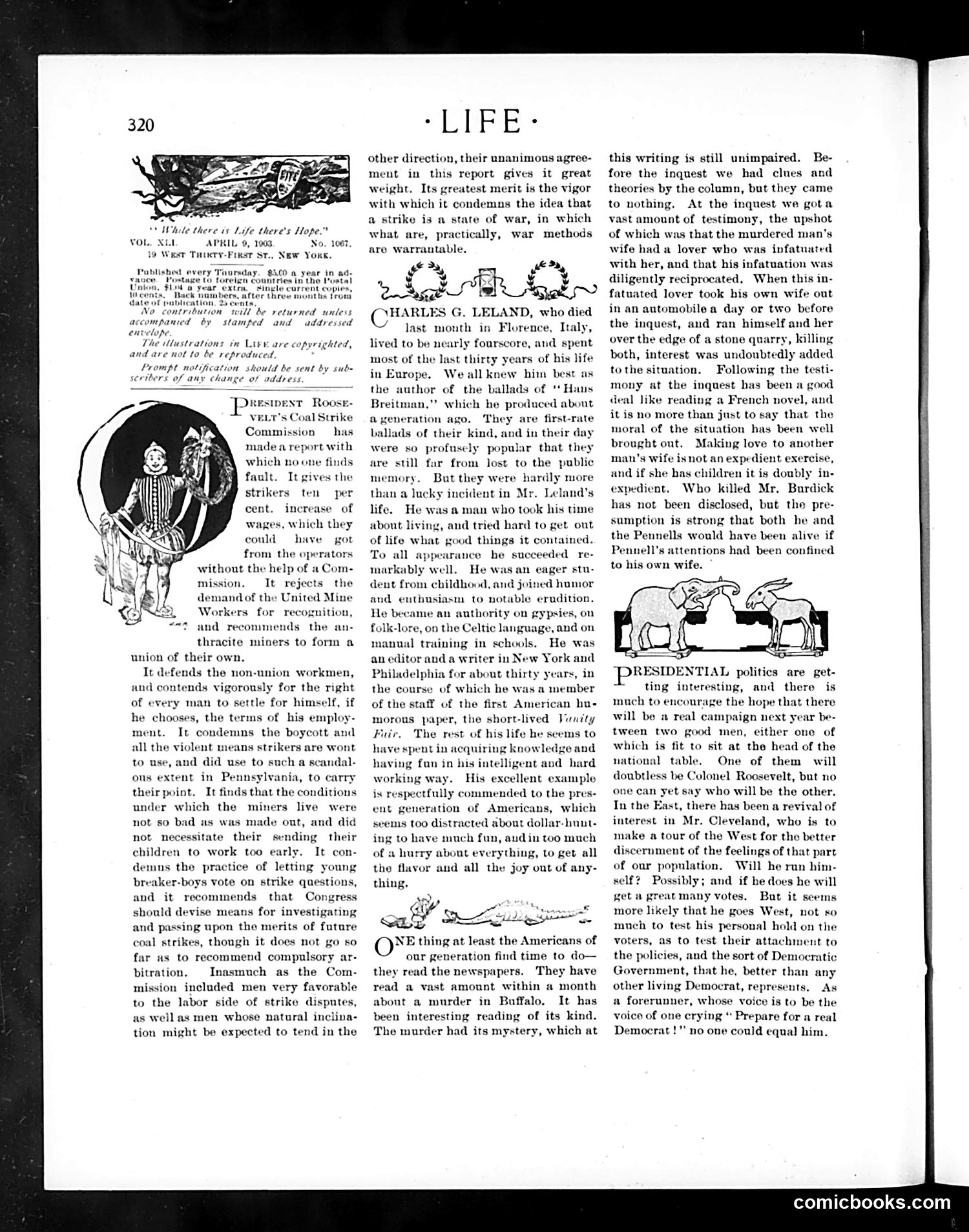
This page contains editorial commentary rather than cartoons. The main illustrated element shows a circular portrait of **President Roosevelt** alongside discussion of a **Coal Strike Commission** report. The text defends the Commission's findings, which condemned strike tactics as "war methods" while supporting workers' rights to unionize and fair wages. The accompanying illustration depicts Roosevelt as a strong, decisive figure, reflecting contemporary editorial support for his labor mediation efforts during the early 1900s coal crisis. The page also discusses **Charles G. Leland**, a recently deceased author and authority on gypsies and Celtic language, and includes political speculation about Democratic candidates, mentioning **Cleveland** potentially running for office again. The overall tone is progressive for its era, supporting labor rights while praising executive intervention.
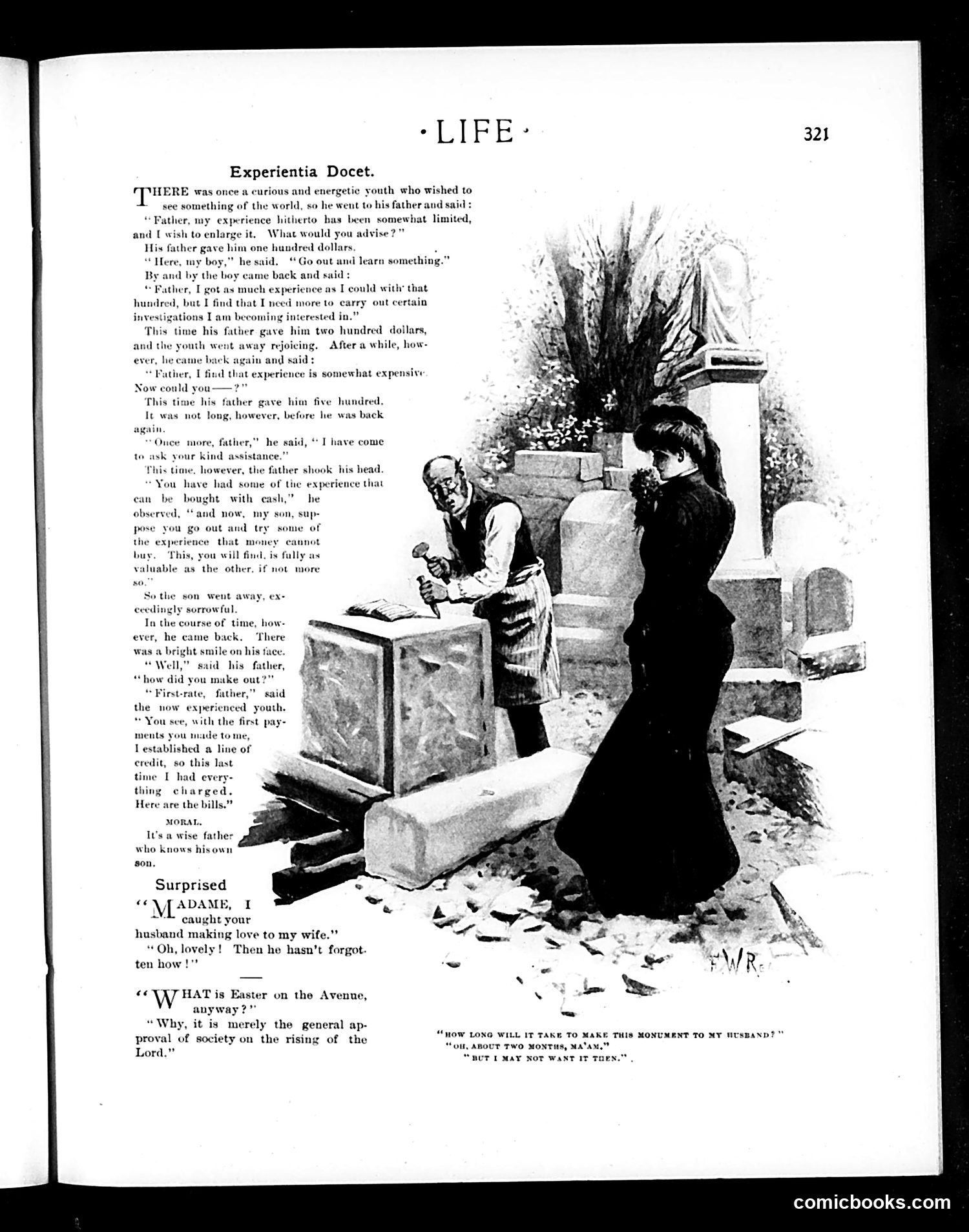
This page contains two separate satirical pieces: **"Experientia Docet"** (Experience Teaches): A story-with-illustration about a father advising his son to gain real-world experience rather than relying on book learning. The son attempts various business ventures, loses money, and returns requesting more funds. The moral: "It's a wise father who knows his own son." The humor lies in the son's repeated failures despite the father's expensive lessons. **"Surprised"**: A brief comedic exchange where a woman catches her husband making love to another woman, and he claims he hasn't forgotten her—it's merely "Easter on the Avenue." This plays on "Easter" as both a holiday and as a euphemism, mocking infidelity excuses. Both pieces use humor to critique human folly—naïve business ventures and marital infidelity—typical of Life magazine's satirical approach.
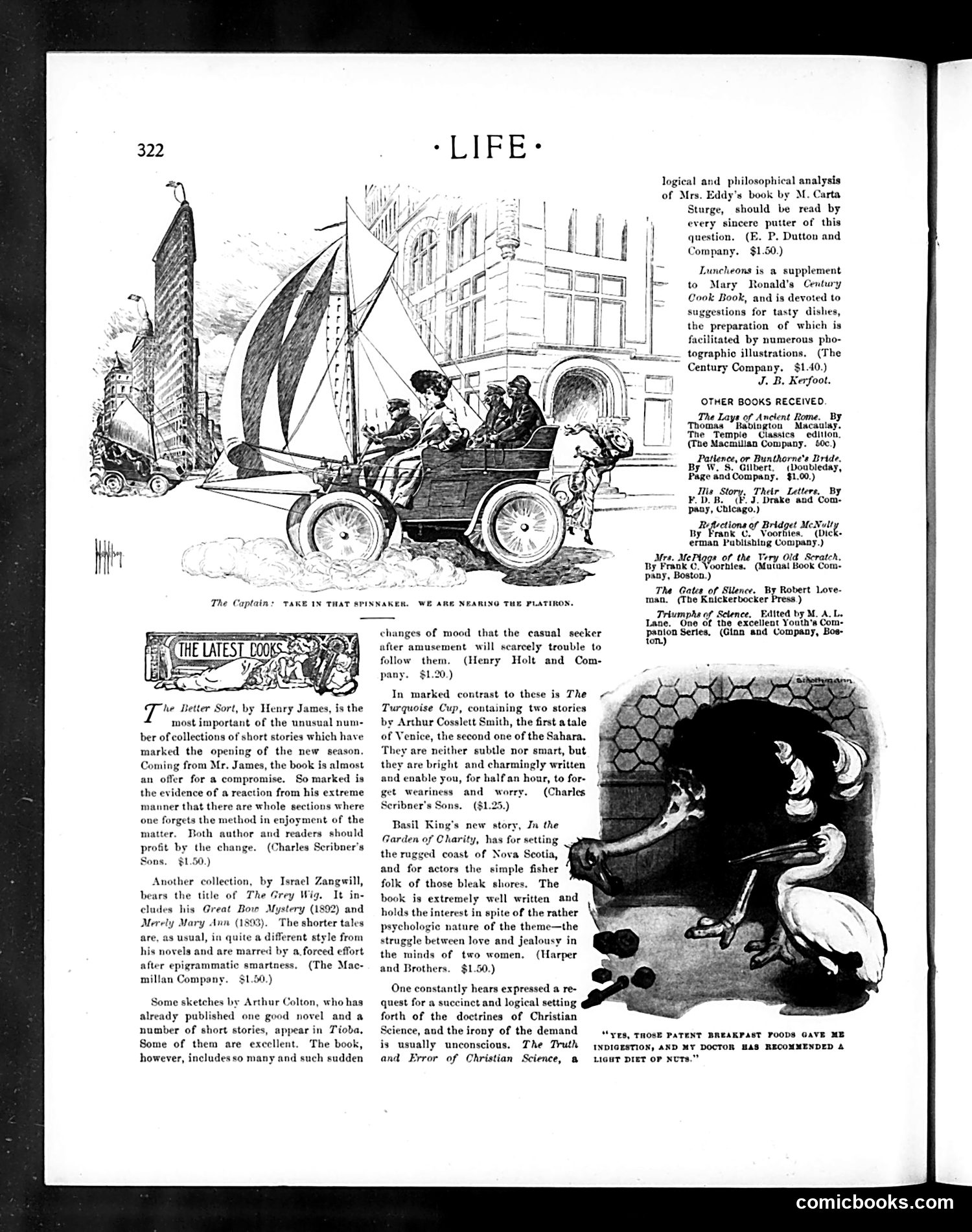
This page primarily contains **book reviews** rather than political satire. The main illustration shows a whimsical scene of people in an early automobile styled like a sailing ship, captioned "The Captain: 'Take in that spinnaker. We are nearing the platoon.'" This appears to be a humorous visual pun combining maritime and automotive imagery—likely illustrating the fantastical nature of one of the reviewed books. The reviews discuss various literary works including collections by Henry James and Israel Zangwill. The second illustration (bottom right) depicts what appears to be a domestic scene with figures, though its specific reference is unclear from the visible text. Overall, this is a **literary criticism page** rather than political commentary, typical of Life's cultural coverage during this period.
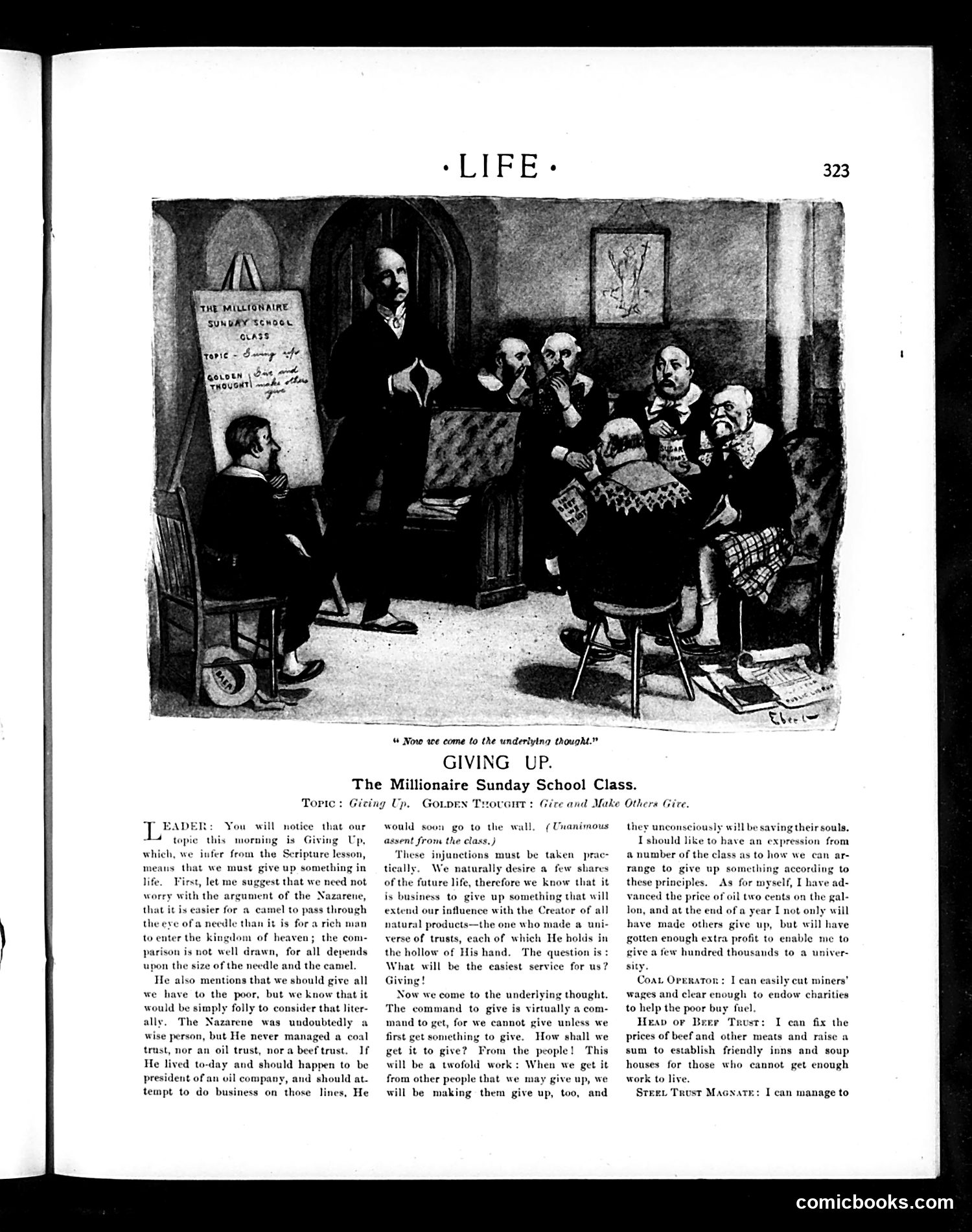
This satirical cartoon depicts wealthy businessmen in a Sunday school lesson about Christian charity and self-sacrifice. The irony is sharp: a class leader discusses "giving up" worldly possessions to help the poor, while the wealthy attendees—identified by their fine clothing and demeanor—offer absurdly minimal or self-serving "sacrifices." Their responses are comically inadequate: a coal operator offers miners' wage cuts; a beef trust magnate proposes raising meat prices; a street trust manager claims he can "manage" (implying no actual change). The satire mocks the hypocrisy of wealthy industrialists attending Sunday school while exploiting workers and consumers—pretending religious piety while refusing genuine sacrifice. The cartoon criticizes how the wealthy weaponize Christianity to avoid actual social responsibility.
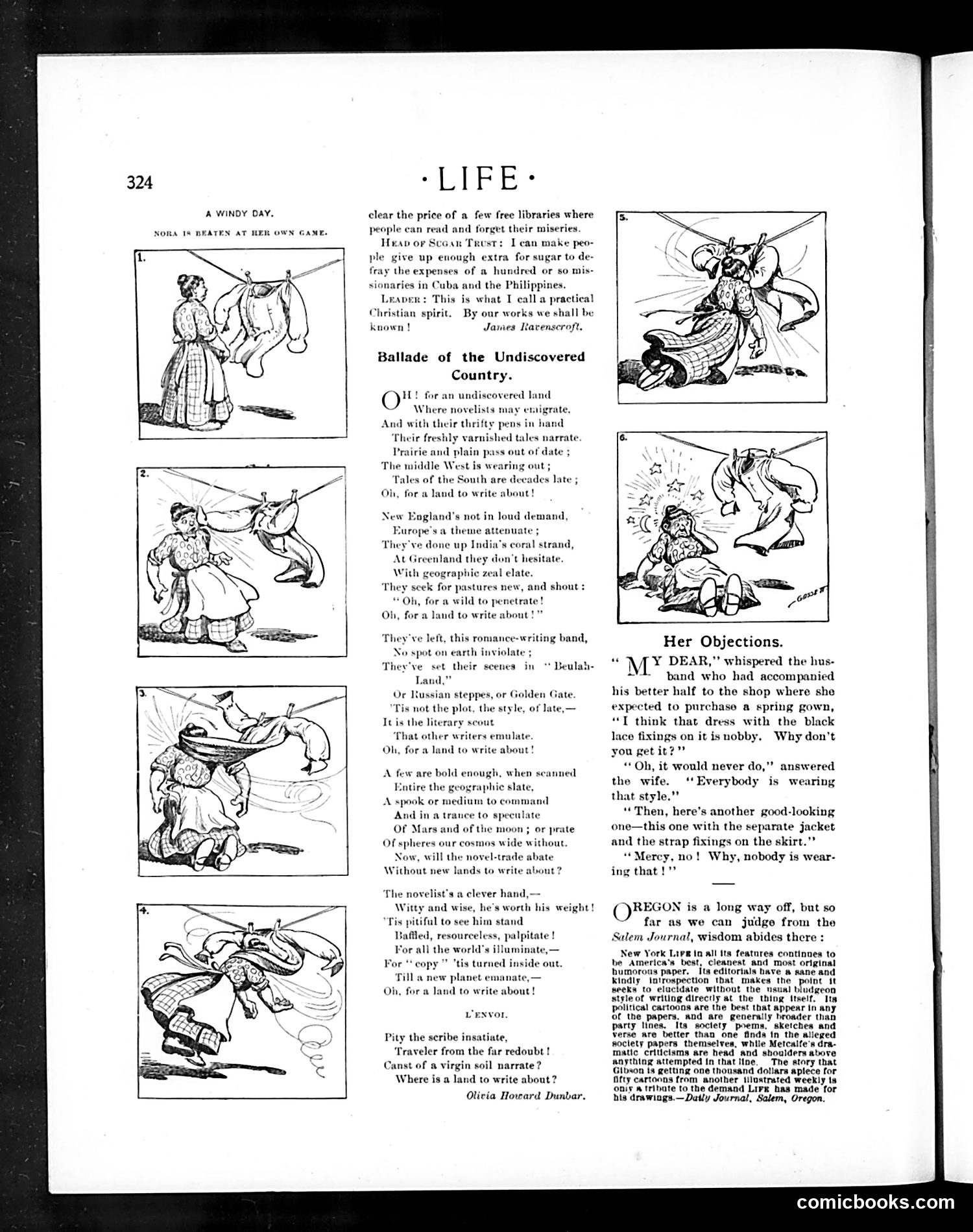
This four-panel comic shows a woman being repeatedly knocked over by wind while trying to control a horse. The progression depicts her losing her grip on the reins as gusts intensify, eventually landing her on the ground. The humor is physical/slapstick rather than political. The title "A Windy Day" appears to reference the common Victorian-era difficulty women faced managing long skirts and bonnets in blustery weather—a relatable domestic comedy for the magazine's readers. The accompanying text pieces ("Ballad of the Undiscovered Country" and "Her Objections") are satirical commentary on literary trends and fashion, unrelated to the comic strip itself.
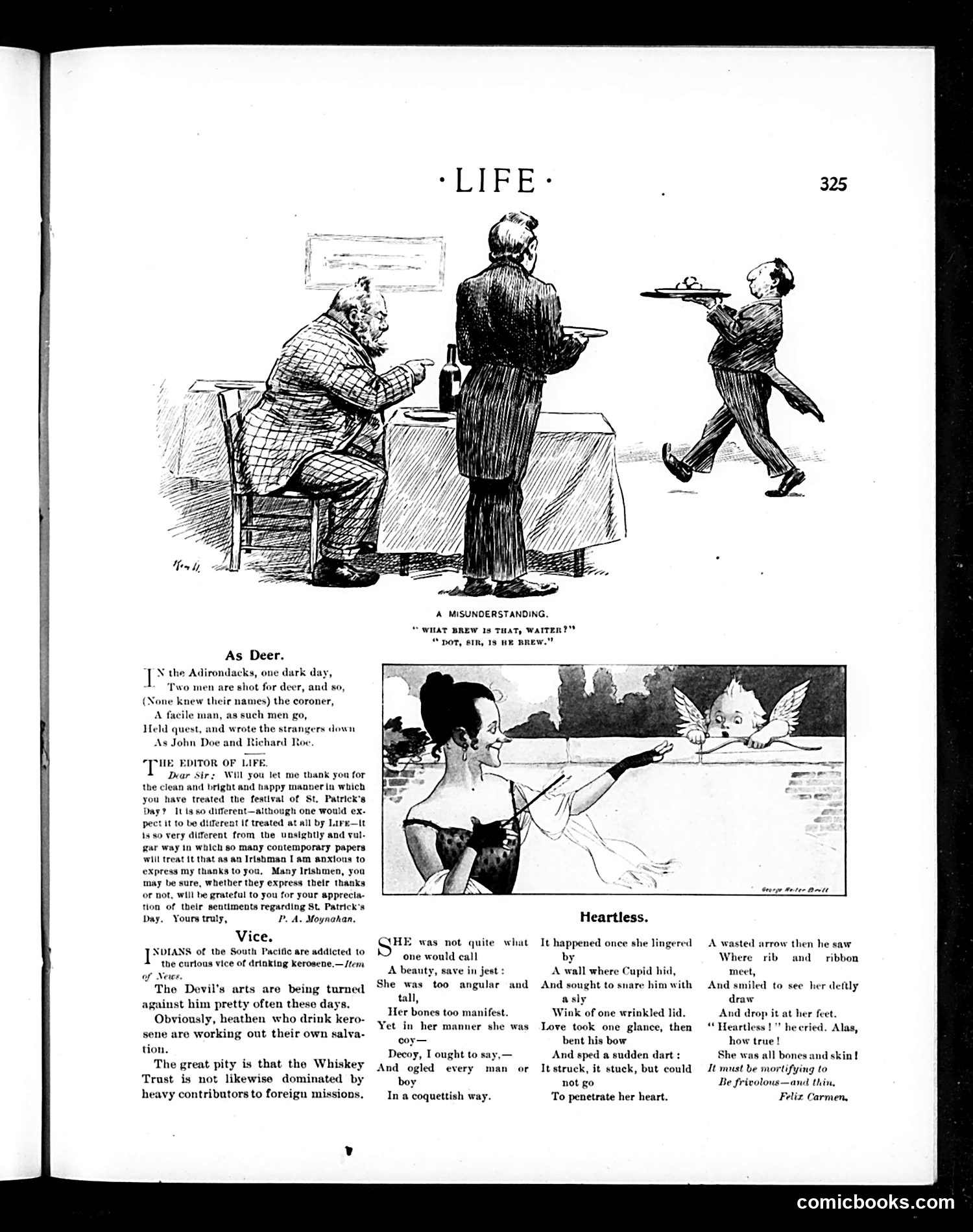
The page contains three distinct pieces: **"Misunderstanding" cartoon (top):** A waiter mishears an order, confusing "What brew is that, waiter?" with "Doss, sir, is he brew"—a pun on servant/beverage confusion typical of early 20th-century humor. **"As Deer" poem (left):** A narrative about deer hunting in the Adirondacks, with editor's note praising the piece's "clean and bright and happy manner." This appears to be reader-submitted content. **"Heartless" illustration (right):** Shows a woman by water with cherubs/cupids, accompanying a poem about unrequited love. The poem critiques a heartless woman who rejects Cupid's arrows—typical sentimental Victorian-era romantic verse. The page reflects Life's mix of satire, reader submissions, and romantic illustration common to early American humor magazines.
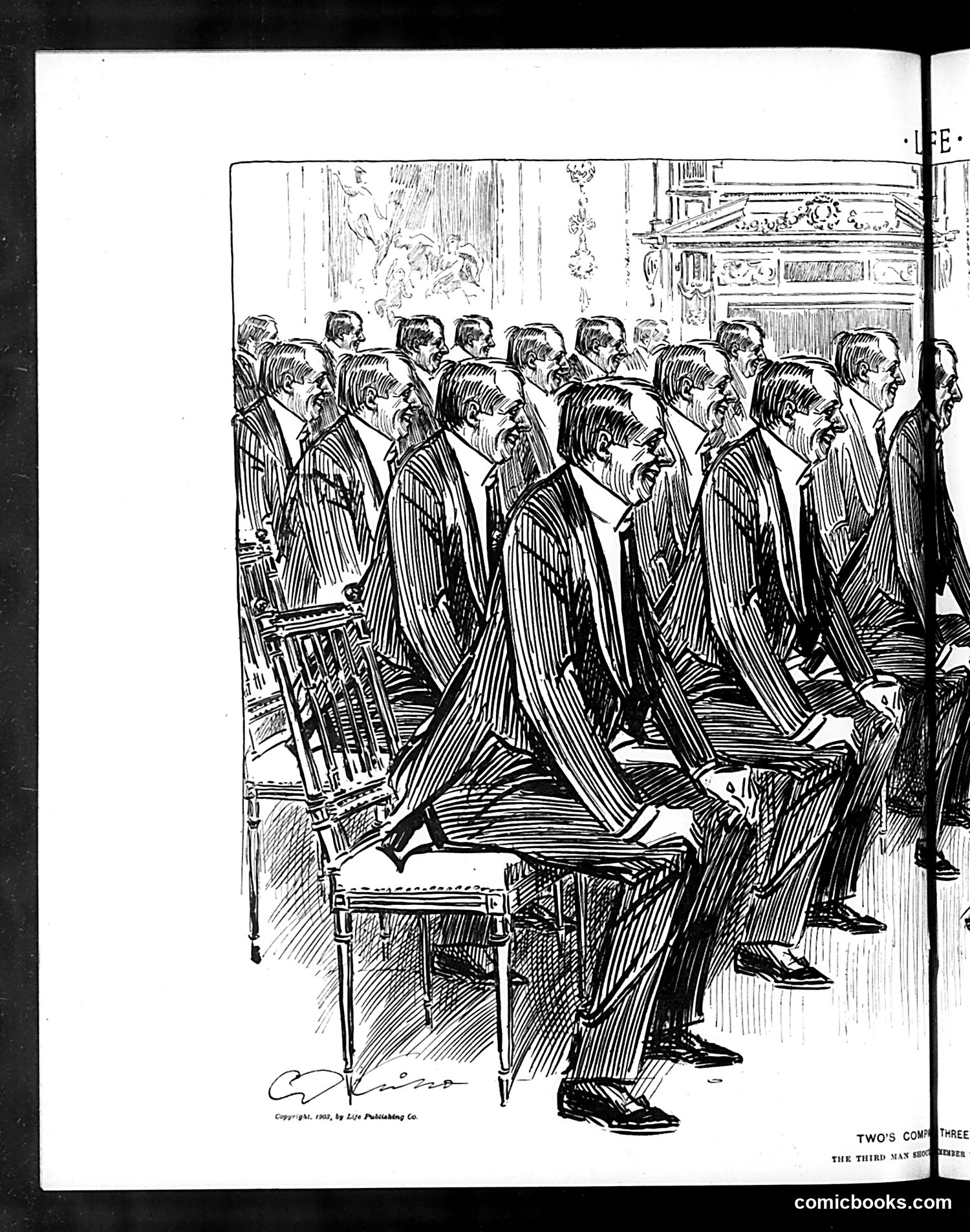
This is a satirical illustration showing a formal governmental or parliamentary proceeding. A large group of men in identical dark pinstriped suits sit in rows, their faces rendered with exaggerated, similar features. The image appears to satirize **conformity and lack of individuality** among political or bureaucratic figures—the repetitive appearance and identical clothing suggests they are interchangeable, without distinctive personalities or independent thought. The ornate interior (visible fireplace and decorative elements) indicates a formal institutional setting, likely a legislature or government chamber. The cartoon's point seems to be that such official bodies consist of indistinguishable members who simply follow the system, lacking genuine individuality or independent judgment. The title reference mentions "two's compliment" and "third man remembers," though the specific context remains unclear without additional page information.
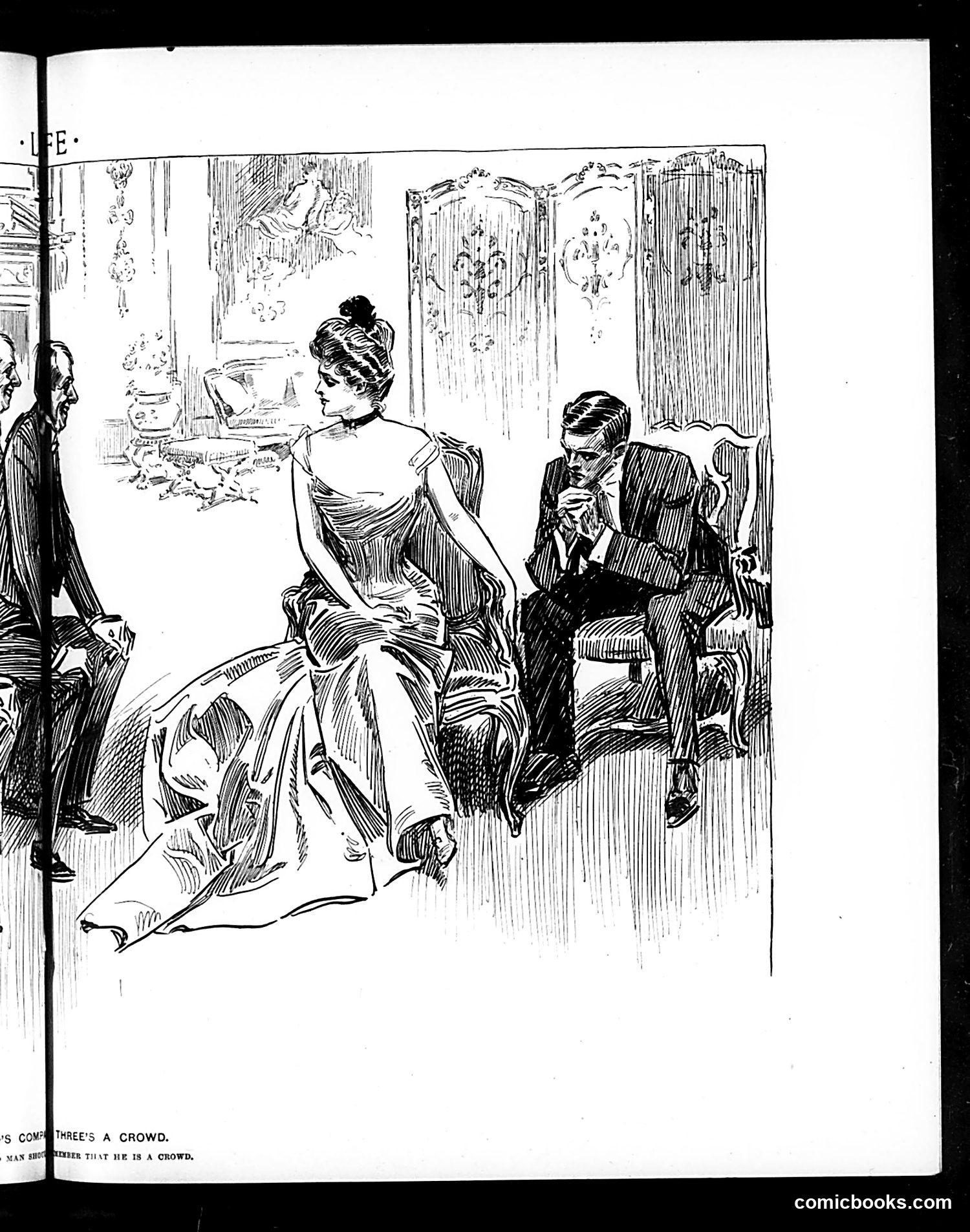
This page shows a social scene in an elegant interior with three figures: a woman in an evening gown seated centrally, a man in formal attire beside her, and another man visible on the left. The visible text reads "THERE'S A CROWD" and "SAYS THAT HE IS A CROWD," suggesting a play on the common phrase "two's company, three's a crowd." The cartoon appears to satirize social dynamics at a formal gathering, likely poking fun at the awkwardness of romantic or social triangles in high society. The woman's prominent, relaxed pose contrasts with the man's nervous demeanor (hand to face), suggesting discomfort with the crowded situation despite being only three people. Without additional context or caption text, the specific social commentary remains unclear, though it likely addresses Victorian-era courtship conventions or social pretension.
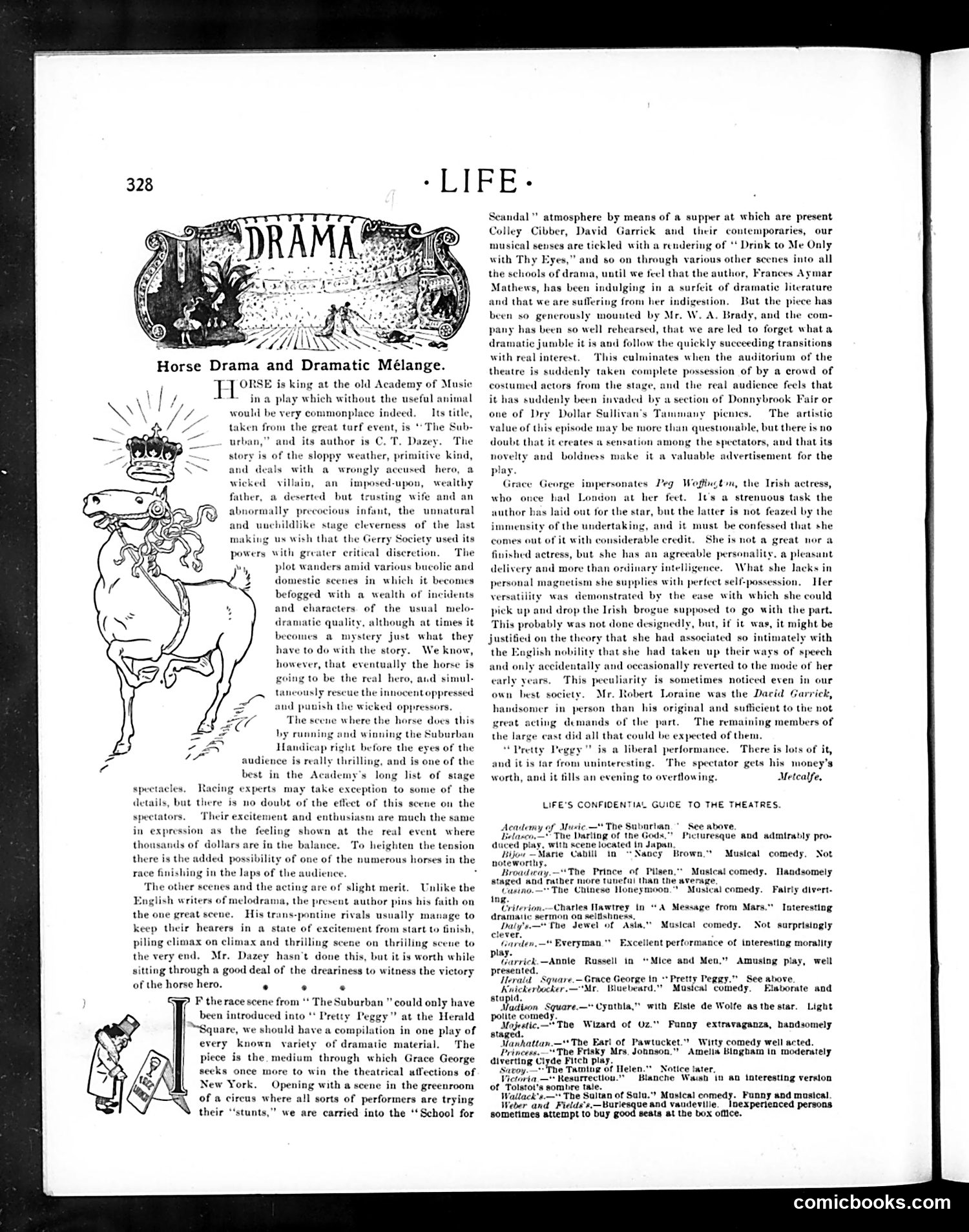
This page reviews theatrical productions, focusing on a play called "The Suburban" at the Academy of Music. The illustrated horse appears to be a satirical representation of the play's central prop—described as unusually prominent in the story, wandering through various scenes. The text humorously notes that while the horse should be the hero, the plot itself is somewhat muddled and melodramatic, becoming "a mystery just what they have to do with the story." The cartoon mocks the theatrical device of using spectacle (the horse) to distract audiences from weak storytelling. The review suggests that excitement from the novelty and "running and winning" scenes compensates for narrative deficiencies—typical satire of stage spectacle prioritized over substance. The page also lists other contemporary theatrical productions with brief critical notes.
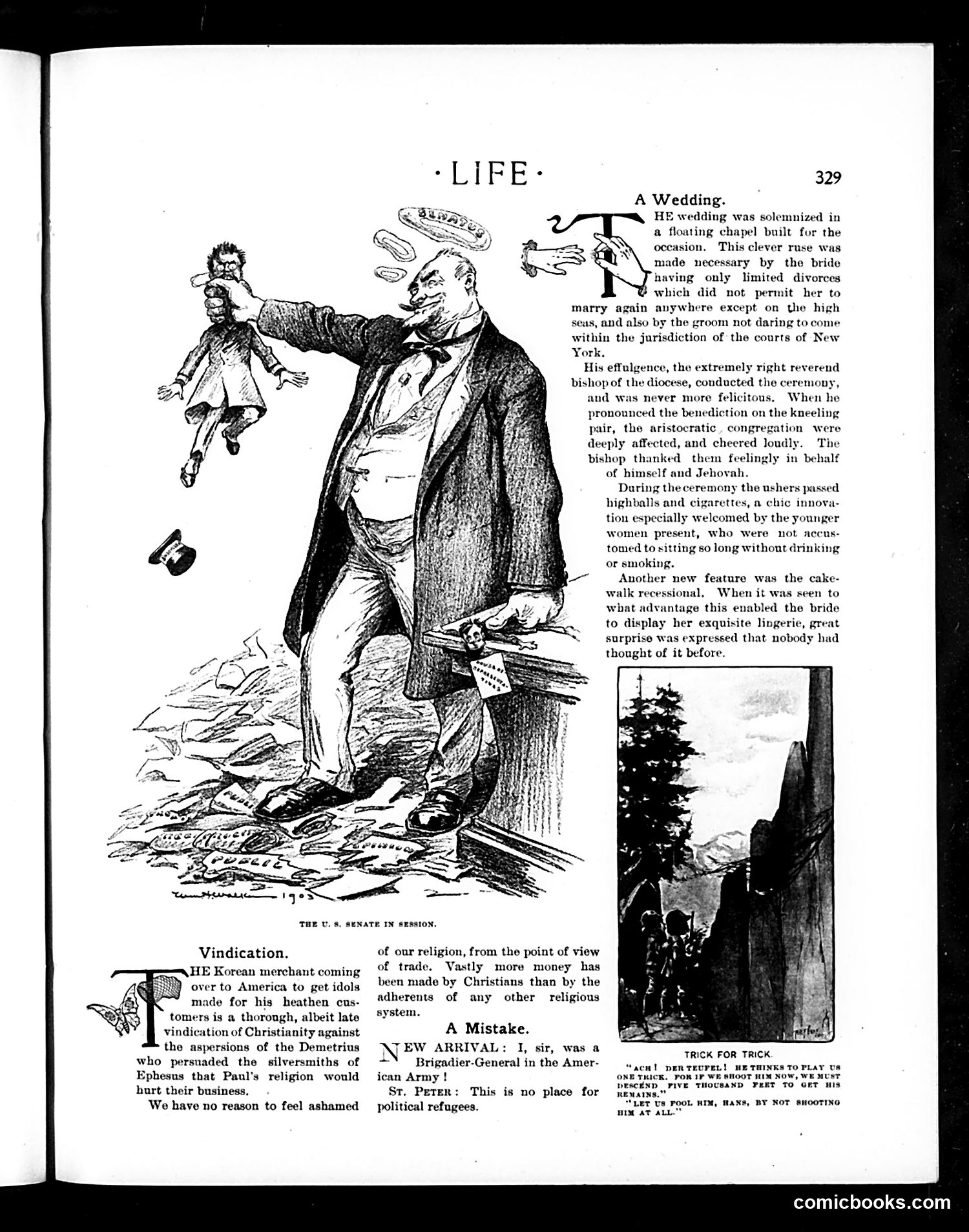
The main cartoon depicts a man in formal dress holding a tiny bride aloft—satirizing a recent high-society wedding that required a "floating chapel" on international waters. The bride had accumulated so many divorces under New York law that she couldn't remarry on land; the groom faced legal consequences if he entered the state's jurisdiction. The satire mocks the wealthy elite's ability to circumvent laws through technicalities, and ridicules the ceremony's scandalous details: serving alcohol and cigarettes during services, and the bride performing a "cake-walk recessional" specifically to display her lingerie—presented as if this was a novel, shocking fashion innovation. The cartoon's title, "The U.S. Senate in Session," appears to reference the man as a senator, suggesting Congress operates with similarly self-serving disregard for rules. The accompanying pieces ("Vindication," "A Mistake," "Trick for Trick") appear unrelated satirical vignettes about religion, military imposters, and international conflict.
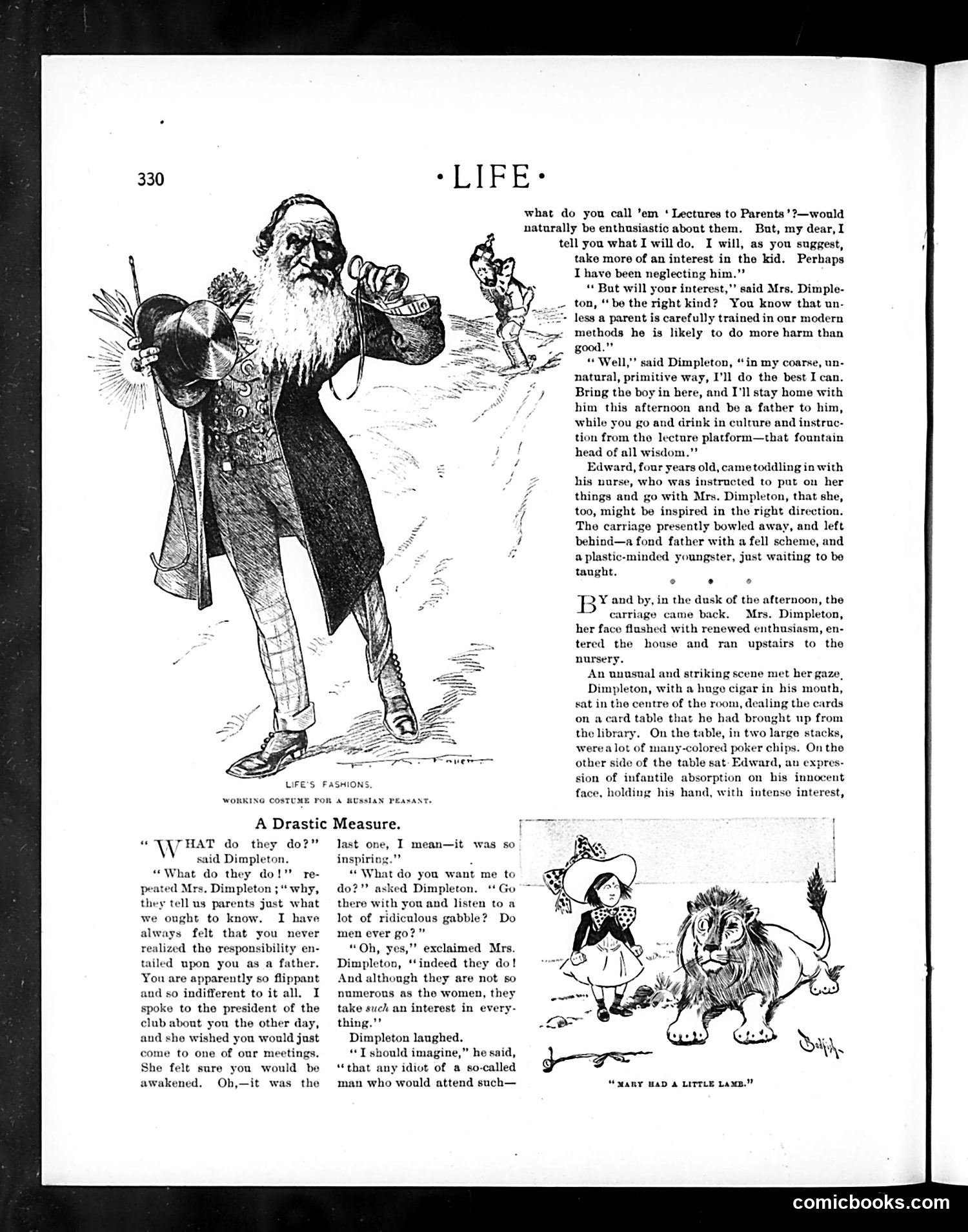
This page satirizes the era's "scientific parenting" movement and women's self-improvement clubs. Mrs. Dimpleton pressures her husband to attend parenting lectures, claiming modern "methods" are necessary—implying he's an inadequate father. Dimpleton resists, viewing it as pretentious gabble. The satire's punchline: while Mrs. Dimpleton attends her lecture on "proper" parenting techniques, Dimpleton teaches their four-year-old son Edward to play poker—explicitly violating contemporary child-rearing wisdom. The joke mocks both the smug certainty of expert parenting advice and the gap between espoused values and actual behavior. The top illustration of a "Russian Peasant" likely comments on crude, unrefined masculinity versus the "cultured" modern approach Mrs. Dimpleton champions.
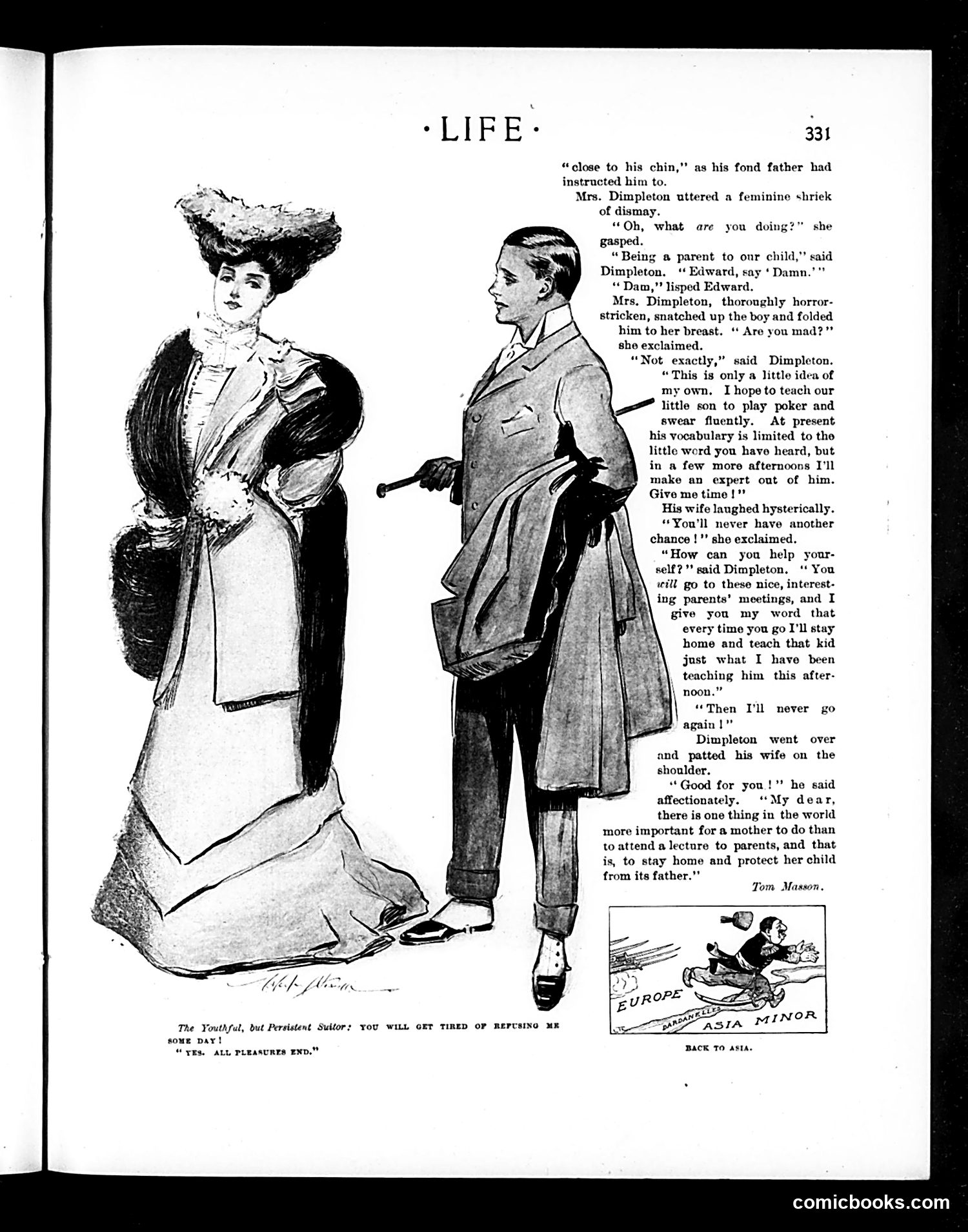
This 1900s-era *Life* magazine page contains a satirical domestic sketch by Tom Masson mocking parental discipline debates of the era. **The Main Cartoon:** Mr. Dimpleton, a foolish father, deliberately teaches his young son Edward to swear and play poker as an experiment in parenting. Mrs. Dimpleton is horrified. The joke exposes absurd masculinity: Dimpleton believes rough behavior makes boys into "experts," while ironically proving fathers are incompetent. His wife's solution—threatening never to attend parent lectures again to prevent his influence—becomes the punchline: mothers must protect children *from* fathers. **The Social Context:** This satirizes contemporary debates about child-rearing, gender roles, and parental authority. It assumes readers share the view that swearing and gambling are genuinely corrupting influences on children (not modern sensibilities). The humor relies on Dimpleton's obvious foolishness being self-evident. **The Small Inset Cartoon** titled "Back to Asia" appears unrelated—likely a separate editorial cartoon about colonial or geopolitical matters.
This page satirizes a **1908 coal miners' strike** through the metaphor of a "book miners' strike"—a humorous inversion where literary figures and book publishers become labor disputants. The strike bulletins mock real labor negotiations by treating books as mined commodities with tonnage demands and operator disputes. The cartoons below address **racial stereotypes and class assumptions** of the era. "Yawcob and His Dog" contrasts a working immigrant's exhausting daily routine with his dog's leisure, highlighting class disparity. The "Southern darky" anecdote reflects period racism, depicting a freed Black man misunderstanding property rights—a stereotype suggesting limited intelligence. The page's heavy advertising (Wilson Whiskey, Tabasco, perfume) was typical of *Life* magazine's revenue model. The overall tone is genteel mockery of labor disputes, immigrant dialect humor, and racial caricature—all considered acceptable entertainment for *Life's* educated, upper-class readership in the Edwardian era.
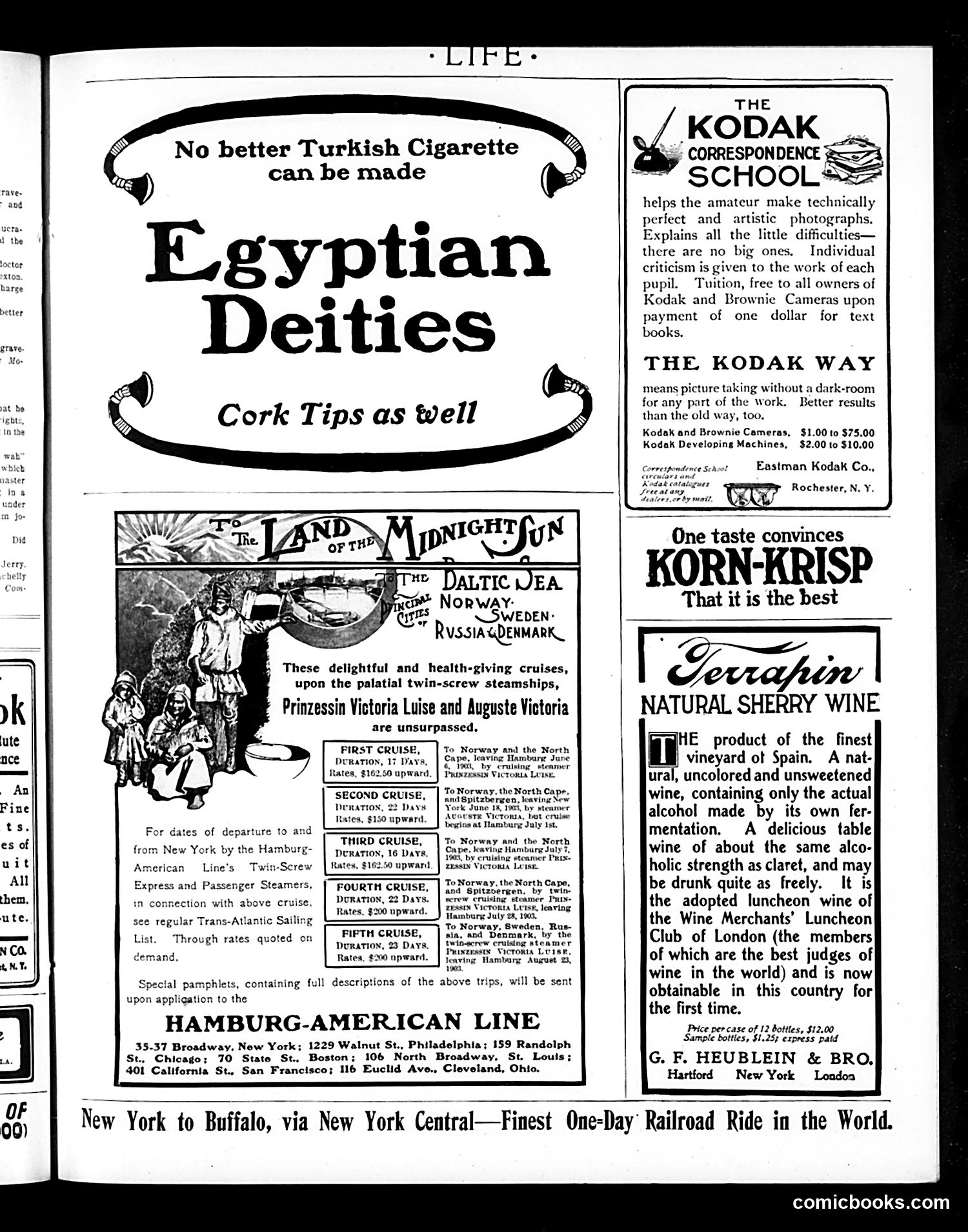
This is primarily an **advertising page** from Life magazine, not satirical content. The page features period advertisements (circa 1905) for: 1. **Egyptian Deities Cigarettes** — a Turkish cigarette brand with cork tips, using "Egyptian" styling as an exotic marketing appeal. 2. **Hamburg-American Line cruises** — advertising luxury steamship voyages to Norway, Russia, Sweden, and Denmark aboard the *Prinzessin Victoria Luise* and *Auguste Victoria*. 3. **Kodak Correspondence School** — offering photography instruction by mail, positioning Kodak cameras as user-friendly for amateurs. 4. **Korn-Krisp** — a Spanish sherry wine marketed as refined and healthful. The "Land of the Midnight Sun" illustration depicts generic Nordic/Arctic imagery to promote European cruises. There is **no political satire or caricature** present — this is straightforward early-20th-century consumer advertising reflecting period attitudes toward luxury travel, photography as leisure, and imported goods as status symbols.
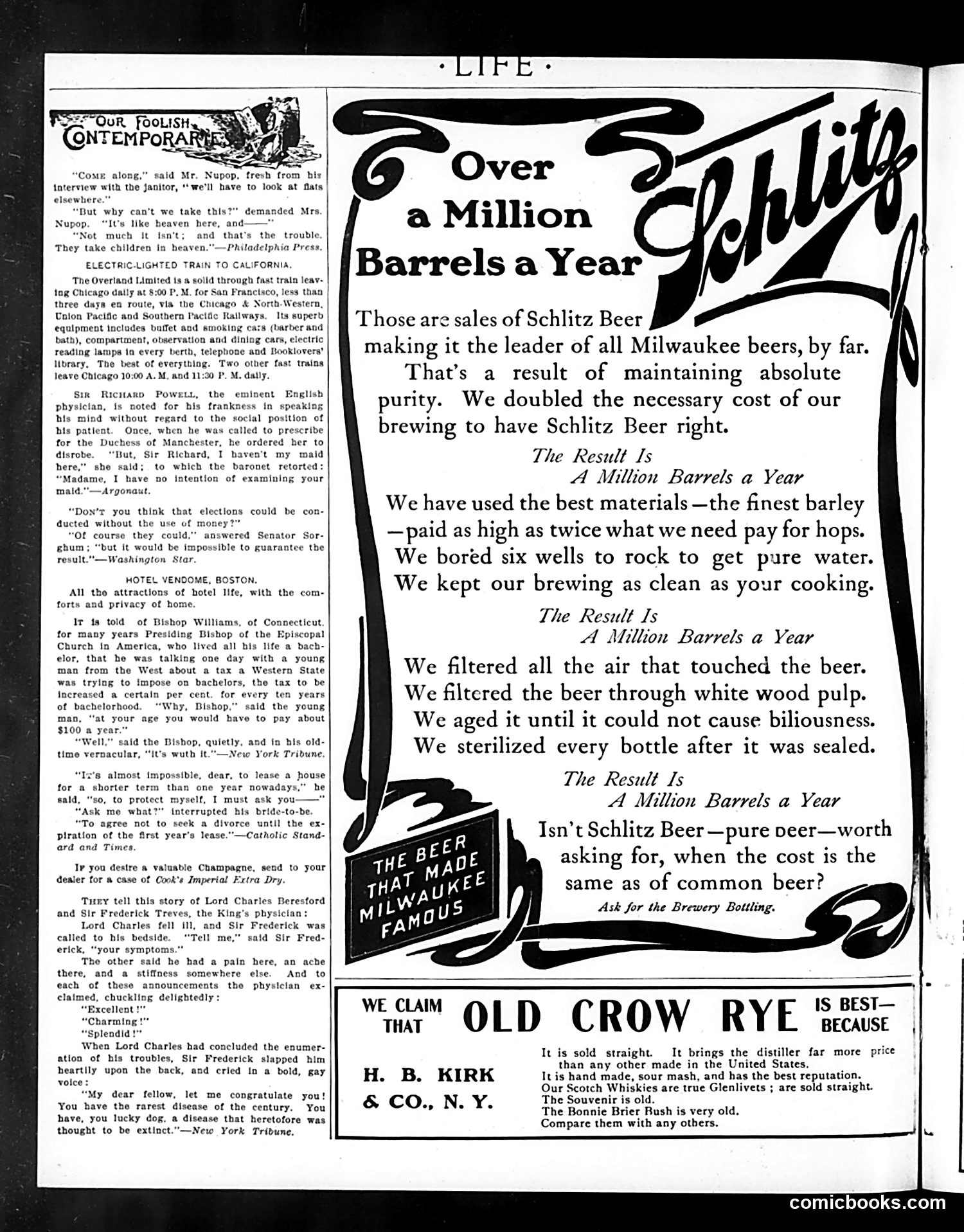
This page combines satirical editorial content with period advertisements. The left side features humorous anecdotes typical of Life's style: a joke about apartment hunting, snippets about English physician Sir Richard Powell's bluntness with patients, Bishop Williams's witty response to bachelor taxes, and a story about Lord Charles Beresford's medical complaints. The dominant right-side advertisement promotes **Schlitz Beer**, emphasizing its market dominance ("over a million barrels a year") and claiming superiority through rigorous quality control—pure water from deep wells, filtered air, aging processes, and sterilization. This reflects early 20th-century competitive beer marketing, where manufacturers highlighted purity standards as a selling point. A smaller ad for **Old Crow Rye whiskey** appears below, similarly emphasizing quality and price premium. The page represents Life's dual nature: satirizing contemporary social foibles while hosting advertisements that themselves make exaggerated quality claims—a subtle irony typical of the magazine's sophisticated approach to both editorial and commercial content.
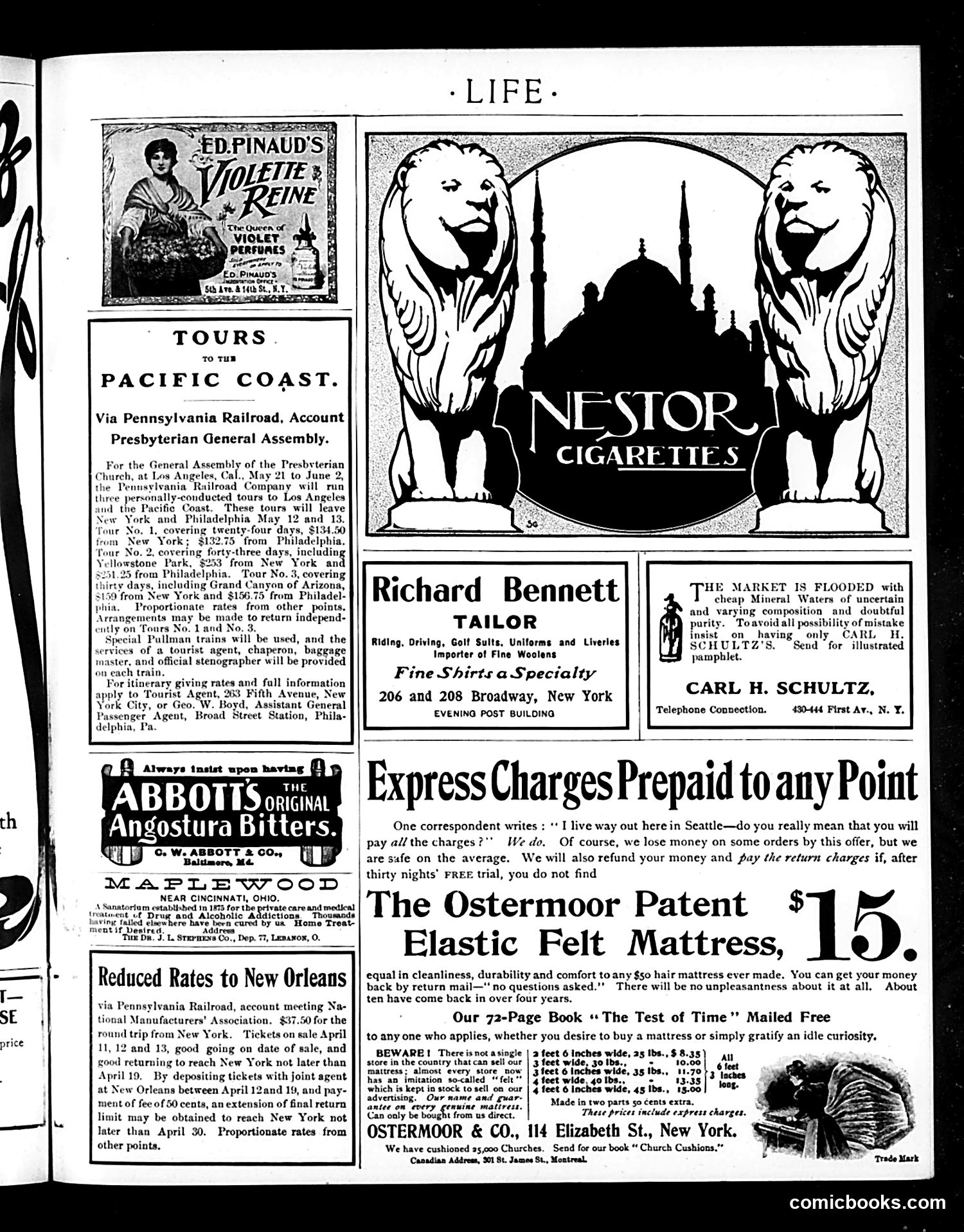
This page is primarily **advertisements and travel notices** rather than satirical editorial content. The main visual elements are: - A **Nestor Cigarettes ad** featuring two large lion heads flanking a silhouetted mosque/Middle Eastern building—using exotic imagery to market cigarettes - A **Violette Reine film advertisement** (top left) - Multiple service advertisements (tailor, mineral water, mattress company) The editorial content consists of **travel announcements** from the Pennsylvania Railroad, promoting tours to the Pacific Coast and New Orleans timed to coincide with religious and business conventions (Presbyterian General Assembly, National Manufacturers' Association). There is **no political satire** visible on this page. The lion imagery in the Nestor ad is purely commercial branding, not commentary. This appears to be a standard magazine page from the early 20th century mixing travel information with commercial advertisements—typical of *Life*'s business model during this era.
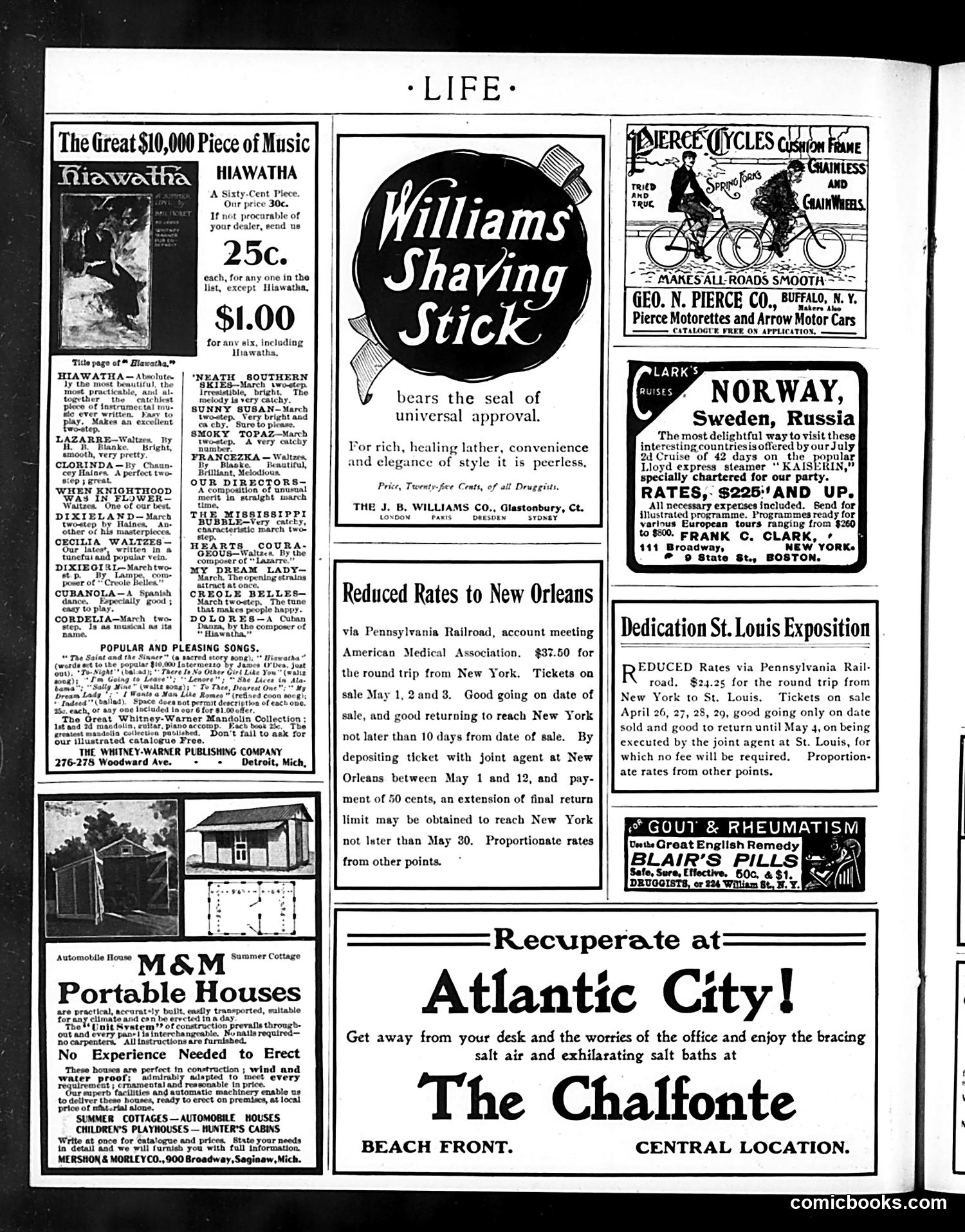
This page is primarily **advertising**, typical of early 1900s magazines. There are no political cartoons or satirical commentary—the "Life" masthead indicates this is the commercial publication, not the later satirical magazine of that name. The advertisements showcase period consumer goods: sheet music (particularly "Hiawatha," marketed as a "$10,000 piece of music"), Williams Shaving Stick, Pierce bicycles and automobiles, portable houses, railroad excursions to New Orleans and European cruises, and patent medicines like Blair's Pills for gout. The page reflects Edwardian consumer culture—mass-produced leisure items, travel opportunities for the wealthy, and aggressive marketing claims (the "$10,000" music reference appears to reference a contest or composition prize). The advertisements reveal what affluent Americans purchased and valued circa 1900-1910: music, vehicles, vacation homes, and travel.
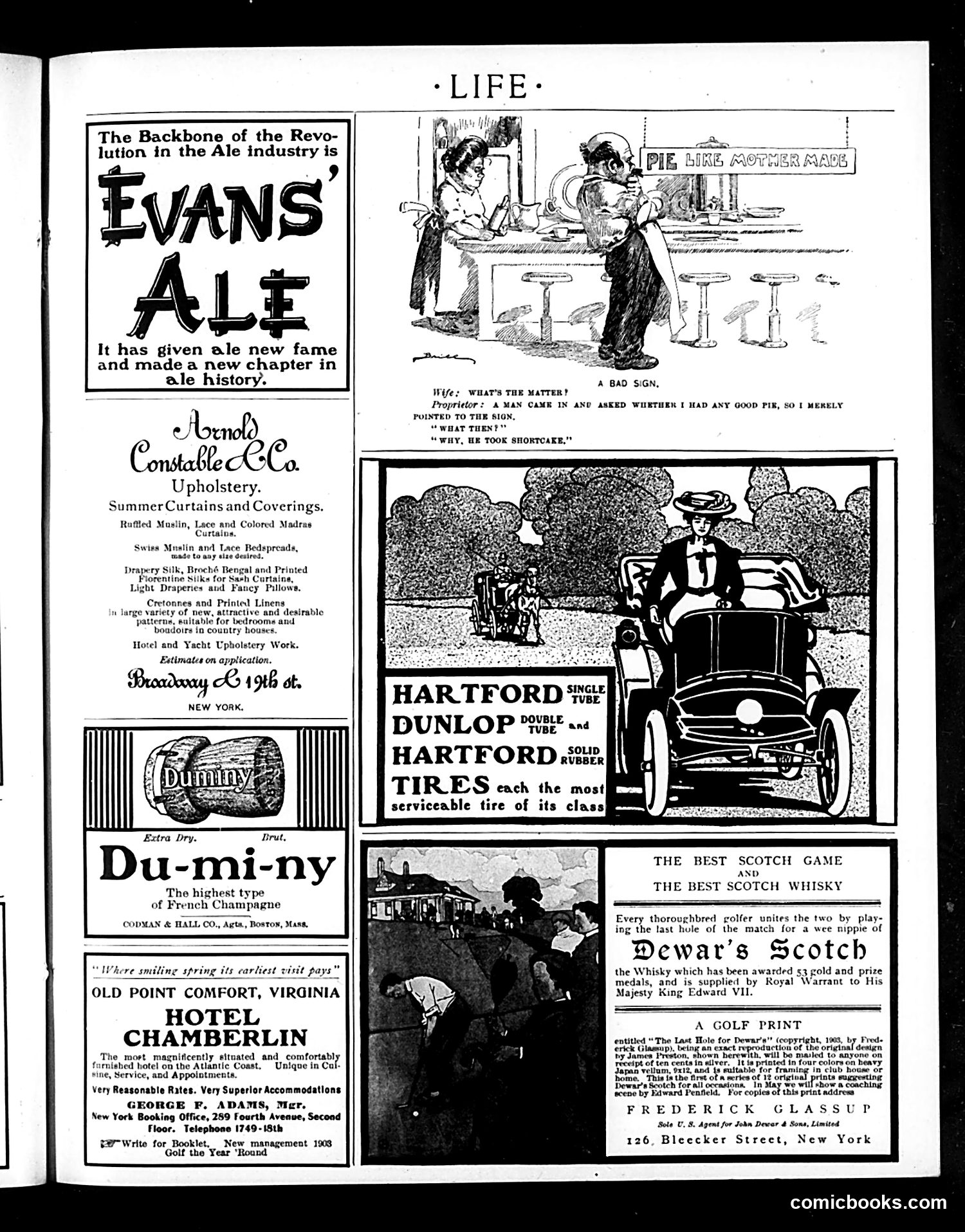
This single-panel cartoon jokes about a restaurant's misleading signage. A proprietor explains to a wife (or customer) why a man ordered shortcake instead of pie: when the man asked if they had good pie, the proprietor simply pointed to a sign reading "PIE LIKE MOTHER MADE." The humor lies in the ironic misunderstanding. The sign, meant as flattering advertising, apparently communicates the opposite—suggesting the pie is *bad* (like mother's poor cooking), so the customer wisely chose shortcake instead. The joke satirizes both poor marketing and the common domestic stereotype about mothers' inferior cooking skills. The page is primarily filled with period advertisements for ales, upholstery, champagne, tires, hotels, and Scotch whisky—typical of early-1900s *Life* magazine content.
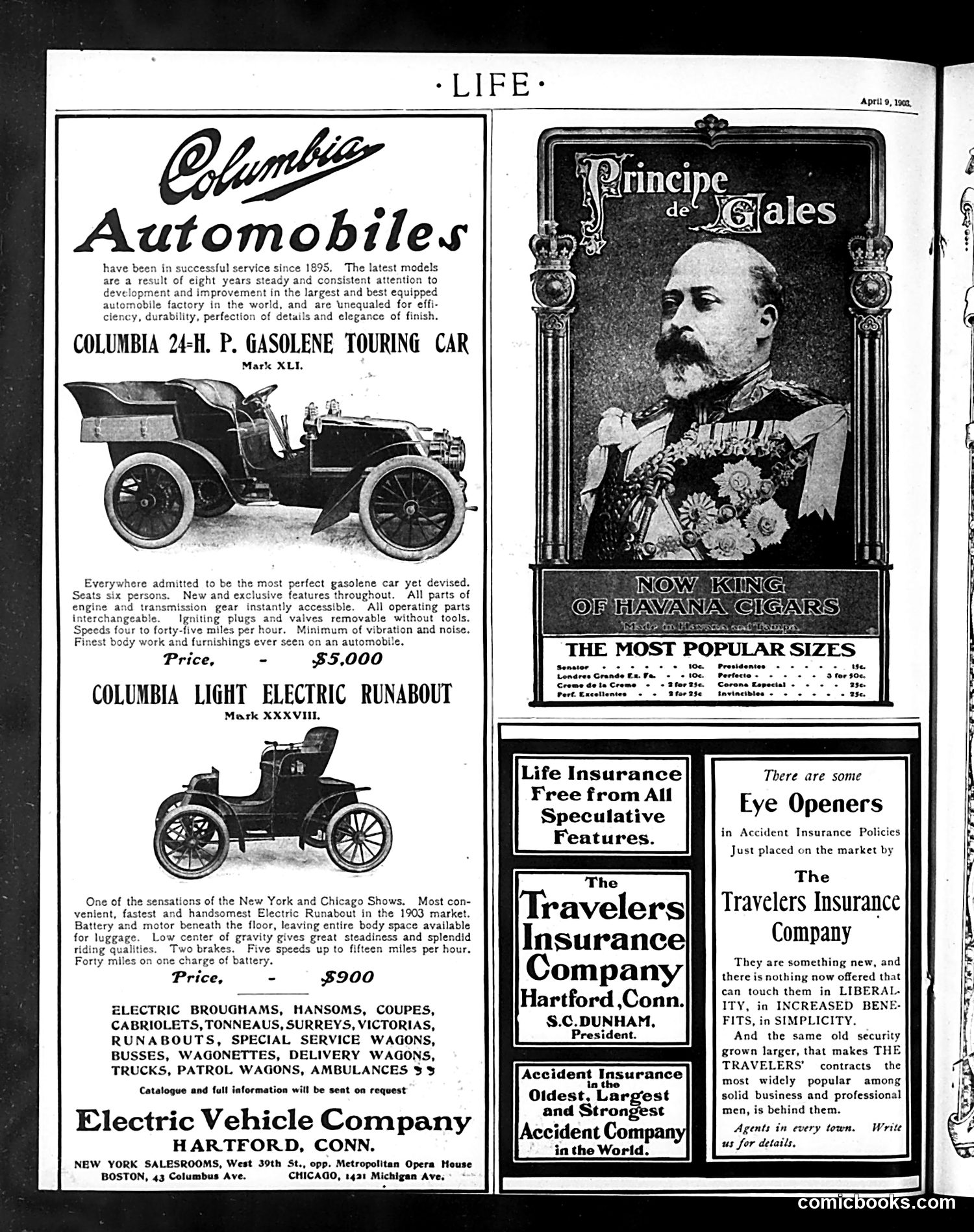
This page is **primarily advertising**, not satire or political cartooning. It contains: **Left side**: Three automobile advertisements from Columbia and Electric Vehicle Company, promoting early motorcar models (gasoline and electric). Prices range from $900 to $5,000—luxury items for the wealthy. **Right side, top**: A portrait labeled "Príncipe de Gales" (Prince of Wales), likely referring to the future King George V. The cigars advertised beneath are "Now King of Havana Cigars"—a commercial pun trading on the royal title. **Right side, bottom**: Insurance advertisements for the Travelers Insurance Company, promoting accident and life insurance policies. **The broader context**: This 1902 issue captures the early automobile era when cars were novel luxury goods, and reflects emerging consumer markets in insurance and tobacco. There is no identifiable political satire on this particular page.