
Life, 1903-04-09 · page 4 of 22
Life — April 9, 1903 — page 4: what you’re looking at
What you’re looking at
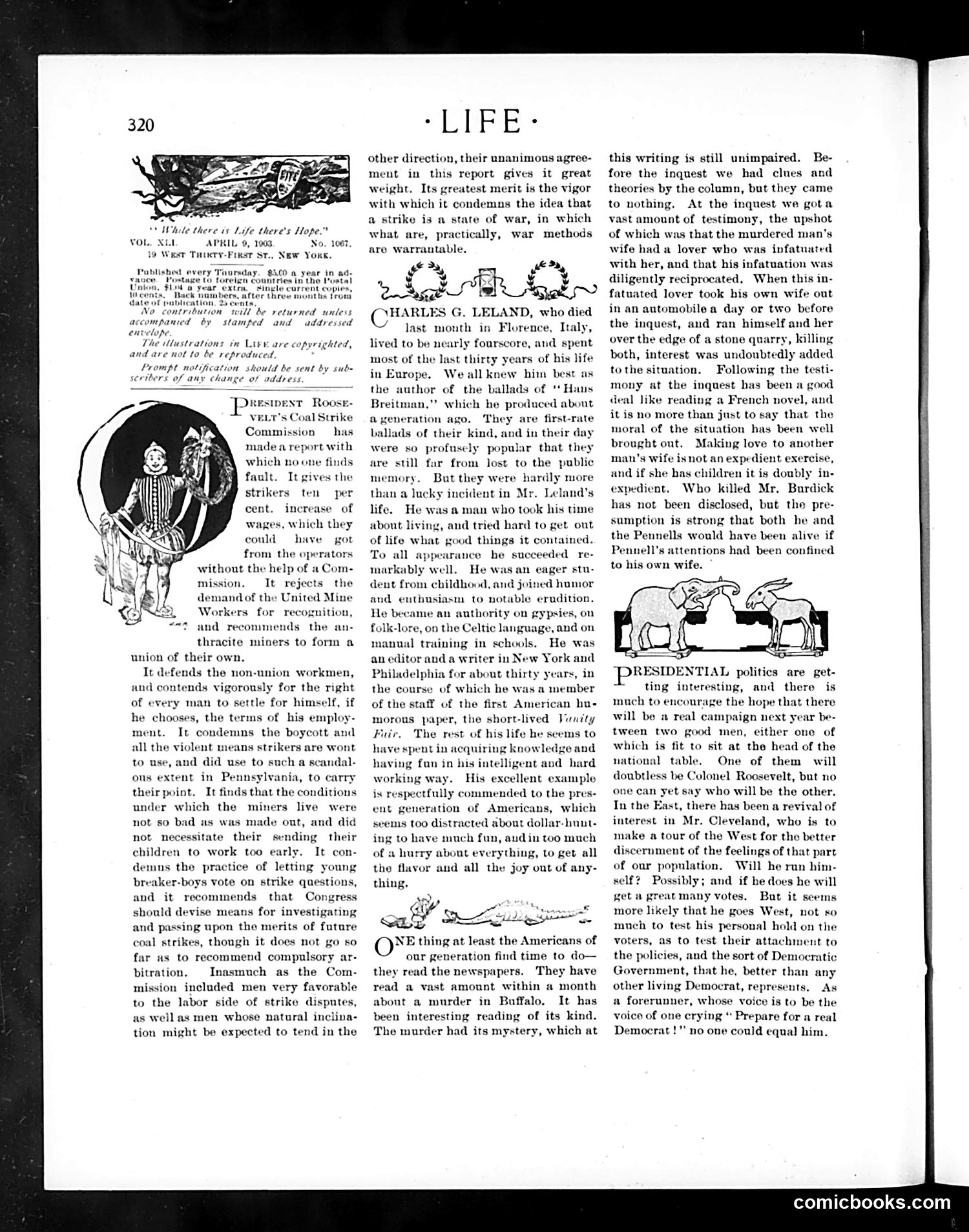
This page contains editorial commentary rather than cartoons. The main illustrated element shows a circular portrait of **President Roosevelt** alongside discussion of a **Coal Strike Commission** report. The text defends the Commission's findings, which condemned strike tactics as "war methods" while supporting workers' rights to unionize and fair wages. The accompanying illustration depicts Roosevelt as a strong, decisive figure, reflecting contemporary editorial support for his labor mediation efforts during the early 1900s coal crisis. The page also discusses **Charles G. Leland**, a recently deceased author and authority on gypsies and Celtic language, and includes political speculation about Democratic candidates, mentioning **Cleveland** potentially running for office again. The overall tone is progressive for its era, supporting labor rights while praising executive intervention.
📄 Transcribed text from this page (OCR, searchable)
Machine-transcribed from the original scan — historical spelling and the odd misread are preserved.
++ While there ts Life there's Hope.” 1 APRIL 9, 19 West Taucry-Frast St., New York. of jableation. tribution stamped and addressed The illustrations in Like. are copyrighted, and are not to be reproduced. ‘ Prompt notification should be sent by sub- sertbers of any change of address Pr IDENT Roose- VELT's Coal Strike Commission made a report with which no one finds fault. It gives the strikers ten per cent. increase of wages, which they could have got from the operators without the help of a Com- mission. It rejects the demand of the United Mine Workers for recognition, and recommends the an- thracite miners to form a union of their own. It defends the non-union workmen, and contends vigorously for the right of every man to settle for himself, if he choo: the terms of his employ- ment. It condemns the boycott and all the violent means strikers are wont to use, and did use to such a scandal- ous nt in Pennsylvania, to carry their point. It finds that the conditions under which the miners live were not so bad as was made ont, and did not necessitate their sending their children to work too early. It con- demns the p ice of letting young breaker-boys vote on strike questions, and it recommends that Congress should devise means for investigating and passing upon the merits of future coal strikes, though it does not go so far as to recommend compulsory ar- bitration. Inasmuch as the Com- mission included men very favorable to the labor side of strike disputes, as well as men whose natural inclina- tion might be expected to tend in the “ERE. other direction, their unanimous agree- ment in this report gives it great weight. Its greatest merit is the vigor with which it condemns the idea that a strike is a state of war, in which what are, practically, war methods are warrantable. ie Cat NHARLES G. LELAND, who died last month in Florence, Italy, lived to be nearly fourscore, and spent most of the last thirty years of his life in Europe. We all knew him best as the author of the ballads of ‘* Hans Breitman.”” which he produced about generation ago. They are first-rate ballads of their kind, and in their day were so profusely popular that th are still far from lost to the public memory, But they were hardly more than a lucky incident in Mr. Leland’s life. He was a man who took his time about living, and tried hard to get out of life what good things it contained. To all appearance he succeeded re- markably well. He was an eager stu- dent from childhood, and joined humor and enthusiasm to notable erudition. He became an authority on gypsies, on folk-lore, on the Celtic language, and on manual training in schools, He was an editor and a writer in New York and Philadelphia for about thirty years, in the course of which he was a member of the staff of the first American hu- morous paper, the short-lived Vanity Fuir. The rest of his life he seems to have spent in acquiring knowledge and having fan in his intelligem d working way. His excellent example is respectfully commended to the pre: ent generation of Americans, which seems too distracted about dollar-hunt- ing to have much fun, andin too much of a hurry about everything, to get all tho flavor and all the joy out of any- thing. Oy ? Ci - - a RZ oe ee O*XE thing at least the Americans of our generation find time to do— they read the newspapers. They have read a vast amount within a month about a murder in Buffalo. It has been interesting reading of its kind. The murder had its mystery, which at this writing is still unimpaired. Be- fore the inquest we had clues and theories by the column, but they came to nothing, At the inquest we gota vast amount of testimony, the upshot of which was that the murdered man’s wife had a lover who was infatuated with her, and that his infatuation was diligently reciprocated, When this in- fatuated lover took his own wife out in an automobile a day or two before the inquest, and ran himself and her over the edge of a stone quarry, killing both, interest was undoubtedly added tothe situation. Following the testi- mony at the inquest has been a good deal like reading a French novel, and it is no more than just to say that the moral of the situation has been well brought out. Making love to another man's wife is not an expedient exercise, and if she has children it is doubly in- expedient. Who killed Mr. Burdick has not been disclosed, but the pre- sumption is strong that both he and the Pennells would have been alive if Pennell's attentions had been confined to his own wife. ‘PRESIDENTIAL politics are get- ting interesting, and there is much to encourage the hope that there will be a real campaign next year be- tween two good men, either one of which is fit to sit at the head of the national table. One of them will doubtless be Colonel Roosevelt, but no one can yet say who will be the other. In the East, there has been a revival of interest in Mr. Cleveland, who is to make a tour of the West for the better discernment of the feelings of that part of our population. Will he run him- self? Possibly; and if be does he will get a great many votes. But it seems more likely that he goes West, not so much to test his personal hold on the voters, as to test their attachment to the policies, and the sort of Democratic Government, that he, better than any other living Democrat, represents. As a forerunner, whose voice is to be the voice of one crying * Prepare for a real Democrat!” no one could equal him. comicbooks.com