
Life, 1903-04-09 · page 7 of 22
Life — April 9, 1903 — page 7: what you’re looking at
What you’re looking at
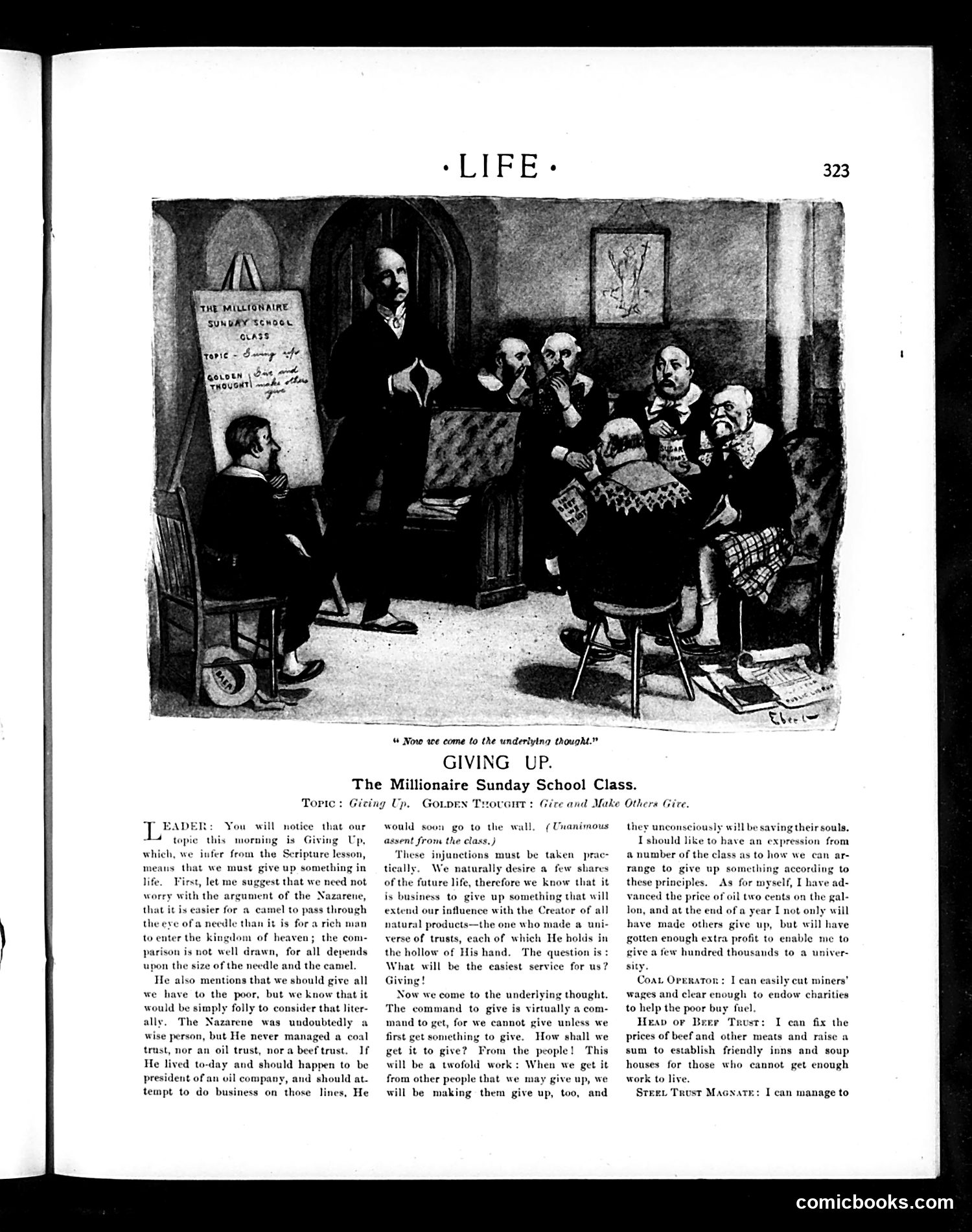
This satirical cartoon depicts wealthy businessmen in a Sunday school lesson about Christian charity and self-sacrifice. The irony is sharp: a class leader discusses "giving up" worldly possessions to help the poor, while the wealthy attendees—identified by their fine clothing and demeanor—offer absurdly minimal or self-serving "sacrifices." Their responses are comically inadequate: a coal operator offers miners' wage cuts; a beef trust magnate proposes raising meat prices; a street trust manager claims he can "manage" (implying no actual change). The satire mocks the hypocrisy of wealthy industrialists attending Sunday school while exploiting workers and consumers—pretending religious piety while refusing genuine sacrifice. The cartoon criticizes how the wealthy weaponize Christianity to avoid actual social responsibility.
📄 Transcribed text from this page (OCR, searchable)
Machine-transcribed from the original scan — historical spelling and the odd misread are preserved.
SUNDAY SchOoK QLAss reric = Sannp fe 9 he THOUGH 4 Now awe come to the underlying thought.” GIVING UP. The Millionaire Sunday School Class. Toric : Gieing Up. notice that our Giving Up, cripture lesson, TPADER: You wilt 44 topic this morning is infer from the & we must giy irst, let me suggest that we need not worry with the argument of the Nazarene, that it is easier for a camel to pass through the eve ofa needle than it is for a rich man toenter the kingdom of heaven; the com- parison is not well drawn, for all de; upon the size of the needle and the ea up something in He also mentions that we should give all we have to the poor, but we know that it would be simply folly to consider that liter- ally, The Nazarene was undoubtedly wise person, but He never managed a coal trust, nor an oil trust, nora beef trust. If He lived to-day and should happen to be president of an vil company, and should at. tempt to do business on those lines, He Gove T: would soon go to the wall, (Unanimous assent from the class. ‘These injunctions must be taken prac tically. We naturally desire a of the future life, therefore we know that it is business to give up something that will extend our influence with the Creator of all natural products—the one who made a uni- verse of trusts, each of which He holds in the hollow of His hand. The question is : What will be the easiest service for us? Giving! Now we come to the underlying thought. The command to give is virtually a com- mand to get, for we cannot give unless we first get something to give. How shall we get it to give? From the people! This will be a twofold work: When we get it from other people that we may give up, we will be making them give up, too, and w shares aT: Gire and Make Others Give. they unconsciously will be saving their souls, I should like to have an ex a number of the class as to how we c: range to give up s hing accord rinciples. As for myself, I have ad- the price of oil two cents on the gal- lon, and at the end of a year I not only will have made others give up, but will have gotten enough extra profit to enable me to give a few hundred thousands to a univer- sity Coat Orrrator : I can easily cut miners’ wages 3 these vane d clear enough to endow charities to help the poor buy fuel Heap or Beer Trust: I can fix the prices of beef and other meats and raise a sum to establish friendly inns and soup houses for those who cannot get enough work to live. Steet Trust Macyate: I can manage to comicbooks.com