
Life, 1903-04-09 · page 12 of 22
Life — April 9, 1903 — page 12: what you’re looking at
What you’re looking at
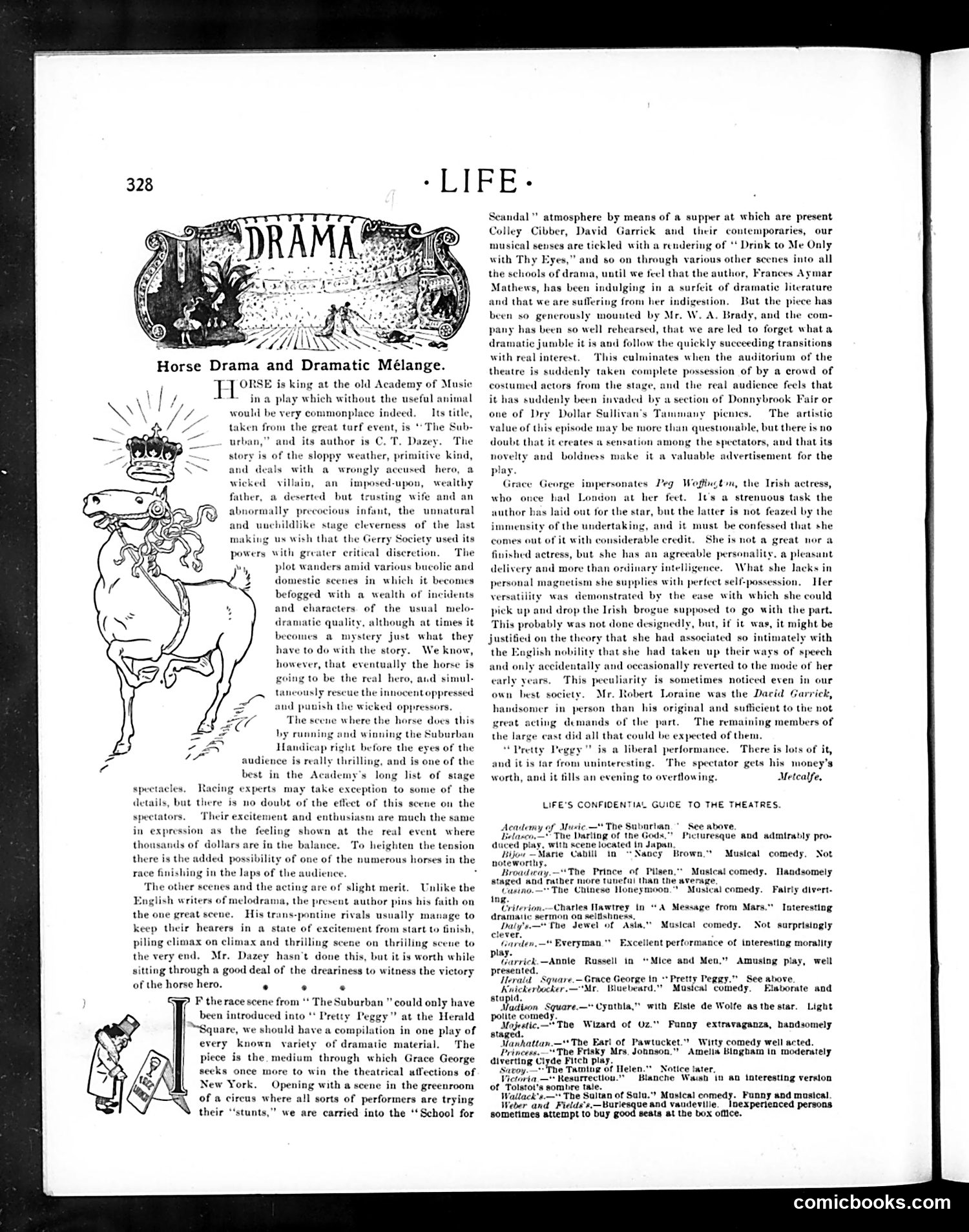
This page reviews theatrical productions, focusing on a play called "The Suburban" at the Academy of Music. The illustrated horse appears to be a satirical representation of the play's central prop—described as unusually prominent in the story, wandering through various scenes. The text humorously notes that while the horse should be the hero, the plot itself is somewhat muddled and melodramatic, becoming "a mystery just what they have to do with the story." The cartoon mocks the theatrical device of using spectacle (the horse) to distract audiences from weak storytelling. The review suggests that excitement from the novelty and "running and winning" scenes compensates for narrative deficiencies—typical satire of stage spectacle prioritized over substance. The page also lists other contemporary theatrical productions with brief critical notes.
📄 Transcribed text from this page (OCR, searchable)
Machine-transcribed from the original scan — historical spelling and the odd misread are preserved.
*LIFE- ee JUSS Horse Drama and Dramatic Mélange. FL OBSE is king at the old Academy of Musie 4 ina play which without the useful animal would be very commonplace indeed. — Its title, ken from the great turf event, is The Sub- nd its author is C.'T. Dazey. The the sloppy weather, primitive kind, with urban, story is 0} wrongly accused hero, a imposed-upow, wealthy but trusting wife and an abnormally precocious infant, the unnataral and unchildlike stage cleverness of the last making us wish that the Gerry Society used its powers with greater critical discretion, The My plot wanders amid various bucolic and dom and deals wicked jain, an her, deserted which it becomes befogged with a wealth of and characters of the usual melo- dramatic quality, although at times it becomes a mystery just what they We know, however, that eventually the horse is ing to be the real hero, and simul- sly rescue the Innocentoppressed stic scenes in incidents have to do with the stor tane and | The sees by running and winning the § Hand audience is re nish the wicked oppressors. where the horse does this ap right before the Hy thrilling, and is one of the best in the Academy's long list of stage Racing experts m; details, but there is no dou spectacles, y take exception to some of the t of the effect of this scen ‘Their excitement and enthusiasm are much the same on the pectators. in expression as the feeling shown at the real event where thousands of dollars are in the balance. To heighten the tension d possibility of one of the numerous horses in the race finishing in the laps of the audience . The other scenes and the acting are of slight merit. Unlike the glish writers of melodrama, the present author pins his faith on the one great scene. His trans-pontine rivals usually manage to keep their hearers in a state of excitement from start to finish, piling climax on climax and thrilling scene on thrilling scene to the very end. Mr. Dazey hasn't dove this, but it is worth while sitting through a good deal of the dreariness to witness the victory of the horse hero. . « «# there is the add F the race scene from ‘* The Suburban " could only have been introduced into '* Pretty Peggy” at the Herald “Square, we should have a compilation in one play of every known variety of dramatic material. The piece is the medium through which Grace George seeks once more to win the theatrical affections of New York. Opening with a scene in the greenroom of a circus where all sorts of performers are trying their “stunts,” we are carried into the ‘School for Scandal” atmosphere by means of a supper at which are present Colley Cibber, David Garrick and their contemporaries, our musical senses are tickled with a rendering of ** Drink to Me Only with Thy Eyes,” and so on through various other scenes into all the schools of drama, until we feel that the author, Frances Aymar Mathews, has been indulging in a surfeit of dramatic literature and that we are suffering fron But the piece has been so generously mounted by Mr. W. A. Brady, and the com- pany has been so well rehearsed, that we are led to forget what a dramatic jumble it is kly succeeding transitions This culminates when the auditorium of the theatre is suddenly taken complete possession of by a crowd of costumed actors from the stage, and the real audience feels that it has suddenly been invaded by a section of Donnybrook Fair or one of Dry Dollar Sullivan The artistic value of this epi be more than questionable, but there is no sation among the spectators, and that its novelty and boldness make it a valuable advertisement for the play. Grace George impersonates Peg Wogfington, the Trish actress, who once had London at her feet. Its a strenuous task the author bas laid out for the star, but the latter is not feazed by the immensity of the undertaking, and it must be confessed that she ple credit. She is not a great nor a an agree pality. a ple: delivery and more than ordinary intelligence. What she lac personal magnetism she supplies with pertect sel versatility was demonstrated by the ease with which she c pick up and drop the Irish brogue supposed to go with the part. This probably was not done designedly, but, if it was, it might be justified on the theory that she had associated so intimately with the English nobility that she had taken up their ways of speech sly accidentally and occasionally reverted to the mode of her carly years. This pecu is sometimes noticed even in our Mr. Robert Loraine was the Dacid Garrick, handsomer in person than his original and sufficient to the not great acting demands of the part. The remaining members of the large cast did all that could be expected of them. “Pretty Peggy" is a liberal performance, and it is tar from uninteresting. worth, and it fills an evening to 01 her indigestion. nd follow the quic with real interest. mes. Je ma, doubt that it creates a se comes out of it with conside finished actress, but she le per possessio and aril own hest society There is lots of ‘The spectator gets his money's flowing. Metcalfe, LIFE'S CONFICENTIAL GUIDE TO THE THEATRES. See above. Academy of Music —* The Subarian Th Picturesque and admirably pro- Bel Darling of the Gods. duced play, with scene located | Bijon Marie Cabill in“ Nancy noteworthy. Broadway.—“The Prince of Pilsen,"* staged and rather more tuneta Castno.—" The Chinese HM ing. Criterion.Charles Hawtrey in “A Message from Mars dramatic sermon on selfishness, Daly'e—" The Jewel of Asia. clever. Garden, —" Everyman. Excellent performance of interesting morality lay. Pilarrick.—Anole Russell in presented. Herald Square.— Grace George in “Pretty Peggy.” See above. Knickerbocker. —"Mr, Bluebeard.” Musical cotiedy. Elaborate and stupid. ‘Wadison Square.—Cynthla,” with Fiste de Wolfe as the star polite comedy. Mojestic.—"The Wizard of Uz." staged. Vanhattan.— The Earl of Pawtucket.” Princess.“ The Frisky Mrs, Jonson.” diverting Cipde Fitch play, Savoy." The Tatniug of Helen."" Notice tater, Victoria —" Resurrectiou.” Blanche Waish in ao toteresting version of Tolstot's sombre tale. Wadiack's—" The Saltan of Salu.” Musical comedy. Funny and masical Weber and Fields's—Burlesque and vaudeville. Inexperienced persons sometimes attempt to buy seats at the box office. itrown,” Musical comedy, Not Musica! comedy. than the average, ymoon. Musical comedy. Falrly divert. Nandsomely Interesting Musical comedy. Not surprisingly “Mice and Men.” Amusing play, weil Light Funny extravaganza, handsomely Witty comedy well acted. Amelis Bingham in moderately comicbooks.com