
A complete issue · 24 pages · 1903
Life — March 26, 1903
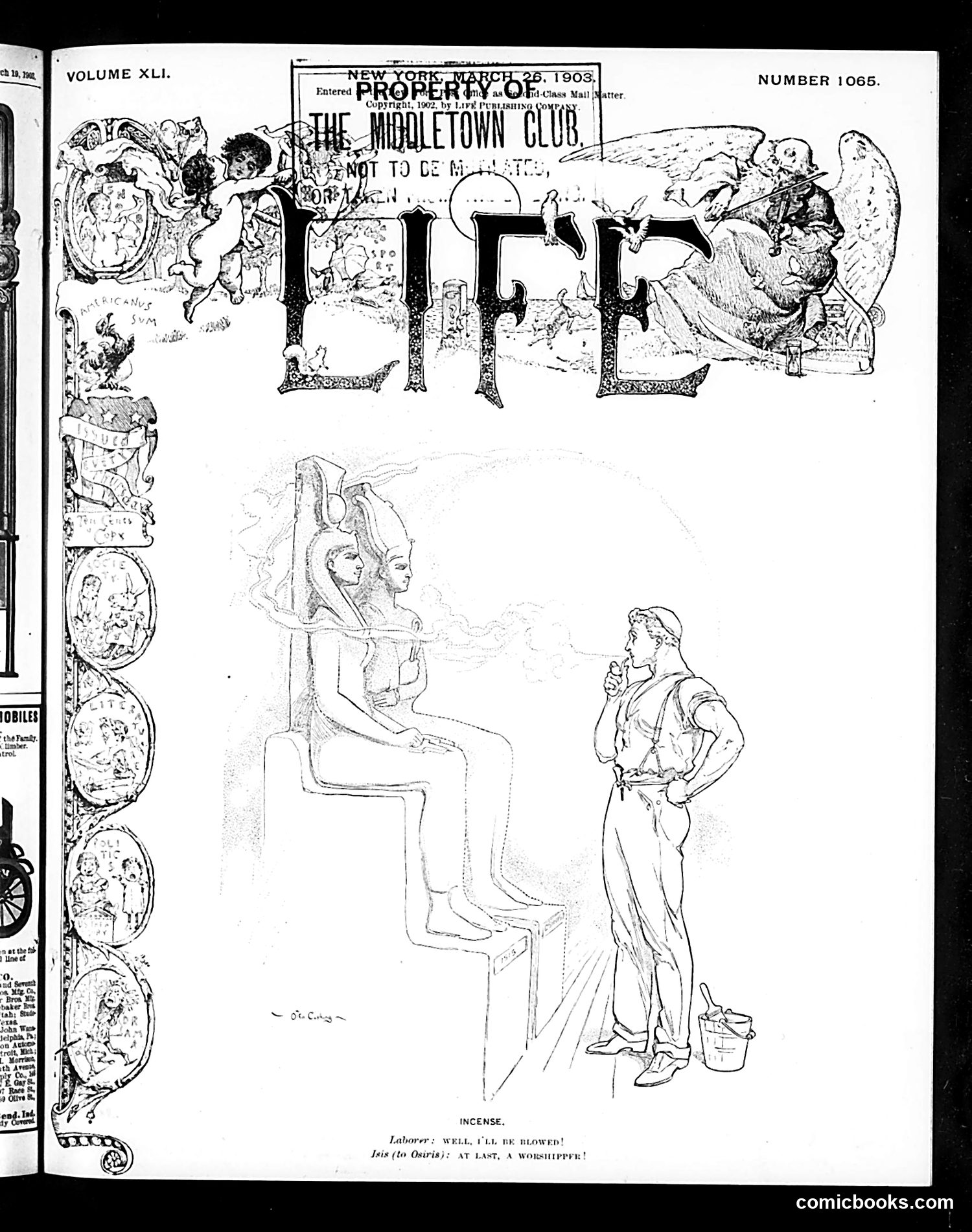
**Date:** March 26, 1908 | **Issue:** Volume XLI, Number 1065 This page contains a single-panel cartoon titled "INCENSE" depicting two figures. A large seated Egyptian-style statue with an elaborate headdress dominates the composition. A man in work clothes stands before it, appearing to offer incense or worship. The caption reads: "Laborer: WELL, I'LL BE BLOWED! / Iris (to Osiris): AT LAST, A WORSHIPPER!" The satire appears to critique the veneration of wealth or industrial power—the working man unknowingly "worships" at the altar of some grand idol (possibly representing capital, corporations, or industrial magnates). The Egyptian aesthetic suggests timeless, quasi-religious devotion to false gods, mocking how laborers unwittingly serve powerful interests.
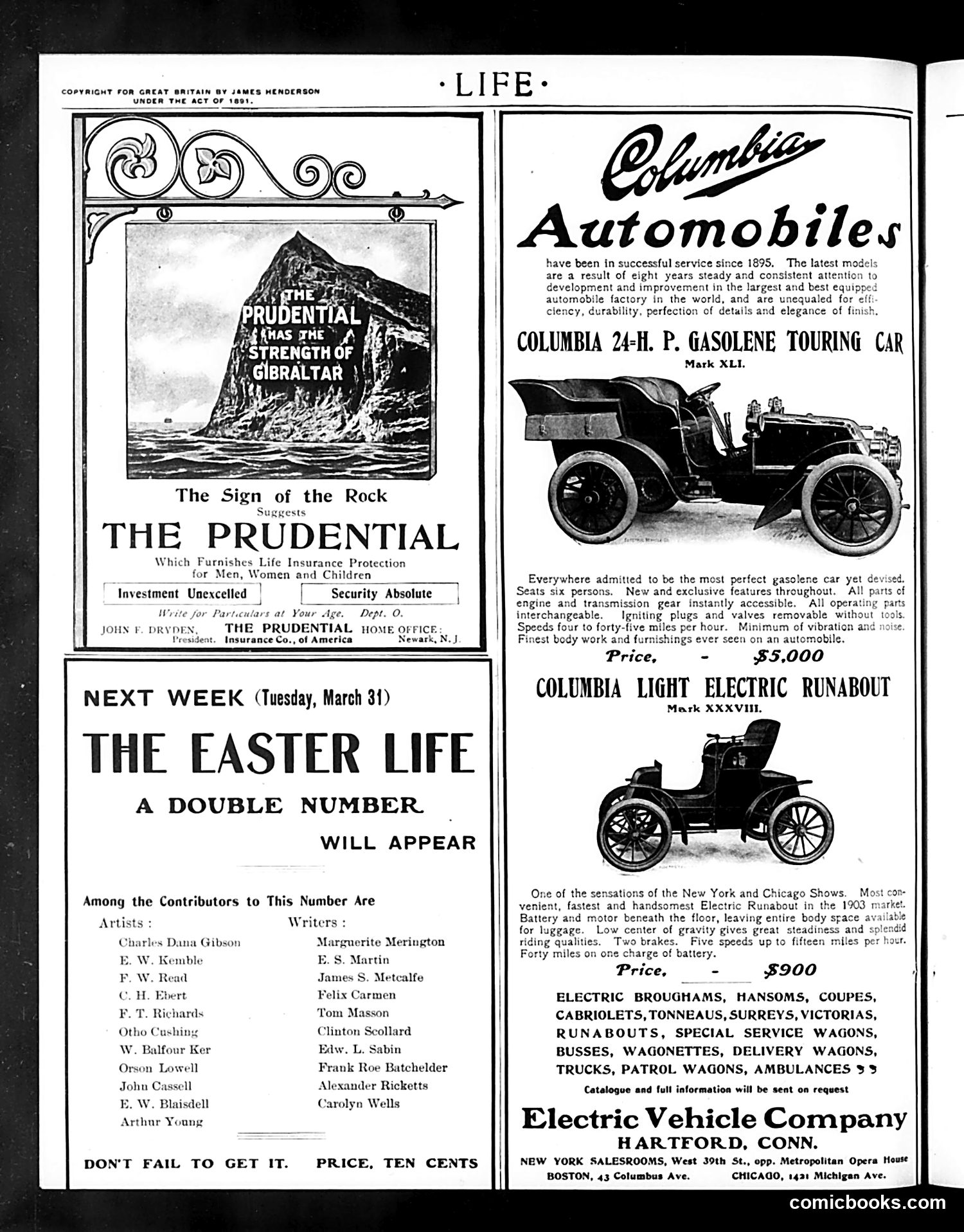
This page is primarily **advertising**, not political satire. The left side features a Prudential Insurance ad using Gibraltar's Rock as a metaphor for strength and security ("Investment Unexcelled / Security Absolute"). The imagery associates the insurance company with an immovable natural landmark. The right side advertises early automobiles: Columbia's gasoline touring car ($5,000) and electric runabout ($900), along with the Electric Vehicle Company's broader catalog of electric vehicles. These ads showcase emerging automobile technology from the early 1900s. The bottom left announces next week's Easter-themed double issue of *Life* magazine, listing contributing artists and writers. **No political cartoons or satire appear on this page.** It represents typical period advertising emphasizing industrial progress and financial security.
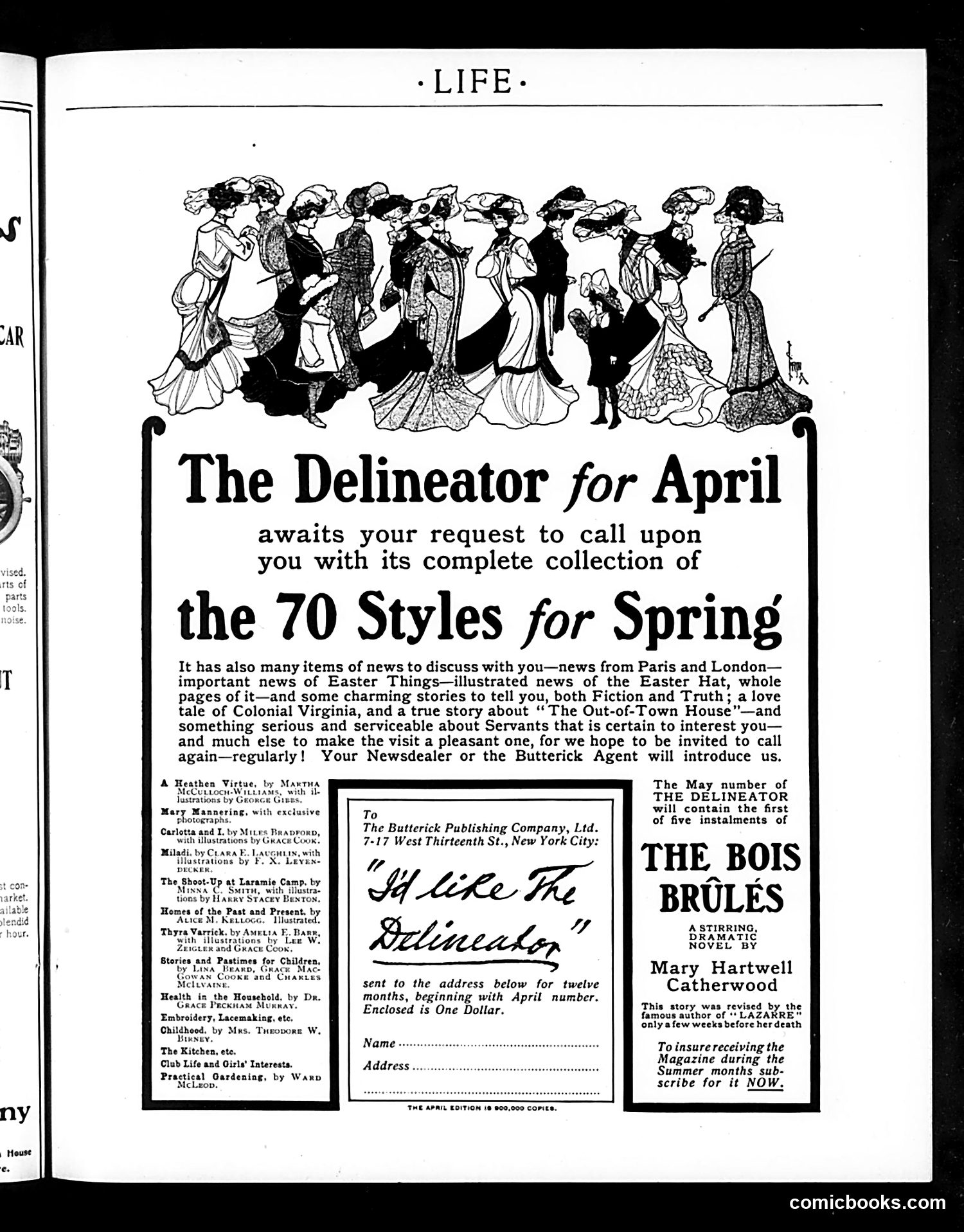
This page is primarily advertising rather than political satire. The main content advertises "The Delineator for April," a women's fashion and lifestyle magazine featuring "70 Styles for Spring." The illustrated header shows fashionably dressed women in Edwardian-era clothing with large hats, typical of early 1900s women's fashion. The advertisement emphasizes content about Easter fashions, Easter hats, and spring styles, alongside lifestyle articles about Colonial Virginia and domestic servants. A subscription form requests one dollar for twelve months' delivery. Additional ads promote "The Bois Brûlés," a novel by Mary Hartwell Catherwood, and various other magazine features. The page reflects early twentieth-century consumer culture targeting affluent women interested in fashion and genteel domesticity.
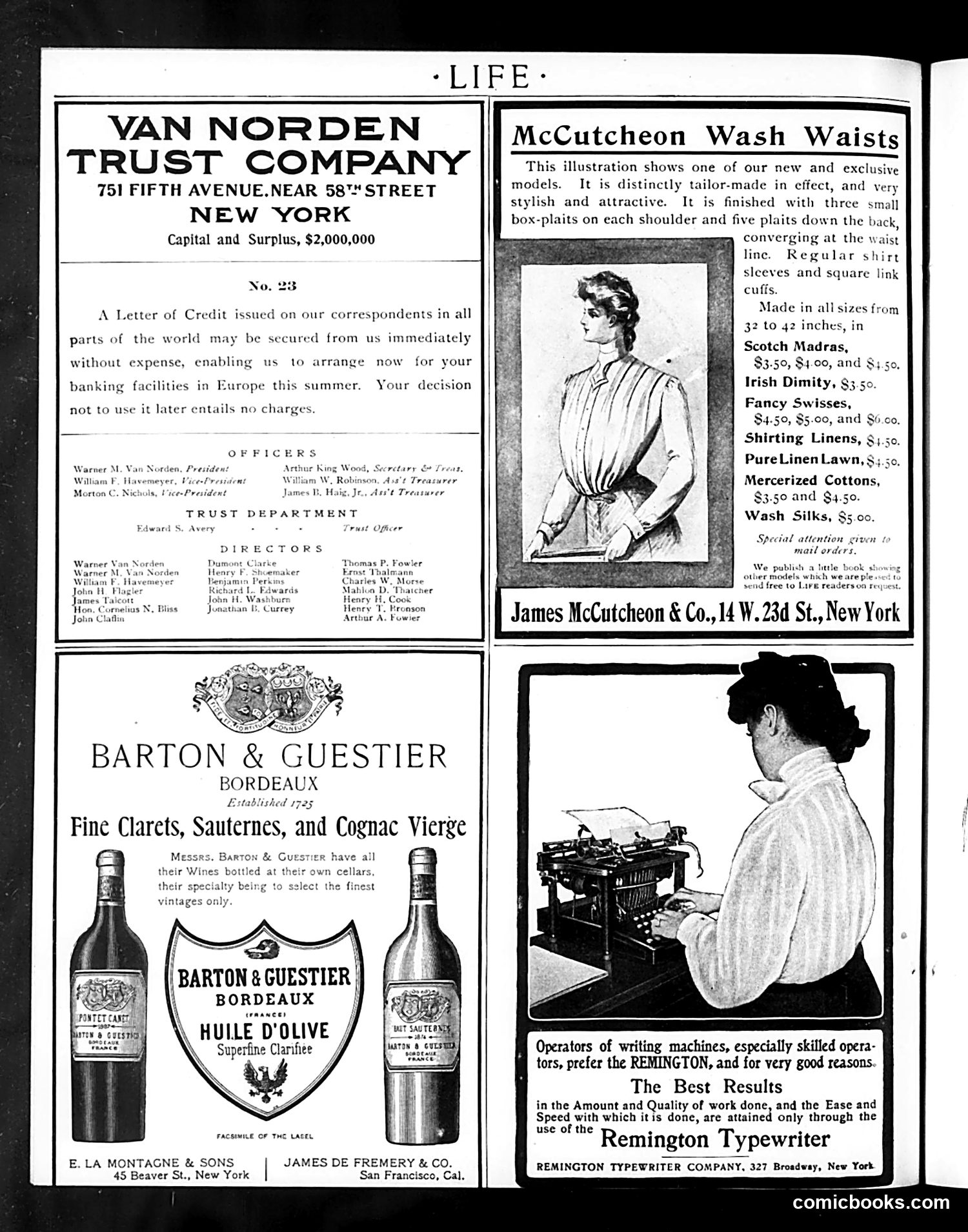
This page is **primarily advertising**, not satire or political commentary. It contains four advertisements: 1. **Van Norden Trust Company** — a banking service offering letters of credit for international travel 2. **McCutcheon Wash Waists** — women's blouses in various fabrics, priced $1.50–$5.00 3. **Barton & Guestier** — French wines and cognac from Bordeaux, established 1725 4. **Remington Typewriter** — featuring a skilled operator at a machine, emphasizing quality workmanship The Remington ad includes a photograph of a man using a typewriter, with text claiming operators "prefer the REMINGTON" for superior results. There are no political cartoons, caricatures, or satirical commentary visible on this page. It represents typical early 20th-century Life magazine advertising content.
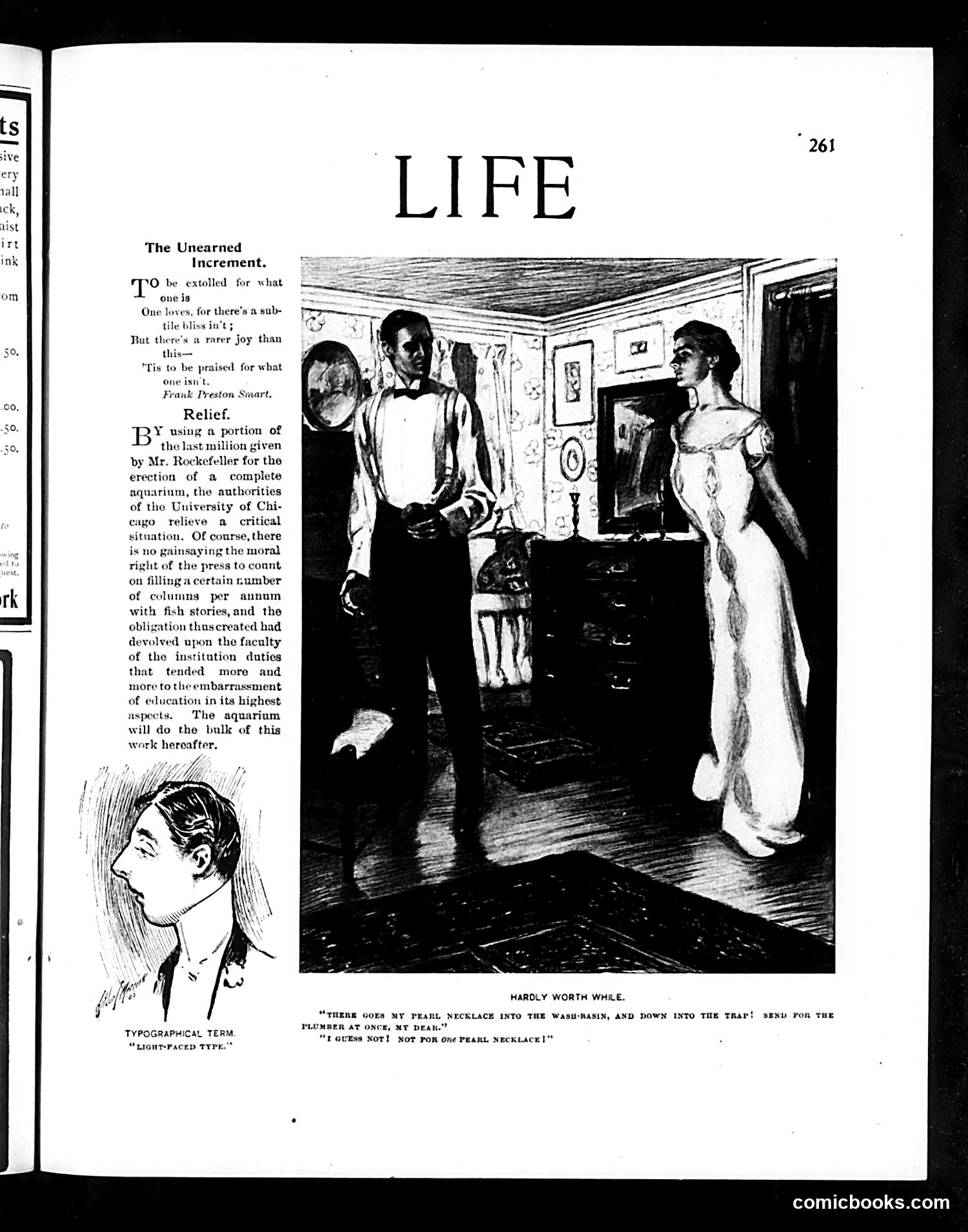
This page contains two distinct pieces: **"The Unearned Increment"** (left text) discusses a Rockefeller donation funding an aquarium at the University of Chicago, debating whether accepting such gifts creates moral obligations for the press and educational institutions. **"Hardly Worth While"** (main illustration) depicts a domestic scene where a woman in a nightgown confronts a man about a pearl necklace, with dialogue suggesting the necklace will end up in a pawn shop. The caption implies financial desperation or infidelity. **"Typographical Term: 'Light-Faced Type'"** (small portrait) is a visual pun—a sketch of a thin-faced man accompanying the printing terminology reference. The page satirizes both institutional ethics and domestic financial/marital trouble, typical of Life's mix of social commentary and domestic humor.
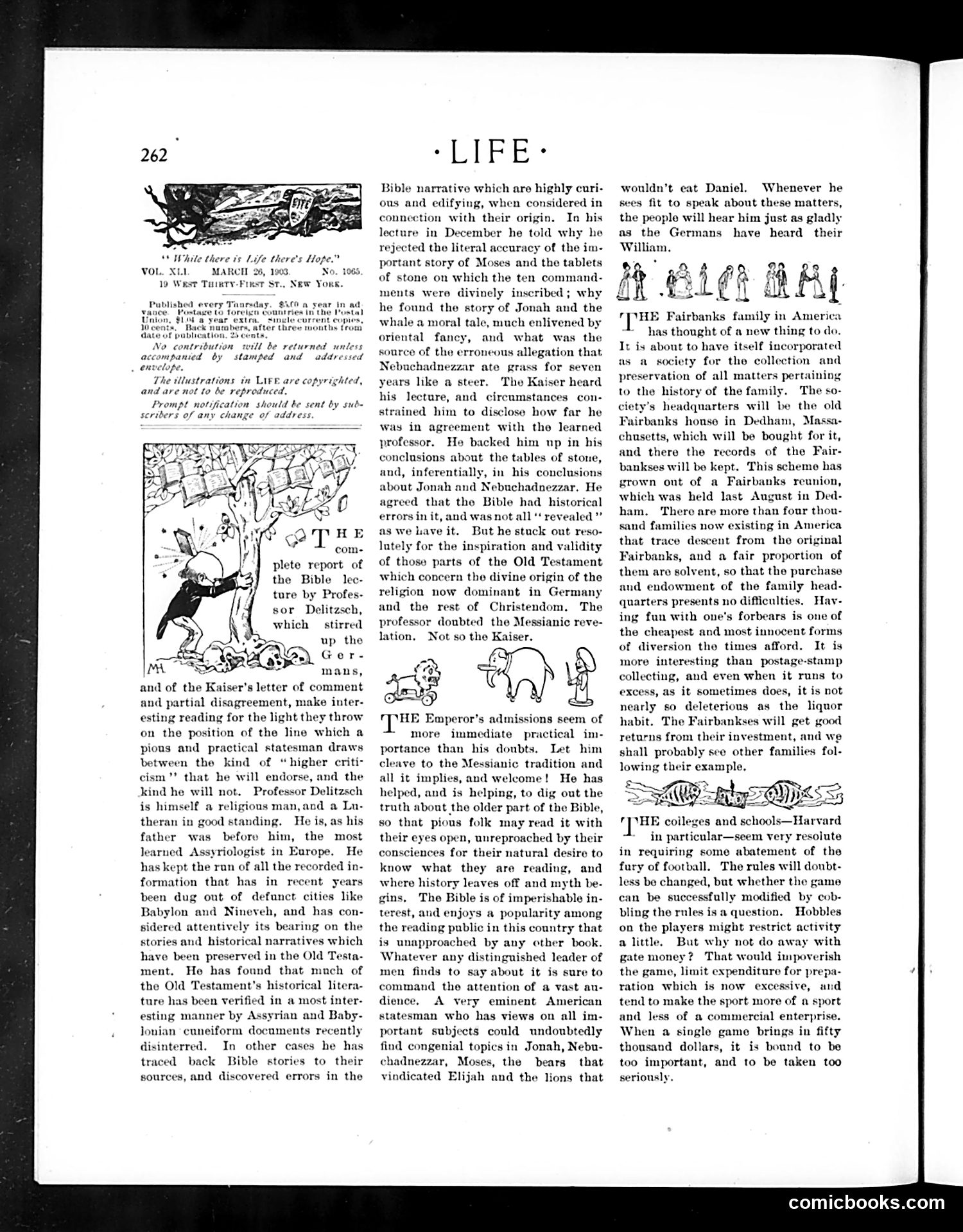
The page contains two distinct satirical pieces: **Upper cartoon** ("While there is Life there's Hope"): Depicts a figure (appears to be Professor Delitzsch based on the text) precariously balanced on a tightrope over a chasm. The satire mocks Delitzsch's controversial biblical scholarship—specifically his claims about historical errors in the Old Testament. The precarious positioning suggests his theories are dangerously unstable. **Lower section**: Discusses the Fairbanks family's plan to incorporate themselves as a society for collecting family history. The satire targets American wealthy families' pretentious genealogical obsessions and the commercialization of heritage documentation. Both pieces employ exaggeration to mock early 1900s intellectual and social pretensions—one targeting academic biblical criticism, the other wealthy family vanity projects.
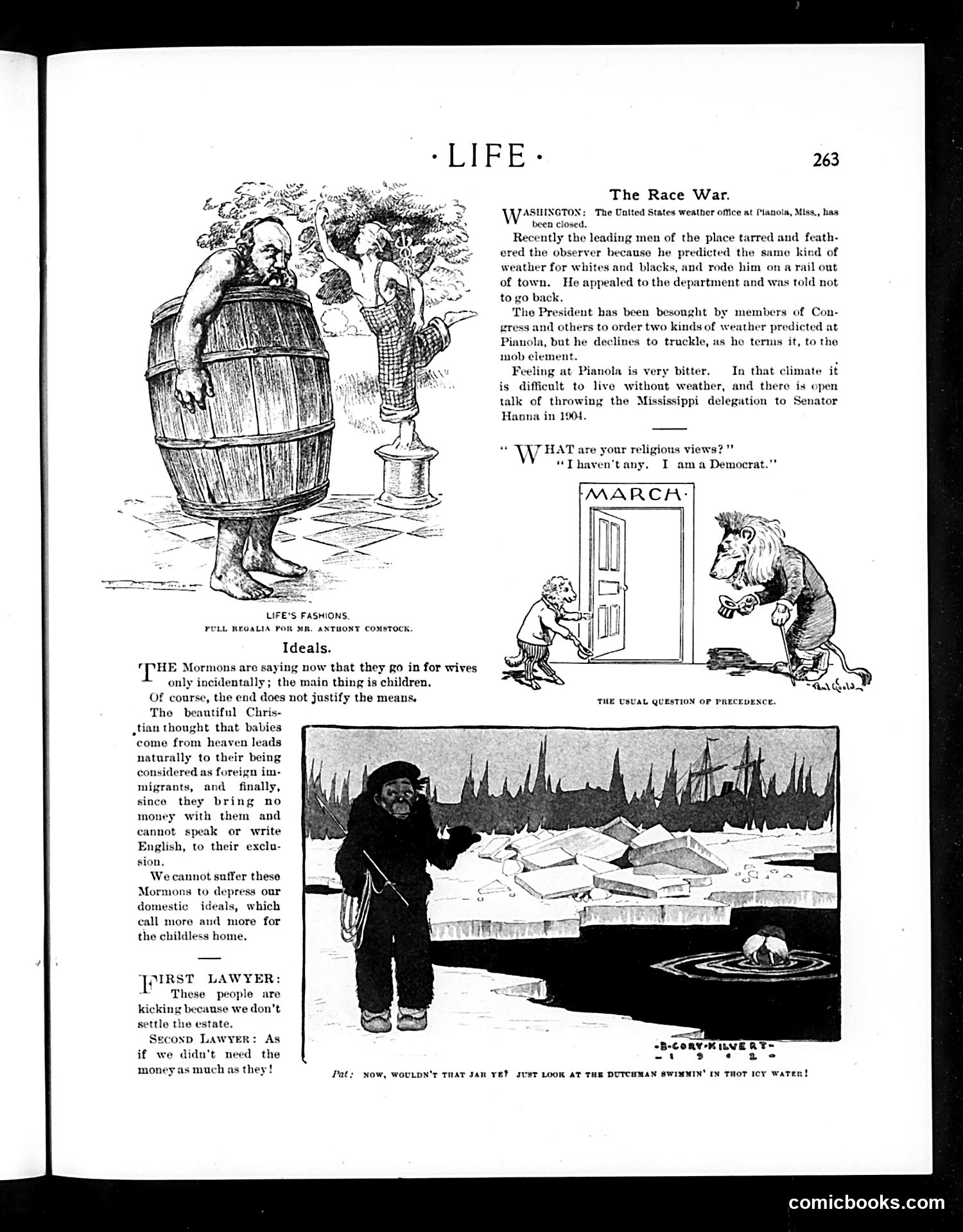
**"The Race War"** section discusses a weather office closure in Pianola, Mississippi, where an observer was dismissed after predicting identical weather for both white and Black residents—apparently offensive to local racial attitudes. **"Life's Fashions"** cartoon (left) mocks Victorian fashion excess, showing a woman in an enormous barrel-like dress. **"The Usual Question of Precedence"** (top right) depicts two figures—one appears to be a caricatured Irish immigrant and another figure—contesting position through a doorway, satirizing ethnic tensions and competition for social standing. **"Bosky River"** (bottom) shows a figure in winter clothing pointing at another swimming in icy water, with the caption mocking someone foolish enough to swim in such conditions. The page reflects early 1900s American racial tensions, fashion criticism, ethnic stereotyping, and social commentary typical of Life's satirical approach.
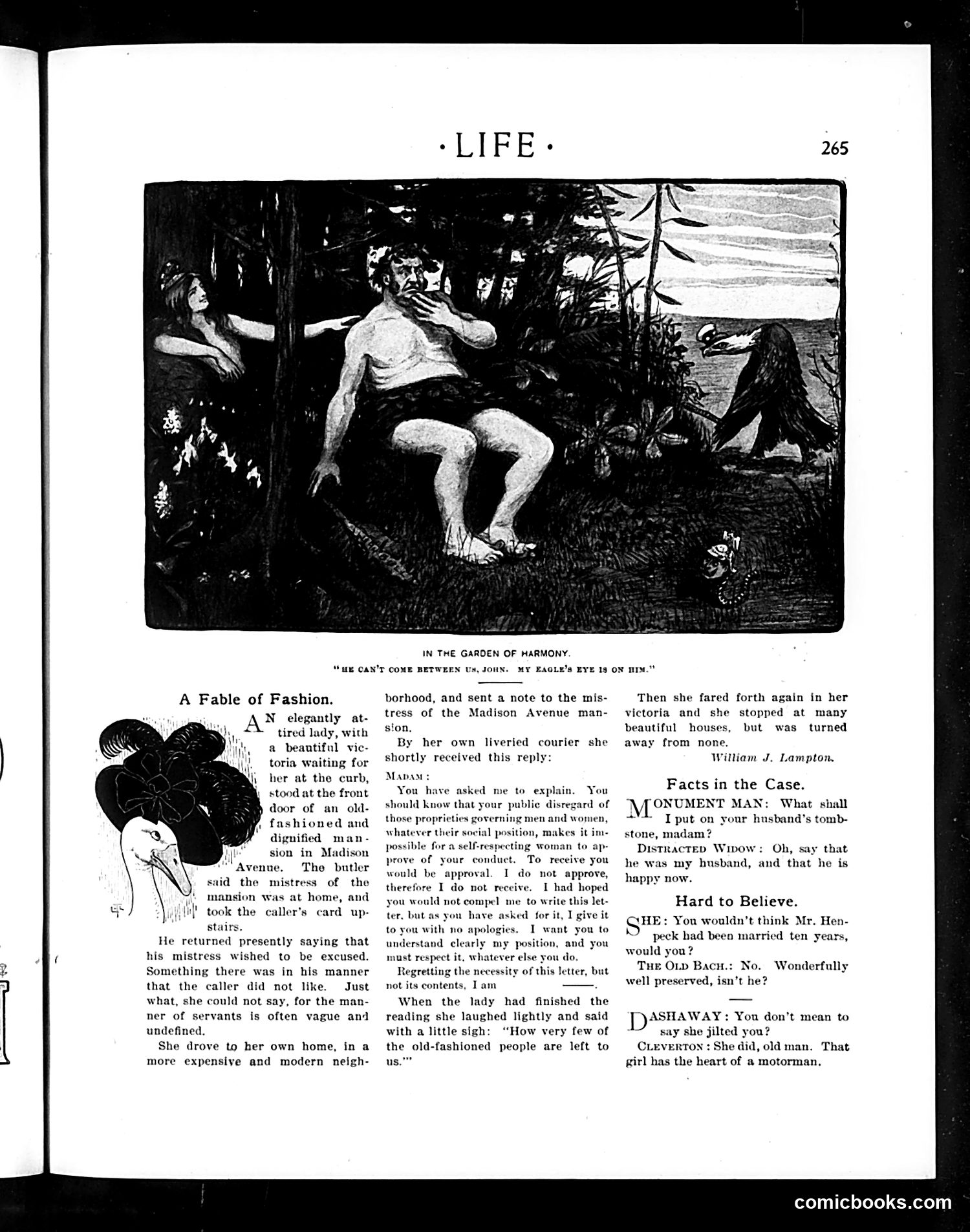
This page contains three brief satirical pieces typical of early-20th-century Life magazine humor: 1. **"In the Garden of Harmony"** (top illustration): A woodcut showing figures in a garden setting, captioned with dialogue about a man's eye being "on" someone—likely satirizing romantic entanglements or infidelity in fashionable society. 2. **"A Fable of Fashion"**: Satirizes a wealthy woman's social pretensions. She demands her servant be excused from duty, then complains when he complies—mocking the illogical demands of the fashionable elite and their poor treatment of domestic staff. 3. **"Facts in the Case" / "Hard to Believe" / "Dashaway"**: Brief joke exchanges about a woman's fidelity and motorcar driving, suggesting she has "the heart of a motorman"—early automotive satire about women drivers. The humor targets upper-class vanity and changing gender roles.
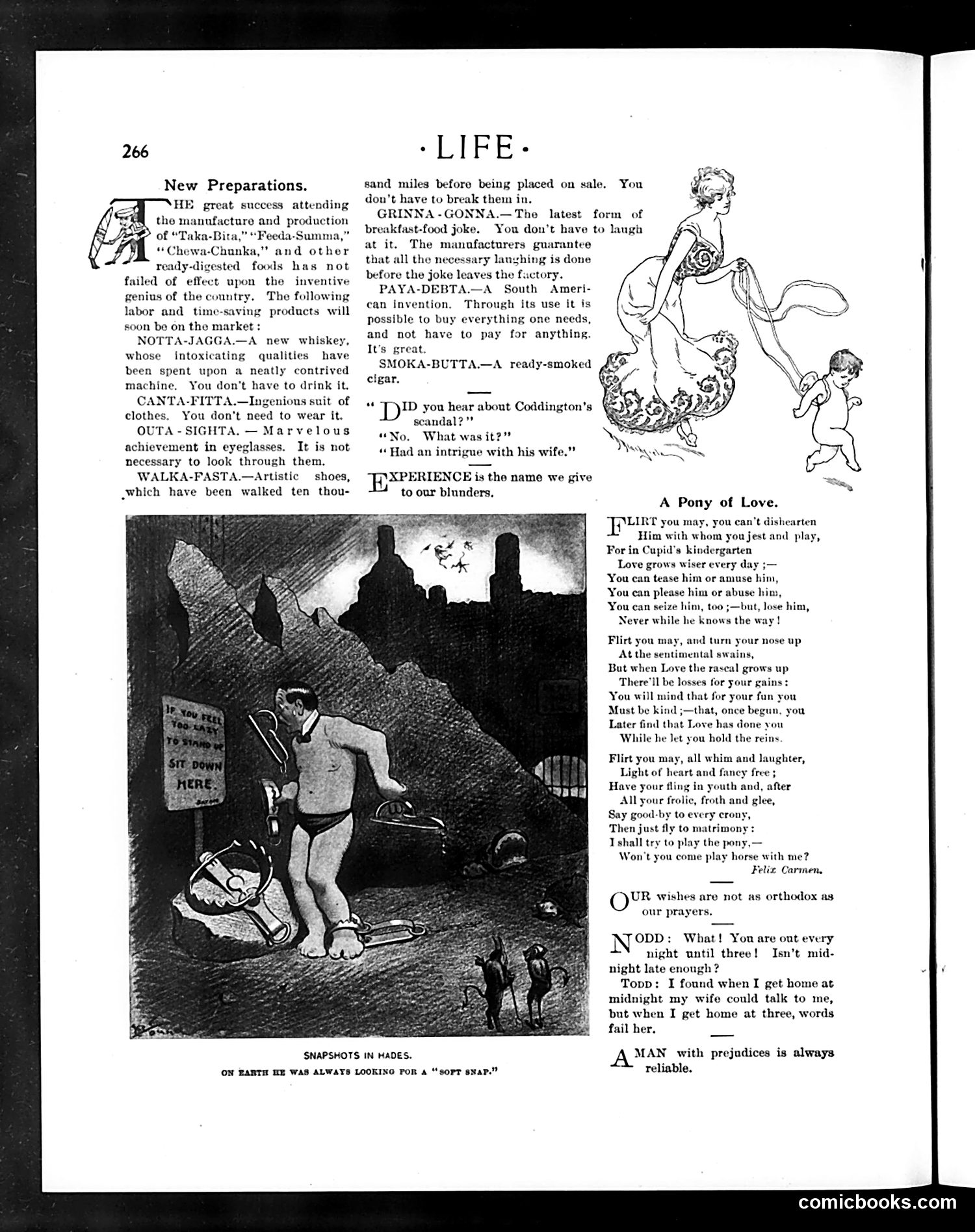
The large cartoon depicts a naked male figure in Hell, looking at what appears to be a sign reading "SIT DOWN HERE." The caption states: "ON EARTH HE WAS ALWAYS LOOKING FOR A 'SOFT SNAP.'" This is satirical commentary on a common expression of the era—seeking a "soft snap" or easy job/comfortable situation. The cartoon's joke: a man who spent his life looking for cushy, effortless positions has ended up in Hell, where—ironically—he's being told to sit, perhaps suggesting that even damnation offers no escape from consequences. The dark humor typical of *Life* magazine mocks those who prioritize comfort and laziness over honest work.
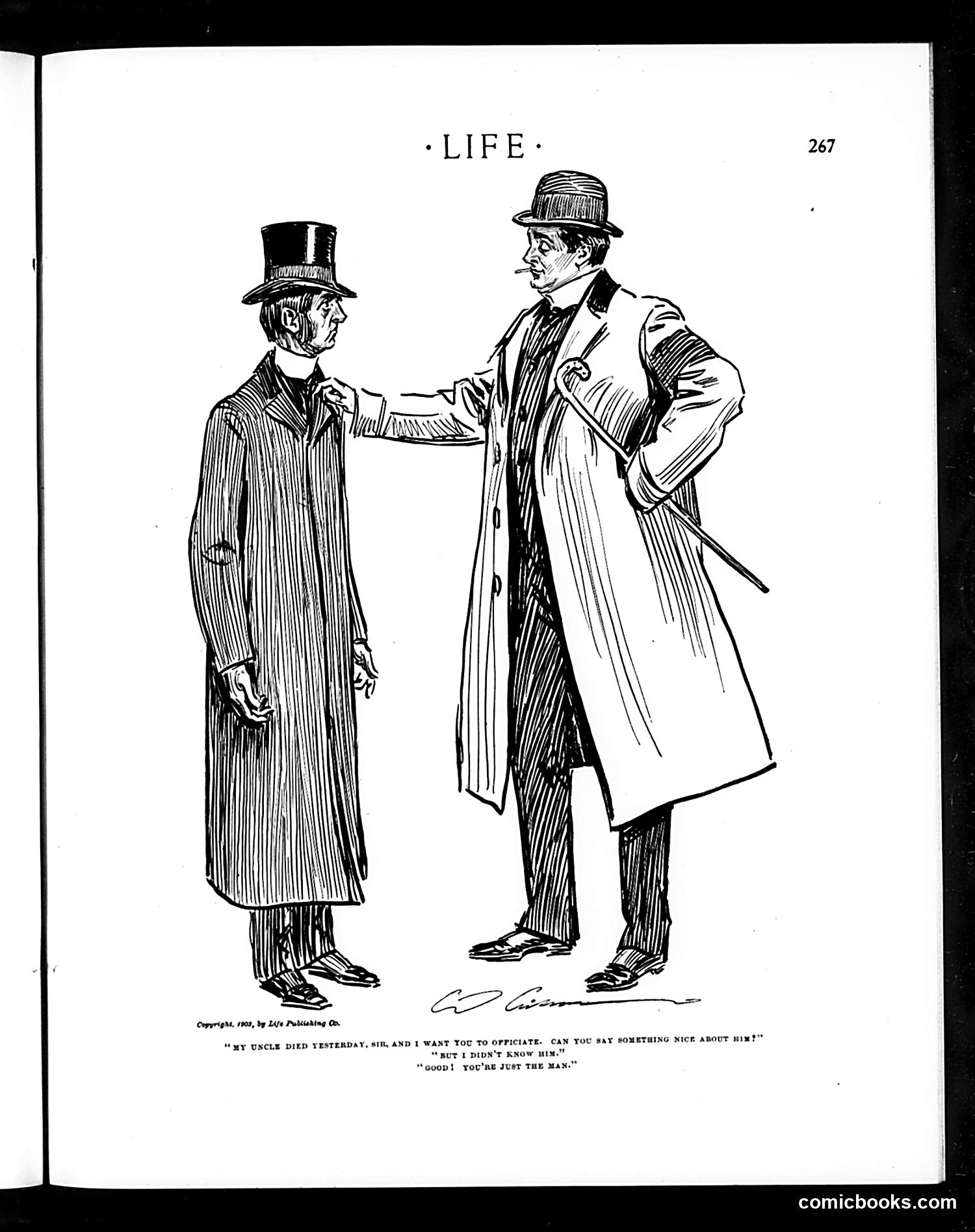
This single-panel cartoon depicts two men in formal early 20th-century attire. The man on the right, wearing a long overcoat and bowler hat, places a hand on the shoulder of a smaller man in a top hat and overcoat on the left. The caption reads: "My uncle died yesterday, sir, and I want you to officiate. Can you say something nice about him?" / "But I didn't know him." / "Good! You're just the man." The joke satirizes the convention of hiring clergy or officials to deliver eulogies for people they never knew. The humor lies in the absurd logic that unfamiliarity makes someone ideal for the job—implying the deceased was disliked enough that only a stranger could offer "something nice" without lying.
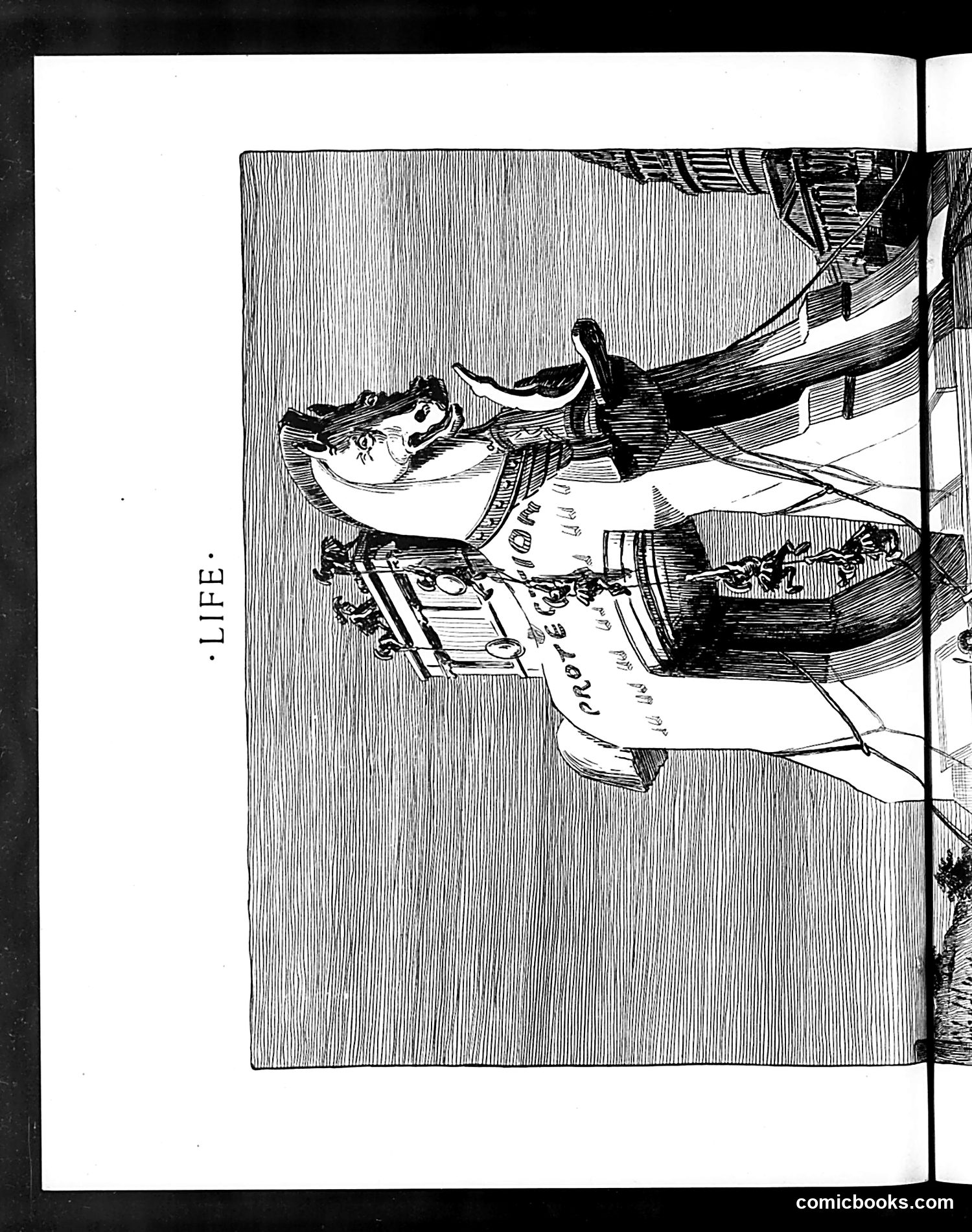
This page shows a single political cartoon titled "LIFE" (the magazine's masthead). The image depicts a figure in classical or allegorical dress (appearing to represent Liberty or a similar concept) reclining or floating, with what looks like official or governmental buildings or structures in the background on the right side. The drawing style uses heavy cross-hatching characteristic of late 19th/early 20th-century satirical illustration. However, without additional context text or captions visible on this page, the specific political commentary or target of this satire is unclear. The allegorical nature suggests it comments on American politics or governance, but the precise reference—whether to a specific event, policy, or public figure—cannot be determined from the image alone.
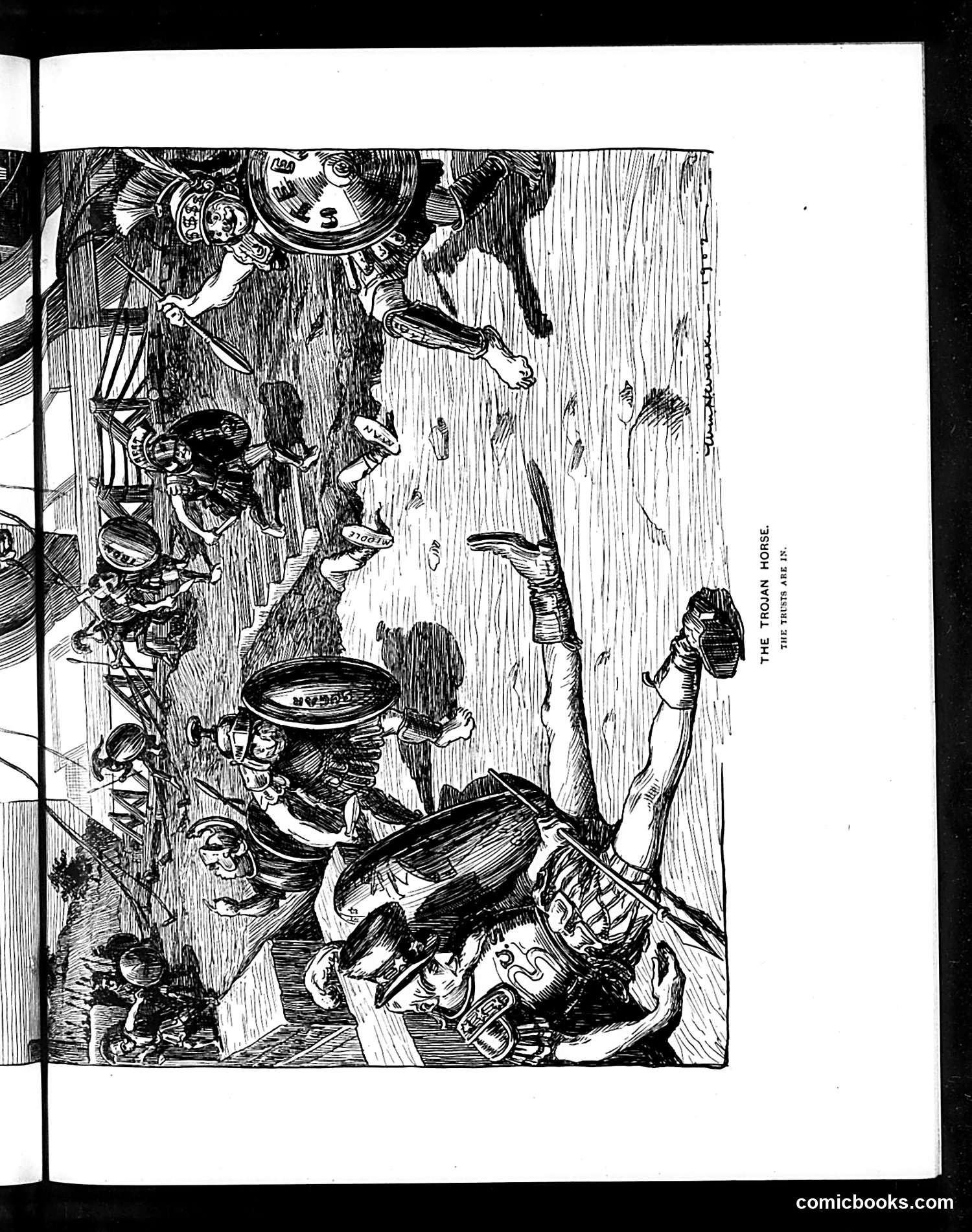
This political cartoon depicts corporate "trusts" (monopolistic business combinations) as a massive Trojan Horse being wheeled into a city. Tiny figures representing workers or citizens are being crushed, trampled, or carried away by the structure and its contents. The cartoon uses the classical allusion to suggest that trusts appear outwardly beneficial or inevitable but actually conceal dangerous consequences for ordinary people. The title "THE TRUSTS ARE IN" indicates the cartoonist warns that monopolies have already infiltrated American commerce and society. This reflects early 20th-century Progressive Era concerns about unchecked corporate power and consolidation. The visual metaphor equates trusts with ancient warfare's deceptive tactics—suggesting they destroy communities from within while appearing legitimate.
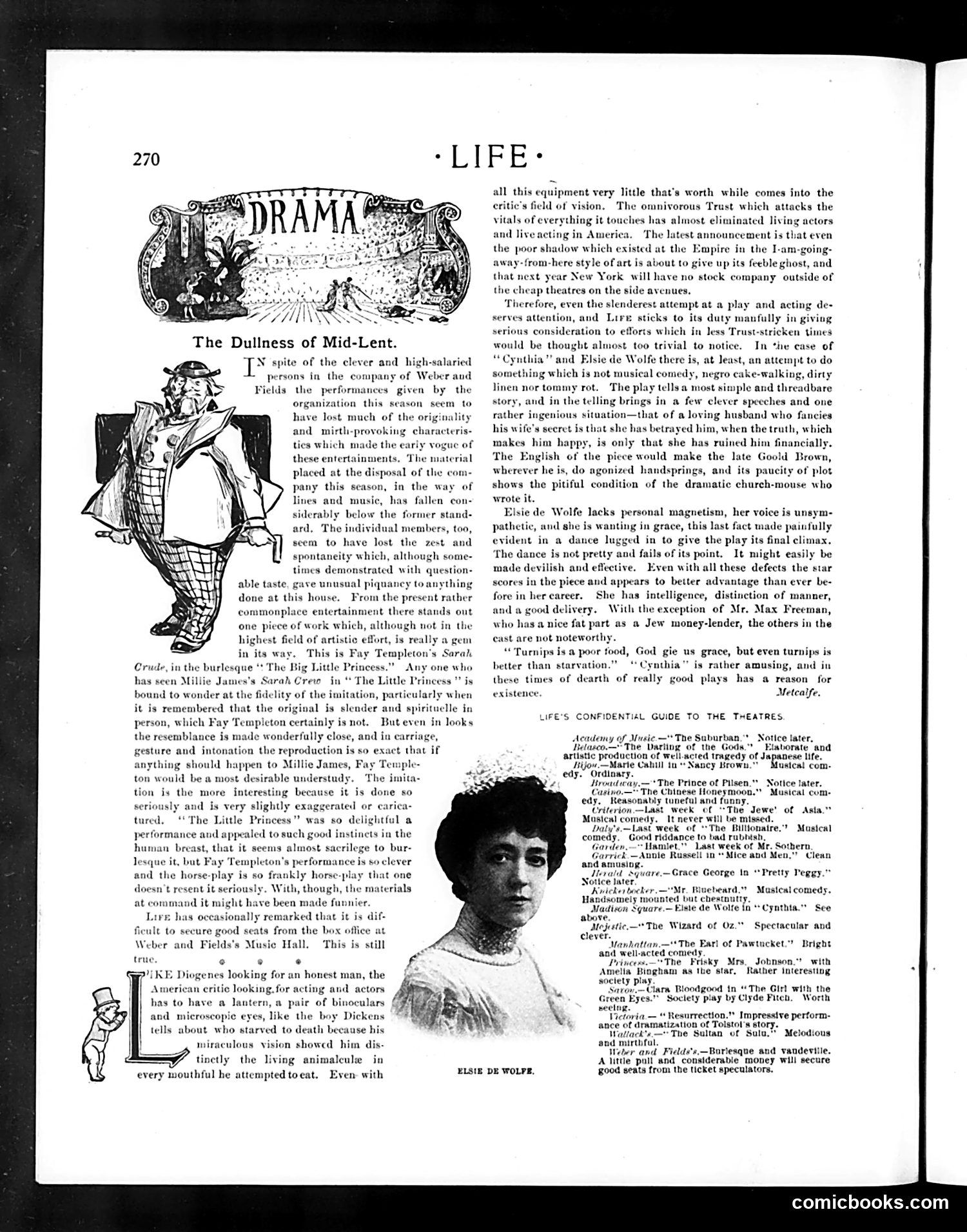
This page reviews theatrical productions, primarily critiquing Weber and Fields' company and their show "The Big Little Princess," featuring actress Fay Templeton's burlesque of child star Millie James in "The Little Princess." **The Main Cartoon/Illustration:** The left side shows a character in "Sarah Crude" — Fay Templeton's role — depicted as a crude, exaggerated burlesque version of the delicate original character. **The Satire:** The critic praises Templeton's faithful *parody* of Millie James, noting the irony that Templeton, who is heavier and less "spirituelle" than James, nonetheless captures her mannerisms so exactly she could understudy the role. This is gentle mockery of burlesque theater's mimicry. **Social Context:** The piece also laments America's theatrical decline, blaming the "omnivorous Trust" (theatrical monopolies) for eliminating quality live theater and actors. The critic complains that even finding decent theater seats or talented performers requires Diogenes-like effort. The tone is weary commentary on early-1900s commercial theater's mediocrity.
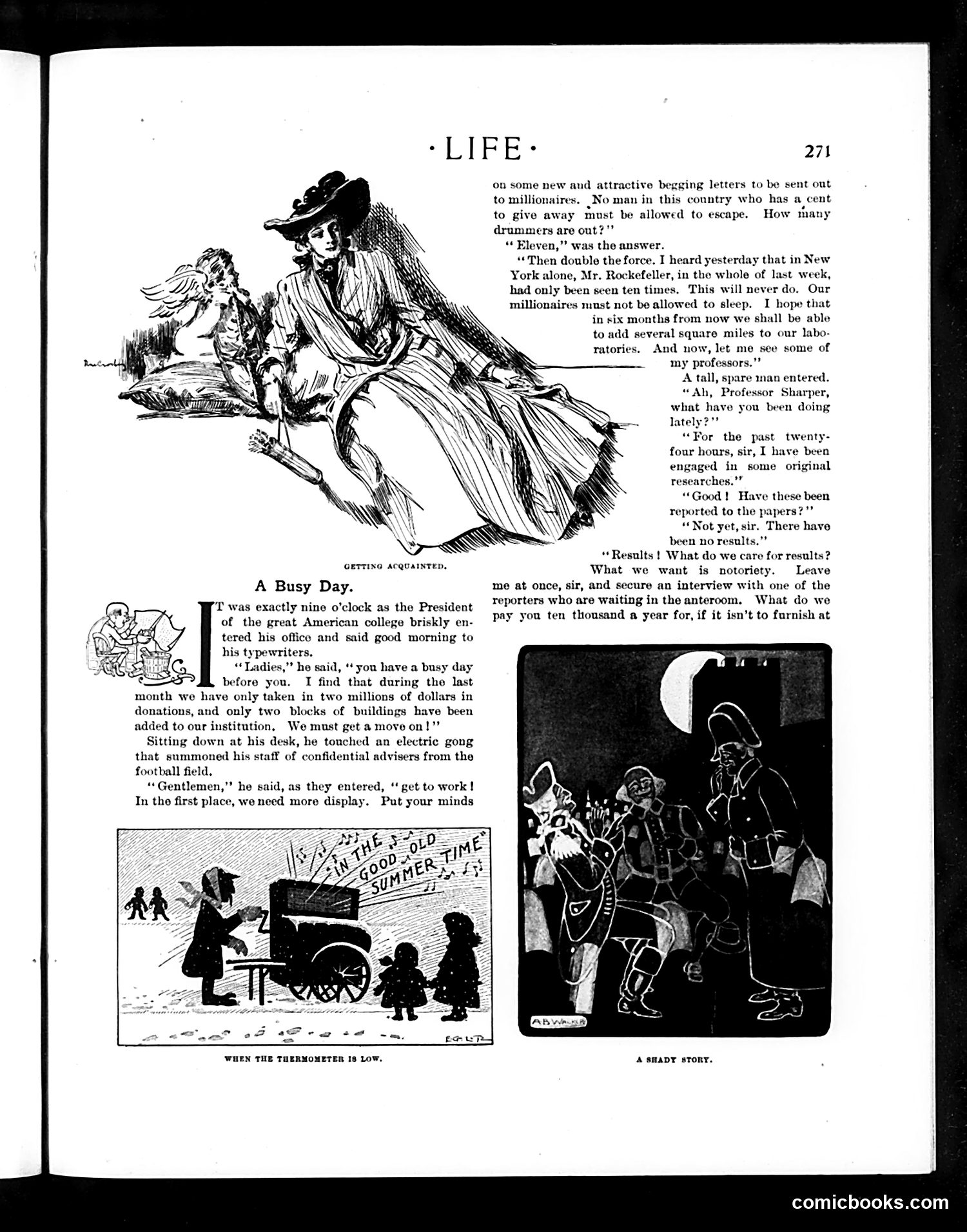
This page satirizes the commercialization and publicity-obsessed management of American higher education. The main story, "A Busy Day," mocks a college president who treats academia as a fundraising enterprise rather than an institution of learning. Key targets of ridicule: **The President** prioritizes donor cultivation over actual education—his staff includes "drummers" (salesmen) tasked with pursuing wealthy donors like Rockefeller relentlessly. **Professor Sharper** represents the absurdity: he's valued not for genuine research results, but for generating newspaper publicity and notoriety to attract donations. The satire's point: colleges have become "begging" operations chasing millionaires' money, reducing professors to publicity generators and education to marketing. The accompanying cartoons satirize summer poverty and related social conditions, reinforcing the magazine's critique of institutional priorities misaligned with genuine public good.
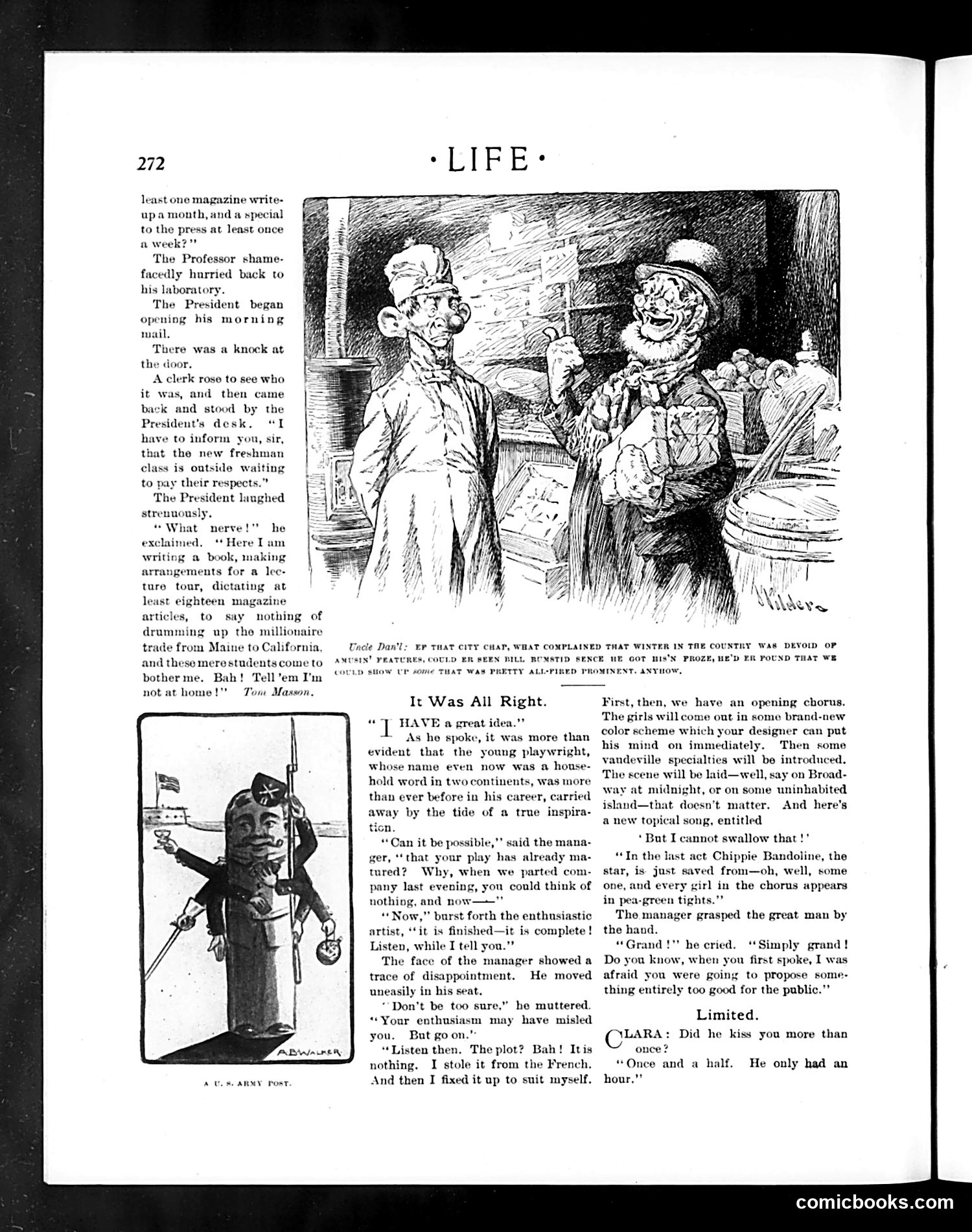
This page contains two satirical pieces about creative professionals' inflated self-importance. **Top cartoon**: A university President, overwhelmed with self-promotion duties (book-writing, lecture tours, magazine articles), dismissively refuses to meet freshman students paying respects. The satire mocks academic egotism and the expectation that scholars constantly publicize themselves. **Bottom story**: A playwright claims to have completed a play overnight, revealing it's entirely derivative—stolen French plot, generic staging, and recycled theatrical clichés (chorus girls, vaudeville acts, a last-minute rescue). The theater manager, initially skeptical of "too good" art, is delighted by this mediocrity. The satire ridicules both the artist's shameless theft and the manager's preference for predictable commercial entertainment over genuine quality. Together, these pieces mock early 20th-century cultural institutions: academia's self-aggrandizement and theater's cynical embrace of formulaic, derivative work.
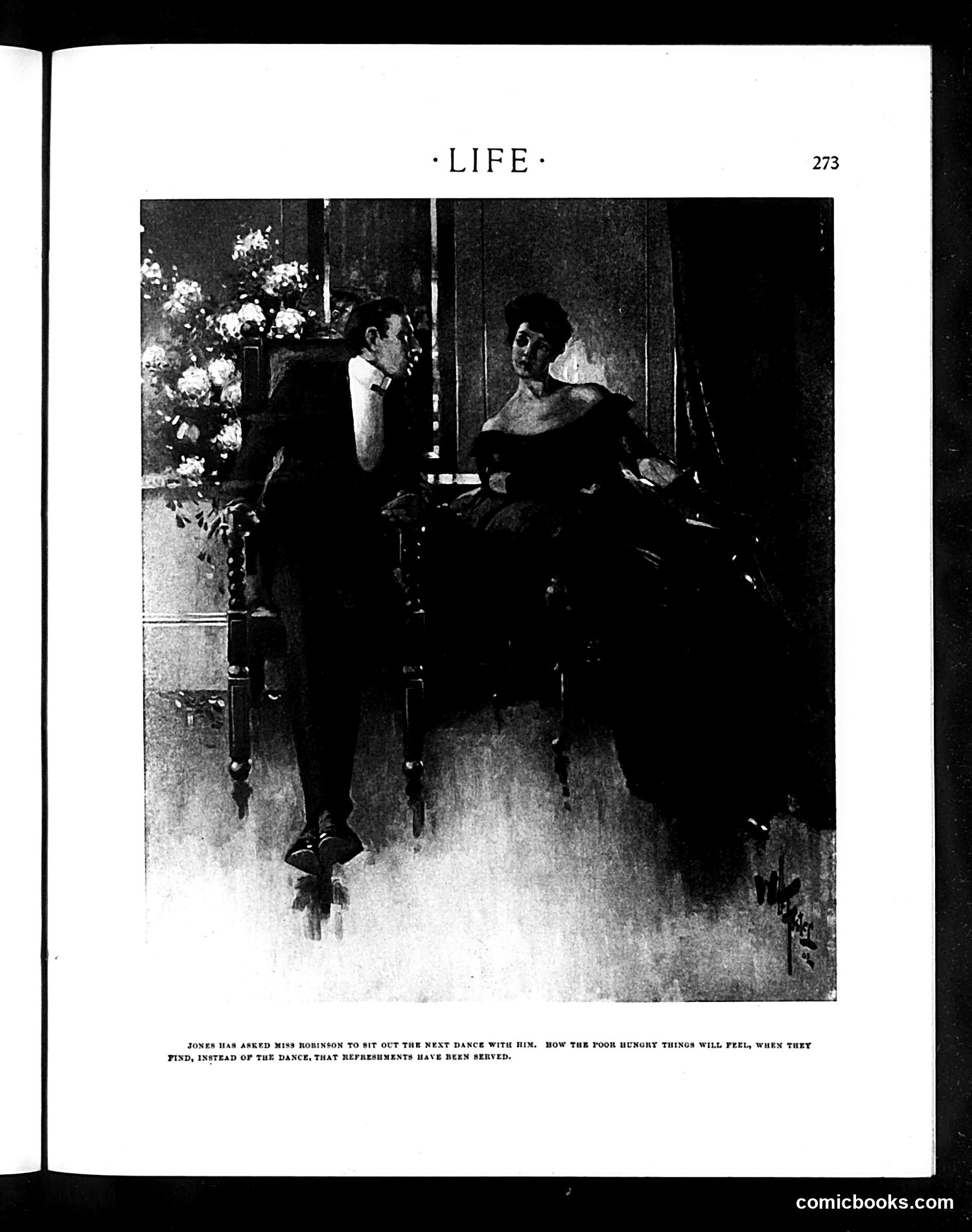
This appears to be a satirical illustration from *Life* magazine commenting on social expectations and disappointment. The scene shows a man (Jones) who has invited a woman (Miss Robinson) to sit out a dance with him, presumably expecting romantic attention. However, the caption reveals the joke: instead of dancing or socializing, refreshments will be served. The satire mocks the contrast between what the "poor hungry things" (the young couple) anticipated—romantic activity—versus the mundane reality of being offered food. It's a commentary on social rituals and unmet romantic expectations, suggesting that a simple meal is a disappointing substitute for the desired interaction. The humor relies on the audience understanding courtship conventions of the era, where dancing was a key social/romantic opportunity.
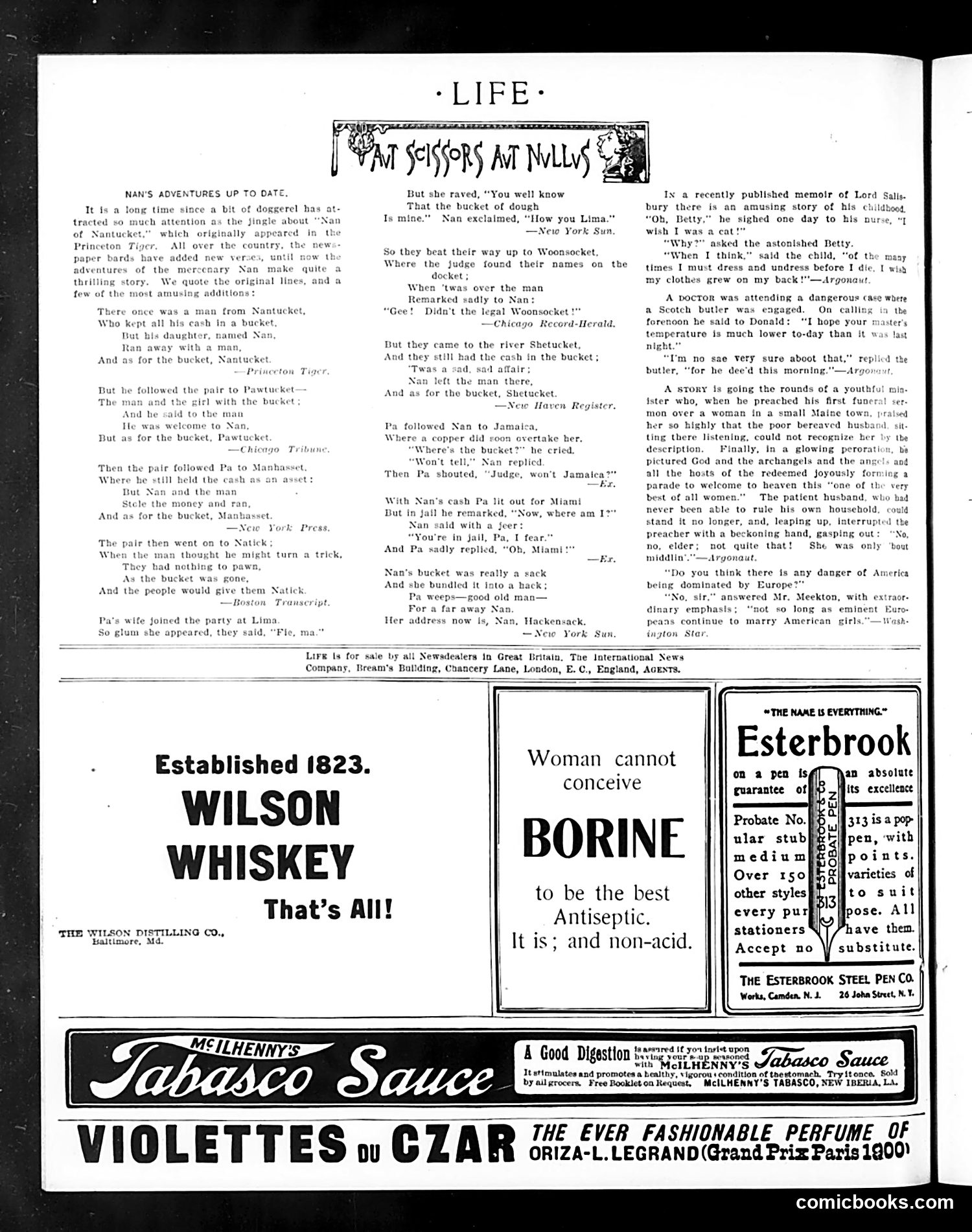
This page primarily contains a humorous serialized poem about "Nan," a woman obsessed with a bucket of money. The narrative follows Nan and a man's romantic pursuit complicated by her attachment to this "bucket of dough," tracing their misadventures from Nantucket through various New England locations (Woonsocket, Shetucket, Jamaica, etc.). The satire appears gentle—poking fun at a woman's materialism and the chaos it causes. The poem is interspersed with unrelated anecdotes in the sidebars—jokes about children, clergy, and doctors—typical of *Life* magazine's miscellaneous humor format. The remainder consists of period advertisements: Wilson Whiskey, Borine antiseptic, Esterbrook pens, Tabasco sauce, and perfume. The page is largely advertising-driven, typical of early 20th-century magazine layouts where editorial content competed equally with commercial notices.
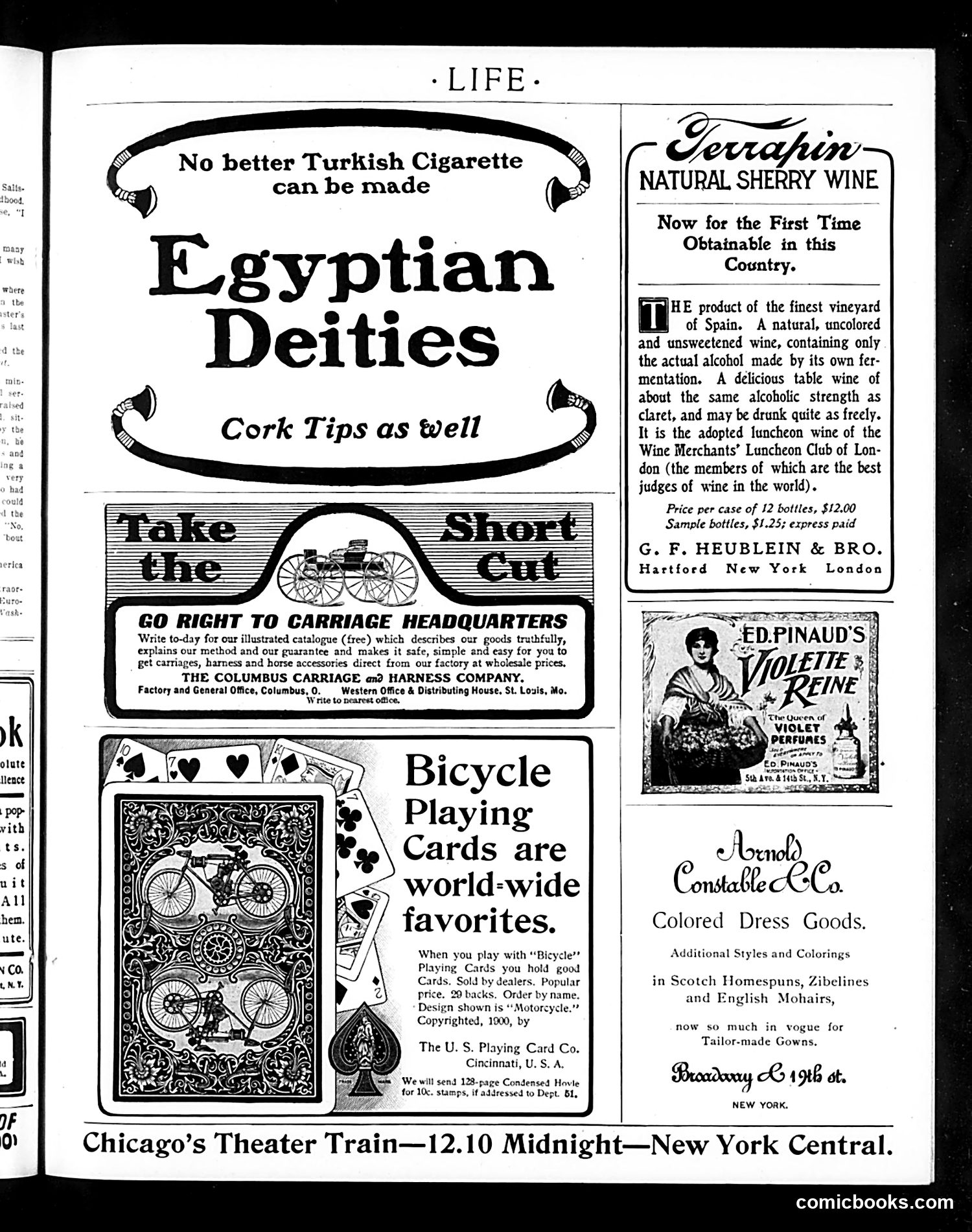
This is primarily an **advertising page**, not a satirical cartoon. It features various product advertisements typical of early 1900s American commerce. The "Egyptian Deities" cigarette ad uses exotic branding—invoking ancient Egypt to suggest sophistication and quality. This reflects the period's fascination with Orientalism and non-Western aesthetics as markers of luxury. Other notable ads include: - **Terrapin Natural Sherry Wine**, marketed as newly available in America, emphasizing its Spanish origin and endorsement by London's Wine Merchants' Luncheon Club - **Bicycle Playing Cards**, established since 1900, marketed as "world-wide favorites" - **Columbus Carriage & Harness Company**, offering direct factory sales at wholesale prices - **Arnold Constable & Co.** promoting Scottish and English dress fabrics for tailor-made gowns The page reflects fin-de-siècle consumer culture: imported luxury goods, industrial manufacturing efficiency, and emerging mass-market branding strategies. These weren't satirized but earnestly marketed to Life's affluent readership.
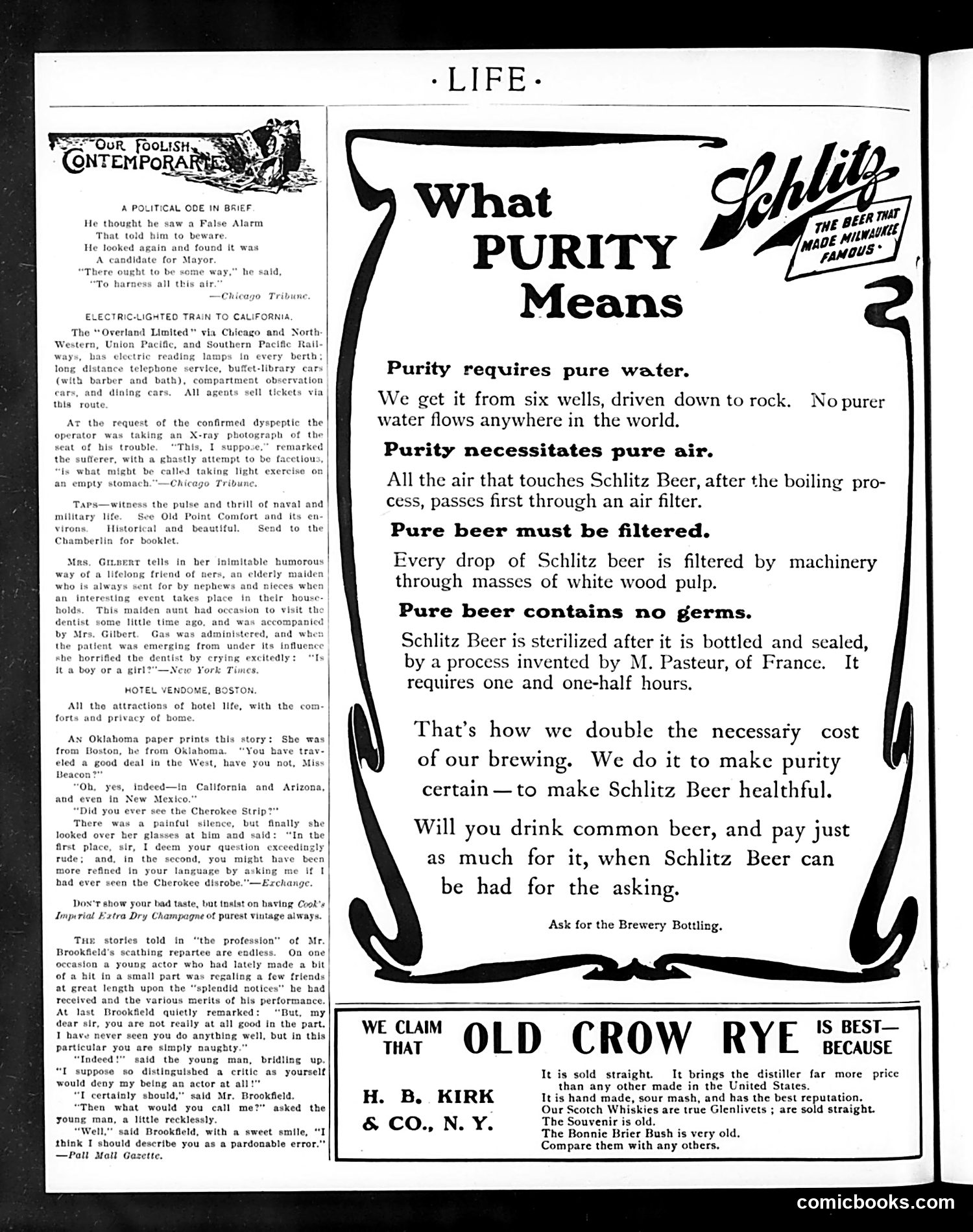
This page from *Life* magazine combines satirical commentary with period advertising. **Left column** contains brief humorous anecdotes—including a story about an actress's trip West and a theater critic's cutting remark about a young actor. These reflect early 1900s social humor about manners, pretension, and wit. **Right side** is dominated by a Schlitz Beer advertisement claiming superiority through "purity"—emphasizing filtered water, sterilized air, and Pasteur's sterilization process. This reflects the era's fascination with germ theory and scientific advancement as marketing tools. The ad's repeated emphasis on purity was common in early 20th-century beer advertising, when breweries competed on sanitation claims. **Bottom** advertises Old Crow Rye whiskey and other spirits, using age and tradition as selling points. The page reveals how *Life* blended satirical content with lucrative advertising—a common model for such magazines.
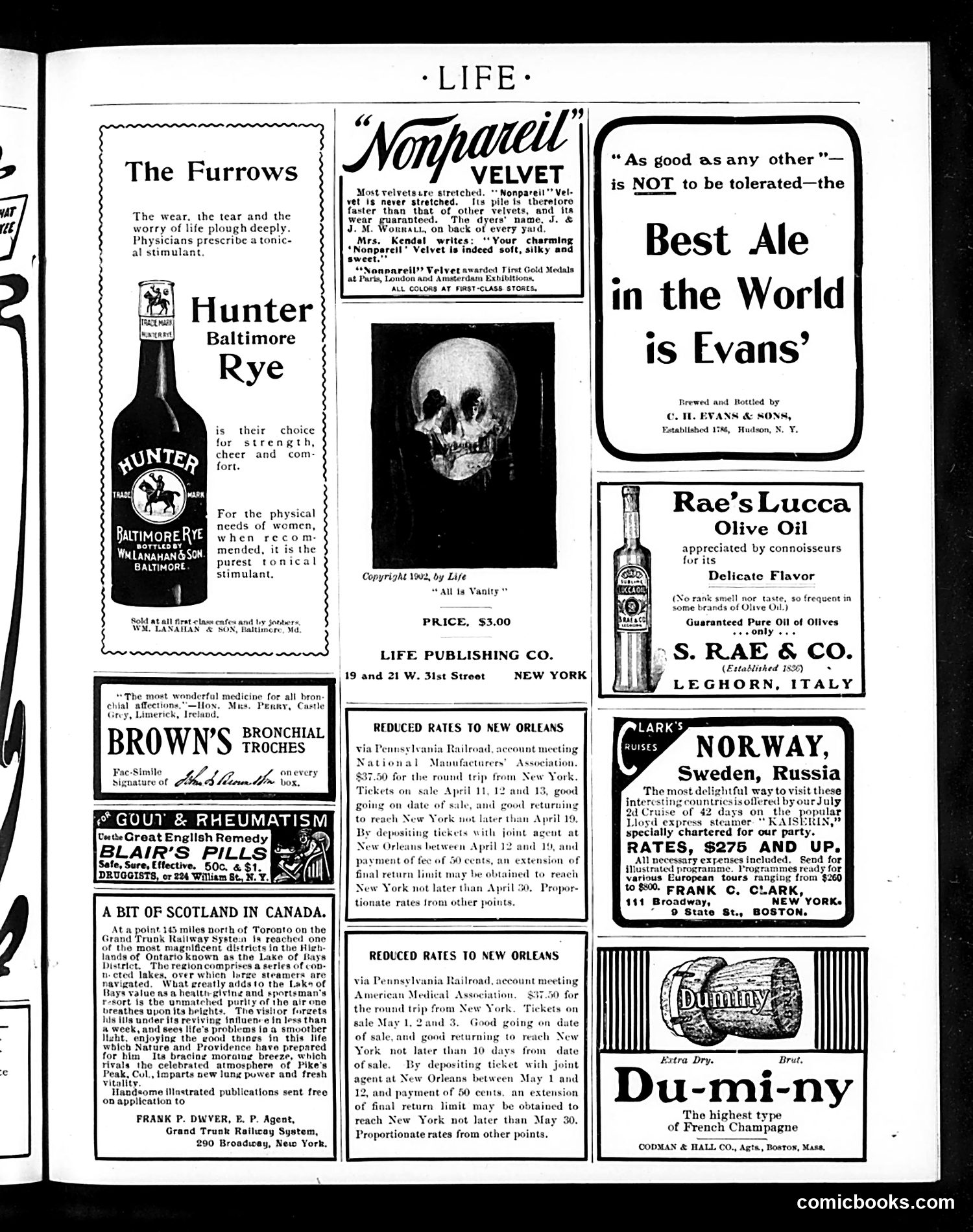
This page is primarily **advertising**, not political satire or cartooning. It consists of commercial advertisements for consumer goods and services typical of 1902 America. Key advertisements include: - **Hunter Baltimore Rye** whiskey, marketed as a "tonic-al stimulant" for "the physical needs of women"—reflecting the era's practice of marketing alcohol for supposed medicinal benefits - **Patent medicines** (Brown's Bronchial Troches, Blair's Pills) promising cure-alls - Travel promotions: reduced railroad fares to New Orleans and a luxury cruise to Norway/Sweden/Russia - Consumer goods: fabric ("Nonpareil" Velvet), olive oil, champagne, and ale The only illustration with potential allegorical meaning is a skull captioned "All is Vanity," accompanying a Life Publishing Company advertisement for a $3 book—likely reflecting Victorian memento mori themes about mortality and materialism. The page demonstrates how early 1900s publications blended editorial content with extensive advertising.
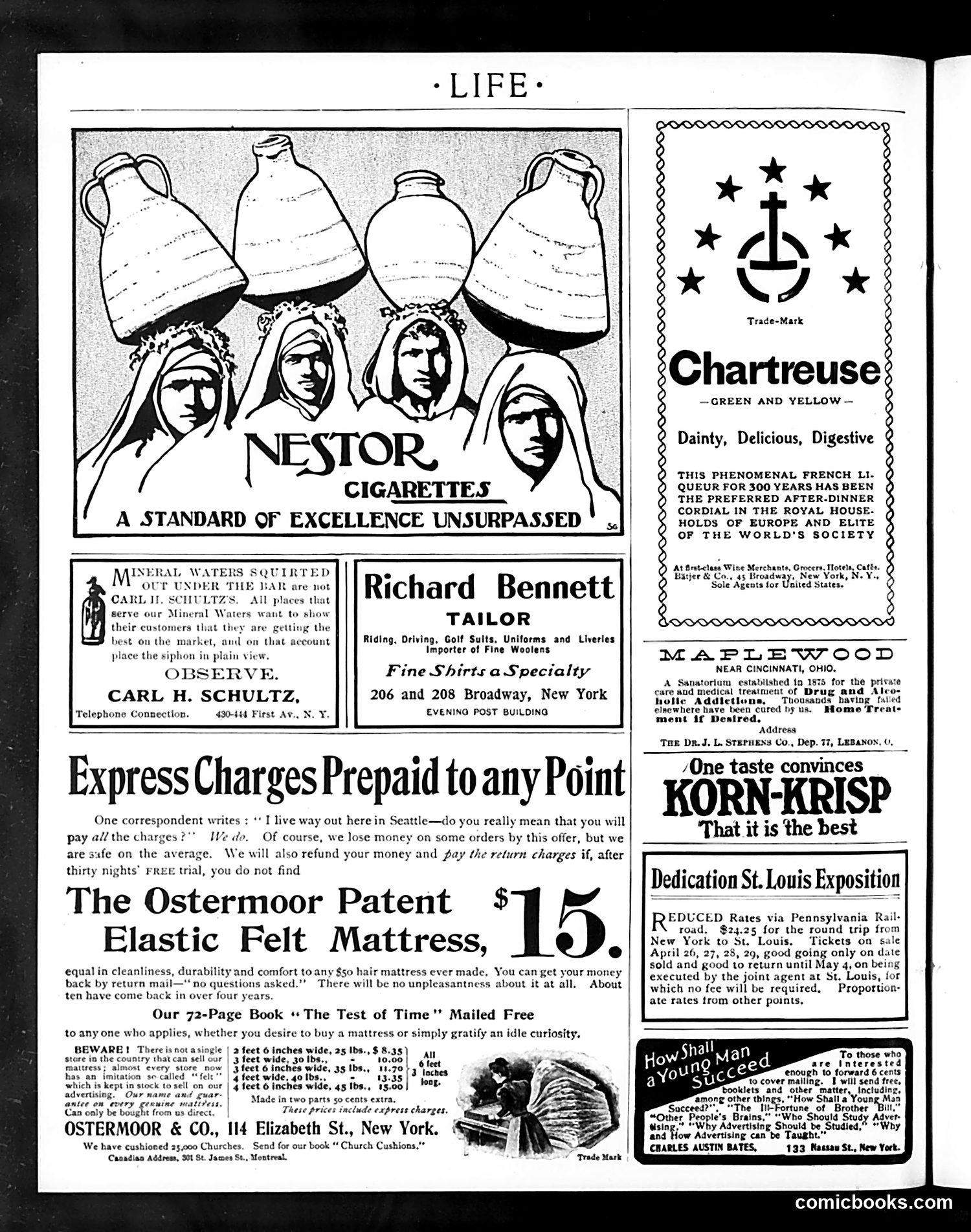
This is primarily an **advertising page** from Life magazine, not a political cartoon page. It contains multiple commercial advertisements from the early 1900s (the 1904 St. Louis Exposition reference dates it). The main visual element is a **Nestor Cigarettes advertisement** featuring four classical female figures with large bottles above their heads. This appears to be generic allegorical imagery (likely representing qualities like quality or tradition) rather than satirical caricature—a common advertising approach of the era. The remaining content consists of product ads: mattresses, tailors, mineral water, liqueur, sanitariums, breakfast cereal, and railroad tickets. A small item at bottom by Charles Austin Bates offers free advertising advice literature. There is **no discernible political satire or social commentary** on this particular page. It's a straightforward commercial advertising layout typical of Life's revenue model during this period.
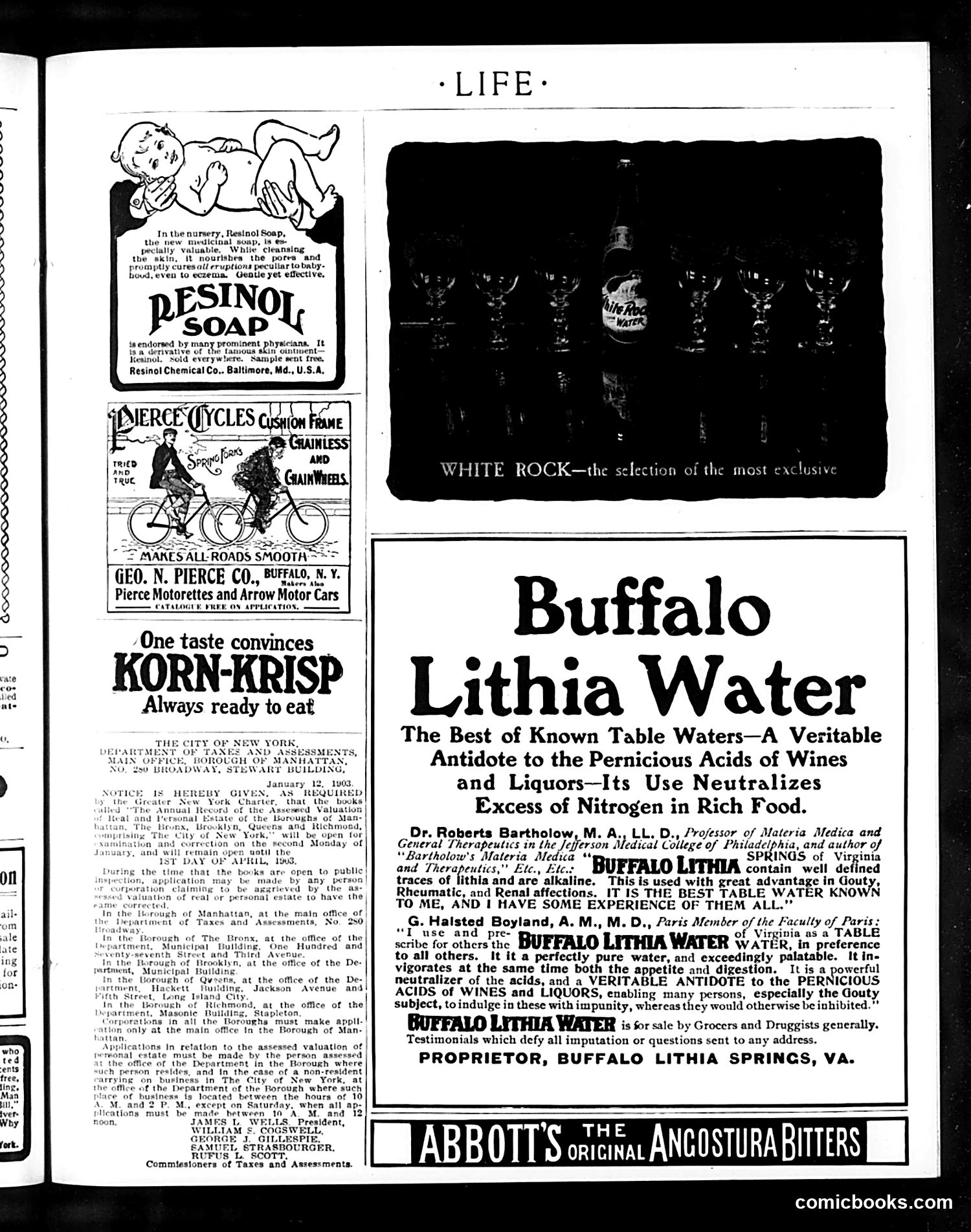
This page is primarily **advertising**, not political satire. It contains four distinct product advertisements typical of early 20th-century magazines: 1. **Resinol Soap** — a medicinal soap marketed for babies' skin conditions, claiming to cure eczema and other eruptions. 2. **Pierce Cycles and Motor Cars** — bicycles and early automobiles from Buffalo, New York. 3. **Korn-Krisp** — a breakfast cereal advertised as "always ready to eat." 4. **Buffalo Lithia Water** — the dominant advertisement, featuring testimonials from prominent physicians claiming the mineral water neutralizes acids from wine and rich foods, particularly benefiting gout sufferers. The page also includes official New York City tax assessment notices at the bottom. There is **no political cartoon or satire** visible. The small illustration accompanying the Resinol ad shows a baby, and the Pierce ad shows cyclists—both are simple product imagery rather than commentary. This is a standard advertising page from a magazine that supported itself through commercial endorsements.
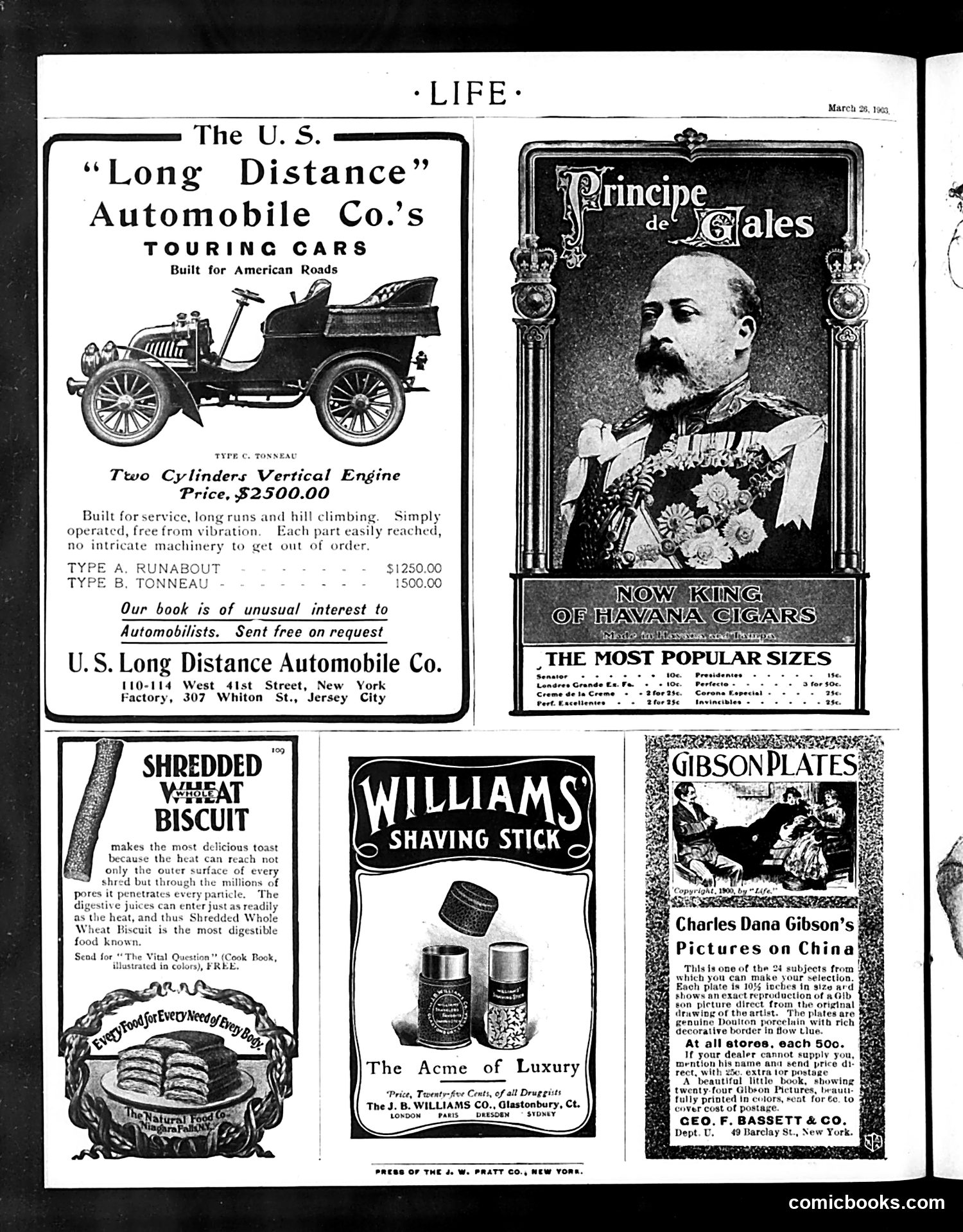
This page consists entirely of advertisements with no political cartoons or satire. The content includes: **Automobiles**: U.S. Long Distance Automobile Co. advertises touring cars ($2,500), appealing to early motorists with promises of reliability and simplicity. **Food & Personal Care**: Shredded Wheat Biscuit promotes digestibility through detailed explanation of how heat penetrates its structure; Williams Shaving Stick advertises itself as "The Acme of Luxury." **Art/Collectibles**: Charles Dana Gibson's "Pictures on China"—decorative porcelain plates featuring Gibson Girl imagery, a popular cultural phenomenon of the era, sold through Geo. F. Bassett & Co. The page reflects early 1900s consumer culture: emerging automobile ownership, health-conscious food marketing, luxury grooming products, and aesthetic home decoration tied to celebrity artist endorsement. No satire or political content is present.