
Life, 1903-03-26 · page 6 of 24
Life — March 26, 1903 — page 6: what you’re looking at
What you’re looking at
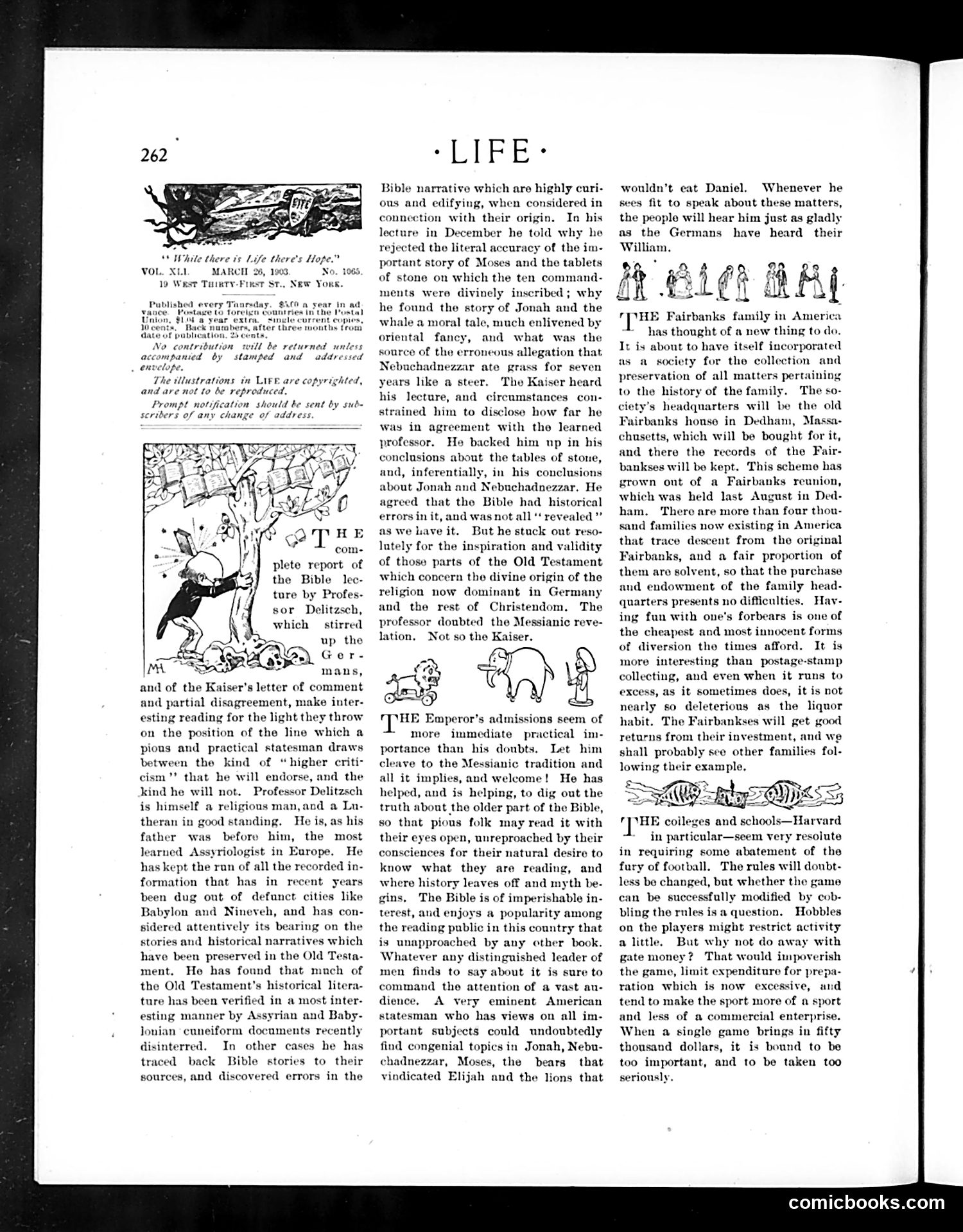
The page contains two distinct satirical pieces: **Upper cartoon** ("While there is Life there's Hope"): Depicts a figure (appears to be Professor Delitzsch based on the text) precariously balanced on a tightrope over a chasm. The satire mocks Delitzsch's controversial biblical scholarship—specifically his claims about historical errors in the Old Testament. The precarious positioning suggests his theories are dangerously unstable. **Lower section**: Discusses the Fairbanks family's plan to incorporate themselves as a society for collecting family history. The satire targets American wealthy families' pretentious genealogical obsessions and the commercialization of heritage documentation. Both pieces employ exaggeration to mock early 1900s intellectual and social pretensions—one targeting academic biblical criticism, the other wealthy family vanity projects.
📄 Transcribed text from this page (OCR, searchable)
Machine-transcribed from the original scan — historical spelling and the odd misread are preserved.
VOL. XL 19 Wrst Turety-Fr (0 a sear in ad tal from ull be returned unless stamped and addressed The illustrations in LUFE are copyrighted, and are not to be reproduced. Prompt notification should be sent by sub- scribers of any change of address. plete report of the Bible lec- ture by Profes- sor Delitzsch, which © stirred ‘ up the LAGAN. Ger- mans, and of the Kaiser's letter of comment and partial disagreement, make inter- esting reading for the light they throw on the position of the line which a pious and practical statesman draws between the kind of “higher criti- cism’’ that he will endorse, and the kind he will not, Professor Delitzsch is himself a religious man,and a Lu- theran in good standing. He is, as his father before him, the most learned Assyriologist in Europe. He has kept the ran of all the recorded in- formation that has in recent years been dug out of defunct cities like Babylon and Nineveh, and has con- sidered attentively its bearing on the stories and historical narratives which have been preserved in the Old Testa- ment. He has found that much of the Old Testament’s historical litera- ture has been verified in a most inter- esting manner by Assyrian and Baby- lonian cuneiform documents recently disinterred. In other cases he has traced back Bible stories to their sources, and discovered errors in the was “LIFE * Bible narrative which are highly curi- ous and edifying, when considered in connection with their origin. In his lecture in December he told why he rejected the literal accuracy of the im- portant story of Moses and the tablets of stone on which the ten command- ments were divinely inscribed ; why he found the story of Jonah and the whale a moral tale, much enlivened by oriental fancy, and what was the source of the erroneous allegation that Nebuchadnezzar ate grass for seven years like a steer. The Kaiser heard his lecture, and circumstances con- strained him to disclose how far he was in agreement with the learned professor. He backed him up in his conclusions about the tables of stone, and, inferentially, in his conclusions about Jonah and Nebuchadnezzar, He agreed that the Bible historical errors in it, and was not all‘ revealed” But he stuck out reso- lutely for the inspiration and validity of those parts of the Old Testament which concern the divine origin of the religion now dominant in Germany as we have it. and the rest of Christendom, The professor doubted the Messianic reve- lation, Not so the Kaiser. sais rpHE Emperor’s admissions seem of more immediate practical im- portance than his doubts. Let him cleave to the Messianic tradition and all it implies, and welcome! He has helped, and is helping, to dig out the truth about the older part of the Bible, so that pious folk may read it with their eyes open, unreproached by their consciences for their natural desire to know what they are reading, and where history leaves off and myth be- gins, The Bible is of imperishable in- terest, and enjoys a popularity among the reading public in this country that is unapproached by any other book. Whatever any distinguished leader of men finds to say about it is sure to command the attention of a vast au- dience, A very eminent American statesman who has views on all im- portant subjects could undoubtedly find congenial topics in Jonah, Nebu- chadnezzar, Moses, the Dears that vindicated E! h and the lions that wouldn’t eat Daniel. Whenever he fit to speak about these matters, the people will hear him just as gladly as the Germans have heard their William. ao 2 wht He LGA Oh -tstrogd ‘PHe Fairbanks family in America has thought of a new thing to do, It is about to have itself incorporated as a society for the collection and preservation of all matters pertaining to the history of the family. The so- ’s headquarters will be the old Fairbanks honse in Dedham, Ma: chusetts, which will be bought for it, and there the records of the Fair- bankses will be kept. This scheme has grown out of a Fairbanks reunion, which was held last August in Ded- ham. There are more than four thou- sand families now existing in America that trace descent from the original Fairbanks, and a fair proportion of them are solvent, so that the purchase and endowment of the family head- quarters presents no difficulties, Hav- ing fun with one's forbears is one of the cheapest and most innocent forms of diversion tho times afford, It is more interesting than postage-stamp collecting, and even when it runs to excess, as it sometimes does, it is not nearly so deleterious as the liquor habit. The Fairbankses will get good returns from their investment, and we shall probably see other families fol- lowing their example. "THE coileges and schools—Harvard in particular—seem very resolute in requiring some abatement of the fury of football, The rules will doubt- less be changed, but whether the game can be successfully modified by cob- bling the rules is a question. Hobbles on the players might restrict activity a little. But why not do away with gate money? That would impoverish the game, limit expenditure for prepa- ration which is now excessive, and tend to make the sport more of a sport and less of a commercial enterprise. When a single game brings in fifty thousand dollars, it is bound to be too important, and to be taken too seriously, comicbooks.com