
A complete issue · 24 pages · 1903
Life — February 19, 1903
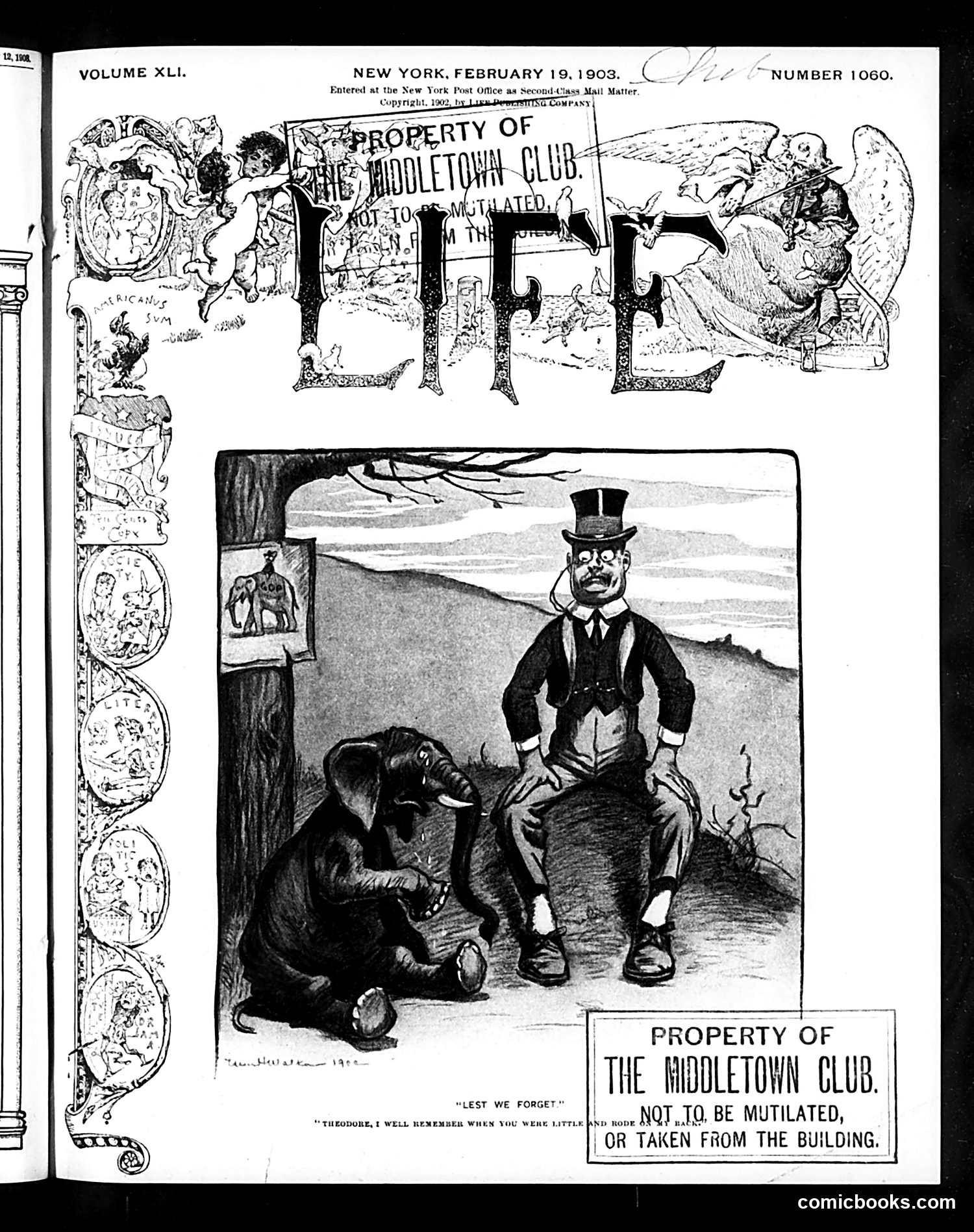
This satirical cartoon depicts a well-dressed man in a top hat confronting two dogs. The caption reads "Lest We Forget" with dialogue: "Theodore, I will remember when you were little and more or less decent." The figure appears to be **Theodore Roosevelt**, identifiable by the caricatured features and top hat typical of Rooseveltian depictions. The cartoon likely critiques Roosevelt's political evolution or behavior—suggesting he was once principled ("little and more or less decent") but has since changed course. The dogs likely symbolize political opponents or allies he's turned against. This reflects early-1903 tensions during Roosevelt's presidency regarding trust-busting, conservation policies, or political alliances. The "Lest We Forget" caption ironically warns that history remembers his earlier, better self.
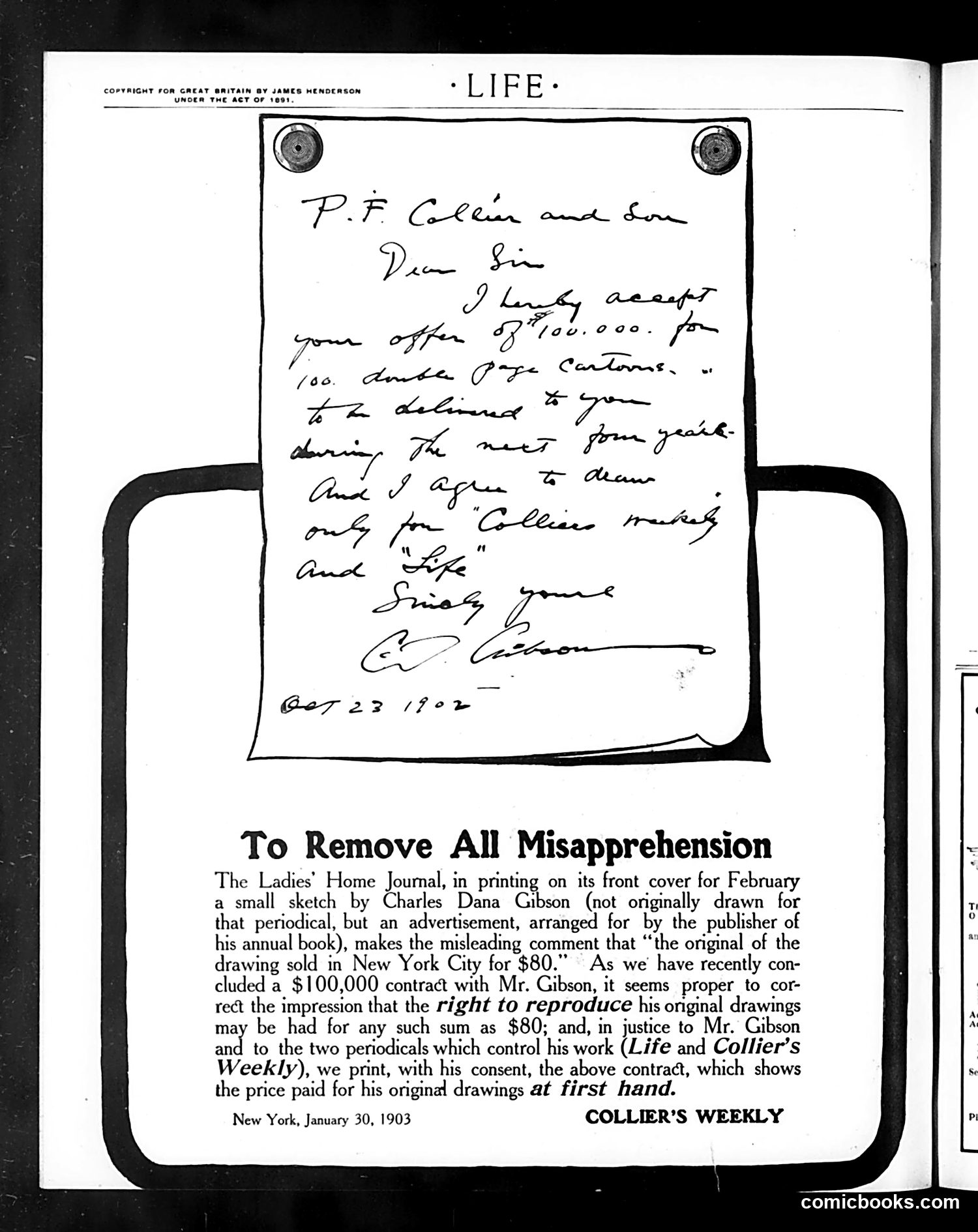
This page is primarily a **legal/business document** rather than political satire. It reproduces a handwritten contract dated October 23, 1902, between Charles Dana Gibson and P.F. Collier & Son. The accompanying text (dated January 30, 1903) addresses a dispute about Gibson's drawing rights and reproduction fees. The Ladies' Home Journal had claimed a Gibson sketch sold for $80, implying his original work was undervalued. Collier's Weekly responds by publishing this contract to clarify that Gibson actually received a $100,000 agreement with them—establishing his substantial compensation and correcting the public record about his professional value and which publications controlled his work. This is essentially a cease-and-desist via transparency rather than satire.
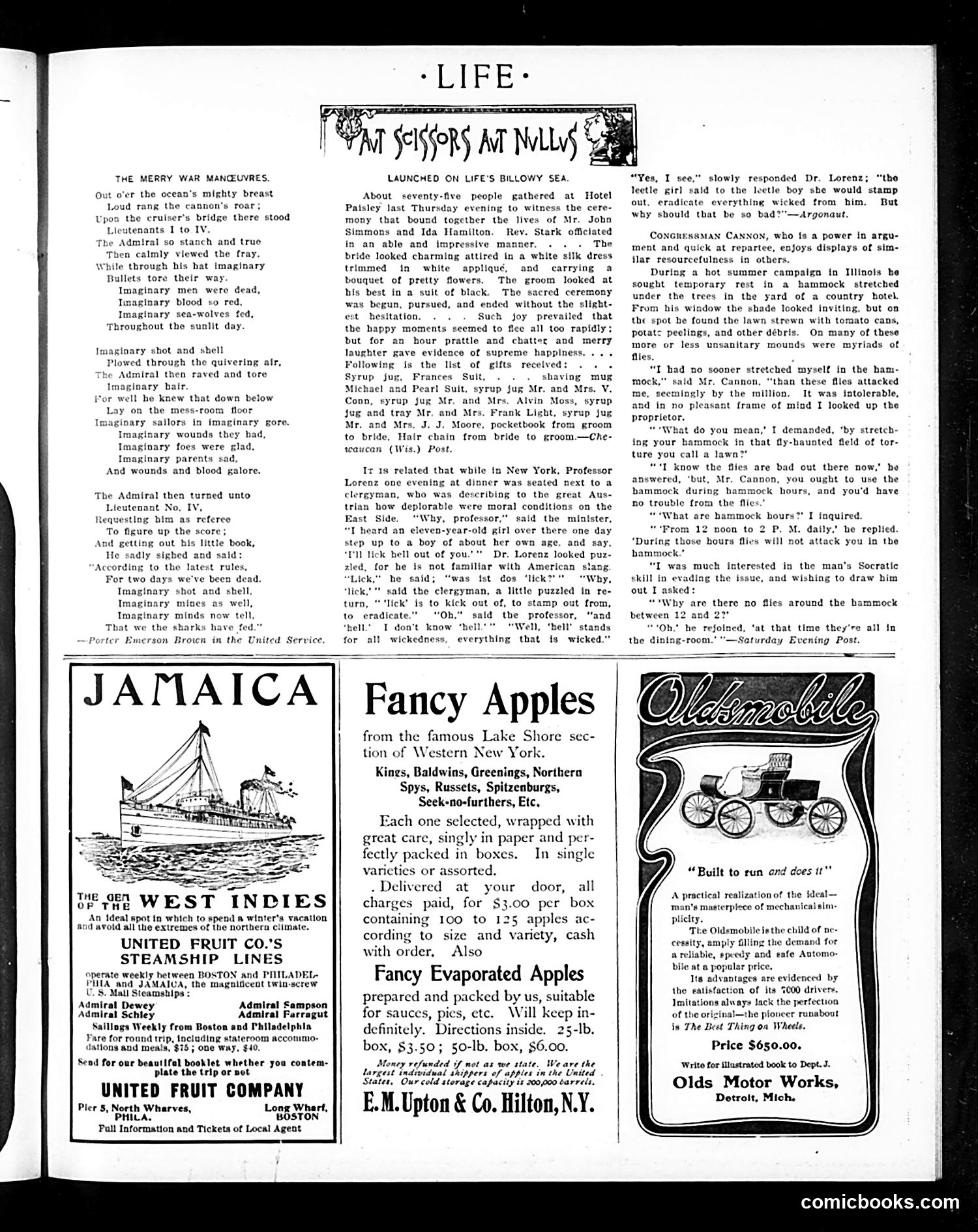
This page is predominantly **advertising** (Jamaica steamships, fancy apples, Oldsmobile automobiles), with the primary content being a satirical poem titled "At Scissors at Nulls" about military absurdity. The poem mocks **wartime bureaucratic incompetence**, particularly through dialogue between a Congressman and "Cannon" (likely referring to Speaker Joseph Cannon, a prominent political figure). The satire targets military regulations and chain-of-command ridiculousness—specifically, a soldier receiving contradictory orders about hammocks and proper military decorum during wartime. The humor derives from the clash between rigid military formality and practical field conditions, suggesting the poem criticizes how politicians and military leadership create pointless regulations divorced from soldiers' actual needs during combat operations.
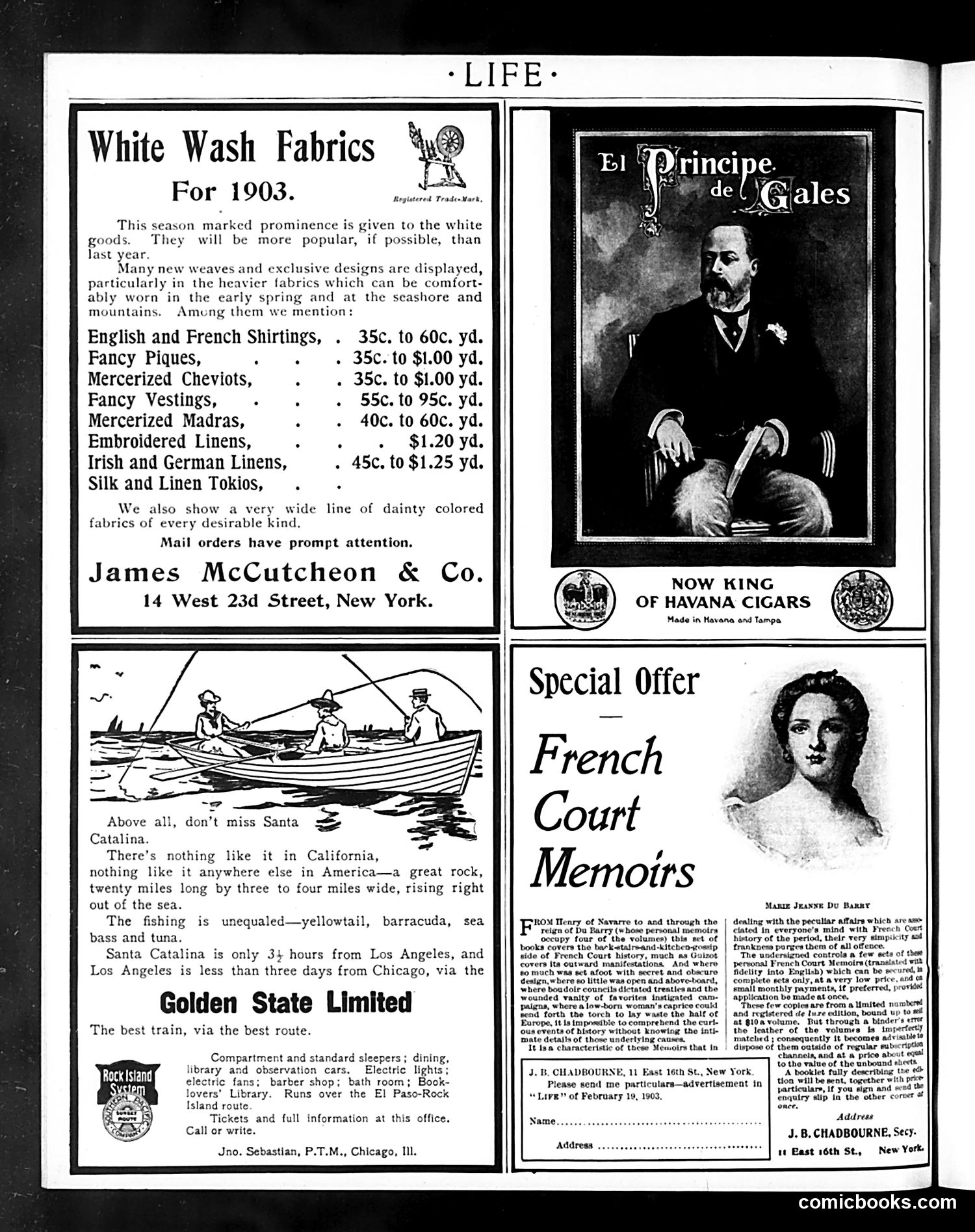
This page is primarily **advertising**, not satire or political content. It contains four distinct ads: 1. **James McCutcheon & Co.** (top left): White fabric merchant advertising spring goods with specific prices 2. **El Príncipe de Gales** (top right): A portrait of a man identified as "NOW KING OF HAVANA CIGARS"—likely referencing a cigar brand name rather than actual royalty 3. **Santa Catalina** (center left): Travel promotion for California destination, featuring a fishing scene 4. **Golden State Limited** (bottom left): Railroad advertisement 5. **French Court Memoirs** (right): Book advertisement with a woman's portrait and order form The only potentially satirical element is the cigar ad's mock-royal branding, but it's primarily commercial. This page reflects early 1900s magazine advertising practices rather than political cartoon commentary.
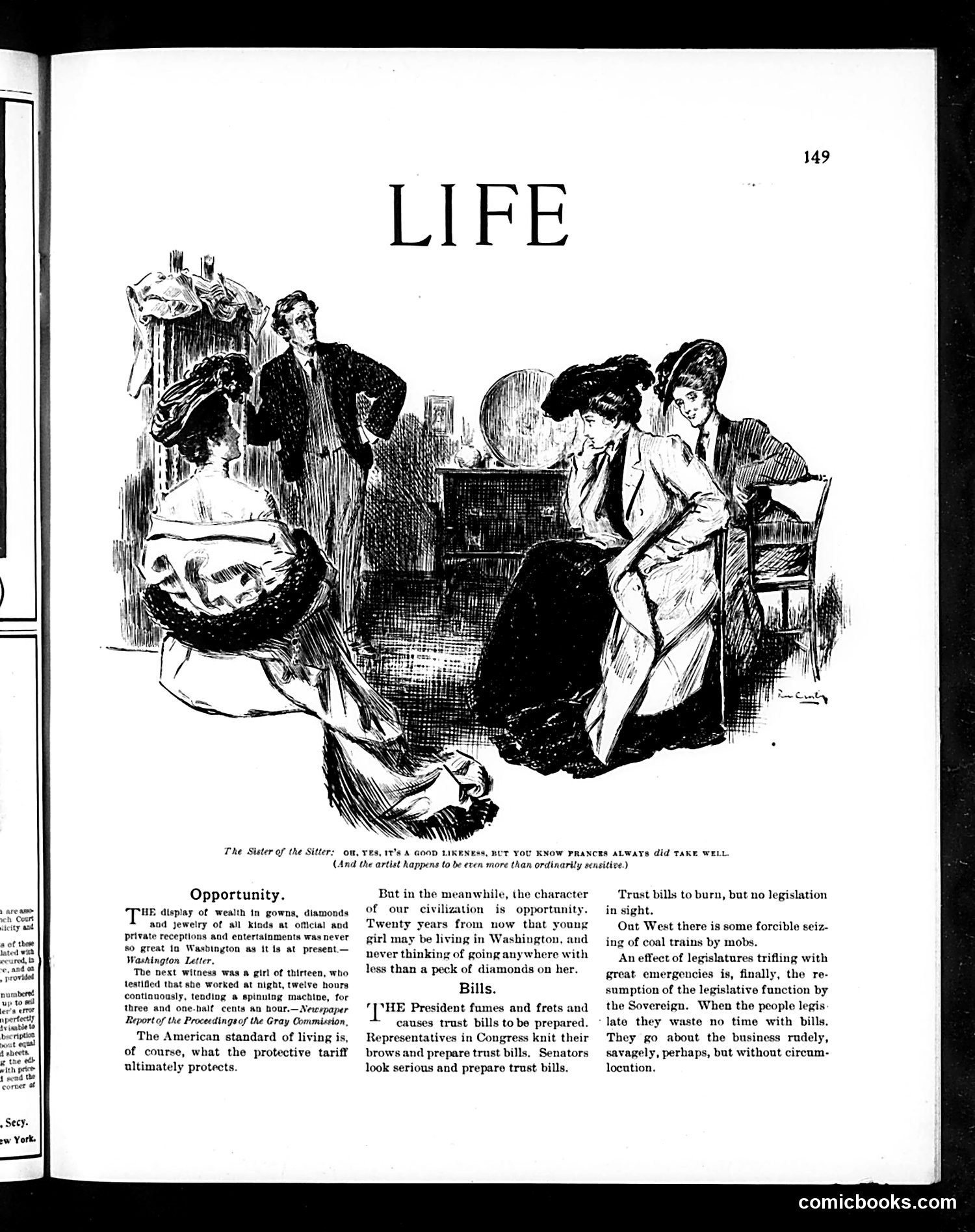
**The Cartoon**: "The Sister of the Sitter" depicts women in an interior setting. The caption suggests ironic commentary about a woman named Frances who "always did take well" and "the artist happens to be even more than ordinarily sensitive." **The Articles**: Two short pieces address early 20th-century American economic and political concerns: - "Opportunity" discusses wealth concentration, protective tariffs, and living standards - "Bills" satirizes government dysfunction—presidents and Congress create trust bills while senators appear indifferent, suggesting legislative paralysis around economic regulation **Overall Theme**: The page critiques Gilded Age anxieties: monopolistic wealth, tariff politics, and governmental ineffectiveness at addressing corporate power. The magazine's satirical approach targets both economic inequality and legislative gridlock.
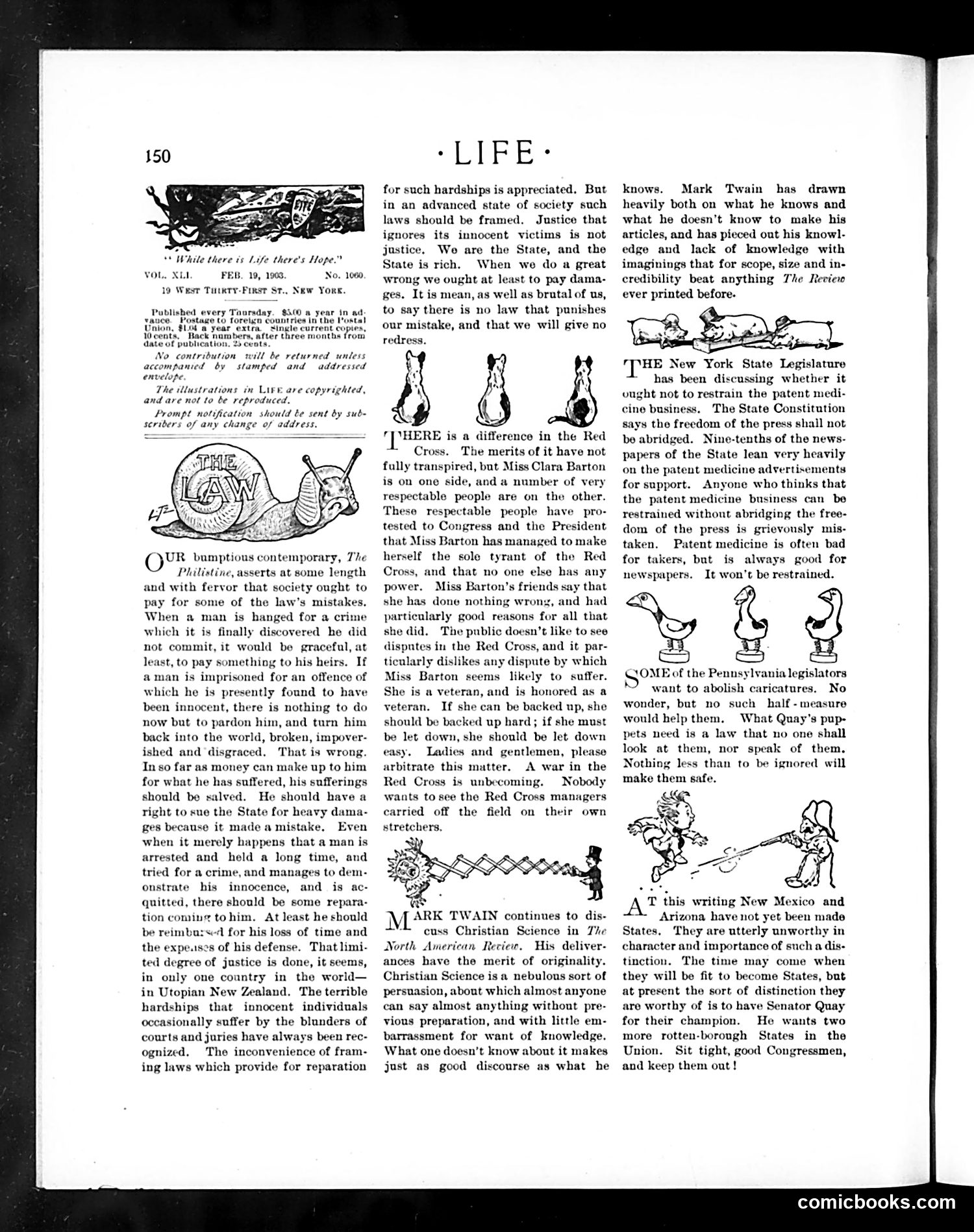
This page contains editorial commentary rather than political cartoons. The main illustration shows three identical snail figures, likely representing slowness or inertia in government. The text discusses several issues: 1. **Red Cross controversy**: References Miss Clara Barton and disputes over Red Cross management, suggesting she faced criticism from some respectable people who protested to Congress and the President. 2. **Patent medicine regulation**: Argues against restraining the patent medicine business, claiming it would violate press freedom—newspapers apparently advertised patent medicines heavily. 3. **State legislation concerns**: Critiques Pennsylvania and New Mexico/Arizona legislators as unworthy, calling for better representation in Congress. The snail imagery suggests the author views legislative progress on these issues as frustratingly slow, despite their importance.
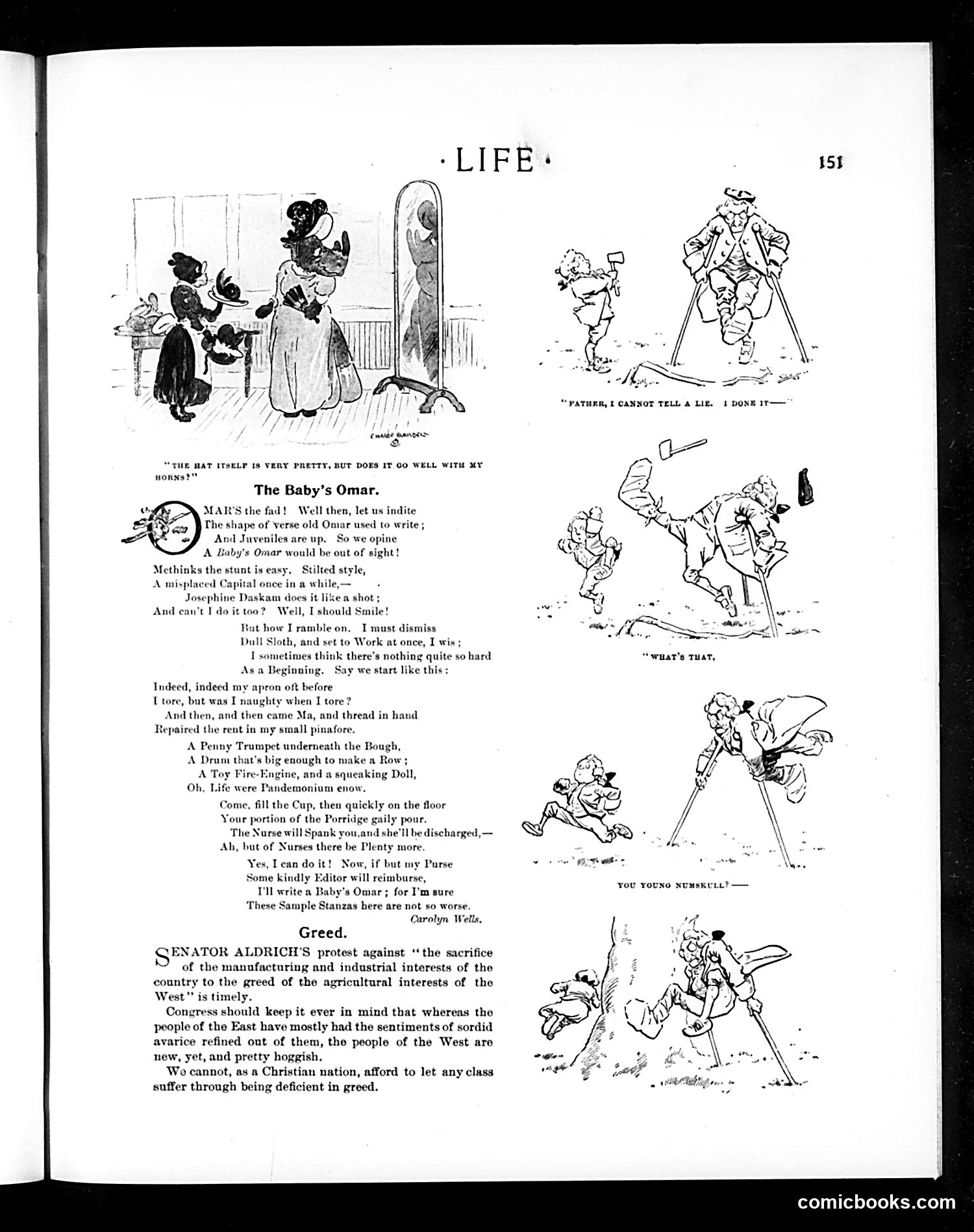
This page contains humorous illustrations about childhood and social commentary: **"The Baby's Omar"** is a poem by Carolyn Wells parodying the Rubaiyat of Omar Khayyam, using childish imagery (toys, nurses, porridge) instead of philosophical themes. The accompanying cartoon shows a woman holding a messy child—the joke being the child's appearance contradicts the caption "The hat itself is very pretty, but does it go well with my horns?" **The right-side cartoons** depict children playing roughly with adults, captioned "Father, I cannot tell a lie" and "What's that" and "You young rascal!"—suggesting innocent mischief. **"Greed"** is a serious editorial comment by Senator Aldrich protesting industrial greed's harm to agricultural interests, warning that a Christian nation cannot allow class suffering due to greed. The page mixes lighthearted child humor with political critique about economic inequality.
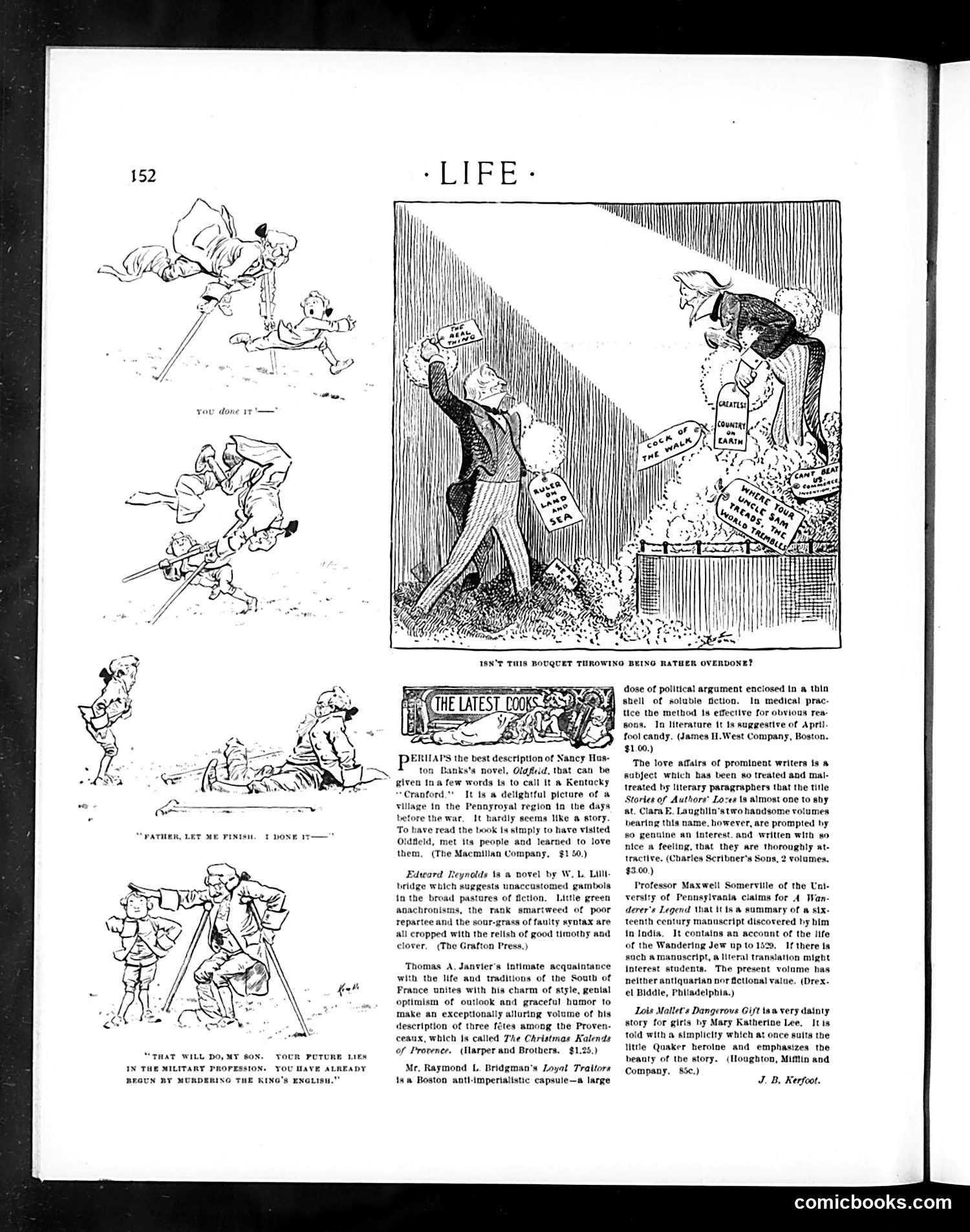
This page contains satirical illustrations (left side) and book reviews (right side) from *Life* magazine. The left-side cartoons depict a child's physical misadventures with a toy or plaything—shown falling, being struck, and generally getting hurt. The captions suggest a parent's dry commentary on the child's mishaps ("You do it," "Father, let me finish, I done it"). The main cartoon (top right) shows a figure at what appears to be a podium or speaker's stand, with text reading "ISN'T THIS BOUQUET THROWING BEING RATHER OVERDONE?" This appears to satirize excessive public adoration or fan behavior—possibly directed at a political figure or celebrity—suggesting the practice of throwing bouquets in tribute has become absurdly exaggerated. The right column contains book reviews of contemporary novels, discussing literary merit and subject matter of recent publications.
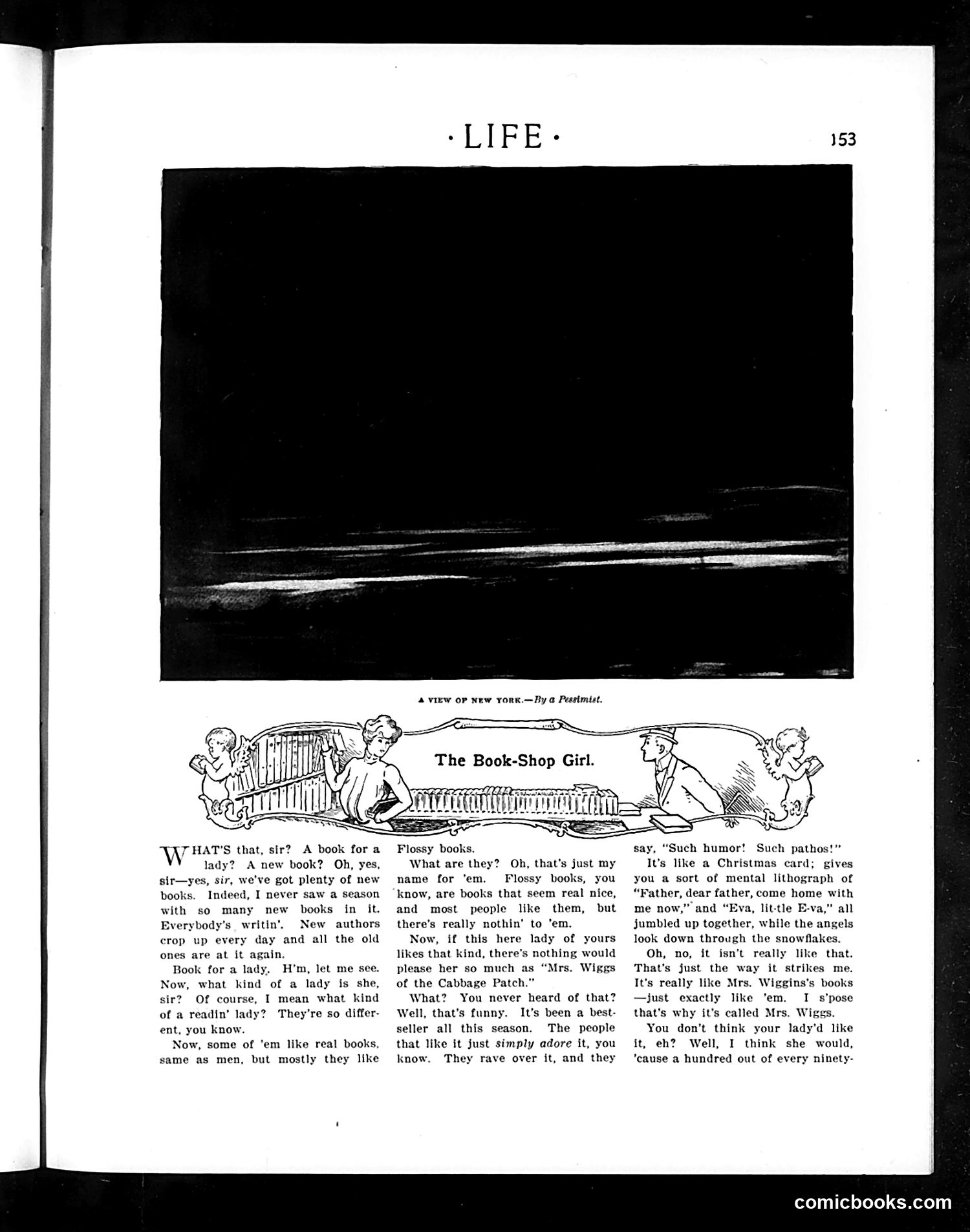
This is a humorous dialogue piece about popular literature tastes, not a political cartoon. A book-shop clerk discusses "flossy books"—sentimental, popular novels that appeal to ordinary readers rather than serious literature enthusiasts. The conversation centers on "Mrs. Wiggs of the Cabbage Patch," apparently a bestselling book that intellectuals dismiss but the general public loves. The satire mocks both pretentious readers who sneer at popular fiction and the masses who enthusiastically embrace sentimental stories. The clerk defends "Mrs. Wiggs," suggesting it has genuine merit and emotional resonance for readers. The piece likely reflects early 1900s tensions between "high" and "low" literary culture.
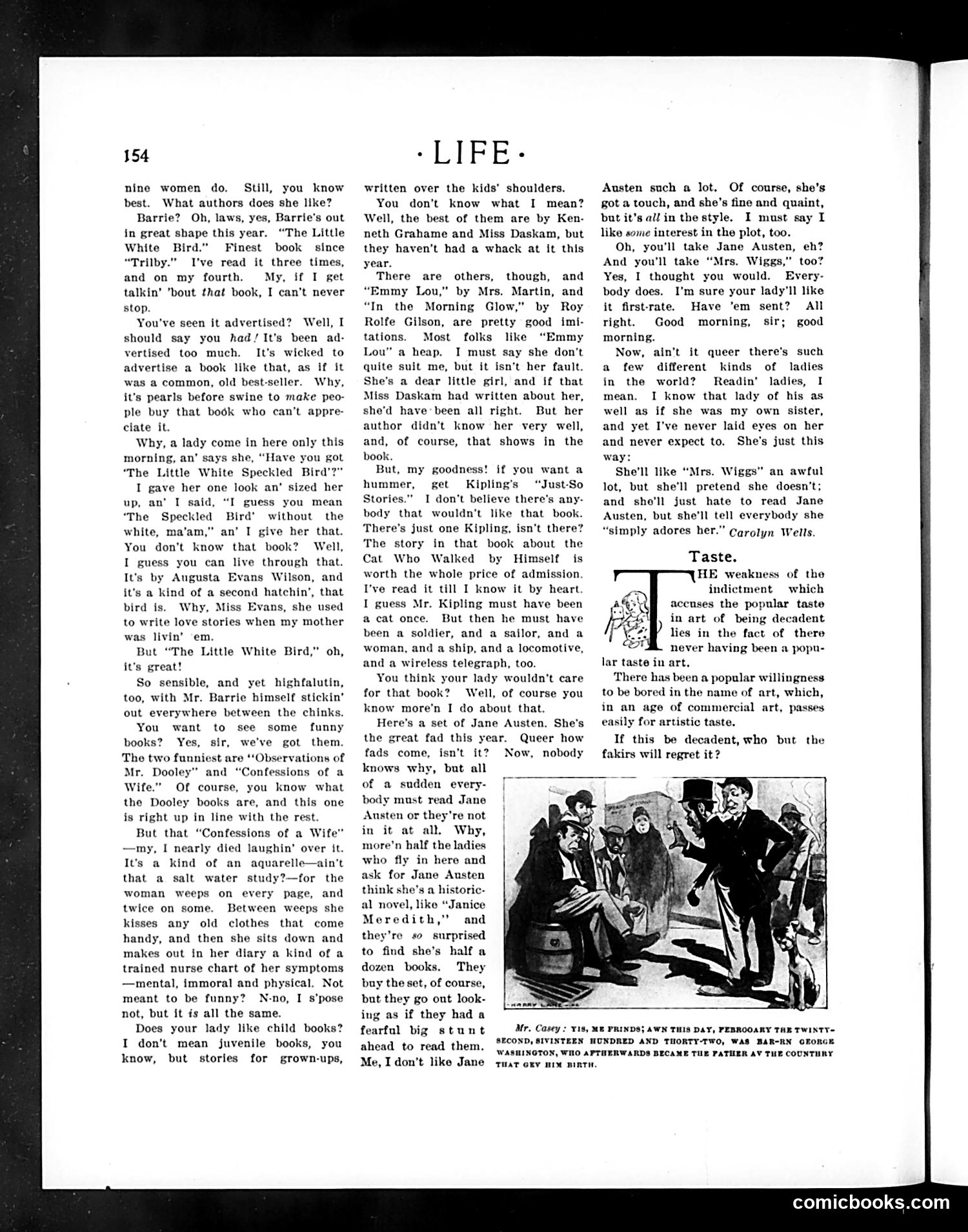
This page contains a literary discussion column about women authors and book recommendations, particularly praising Jane Austen's novels. The text discusses Austen's popularity among readers of the era and recommends her works alongside other authors like Kenneth Grahame and Roy Bolfe Gilson. At the bottom is a cartoon captioned about "Mr. Corey" with a caption mentioning George Washington and "the country that got his birth." The cartoon appears to depict multiple figures in period dress, likely illustrating a humorous scene related to Washington's birthday (February 22nd is mentioned in the caption). The "Taste" section defines aesthetic appreciation in art, noting the decline of decadent art in favor of popular taste. The content reflects early 20th-century genteel literary culture and patriotic American humor around Washington's birthday observance.
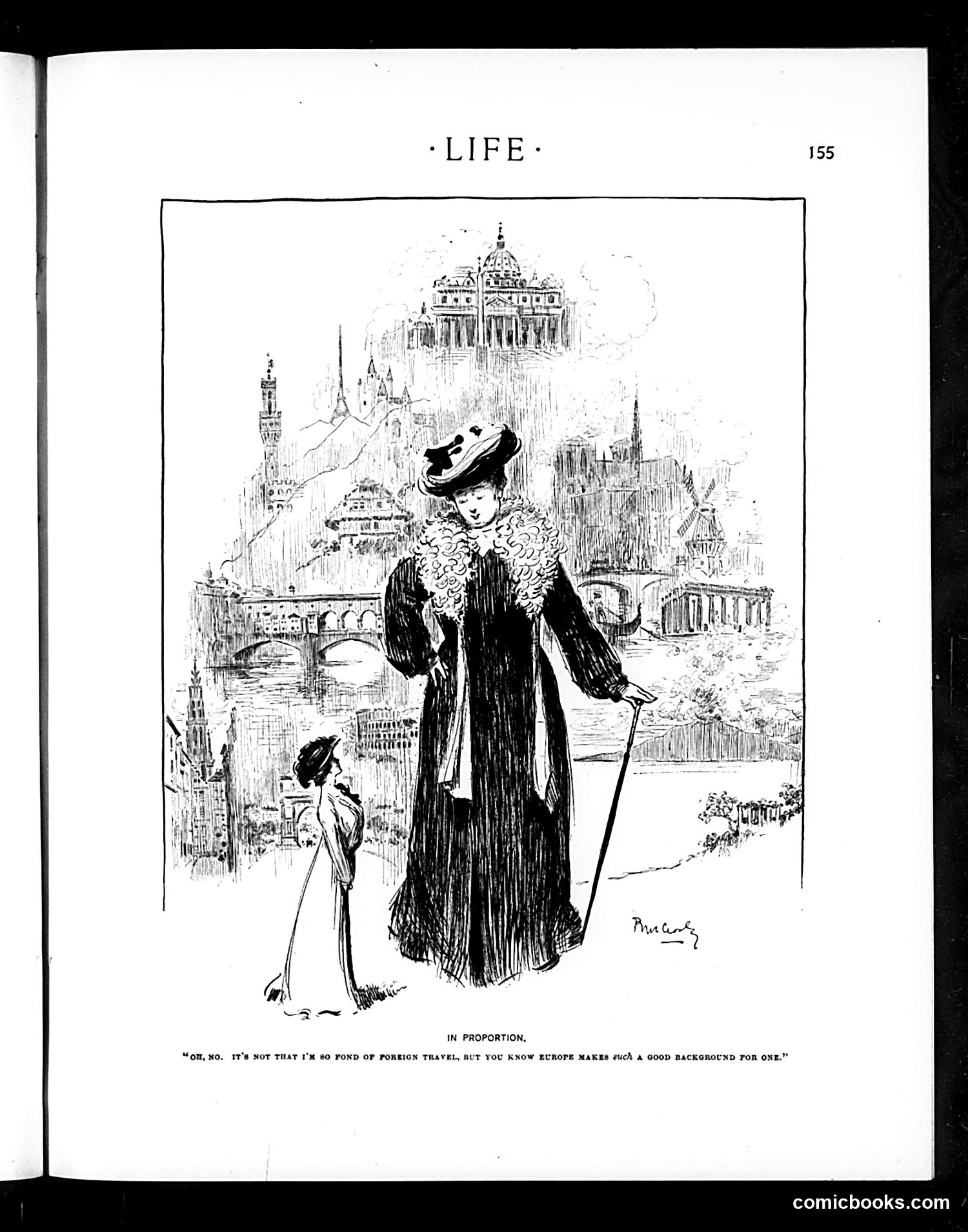
This is a single illustration titled "In Proportion" from Life magazine (page 155). It depicts two figures in an early 20th-century European setting with distinctive architecture (cathedrals, bridges, suggesting a continental city). The cartoon shows an adult woman and child, both holding canes/walking sticks, standing before an elaborate cityscape. The caption reads: "Oh no, it's not that I'm so fond of foreign travel, but you know Europe makes such a good background for one." The satire targets American wealthy travelers, specifically women who visit Europe primarily for social status and appearance rather than genuine cultural interest. The "proportion" joke contrasts the tiny figures against the grand European architecture—suggesting the travelers view Europe as mere backdrop for self-display rather than engaging meaningfully with its culture or history.
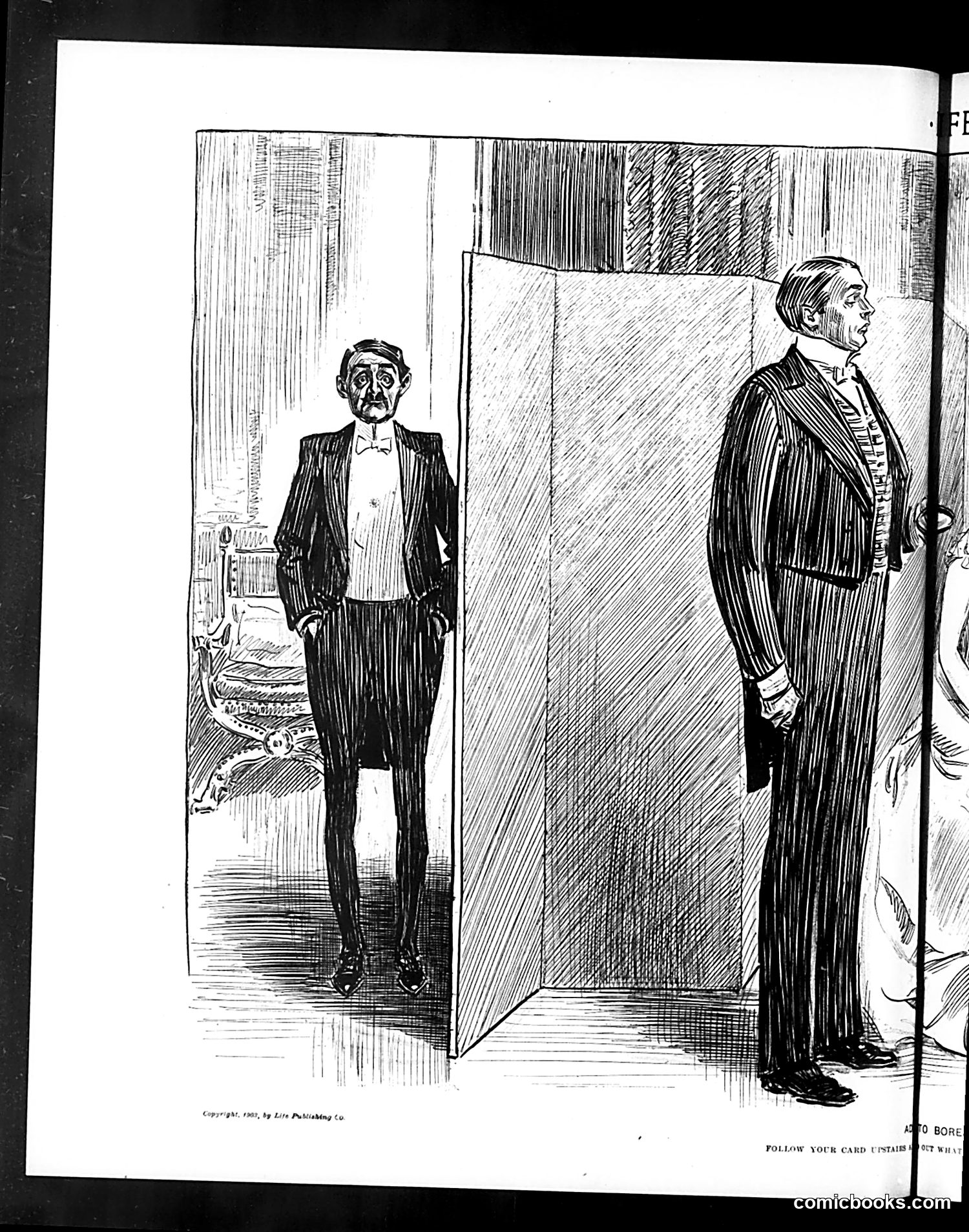
This cartoon depicts two men in formal attire separated by a partition or door. The man on the left appears distressed or anxious, while the man on the right stands calmly. The caption at bottom reads "FOLLOW YOUR CARD UNTIL YOU GET WHAT" (text cut off). This appears to be a satirical commentary on **bureaucratic procedures or waiting room protocol** — possibly mocking the frustration of dealing with official processes where one must follow numbered tickets or cards to reach assistance. The partition suggests separate spaces or compartments, common in banks, government offices, or formal institutions of the era. The anxious expression on the left figure contrasts with the composed demeanor of the right, suggesting the cartoon critiques either the emotional toll of bureaucracy or the indifference of officials. Without the complete caption, the specific target remains partially unclear.
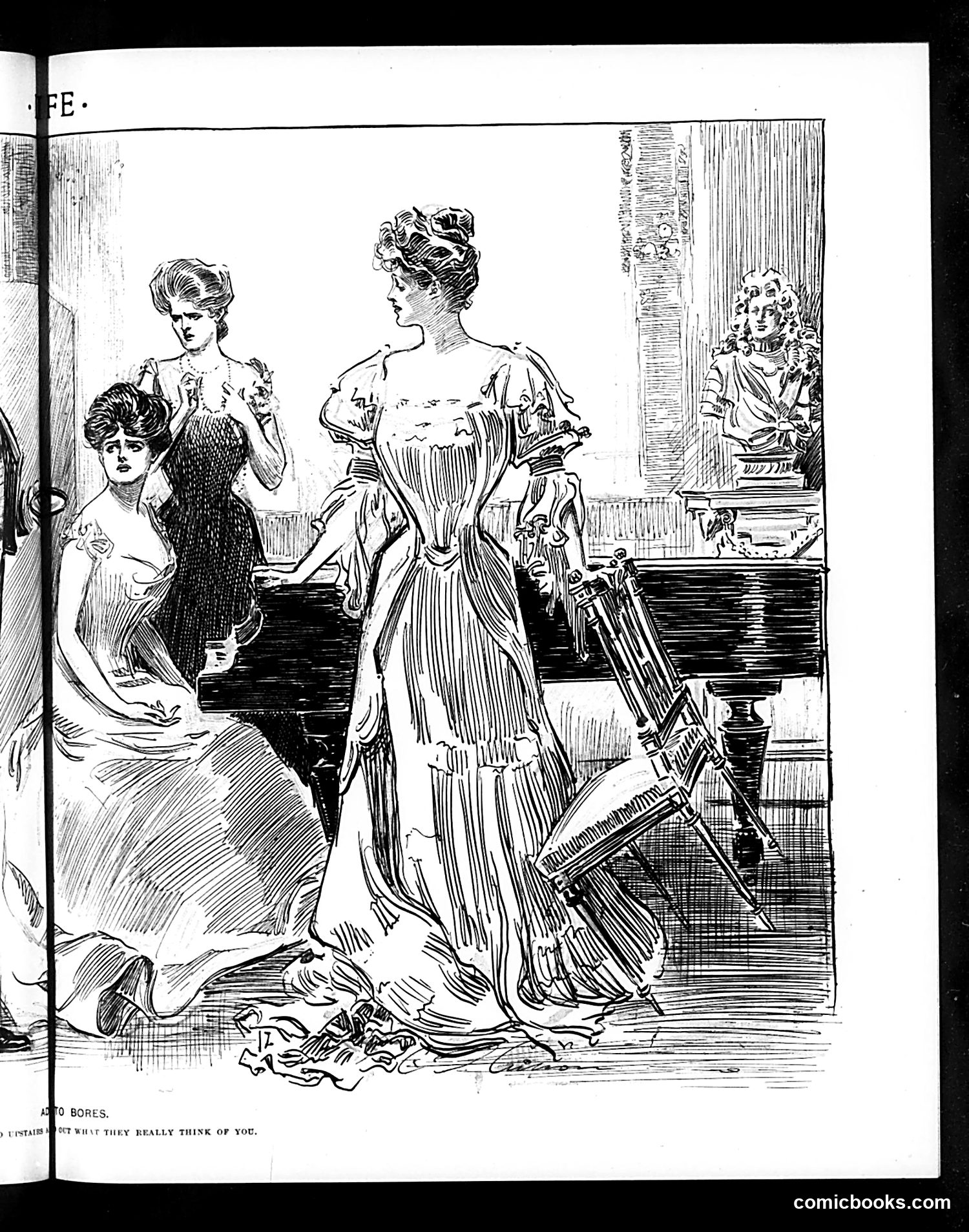
This is a satirical illustration from *Life* magazine depicting an elegant social scene with well-dressed women in Edwardian-era gowns. The visible text fragment reads "TO BORES" and "...JUST WHAT THEY REALLY THINK OF YOU," suggesting this cartoon satirizes insincere social interactions among the upper classes. The humor appears to target the gap between what society women publicly say to each other versus their actual private opinions—a commentary on superficial politeness and hypocrisy in high society. The women's elaborate fashions and refined poses contrast with the implied mockery in the caption, exposing the artificiality of wealthy social circles. The specific identities of the figures remain unclear from this page alone.
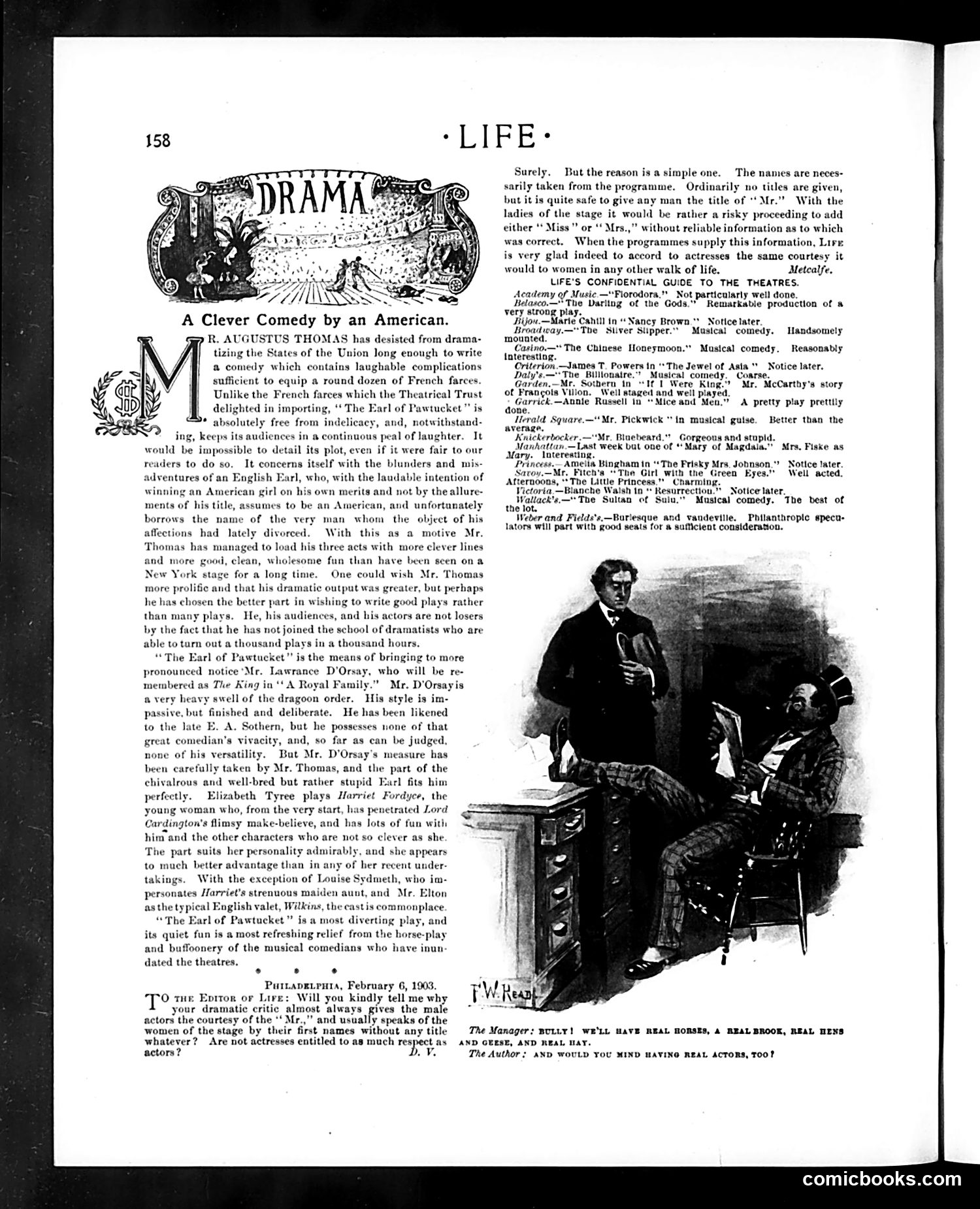
This page reviews "The Earl of Pawtucket," a comedy by American playwright Augustus Thomas. The article praises the play's clean humor and clever plotting, contrasting it favorably with French farces imported by the theatrical trusts. The plot involves an English earl impersonating an American to win a woman's affections—a premise that allows for comedic confusion. The review highlights actor Lawrance D'Orsay's performance, comparing him to the late E.A. Sothern while noting D'Orsay lacks Sothern's vivacity. The bottom of the page includes a reader's complaint about Life's theatrical critic consistently giving male actors the courtesy title "Mr." while withholding "Miss" or "Mrs." from actresses without verified information—a practice reflecting era-specific anxieties about women's marital status and respectability. Life's editor defends the policy as courteous discretion.
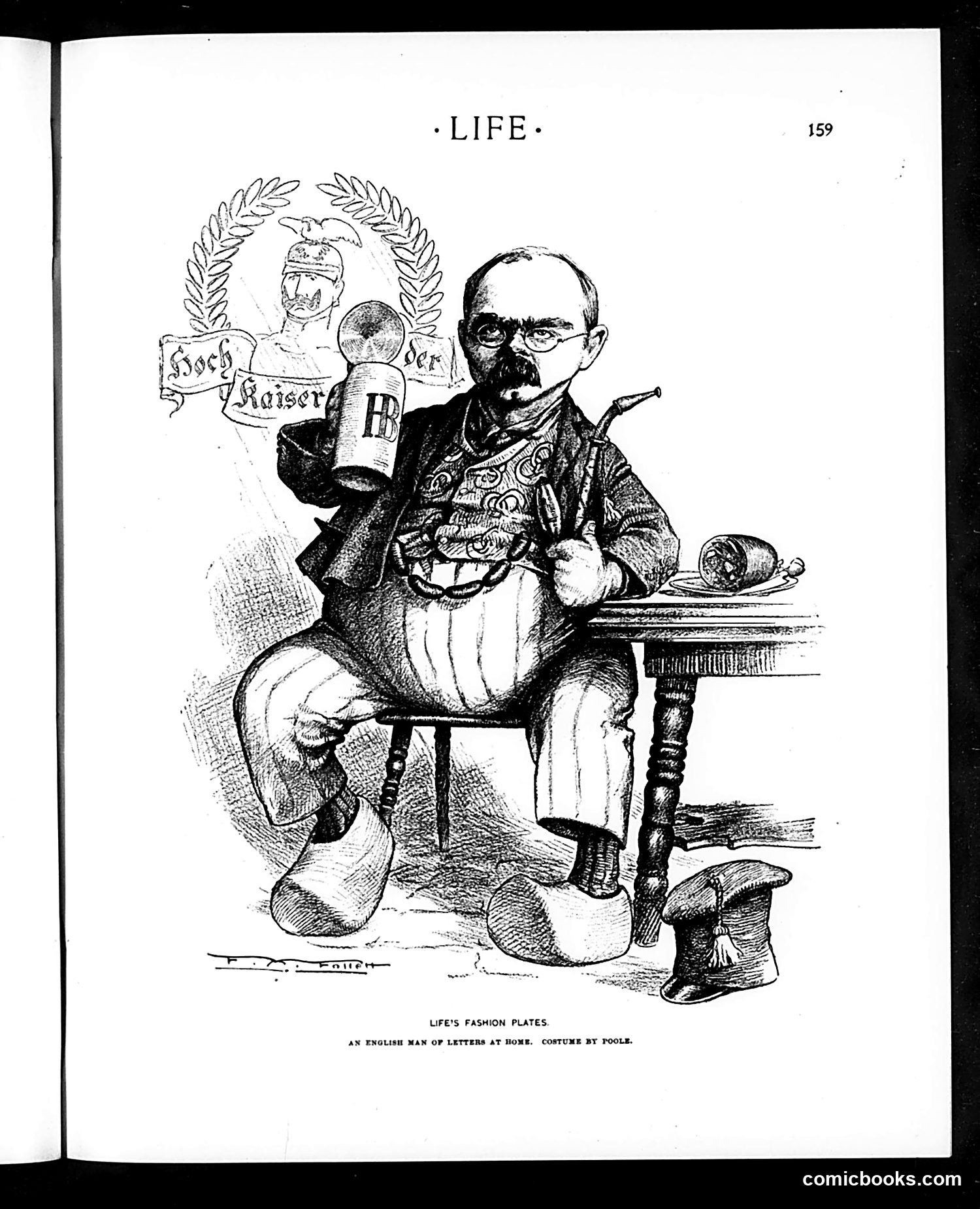
This is a satirical fashion plate from Life magazine mocking an English literary man in his home attire. The figure wears glasses, has a distinctive mustache and beard, and sports elaborate clothing—including a decorative vest and formal jacket—while seated at a desk with a beer stein. Behind him hangs a German coat of arms or emblem. The satire appears to target pretension and Anglophilia among literary intellectuals, suggesting affectation in their "costume" and lifestyle choices. The reference to "Poole" (likely a fashionable tailor) reinforces the mockery of fashion consciousness. The German insignia may imply foreign influence or suggest the figure's affected cosmopolitanism. The overall point ridicules the self-conscious theatricality of a man of letters concerned more with appearance and status symbols than genuine intellectual substance.
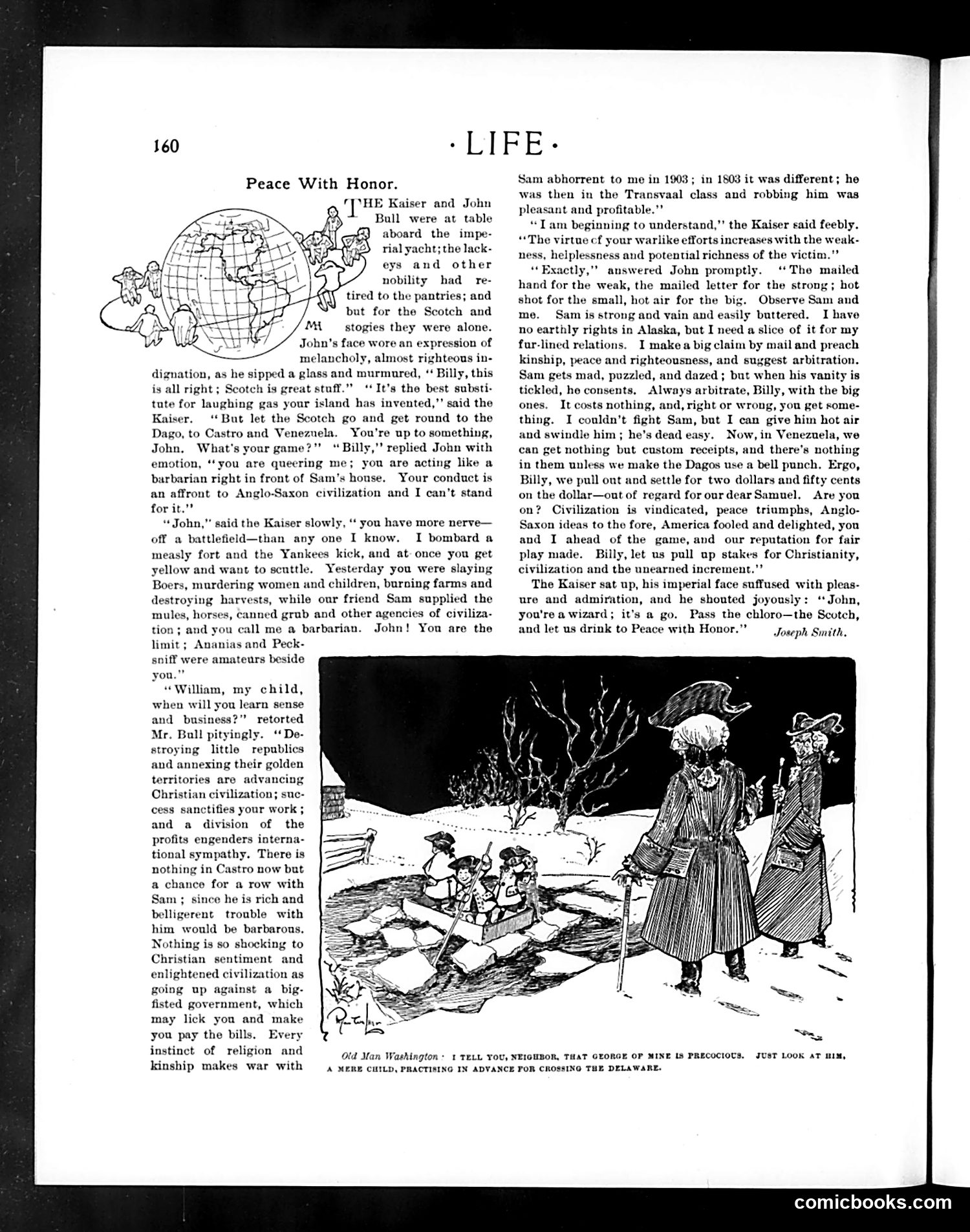
This 1903 *Life* magazine satirical dialogue depicts **the Kaiser (Wilhelm II of Germany)** and **John Bull (Britain)** in private conversation aboard a yacht, with "Sam" representing the **United States**. The satire exposes British hypocrisy: Bull justifies colonizing weak nations (destroying "little republics," annexing territories, exploiting the Transvaal) as "Christian civilization," yet refuses war with powerful America for fear of losing money. The cartoon ridicules Britain's selective morality—violence against defenseless peoples is "civilization"; aggression against equals is "barbarous." Bull's Alaska and Venezuela strategies reveal the deeper joke: he uses diplomatic bluster and arbitration to intimidate weaker nations ("hot air for the big ones"), extracting concessions through vanity rather than force. The accompanying illustration shows Old Man Washington warning a child not to practice crossing the Delaware—a jab at American naïveté. The satire condemns imperial powers' self-serving ethics while mocking America's potential vulnerability to such manipulation.
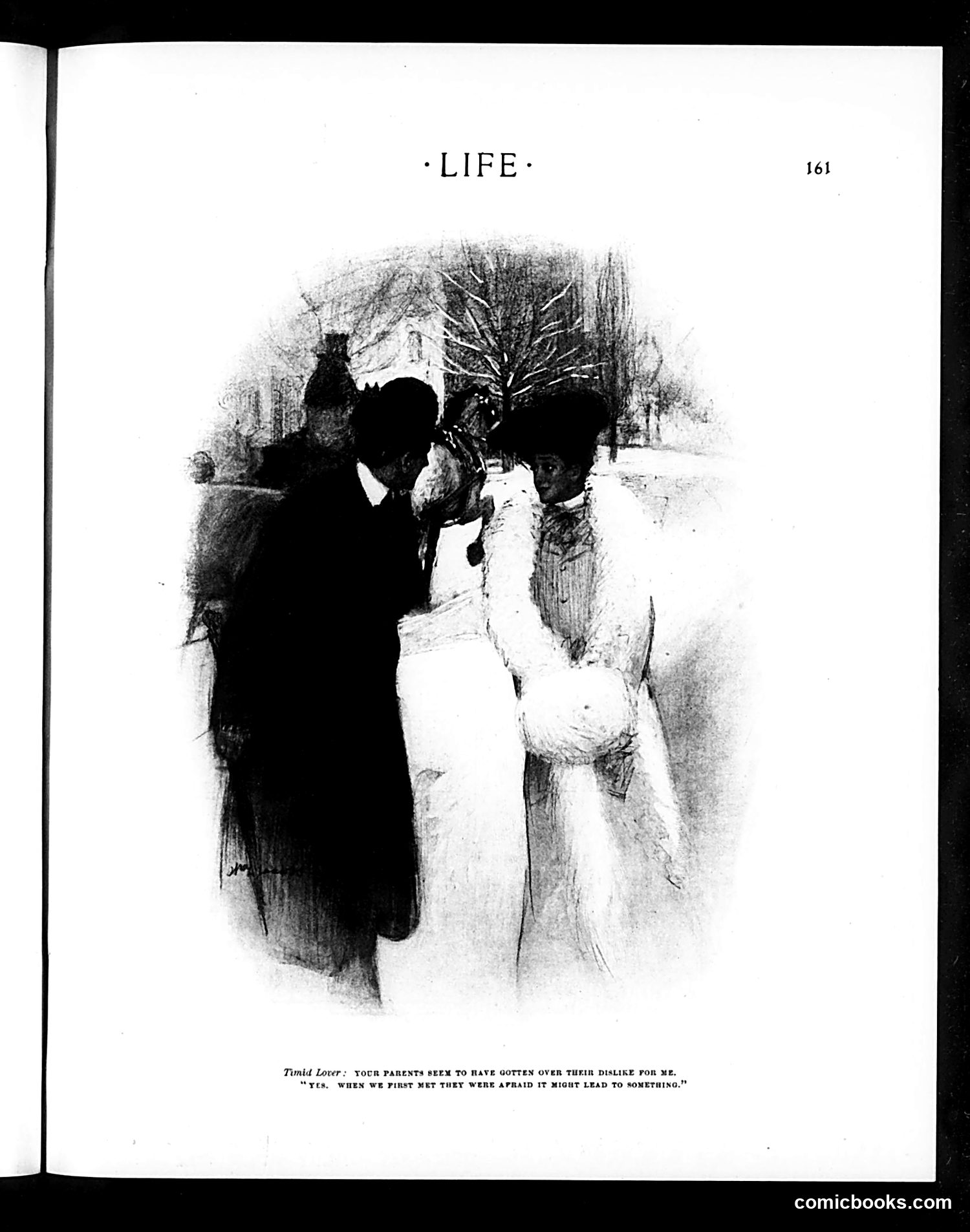
This satirical cartoon depicts a couple in an intimate moment, with the caption presenting a humorous reversal of parental concern. The "timid lover" references a young man whose romantic interest in a woman initially worried her parents—they feared the relationship might "lead to something" (implying premarital intimacy or scandal). The joke's point: the parents' fears have proven justified, as the couple is now clearly physically involved. The satire mocks both the naiveté of parental worry and the predictable outcome of young romance. This reflects early 20th-century social anxieties about courtship, sexuality, and generational conflict—concerns that would have resonated strongly with *Life* magazine's educated, urban readership who appreciated subtle commentary on Victorian moral pretense.
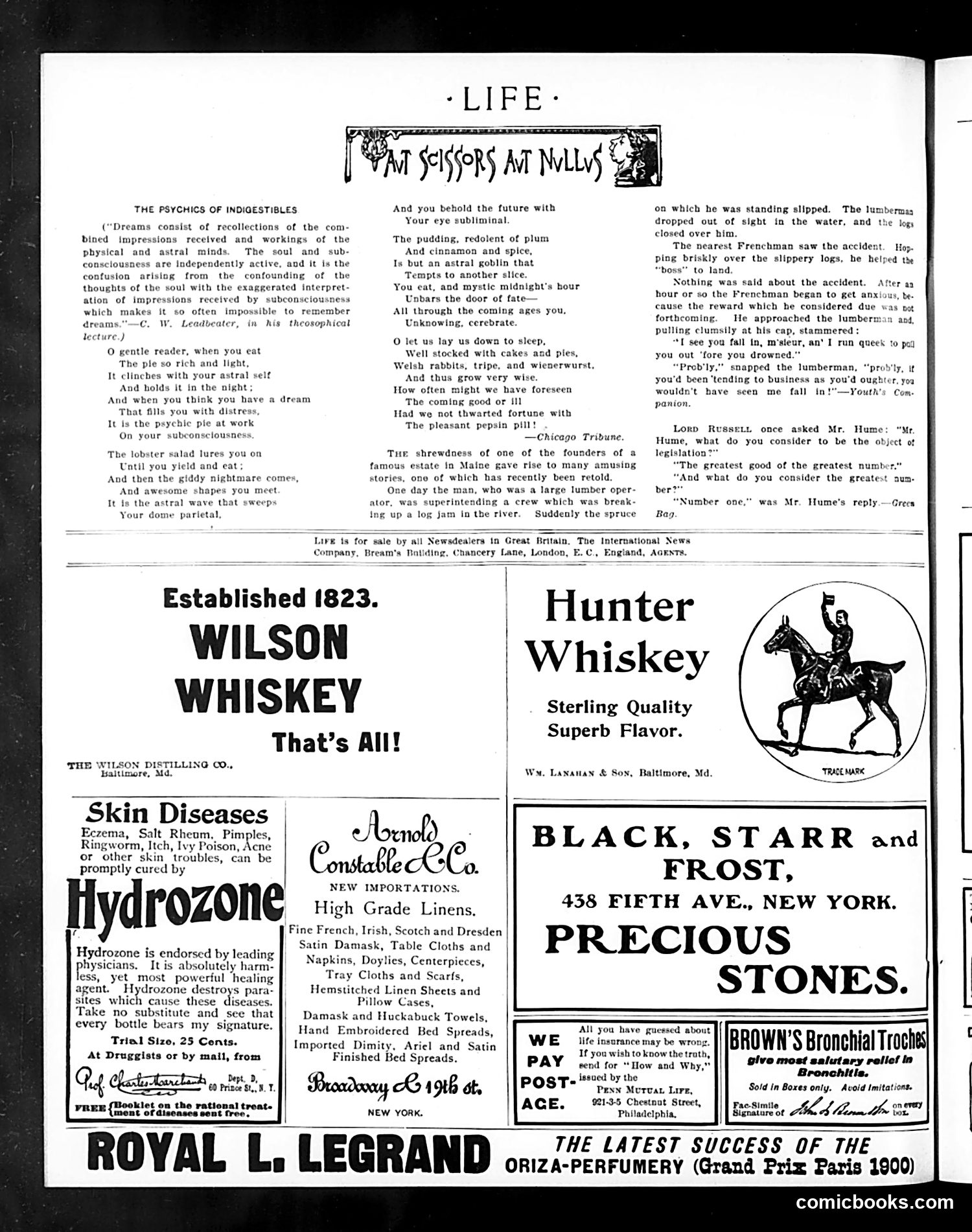
This page mixes satirical content with period advertisements. The main article, "Psychics of Indigestibles," parodies spiritualist and theosophical trends popular in the early 1900s. It mocks the era's fascination with mysticism by blaming indigestion—not mystical forces—for vivid dreams and nightmares. The joke: rich foods (lobster salad, pudding, Welsh rabbit) are humorously reframed as "astral goblins" causing supposedly profound visions. This satirizes both spiritualists' grandiose claims and the public's credulity. Two anecdotes follow: one about a lumberman's ungrateful response to rescue, the other a philosophical exchange about legislation's purpose—both illustrating human nature rather than engaging current events. The advertisements (Wilson Whiskey, Hunter Whiskey, Hydrozone skin remedy, linens, jewelry, bronchial lozenges) reflect typical early-1900s marketing. The page is primarily promotional content with light satirical framing.
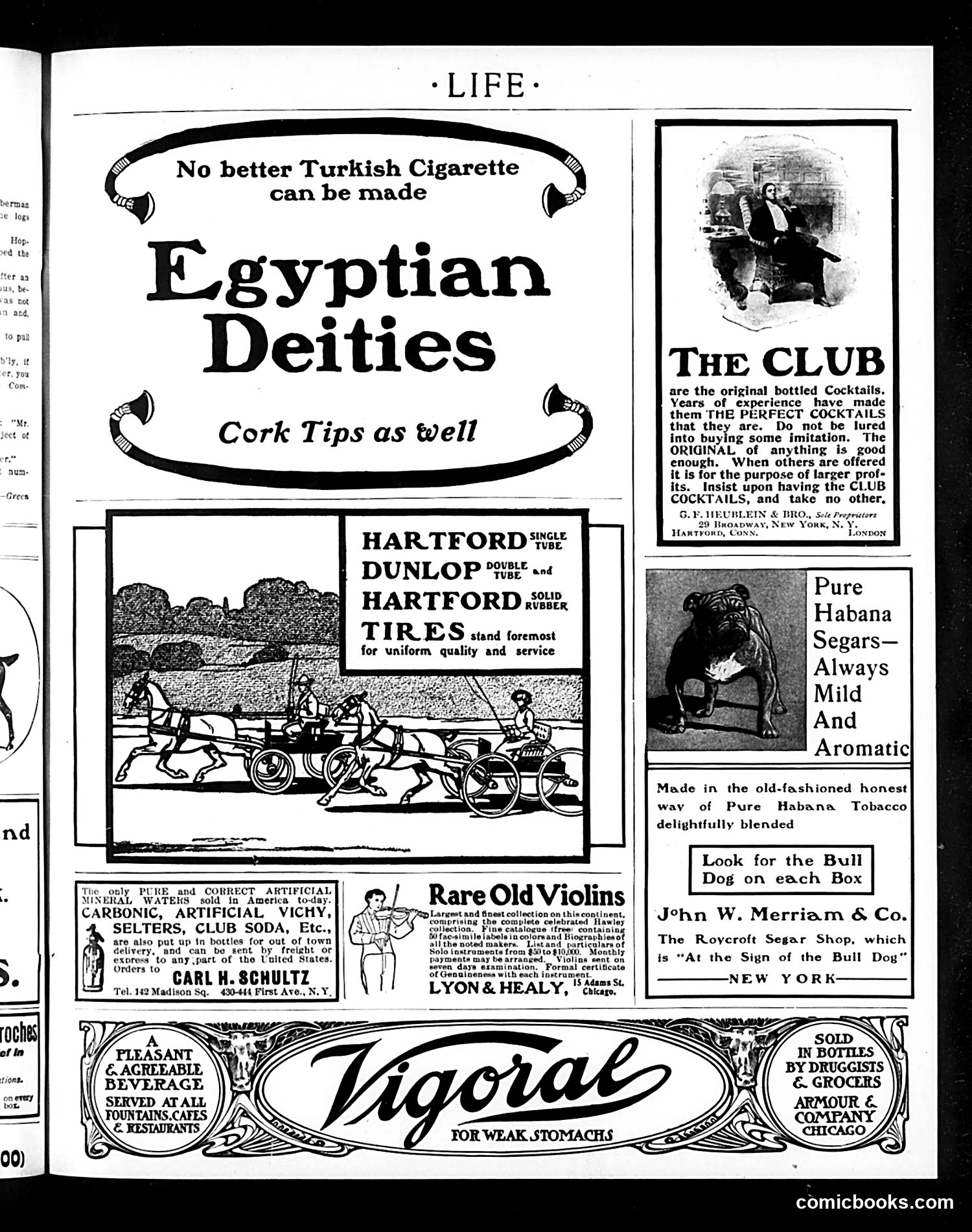
This is primarily an **advertising page**, not a political cartoon. It features early 20th-century product ads with minimal satirical content. The main advertisements are: - **Egyptian Deities cigarettes** (Turkish tobacco with cork tips) - **Hartford tires** (illustrated with a chariot race scene, a classical reference matching the "Egyptian" branding theme) - **Carbonic mineral waters** (claiming to be America's only "pure and correct" artificial mineral waters) - **Club Cocktails** (pre-bottled, emphasizing originality over imitations) - **Pure Habana Segars** (Cuban cigars) - **Vigoral** (digestive tonic for weak stomachs) - **Rare Old Violins** (instruments for sale) The page's only mild satire appears in the **Club Cocktails ad**, which ironically warns against buying imitations while promoting the "original"—a common advertising strategy of the era. Otherwise, this reflects typical early 1900s American consumer culture emphasizing quality, authenticity, and luxury imports.
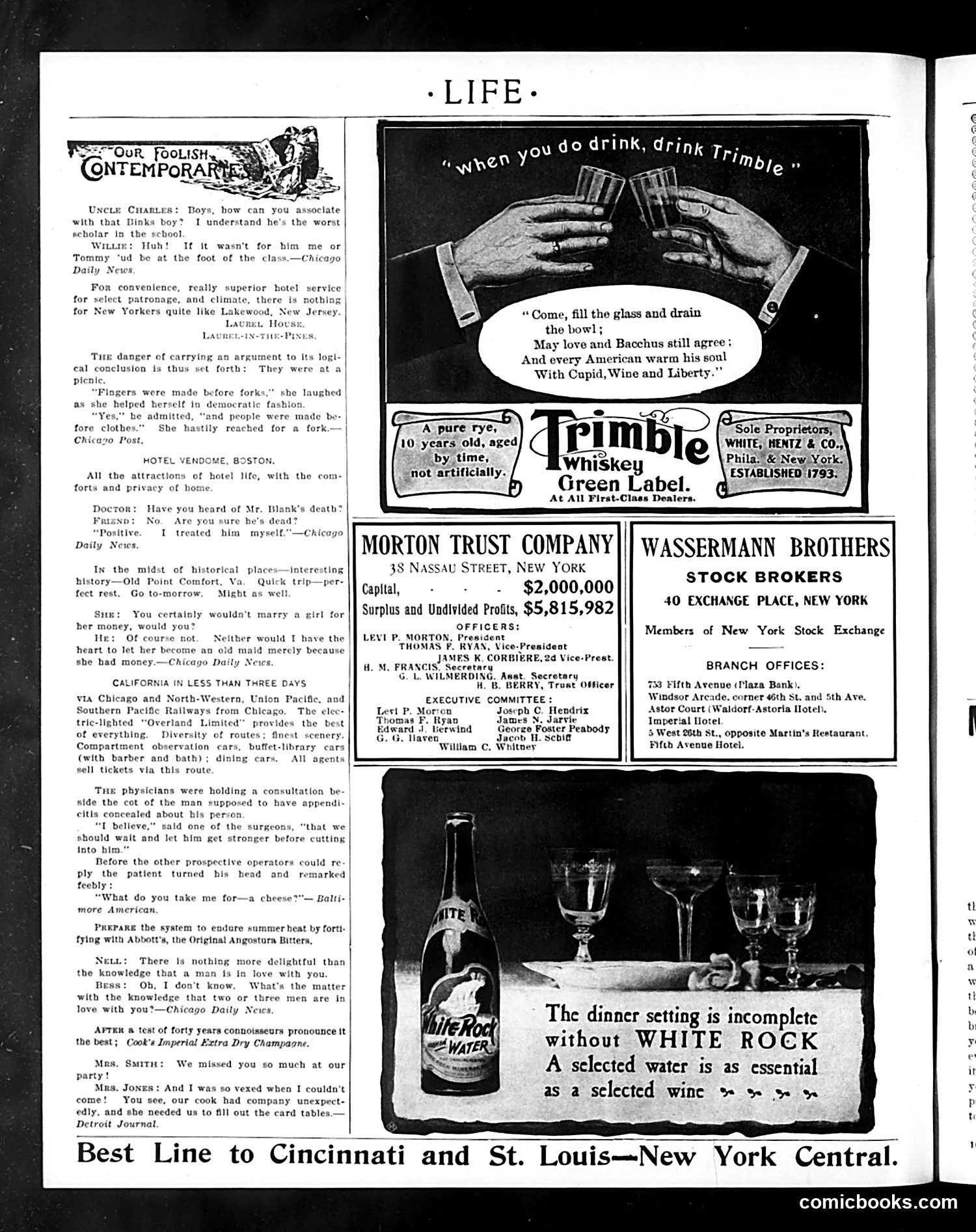
This page is primarily **advertising and humor** rather than political satire. The content reflects early 1900s American culture and social attitudes. **Key elements:** The "Our Foolish Contemporary" section contains brief humorous anecdotes poking fun at everyday situations—a boy's academic standing, doctors' consultations, courtship, and dinner etiquette. These are gentle social satire typical of Life magazine's satirical humor. **The advertisements** reveal period concerns: Trimble Whiskey emphasizes quality ("pure rye, 10 years old, aged by time, not artificially"), White Rock water promotes selected water as essential to dining (reflecting Victorian-era concerns about water purity), and railroad ads tout rapid cross-country travel as a luxury. **The Morton Trust Company and Wassermann Brothers ads** showcase financial institutions seeking wealthy clientele. The page reflects Edwardian-era preoccupations: class distinctions, proper etiquette, health consciousness, and modern transportation as status symbols. The humor assumes familiarity with contemporary social conventions now largely obsolete.
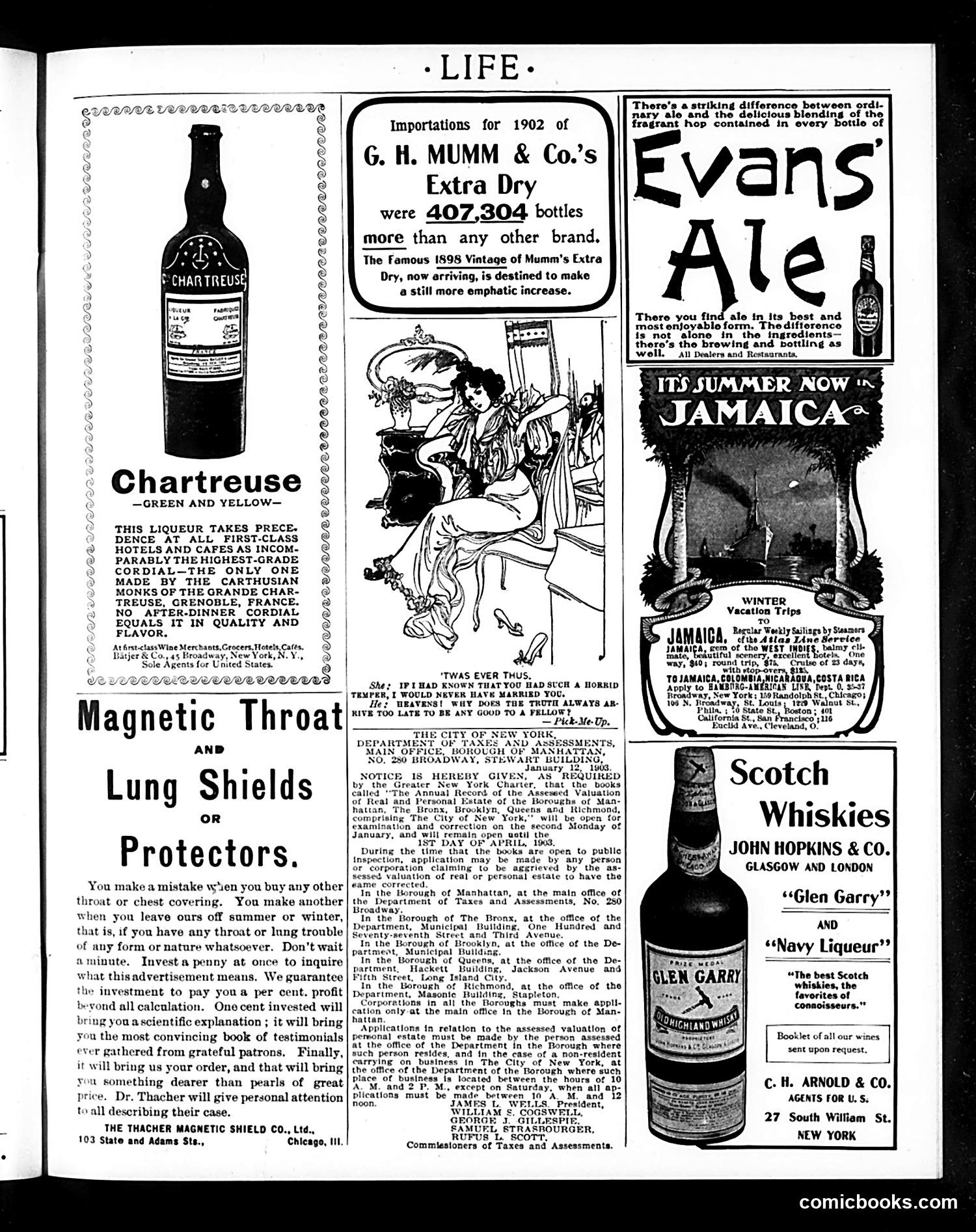
This page is primarily **advertising and official notices**, not editorial cartoons or satire. The small cartoon labeled "'TWAS EVER THUS" is a domestic humor sketch: a woman says she wouldn't have married her husband if she'd known his temper, and he replies that the truth always arrives too late to be useful—a cynical joke about marriage. It's from *Pick-Me-Up* magazine. The rest consists of commercial ads (Chartreuse liqueur, Mumm champagne, Evans' Ale, throat shields) and a government notice about property tax assessments for New York City. There is no meaningful political or social satire present on this page.
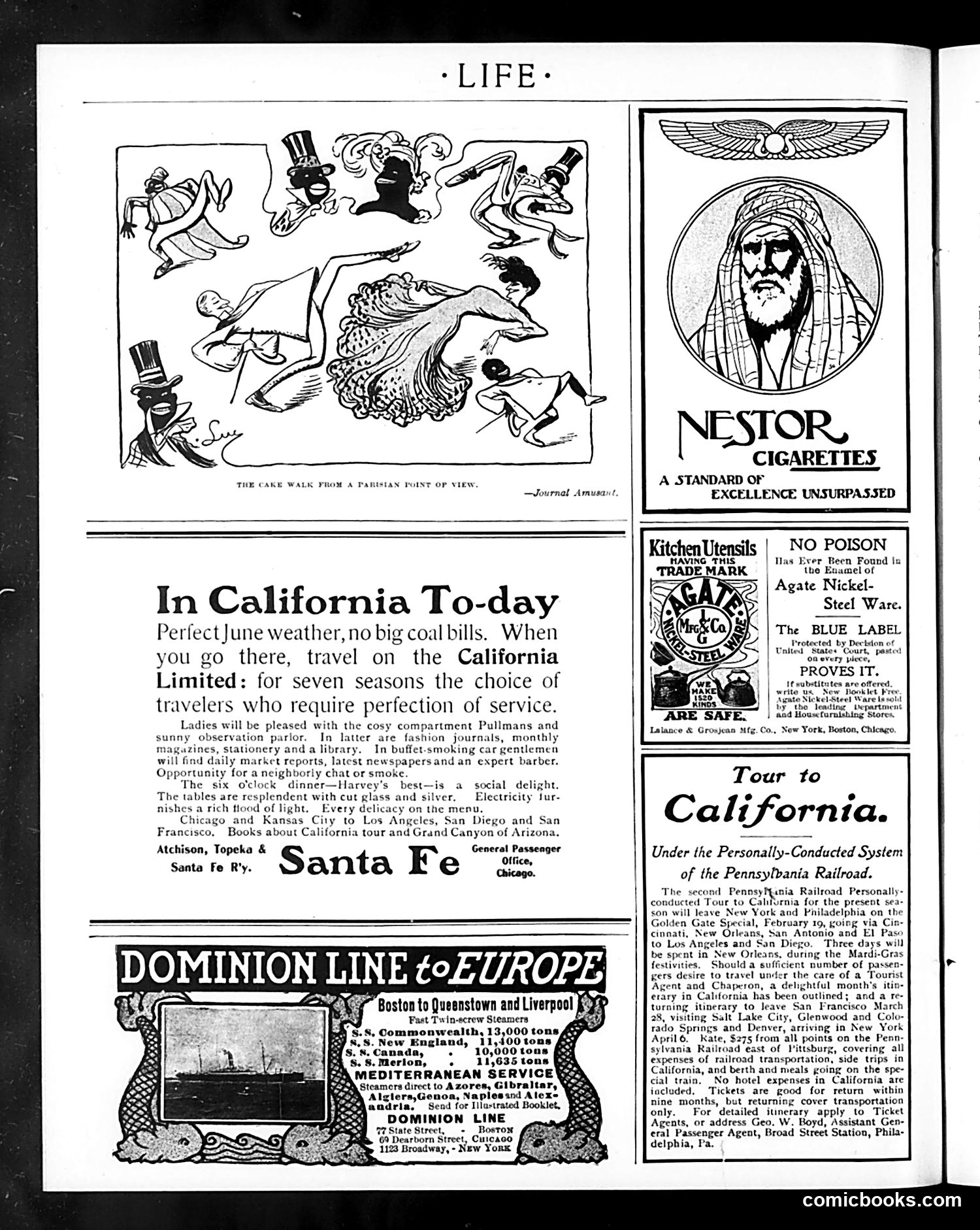
The cartoon satirizes the "cake walk," a dance craze of the early 1900s that originated from African American performance traditions. The French publication *Journal Amusant* offers a deliberately exaggerated, absurdist European perspective on this American fad—depicting dancers in wildly contorted, physically impossible poses to mock how foreigners viewed American popular culture as chaotic and undignified. The figures wear top hats and formal dress while performing ridiculous acrobatic movements, suggesting the incongruity of genteel society participating in what Europeans considered crude entertainment. The satire works on two levels: mocking both American enthusiasm for the dance and European condescension toward American tastes. This reflects early-20th-century transatlantic cultural tensions, where European arbiters of taste often dismissed American popular movements as lowbrow spectacle.
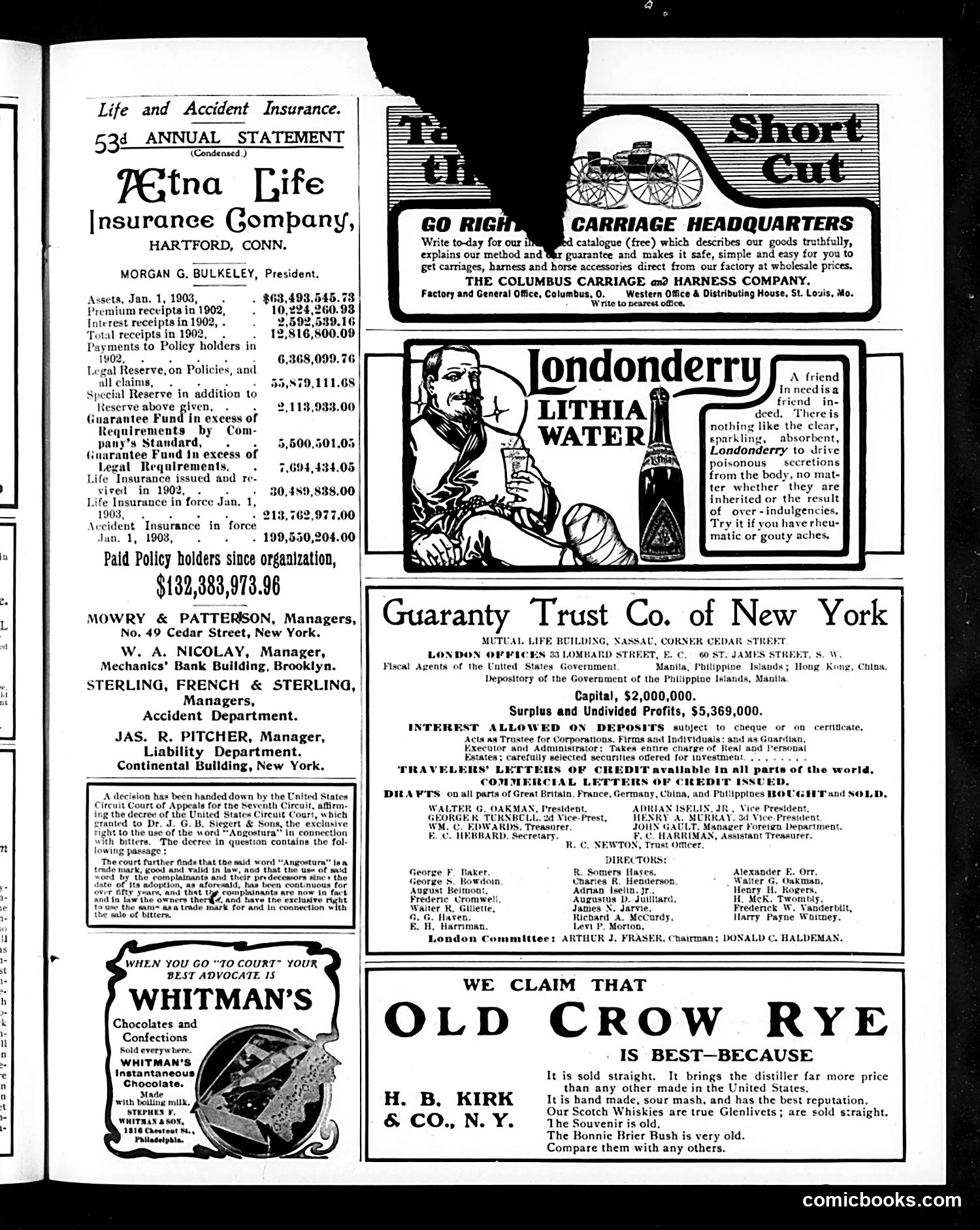
This page is primarily advertising and financial documents rather than political satire. It contains: **Main Content:** - Aetna Life Insurance Company's 1903 financial statement (top-left) - Multiple commercial advertisements for carriages, chocolates, lithia water, and whiskey - A brief legal notice about the Angostura bitters trademark **No Political Cartoon:** The only illustrated figure is a **man holding a bottle of Londonderry Lithia Water** (center-right), advertising its health benefits for rheumatism and gout. This is product marketing, not satire. The "Angostura" legal notice mentions a court decision protecting a trademark—straightforward business information, not commentary. **Context for Modern Readers:** This reflects early-1900s magazine layout: editorial/financial content mixed freely with advertisements. The health claims (lithia water curing gout) reflect period medical understanding. No satire or political content is present on this particular page.
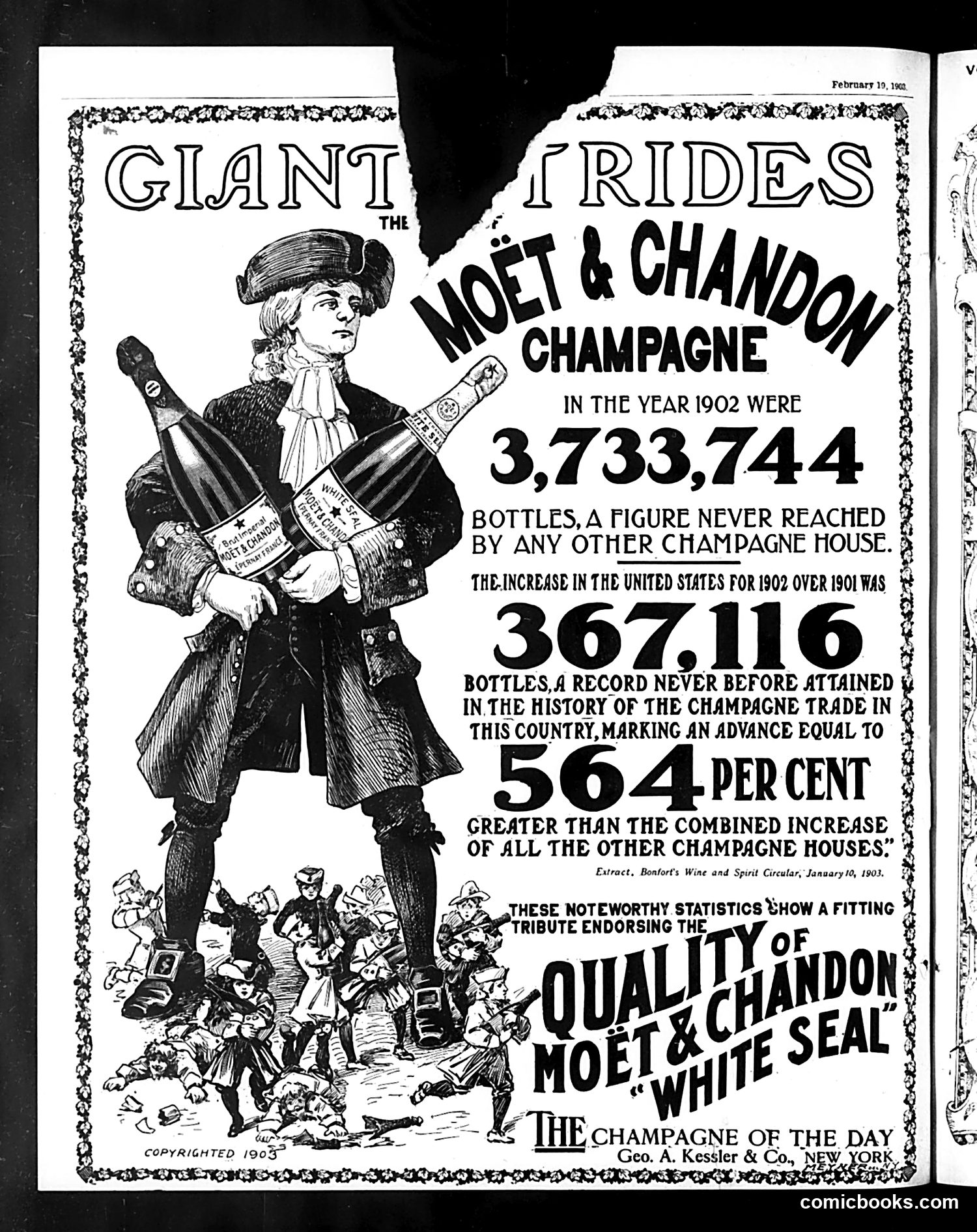
This is primarily a **champagne advertisement**, not political satire. The page features an 18th-century French aristocratic figure (dressed in period costume with tricorn hat) holding bottles of Moët & Chandon champagne, surrounded by celebratory cherubs and figures. The "cartoon" element—the exaggerated historical gentleman—serves as branding rather than satire. The advertisement presents impressive sales statistics: 3.7 million bottles sold in 1902, with a 564% increase in U.S. sales over competing champagne houses. **For modern readers:** This represents early 1900s luxury marketing using European aristocratic imagery to convey sophistication and prestige. The humorous figure makes the ad memorable while the dense statistics function as proof of the brand's superiority—a marketing strategy combining entertainment with quantitative claims to credibility.