
Life, 1903-02-19 · page 8 of 24
Life — February 19, 1903 — page 8: what you’re looking at
What you’re looking at
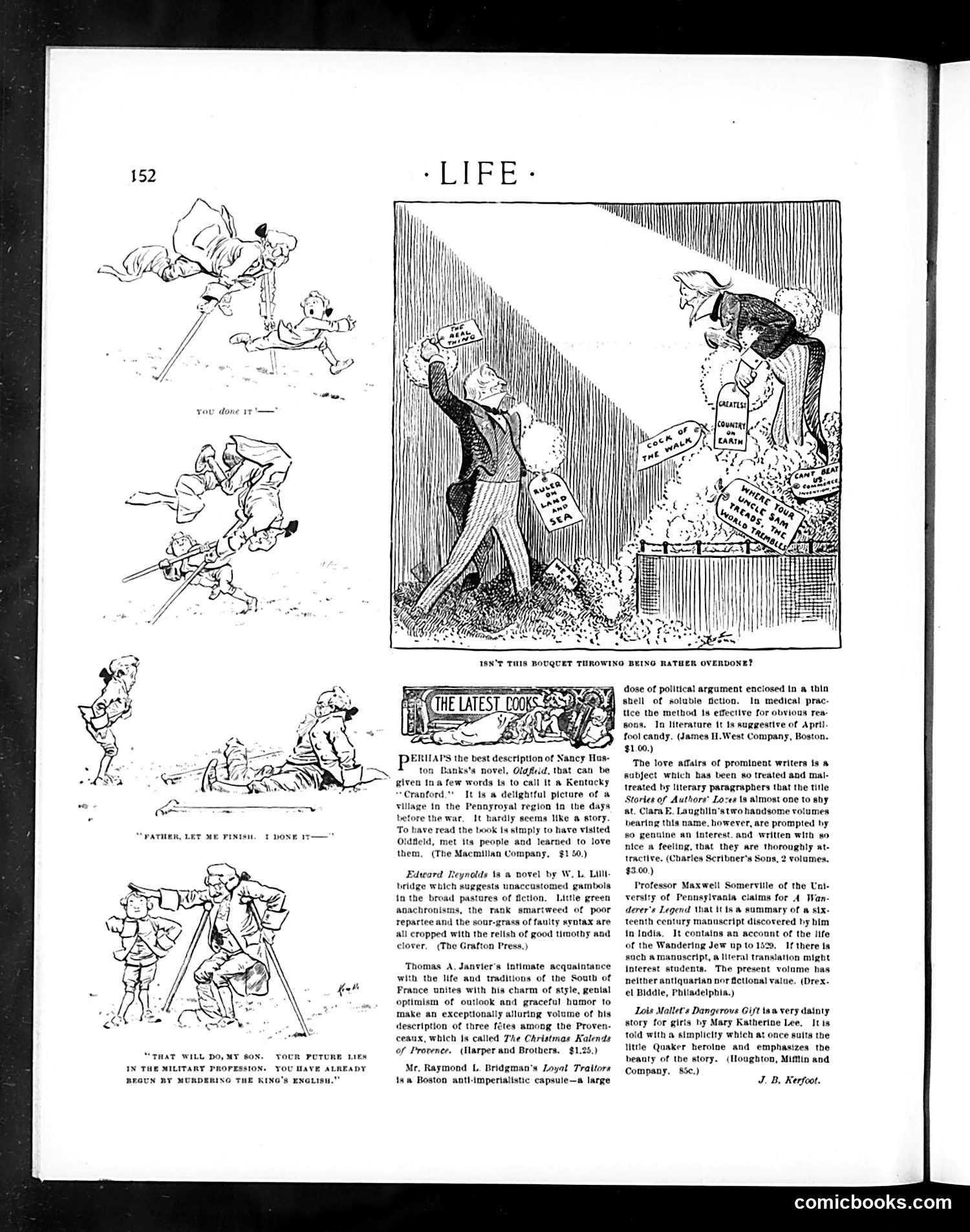
This page contains satirical illustrations (left side) and book reviews (right side) from *Life* magazine. The left-side cartoons depict a child's physical misadventures with a toy or plaything—shown falling, being struck, and generally getting hurt. The captions suggest a parent's dry commentary on the child's mishaps ("You do it," "Father, let me finish, I done it"). The main cartoon (top right) shows a figure at what appears to be a podium or speaker's stand, with text reading "ISN'T THIS BOUQUET THROWING BEING RATHER OVERDONE?" This appears to satirize excessive public adoration or fan behavior—possibly directed at a political figure or celebrity—suggesting the practice of throwing bouquets in tribute has become absurdly exaggerated. The right column contains book reviews of contemporary novels, discussing literary merit and subject matter of recent publications.
📄 Transcribed text from this page (OCR, searchable)
Machine-transcribed from the original scan — historical spelling and the odd misread are preserved.
“PATHER, LET ME FINISH. 1 DONE “THAT WILL DO, MY SOX. YOUR FUTURE Lins IN THE MILITARY PROFESSION. YOU HAVE ALREADY BEGUN BY MURDERING THE KING'S ENGLISH.” ISN'T THIS BOUQUET THROWING BEING RATHER OVERDONE? ERIAPS the best description of Nancy Hus- ton Banks's novel, Olafedd, that can be given ina few words ts to call it a Kentacky “Cranford.” It 1s ® delightful picture of a village In the Pennyroyal region in the days betore the war, It hardly seems like @ story. To have read the book Is simply to have visited Oldfield, met its people and learned to love them, (The Macmillan Company, $1 $0.) Edward Reynolds 13 @ novel by W. Le Liltt- bridge which suggests unaccustomed gambols in the broad pastures of fiction, Little green anachronisins, the rank smartweed of poor repartee and the sour-grass of faulty syntax are all cropped with the relish of good timothy and clover. (The Grafton Press.) ‘Thomas A, Janvier's intimate acquaintance with the life and traditions of the South of France unites with his charm of style, gental optimism of ontlook and graceful humor to make an exceptionally alluring volume of bis description of three fétes among the Proven- ceaux, which is called The Christmas Kalends of Provence. (Harper and Brothers. $1.25.) Mr, Raymond L. Bridgman's Loyat Trattore 144 Boston antl-mperialistic capsule—a large dose of political argument enclosed tn a thin shell of soluble fiction. In medical prac- tice the method 18 effective for obvious rea- sons. In Iiterature it 1s suggestive of April fool candy. (James H.West Company, Boston. $1.00.) The love atfairs of prominent writers 1s & subject which has been so treated and mal- treated by literary paragraphers that the title Stories of Authors’ Loves 8 almost one to shy at. Clara E. Laughita’stwo handsome volumes bearing this name, however, are prompted by so genuine an interest. and written with 80 nice a feeling, that they are thoroughly at- tractive. (Charles Scribner's Sons, 2 volumes. $3.00.) Professor Maxwell Somerville of the Uni- versity of Pennsylvania claims for 4 Wan- derer’s Legend Wat itis 8 summary of # six. teenth century manuscript discovered by bim in India, It contains an account of the life of the Wandering Jew up to 1529. If there ts such Amanuscript, # literal translation might Interest students. The present volnme has neither antiquarian nor fictional value. (Drex. el Biddle, Phtiadelpbia.) Lois Maltet's Dangerovs Gift aa very dainty story for girs by Mary Katherine Lee, Its told with a simplicity which at once suits the Mttle Quaker heroine and emphasizes the Deanty of the story. (Houghton, Mittin and , 85.) Gnmpeng.: 6) J.B. Kerfoot. comicbooks.com