
A complete issue · 22 pages · 1903
Life — February 12, 1903
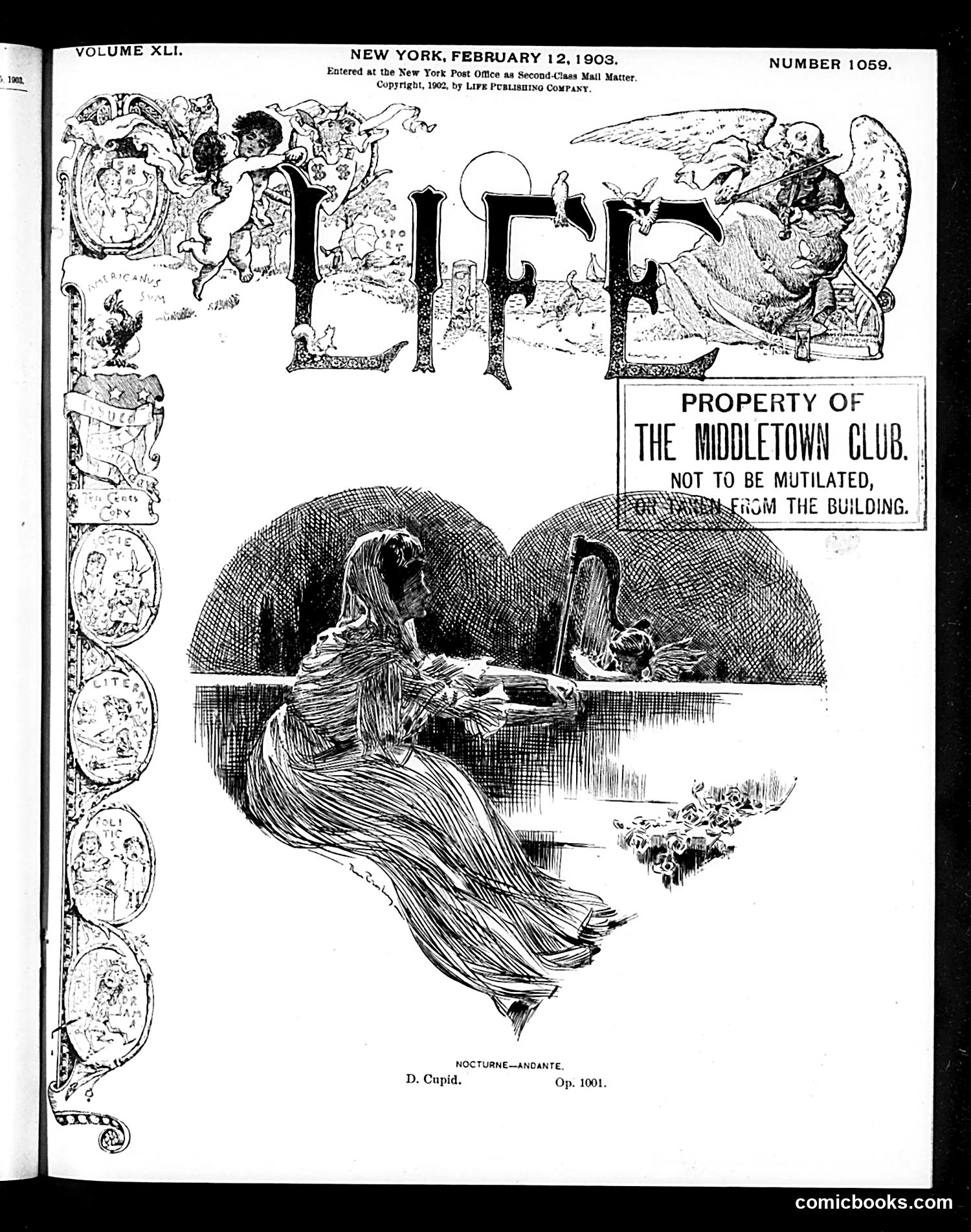
This page features a satirical illustration titled "Life" (the magazine's masthead design) with decorative margins. The central image shows a figure in classical robes gazing into what appears to be a mirror or reflective surface, with cherubs and mythological imagery in the ornamental border. The bottom credits this as "Costume—Andante" by D. Cupid, Op. 1001. The property stamp indicates this was owned by the Middletown Club. The satire likely mocks vanity or self-admiration, using classical/mythological imagery to parody contemporary figures or social pretensions. However, without additional context about specific 1903 events or personalities referenced, the exact target remains unclear. The decorative cherubs and allegorical style suggest commentary on fashion, theater, or high society.
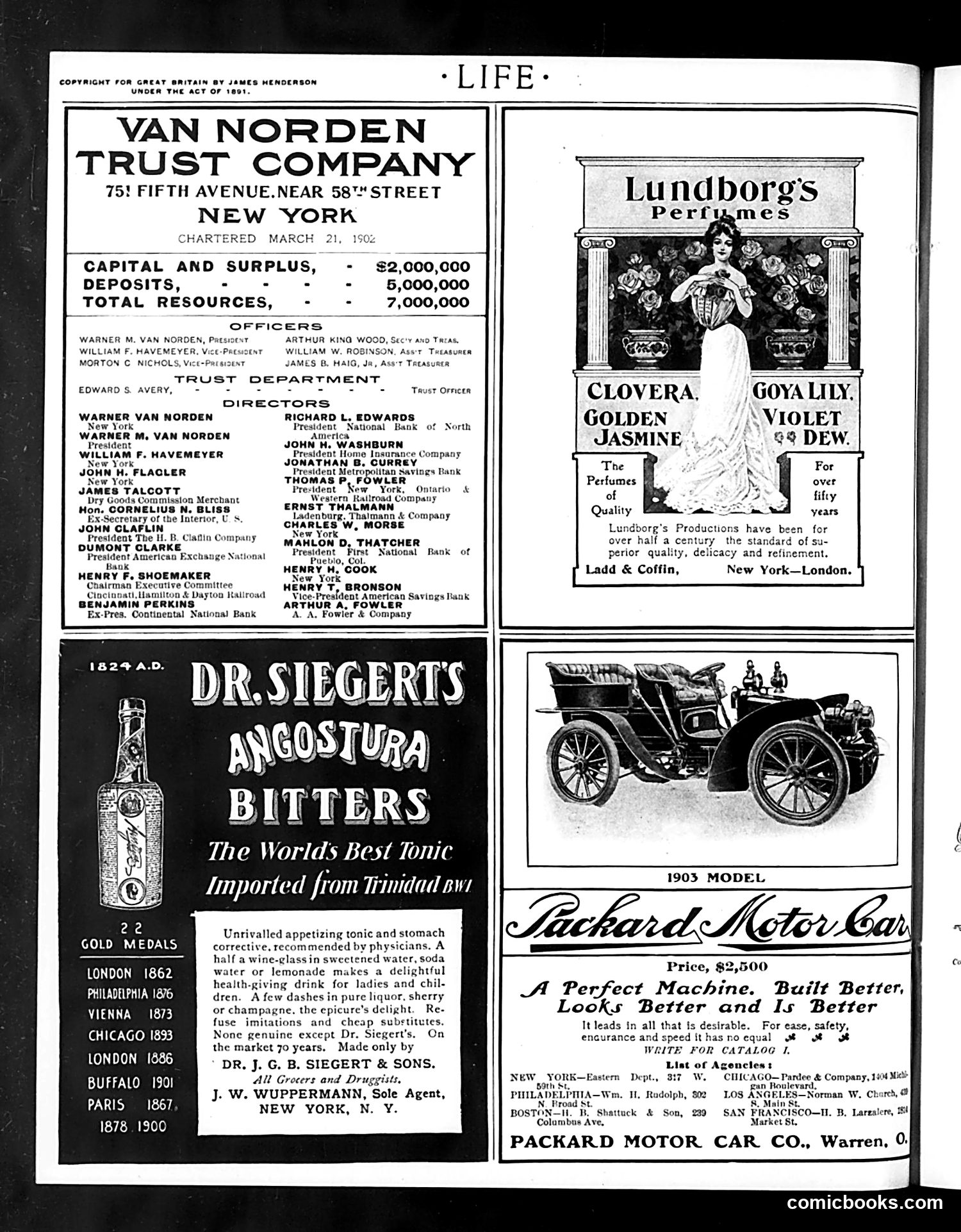
This page is primarily **advertising**, not political satire or editorial cartoon content. The advertisements include: - **Van Norden Trust Company** (financial services, New York) - **Lundborg's Perfumes** (fragrances with names like "Clovera" and "Goya Lily") - **Dr. Siegert's Angostura Bitters** (a medicinal tonic imported from Trinidad, marketed as "The World's Best Tonic") - **Packard Motor Car** (1905 automobile model, priced at $2,500, marketed as "A Perfect Machine, Built Better") The page reflects early 1900s consumer culture, with luxury goods and new automotive technology targeting wealthy readers. There is no discernible political commentary or satirical content visible on this particular page—it represents Life magazine's revenue through display advertising rather than editorial content.
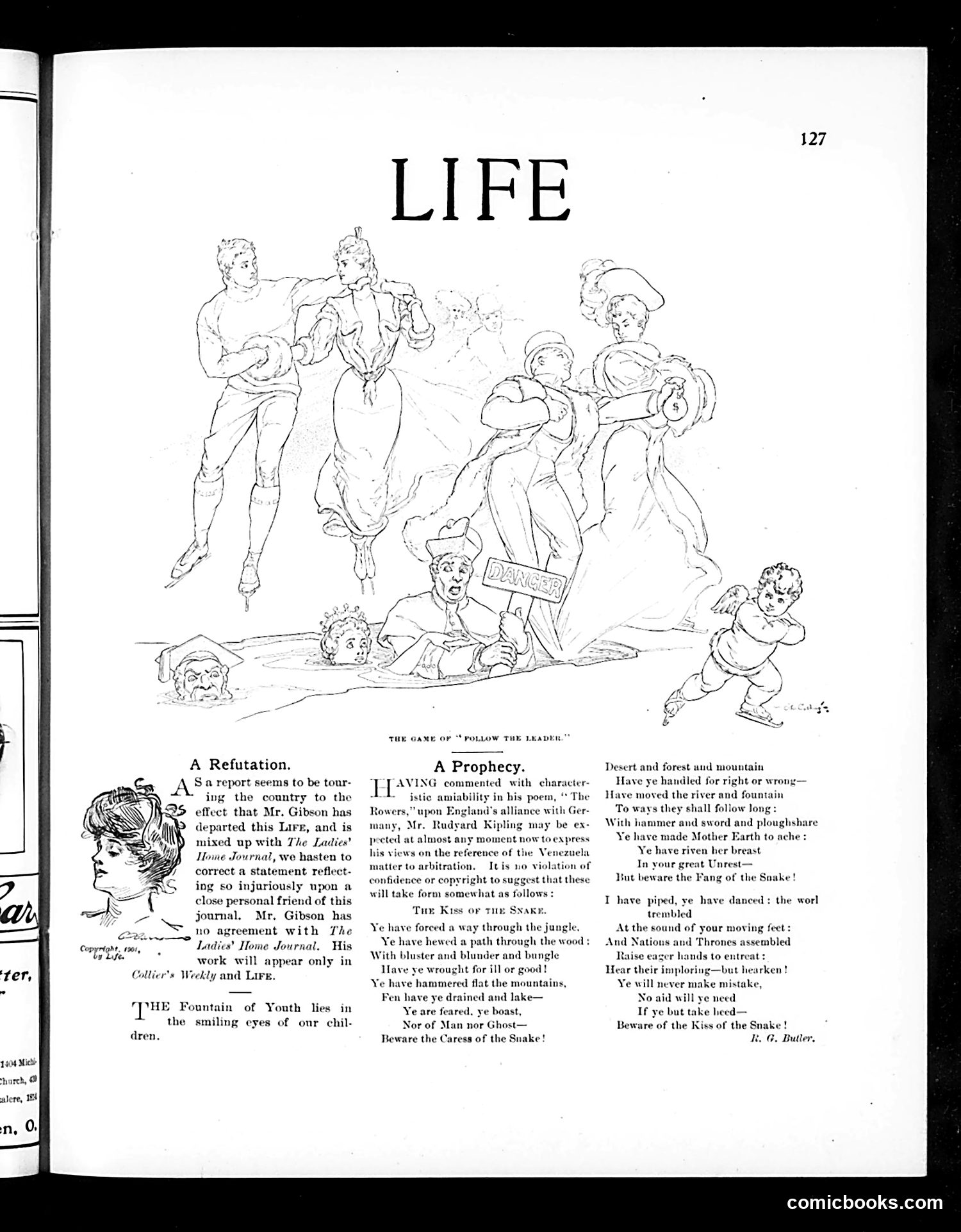
The main cartoon depicts figures following a leader off a cliff into danger, labeled "The Game of 'Follow the Leader.'" This is classic satirical commentary on blind political allegiance and the dangers of uncritical followership. The page includes three separate pieces: "A Refutation" addressing Mr. Gibson's departure from *The Ladies' Home Journal*, "A Prophecy" (verse warning of consequences), and "The Fountain of Youth" (unrelated). The refutation defends *Life* magazine's editorial position against Gibson's exit, suggesting editorial disagreement between the publications. The verse "A Prophecy" uses snake imagery and colonial/imperial references (mentions of jungle, mountains, the "Kiss of the Snake"), likely criticizing British imperial ventures or specific 19th-century colonial policies. The satirical point: leaders blindly following dangerous paths endanger their followers.
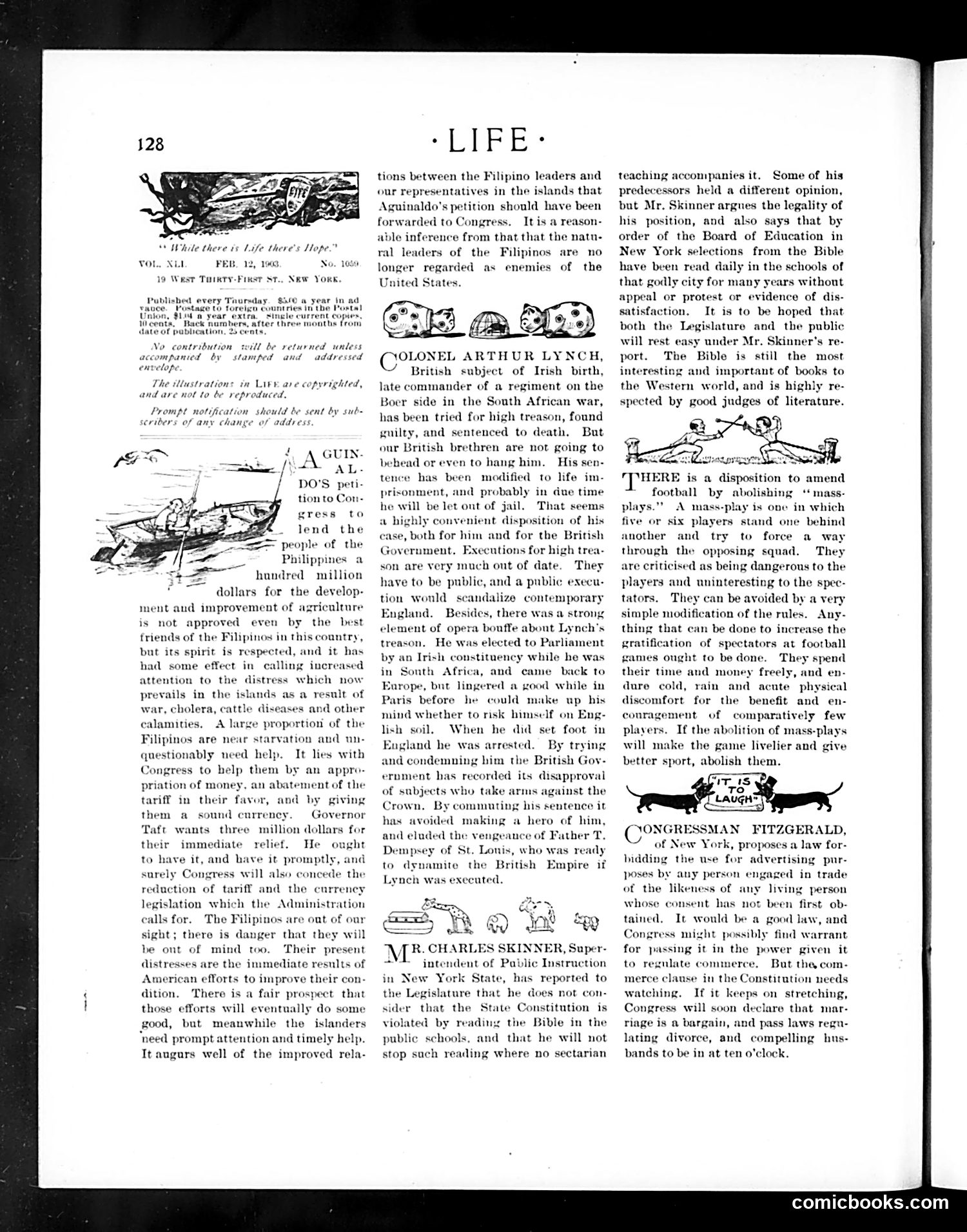
The page contains three distinct editorial items rather than unified cartoons: 1. **Colonel Arthur Lynch** - A British-Irish officer sentenced to death for high treason during the Boer War. The text debates whether his execution would scandalize England and discusses his commuted sentence. 2. **Football Mass-Play Critique** - A satirical piece opposing the "mass-play" football tactic where multiple players bunch together to force through opposing lines. The author argues it's dangerous and proposes simple rule modifications to eliminate the practice—positioning abolishing mass-plays as improving the sport. 3. **Congressman Fitzgerald's Advertising Law Proposal** - Commentary on a proposed law regulating commercial advertising, debating whether Congress has constitutional authority to restrict trade advertising practices. The page reflects Progressive Era concerns about military justice, sports safety, and commercial regulation.
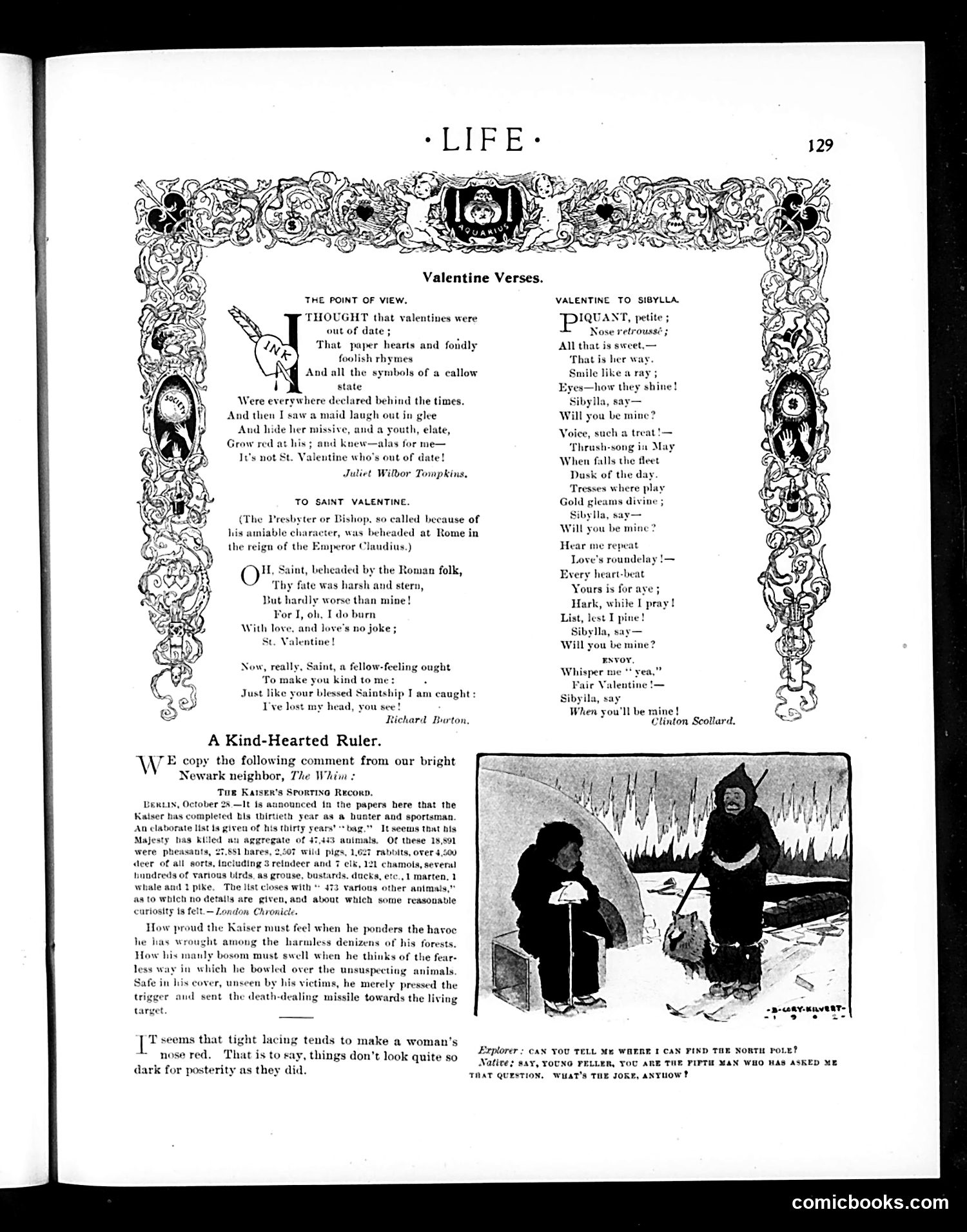
This page from *Life* magazine (page 129) contains Valentine's Day poetry and commentary rather than political cartoons. The "Valentine Verses" section includes romantic poems like "Valentine to Sibylla" by Clinton Scollard, presenting conventional courtship themes. The main satirical content is "A Kind-Hearted Ruler," which comments on the German Kaiser's hunting record. The piece mocks the Kaiser's pride in killing thousands of animals—describing his "thirty years'" worth of game including 1,891 rabbits and numerous birds. The satire suggests this "ruler" is morally callous, pressing triggers toward "living targets," implying his hunting obsession reflects dangerous militaristic character. This pre-World War I critique uses animal slaughter as metaphor for the Kaiser's broader threat. The accompanying illustration shows two figures in winter gear, with a caption about finding the North Pole—likely unrelated satirical commentary.
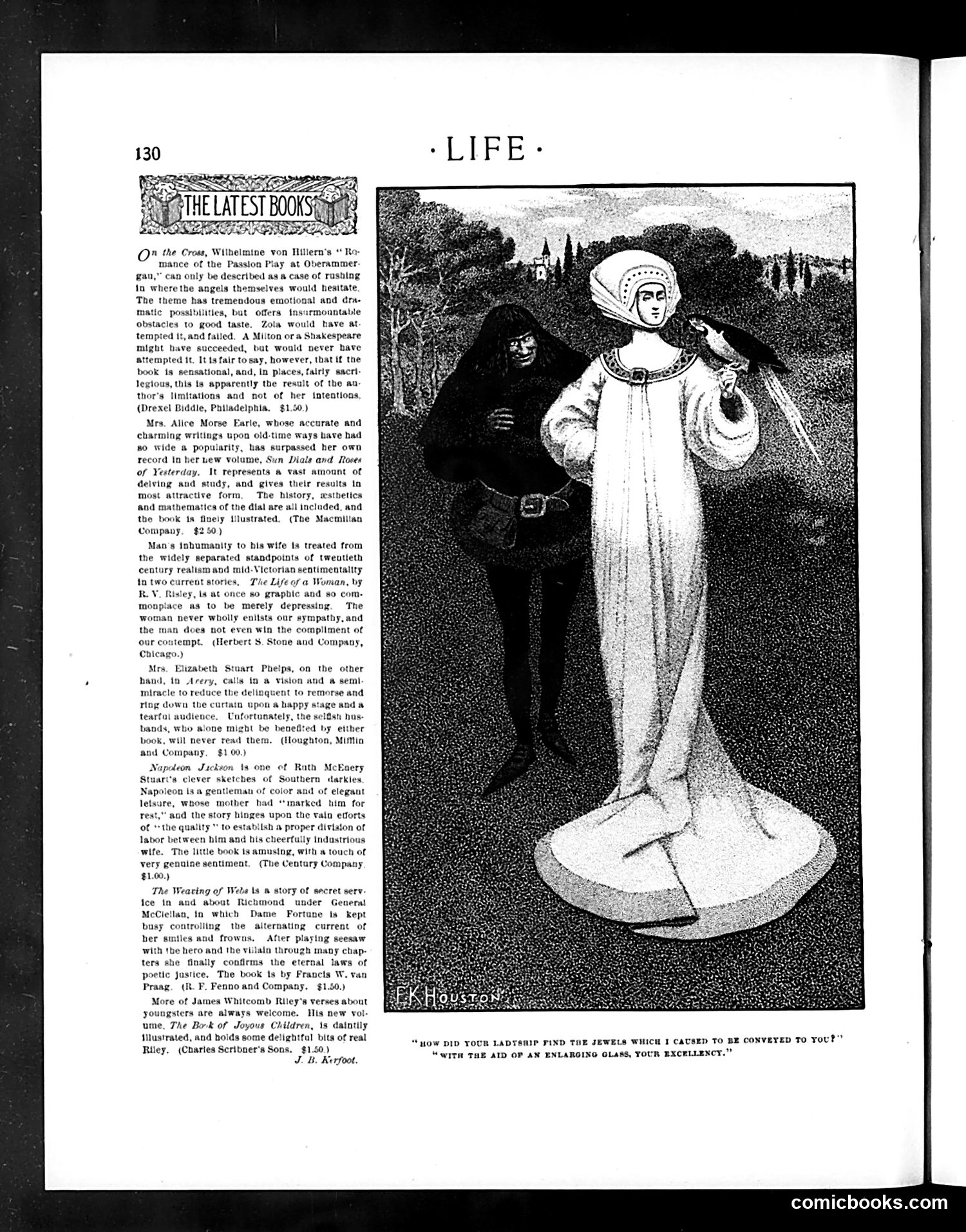
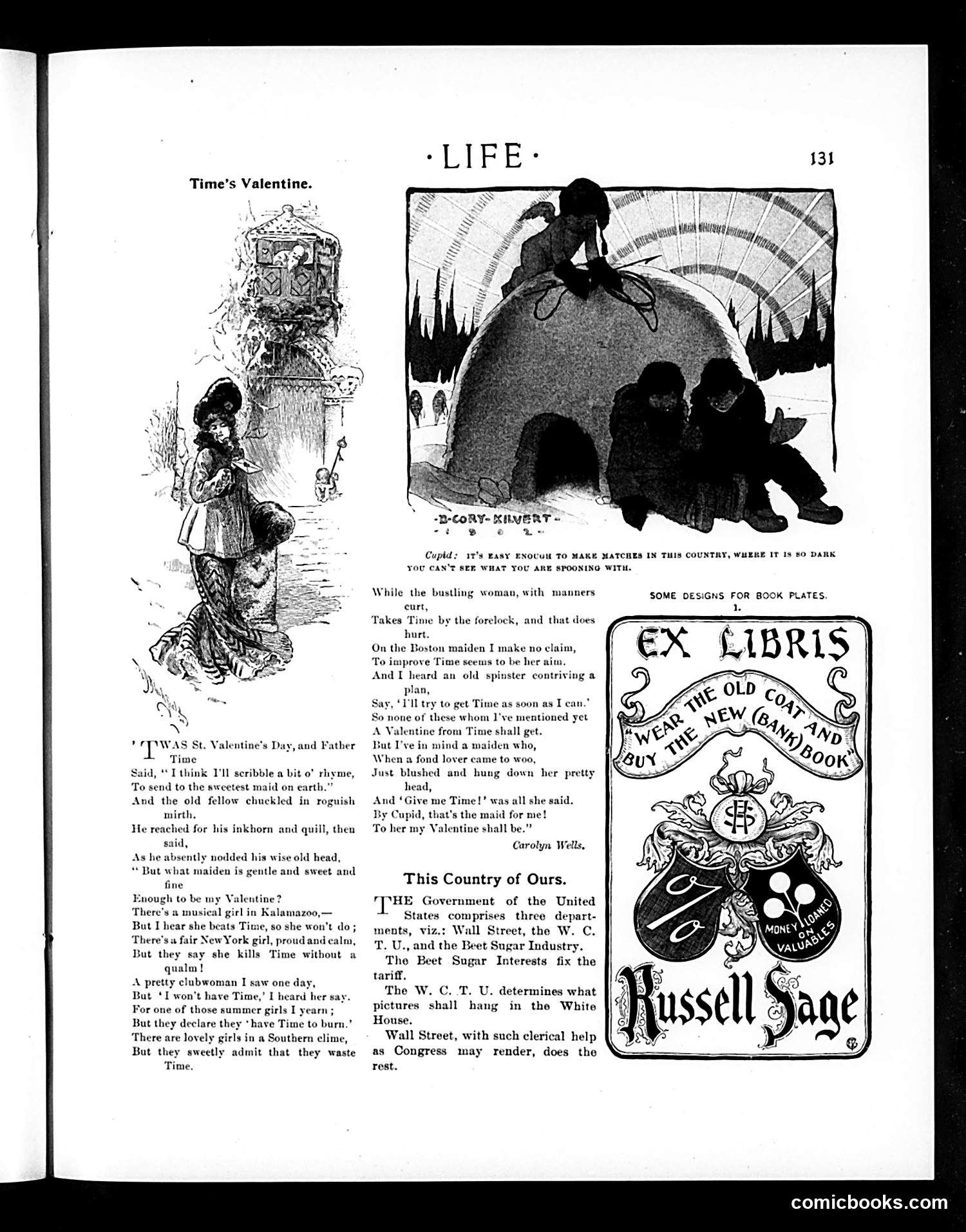
This page contains three distinct elements: **"Time's Valentine"** (left): A satirical poem mocking Father Time's romantic pursuits. The verse humorously portrays Time as an aging suitor attempting to court women, with the punchline that women resist him because "they sweetly admit that they waste / Time." **"Cory-Kilvert" cartoon** (top right): Shows people huddled in an igloo with the caption about it being dark enough to make matches without seeing. This appears to be a joke about obscurity or invisibility in harsh conditions. **"This Country of Ours"** (bottom right): A satirical article mocking the U.S. Government's three "departments"—Wall Street, the W.C.T.U. (Women's Christian Temperance Union), and the Beet Sugar Industry—suggesting these actually govern America rather than official agencies. It's political satire about corporate and special-interest influence.
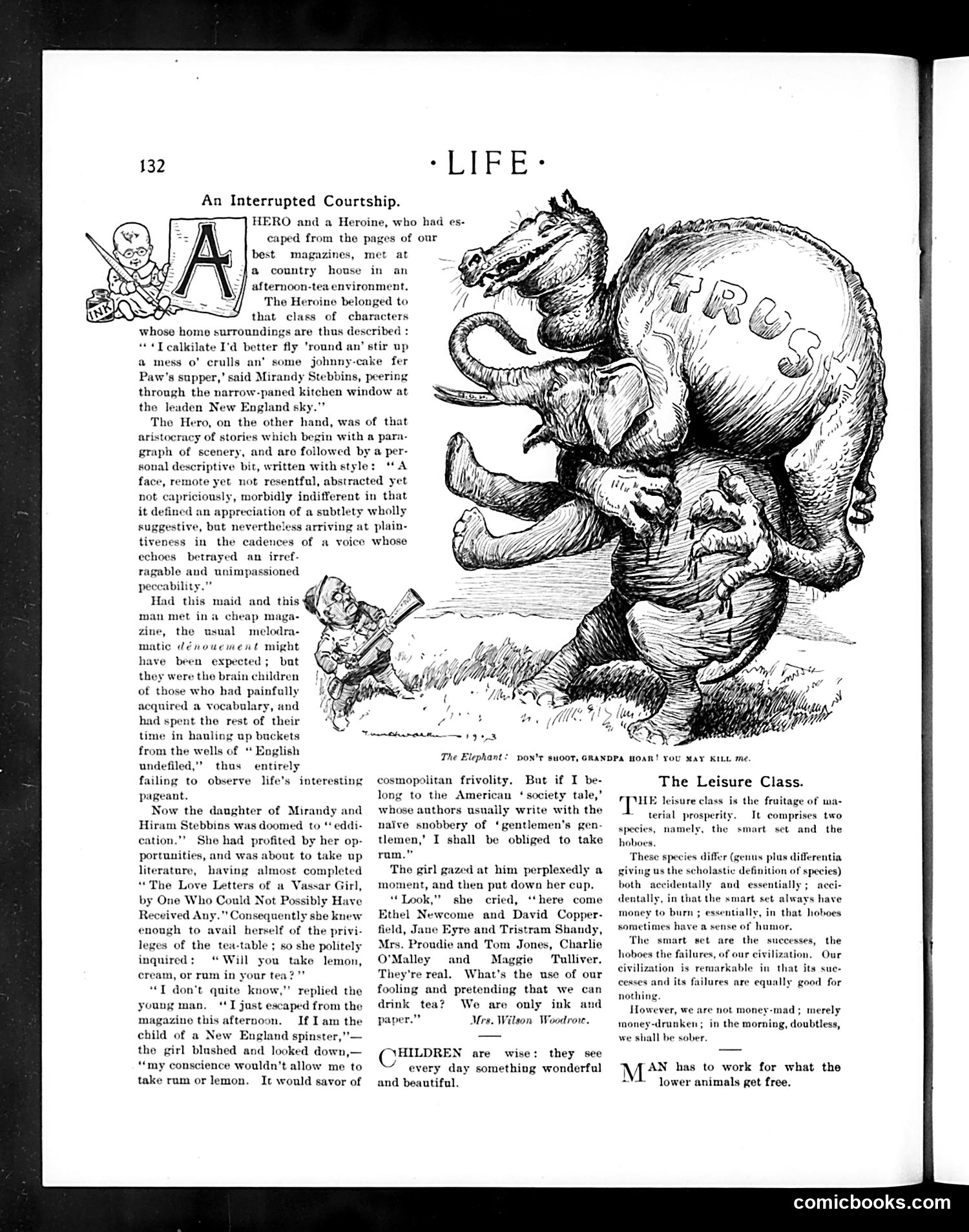
The main illustration shows an elephant labeled "TRUCK" being ridden by a small figure, with the caption "The Elephant don't snort, Grandpa Boar! You may kill me." This appears to be satirizing the Republican Party (symbolized by the elephant) and its relationship to political power. The "truck" label suggests the elephant represents concentrated political force or machinery. The small rider implies someone (unclear who specifically) is attempting to control this powerful force. The page's text discusses an "interrupted courtship" involving literary characters and social commentary on the "leisure class." The overall content critiques American social pretensions and the gap between aspiring intellectuals and actual substance—typical of Life magazine's satirical focus on early 20th-century American society and politics.
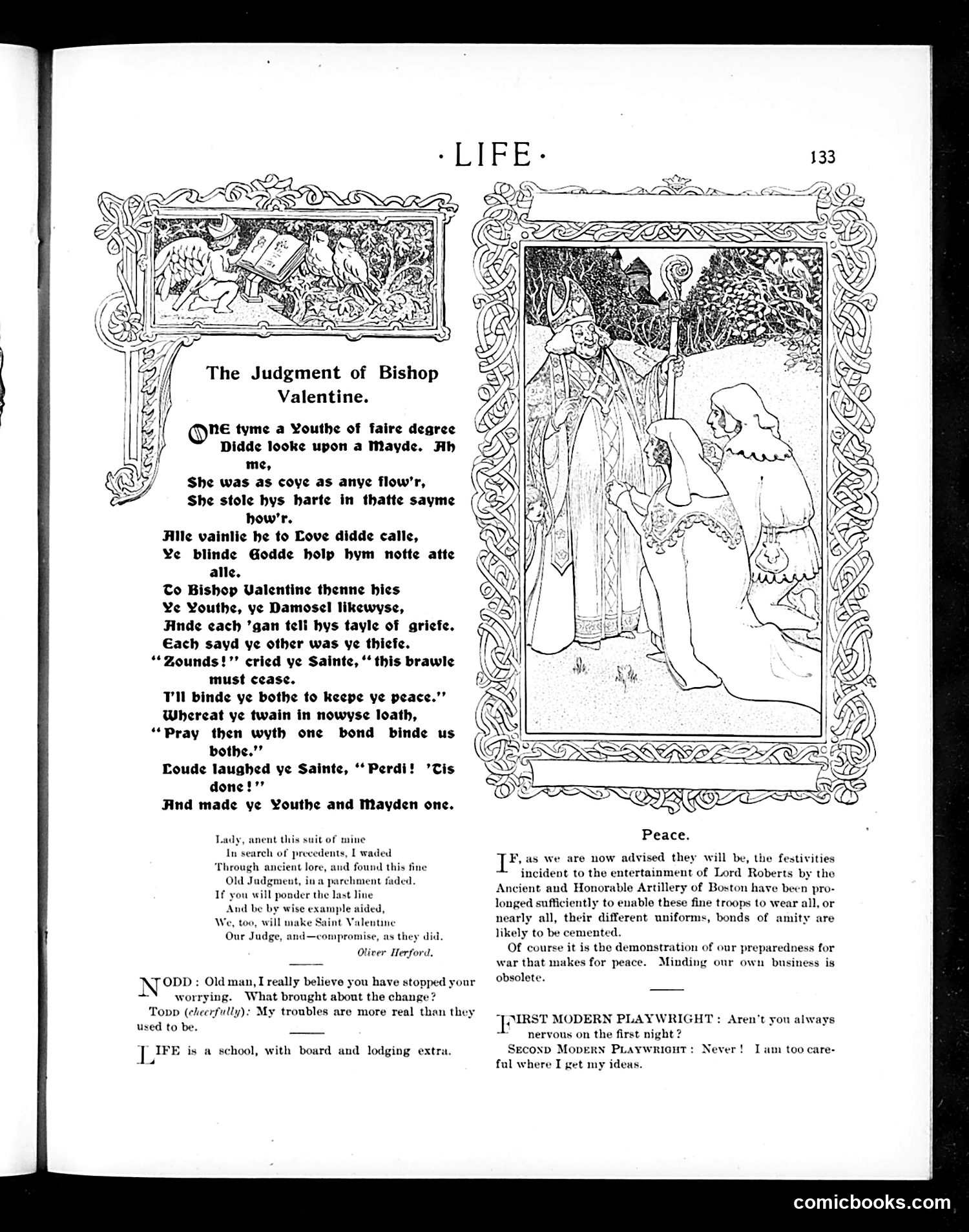
This page presents a medieval-styled poem and illustration about Saint Valentine settling a dispute between a youth and maiden. The narrative describes the young couple quarreling, each accusing the other of theft and dishonesty. Bishop Valentine intervenes, commanding them to make peace and bind themselves together "with one bond." The satire appears to mock sentimentalized Victorian attitudes toward Saint Valentine's Day and romantic love. By presenting the saint as a judge forcing incompatible, quarrelsome people into union "for peace," the piece ridicules the idealized notion that love conquers all differences. Below, brief dialogue between "Todd" and two modern playwrights adds contemporary humor about creative anxiety—unrelated to the main feature.
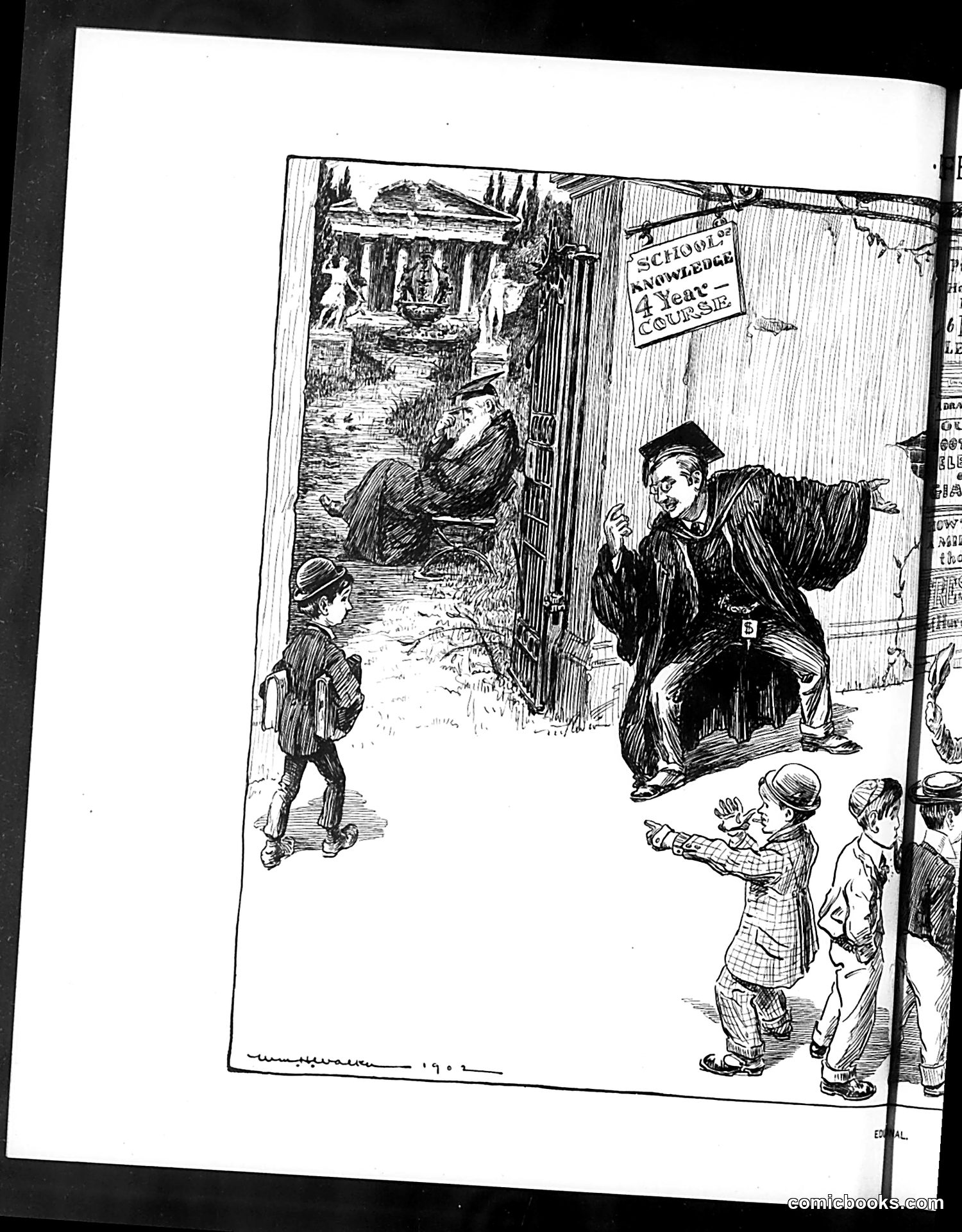
This appears to be an early 20th-century satirical cartoon about school enrollment. A sign reading "SCHOOL'S ANNOUNCED A YEAR COURSE" hangs on a gate or wall. An adult figure (possibly a truant officer or school official) addresses a young boy, while other children gather nearby on the street. The satire seems to mock either: - Children's reluctance to attend school - Truancy problems in urban areas - The disconnect between official school announcements and actual student attendance The crowded street scene with multiple children suggests this depicts a common urban social issue of the era—perhaps children avoiding mandatory education or being recruited back to school. The official's gesture and the children's body language suggest some tension or resistance around school enrollment.
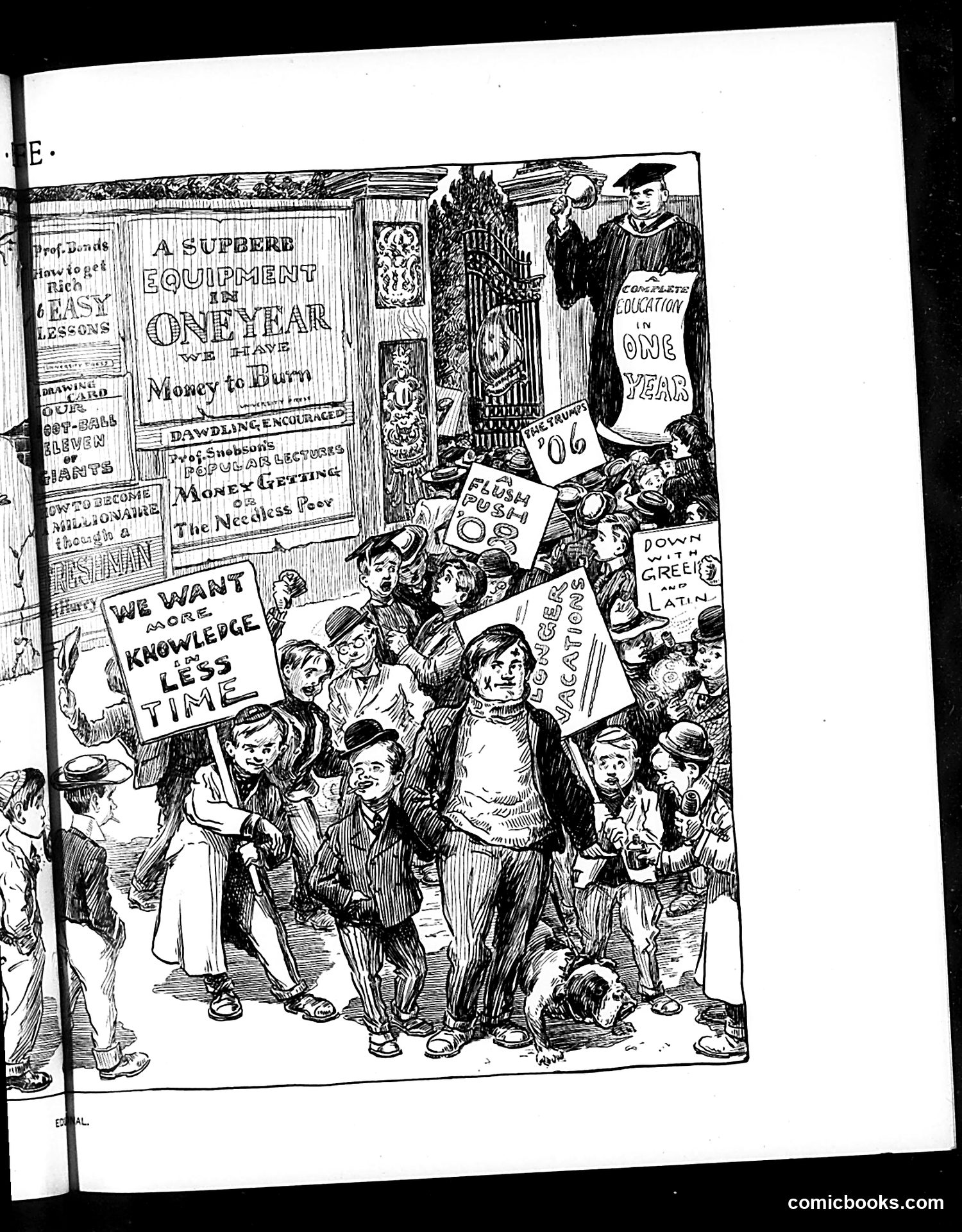
This is a satirical cartoon criticizing educational reform movements of the early 20th century. A crowd of working-class men and boys hold protest signs demanding "We Want More Knowledge Less Time" and "Down with Greek! Latin!" — opposing classical curriculum requirements. Upper left shows advertisements for dubious correspondence courses promising "Complete Education in One Year" and "Money to Burn" — exploitative schemes targeting those frustrated with traditional schooling. The cartoon satirizes both sides: students/workers seeking quick alternatives to rigorous education, and fraudulent educators profiting from these demands. The dog in the foreground adds comedic commentary on the intellectual level of the debate. The satire suggests that calls for simplified, faster education enable charlatans while undercutting legitimate learning.
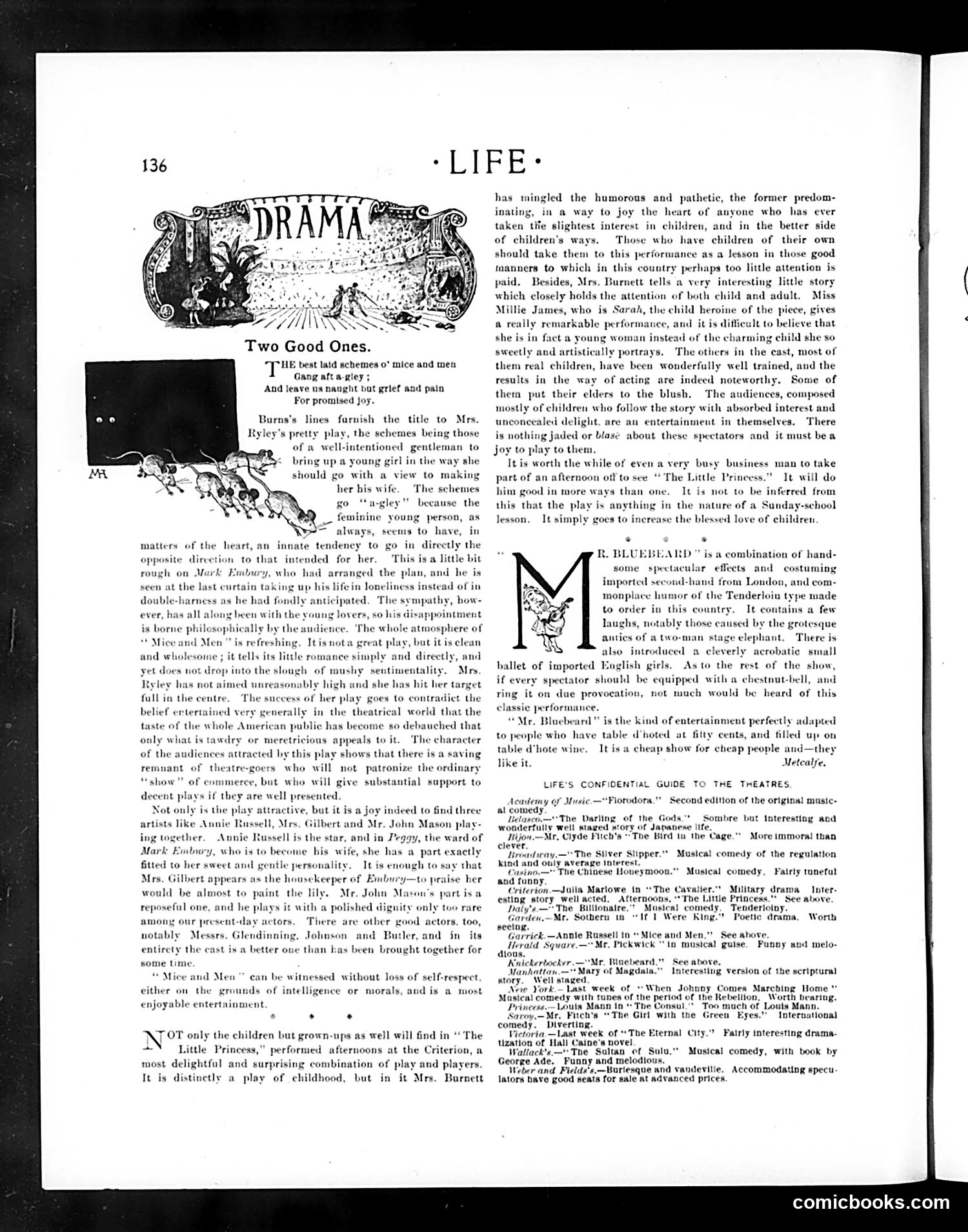
This page reviews theatrical productions, focusing on "Two Good Ones"—plays praised for their quality entertainment value rather than heavy-handed morality. The main cartoon (top left) appears to show figures in a comedic scene, though specific characters are unclear from the image quality. The text critiques Mrs. Burnett's "The Little Princess," performed at the Criterion Theatre with child actress Millie James. The review praises the production as genuinely entertaining rather than didactic, noting it appeals to both children and adults without condescension. The second section reviews "Mr. Bluebeard," describing it as spectacular entertainment with imported English scenery and acrobatic acts—a cheap, accessible show for working-class audiences. The page concludes with a theater guide listing various productions and their merits, treating theater as popular entertainment across social classes.
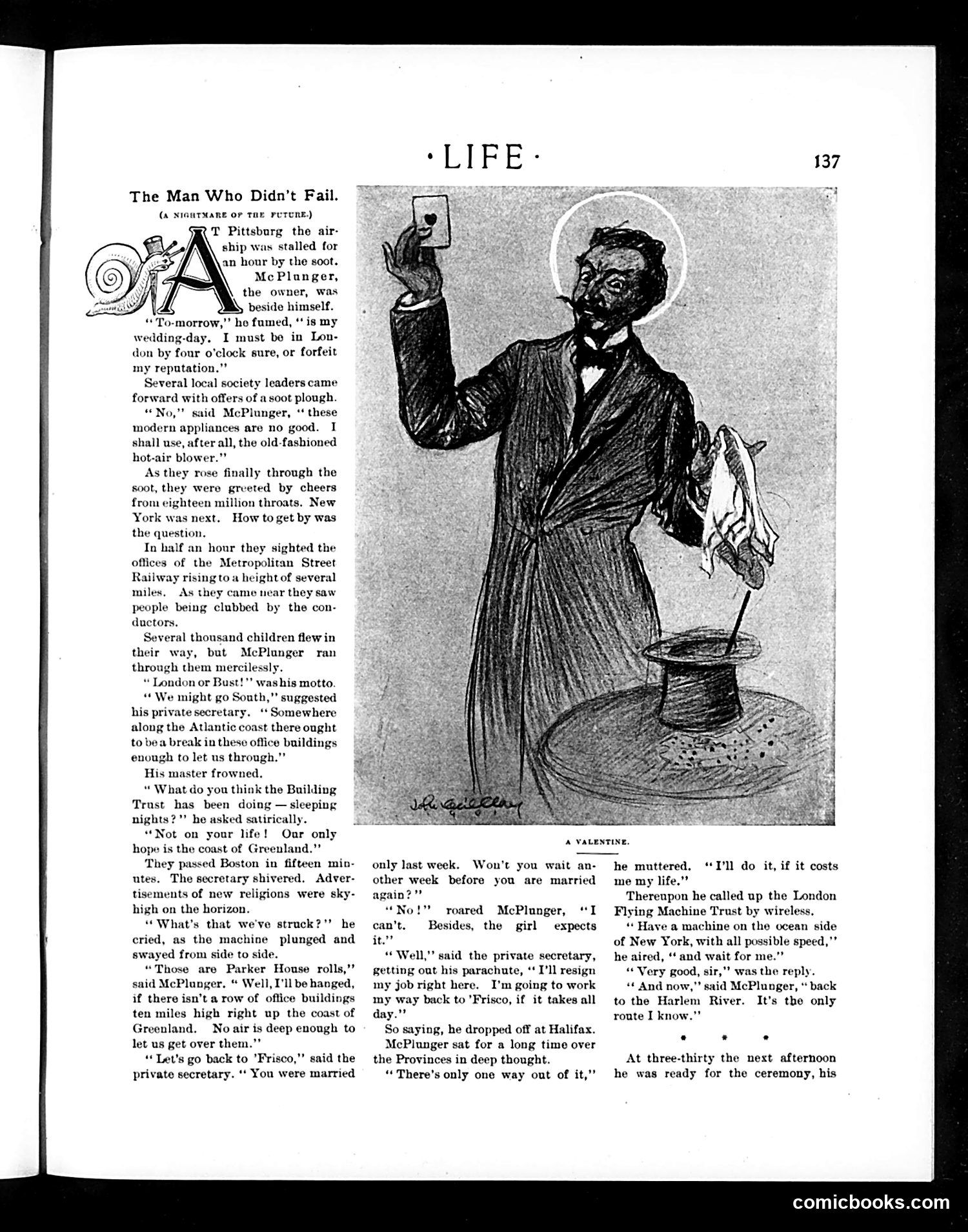
This story satirizes **early 1900s corporate monopolies and their stranglehold on American cities**. McPlunger, an airship owner, must reach London for his wedding but encounters absurd obstacles representing real anxieties of the era: - **The "Building Trust"** represents corporate consolidation—office buildings impossibly tall, blocking even airspace - **The Metropolitan Street Railway** appears as a brutal monopoly where conductors club passengers - **Parker House rolls** and various "Trusts" suggest how monopolies controlled everyday life - **Advertisements of new religions sky-high** mocks commercialization of spirituality The satire's dark humor: despite obstacles, McPlunger simply *succeeds anyway*, arriving on time for his wedding—suggesting either that determination conquers monopolies, or that the obstacles are too absurd to stop him. The private secretary's resigned parachute escape underscores the helplessness ordinary people felt against corporate power in this period.
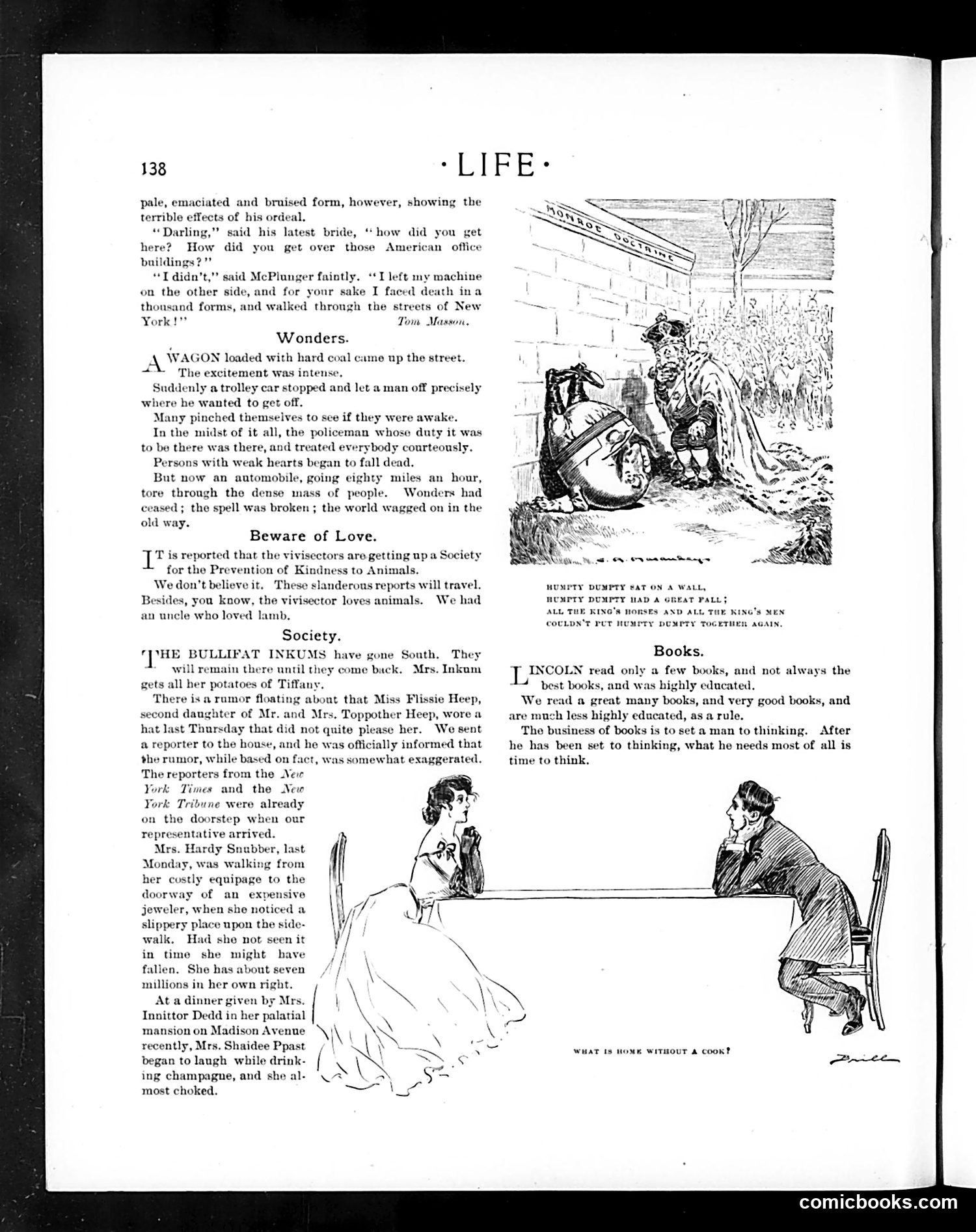
This page contains several satirical pieces mocking American society's absurdities: **"Wonders"** describes miraculous urban events (a trolley stopping at the right place, a courteous policeman) so improbable they shock bystanders—until normalcy returns when an automobile speeds recklessly through crowds. The satire attacks dangerous driving and poor city services. **"Beware of Love"** sarcastically mocks vivisectors (animal experimenters) claiming to love animals while performing painful procedures on them. **"Society"** ridicules the wealthy for trivial concerns: Mrs. Snubber nearly falls but is unharmed because she's rich enough to matter; Miss Heep's mild wardrobe complaint becomes gossip fodder. **"Books"** contrasts Lincoln's limited reading with modern educated readers' consumption of many books—yet Lincoln was wiser. The satire suggests quantity doesn't equal genuine learning. The Humpty Dumpty illustration references the nursery rhyme, likely about irreparable damage or failed restoration.
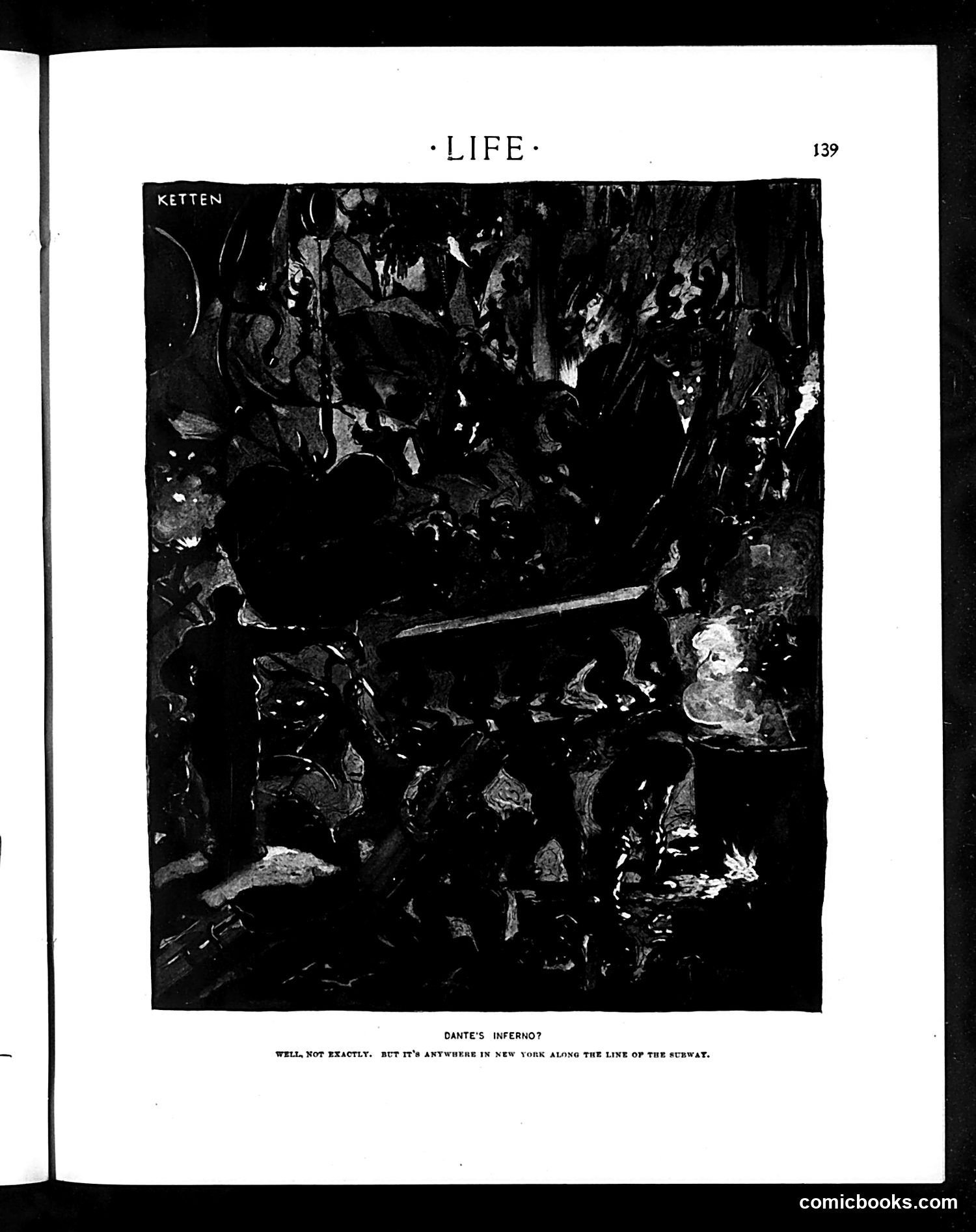
This cartoon by Ketten satirizes conditions in New York City's subway system by comparing it to Dante's Inferno—the medieval poet's depiction of Hell. The crowded, chaotic underground scene filled with packed bodies becomes a humorous visual metaphor for the misery of commuting. The caption's joke deflates the grandiose comparison: it's "not exactly" Dante's Hell, but rather just "anywhere in New York along the line of the subway." This suggests that everyday subway conditions were so unpleasant—overcrowded, uncomfortable, hellish—that they rivaled literary descriptions of the underworld. The humor relies on relatable frustration with urban transit rather than requiring knowledge of specific political figures or events.
This satirical poem, attributed to the Indianapolis News, uses an elephant's perspective to mock British colonial arrogance during the Raj. Lord Curzon, the Viceroy of India, is referenced entering Delhi in ceremonial procession with his wife ("fair lady"), treated as a deity by crowds. The satire lies in the elephant's supposed indifference to this grandeur—repeatedly asking "what did the elephant think?" The poem suggests that beneath the pomp of imperial spectacle, the colonized population (represented by the unimpressed elephant) sees through the pretense. It mocks both the British assumption of reverence and the performative nature of colonial authority. Published in *Life*, a satirical American magazine, this likely reflects American skepticism toward British imperialism, a common theme of the era.
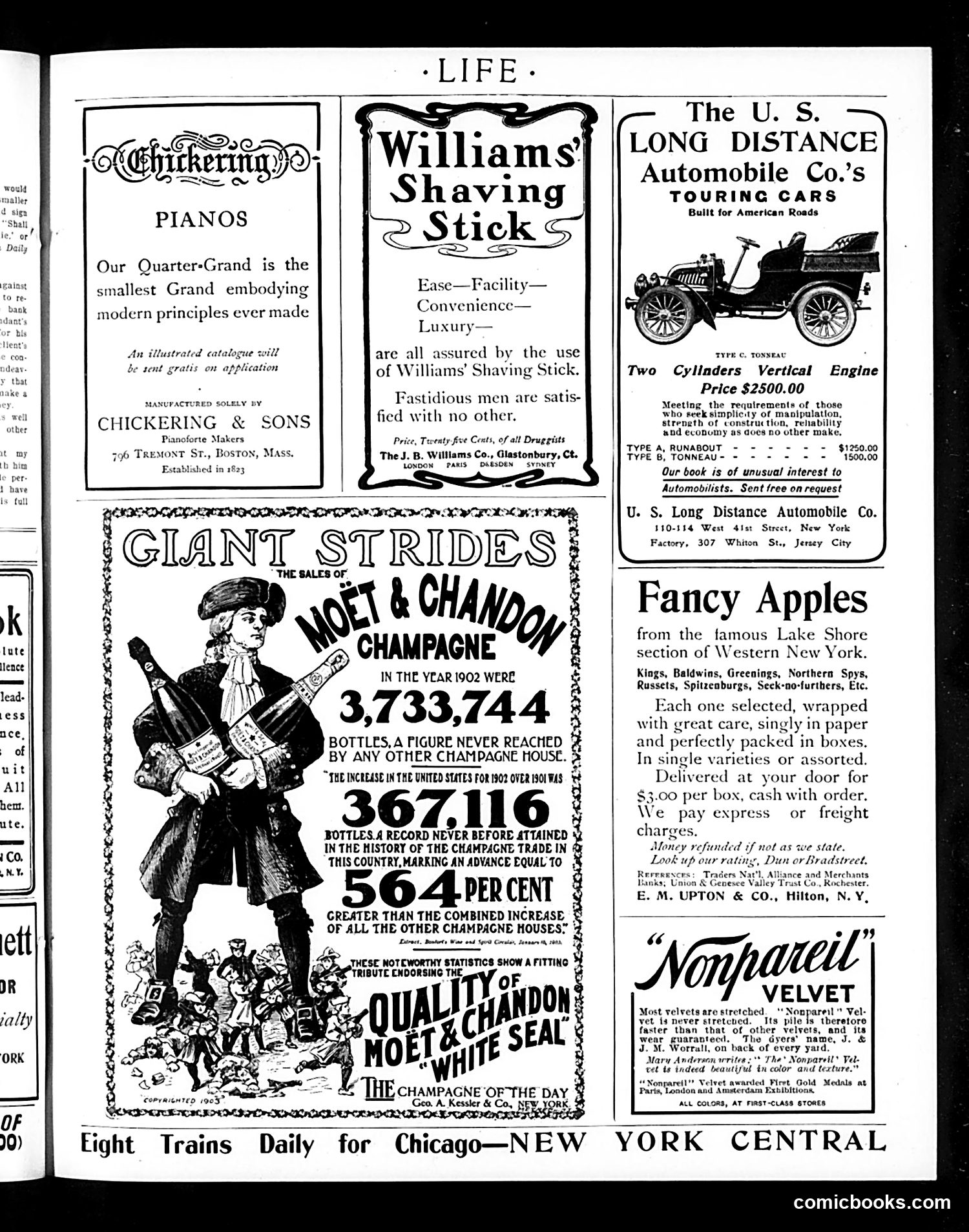
This page is primarily **advertisements** rather than satirical cartoons. The dominant feature is a large Moët & Chandon champagne ad celebrating the brand's 1902 sales figures (3.7+ million bottles) with a historically-dressed aristocratic figure. The ad presents champagne sales statistics as markers of prestige and quality—implying that commercial success proves superiority. Surrounding this are typical early-1900s product advertisements: pianos, shaving cream, automobiles, apples, velvet fabric, and railroad services. These ads reflect upper-middle-class consumer culture of the era. **The satire**, if present, is subtle: the page juxtaposes luxury goods (champagne, pianos, fine fabrics) with practical products (apples, automobiles), all promoted through statistics and claims of superiority. This mirrors Life magazine's satirical function—mocking consumer culture and the commercial obsession with sales figures as proof of worth. The page lacks explicit political commentary or identifiable caricatures of public figures.
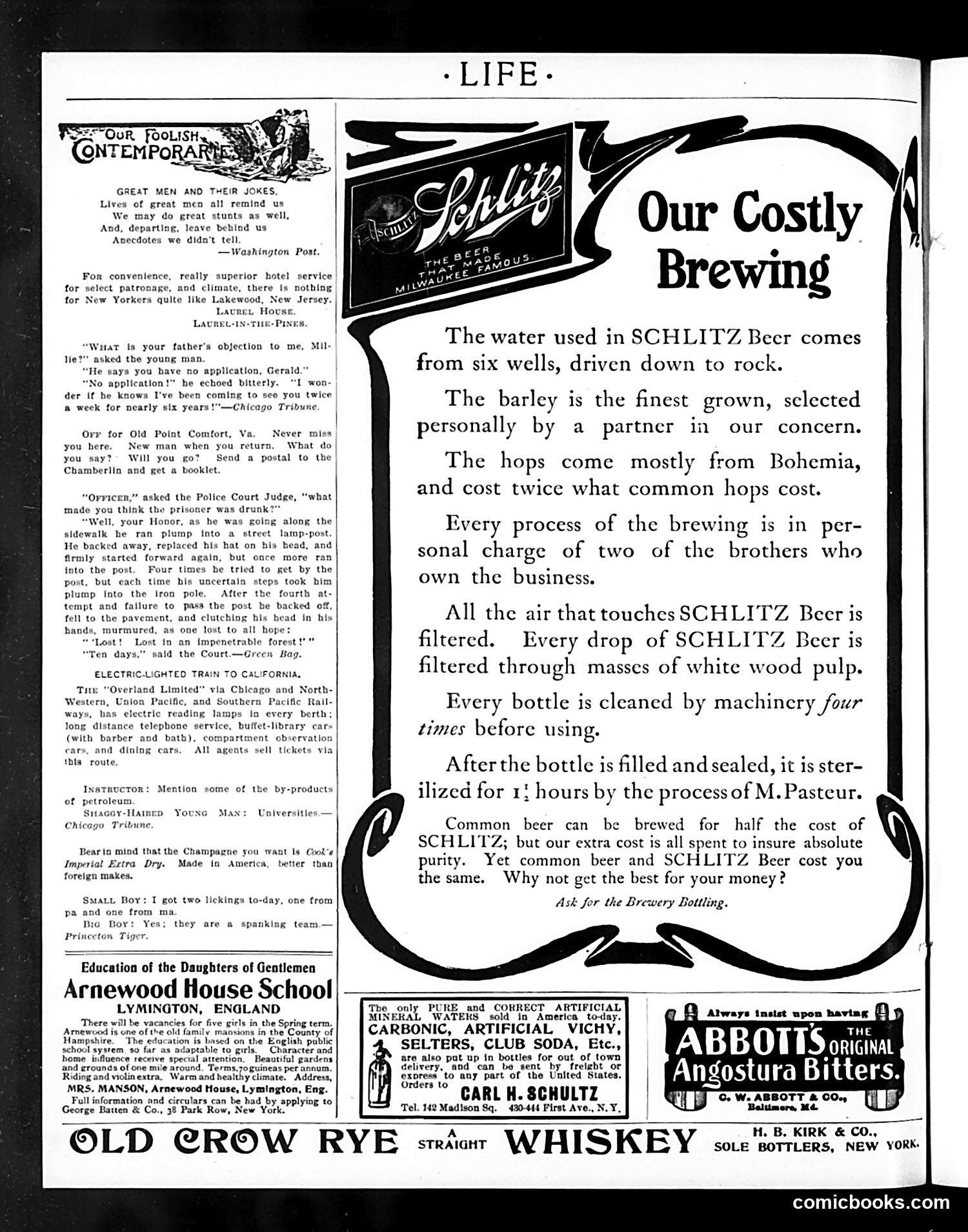
This is primarily an **advertising and humor page** from Life magazine. The left column contains short jokes and anecdotes typical of early 20th-century humor magazines—puns about courtship, drunkenness, and railroad travel. These reference contemporary publications like the *Chicago Tribune* and *Princeton Tiger*. The dominant feature is a large **Schlitz Beer advertisement** ("Our Costly Brewing") that occupies roughly half the page. The ad emphasizes premium quality through detailed claims: imported Bohemian hops, filtered water from deep wells, Pasteur sterilization, and family ownership. This positioning—touting expense as a marker of superiority—reflects early 1900s marketing strategy appealing to middle and upper-class consumers. The page also advertises schools, whiskey, bitters, and hotel services. The humor pieces are genteel and inoffensive by design, suitable for Life's educated readership. There are **no identifiable political cartoons or satirical commentary** on this particular page—it's primarily commercial content dressed in period humor.
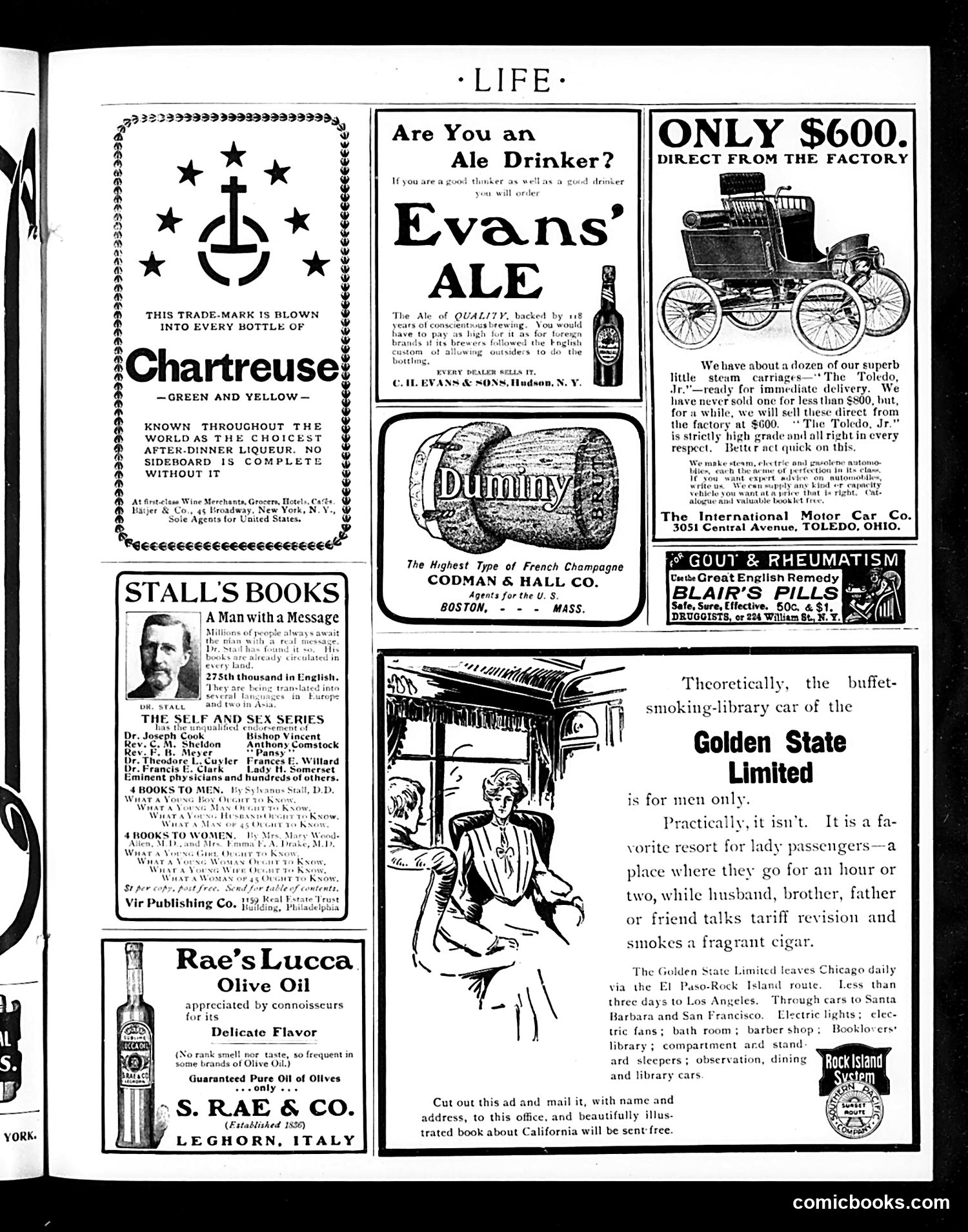
This is primarily an **advertising page**, not a satirical cartoon. The page contains vintage product advertisements from approximately the early 1900s, including Chartreuse liqueur, Evans' Ale, Stall's Books, Rae's Lucca Olive Oil, and automobiles. The one narrative element is a brief humorous piece about the **Golden State Limited train**. It jokes that although the buffet-smoking-library car is "theoretically" for men only, women frequently use it—ostensibly to escape while male passengers discuss tariffs and smoke cigars. This reflects early 20th-century gender dynamics and segregated social spaces. The satirical point is gentle: despite rules excluding women, they pragmatically ignore them. The humor assumes readers will recognize both the absurdity of rigid gender separation and the reality that women simply do what they want regardless.
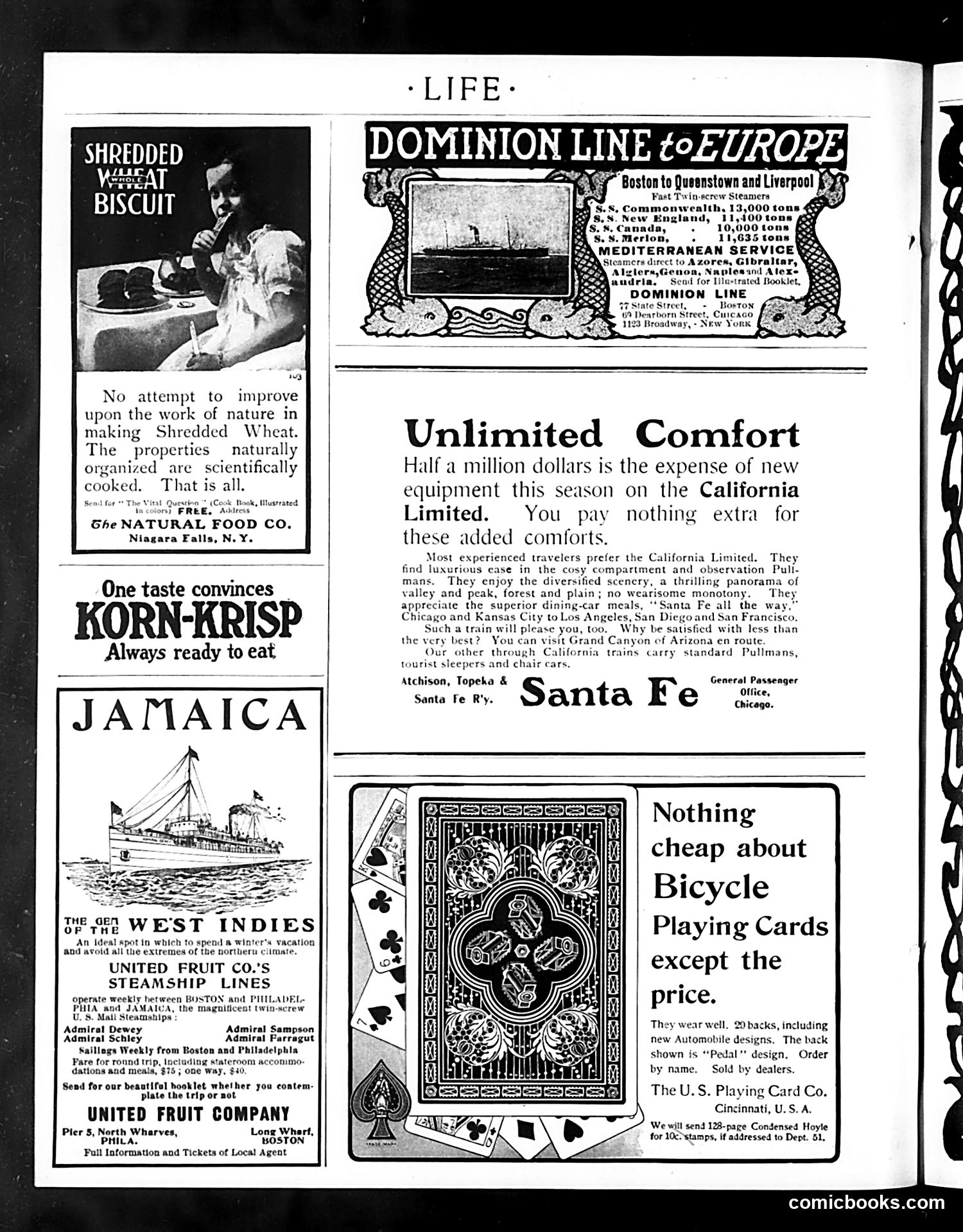
This is primarily an **advertising page**, not a political cartoon. It contains no satire or social commentary—rather, it's a collection of early 20th-century commercial advertisements. The ads promote: - **Food products** (Shredded Wheat, Korn-Krisp) emphasizing "natural" preparation - **Steamship lines** (Dominion Line to Europe, United Fruit Company to Jamaica, Santa Fe railroad) - **Luxury travel** on the "California Limited" train, highlighting new comfort amenities - **Consumer goods** (Bicycle Playing Cards) The page reflects the era's commercial interests: transatlantic shipping, tropical tourism (Jamaica marketed as winter escape), American rail expansion, and mass-produced leisure products. The design uses decorative borders and period typography typical of early 1900s advertising. **No political figures or satire are present**—this is straightforward commercial promotion aimed at affluent consumers who could afford steamship travel and luxury train accommodations.
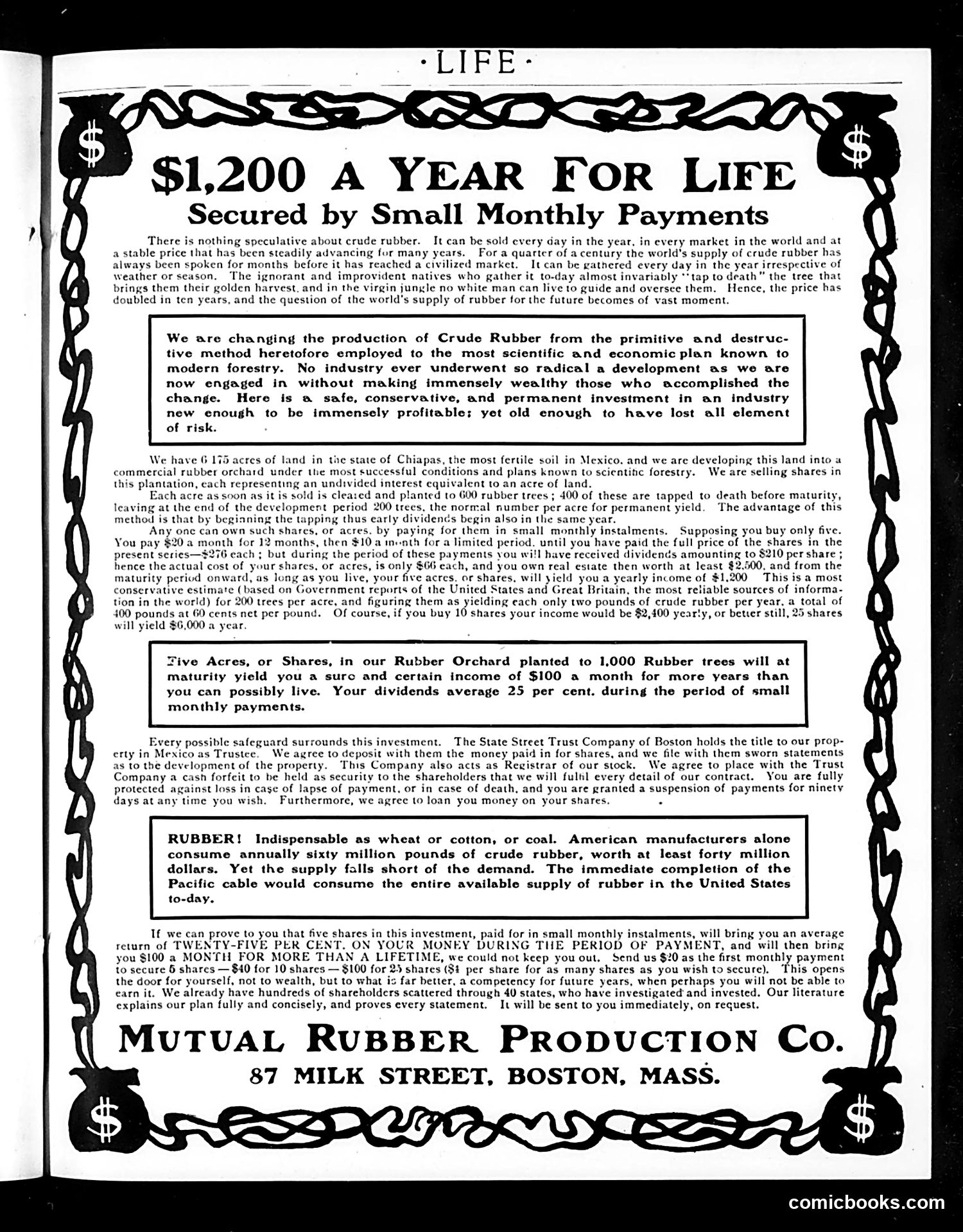
This is a financial advertisement, not a satirical cartoon. The page promotes shares in a Mexican rubber plantation in Chiapas, sold through small monthly payments ($20/month initially). The pitch emphasizes rubber's rising value and steady demand, claiming buyers will earn "$1,200 a year for life" from five shares. It promises dividends beginning immediately despite a long development period, and claims the actual cost per share is only $66 after dividend payments. Red flags for modern readers: The scheme appears highly speculative despite claims of being "safe, conservative, and permanent." Promised returns (25% dividends) seem unrealistic. The company relies on the State Street Trust Company of Boston as a safeguard, but offers limited concrete guarantees. This represents early-20th-century investment marketing targeting middle-class savers, before modern securities regulations. Whether this was legitimate or fraudulent remains unclear from the advertisement alone.
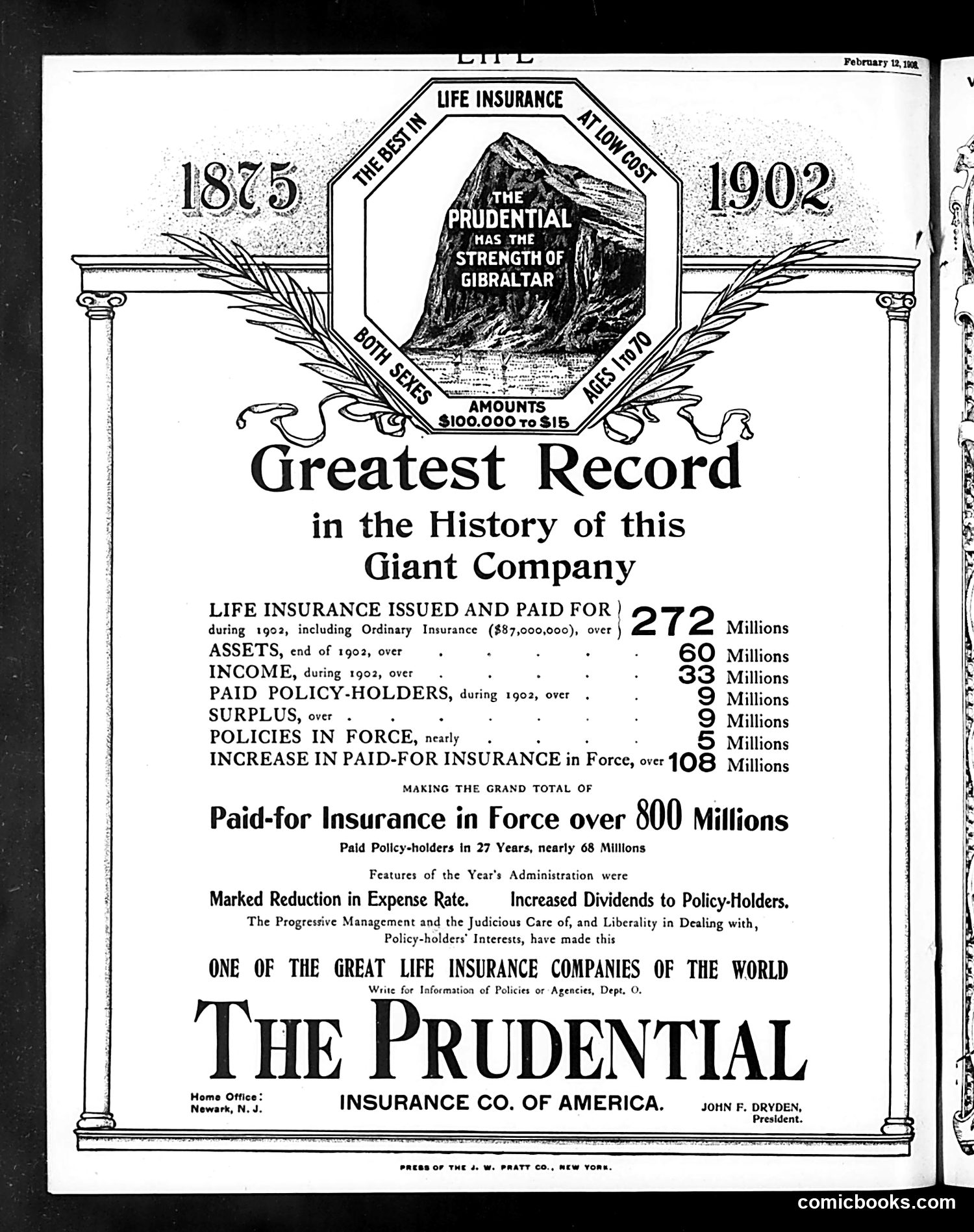
This is **not a cartoon or satire**—it's a straightforward **advertisement** for The Prudential Insurance Company of America, published in *Life* magazine on February 12, 1902. The page celebrates the company's 27-year track record with financial statistics: over 272 million in life insurance issued, 800 million in force, and 68 million paid to policyholders. The central image of the Rock of Gibraltar emphasizes stability and strength—a common metaphor for reliable insurance companies. The "greatest record" headline and detailed metrics were typical boasting language in early-1900s corporate advertising, when companies used prestigious publications like *Life* to build investor and customer confidence. The mention of "marked reduction in expense rate" and "increased dividends" targeted both current policyholders and potential customers. There is no satire here—just period business advertising.