
Life, 1903-02-12 · page 4 of 22
Life — February 12, 1903 — page 4: what you’re looking at
What you’re looking at
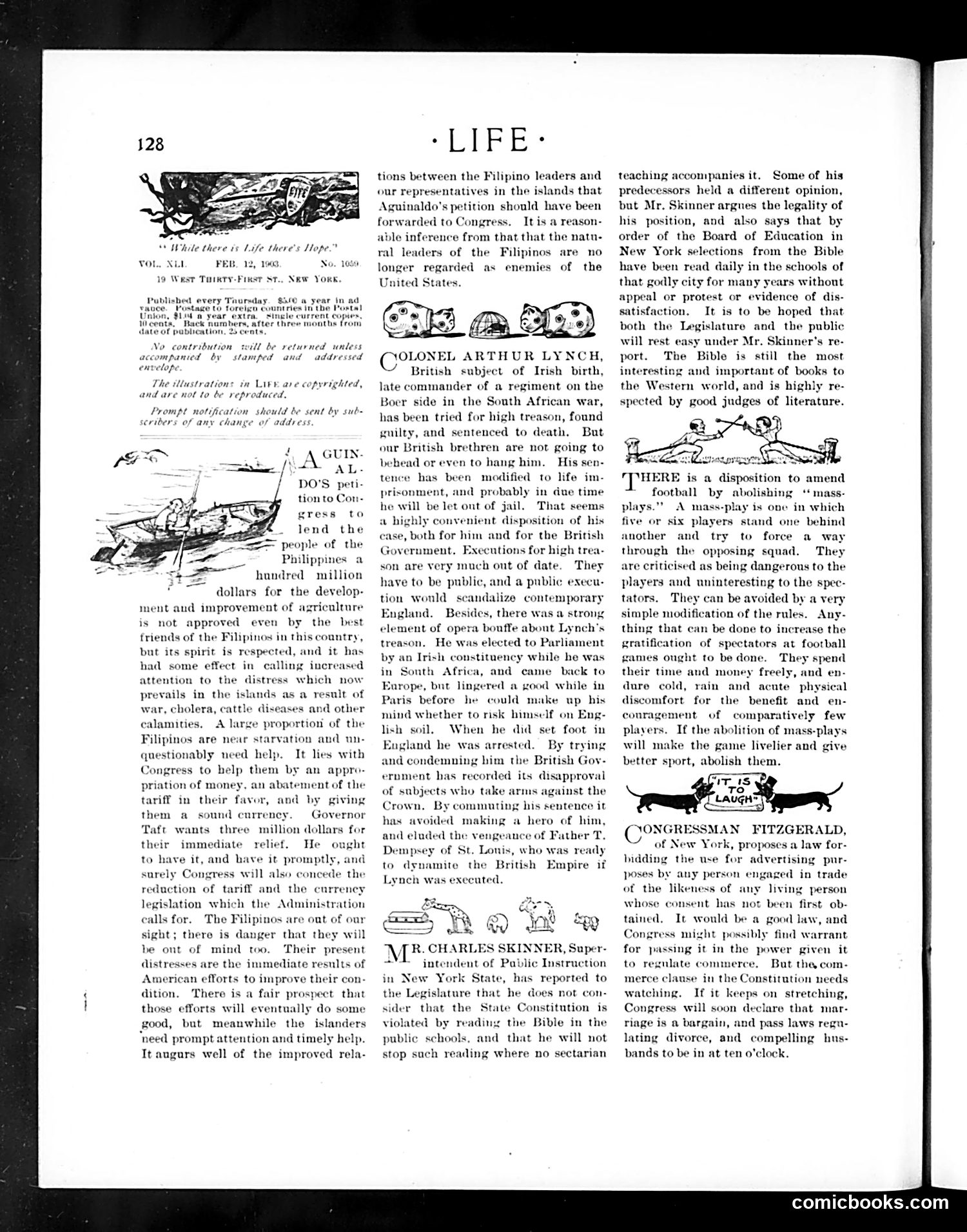
The page contains three distinct editorial items rather than unified cartoons: 1. **Colonel Arthur Lynch** - A British-Irish officer sentenced to death for high treason during the Boer War. The text debates whether his execution would scandalize England and discusses his commuted sentence. 2. **Football Mass-Play Critique** - A satirical piece opposing the "mass-play" football tactic where multiple players bunch together to force through opposing lines. The author argues it's dangerous and proposes simple rule modifications to eliminate the practice—positioning abolishing mass-plays as improving the sport. 3. **Congressman Fitzgerald's Advertising Law Proposal** - Commentary on a proposed law regulating commercial advertising, debating whether Congress has constitutional authority to restrict trade advertising practices. The page reflects Progressive Era concerns about military justice, sports safety, and commercial regulation.
📄 Transcribed text from this page (OCR, searchable)
Machine-transcribed from the original scan — historical spelling and the odd misread are preserved.
vol. Nil FEB. 19 West Turkry-Fixst st. New Yous. $00 a year in ad r tml Vo contribution accompanied by rill be returned untess stamped and addressed The illustrations in Livy. ave copyrighted, and are not to be reproduced, Prompt notification should be seribers of any change of addre ent by subs ‘4 GUIN- [its AL- DO'S peti- tion to Ce gress to lend the ppines a hundred million dollars for the develop- ment aud improvement of agriculture is not approved even by the best friends of the Filipinos in this country, but its spirit is respected, and it has had some effect in calling increased attention to the distress which now prevails in the islands as a result of war, cholera, cattle diseases and other calamities. A large proportion of the Filipinos are near starvation and un- questionably need help. It lies with Congr to help them by an appro- priation of money, an abatement of the tariff in their favor, and by giving them a sound currency. Governor aft wants three million dollars for their immediate relief. He ought to have it, and have it prompt), y Congress will al. reduction of tariff and the curreney legislation which the Administration calls for. The Filipinos are out of our sight; there is danger that they will be ont of mind too. Their present are the immediate results of. American efforts to improve their con- dition. There is a fair prospect that those efforts will eventually do some good, but meanwhile islanders ‘need prompt attention and timely help. It augurs well of the improved rela- » concede the distresse: the * LIP E. tions between the Filipino leaders and our representatives in the islands that Aguinaldo’s petition should have been forwarded to Congress. It is a reason- able inference from that that the natu- ral leaders of the Filipinos are no longer regarded as enemies of the United States. OLONEL ARTHUR LYNCH, British subject of Irish birth, late commander of a regiment on the Boer side in the South African war, has been tried for high treason, found guilty, and sentenced to death. But our British brethren are not going to Debead or even to hang him. His sen- tence has been modified to life im- prisonment, and probably in due time he will be let out of jail. That seems a highly convenient disposition of his case, both for him and for the British Goverument. Executions for high trea- son are very much out of date. They have to be public, and a public execu- tion would scandalize contemporary England. Besides, there was a strony element of opera bouffe about Lynch's treason. He was elected to Parliament by an Irish constituency while he was in Sonth Africa, and came back to Europe, but lingered a good while in Paris before he could make up his mind whether to risk himself on Eng- lish soil, When he did set foot in England he was arrested. By trying and condemning him the British Gov- erpment has recorded its disapproval of subjects who take arms against the Crown. By commuting his sentence it has avoided making a hero of him, and eluded the vengeance of Father T, empsey of St. Lonis, who was ready the British Empire if executed, YS amite in New York § reported to the Legislature that he does not con- that the State Constitution is violated by reading the Bible in the public schools, and that he will not stop such reading where no sectarian teaching accompanies it. Some of his predecessors held a different opinion, but Mr, Skinner argues the legality of his position, and also says that by order of the Board of Education in New York selections from the Bible have been read daily in the schools of that godly city for many years without appeal or protest or evidence of dis- satisfaction. It is to be hoped that both the Legislature and the public will rest easy under Mr, Skinner's re- port. The Bible is still the most interesting and important of books to the Western world, and is highly re- spected by good judges of literature. ae "TREte is a disposition to amend football by abolishing ‘mass- plays.” A mass-play is one in which five or six players stand one behind another and try to force a way through the opposing squad. They are criticised as being dangerous to the players and uninteresting to the spec- tators. They can be avoided by a y simple modification of the rules. Any- thing that can be done to increase the gratification of spectators at football games ought to be done. They spend their time and money freely, and en- dure cold, rain and acute physical discomfort for the benefit and en- conragement of comparatively few rs. If the abolition of mass-plays uke the game livelier and gi better sport, abolish them. YONGRESSMAN p FITZGERALD, of New York, proposes a law for- bidding the use for advertising pur- poses by any person engaged in trade the likeness of any living person whose consent has not been first ob- tained. It would be a good law, and Congress might possibly find warrant for passing it in the power given it to regulate Commerce, But the, com- merce clause in the Constitution needs watching. If it keeps on stretching, Congress will soon declare that mar- riage is a bargain, and pass laws regu- lating divorce, and compelling hus- bands to be in at ten o'clock. comicbooks.com