
Life, 1903-02-12 · page 12 of 22
Life — February 12, 1903 — page 12: what you’re looking at
What you’re looking at
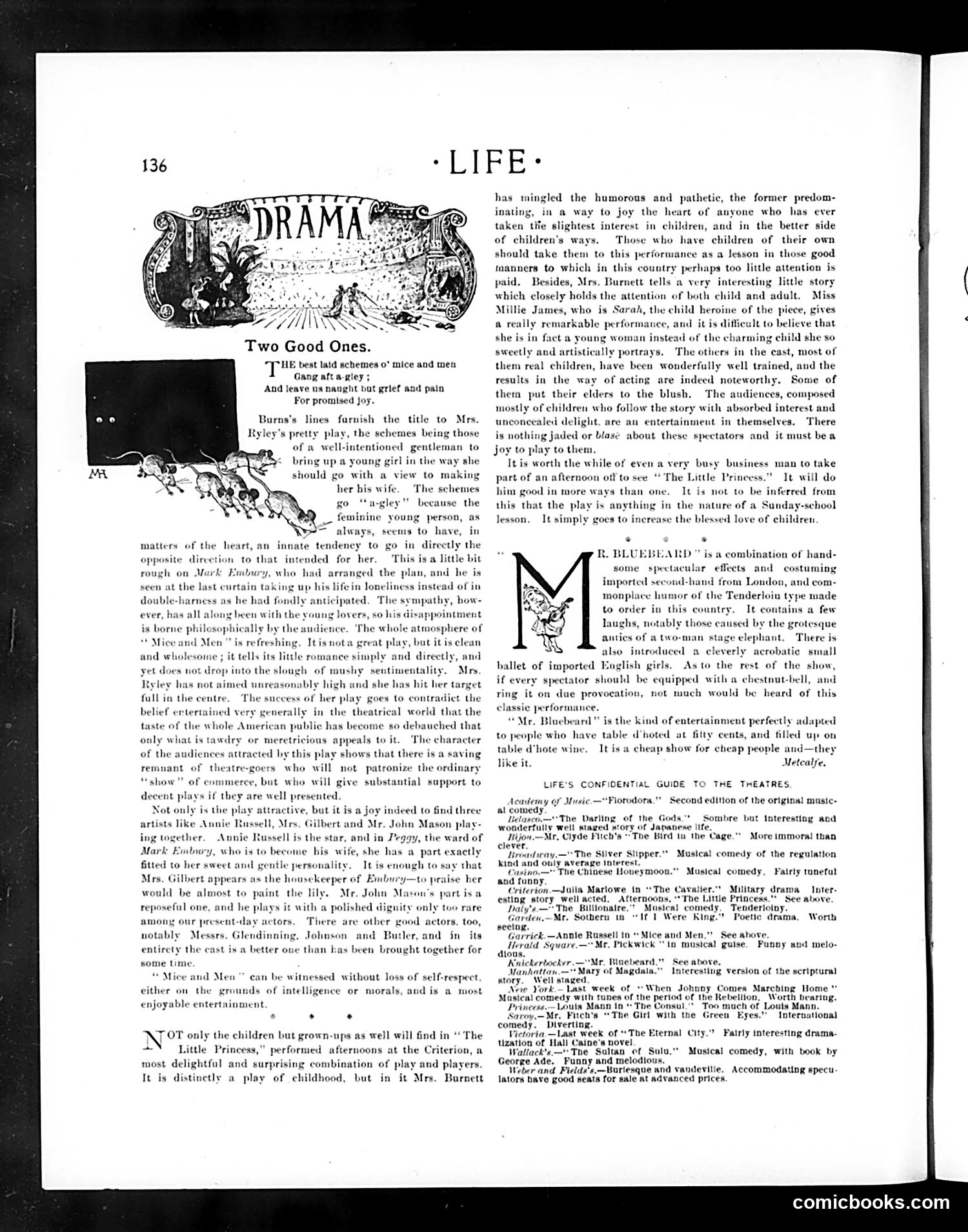
This page reviews theatrical productions, focusing on "Two Good Ones"—plays praised for their quality entertainment value rather than heavy-handed morality. The main cartoon (top left) appears to show figures in a comedic scene, though specific characters are unclear from the image quality. The text critiques Mrs. Burnett's "The Little Princess," performed at the Criterion Theatre with child actress Millie James. The review praises the production as genuinely entertaining rather than didactic, noting it appeals to both children and adults without condescension. The second section reviews "Mr. Bluebeard," describing it as spectacular entertainment with imported English scenery and acrobatic acts—a cheap, accessible show for working-class audiences. The page concludes with a theater guide listing various productions and their merits, treating theater as popular entertainment across social classes.
📄 Transcribed text from this page (OCR, searchable)
Machine-transcribed from the original scan — historical spelling and the odd misread are preserved.
‘LIPE* Two Good Ones. P HE best taid schemes o* mice and men Gang aft a-gley ; And leave us nanght but grief and pain For promised joy. the title to Mrs. the schemes being those Burns's lines furnish Ryley’s pretty play a well-intentioned gentleman to bring upa should go with a view to making her bis wife. ‘The schemes go ‘“a-gley" because the feminine young person, oung girl in the way she always, seems to have, in tendene intended for her matters of th ite dircet rough on Mark seen at the last curtain double-harness as he had f rt, an to go in directly the to that ‘This is a little bit vbury, who had arranged the pl innat and he is aking up his life in loneliness instead of in lly anticipated. The sympathy, how- ing lovers, so his disappointment The whole a ever, has all along been with th is borne philosophically by the audience. “ Miceand Men "is refreshing. Itis nota g and wholesome ; it tells its little ror of mushy sentimentality. mosphere of at play, but it is clean and directly, and Mrs. she has hit her target nce simply t does not drop into the slough: Ryley has not aimed unreasonably high i f her play nerally in the theatrical world that the rican public full in the centre. The success nes to contradict the belief entertained very taste of the whole An only what is tawdry or meretricious appeals to it. T of the audiences attracted by this muant of as become so debauched that character ay shows that there is a saving theatre-goers. who will not patronize the ordinary * of commerce, but who will give substantial support to decent plays if they are well presented Not only is the play attractive, but it is a joy in artists li Ann ing together ed to find three Russell, Mrs, Gilbert and Mr. John Mason play Annie Russell is the star, and in Peggy, t dof Mark Embwry, who is to become his wife, she has a part exactly fitted to her sweet and gentle personality that Mrs, Gilbert appears as the housekeeper ¢ her would be almost to paint the lily. Mr. John Mason's part isa polished dignity only too rare are other good actors, too, and Butler, and in its cast is a better ove than kas been brought together for It is enough to say Embury—to praise reposeful one, and he plays it with among our present-day actors. Th notably Messrs, Glendinning, Johnson entirety th some tit Mi cither on and Men” can be witnessed without loss of self-respect. the grounds of intelligence or morals, and is a most enjoyable entertainment . . . N0T pay the children but grown-ups as well will find in “The +‘ Little Princess,” performed afternoons at the Criterion, a most delightful and surprising combination of play and playe It is distinctly a play of childhood, but in it Mrs. Burnett has mingled the humorous and ps inating, in a way to jo’ taken tife slightest interest in children, and in the better side Those who have children of their own should take them to this performance as a lesson in those good tnanners to which in this country perhaps too little attention is Besides, Mrs, Burnett tells a very interesting little story which closely holds the attention of both child and adult. Miss Millie James, who is Sarah, the child heroine of the piece, gives y remarkable performance, and it is difficult to believe that she is in fact a young woman instead of the charming ehild she so sweetly and artistically portrays. The others in the east, most of them real children, have been wonderfully well trained, and the results in the way of acting are indeed noteworthy. Some of them put their elders to the blush, The audiences, composed mostly of children who follow the story with absorbed interest and. ight. are an entertainment in themselves, There is nothing jaded or Vlase about these spectators and it must be a joy to play to them, It is worth the while of even a very busy business man to take The Little Princess.” It will do It is not to be inferred from is anything in the nature of a Sunday It simply g hetic, the former predom- the heart of anyone who has ever of children’s ways. unconce: part of an afternoon off to see him good in more ways than on this that the pl hool Jesson. es to increase the blessed love of children: ° e . R. BLUEBEARD ” is some spectaculs combination of hand- effects and costuming and from London, and com- ace humor of the Tenderloin type made untry. It contains a few hose caused by the grotesque imported second mony to order iv this © laughs, notably antics of a two-man stage elephant also introduced a cleverly acrobatic small ballet of imported English girls. Asto the rest of the show, if every spectator should be equipped with a chestnut-bell, and ring it on due provocation, not much would be heard of this There is classic performance. “Me. Bluebeard” is the kind of entert to people who have table d'hoted at fi table @hote wine. It is a eh like it. nment perfectly adapted cents, and filled up on show for cheap people and—they Metcalfe, LIFE'S CONFIDENTIAL GUIDE TO THE THEATRES. teademy of Music. —"Florodora.”* al comedy Helasco.—"The Darling wonder Bijon clever. Broadiway.—°The Stiver Slipper.” nd only average interest. Casino.—" The Chinese Honeymoon.” Musical comedy ‘and funny. Criterion —Juiis Marlowe in “The Cavalier.” Military drama esting story well acted. Afternod The Littie Princess.” Daly's — "The Billionaire.” Musical comedy. Gorden.—Mr. Sotheru in “It 1 Were King." seeing. Garrick.—Annie Russell in“ Mice and Men.” See above. Herald Square.—" Mr. Pickwick "to musical guise. Funny and meto- dtous. Knickerbocker.— "Mr. Blaebeard.”” Manhattan.—* Mary of Magdala,” story. Well staged Neio York.— Last week of ‘When Johnny Comes Marching Home " Masical comedy with tunes of the period of the Rebellion, Worth bearing. Princess. Louts Mann to * The Consul." Too mach of Louts Mann. Saroy.—Mr. Fuch’s “The Girl with the Green Eyes.” International comedy. Diverting. Victoria —Last week of “The Eternal City.” Uzation of Hall Caine’s novel Wallack's.—"The Sultan of Sulu," George Ade. Funny and melodious. Weber and Pieds'e,—Buriesque and vandevilie, Accommodating specu lators bave good seats for sale at advanced prices. Second edition of the original masic- of the Gods? Sombre but interesting and ly Well staged story of Japanese life. Mr, Clyde Flu ne Bird iu the Cage.’ More immoral than Musica! comedy of the regulation Fairly tonefut ° Inter- See above. Tenderioiny. Poetic drama, Worth See above, interesting version of the scriptural Fairly interesting drama- Musical comedy, with book by comicbooks.com