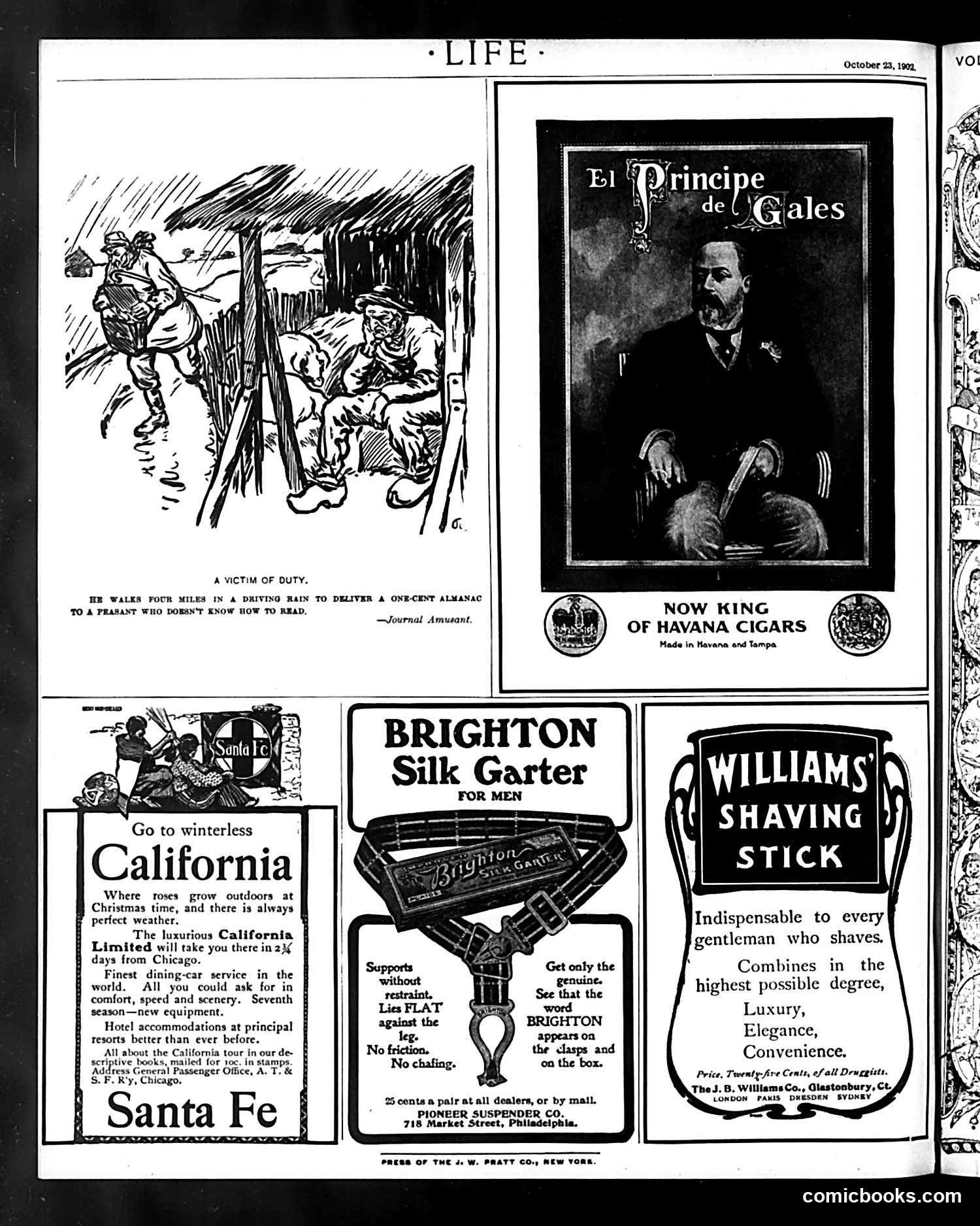
A complete issue · 22 pages · 1902
Life — October 23, 1902
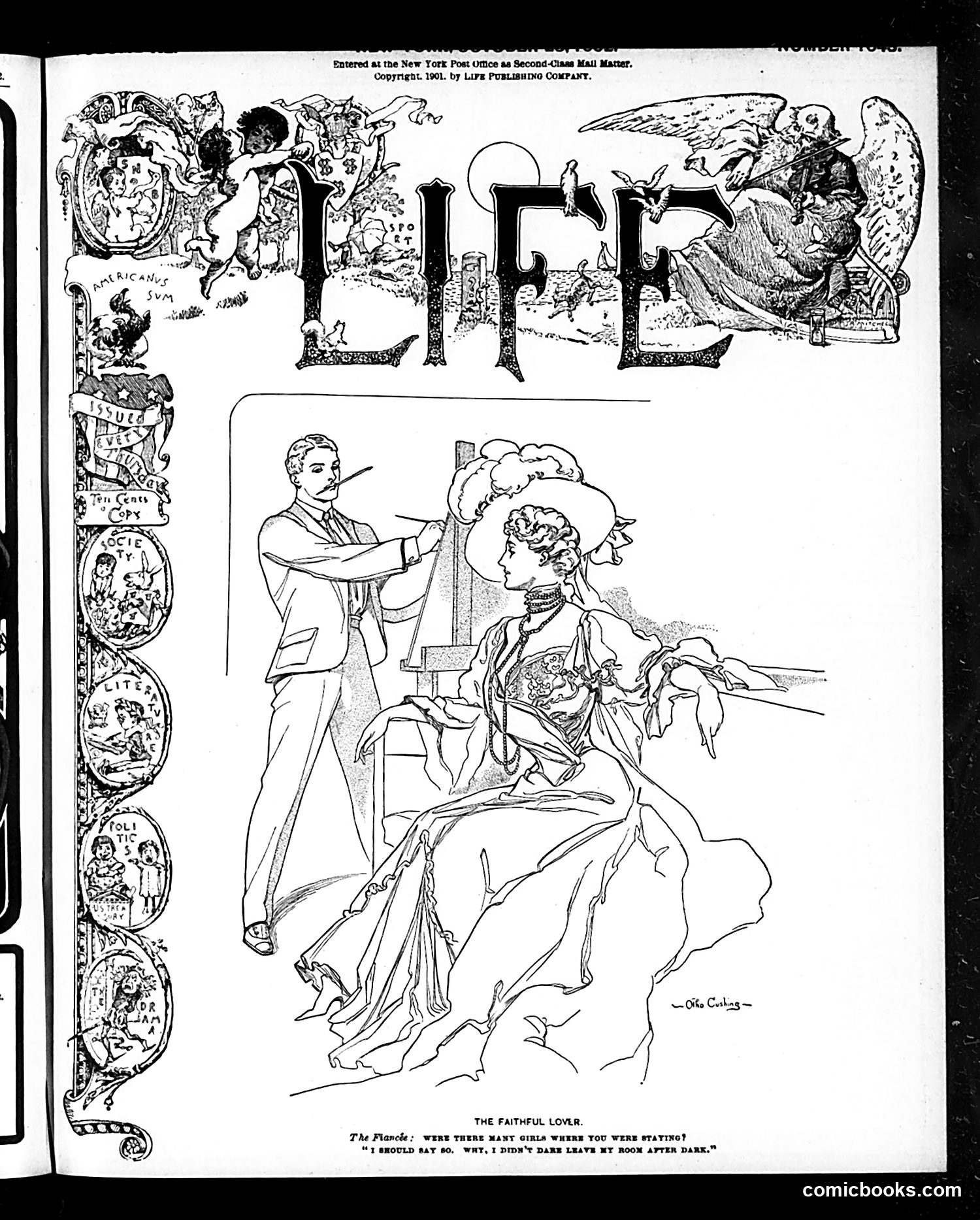
This page from Life magazine (dated November 1901, based on the header) features two main illustrations: **The Decorative Header** presents the word "LIFE" surrounded by ornate Art Nouveau designs with cherubs and classical figures, typical of the magazine's aesthetic. **The Main Cartoon** titled "The Faithful Lover" depicts a scene where a well-dressed man holds up what appears to be a mirror or reflective surface to an elegantly dressed woman. The caption reads: "Were there many girls where you were staying?" / "I should say no. Why, I didn't dare leave my book after dark." This appears to be a humorous domestic or romantic scenario, likely satirizing courtship anxieties or fidelity concerns of the Edwardian era. The joke seems to play on anxieties about a gentleman's whereabouts and the woman's concern about potential rivals.
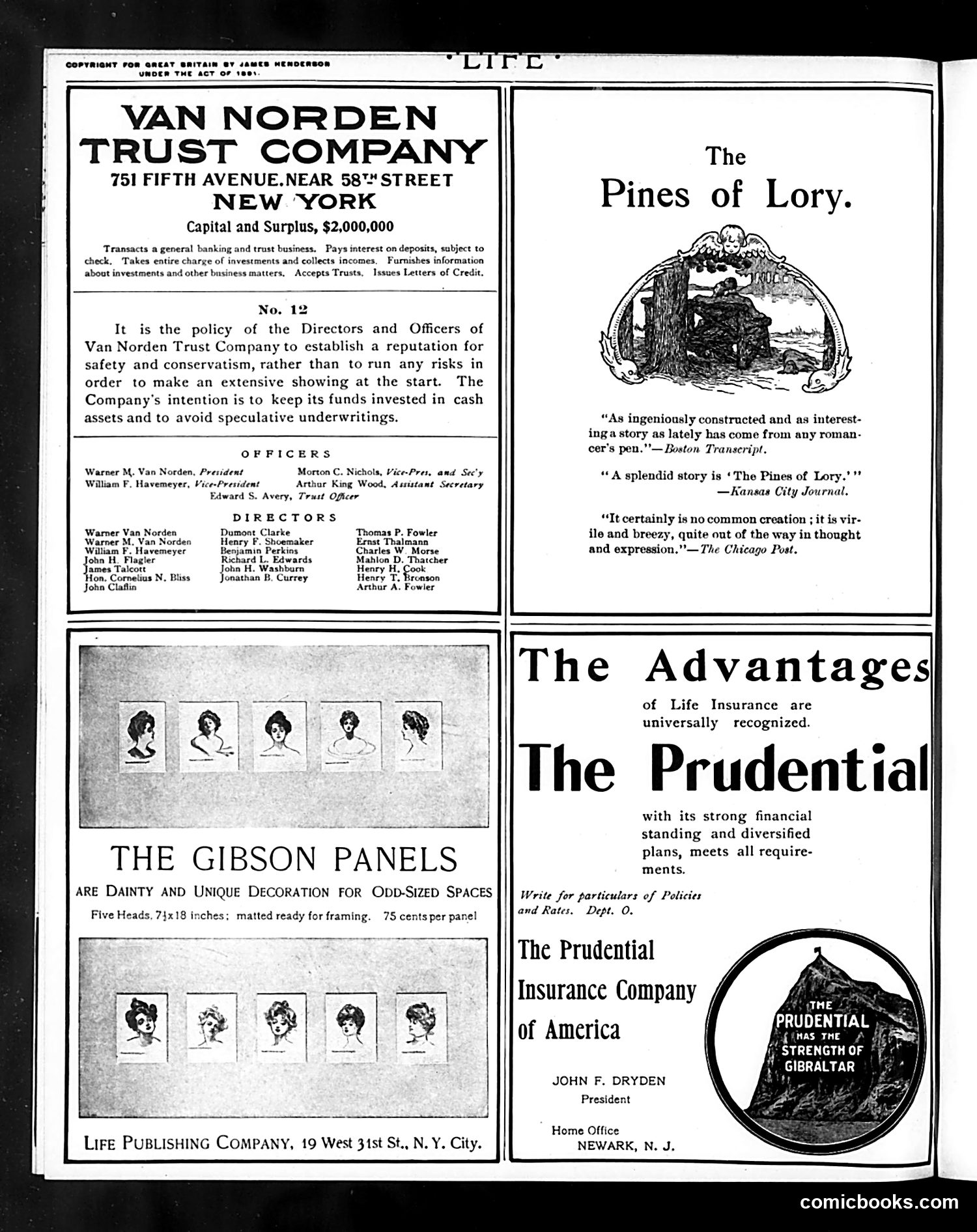
This page consists primarily of **advertisements** rather than editorial cartoons or satirical content. The top left advertises **Van Norden Trust Company**, a New York financial firm emphasizing conservative investment practices and safety over speculative ventures. The right side features ads for **"The Pines of Lory"** (a book praised by period newspapers) and **The Prudential Insurance Company**, using the famous "Rock of Gibraltar" symbol to convey financial strength and stability. The bottom left shows **The Gibson Panels**—decorative illustration sets by Life Publishing Company featuring five female head portraits, marketed as "dainty and unique decoration for odd-sized spaces." The overall page reflects early 1900s advertising priorities: financial security, home decoration, and literature—with no apparent political satire or cartoon content present.
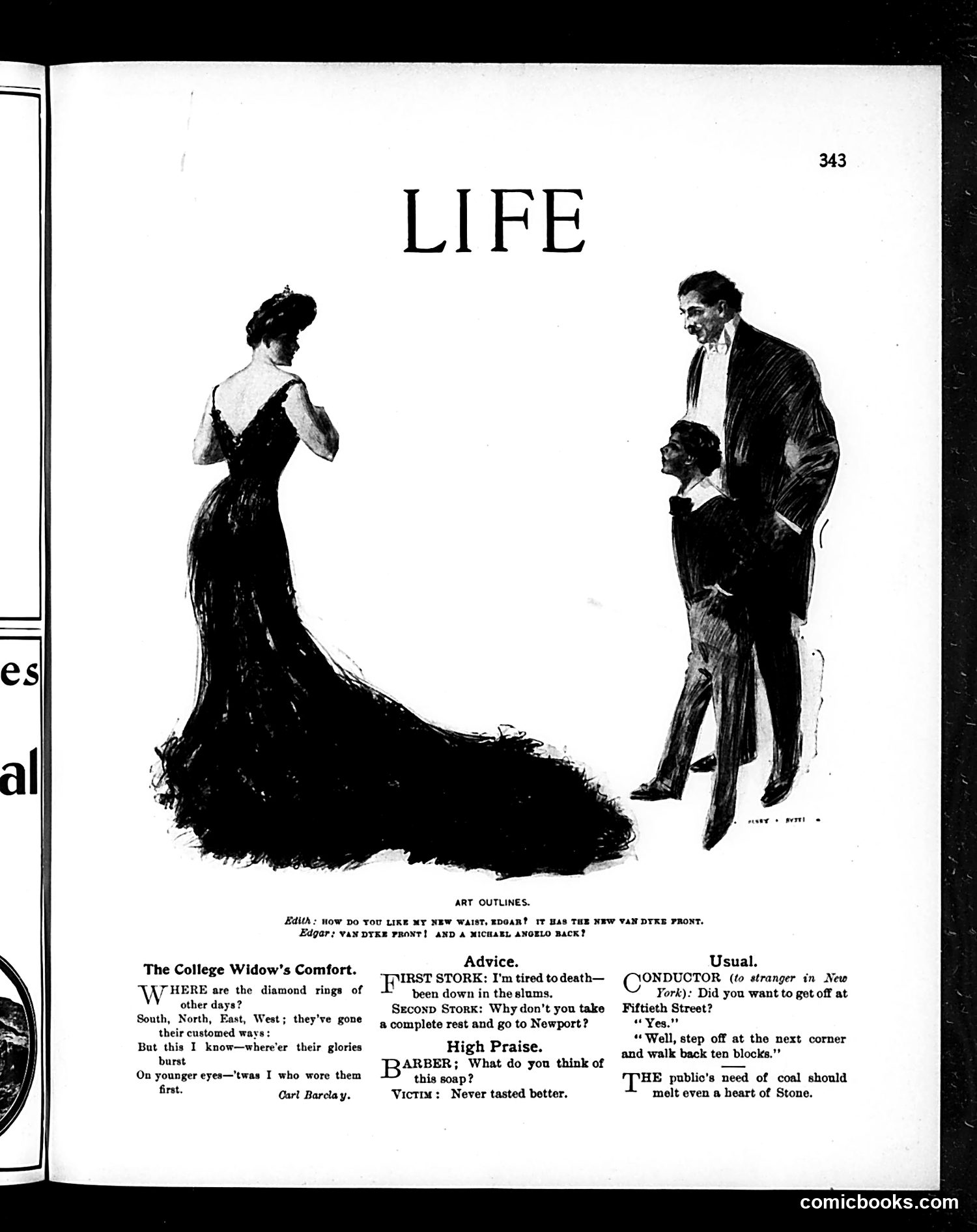
This page from *Life* magazine contains several satirical sketches and brief humorous pieces typical of early 20th-century American humor. The main illustration shows a woman in an elegant black gown viewed from behind, with two men observing her. The caption references "Art Outlines" and jokes about fashion and perspective. Below are four short comedic pieces: "The College Widow's Comfort" (about diamond rings and romance), "Advice" (two store workers discussing fatigue and rest), "High Praise" (a barber and customer exchanging compliments about soap), and "Usual" (a conductor directing a pedestrian on a New York street). The humor is gentle, domestic, and socially observant—focused on everyday situations, class interactions, and contemporary urban life rather than specific political events or figures. The satire targets common human foibles and social conventions of the era.
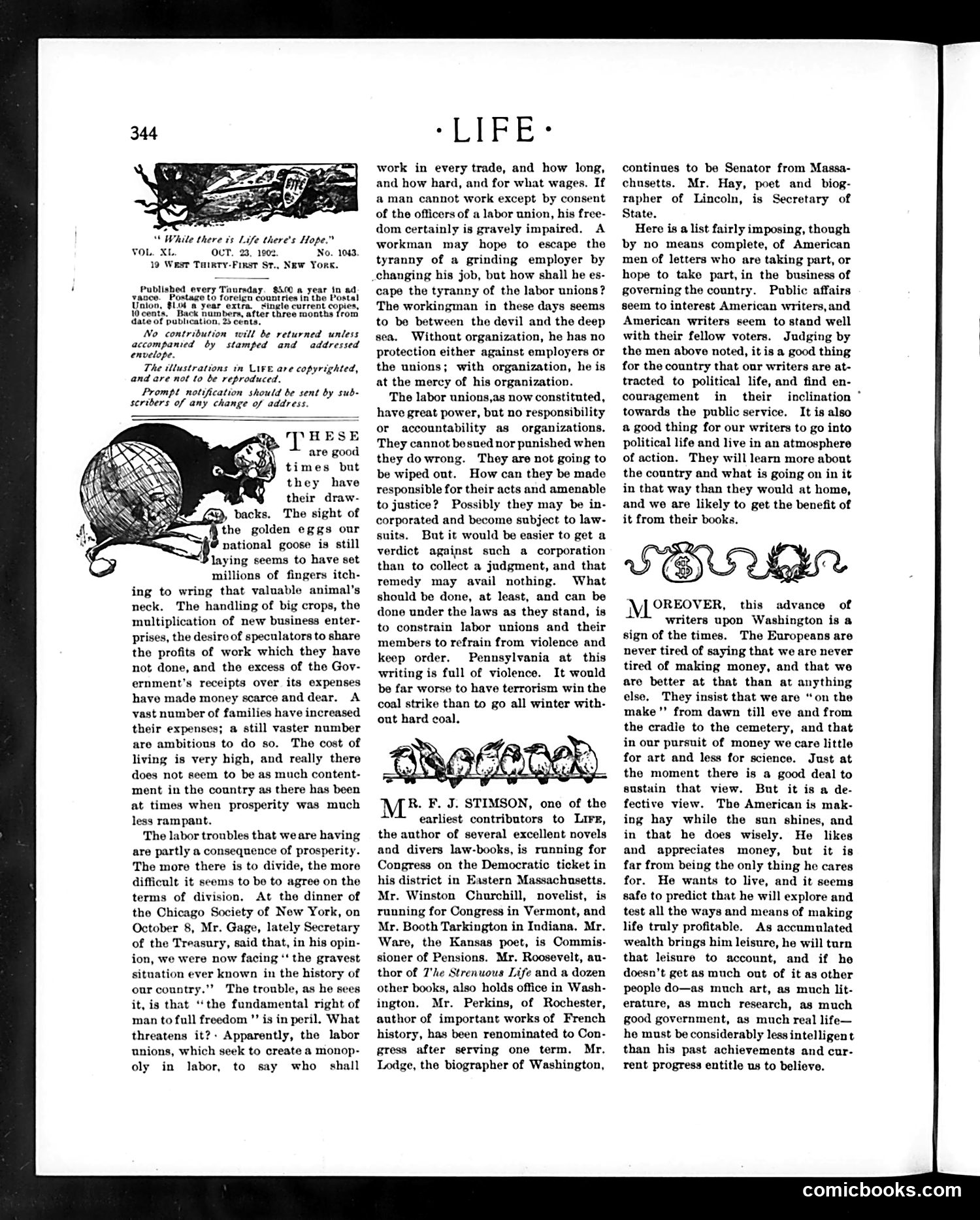
This page combines editorial commentary on labor unions with two illustrations. The main text debates whether labor unions have become too powerful and unaccountable, arguing they should be "wiped out" or reformed to prevent violence. The author expresses concern that unions operate without legal responsibility for their members' actions, citing Pennsylvania coal strikes as examples of union-related violence. The cartoons illustrate labor concerns: one depicts a goose laying golden eggs (representing profitable labor), suggesting employers have exploited workers' productivity. The second shows what appears to be working-class figures, likely representing laborers caught between employer and union pressures. The piece reflects early 20th-century anxieties about labor organization, capitalism, and social order during a period of significant labor unrest and strikes.
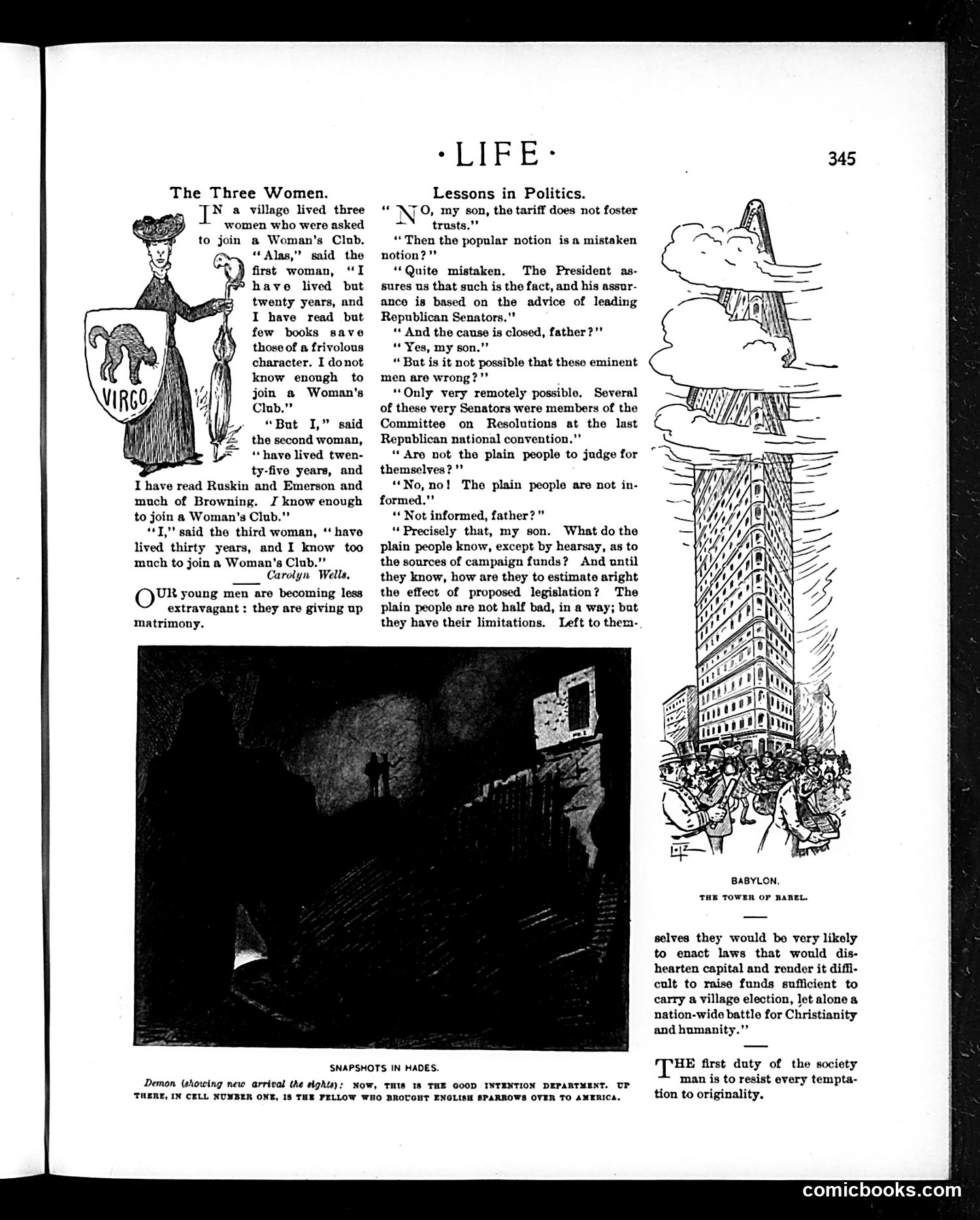
**"The Three Women"** presents a humorous debate about women joining a Woman's Club. Three women discuss qualifications: one cites twenty years of "frivolous" living; another references reading Ruskin, Emerson, and Browning; the third claims thirty years of intellectual pursuits. The joke satirizes women's self-deprecating justifications for club membership and social participation—mocking both intellectual pretension and dismissive attitudes toward women's capabilities. **"Lessons in Politics"** depicts a father-son conversation about tariffs and Republican campaign strategy, suggesting ordinary citizens lack knowledge about complex legislation and campaign funding. The satire critiques both politicians' reliance on elite advisors and the public's political ignorance. **Right illustrations** show "Babylon: The Tower of Babel" and "Snapshots in Hades," using classical/mythological imagery for social commentary. The specific satirical targets remain unclear without additional context.
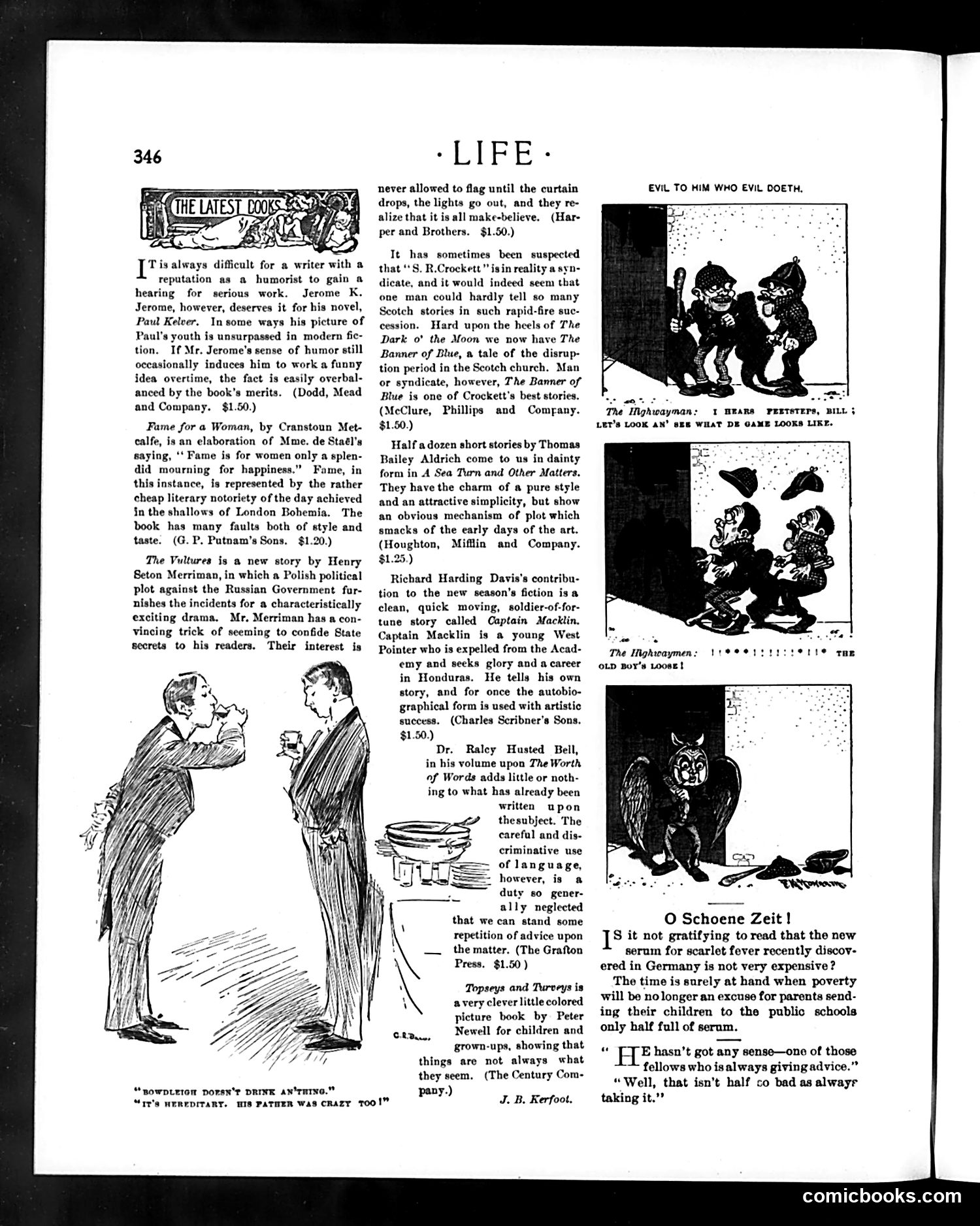
This page primarily contains **book reviews** rather than political cartoons. The main illustration shows two men in conversation—one appears to be offering unsolicited advice to the other, who looks exasperated. The caption reads: "SWORDFISH DORA'S DRINK AN'TUTTO" / "IT'S HEREDITARY. HIS FATHER WAS CRAZY TOO!" This is a **humorous commentary on unwanted advice-giving**—a social satire about the tendency of people to offer dubious counsel. The hereditary joke suggests foolishness runs in families. The page also includes illustrations related to reviewed books, including what appears to be fantastical or satirical imagery (demons, creatures), but these accompany literary criticism rather than political commentary. The content focuses on cultural criticism of contemporary fiction and literature.
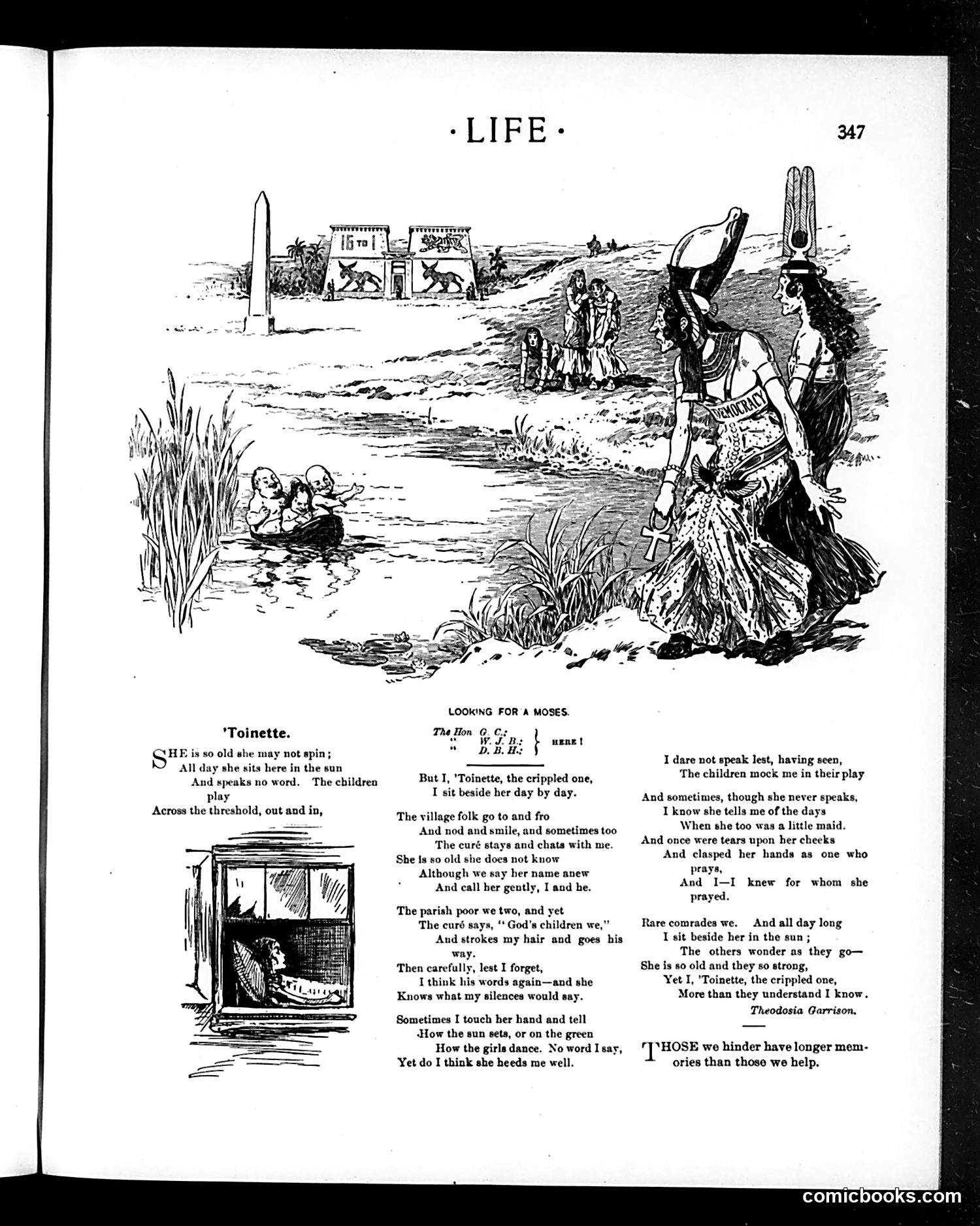
This page from *Life* magazine contains a poem titled "Toinette" by Theodosia Garrison, illustrated with period engravings. The content is not political satire but rather sentimental Victorian poetry about a disabled girl named Toinette who "cannot spin" and "speaks no word" yet is beloved by her village community. The main illustration depicts an Egyptian riverside scene labeled "Looking for a Moses," showing figures in classical dress by water with palm trees and ancient architecture. This appears to be a literary illustration rather than commentary—likely accompanying or referencing the poem's themes of care for a vulnerable, speechless child. The page demonstrates *Life*'s mix of social commentary, literature, and illustration typical of late 19th/early 20th-century American magazines.
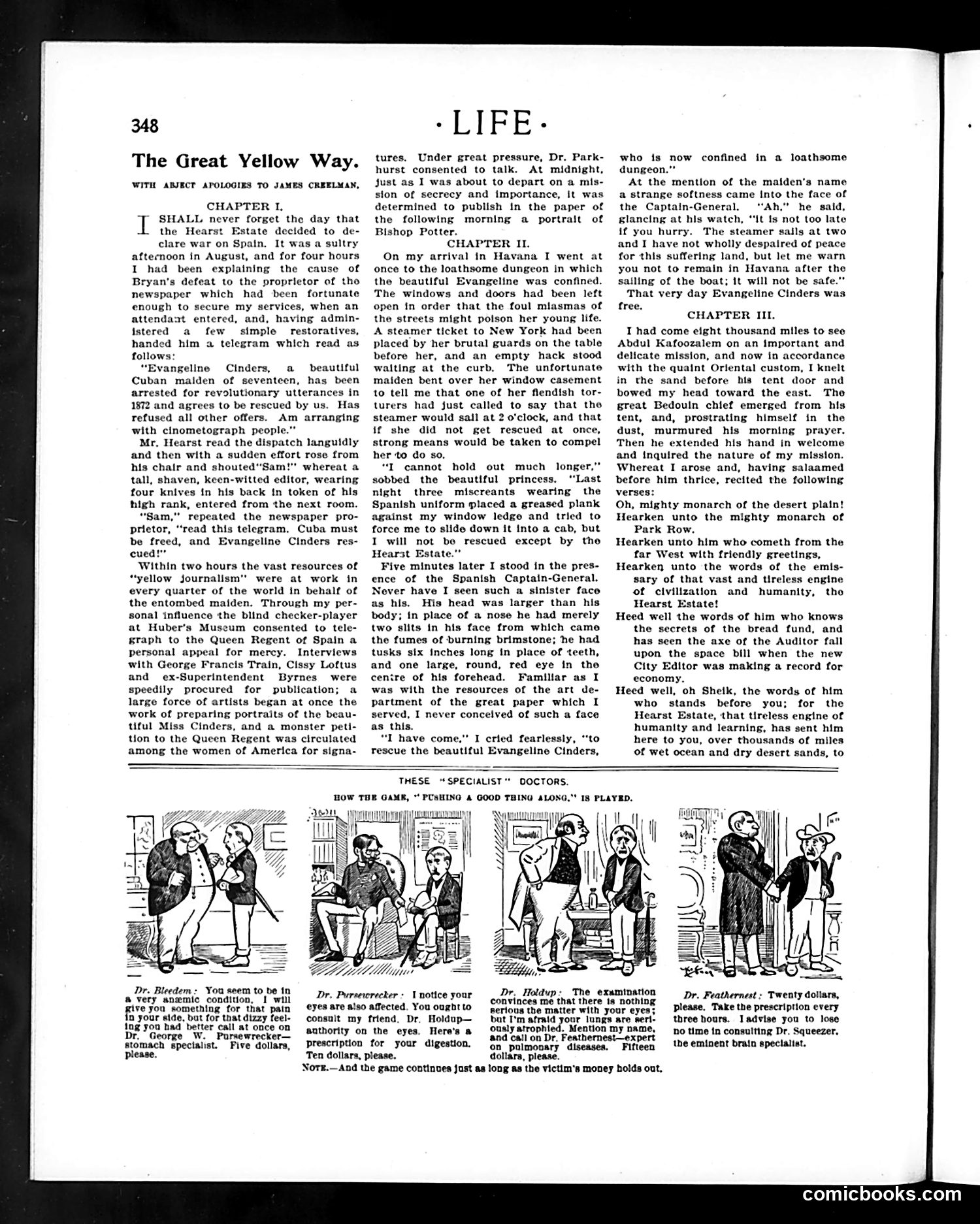
This page contains the opening of a serialized fiction story titled "The Great Yellow Way" (with apologies to James Cheesman). The narrative follows a journalist's investigation into the detention of a woman named Evangeline Cinders in a Cuban dungeon, eventually leading to a rescue mission. Below the story text is a satirical cartoon titled "These 'Specialist' Doctors: How the Game, 'Pushing a Good Thing Along,' Is Played." It depicts four fraudulent physicians each claiming expertise in different ailments (digestive problems, heart conditions, eye disorders, and nervous diseases) while charging fees to desperate patients. The satire critiques medical quackery and doctor overspecialization—showing how con artists exploit sick people by pretending to be specialists, with the note that "the game continues just as long as the victim's money holds out."
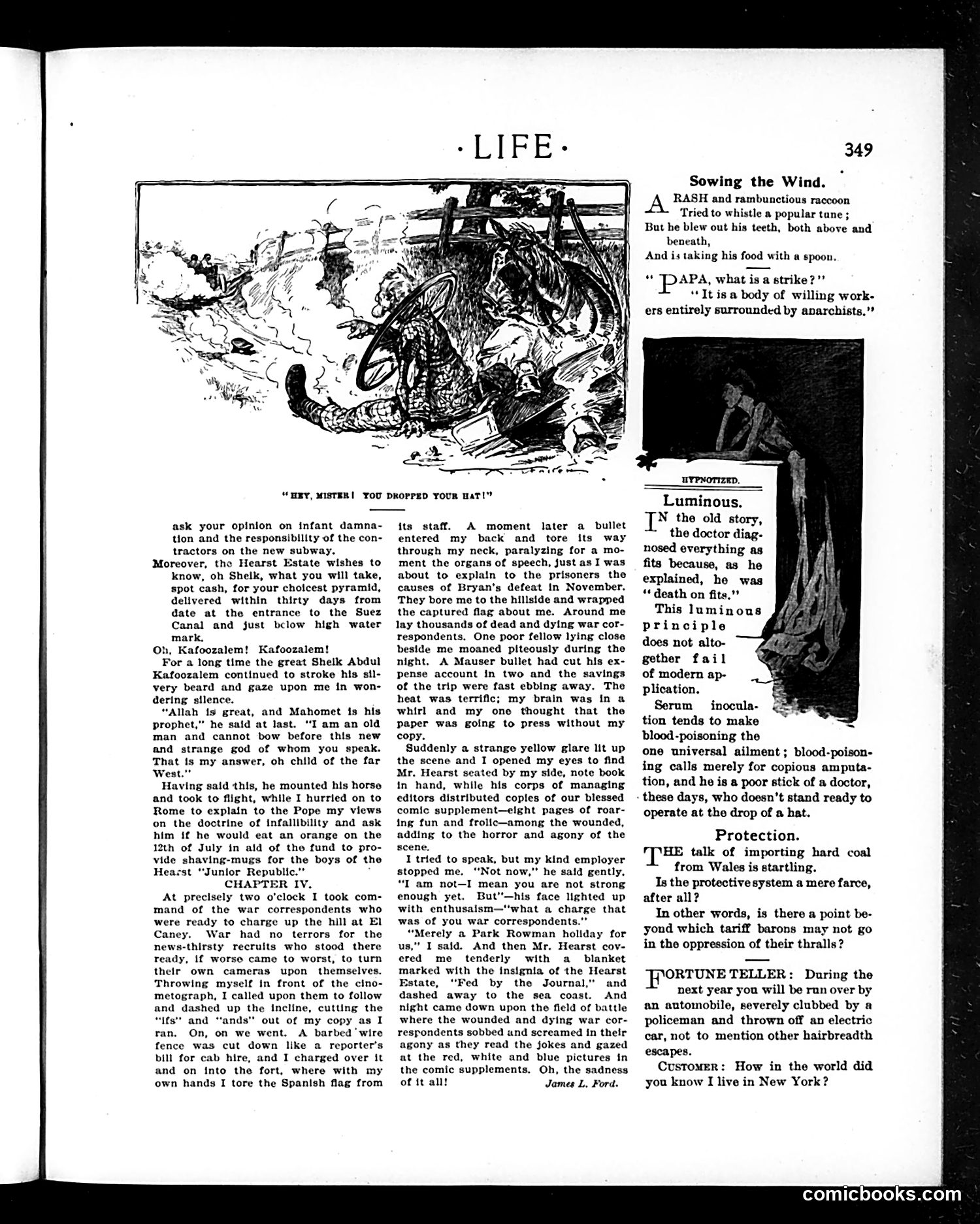
This page features a satirical cartoon and accompanying text mocking labor unrest. The main illustration depicts a disheveled raccoon character whistling while eating with a spoon—a visual metaphor for someone indifferent to chaos around them. The accompanying dialogue contains a father-child exchange where the child asks about a "strike." The father responds it's "a body of willing workers entirely surrounded by anarchists"—a barbed joke reflecting early 20th-century American anxieties about labor movements and radical political ideology. The cartoon satirizes wealthy industrialists' dismissive attitudes toward worker organizing, portraying strikes as dangerous chaos orchestrated by extremists rather than legitimate labor grievances. This reflects the period's deep class tensions and establishment fear of socialist/anarchist influence in labor movements.
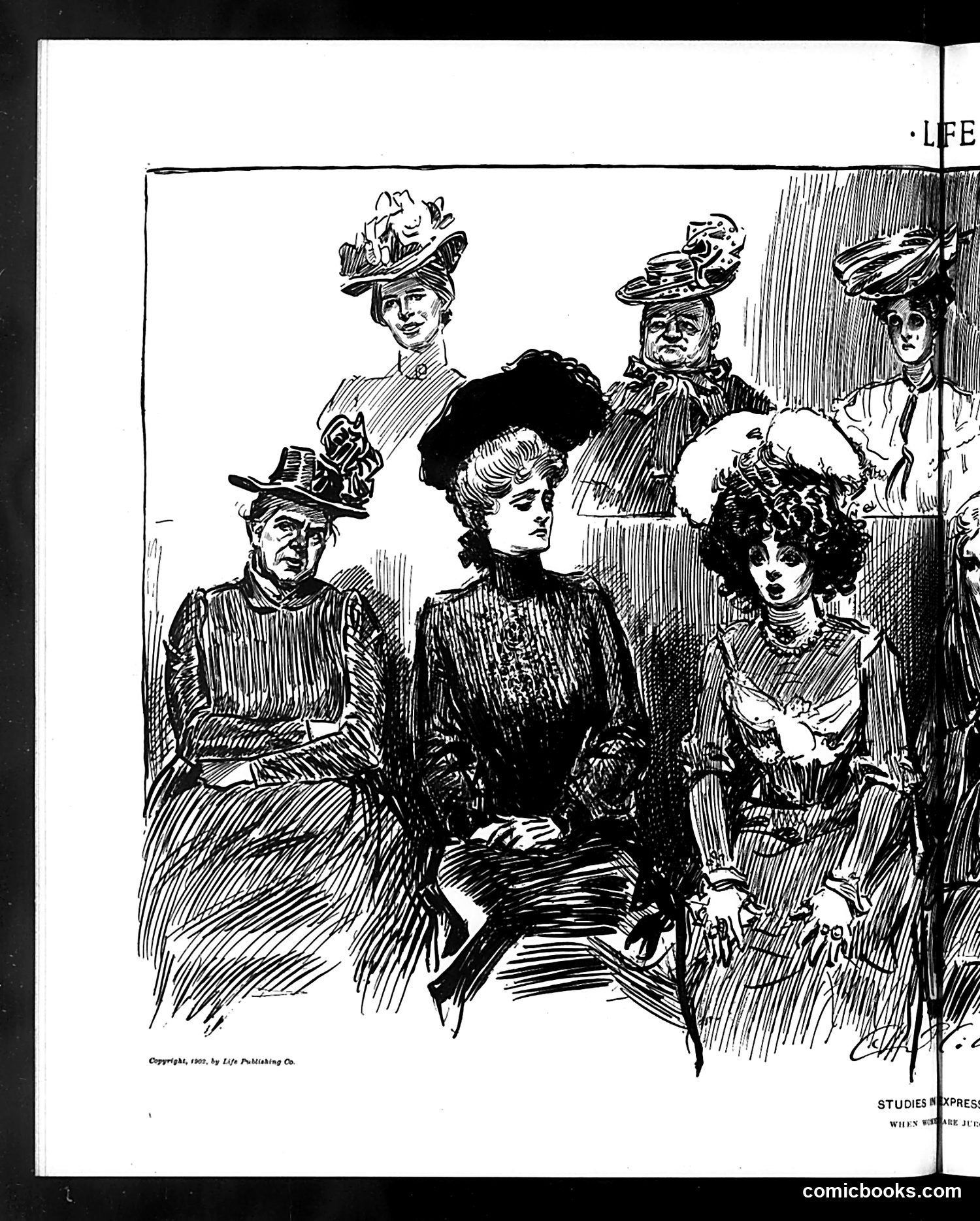
This appears to be a social satire illustration from *Life* magazine depicting fashionable women of the early 1900s. The sketch shows seven elegantly dressed figures wearing elaborate hats adorned with feathers and decorative elements—typical of the Edwardian era's extravagant millinery styles. The satire likely targets the conspicuous consumption and absurdity of high-society women's fashion, particularly the impractical enormity of their hats. The women's serious expressions contrast with their ridiculous headwear, suggesting mockery of how fashion-obsessed society women took themselves seriously while wearing objectively absurd clothing. The copyright attribution to "Life Publishing Co." and the artist's signature are visible. The title partially reads "STUDIES IN EXPRESS" (text cut off), suggesting this may be part of a series examining contemporary social types or expressions.
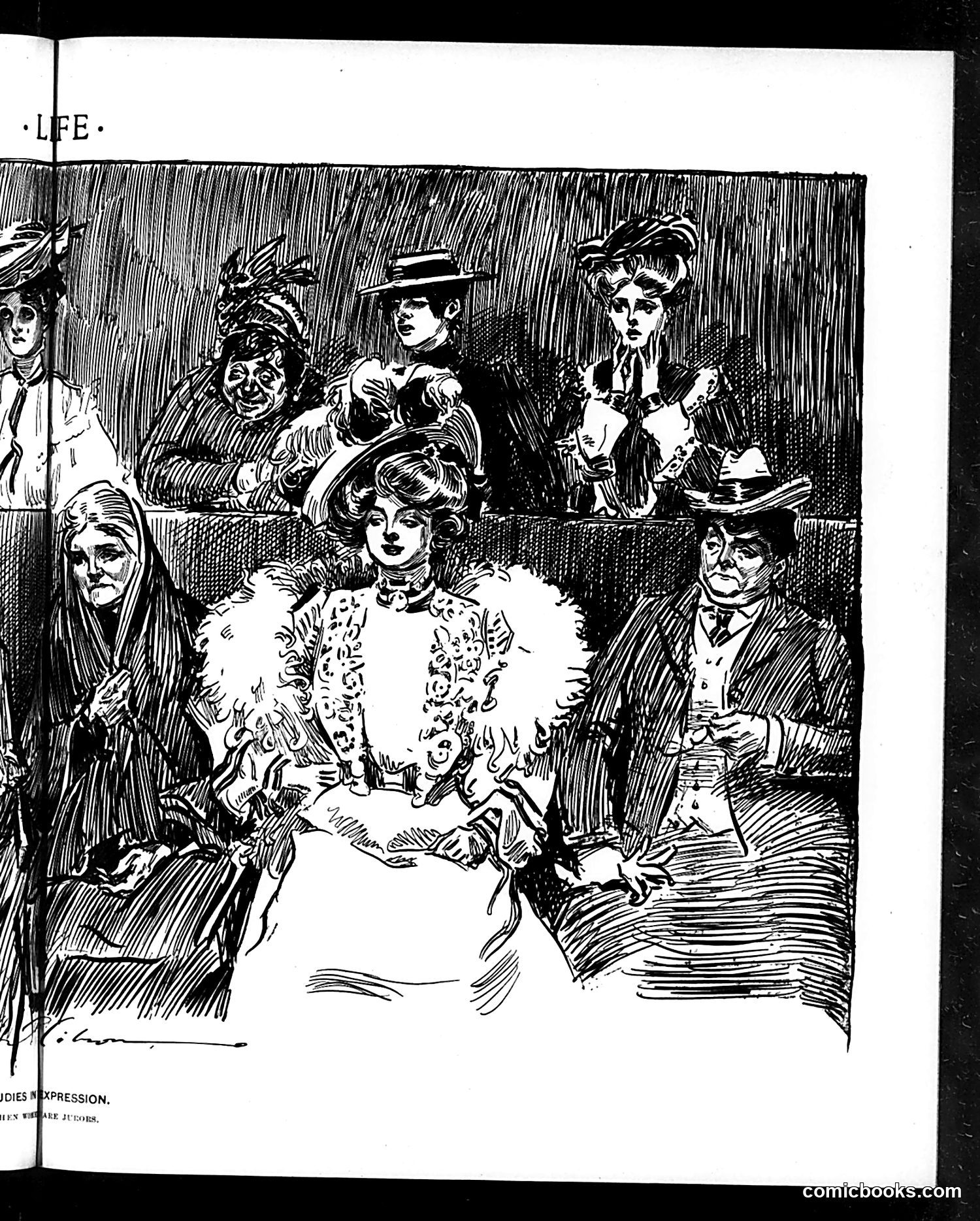
This satirical illustration depicts what appears to be a theater or opera box scene from the early 20th century. The cartoon critiques high society's performative nature and excessive fashion consumption. The central figure is a fashionably dressed woman wearing an extravagant fur-trimmed gown—the visual joke likely targets the era's ostentatious wealth display among the upper classes. She's surrounded by various attendees in formal dress, including figures in the background wearing elaborate hats and accessories. The satire appears to mock the frivolity and vanity of wealthy society women, their obsession with fashionable appearance, and their prominent public display at cultural venues like theaters. The exaggerated rendering of clothing and accessories emphasizes the absurdity of such conspicuous consumption during this period. The page header "LIFE" confirms this is from the well-known American humor magazine.
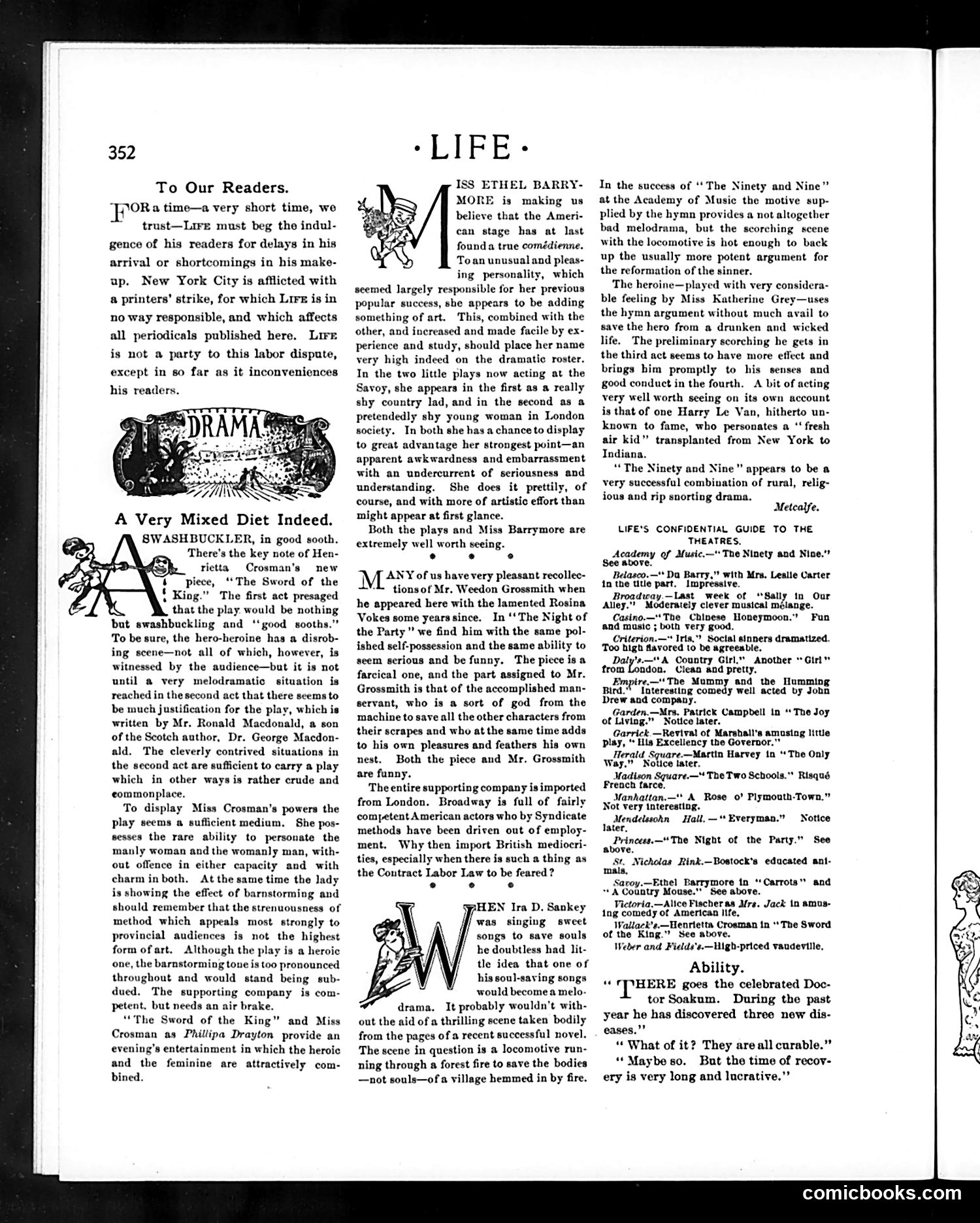
This page reviews theatrical productions, with one cartoon satirizing a play called "The Sword of the King." The cartoon depicts an **Swashbuckler character** (recognizable by the theatrical sword-fighting pose) in what appears to be an absurd or over-the-top dramatic moment. The satire critiques the play's melodramatic quality—the text notes it involves "swashbuckling and 'good sooths'" and reaches "a very melodramatic situation." The joke seems to be that such theatrical fare offers entertainment that's entertainingly ridiculous rather than artistically serious, hence the "mixed diet" reference to varied theatrical fare of questionable quality being served to audiences.
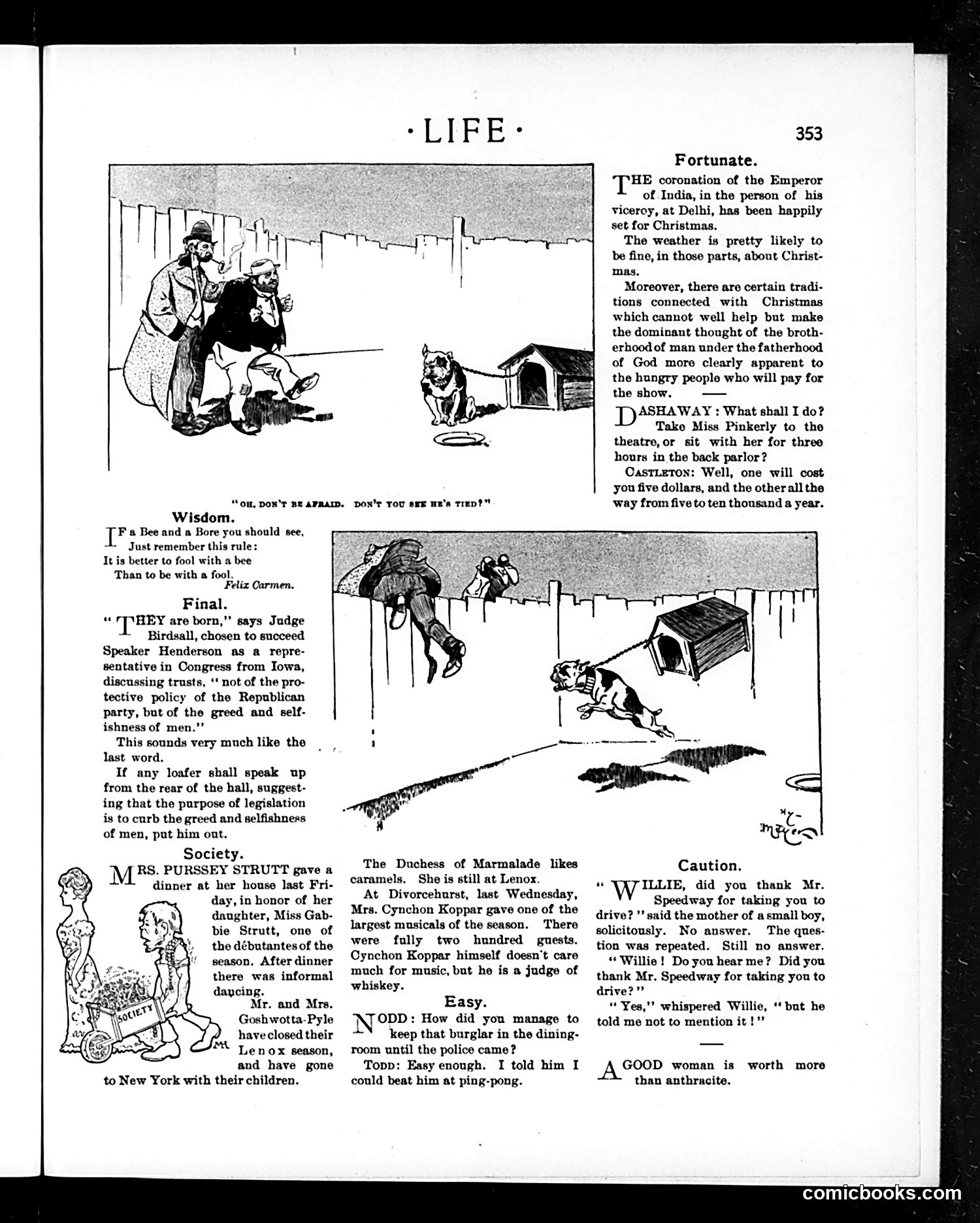
This page contains **satirical commentary and humor** typical of early 20th-century Life magazine: **The cartoons** show domestic scenes with social commentary. The top illustration depicts a child reassuring a nervous adult about a tied dog, symbolizing false security. Below, a scene shows someone entertaining a burglar with ping-pong—the joke being that distraction (or entertainment) can accomplish what force cannot. **The "Final" section** mocks Judge Birdsall's sanctimonious statement about trusts arising from human greed rather than Republican policy, sarcastically suggesting this is the "last word" on the matter—implying politicians use such rhetoric to avoid real reform. **The "Society" section** parodies high-society gossip, poking fun at the wealthy's trivial pursuits and marital troubles (the Koppar musical mentions the husband's whiskey judgment, hinting at infidelity). **The humor** throughout targets hypocrisy: wealthy people's shallow concerns, political evasion of responsibility, and the gap between stated values and actual behavior. The magazine assumed readers shared skepticism toward both politicians and the upper classes.
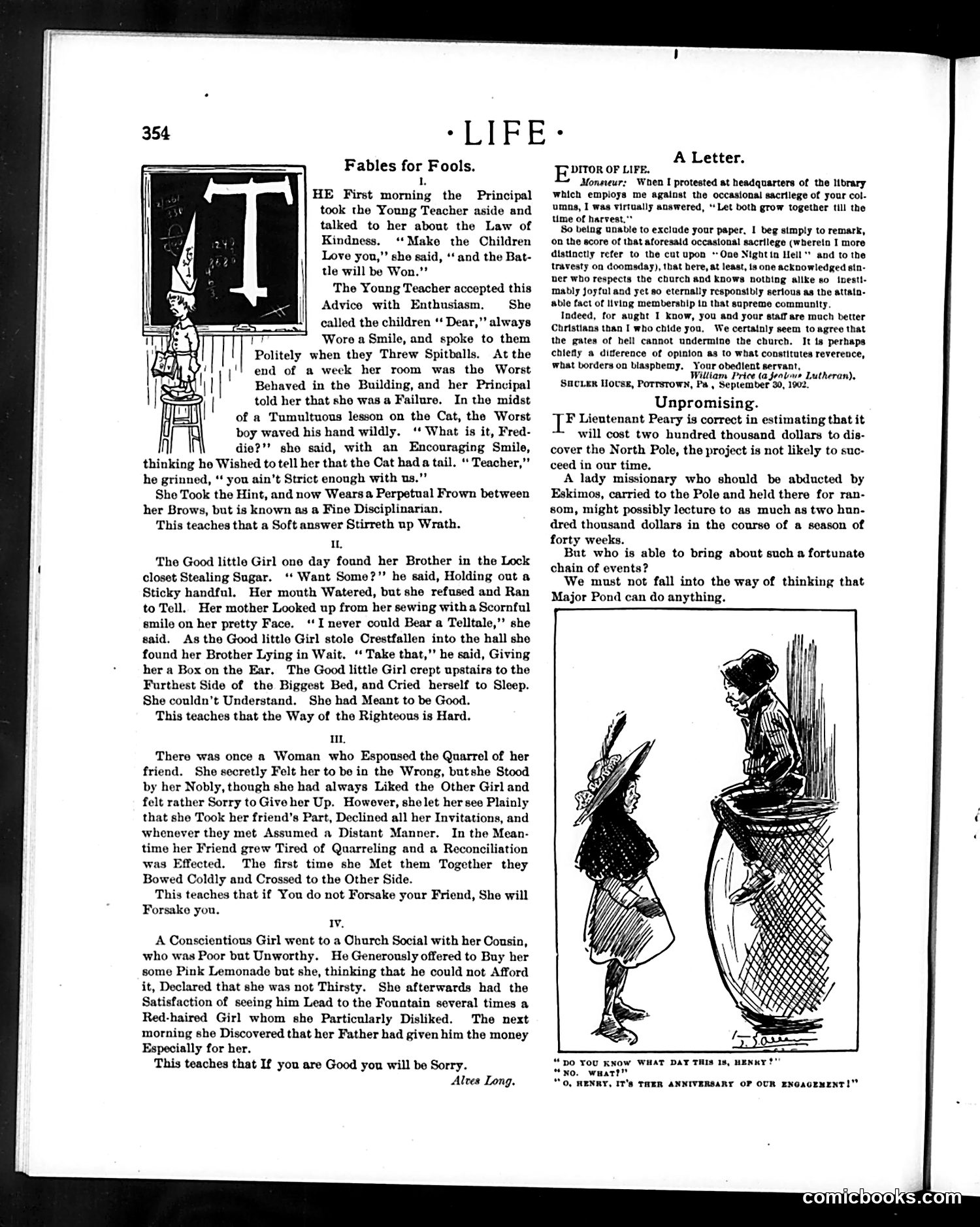
This page contains two distinct sections: **"Fables for Fools"** — a satirical series of four morality tales that subvert conventional wisdom. Each fable presents a "lesson" that contradicts what readers expect: 1. A kind teacher fails; students respect only strictness 2. A girl who reports wrongdoing gets punished by her brother and mother 3. A woman loyally supports her friend but loses both friendships anyway 4. A modest girl refuses refreshment to avoid burdening her cousin; he spends money on another girl instead, and her father had funded him anyway The satire targets naive moral instruction and suggests that virtue often goes unrewarded or backfires in real life. **"A Letter"** — a response from a library employee protesting Life's occasional irreverent content (referencing past cartoons mocking religious themes). The writer defends both the church and Life's right to publish, claiming sincere faith coexists with satire. **The cartoon** (right side) appears unrelated—showing two figures in apparent conversation, captioned about an engagement anniversary. The page demonstrates Life's satirical approach to both morality and religion circa early 20th century.
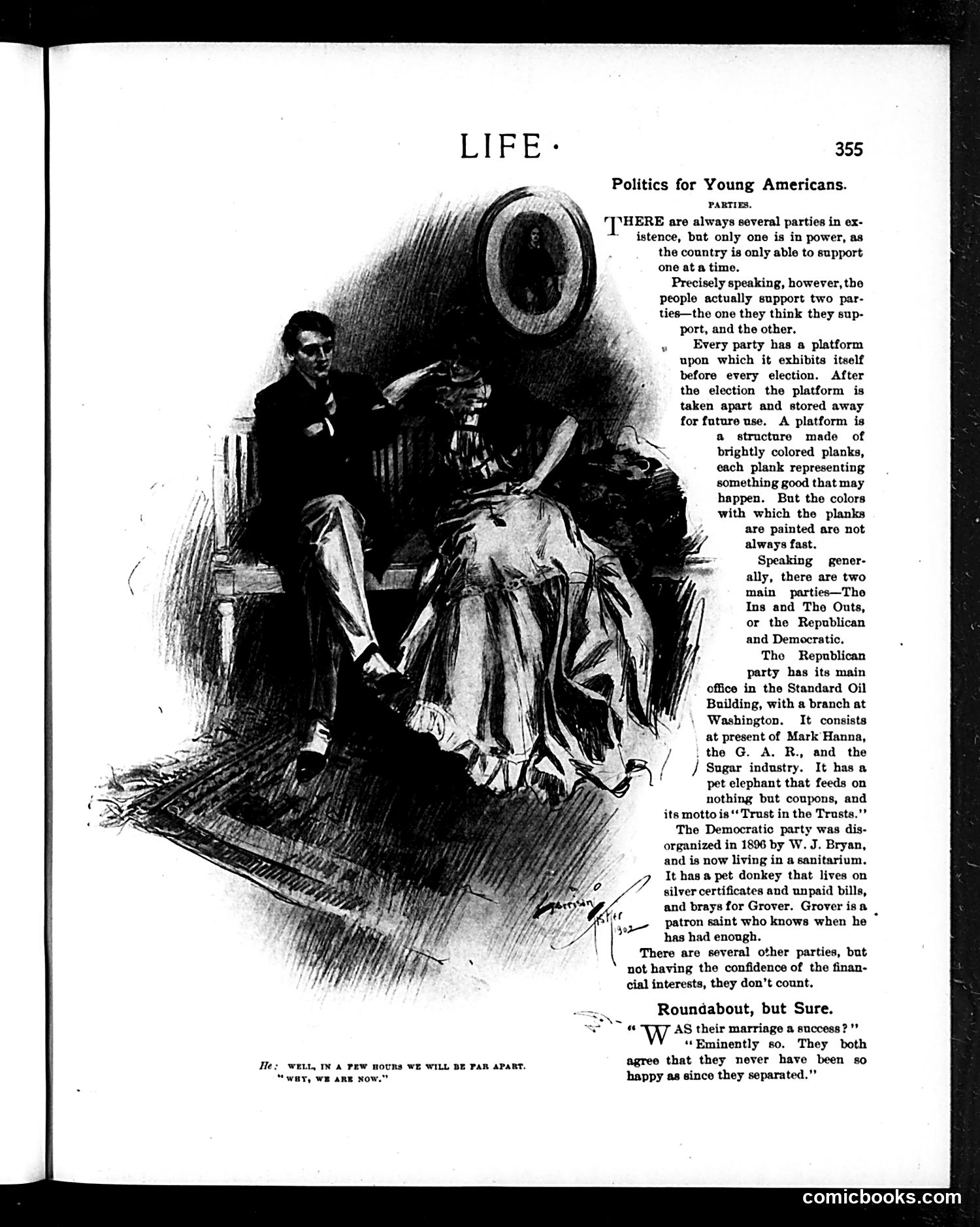
This Life magazine article satirizes American political parties circa 1896-1900. The text mockingly explains that only two parties matter: Republicans ("The Ins") and Democrats ("The Outs"). The satire targets specific figures and issues: - **Mark Hanna** (Republican power broker) and the **Sugar industry** are depicted as controlling Republicans - Republicans are portrayed as servants of **trusts and monopolies** (the Standard Oil reference) - **William Jennings Bryan** allegedly disorganized Democrats in 1896; the party is jokingly "in a sanitarium" - Democrats are reduced to advocating **free silver** (silver certificates) - **Grover Cleveland** is invoked as a Democratic icon The cartoon illustration shows a couple parting, supporting the final joke: a marriage succeeds because the couple "never have been so happy as since they separated"—implying American politics functions through mutual opposition rather than genuine cooperation. The overall message: both parties are corrupted by special interests and exist mainly to oppose each other.
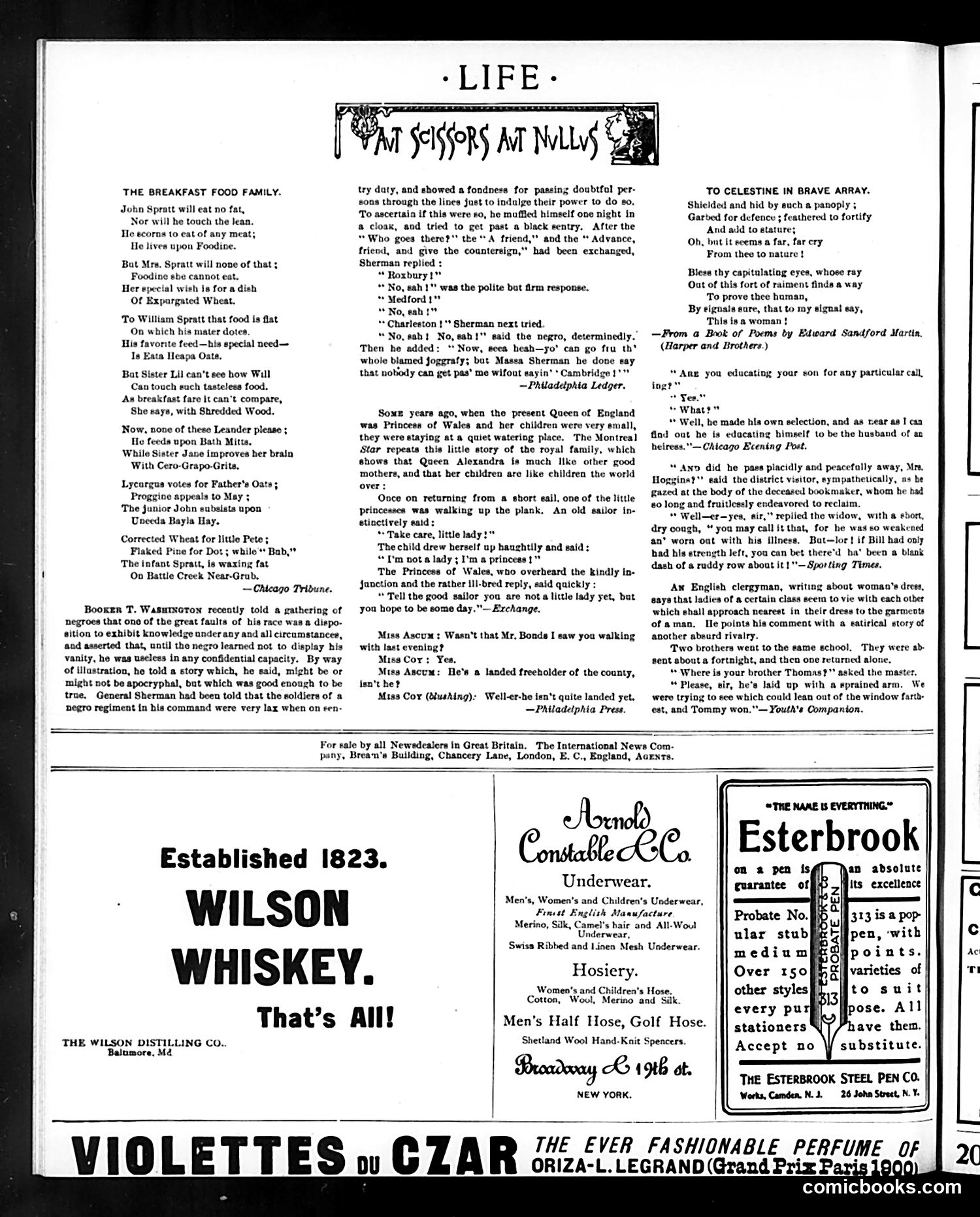
This page contains three distinct pieces of satirical content: **"The Breakfast Food Family"** parodies the explosion of newly-marketed breakfast cereals in early 20th-century America. The joke lists fictional grain products (Foodine, Expurgated Wheat, Eata Heapa Oats, Shredded Wood, Cero-Grapo-Grits) that satirize real breakfast brands flooding the market. Each family member inexplicably prefers a different cereal, mocking aggressive advertising that convinced consumers each product offered unique benefits. **The General Sherman anecdote** presents a racial stereotype: a Black sentry takes pride in following orders so literally he refuses even Sherman passage, then boasts that "Massa Sherman" forbids anyone saying anything *but* "Cambridge." The satire appears directed at both Sherman's critical claims about Black soldiers' vanity and the absurdity of his illustrative story itself. **The Princess anecdote** shows Queen Alexandra gently correcting her child's haughty correction of a sailor—a domestic lesson in humility dressed as royalty humor. The remaining content is period advertising.
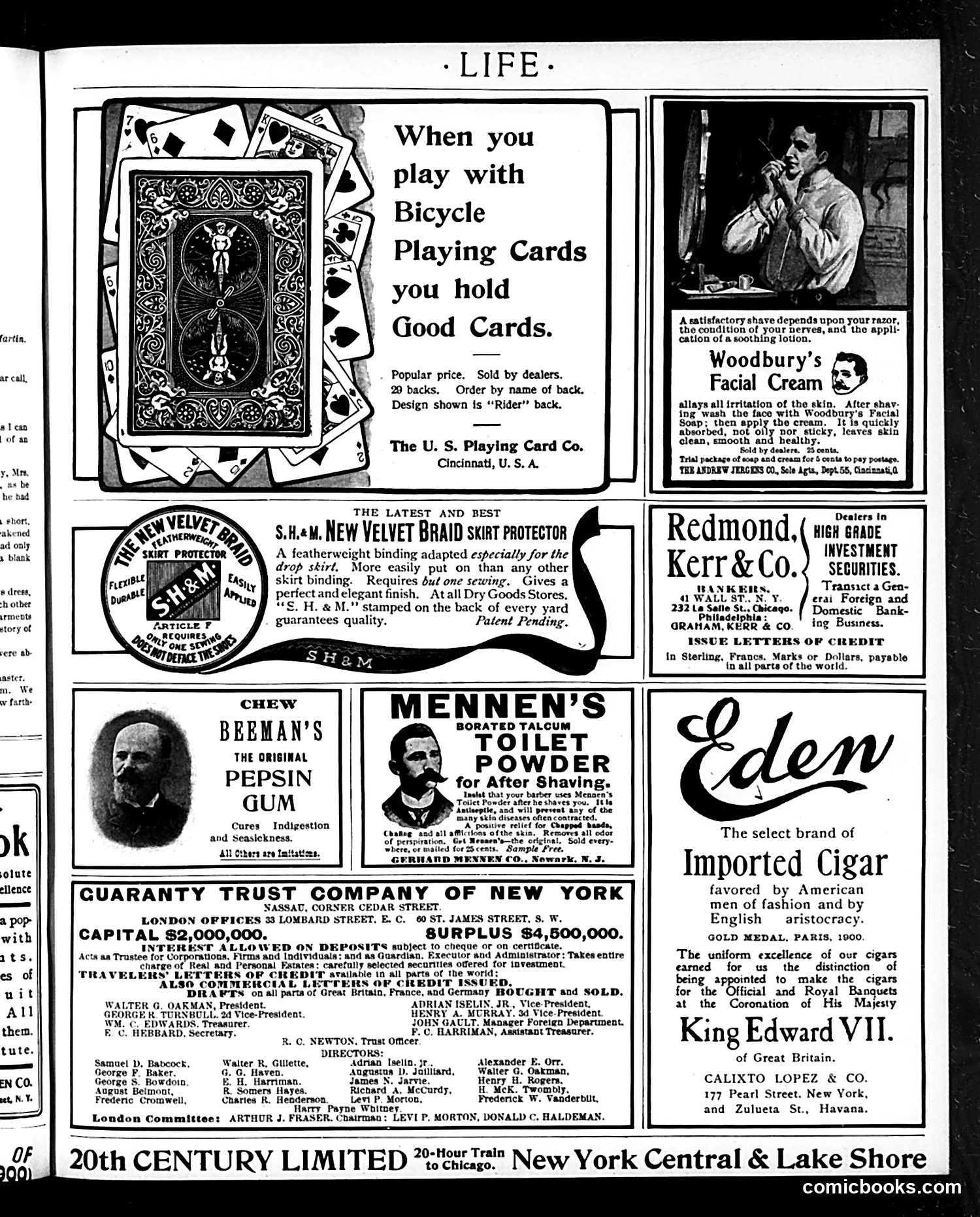
This page is primarily advertising, containing no political cartoons or satirical content. Rather, it consists of early 20th-century product advertisements and financial notices aimed at affluent readers. The ads showcase period consumer goods (playing cards, shaving cream, skirt bindings, chewing gum, talcum powder, cigars) and banking services. Notably, the Guaranty Trust Company of New York advertisement emphasizes its large capital ($2,000,000) and surplus ($4,500,000), targeting wealthy clients and investors. The Eden cigar ad specifically mentions the "Coronation of His Majesty King Edward VII," dating this page to around 1902-1910. These advertisements collectively reflect the commercial concerns and luxury consumption patterns of the American upper class during the Progressive Era.
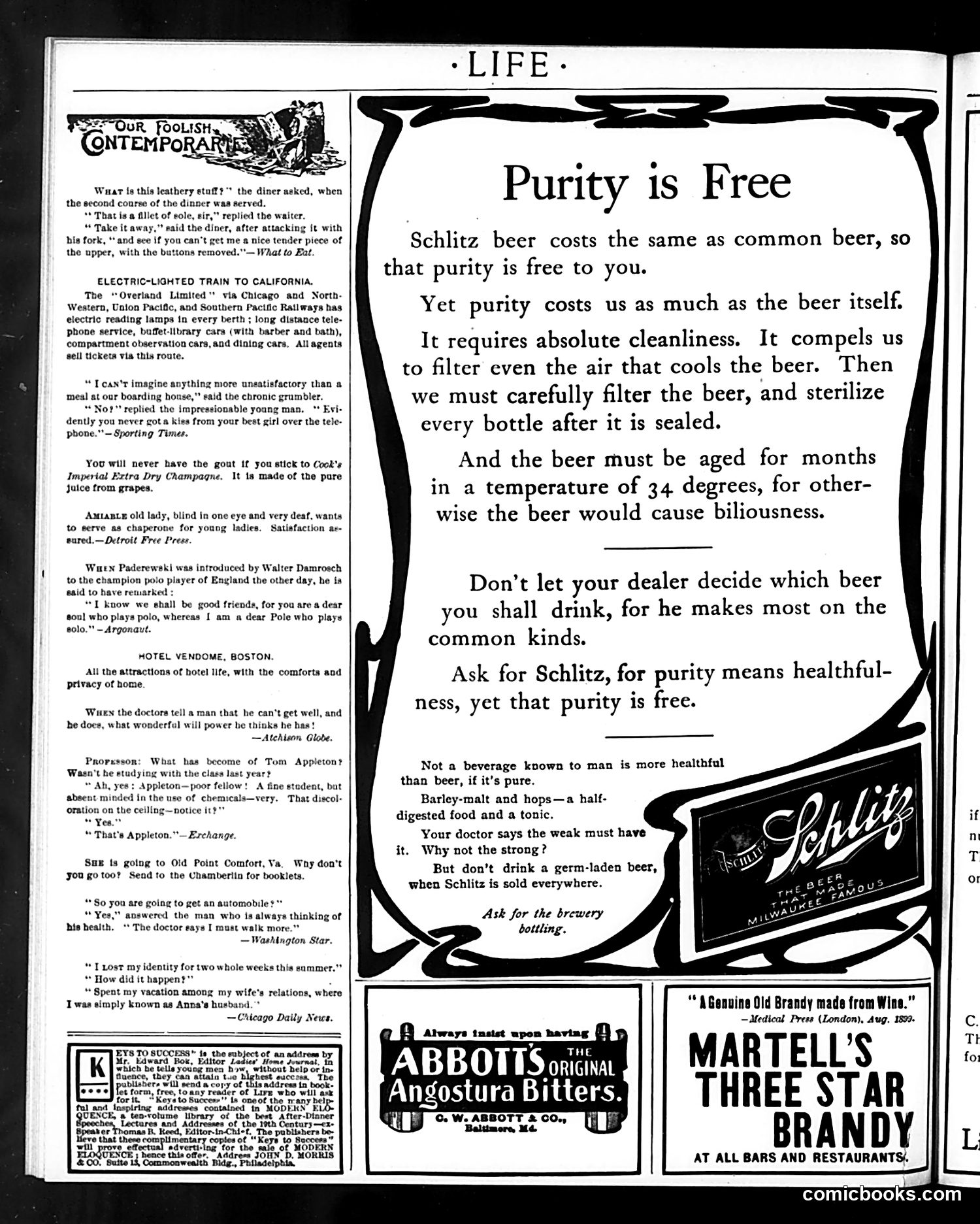
This page from *Life* magazine contains satirical short jokes and advertisements, primarily from the early 1900s. **The Satire:** The left column features "Our Foolish Contemporaries"—brief comedic anecdotes mocking human folly. These include complaints about tough restaurant food, a chronic grumbler's pessimism, and absent-minded academics. The humor relies on wordplay and absurdist reversals (e.g., a man wanting to walk more despite an automobile). **The Advertisement:** The dominant right-side advertisement is for Schlitz beer, marketing "purity" as a health benefit while paradoxically claiming purity costs nothing to consumers. The ad employs pseudo-scientific claims about filtration, sterilization, and temperature control to distinguish Schlitz from "germ-laden" competitors. It targets health-conscious drinkers and warns against dealer pressure to buy cheaper brands. **Context:** Early 1900s America was experiencing growing concerns about food and beverage safety, making purity marketing effective. The page reflects *Life's* satirical approach: mocking contemporary absurdities while accepting advertising that exploited similar consumer anxieties about product quality.
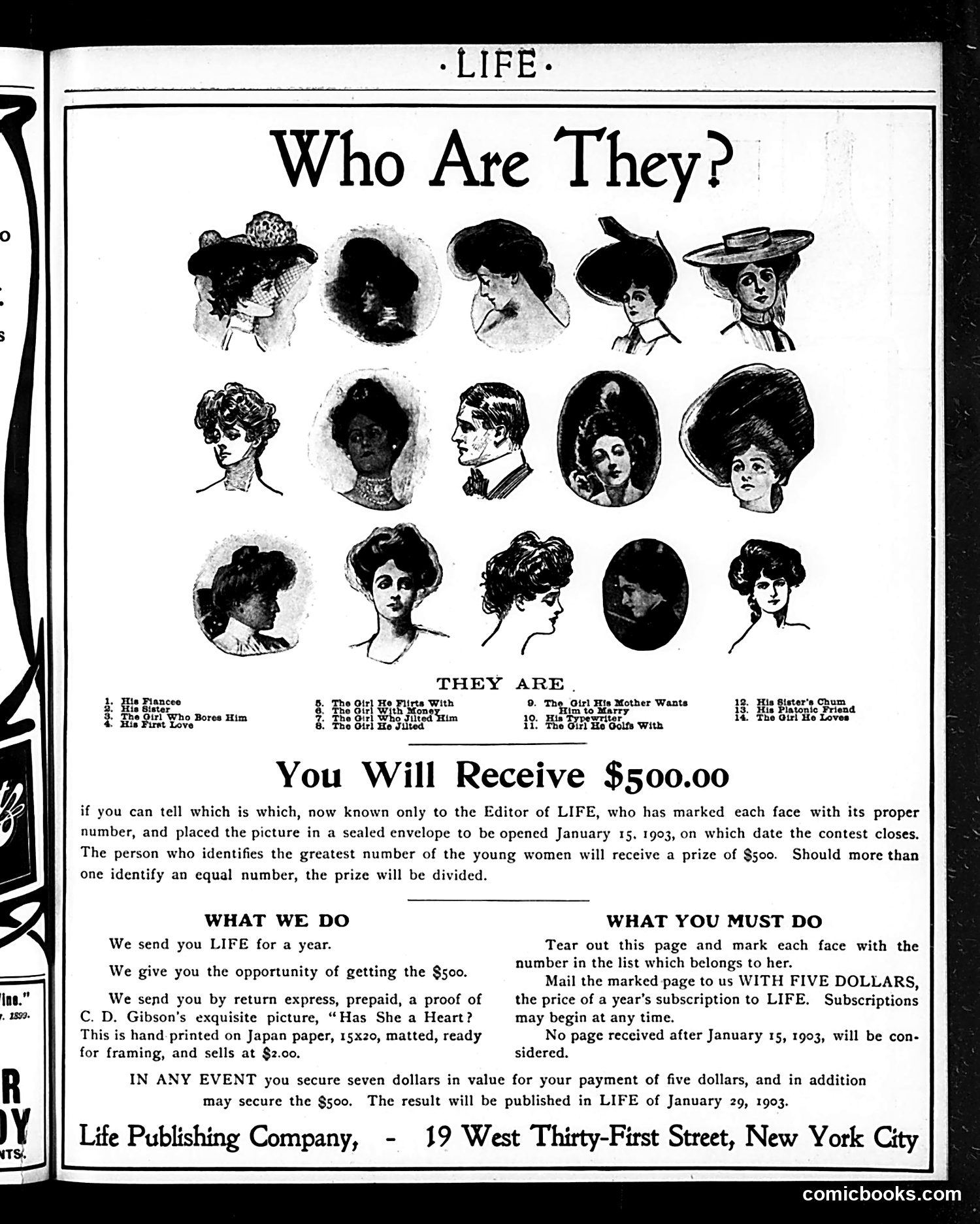
This is a subscription-promotion contest, not political satire. Life Publishing Company presents fifteen portrait sketches by illustrator C.D. Gibson, each labeled with relationship types to an unnamed man: "His Fiancée," "The Girl Who Bores Him," "His Sister's Chum," "The Girl He Jilted," etc. Readers pay $5 for a year's subscription and attempt to match each face to its label. The winner receives $500 (substantial money in 1902) plus a framed Gibson art print worth $2. The humor reflects turn-of-the-century attitudes about romantic entanglement—the premise that a desirable man maintains multiple simultaneous relationships with different women, each serving different social purposes. Gibson was famous for depicting idealized "Gibson Girl" types; this contest playfully invites readers to decode the social hierarchies and emotional dynamics among his female subjects. The contest deadline was January 15, 1903.
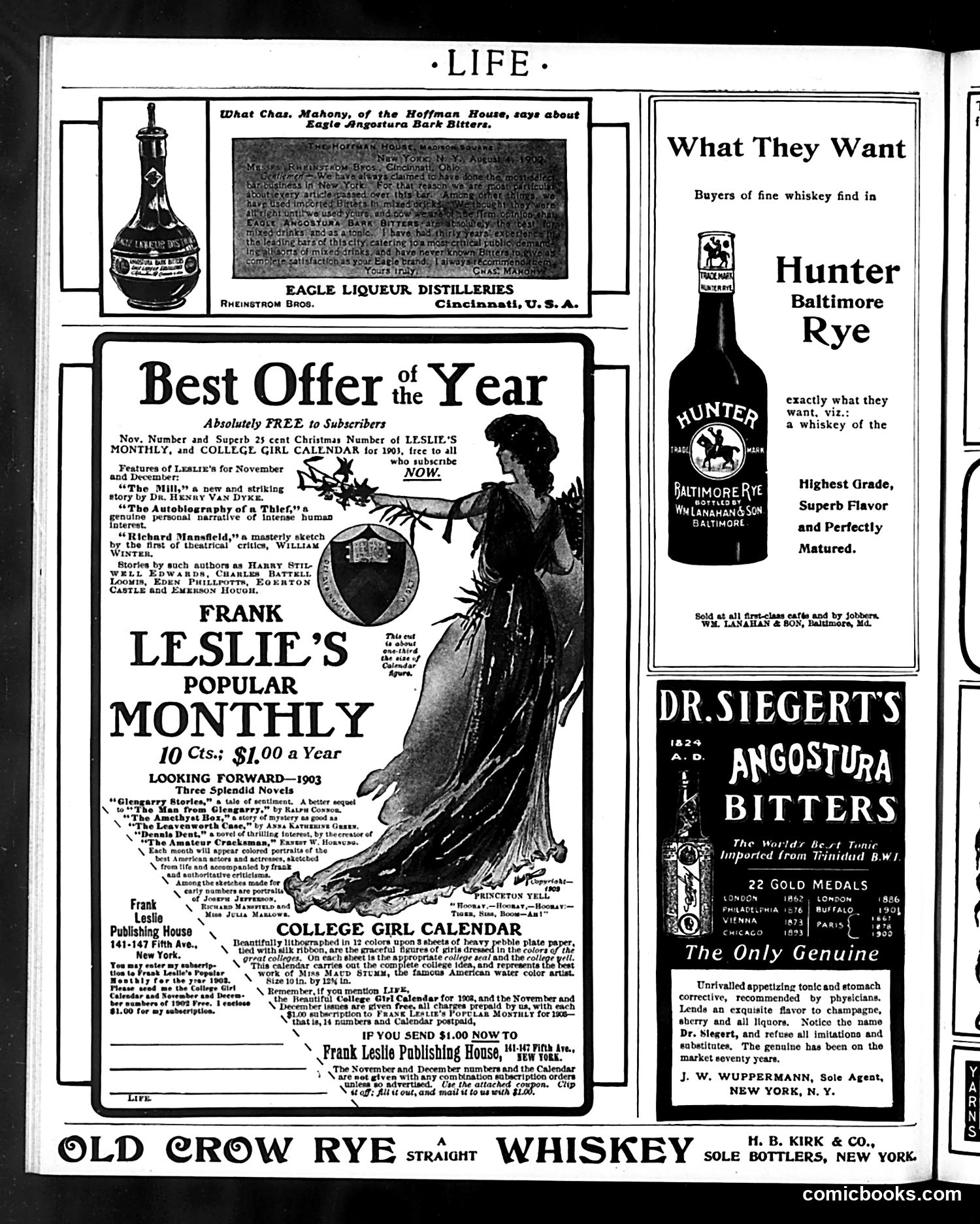
This page is primarily **advertising**, not editorial cartoon or satire. It's from Life magazine (circa 1902-1903) and consists entirely of commercial advertisements for alcohol and a magazine subscription offer. The ads promote: 1. **Frank Leslie's Popular Monthly** — a magazine offering free premiums (including a "College Girl Calendar") to new subscribers 2. **Whiskey brands** — Hunter Baltimore Rye and Old Crow Rye, marketed as premium spirits 3. **Bitters and tonics** — Eagle Angostura Bark Bitters and Dr. Siegert's Angostura Bitters, promoted as medicinal tonics The "College Girl Calendar" advertisement is notable for its era—depicting illustrated women in college settings, reflecting turn-of-century American popular culture and gender representations. **Historical context**: Before Prohibition (1920), alcohol advertising was ubiquitous in mainstream magazines, and medicinal "bitters" were commonly marketed as health tonics despite containing significant alcohol content.
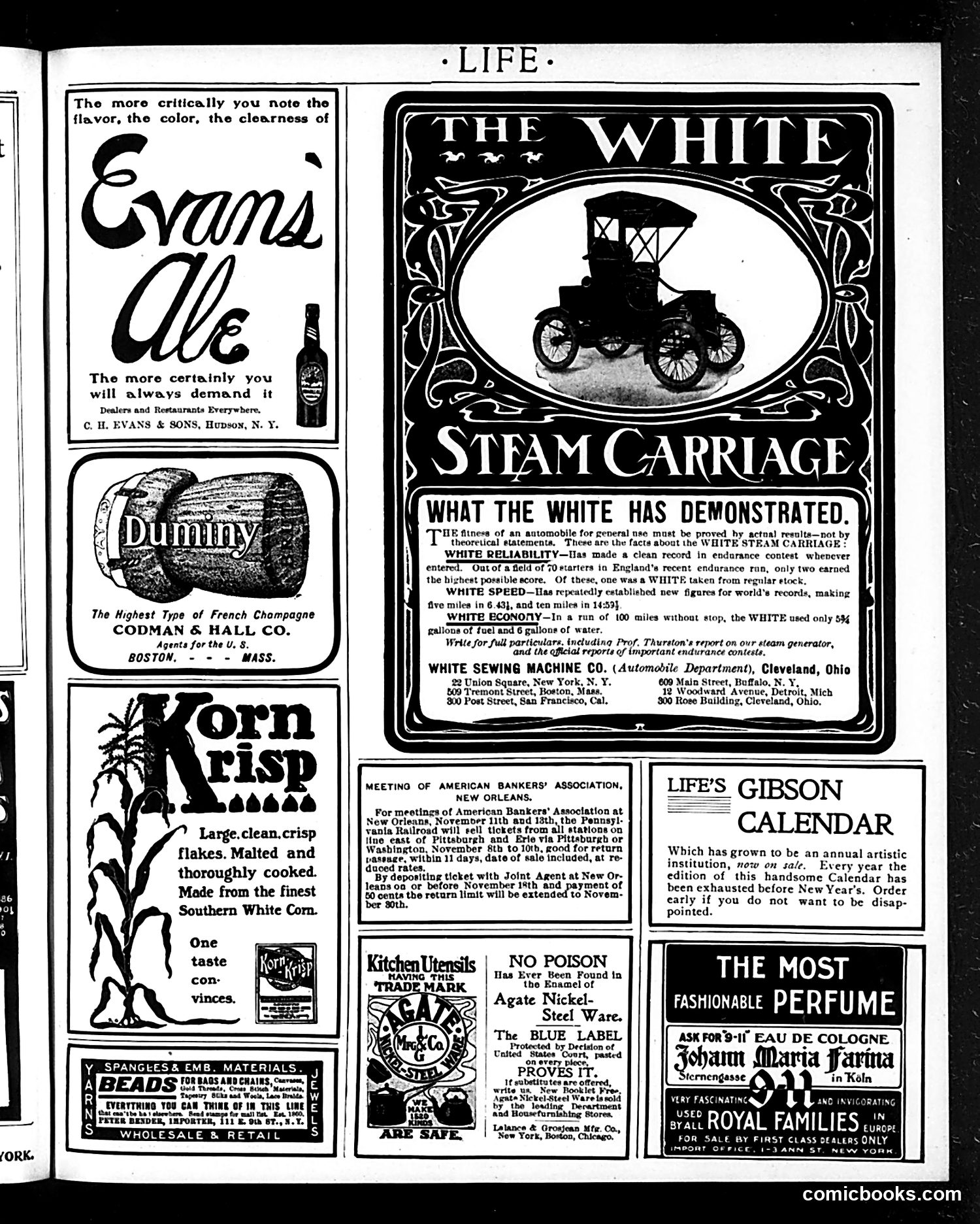
This is **primarily an advertisements page**, not a satirical cartoon page. The content consists entirely of product advertisements typical of early 20th-century American magazines. Notable ads include: - **Evans Ale** and **Codman & Hall champagne** (alcoholic beverages) - **Korn Krisp** cereal - **White Steam Carriage** (automobile), emphasizing reliability, speed records, and economy through detailed performance claims - **Kitchen Utensils** with "Agate Nickel-Steel Ware" (cookware, emphasizing it contains "no poison") - **Johar Maria Farina cologne** claiming use by "royal families" - **Life's Gibson Calendar** (promoting the magazine's own annual calendar) - Various other products and services The page reflects consumer advertising standards of the period: emphasis on technical superiority, safety assurances, and prestige. There is **no political satire or cartoon commentary** visible—this is a straightforward commercial page from Life magazine's advertising section.