
Life, 1902-10-23 · page 12 of 22
Life — October 23, 1902 — page 12: what you’re looking at
What you’re looking at
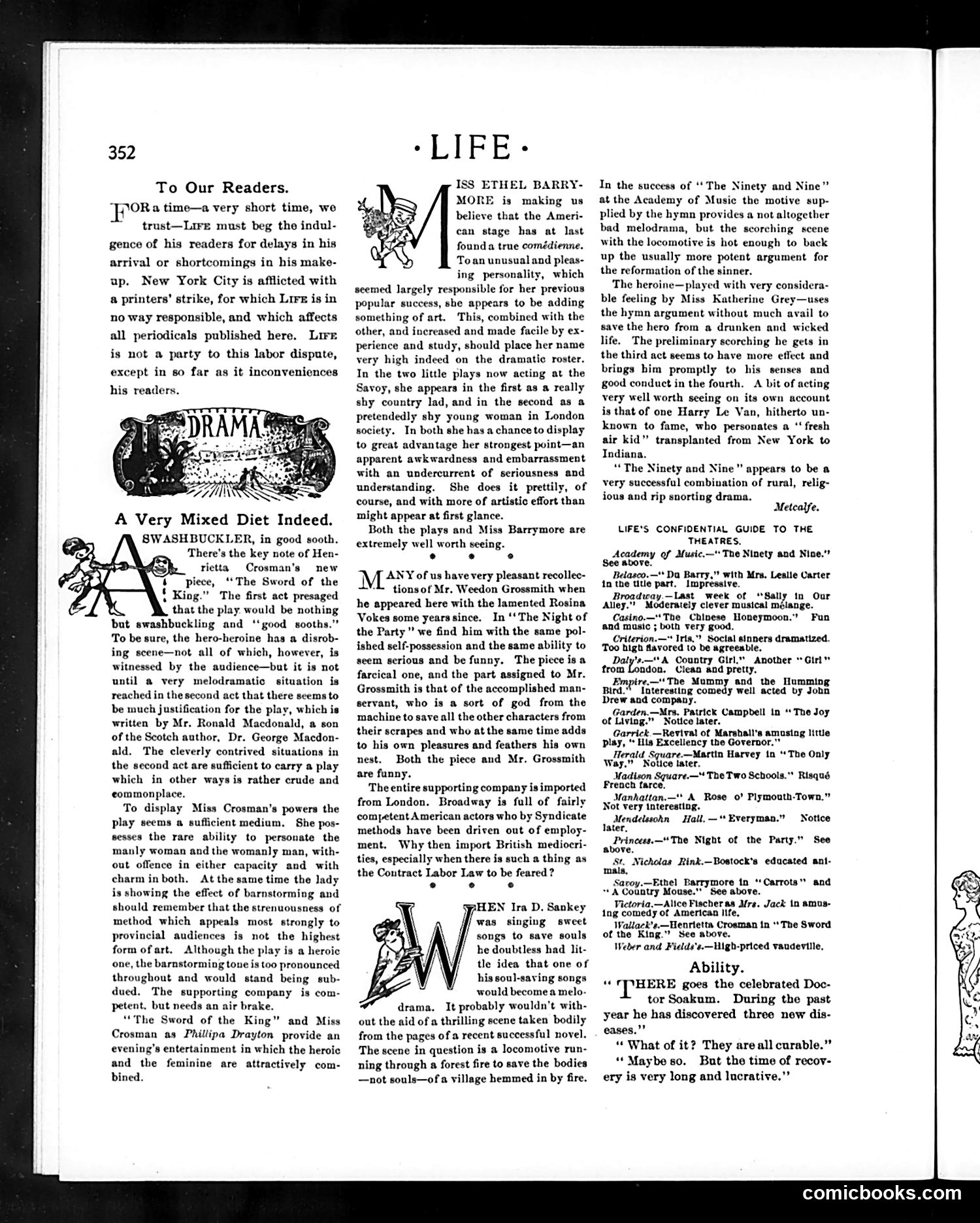
This page reviews theatrical productions, with one cartoon satirizing a play called "The Sword of the King." The cartoon depicts an **Swashbuckler character** (recognizable by the theatrical sword-fighting pose) in what appears to be an absurd or over-the-top dramatic moment. The satire critiques the play's melodramatic quality—the text notes it involves "swashbuckling and 'good sooths'" and reaches "a very melodramatic situation." The joke seems to be that such theatrical fare offers entertainment that's entertainingly ridiculous rather than artistically serious, hence the "mixed diet" reference to varied theatrical fare of questionable quality being served to audiences.
📄 Transcribed text from this page (OCR, searchable)
Machine-transcribed from the original scan — historical spelling and the odd misread are preserved.
352 To Our Readers. ‘JFOR a time—a very short time, we trust—Lire must beg the indul- gence of his readers for delays in his arrival or shortcomings in his make- ap. New York City is afflicted with a printers’ strike, for which Lirs is in no way responsible, and which affects all periodicals published here. Lire is not a party to this labor dispute, except in so far as it inconveniences his readers, A Very Mixed Diet Indeed. SWASHBUCKLER, in good sooth. There's the key note of Hen- rietta Crosman's new ‘piece, ‘The Sword of the { King.” The first act presaged that the play. would be nothing but swashbuckling and ‘‘good sooths.”” To be sure, the hero-heroine has a disrob- ing scene—not all of which, however, is witnessed by the audience—but it is not until a very melodramatic situation is reached in the second act that there seems to be much justification for the play, which is written by Mr. Ronald Macdonald, a son of the Scotch author, Dr. George Macdon- ald, The cleverly contrived situations in the second act are sufficient to carry a play which in other ways is rather crude and commonplace. To display Miss Crosman’s powers the play seems a sufficient medium. She pos- sesses the rare ability to personate the manly woman and the womanly man, with- out offence in either capacity and with charm in both, At the same time the lady is showing the effect of barnstorming and should remember that the strenuousness of method which appeals most strongly to provincial audiences is not the highest form of art. Although the play is a heroic one, the barnstorming tone is too pronounced throughout and would stand being sub- dued. The supporting company is com- petent, but needs an air brake. “The Sword of the King” and Miss Crosman as Phillipa Drayton provide an evening's entertainment in which the heroic and the feminine are attractively com- bined. LIFE ISS ETHEL BARRY- MORE is making us believe that the Ameri- can stage has at last founda true comédienne. Toan unusual and pleas- ing personality, which seemed largely responsible for her previous popular success, she appears to be adding something of art. This, combined with the other, and increased and made facile by ex- perience and study, should place her name very high indeed on the dramatic roster. In the two little plays now acting at the Savoy, she appears in the first as a really shy country lad, and in the second as a pretendedly shy young woman in London society, In both she has a chance to display to great advantage her strongest point—an apparent awkwardness and embarrassment with an undercurrent of seriousness and understanding. She does it prettily, of course, and with more of artistic effort than might appear at first glance. Both the plays and Mis extremely well worth seeing. ° ° ° MAS of us have very pleasant recollec- Barrymore are tionsof Mr. Weedon Grossmith when he appeared here with the lamented Rosina Vokes some yearssince. In ‘The Night of the Party” we find him with the same pol- ished self-possession and the same ability to seem serious and be funny. The piece is a farcical one, and the part assigned to Mr. Grossmith is that of the accomplished man- servant, who is a sort of god from the machine to save all the other characters from their scrapes and who at the same time adds to his own pleasures and feathers his own nest. Both the piece and Mr. Grossmith are funny. ‘The entire supporting company is imported from London. Broadway is full of fairly comyetent American actors who by Syndicate methods have been driven out of employ- ment. Why then import British mediocri- ties, especially when there is such a thing as the Contract Labor Law to be feared? e e WHEN Ira D. Sankey was singing sweet songs to save souls he doubtless had lit- tle idea that one of his soul-saving songs would become a melo- drama. It probably wouldn't with- out the aid of a thrilling scene taken bodil from the pages of a recent successful novel. ‘The scene in question is a locomotive run- ning through a forest fire to save the bodies —not souls—of a village hemmed in by fire. In the success of ‘The Ninety and Nine” at the Academy of Music the motive sup- plied by the hymn provides a not altogether bad melodrama, but the scorching scene with the locomotive is hot enough to back up the usually more potent argument for the reformation of the sinner. The heroine—played with very considera- ble feeling by Miss Katherine Grey—uses the hymn argument without much avail to save the hero from a drunken and wicked life. The preliminary scorching he gets in the third act seems to have more effect and brings bim promptly to his senses and good conduct in the fourth. A bit of acting very well worth seeing on its own account is that of one Harry Le Van, hitherto un- known to fame, who personates a ‘‘ fresh air kid” transplanted from New York to Indiana. “The Ninety and Nine” appears to be a very successful combination of rural, relig- ious and rip snorting drama. Metcalfe. LIFE’S CONFIDENTIAL GUIDE TO THE THEATRES, Academy of Music.— The Ninety and Nine.” See above. Belasco.” Da Barry.” with Mrs. Leaite Carter in the title part. Impress! Broadvway.—Last week “ot “Sally in Our Alley.” Moderately clever mustcal mélange. Casino.—“"The Chinese Honeymoon.” Fun sna maasio 3 both very good. ris," Social sinners dramatized. ne ‘ign Mavored 16 be agreeable. *A Count Girl.” Another “Giri” trowLosdons Clean aad pretty, Fmpire—s*The Mummy and the Humming Bird." Interesting comedy well acted by John Deer and company. rden.—Mra, Patrick Campbell in “The Joy ot barrie "Notice later. Garrick —Revival of Marshall's amusing little play, " His Excellency the Governor.” Herald Square.—Martin Harvey in “The Only yet "Notice later. fadison Square.—“ The Two Schools.” Risqué Preset farce, Manhattan.—* A Rose o’ Plymouth-Town.”” Not very interesting. Mendelssohn Hall, —“* Everyman.” later. Princess,—“The Night of the Party.” above. St, Nicholas Rink.—Bostock’s educated ant- mals, Saroy.—Ethel Barrymore in ‘Carrots and *+A Country Mouse." See above. Tictoria.—Alce Fischer as Mre. Jack in amus- ing comedy of American life. Wailack’.—Henrtetta Crosman in “The Sword of the King.” See above. Weber and Fields's.—Uigh-priced vaudeville, Ability. a "THERE goes the celebrated Doc- tor Soakum. During the past year he has discovered three new dis- eases.”” “ What of it? They are all curable.” “Maybe so. But the time of recov- ery is very long and lucrative.”” Notice See comicbooks.com