
Life, 1902-10-23 · page 4 of 22
Life — October 23, 1902 — page 4: what you’re looking at
What you’re looking at
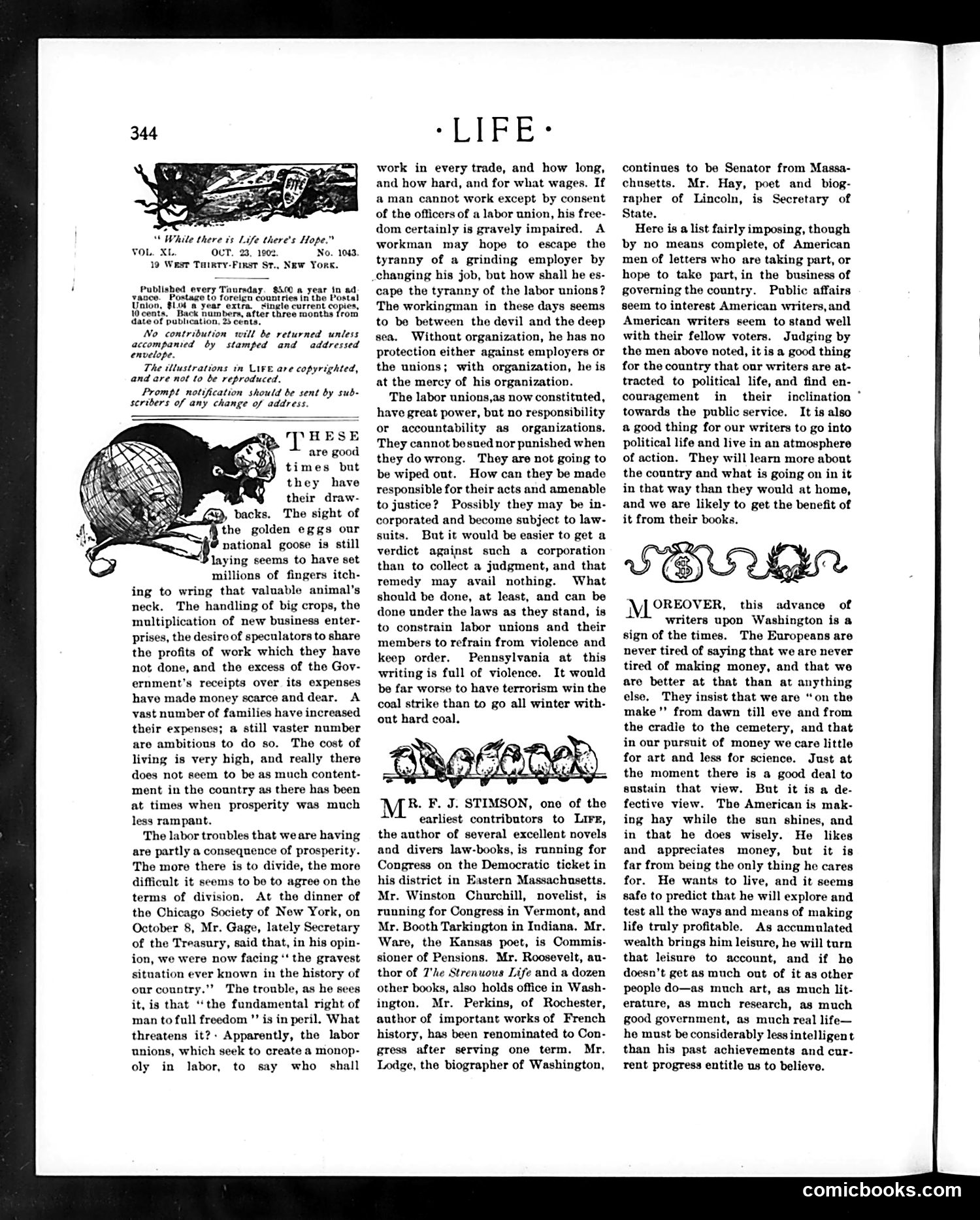
This page combines editorial commentary on labor unions with two illustrations. The main text debates whether labor unions have become too powerful and unaccountable, arguing they should be "wiped out" or reformed to prevent violence. The author expresses concern that unions operate without legal responsibility for their members' actions, citing Pennsylvania coal strikes as examples of union-related violence. The cartoons illustrate labor concerns: one depicts a goose laying golden eggs (representing profitable labor), suggesting employers have exploited workers' productivity. The second shows what appears to be working-class figures, likely representing laborers caught between employer and union pressures. The piece reflects early 20th-century anxieties about labor organization, capitalism, and social order during a period of significant labor unrest and strikes.
📄 Transcribed text from this page (OCR, searchable)
Machine-transcribed from the original scan — historical spelling and the odd misread are preserved.
“* While there ts Life there's Hope.” VOL. XL. OCT. 23, 1902 19 Wast Tairty-First S Published every Taursday. $30 a year tn ad, va 20. 6 to foreign countries in the Post aloo. $1.04 a year extra. single current co) cent Back hambers, after three months {rot date of publication, 2 coats, No contribution will be returned unless accompanied by stamped and addressed envelope. The illustrations in Live are copyrighted, and are not to be reproduced. Prompt notification should be sent by sub- scribers of any change of address. MHESE are good times but they have their draw- The sight of the golden eggs our national goose is still ‘D laying seems to have set millions of fingers itch- ing to wring that valuable animal's neck. The handling of big crops, the multiplication of new business enter- prises, the desiro of speculators to share the profits of work which they have not done, and the excess of the Gov- ernment’s receipts over its expenses have made money scarce and dear. A vast number of families have increased their expenses; a still vaster number are ambitions to do so. The cost of living is very high, and really there does not seem to be as much content- ment in the country as there has been at times when prosperity was much less rampant. The labor troubles that we are having are partly a consequence of prosperity. The more there is to divide, the more difficult it seems to be to agree on the terms of division, At the dinner of the Chicago Society of New York, on October 8, Mr. Gage, lately Secretary of the Treasury, said that, in his opin- ion, we were now facing ‘‘ the gravest situation ever known in the history of our country.’? The trouble, as he sees it, is that ‘the fundamental right of man to full freedom "’ is in peril, What threatens it? Apparently, the labor unions, which seek to create a monop- oly in labor, to say who shall LIFE work in every trade, and how long, and how hard, and for what wages. If a man cannot work except by consent of the officers of a labor union, his free- dom certainly is gravely impaired. A workman may hope to escape the tyranny of a grinding employer by changing his job, but how shall he es- cape the tyranny of the labor unions? The workingman in these days seems to be between the devil and the deep sea. Without organization, he has no protection either against employers or the unions; with organization, he is at the mercy of his organization. The labor unions,as now constituted, have great power, but no responsibility or accountability as organizations. They cannot besued nor punished when they dowrong. They are not going to be wiped out. How can they be made responsible for their acts and amenable to justice? Possibly they may be in- corporated and become subject to law- suits. But it would be easier to get a verdict against such a corporation than to collect a judgment, and that remedy may avail nothing. What should be done, at least, and can be done under the laws as they stand, is to constrain labor unions and their members to refrain from violence and keep order. Pennsylvania at this writing is full of violence. It would be far worse to have terrorism win the coal strike than to go all winter with- out hard coal. R. F. J. STIMSON, ono of the earliest contributors to Lirz, the author of several excellent novels and divers law-books, is running for Congress on the Democratic ticket in his district in Eastern Massachusetts. Mr. Winston Charchill, novelist, is running for Congress in Vermont, and Mr. Booth Tarkington in Indiana, Mr. Ware, the Kansas poet, is Commis- sioner of Pensions. Mr. Roosevelt, au- thor of 7'he Strenuous Life and a dozen other books, also holds office in Wash- ington. Mr. Perkins, of Rochester, author of important works of French history, has been renominated to Con- gress after serving one term. Mr. Lodge, the biographer of Washington, continues to be Senator from Massa- chusetts. Mr. Hay, poet and biog- rapher of Lincoln, is Secretary of State. Here is a list fairly imposing, though by no means complete, of American men of letters who are taking part, or hope to take part,in the business of governing the country. Public affairs seem to interest American writers, and American writers seem to stand well with their fellow voters. Judging by the men above noted, it is a good thing for the country that our writers are at- tracted to political life, and find en- couragement in their inclination © towards the public service. It is also a good thing for our writers to go into political life and live in an atmosphere of action. They will learn more about the country and what is going on in it in that way than they would at home, and we are likely to get the benefit of it from their books. M OREOVER, this advance of writers upon Washington is a sign of the times. The Europeans are never tired of saying that we are never tired of making money, and that we are better at that than at anything else, They insist that we are “on the make ’’ from dawn till eve and from the cradle to the cemetery, and that in our pursuit of money we care little for art and less for science. Just at the moment there is a good deal to sustain that view. But it is a de- fective view. The American is mak- ing hay while the sun shines, and in that he does wisely. He likes and appreciates money, but it is far from being the only thing he cares for. He wants to live, and it seems safe to predict that he will explore and test all the ways and means of making life traly profitable. As accumulated wealth brings him leisure, he will tarn that leisure to account, and if he doesn’t get as much ont of it as other people do—as much art, as much lit- erature, as much research, as much good government, as much real life— he must be considerably less intelligent than his past achievements and cur- rent progress entitle us to believe. comicbooks.com