
Life, 1902-10-23 · page 9 of 22
Life — October 23, 1902 — page 9: what you’re looking at
What you’re looking at
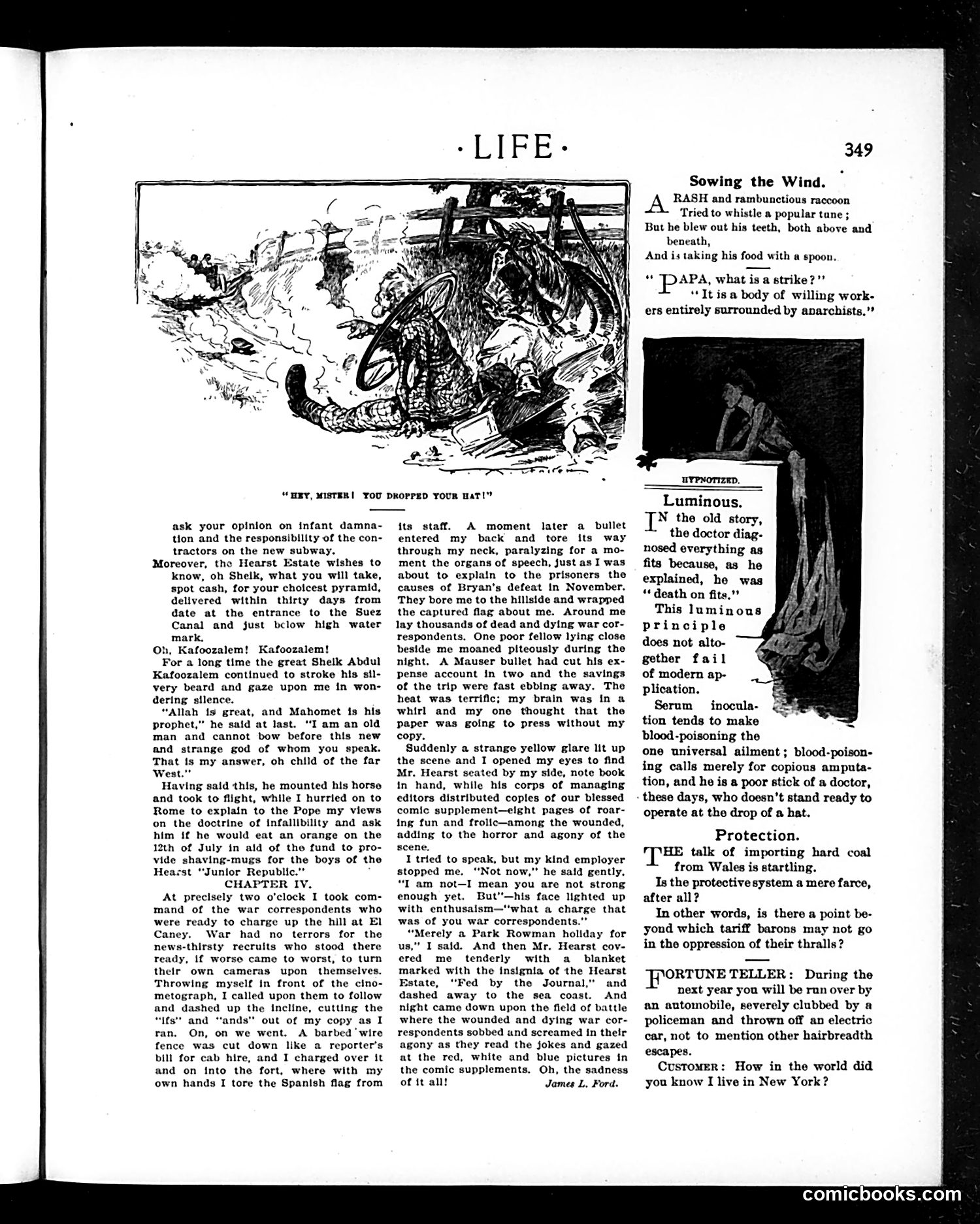
This page features a satirical cartoon and accompanying text mocking labor unrest. The main illustration depicts a disheveled raccoon character whistling while eating with a spoon—a visual metaphor for someone indifferent to chaos around them. The accompanying dialogue contains a father-child exchange where the child asks about a "strike." The father responds it's "a body of willing workers entirely surrounded by anarchists"—a barbed joke reflecting early 20th-century American anxieties about labor movements and radical political ideology. The cartoon satirizes wealthy industrialists' dismissive attitudes toward worker organizing, portraying strikes as dangerous chaos orchestrated by extremists rather than legitimate labor grievances. This reflects the period's deep class tensions and establishment fear of socialist/anarchist influence in labor movements.
📄 Transcribed text from this page (OCR, searchable)
Machine-transcribed from the original scan — historical spelling and the odd misread are preserved.
“HEY, MISTER! YOU DROPPED YOUR wAT!” ask your opinion on infant damna- tion and the responsibility of the con- tractors on the new subway. Moreover, the Hearst Estate wishes to know, oh Shelk, what you will take, spot cash, for your choicest pyramid, delivered within thirty days from date at the entrance to the Suez Canal and just bclow high water mark, Oh, Kafoozalem! Kafoozalem! For a long time the great Shelk Abdul Kafoozalem continued to stroke his sil- very beard and gaze upon me in won- dering silence. “Allah is great, and Mahomet is his prophet,” he said at last. “I am an old man and cannot bow before this new and strange god of whom you speak. That 1s my answer, oh child of the far West.” Having said this, he mounted his horse and took to flight, while I hurried on to Rome to explain to the Pope my views on the doctrine of infallibillty and ask him if he would eat an orange on the 12th of July in ald of the fund to pro- vide shaving-mugs for the boys of the Heasst “Junior Republic.” CHAPTER IV, At precisely two o'clock I took com- mand of the war correspondents who were ready to charge up the hill at El Caney. War had no terrors for the news-thirsty recruits who stood there ready, if worse came to worst, to turn their own cameras upon themselves, Throwing myself in front of the cino- metograph, I called upon them to follow and dashed up the incline, cutting the “ifs and “ands” out of my copy as I ran. On, on we went. A barbed ‘wire fence was cut down like a reporter's bill for cab hire, and I charged over it and on into the fort, where with my own hands I tore the Spanish flag from its staff. A moment later a bullet entered my back and tore its way through my neck, paralyzing for a mo- ment the organs of speech, just as I was about to explain to the prisoners the causes of Bryan's defeat In November. They bore me to the hillside and wrapped the captured flag about me. Around me lay thousands of dead and dying war cor- respondents. One poor fellow lying close beside me moaned piteously during the night. A Mauser bullet had cut his ex- pense account in two and the savings of the trip were fast ebbing away. The heat was terrific; my brain was in a whirl and my one thought that the paper was going to press without my copy. Suddenly a strange yellow glare lit up the scene and I opened my eyes to find Mr. Hearst seated by my side, note book in hand, while his corps of managing editors distributed copies of our blessed comic supplement—elght pages of roar- ing fun and frolic—among the wounded, adding to the horror and agony of the scene. I tried to speak, but my kind employer stopped me. ‘Not now," he sald gently. “Iam not—I mean you are not strong enough yet. But"—his face Ighted up with enthusaism—‘‘what a charge that was of you war correspondents.” Merely a Park Rowman holiday for us," I said. And then Mr. Hearst cov- ered me tenderly with a blanket marked with the insignia of the Hearst Estate, “Fed by the Journal," and dashed away to the sea coast. And night came down upon the field of battle where the wounded and dying war cor- respondents sobbed and screamed in thelr agony as they read the jokes and gazed at the red, white and blue pictures in the comic supplements. Oh, the sadness of it all! James L, Ford. 349 Sowing the Wind. A RASH and rambunctious raccoon ‘Tried to whistle a popular tune ; But he blew out his teeth, both above and beneath, And is taking his food with a spoon. ot APA, what is a strike?” “It isa body of willing work- ers entirely surrounded by anarchists,’* Luminous. iy the old story, the doctor diag- nosed everything as fits because, as he explained, he was “death on fits.”” This luminous principle does not alto- gether fail of modern ap- plication. Serum inocula- tion tends to make blood-poisoning the one universal ailment; blood-poison- ing calls merely for copious amputa- tion, and he is a poor stick of a doctor, - these days, who doesn't stand ready to operate at the drop of a hat. Protection. ‘TE talk of importing hard coal from Wales is startling. Is the protective system a mere farce, after all? In other words, is there a point be- yond which tariff barons may not go in the oppression of their thralls? ‘ORTUNE TELLER: During the next year you will be run over by an automobile, severely clubbed by a policeman and thrown off an electric car, not to mention other hairbreadth escapes. Customer: How in the world did you know I live in New York? comicbooks.com