
A complete issue · 22 pages · 1902
Life — October 16, 1902
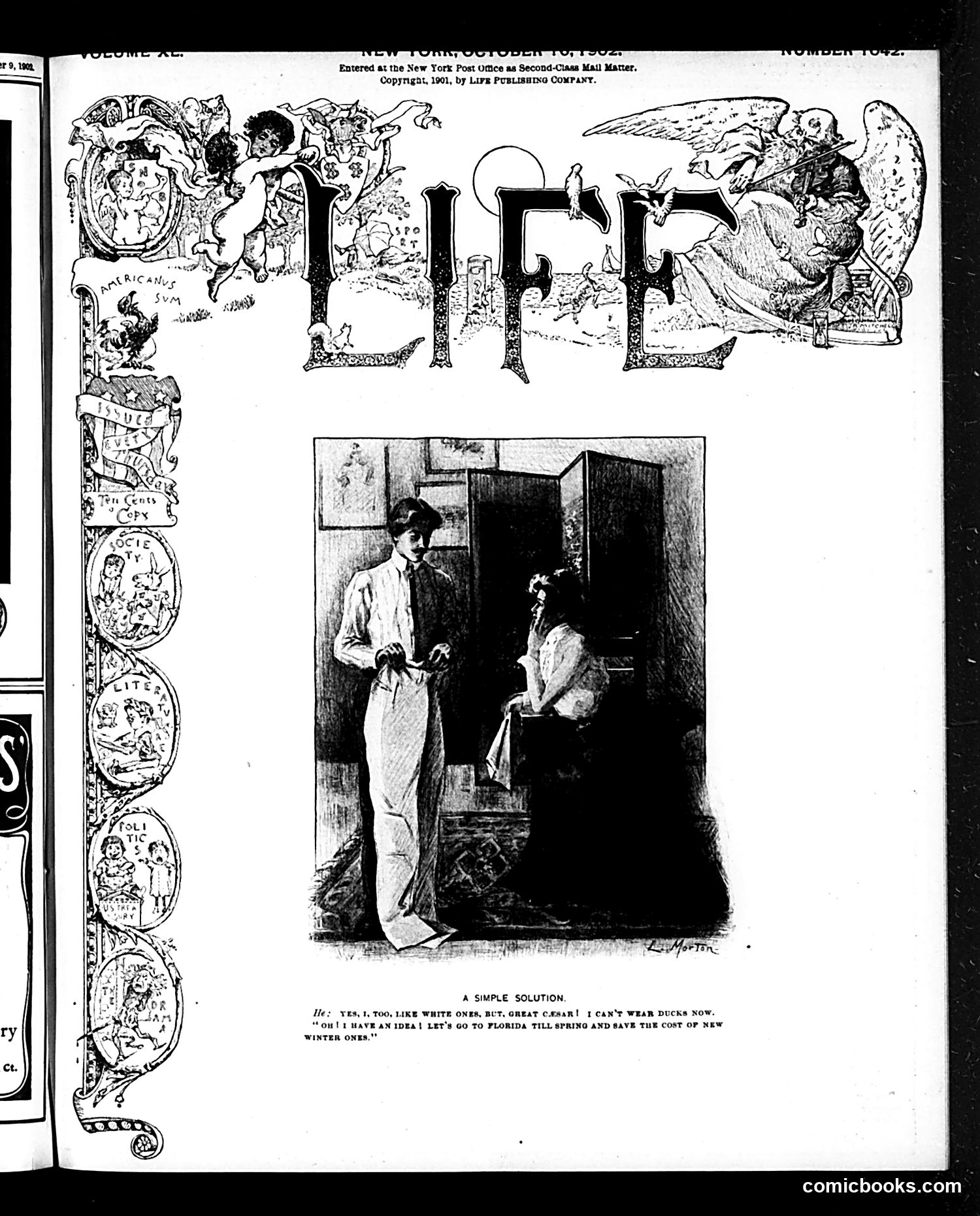
This 1901 cartoon satirizes a domestic disagreement about winter clothing costs. The man proposes a practical solution: move to Florida for spring to avoid purchasing expensive new winter coats. The humor relies on the impracticality of the suggestion—relocating an entire household merely to save on seasonal clothing is absurdly wasteful, despite the man's confident tone ("Yes, I, too, like white over, but great Caesar!"). The cartoon reflects early 20th-century middle-class anxieties about household expenses and gender dynamics around clothing purchases. The woman's skeptical demeanor suggests she recognizes the logical flaw in his "solution." The satire targets husbands' tendency toward implausible financial reasoning when faced with their wives' reasonable domestic needs.
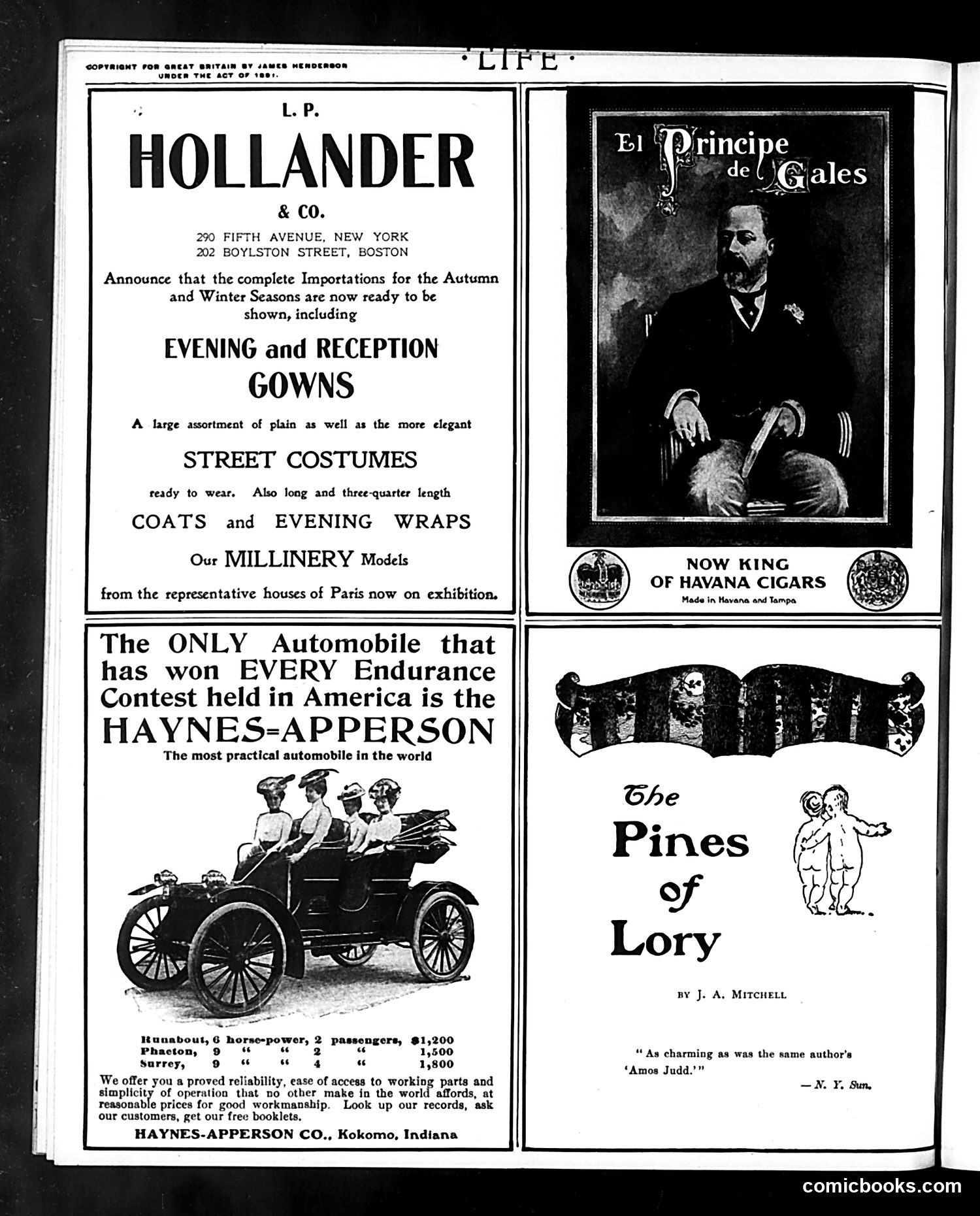
This page is primarily **advertising content** rather than satirical cartoons. It contains four commercial advertisements: 1. **L.P. Hollander & Co.** (top left): Fashion importers advertising women's clothing—evening gowns, street costumes, coats, and millinery from Paris. 2. **Haynes-Apperson automobiles** (bottom left): Promoting their cars' endurance racing record, claiming it's "the most practical automobile in the world." 3. **El Príncipe de Gales cigars** (top right): Cuban cigars advertisement featuring a portrait of a bearded man. 4. **The Pines of Lory** (bottom right): A book advertisement by J.A. Mitchell, compared favorably to the author's previous work "Amos Judd." The page reflects early 20th-century consumer advertising in *Life* magazine, targeting affluent readers with luxury goods and imported products.
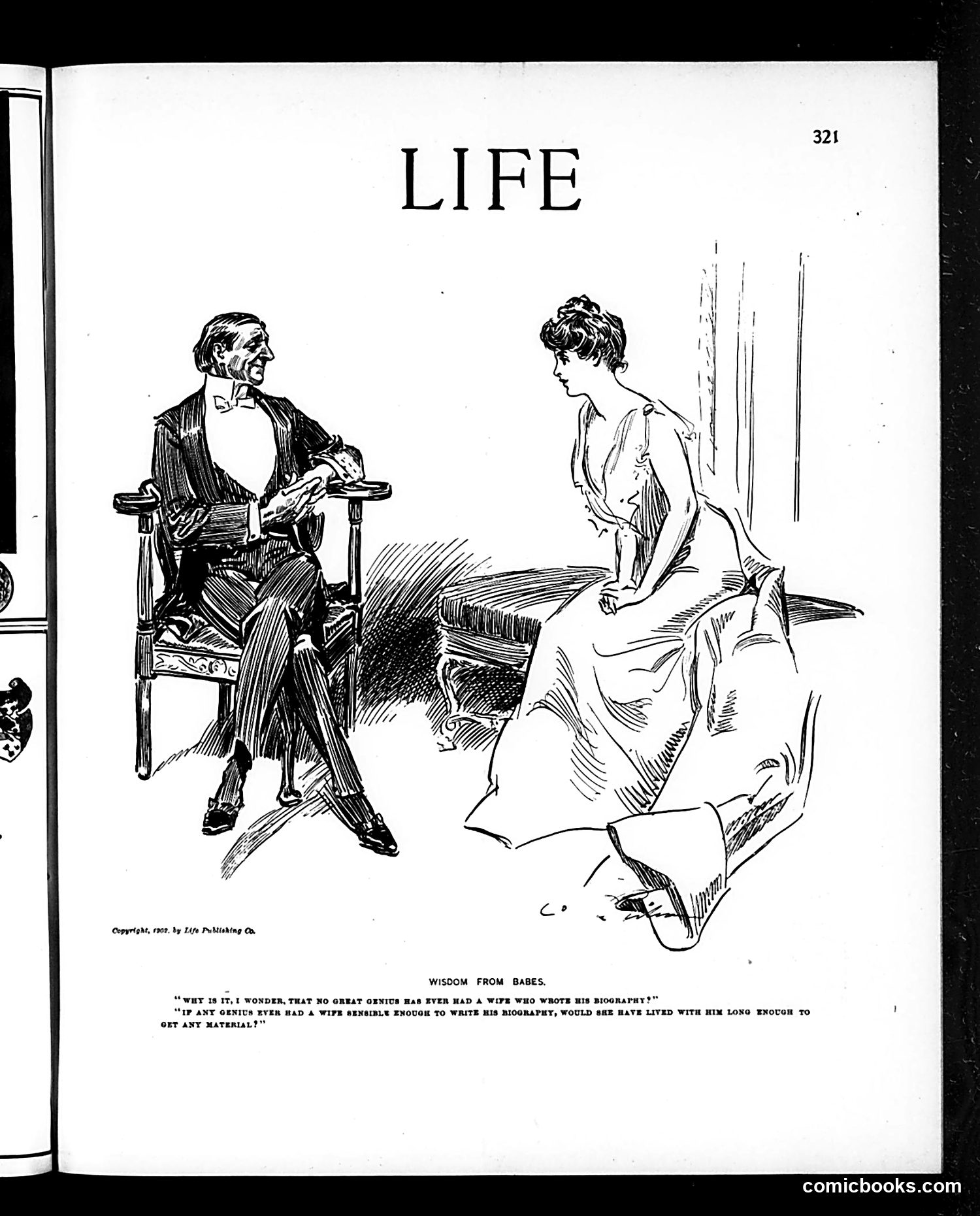
This cartoon satirizes the conventional wisdom about literary genius and marriage. The dialogue presents a paradox: a man marvels that no great genius ever had a wife who wrote his biography, then questions whether any genius's wife was sensible enough to write one—suggesting she would have left him long ago to avoid living with him. The joke targets both celebrated male writers and the traditional expectation that wives should support husbands' careers. It implies that the wives of great men endured difficult marriages, and that any intelligent woman would have abandoned such arrangements. The cartoon appears to critique both masculine self-importance and the marital sacrifices expected of women in the early 20th century.
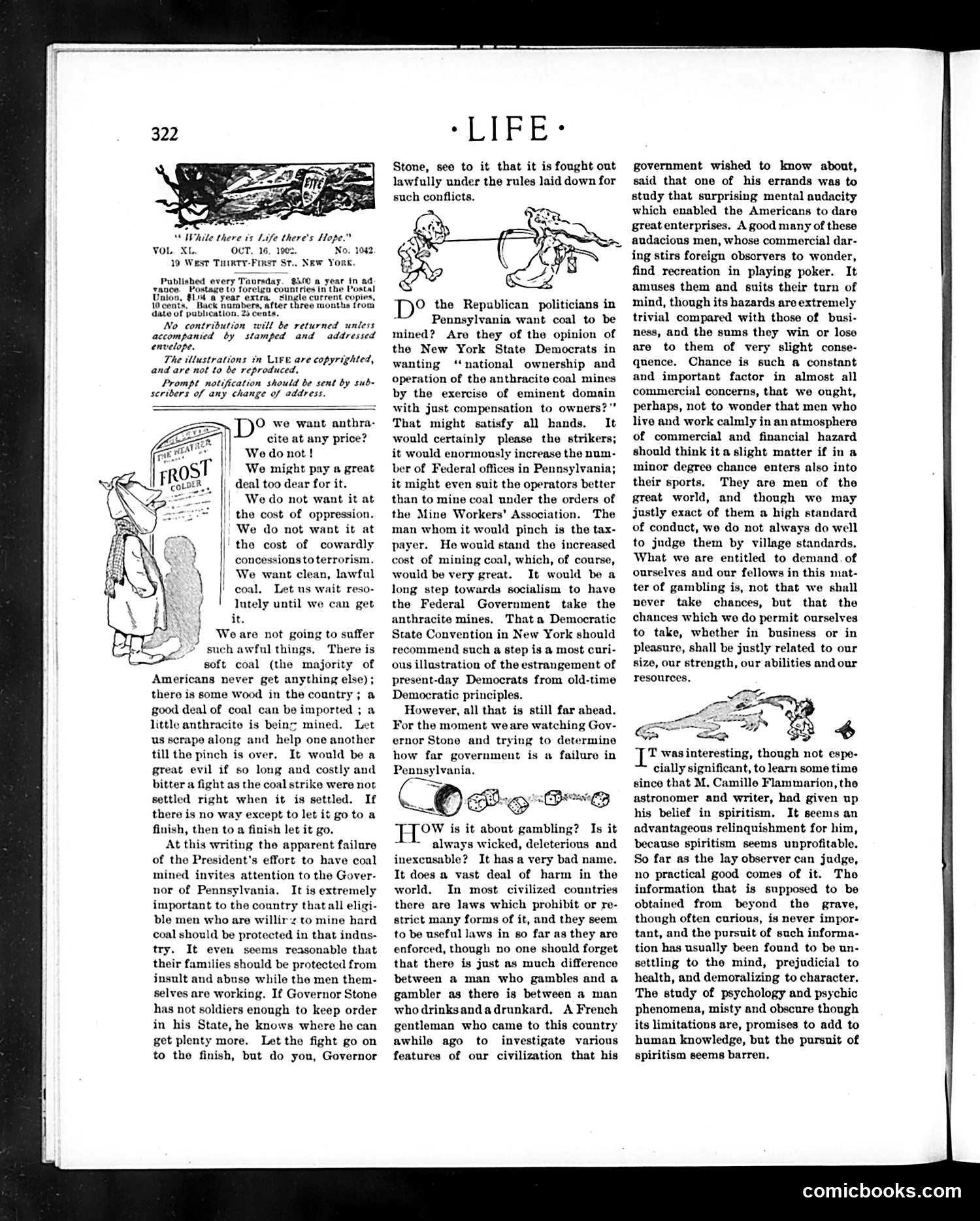
The page contains political commentary rather than a single cartoon. The main illustrated figure appears to be a caricatured politician (likely Governor Stone of Pennsylvania, based on context) depicted as a frozen or rigid character, suggesting ineffectual governance. The editorials debate two issues: (1) whether Pennsylvania Republicans should support federal ownership of anthracite coal mines, and (2) criticism of spiritualism as practiced by the wealthy. The satire targets political inaction on labor issues and wealthy Americans' embrace of spiritualism as foolish superstition. The frozen figure symbolizes governmental paralysis—unable to act decisively on coal mining conflicts or labor disputes. The commentary suggests politicians prioritize trivial entertainment over serious economic problems affecting workers.
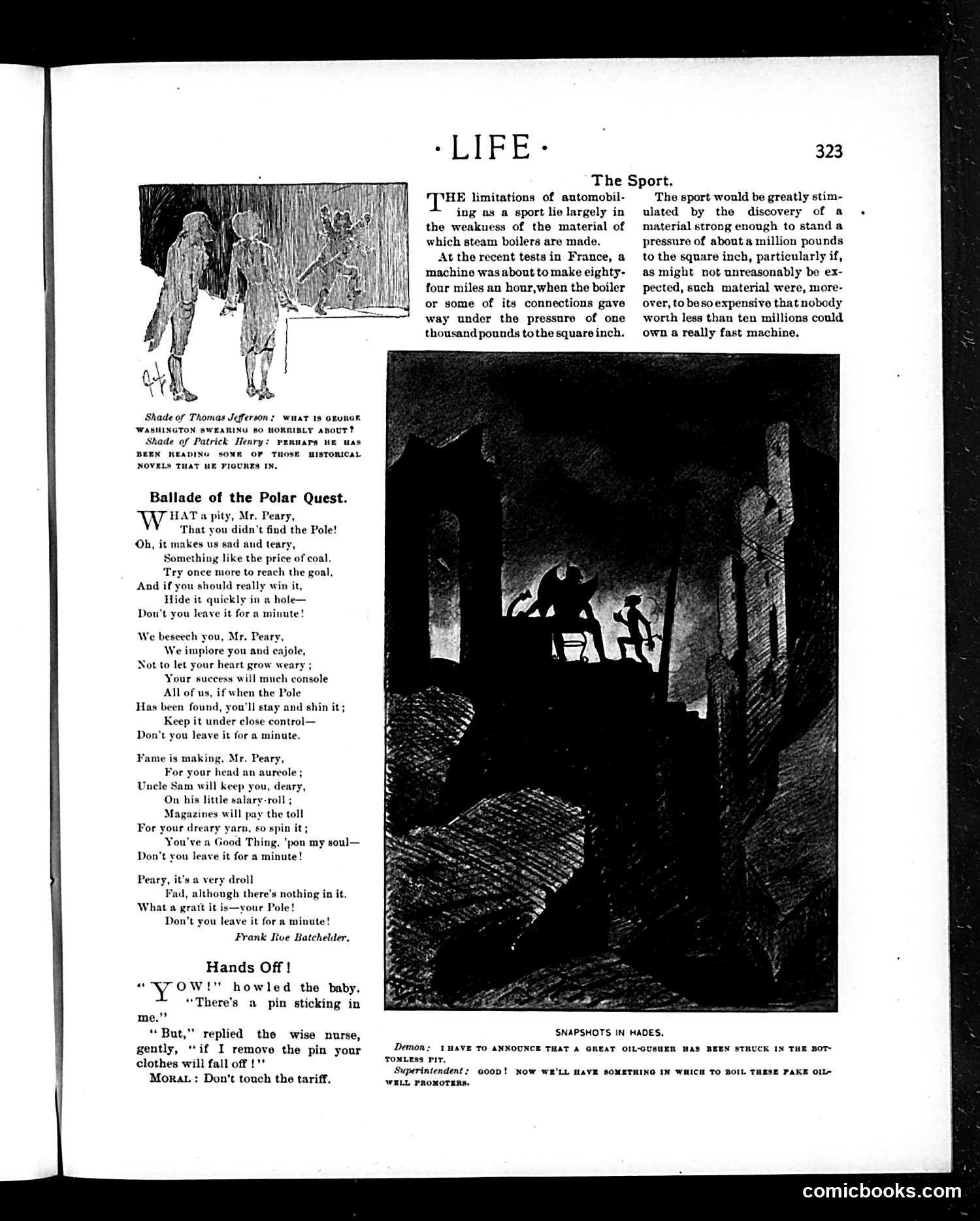
The top cartoon depicts two figures in what appears to be a historical scene, with a caption referencing Thomas Jefferson and Patrick Henry swearing about Washington. This is a humorous commentary on historical figures' language. The main content includes "Ballade of the Polar Quest," a satirical poem mocking explorer Robert Peary's failed attempt to reach the North Pole. The poem's repeated refrain—"Don't you leave it for a minute!"—sarcastically encourages him to try again, while suggesting he'll gain fame and financial reward from magazines and Uncle Sam. The accompanying illustration shows silhouetted figures in what appears to be Arctic exploration conditions. Below is a brief humorous anecdote titled "Hands Off!" about a nurse removing a pin from a baby.
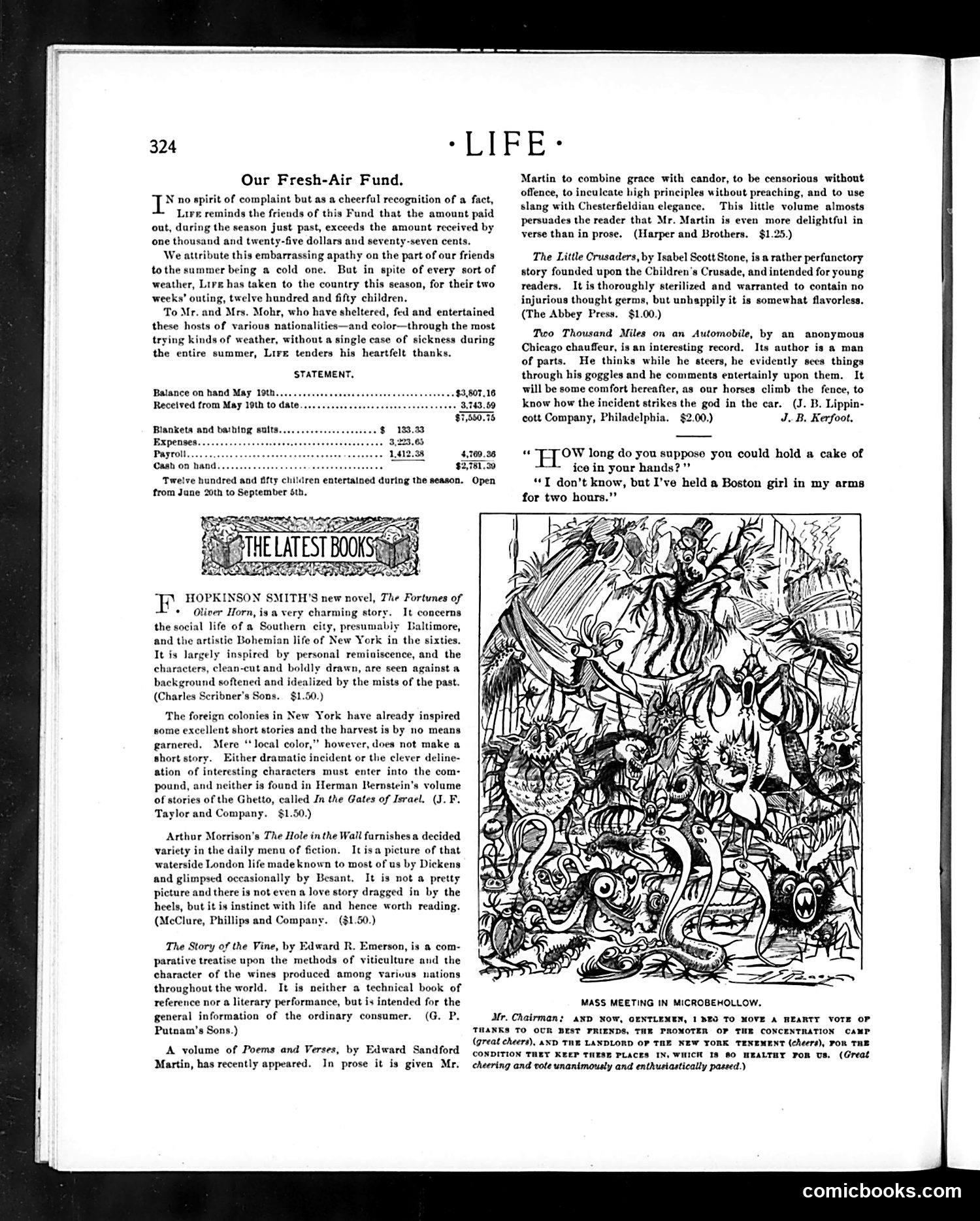
This political cartoon depicts a chaotic assembly of grotesquely drawn figures in what appears to be a satirical commentary on political or social gatherings. The caption references a "mass meeting" and includes mock-parliamentary language about voting thanks to "our best friends" and the "promoter of the concentration camp" and "new york tenement." The style and tone suggest satire directed at urban political meetings, possibly mocking either ward politics, immigrant communities, or tenement reform debates. The grotesque caricatures and frenzied composition emphasize disorder and questionable motives among participants. Without additional historical context about the specific date and Life magazine's editorial stance in this period, the precise political target remains unclear, though the reference to "concentration camp" and tenements suggests Progressive-era social criticism.
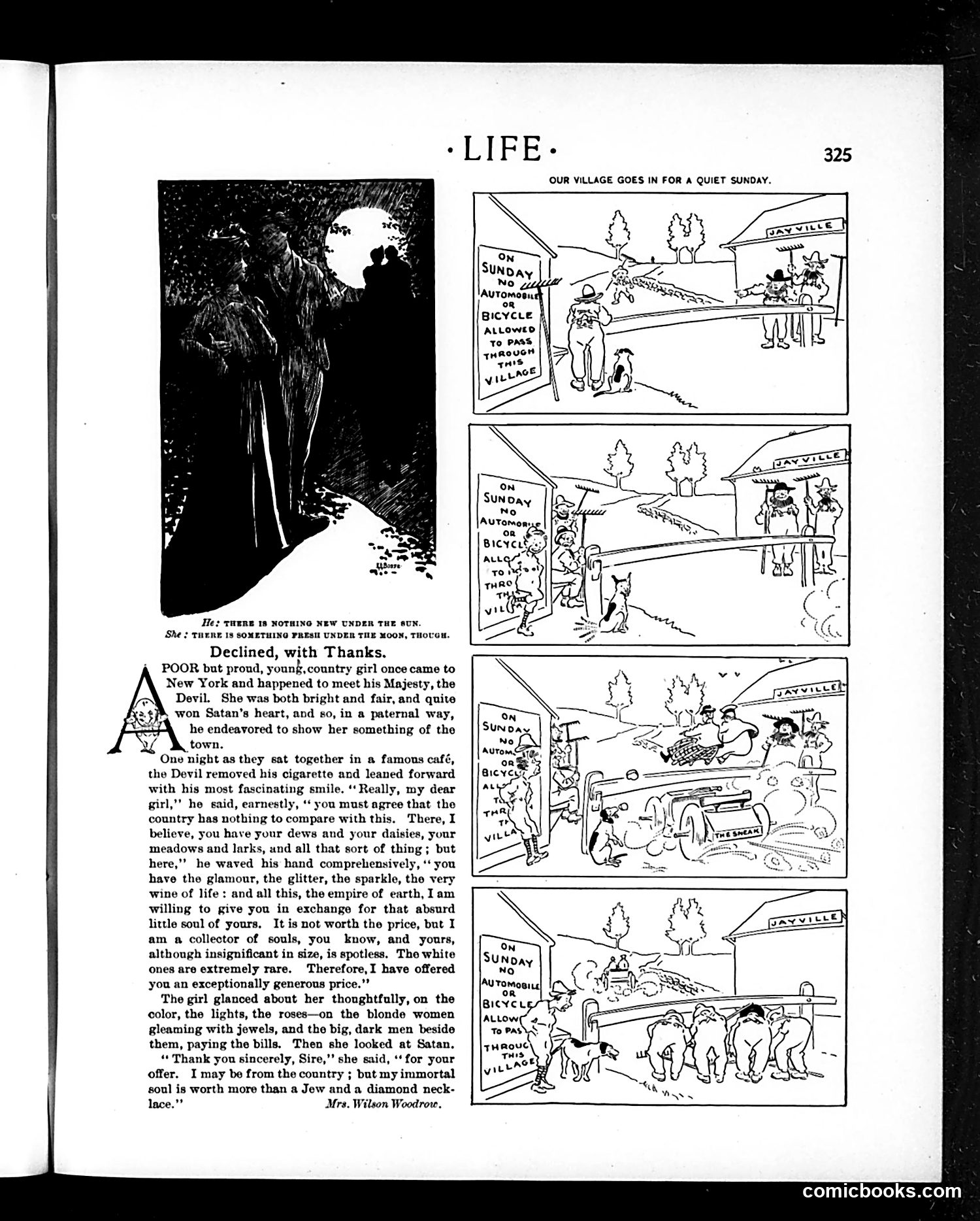
This page contains two distinct elements: **Left side:** A dramatic illustration titled "He: 'There is nothing new under the sun. She: 'There is something fresh under the moon, though.'" This appears to be a romantic/flirtatious exchange, likely satirizing conventional philosophy or courtship dialogue. **Right side:** A four-panel comic strip titled "Our Village Goes in for a Quiet Sunday" showing the ironic contradiction between a village's posted rules prohibiting automobiles and bicycles on Sundays—meant to enforce quietness—and the actual chaotic result when these restrictions cause pedestrians, animals, and people to clog the streets in comical disorder. The satire critiques how well-intentioned regulations can produce the opposite of their intended effect. Both pieces use humor to comment on human nature and social contradictions.
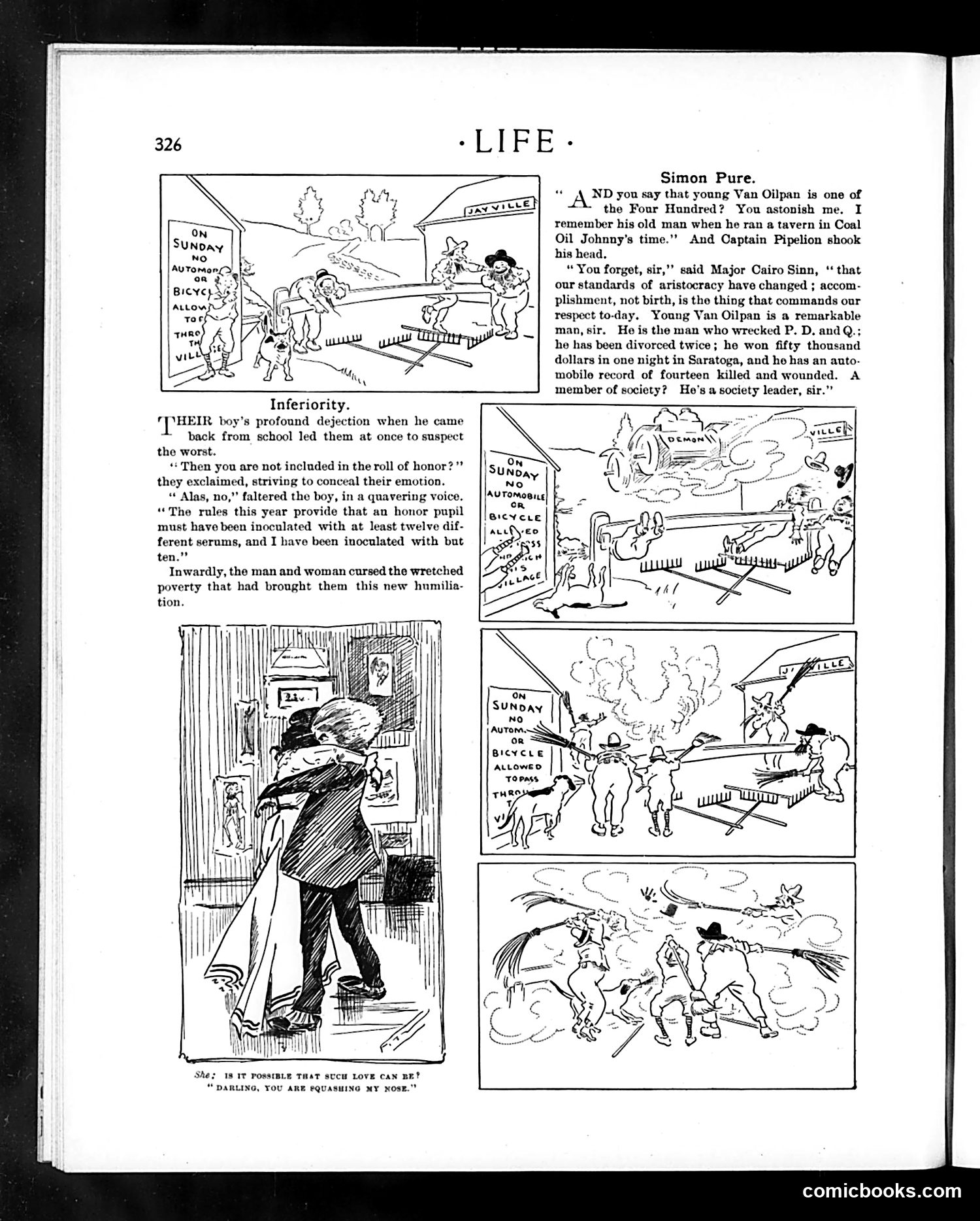
This page satirizes **class anxiety and social mobility** in early 20th-century America. The story "Simon Pure" concerns **Van Oilpan**, a wealthy nouveau riche figure whose fortune comes from disreputable sources (running a tavern, auto accidents, stock manipulation). Despite his money, he's excluded from the social register—the official list of "respectable" society. The satire's target: **old money's gatekeeping**. Major Cairo Sinn defends aristocratic standards based on birth rather than accomplishment, despite Van Oilpan's actual achievements and wealth. The cartoons show him repeatedly rejected from exclusive spaces marked "No Automobiles or Bicycles Allowed on Sundays." The joke exposes the arbitrary, snobbish nature of American class barriers—wealth alone cannot buy social acceptance from the established elite.
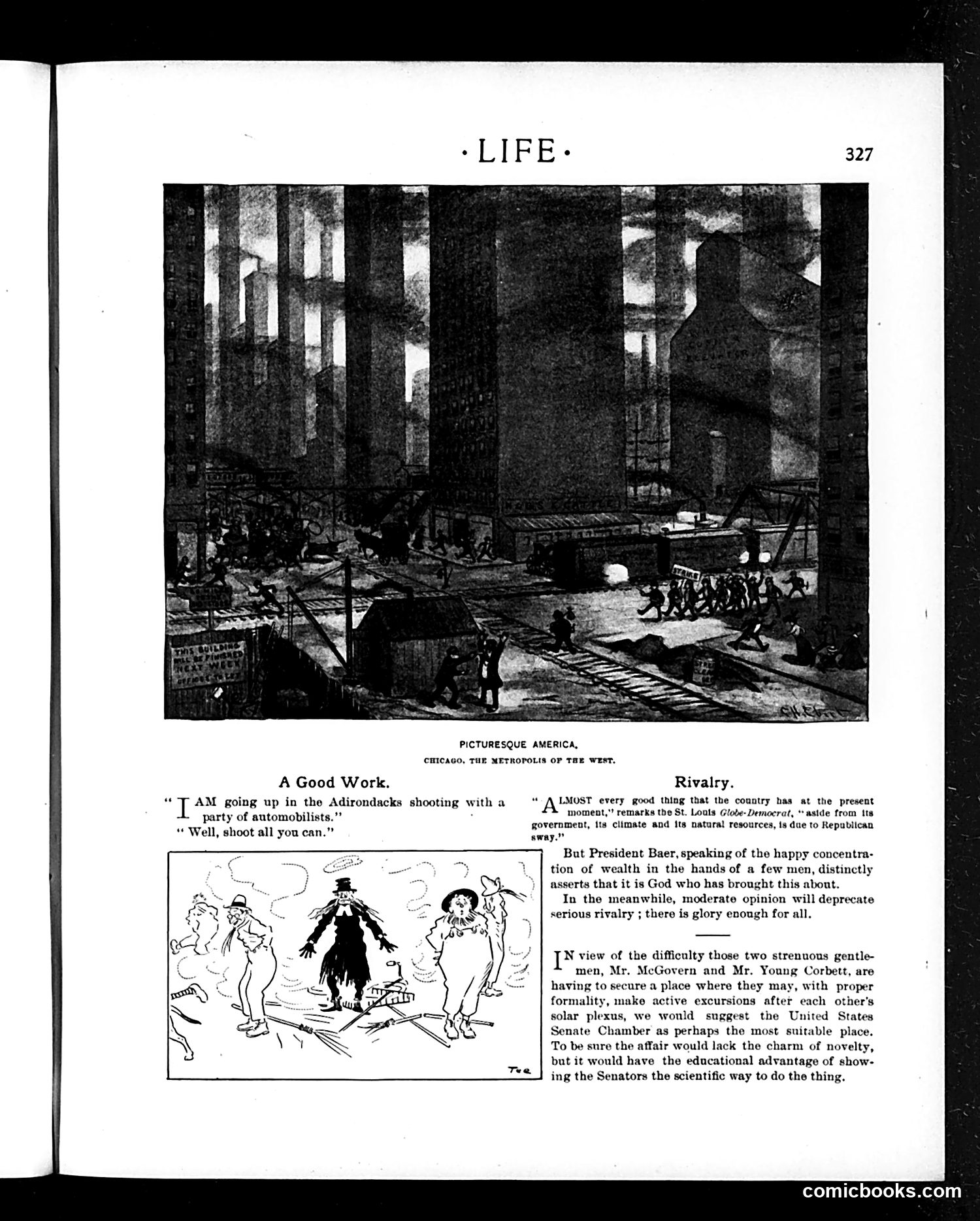
This page from *Life* magazine satirizes industrial rivalry and wealth concentration in early 20th-century America. The top photograph shows Chicago's industrial landscape—"the metropolis of the West"—illustrating the scale of American manufacturing. The cartoon below depicts a figure (likely representing a wealthy industrialist or politician) shooting at automobiles while surrounded by other wealthy figures. The dialogue "I am going up in the Adirondacks shooting with a party of automobiles" / "Well, shoot all you can" mocks the leisure pursuits of the ultra-wealthy. The accompanying text discusses rivalry between wealthy men like McGovern and Cortright competing for Senate attention, and references President Baer's views on wealth concentration. The satire targets both the absurd extravagance of the rich and their political influence, suggesting their competitive vanity wastes resources and deserves public ridicule.
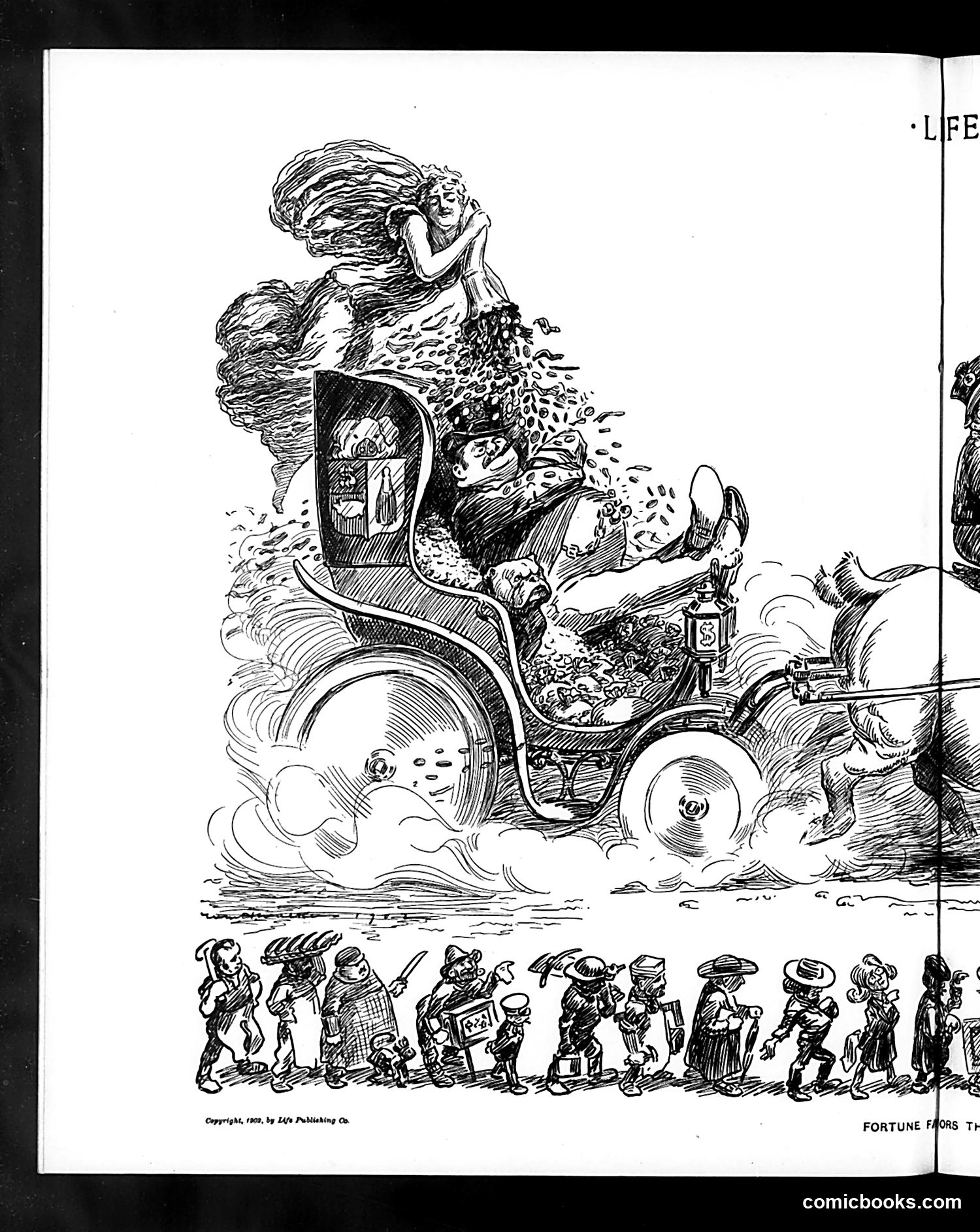
This satirical illustration depicts a massive, ornate carriage drawn by horses, carrying figures in elaborate dress while being pulled through clouds. The carriage appears to represent wealth, luxury, or governmental excess. Below, a procession of smaller figures—appearing to be common workers or citizens—walks in a line, seemingly following or serving the grand vehicle above. The satire likely comments on **class inequality and social hierarchy**: the contrast between the lavishly decorated carriage carrying privileged individuals and the modest procession of ordinary people below suggests criticism of wealth disparity or governmental indifference to workers' conditions. Without visible text identifying specific political figures or dates, the exact historical reference remains unclear, though the imagery strongly suggests early-20th-century American social or labor criticism.
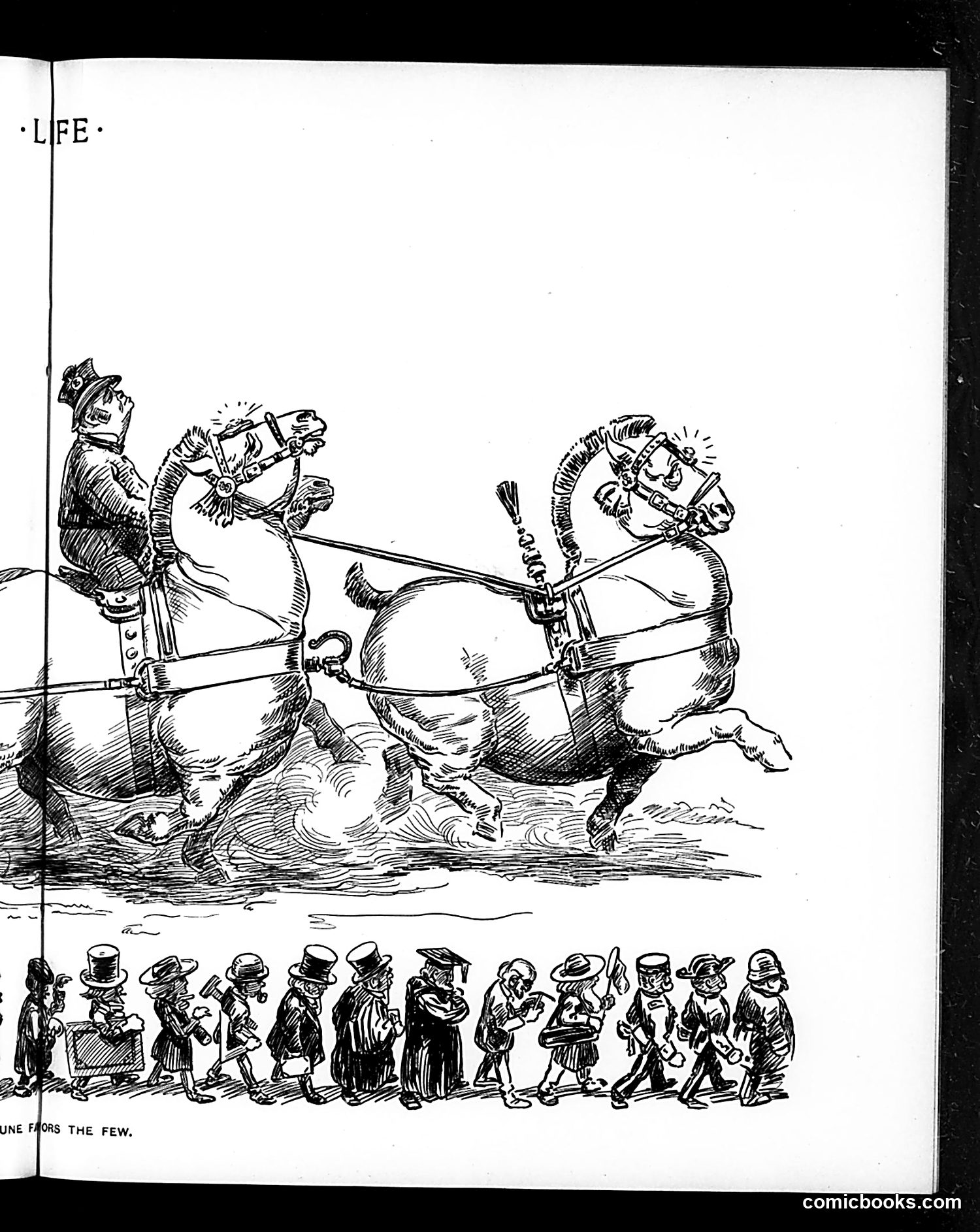
This satirical cartoon depicts two wealthy, corpulent figures on horseback riding over a line of common people below. The riders appear to be robber barons or wealthy industrialists—exaggerated with enormous bodies symbolizing greed and excess. They control the reins while the crowd below walks in submission. The caption reads "FORTUNE FOR THE FEW," which explicitly states the cartoon's message: wealth and power concentrate among a tiny elite while ordinary citizens have little agency or prosperity. This reflects late 19th/early 20th-century American anxieties about income inequality, monopolies, and the power of wealthy industrialists. The stark contrast between the oversized mounted figures and the diminished crowd emphasizes how the system disadvantages the many for the benefit of the few.
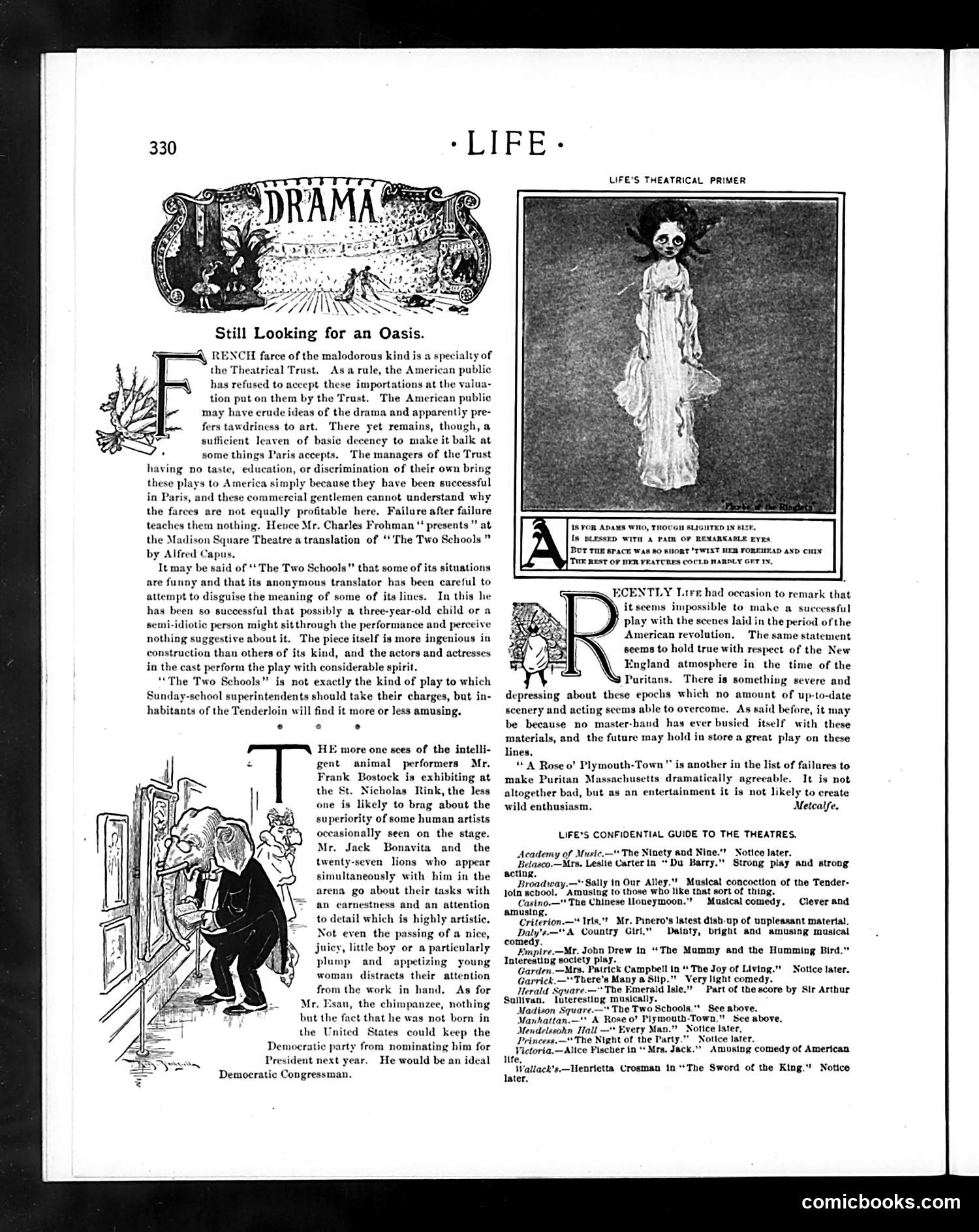
This page critiques the American theatrical establishment's practice of importing unsuccessful French farces. The article "Still Looking for an Oasis" argues that the Theatrical Trust—a powerful American theater monopoly—imports French plays simply because they succeeded in Paris, not understanding why they fail with American audiences. The accompanying illustration depicts theatrical impresarios (likely representing the Trust's management) attempting to force European plays onto reluctant American theatergoers. The satire suggests these commercial gentlemen prioritize profit over cultural taste, importing material unsuited to American sensibilities. The text also reviews contemporary performances, noting that even talented actors like Frank Benson and Jack Bonavita struggle when given poor material—a jab at producers who ignore quality for commercial viability.
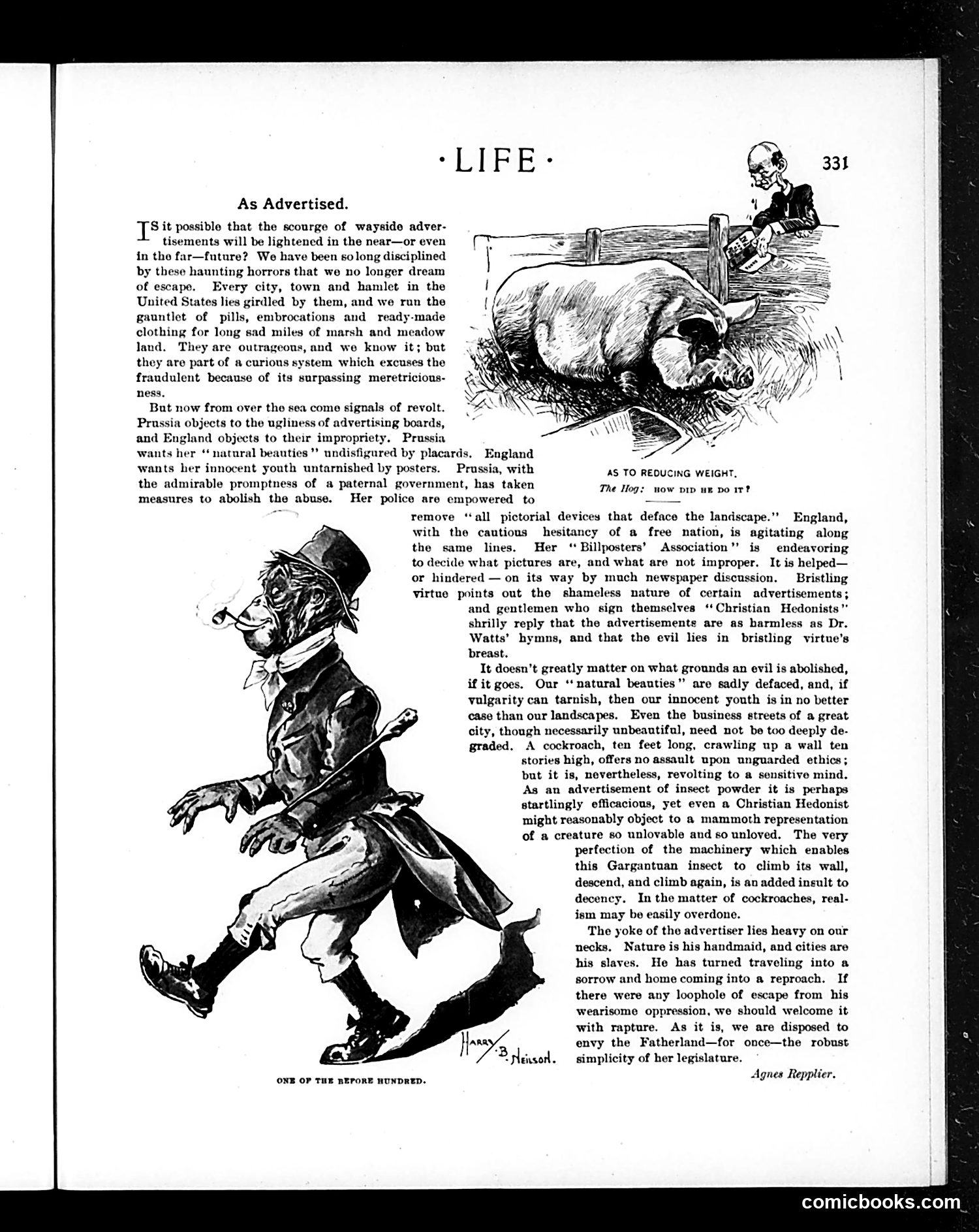
This 1900s *Life* magazine article by Agnes Repplier satirizes aggressive roadside advertising plaguing America. Two cartoons illustrate the absurdity: **Left cartoon** ("One of the Before Hundred"): A grotesquely thin man being chased by a giant hog—mocking weight-loss product ads promising impossible results. **Top right cartoon** ("As to Reducing Weight"): Similar theme, showing advertising's false claims. Repplier argues that while Prussia and England are removing billboards to protect landscapes and youth morality, America tolerates outrageous ads everywhere. She gives a vivid example: a ten-story cockroach climbing a wall advertising insect powder—technically effective advertising but visually revolting and degrading to public spaces. The satire targets both fraudulent advertisers (promising miraculous cures) and sanctimonious defenders claiming ads are "harmless." Repplier's point: it doesn't matter the moral justification—ugly, deceptive advertising damages cities and corrupts innocent youth. She envies Germany's government power to regulate landscape defacement.
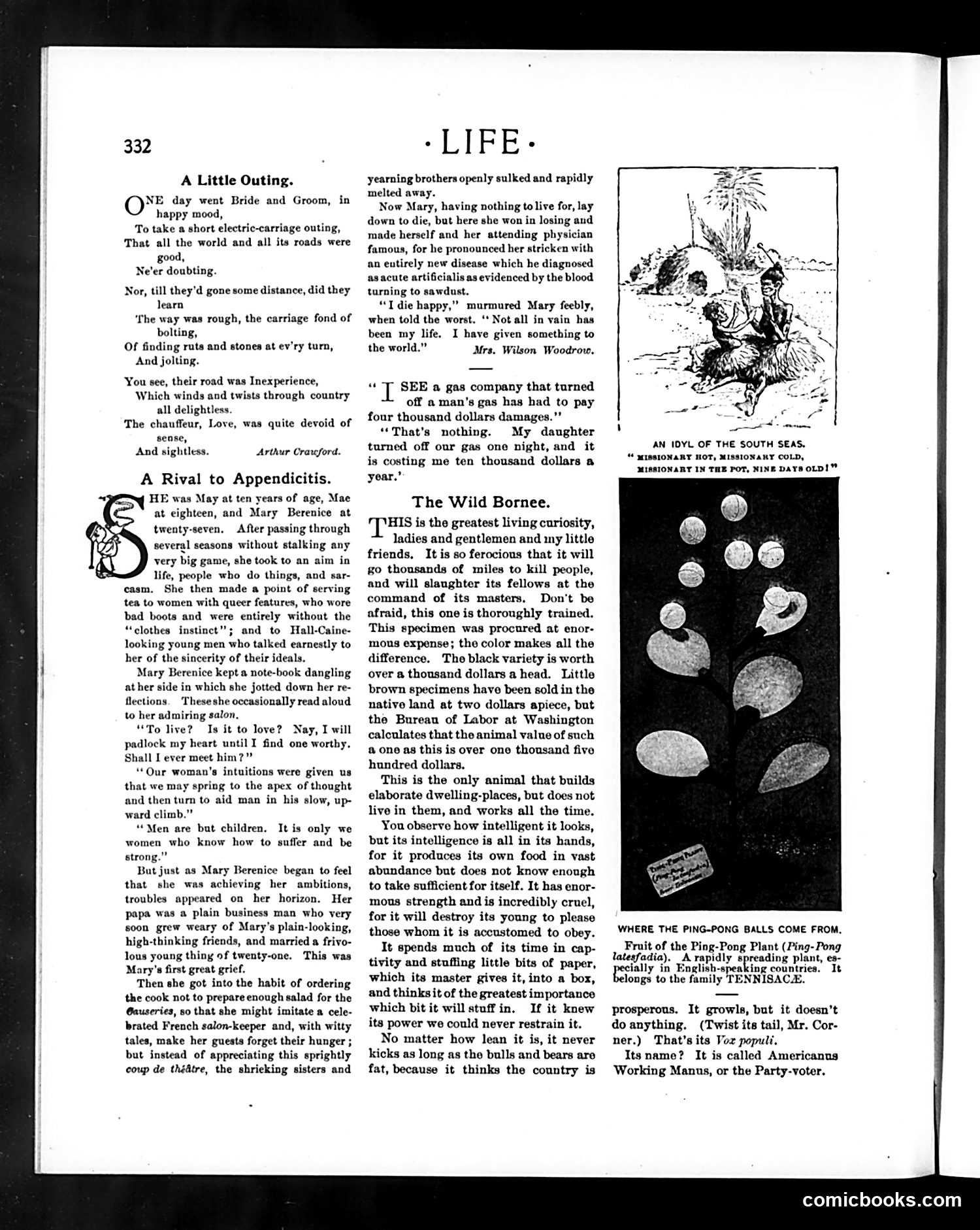
This page contains three distinct satirical pieces mocking pretension and social absurdity in early 20th-century America. **"A Little Outing"** uses newlyweds as vehicles for satire—their rough carriage ride represents marriage itself, with "Love" as a blind, senseless driver navigating "Inexperience." **"A Rival to Appendicitis"** ridicules the affected intellectual woman. Mary Berenice, a pretentious salon-keeper, adopts mannered philosophies, keeps a notebook of pseudo-profound observations, and deliberately serves inadequate salad to imitate European sophistication. Her invented illness—"acute artificialis" (her blood "turning to sawdust")—is Life's cruel diagnosis of her artificiality. The joke: her performative suffering finally makes her "famous," suggesting her entire existence was performative. **"The Wild Borneo"** appears to satirize both circus showmanship and, possibly, racial attitudes of the era—though the text is cut off. The "Wild Bornee" is presented as a valuable curiosity, with value determined by color, suggesting commentary on dehumanizing displays. Throughout, Life targets vanity, affectation, and shallow social climbing.
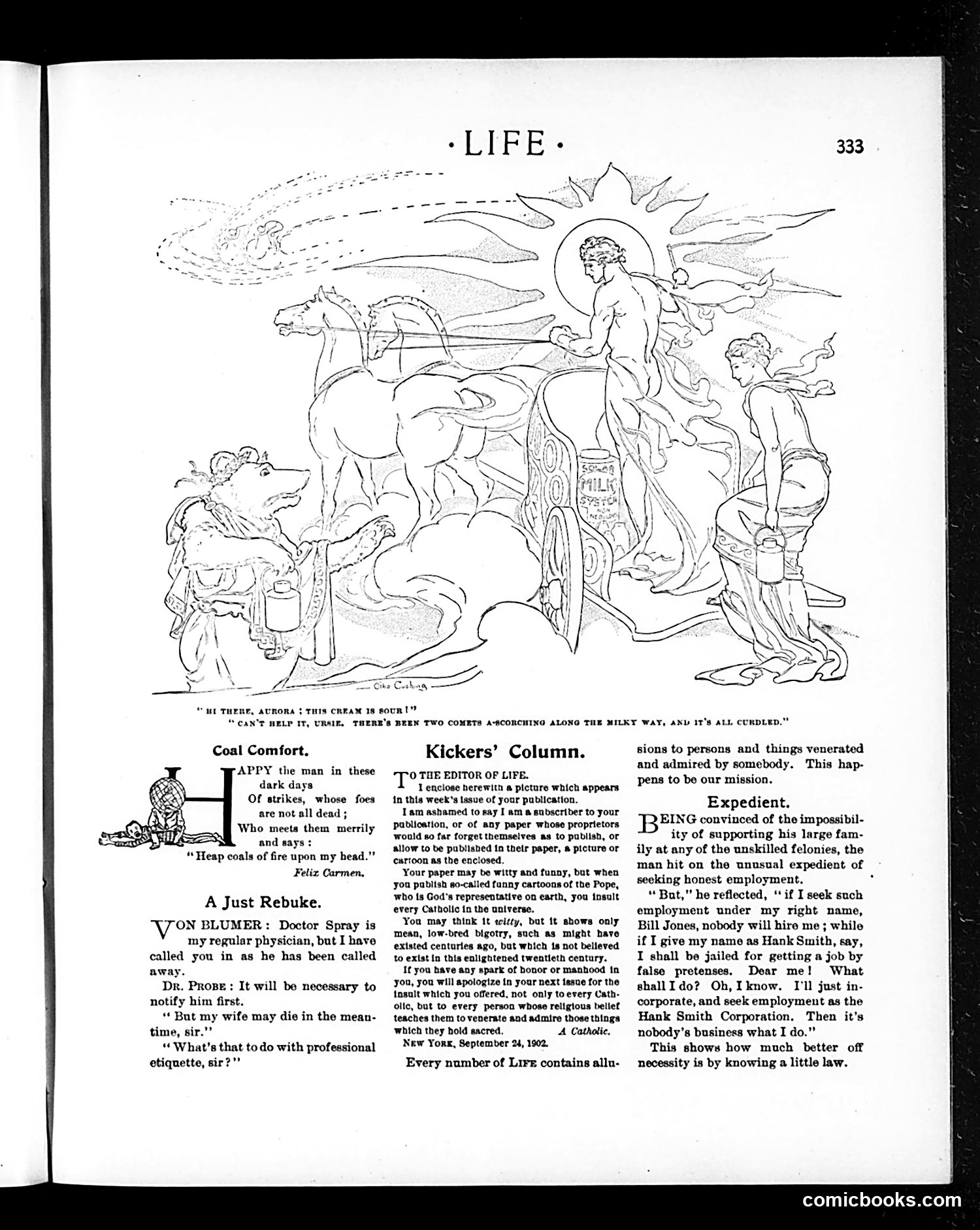
This page contains three distinct satirical pieces: **"Coal Comfort"** mocks strikes through a working-class character who paradoxically welcomes hardship, referencing the biblical phrase "heap coals of fire upon my head." **"A Just Rebuke"** satirizes rigid professional etiquette: a doctor refuses to treat a dying woman without notifying her regular physician first, prioritizing protocol over human life—the satire being the absurdity of such formalism. **"Kickers' Column"** is a reader's complaint about Life publishing a cartoon mocking the Pope. The magazine's response is unapologetically irreverent: they mock religious figures as a deliberate editorial mission. This reflects Life's role as a satirical publication unafraid to offend Catholic sensibilities in early 1900s America. **"Expedient"** jokes about legal loopholes: a man avoids arrest for false employment by incorporating himself as a business entity—satirizing how wealth and legalism allow people to evade consequences ordinary citizens cannot.
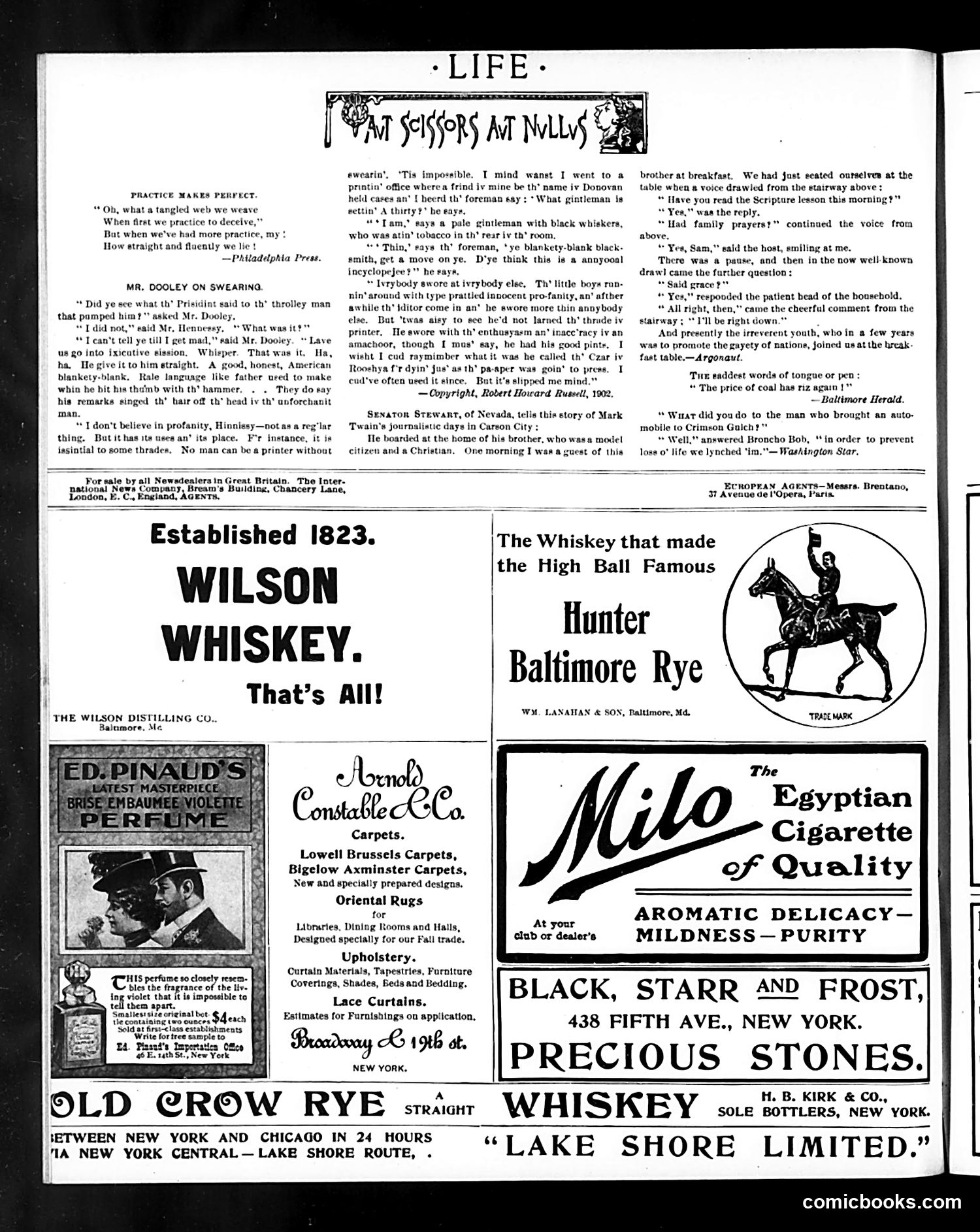
This page from *Life* (circa 1902, based on copyright dates) combines satirical humor with period advertisements. **Main Content:** The page features three humorous anecdotes attributed to "Mr. Dooley" (a popular Irish-American character) and accounts involving Mark Twain. Mr. Dooley's stories mock both deception and profanity—one piece notes that with practice, lying becomes easy; another recounts colorful swearing in a printing office. The Twain anecdote humorously depicts young Mark joining his brother's breakfast after asking whether they'd said grace, only to arrive later requesting—an irreverent commentary on his character. **Satirical Points:** The humor targets hypocrisy (lying improves with practice), working-class speech patterns, and young Mark Twain's irreverence toward religion. **Advertisements:** The lower portion contains period ads for Wilson Whiskey, Ed. Pinaud's perfume, Hunter Baltimore Rye, Milo cigarettes, and other luxury goods—typical of *Life*'s upper-class readership. The page is primarily advertising and light satirical commentary rather than political cartoons.
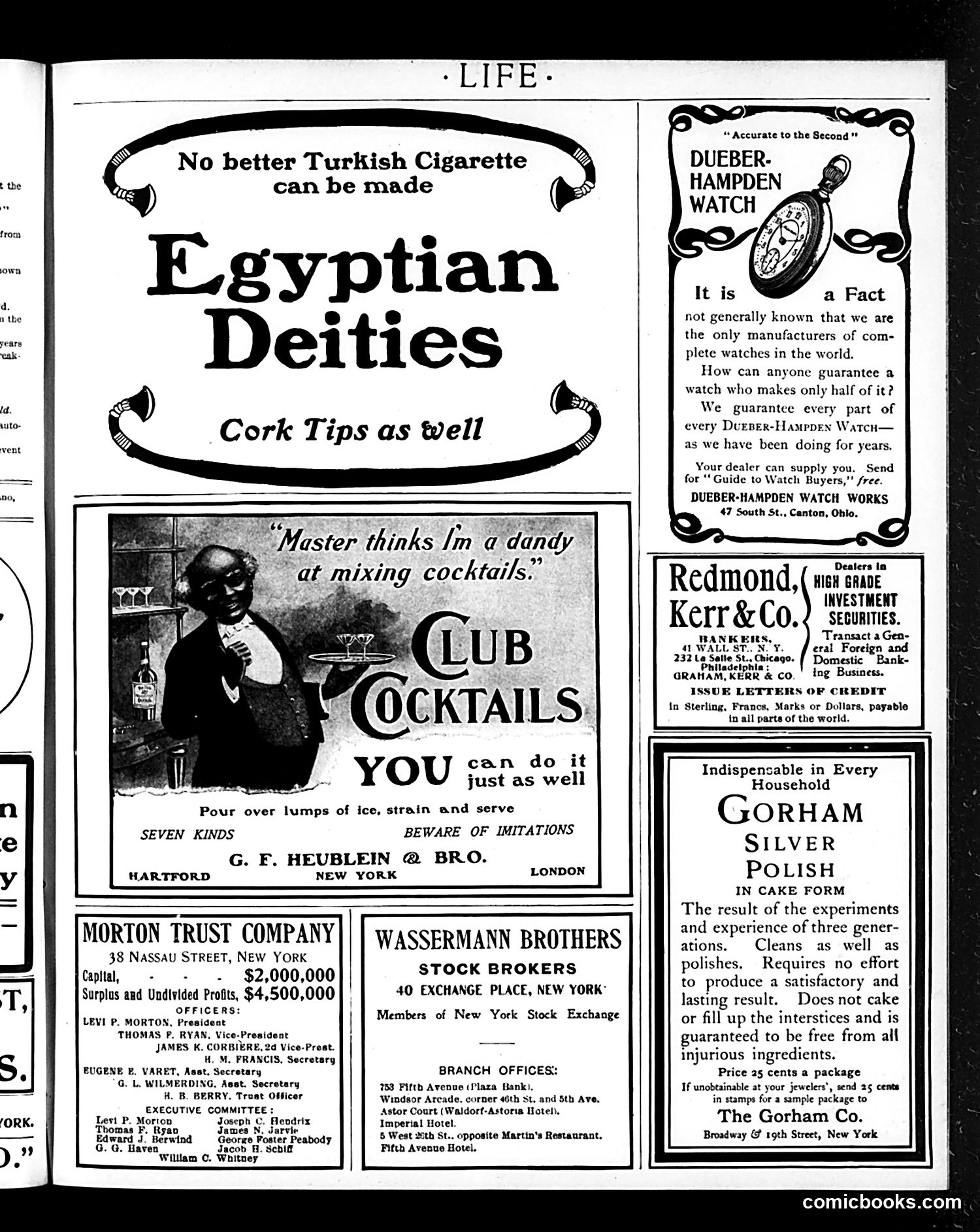
This page is primarily **advertising**, not satirical editorial content. The main cartoon depicts a Black servant mixing cocktails with the caption "Master thinks I'm a dandy at mixing cocktails"—a racist caricature playing on period stereotypes of Black domestic workers and their supposed skill at menial tasks, presented as humor for the white audience. The page otherwise contains business advertisements: Egyptian Deities cigarettes, Club Cocktails (with instructions for home bartending), financial services (Morton Trust Company, Wassermann Brothers stockbrokers, Redmond Kerr & Co.), a Dueber-Hampden pocket watch, and Gorham silver polish. **Context for modern readers**: This reflects early-20th-century casual racism in mainstream American media, where Black figures appeared in advertisements as servants or entertainers. The "humor" relied on dehumanizing stereotypes that were commonplace—and considered acceptable—in period publications.
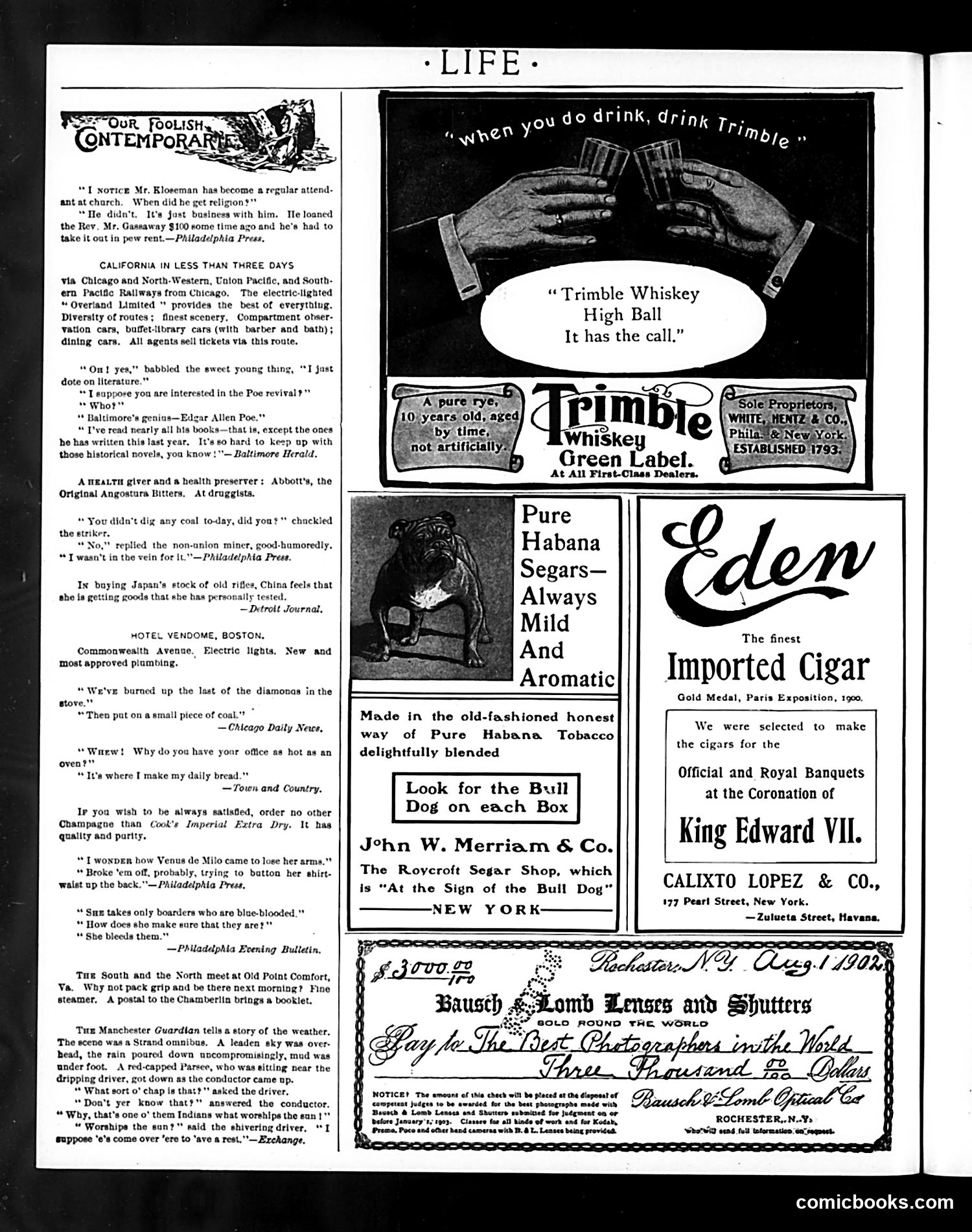
This page is primarily **advertisements and humor vignettes** typical of Life magazine's format. The **cartoons/jokes** are brief, standalone quips about contemporary life: - A man attends church only to collect pew rent from a loan he made to the reverend - A woman claims to read Poe but confuses his historical novels with his actual work - Coal miners make puns about being "in the vein" - A servant woman bleeds aristocratic boarders to verify their "blue blood" - An Indian (Parsee) worships the sun but visits England seeking rest during rain These reflect **turn-of-the-century American attitudes**: religious hypocrisy, literary pretension, class distinctions, and casual ethnic stereotyping. The **advertisements** showcase luxury goods (whiskey, cigars, trains) marketed to wealthy readers, including an Eden cigar specifically promoted as used at **King Edward VII's coronation** (1902), lending royal prestige to products. The overall tone is light satirical commentary on American manners and consumption for an educated, affluent audience.
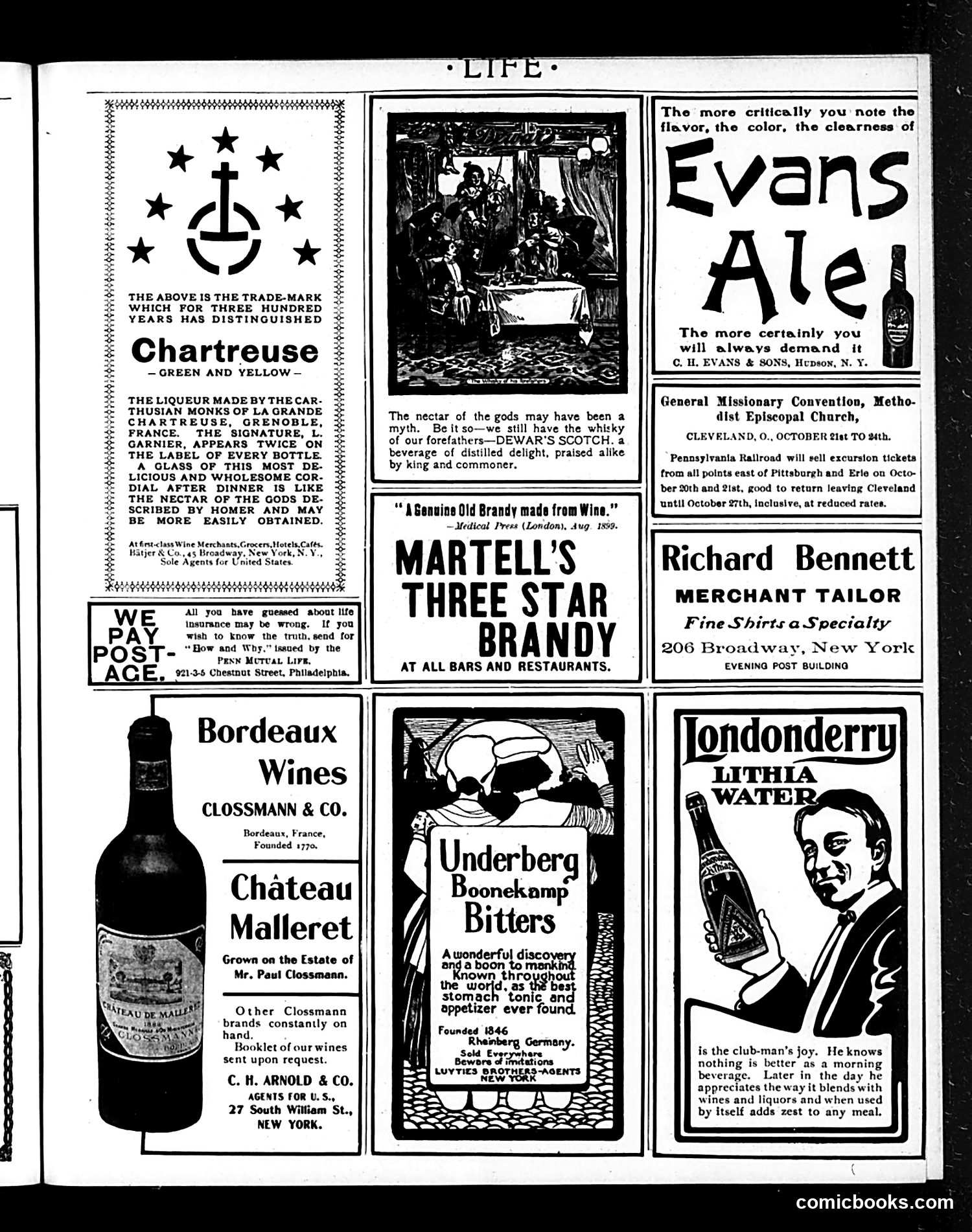
This page is primarily **advertising**, not editorial content or satire. It showcases luxury beverages popular among upper-class American consumers in the early 1900s. The advertisements feature: - **Chartreuse** (French liqueur from Carthusian monks) - **Dewar's Scotch whisky** - **Evans Ale** (American) - **Martell's Three Star Brandy** (French) - **Bordeaux wines** via Clossmann & Co. - **Underberg Bitters** (German digestif) - **Londonderry Lithia Water** (mineral water) Plus notices for a Methodist convention and a merchant tailor. The advertisements use period conventions: classical references (Homer's nectar), heritage claims ("three hundred years"), and appeals to sophistication and masculinity ("club-man's joy"). These are straightforward commercial pitches rather than satirical commentary, reflecting Life's dual role as both humor magazine and high-end advertising vehicle targeting affluent readers.
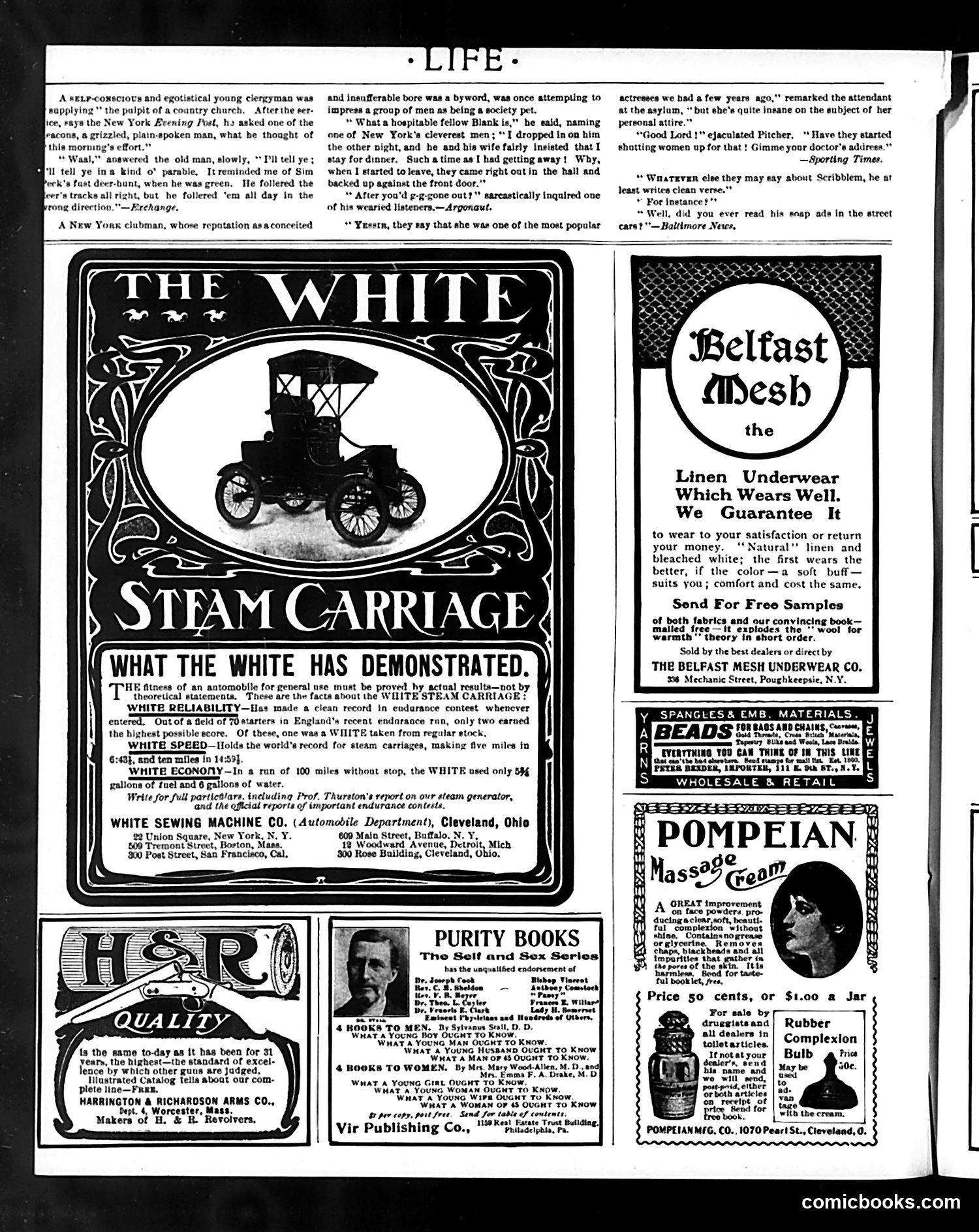
This is primarily an **advertising page** from *Life* magazine, featuring several unrelated commercial advertisements and humorous anecdotes rather than political cartoons. The page includes three brief jokes at the top: one mocking a self-important young clergyman (his sermon missed the point), another ridiculing a conceited New York clubman (the punchline suggests his hosts forced him out), and a third about an actress institutionalized for vanity about her clothing. The main advertisements showcase **early 1900s products**: the White Steam Carriage (demonstrating automotive reliability through racing records), H&R firearms (emphasizing 31 years of quality), Purity Books (moralistic sex-education volumes for men and women—typical of the era's cautious approach to such topics), Belfast Mesh underwear, and Pompeian massage cream. The ads and jokes reflect **turn-of-the-century American middle-class values**: technological progress, commercial competition, sexual propriety, and social pretension—all targets of mild satire or marketing appeals.
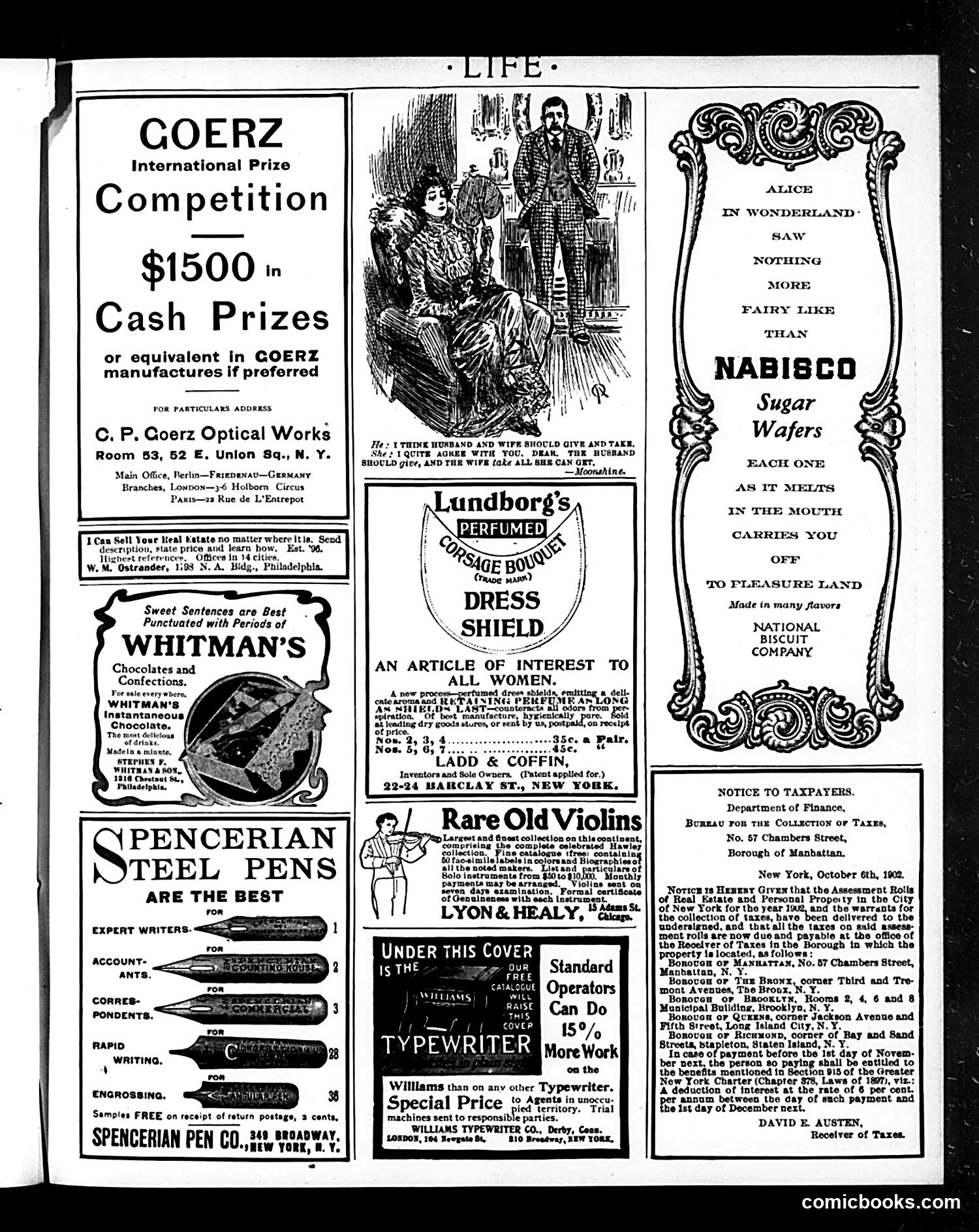
This page is primarily **advertisements** rather than satirical cartoons. However, it contains one notable cartoon strip: ## The Marital Dispute Cartoon The central illustration shows a husband and wife in what appears to be a domestic argument. The caption reads: "I think husband and wife should give and take. With you, dear, the husband gives and the wife takes all she can get." This is labeled as being from "Moonshine," suggesting it's commentary on marriage dynamics—specifically satirizing wives as financially exploitative. ## Context for Modern Readers This reflects early-1900s gender stereotypes about marriage as a financial transaction, where wives were portrayed as mercenary. The "joke" relies on depicting women as materialistic and husbands as victims—attitudes considered offensive today. The remainder of the page consists of period advertisements for products like fountain pens, typewriters, chocolates, violins, and biscuits, along with a tax notice from New York City (dated October 6, 1902), establishing this as an early-20th-century publication.
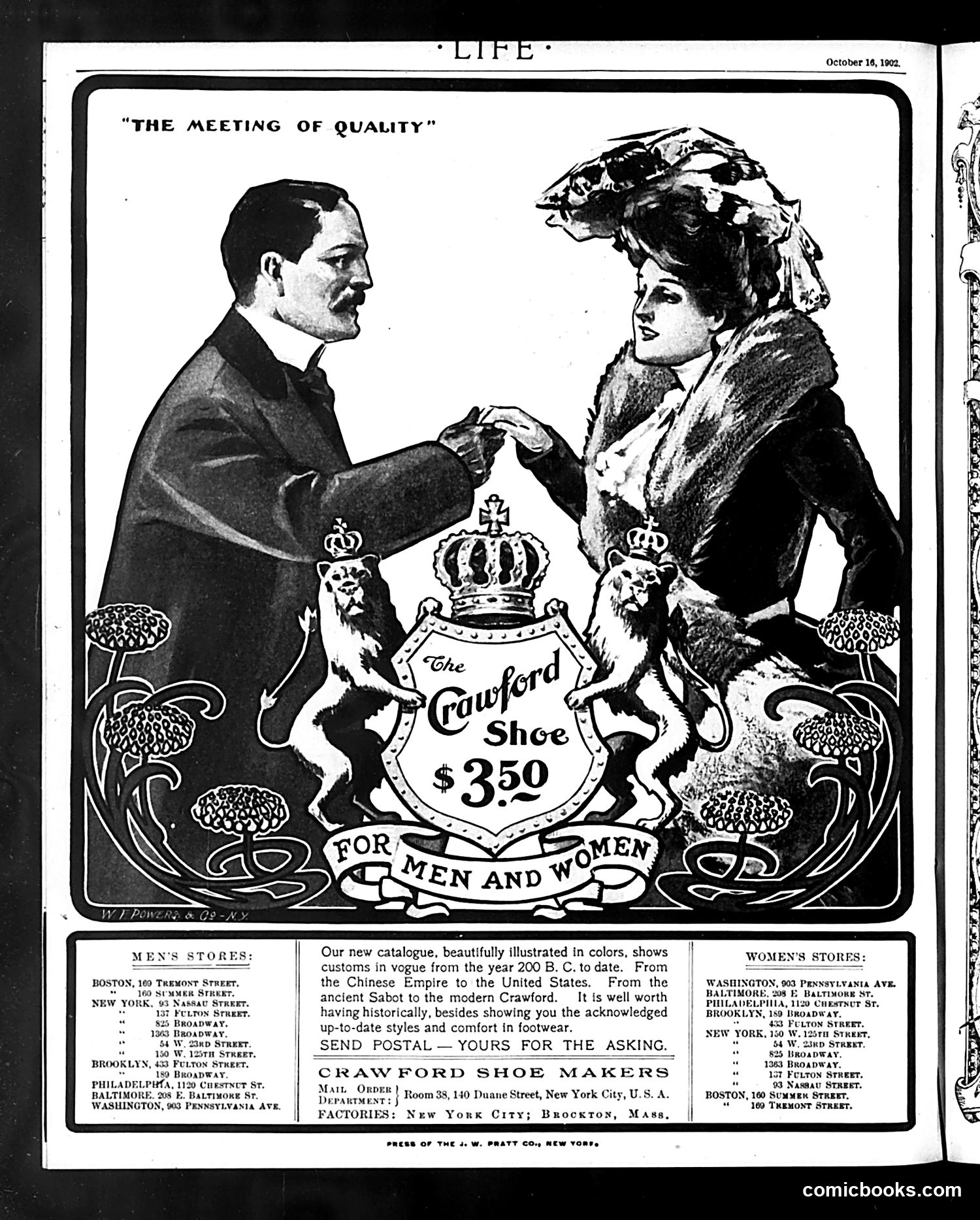
This is primarily a **Crawford Shoe advertisement** disguised as satirical content, typical of Life magazine's advertising approach circa 1902. The illustration depicts a well-dressed man and an elegantly attired woman meeting and shaking hands over a shield bearing "The Crawford Shoe $3.50 FOR MEN AND WOMEN." Both figures wear crowns and are accompanied by heraldic lions, suggesting nobility or prestige. The satire's point: the advertisement claims Crawford shoes represent the pinnacle of quality—a "meeting of quality"—by presenting the shoe as worthy of royal status. The accompanying text humorously suggests the company's new catalog spans from ancient Chinese footwear (200 B.C.) to "the modern Crawford," implying Crawford shoes represent the ultimate evolution in shoe design. This was common early-20th-century advertising rhetoric: positioning affordable mass-produced goods ($3.50) as equivalent to luxury or high society through humorous, grandiose imagery. The ad lists numerous store locations across major American cities, emphasizing national availability.