
Life, 1902-10-16 · page 4 of 22
Life — October 16, 1902 — page 4: what you’re looking at
What you’re looking at
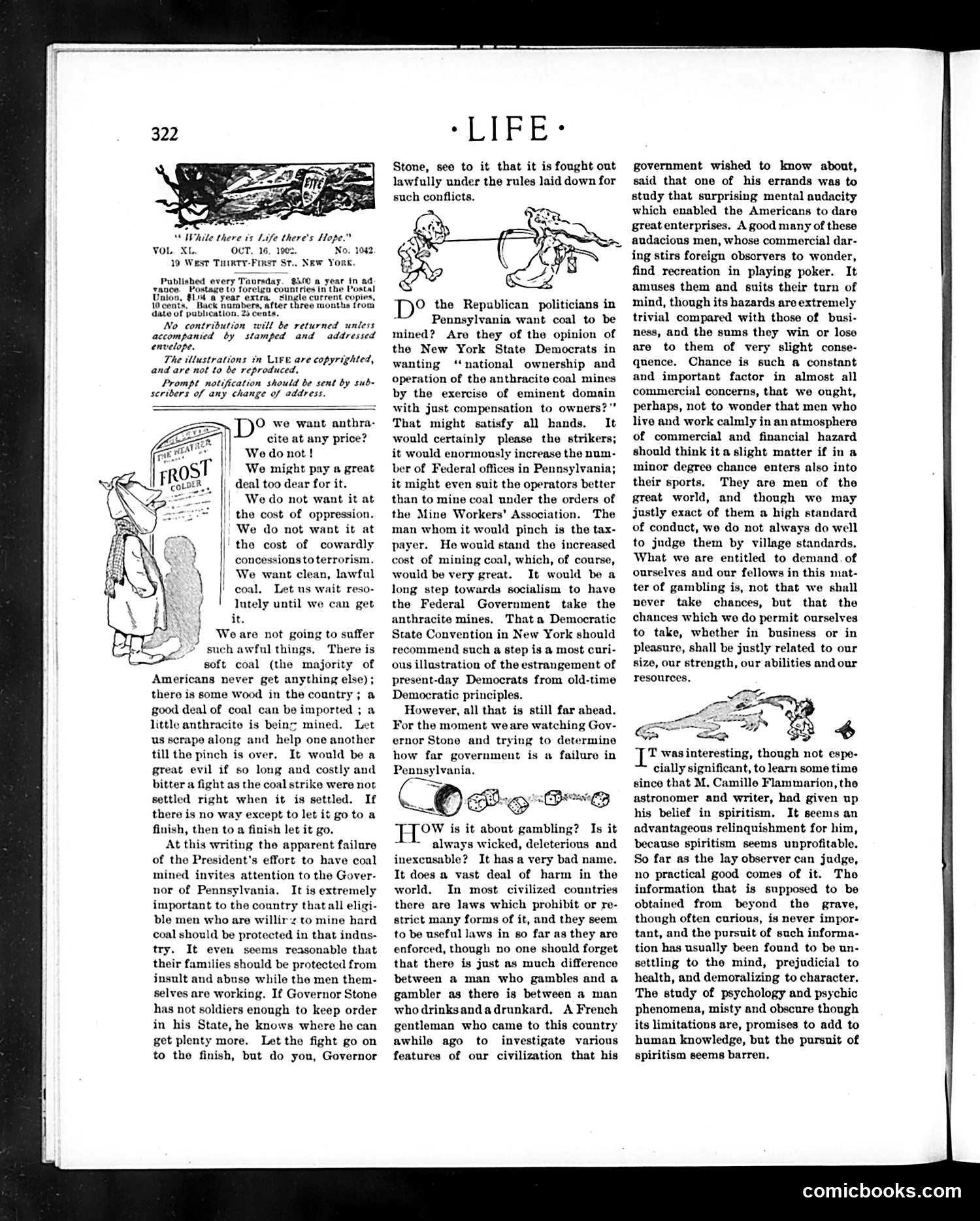
The page contains political commentary rather than a single cartoon. The main illustrated figure appears to be a caricatured politician (likely Governor Stone of Pennsylvania, based on context) depicted as a frozen or rigid character, suggesting ineffectual governance. The editorials debate two issues: (1) whether Pennsylvania Republicans should support federal ownership of anthracite coal mines, and (2) criticism of spiritualism as practiced by the wealthy. The satire targets political inaction on labor issues and wealthy Americans' embrace of spiritualism as foolish superstition. The frozen figure symbolizes governmental paralysis—unable to act decisively on coal mining conflicts or labor disputes. The commentary suggests politicians prioritize trivial entertainment over serious economic problems affecting workers.
📄 Transcribed text from this page (OCR, searchable)
Machine-transcribed from the original scan — historical spelling and the odd misread are preserved.
“While there is Life there's Hope.” VOL. XL. OCT. 16, 1 19 West Tuinty-Finst Published every Taursday. $3.0 a year in ad. vance. Postage to forelga countries in the Postal Union, $LM a year extra. single current copies, \Weents, Back num| ter three months from date of publication. 25 cents, No contribution will be returned unless accompanied by stamped and addressed envelope. The illustrations in Live are copyrighted, and are not to be reproduced. Prompt notification should be sent by sub- scribers of any change of address. O we want anthra- cite at any price? We do not! We might pay a great deal too dear for it. We do not want it at | the cost of oppression. We do not want it at the cost of cowardly concessions toterrorism. We want clean, lawful coal, Let us wait reso- lutely until we can get it. Weare not going to suffer such awful things, There is soft coal (the majority of Americans never get anything else) ; there is some Wood in the country; a good deal of coal can be imported ; a little anthracite is bein mined. Let us scrape along and help one another till the pinch is over. It would be a great evil if so long and costly and bitter a fight as the coal strike were not settled right when it is settled. If there is no way except to let it go to a finish, then to a finish let it go. At this writing the apparent failure of the President's effort to have coal mined invites attention to the Gover- nor of Pennsylvania. It is extremely important to the country that all eligi- ble men who are willirs to mine hard coal should be protected in that indus- try. It even seems reasonable that their families should be protected from insult and abuse while the men them- selves are working. If Governor Stone has not soldiers enough to keep order in his State, he knows where he can get plenty more. Let the fight go on to the finish, but do you, Governor *LiP'E + Stone, see to it that it is fought out lawfully under the rules laid down for such conflicts. D°? the Republican politicians in S Pennsylvania want coal to be mined? Are they of the opinion of the New York State Democrats in wanting ‘national ownership and operation of the anthracite coal mines by the exercise of eminent domain with just compensation to owners?” That might satisfy all hands. It would certainly please the strikers; it would enormously increase the num- ber of Federal offices in Pennsylvania; it might even suit the operators better than to mine coal under the orders of the Mine Workers’ Association. The man whom it would pinch is the tax- payer. He would stand the increased cost of mining coal, which, of course, would be very great. It would be a long step towards socialism to have the Federal Government take the anthracite mines, Thata Democratic State Convention in New York should recommend such a step is a most curi- ous illustration of the estrangement of present-day Democrats from old-time Democratic principles. However, all that is still far ahead. or the moment we are watching Gov- ernor Stone and trying to determine how far government is a failure in Pennsylvania. OW is it about gambling? Is it ~* always wicked, deleterious and inexcusable? It has a very bad name. It does a vast deal of harm in the world. In most civilized countries there are laws which prohibit or re- strict many forms of it, and they seem to be useful laws in so far as they are enforced, though no one should forget that there is just as much difference between a man who gambles and a gambler as there is between a man who drinksandadrunkard, A French gentleman who came to this country awhile ago to investigate various features of our civilization that his government wished to know about, said that one of his errands was to study that surprising mental audacity which enabled the Americans to dare great enterprises. A good many of these audacious men, whose commercial dar- ing stirs foreign obsorvers to wonder, find recreation in playing poker. It amuses them and suits their turn of mind, though its hazards are extremely trivial compared with those of busi- ness, and the sums they win or lose are to them of very slight conse- quence. Chance is such a constant and important factor in almost all commercial concerns, that we ought, perhaps, not to wonder that men who live and work calmly in an atmosphere of commercial and financial hazard should think it a slight matter if in a minor degree chance enters also into their sports. They are men of the great world, and though we may justly exact of them a high standard of conduct, we do not always do well to judge them by village standards. What we are entitled to demand. of ourselves and our fellows in this mat- ter of gambling is, not that we shall never take chances, but that the chances which we do permit ourselves to take, whether in business or in pleasure, shall be justly related to our size, our strength, our abilities andour resources, —<* jt wasinteresting, though not espe- cially significant, to learn some time since that M, Camille Flammarion, the astronomer and writer, had given up his belief in spiritism. It seems an advantageous relinquishment for him, because spiritism seems unprofitable. So far as the lay observer can judge, no practical good comes of it. Tho information that is supposed to be obtained from beyond tho grave, though often curious, is never impor- tant, and the pursuit of such informa- tion has usually been found to be un- settling to the mind, prejudicial to health, and demoralizing to character. The study of psychology and psychic phenomena, misty and obscure though its limitations are, promises to add to human knowledge, but the pursuit of spiritism seems barren. comicbooks.com