
Life, 1902-10-16 · page 6 of 22
Life — October 16, 1902 — page 6: what you’re looking at
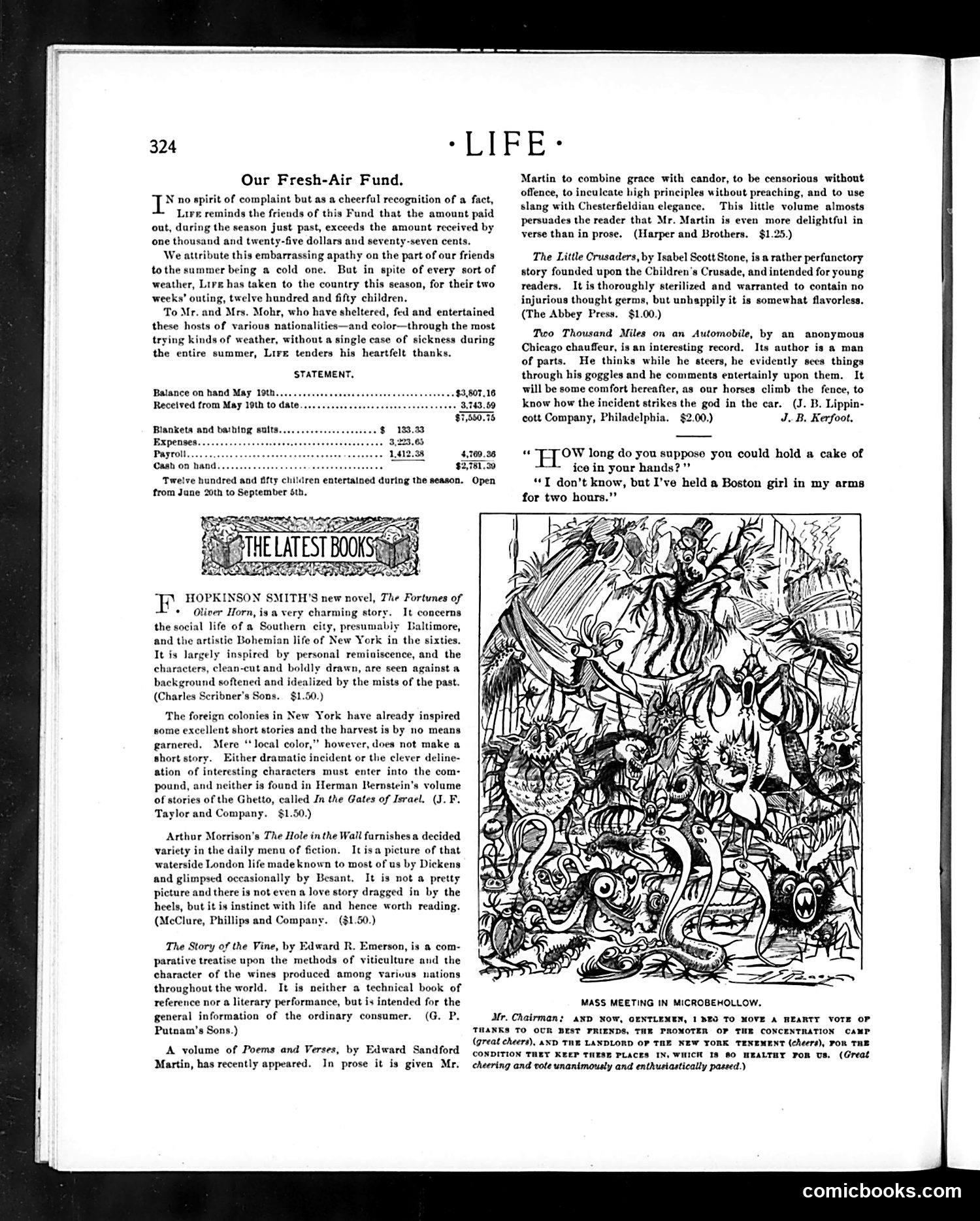
What you’re looking at
This political cartoon depicts a chaotic assembly of grotesquely drawn figures in what appears to be a satirical commentary on political or social gatherings. The caption references a "mass meeting" and includes mock-parliamentary language about voting thanks to "our best friends" and the "promoter of the concentration camp" and "new york tenement." The style and tone suggest satire directed at urban political meetings, possibly mocking either ward politics, immigrant communities, or tenement reform debates. The grotesque caricatures and frenzied composition emphasize disorder and questionable motives among participants. Without additional historical context about the specific date and Life magazine's editorial stance in this period, the precise political target remains unclear, though the reference to "concentration camp" and tenements suggests Progressive-era social criticism.
📄 Transcribed text from this page (OCR, searchable)
Machine-transcribed from the original scan — historical spelling and the odd misread are preserved.
324 Our Fresh-Air Fund. LS ne pit of complaint but as a cheerful recognition of a fact, Lire reminds the friends of this Fund that the amount paid out, daring the season just past, exceeds the amount received by one thousand and twenty-five dollars and seventy-seven cents. We attribute this embarrassing apathy on the part of our friends tothe summer being a cold one. But in spite of every sort of weather, Lire has taken to the country this season, for their two weeks’ outing, twelve hundred and fifty children. To Mr. and Mrs. Mohr, who have sheltered, fed and entertained these hosts of various nationalities—and color—through the most. trying kinds of weather, without a single case of sickness during the entire summer, Lire tenders his heartfelt thanks. STATEMENT, Balance on hand May 194 Recetved from May 19th to date Blankets and bathing sults... Expenses. Pasroll. Cash on hand. Twelve hundred and fifty chitdren entertained during the season. Open from Jane 20th to September sth, HOPKINSON SMITH’S new novel, The Fortunes of * Oliver Horn, is a very charming story. It concerns the social life of a Southern city, presumably Baltimore, and the artistic Bohemian life of New York in the sixties. It is largely inspired by personal reminiscence, and the characters, clean-cut and boldly drawn, are seen against a background softened and idealized by the mists of the past. (Charles Scribner's Sons. $1.50.) The foreign colonies in New York have already inspired some excellent short stories and the harvest is by no means garnered. Mere ‘local color,” however, does not make a short story. Either dramatic incident or the clever delin ation of interesting characters must enter into the com- pound, and neither is found in Herman Rernstein’s volume of stories of the Ghetto, called Jn the Gates of Israel. (J. F. Taylor and Company. $1.50.) Arthur Morrison's The Hole in the Wall farnishesa decided variety in the daily menu of fiction. It is. picture of that waterside London life made known to most of us by Dickens and glimpsed occasionally by Besant, It is not a pretty picture and there is not even a love story dragged in by the heels, but it is instinct with life and hence worth reading. (McClure, Phillips and Company. (31.50.) The Story of the Vine, by Edward R. Emerson, is a com- parative treatise upon the methods of viticulture aud the character of the wines produced among varivus nations throughout the world. It is neither a technical book of reference nor a literary performance, but is intended for the general information of the ordinary consumer. (G. P. Martin to combine grace with candor, to be censorious without offence, to inculcate high principles without preaching, and to use slang with Chesterfieldian elegance. This little volume almosts persuades the reader that Mr. Martin is even more delightful in verse than in prose. (Harper and Brothers. $1.25.) The Little Crusaders, by Isabel Scott Stone, is a rather perfunctory story founded upon the Children’s Crusade, and intended for young readers. It is thoroughly sterilized and warranted to contain no injurious thought germs, but unhappily it is somewhat flavorless. (The Abbey Press. $1.00.) Two Thousand Miles on an Automobile, by an anonymous Chicago chauffeur, is an interesting record. Its author is a man of parts. He thinks while he steers, he evidently sees things through his goggles and he comments entertainly upon them. It will be some comfort hereafter, as our horses climb the fence, to know how the incident strikes the god in the car. (J. B. Lippin- cott Company, Philadelphia. $2.00.) J.B. Kerfoot, “ HOw long do you suppose you could hold a cake of ~- ice in your hands?" “T don’t know, but I’ve held a Boston girl in my arms for two hours.”’ MASS MEETING IN MICROBEHOLLOW. Afr. Chairman: axD NOW, GENTLEMEN, 1BE0 TO MOVE A NEARTY VOTE OP THANKS TO OUR BEST FRIENDS, THE PROMOTER OF THE CONCENTRATION CAMP (great cheers), aXD THE LANDLORD OP THE NEW YORK TENEMENT (cheers), POR THE CONDITION THEY KEEP THESE PLACES IN, WHICH 18 80 HEALTHY FoR Us. (Great cheering and vote unanimously and enthusiastically passed.) Putnam's Sons.) A volume of Poems and Verses, by Edward Sandford Martin, has recently appeared. In prose it is given Mr. comicbooks.com