
Life, 1902-10-16 · page 12 of 22
Life — October 16, 1902 — page 12: what you’re looking at
What you’re looking at
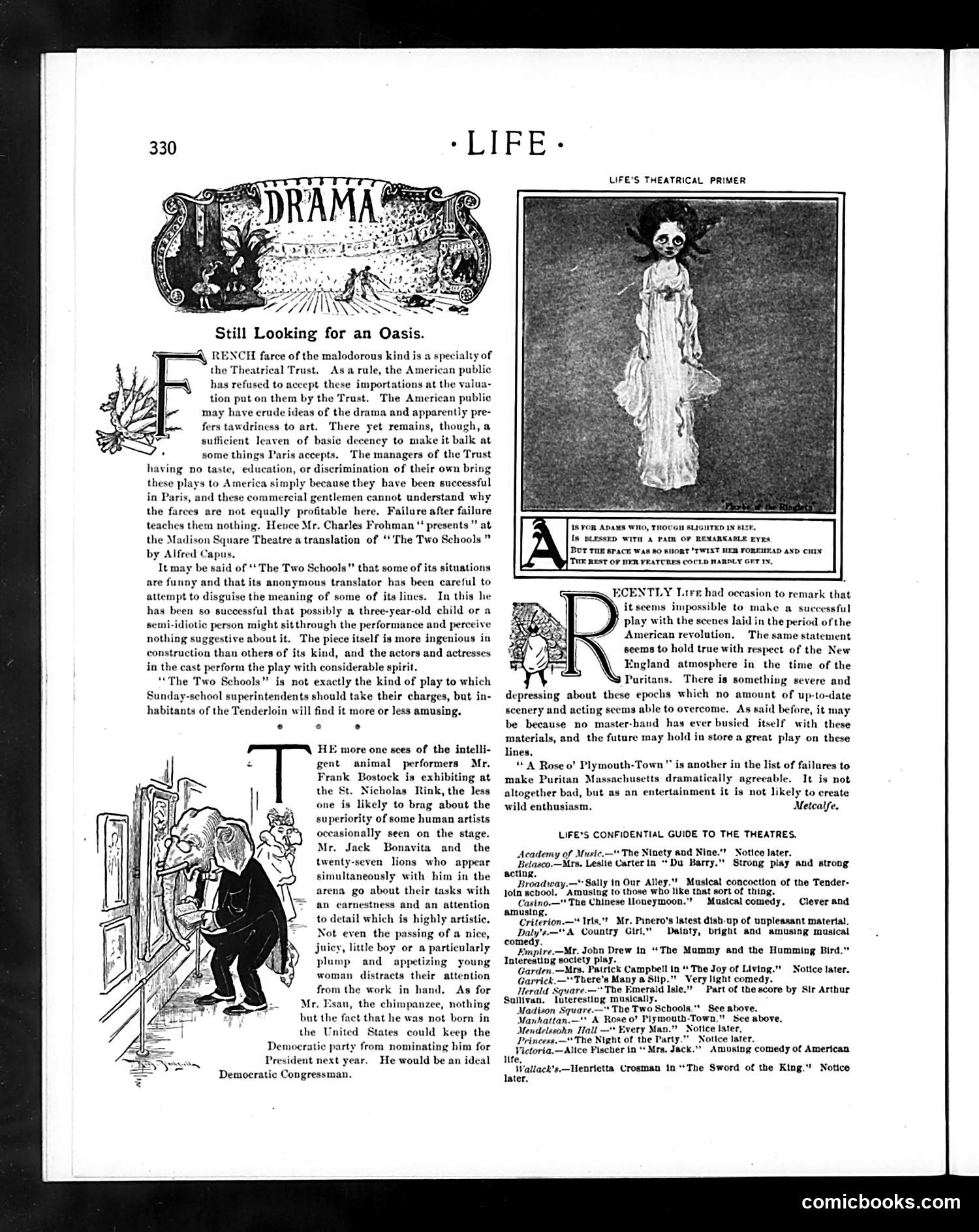
This page critiques the American theatrical establishment's practice of importing unsuccessful French farces. The article "Still Looking for an Oasis" argues that the Theatrical Trust—a powerful American theater monopoly—imports French plays simply because they succeeded in Paris, not understanding why they fail with American audiences. The accompanying illustration depicts theatrical impresarios (likely representing the Trust's management) attempting to force European plays onto reluctant American theatergoers. The satire suggests these commercial gentlemen prioritize profit over cultural taste, importing material unsuited to American sensibilities. The text also reviews contemporary performances, noting that even talented actors like Frank Benson and Jack Bonavita struggle when given poor material—a jab at producers who ignore quality for commercial viability.
📄 Transcribed text from this page (OCR, searchable)
Machine-transcribed from the original scan — historical spelling and the odd misread are preserved.
Still Looking for an Oasis. RENCH farce of the malodorous kind is a specialty of the Theatrical Trust. Asa rule, the American public has refused to accept these importations at the valua- tion put on them by the Trust. The American public may have crude ideas of the drama and apparently pre- fers tawdriness to art. There yet remains, though, a sufficient leaven of basic decency to make it balk at some things Paris accepts, The managers of the Trust having no taste, education, or discrimination of their own bring these plays to America simply because they have beer successful in Paris, and these commercial gentlemen cannot understand why the farces are not equally profitable here. Failure after failure teaches them nothing. Hence Mr. Charles Frohman “‘ presents” at the Madison Square Theatre a translation of ‘The Two Schools ” by Alfred Capus. It may be said of ‘‘ The Two Schools” that some of its situations are funny and that its anonymous translator has been careful to attempt to disguise the meaning of some of its lines. In this he has been so successful that possibly a three-year-old child or a idiotic person might sit through the performance and perceive nothing suggestive about it. The piece itself is more ingenious in construction than others of its kind, and the actors and actresses in the cast perform the play with considerable spirit. “The Two Schools” is not exactly the kind of play to which Sunday-school superintendents should take their charges, but in- habitants of the Tenderloin will find it more or less amusing. ° ° ° sem} HE more one sees of the intelli- gent animal performers Mr. Frank Bostock is exhibiting at the St. Nicholas Rink, the less one is likely to brag about the superiority of some human artists occasionally seen on the stage. Mr. Jack Bonavita and the twent; en lions who appear simultaneously with him in the arena go about their tasks with an carnestness and an attention to detail which is highly artistic. Not even the passing of a nice, juicy, little boy or a particularly plump and appetizing young woman distracts their attention from the work in hand. As for Mr. Esau, the chimpanzee, nothing but the fact that he was not born in the United States could keep the Democratic party from nominating him for President next year. He would be an ideal Democratic Congressman. 18 YOR ADAMS WHO, THOUGH SLEGTED IN KIER, [s BLESSED WITH A PAR OF REMARKABLE EYES. BUT THM RPACE WAS 80 StIORT /TWIXT IER FORFUTAD axD cInY THe REST OF TER FRATURYS COCLD MARDLY GFT IN, \ itscems impossible to make a successful play with the scenes laid in the period of the American revolution, The same statement seems to hold true with respect of the New England atmosphere in the time of the Puritans. There is something severe and depressing about these epochs which no amount of up-to-date scenery and acting seems able to overcome. As said before, it may be because no master-hand has ever busied itself with these materials, and the future may hold in store a great play on these lines, “A Rose o’ Plymouth-Town ™ is another in the list of failures to make Puritan Massachusetts dramatically agreeable. It is not altogether bad, but as an entertainment it is not likely to create wild enthusiasm. Metcaife. LIFES CONFIDENTIAL GUIDE TO THE THEATRES. Academy of Musie,—" The Ninety and Nine.’ Notice later. Belasco.—Mrs. Lesite Carter in “Du Barry." Strong play and strong acting. Broadway.—" Sally in Our Alley.’ Musical concoction of the Tender- Join school. Amusing to those Who like that sort of thing, Casino. The Chinese Honeymoon." Musical comedy, amusing, Criterion.— Iris, Mr. Pinero’s latest dish-up of unpleasant material. Daly'’s—"A Country Girl,” Datoty, bright and amusing musical comedy. Empire—Mr. Jobn Drew in “The Mammy and the Humming Bird." Interesting society play. irs. Patrick Campbell in “The Joy of Living.” here's Many @ Slip.” Very light comedy. Herald Square-—"*The Emerald Isle.” Part of the score by Sir Arthur Sallivan, loteresting musically. Madison Square.—* The Two Schools. See above. Manhattan.—'* A Rose o Piymouth-Town.” See above, Mendelssohn Hall —* Exery Man.” Notice later, Princess.—" The Night of the Party.” Notice later, Victoria.—Alice Fischer in“ Mra. Jack." Amusing comedy of American Clever and Notice later. fe, Watlack’s.—Henrietta Crosman in “The Sword of the King.” Notice later. comicbooks.com