
A complete issue · 22 pages · 1902
Life — September 18, 1902
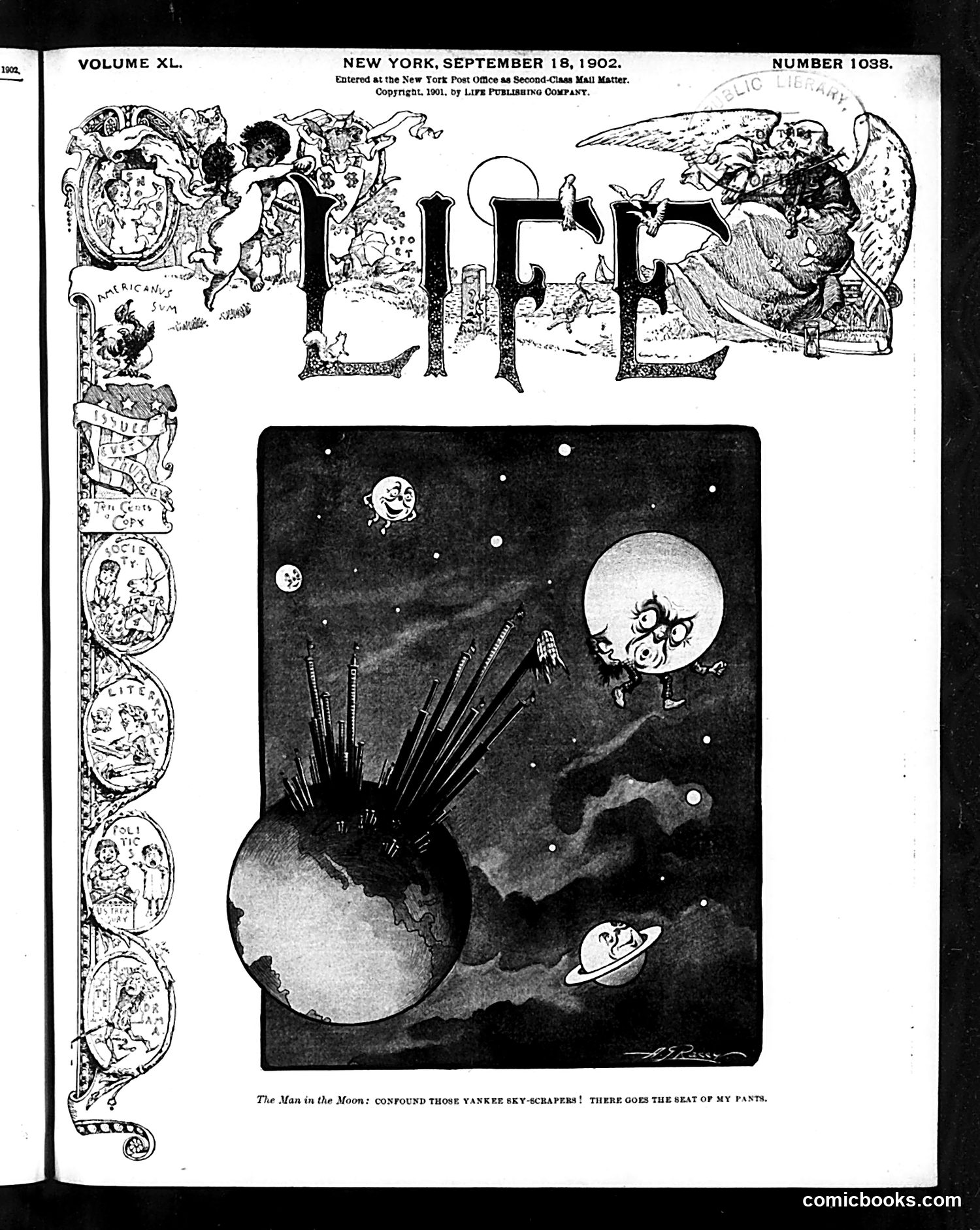
This satirical cartoon depicts a space scene with anthropomorphic celestial bodies and spacecraft engaged in conflict. The caption reads: "The Man in the Moon: compound those Yankee sky-scrapers! There goes the seat of my pants." The joke appears to reference American technological ambition and industrial might—represented by "Yankee sky-scrapers" (tall buildings symbolizing American progress). The Man in the Moon character expresses alarm at these structures, humorously suggesting American innovation is so aggressive it threatens even the moon itself. This reflects early 1900s anxieties and boasts about American industrial supremacy. The comic imagines American technological advancement as so powerful it extends beyond Earth—a satirical exaggeration of American confidence in the industrial age.
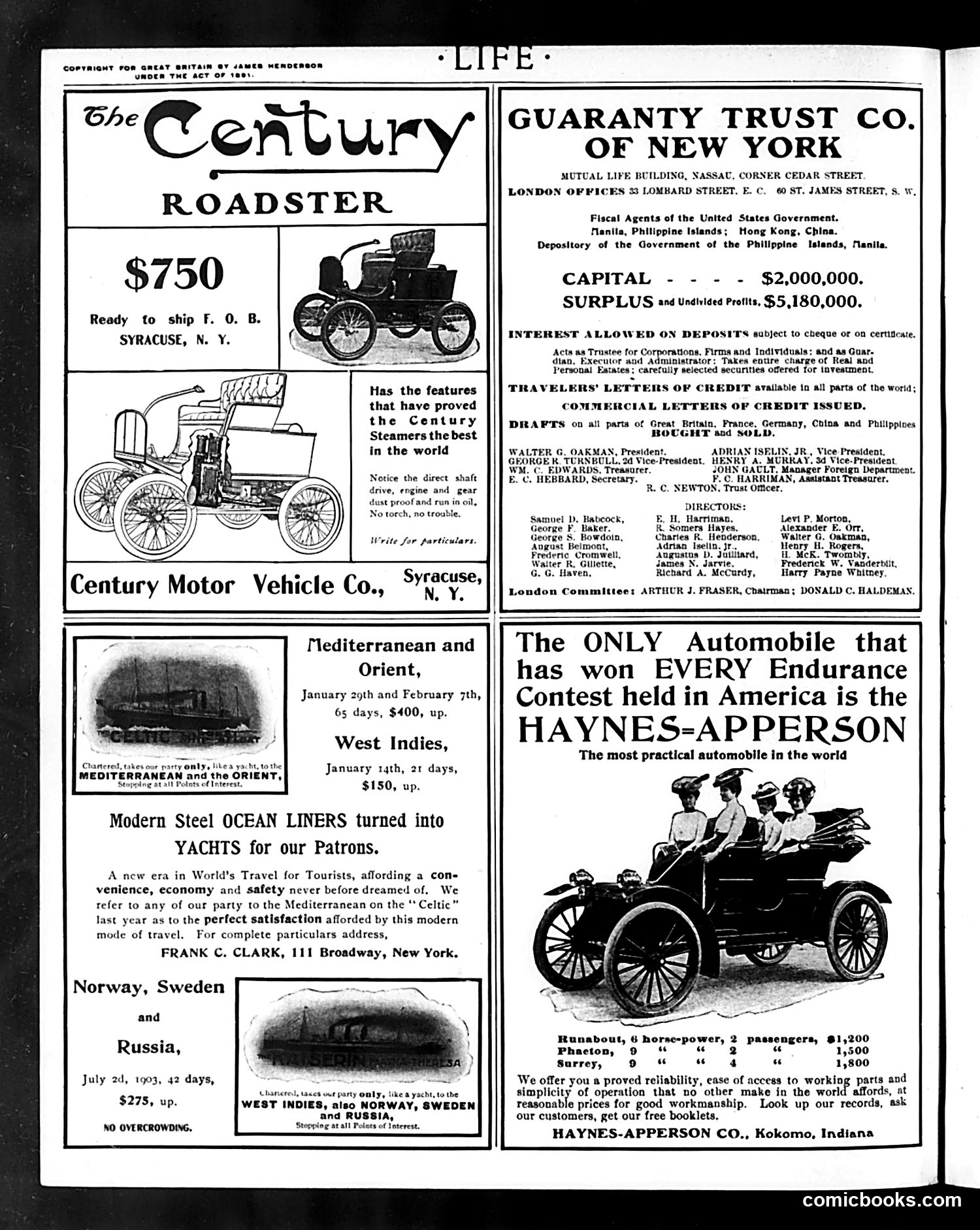
This page is **primarily advertisements**, not satirical cartoons. It contains early 1900s automotive and travel promotions: - **Century Motor Vehicle Co.** advertises a $750 roadster with features claiming superiority over steamers - **Guaranty Trust Co.** displays banking/financial services - **Haynes-Apperson** promotes their automobile, claiming it "won EVERY Endurance Contest held in America" - **Travel advertisements** offer steamship tours to the Mediterranean, West Indies, Norway, Sweden, and Russia The page reflects early automobile industry competition and marketing claims. The humor is incidental—mainly in boastful product claims typical of the era. There are no identifiable political cartoons or caricatures with satirical intent. This appears to be a standard advertising section from *Life* magazine circa early 1900s.
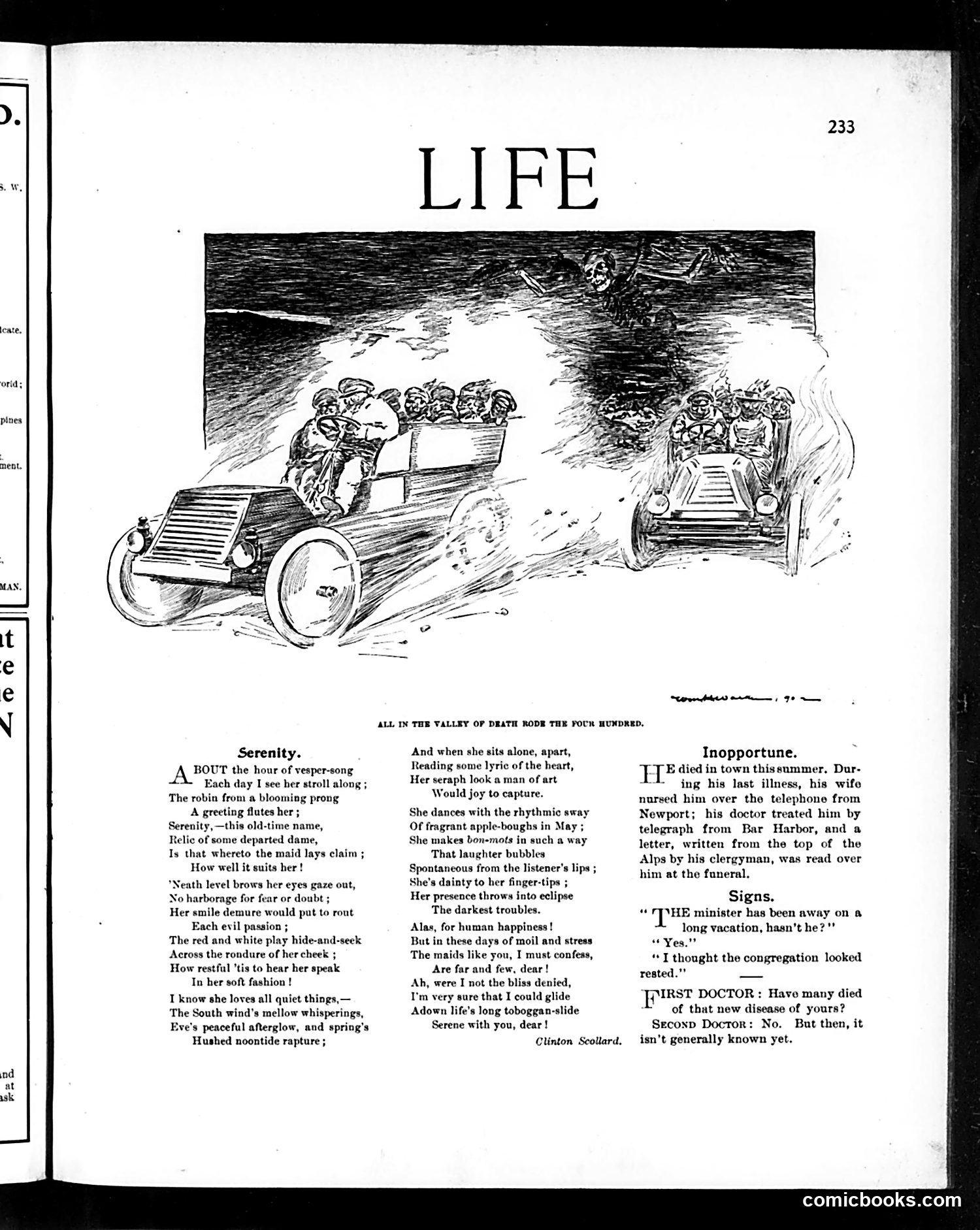
This page from *Life* magazine (page 233) contains three distinct pieces: **Main Illustration**: "All in the Valley of Death Rode the Four Hundred" depicts two early automobiles racing dangerously down a mountain road, filled with passengers. This references reckless automobile driving—a contemporary safety concern in the early automotive era. **"Serenity"**: A poem celebrating a woman's quiet beauty and grace, contrasting with modern life's stress. **"Inopportune"**: A brief anecdote about a man who died during his wife's telephone call from Newport, with his doctor treating him via telegraph. This satirizes the absurdity of modern technology's intrusion into serious moments. **"Signs"**: A humorous doctor dialogue mocking a new, poorly understood disease. The page reflects early 20th-century anxieties about modern technology's effects on society and human interaction.
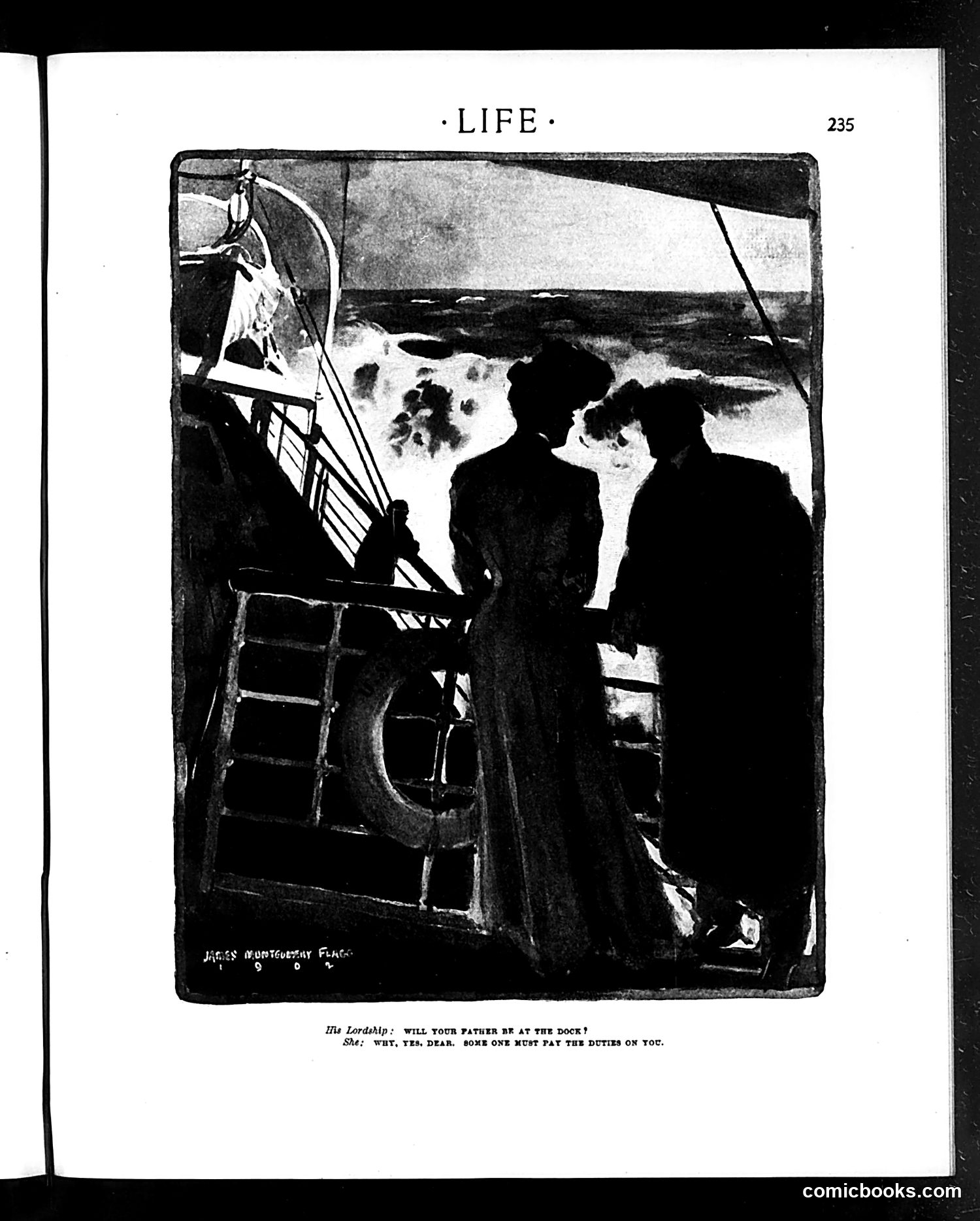
This appears to be a satirical illustration from *Life* magazine (page 235) showing two figures on what looks like a ship's deck, observing rough seas. The caption reads: "His Lordship: 'Will your father be at the dock?' She: 'Why, yes, dear. Some one must pay the duties on you.'" The joke plays on the double meaning of "duties"—both customs duties (taxes on imported goods) and social/familial obligations. The satire mocks the wealthy British aristocracy ("His Lordship"), suggesting that a titled nobleman is so expensive or burdensome that he requires financial compensation, like imported cargo. The illustration's shipboard setting and formal dress emphasize the class commentary. This reflects early 20th-century British class anxieties and satirical critiques of the aristocracy's economic relevance.
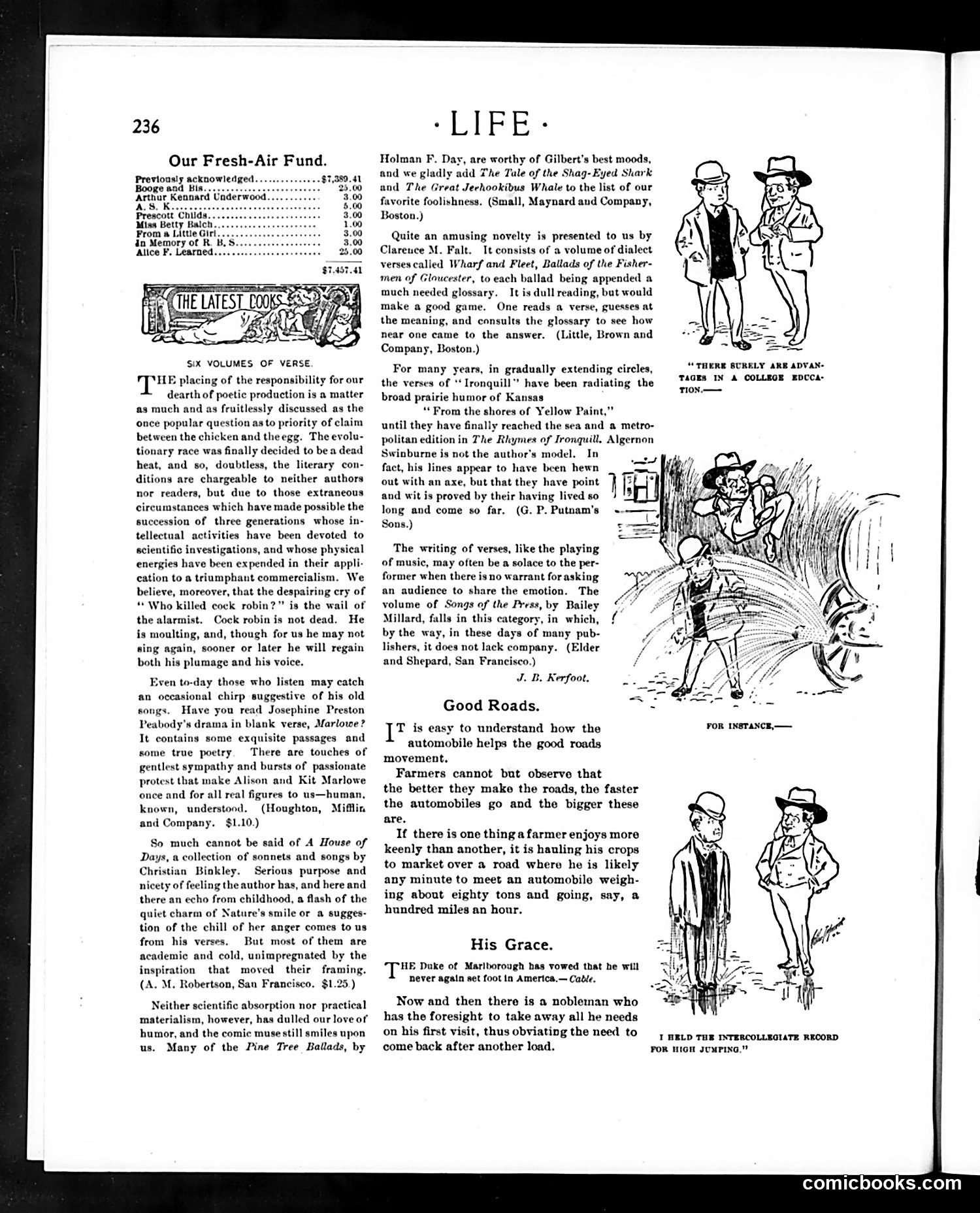
This page contains book reviews and three small cartoon illustrations unrelated to a specific political event. The cartoons depict rural/farming scenes with humorous captions: one shows a farmer being startled (captioned "THERE SURELY ARE ADVANTAGES IN A COLLEGE EDUCATION"), another features a farmer jumping with "FOR INSTANCE," and a third depicts two men with "I HELD THE INTERCOLLEGIATE RECORD FOR HIGH JUMPING." The jokes appear to mock rural/farming life versus college education—suggesting farmers encounter situations requiring quick reflexes or athletic ability that educated men might handle differently. The text reviews books on poetry and good roads, with commentary on American literature and agricultural commerce. No specific political figures or events are referenced. The humor is gentle, class-based satire typical of early 20th-century Life magazine.
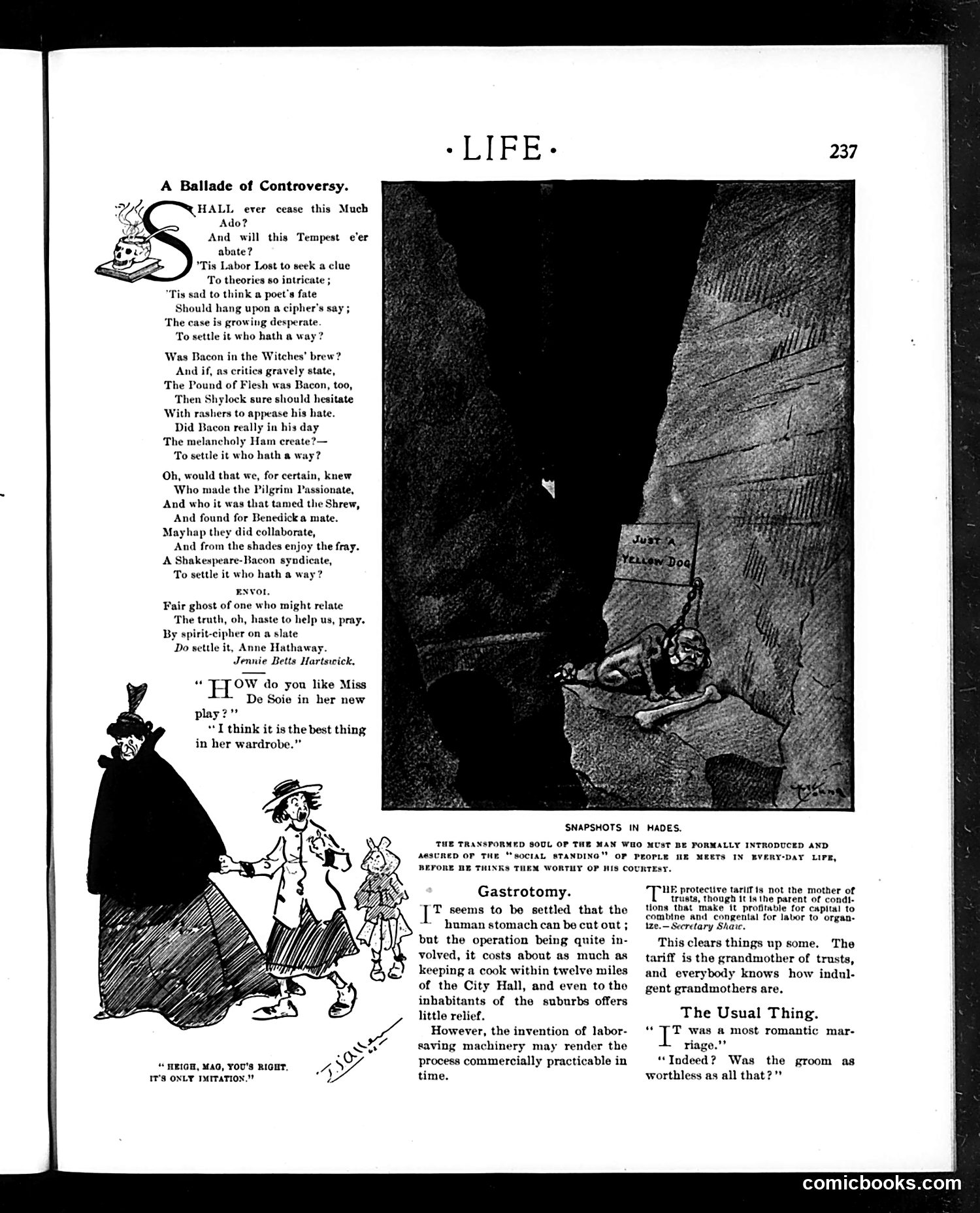
This page contains a satirical poem titled "A Ballade of Controversy" mocking literary and academic debates about authorship attribution—particularly regarding works attributed to Shakespeare and Bacon. The poem questions whether various historical figures actually created what's credited to them, using playful language about "ciphers" and collaborative efforts. The accompanying illustrations show Victorian-era figures in period costume, likely representing the scholars and writers being satirized. The bottom section includes separate brief comedic dialogues about theater and marriage, typical of Life's humor format. The satire targets the obsessive scholarly disputes over historical authorship that were apparently contemporary concerns when this was published. The "Snapshots in Hades" illustration suggests deceased historical figures observing these modern controversies.
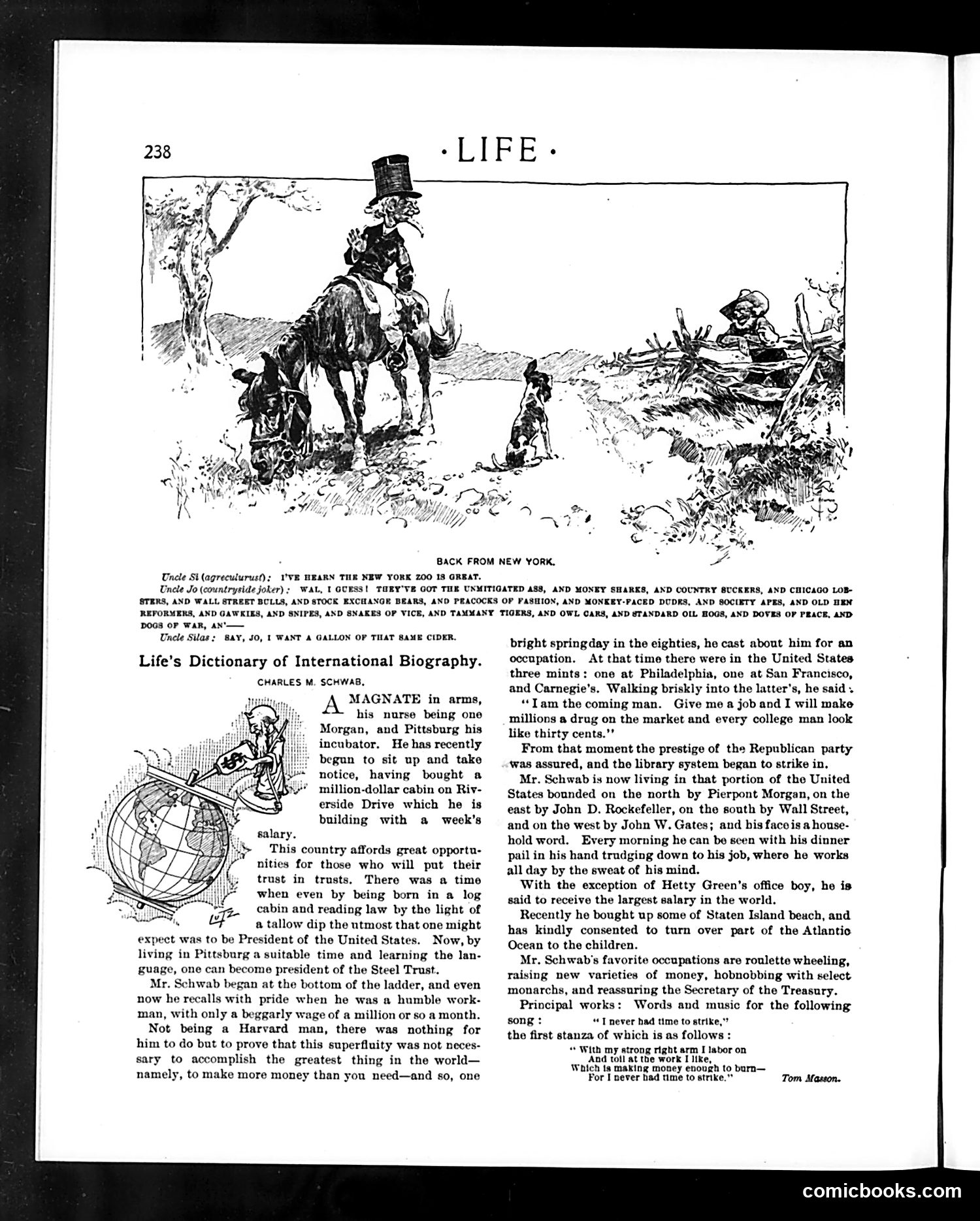
**The Main Cartoon ("Back from New York"):** A figure in a top hat rides a camel while addressing a seated dog, with another figure visible on the right. The caption references the "New York Zoo" being "great," and mentions "unashamed ass, and money sharks, and country suckers" alongside various financial and political figures—suggesting satirical commentary on wealthy New York society and its moral character. **The Biography Section:** Charles M. Schwab's profile describes his rise from log-cabin poverty to Pittsburgh steel magnate and millionaire, emphasizing his self-made success and current prominence in American business and Republican politics. The text suggests he exemplifies the era's industrial capitalist ideal while noting his wealth and cultural influence. The overall tone appears to mock both high society pretensions and robber-baron excess.
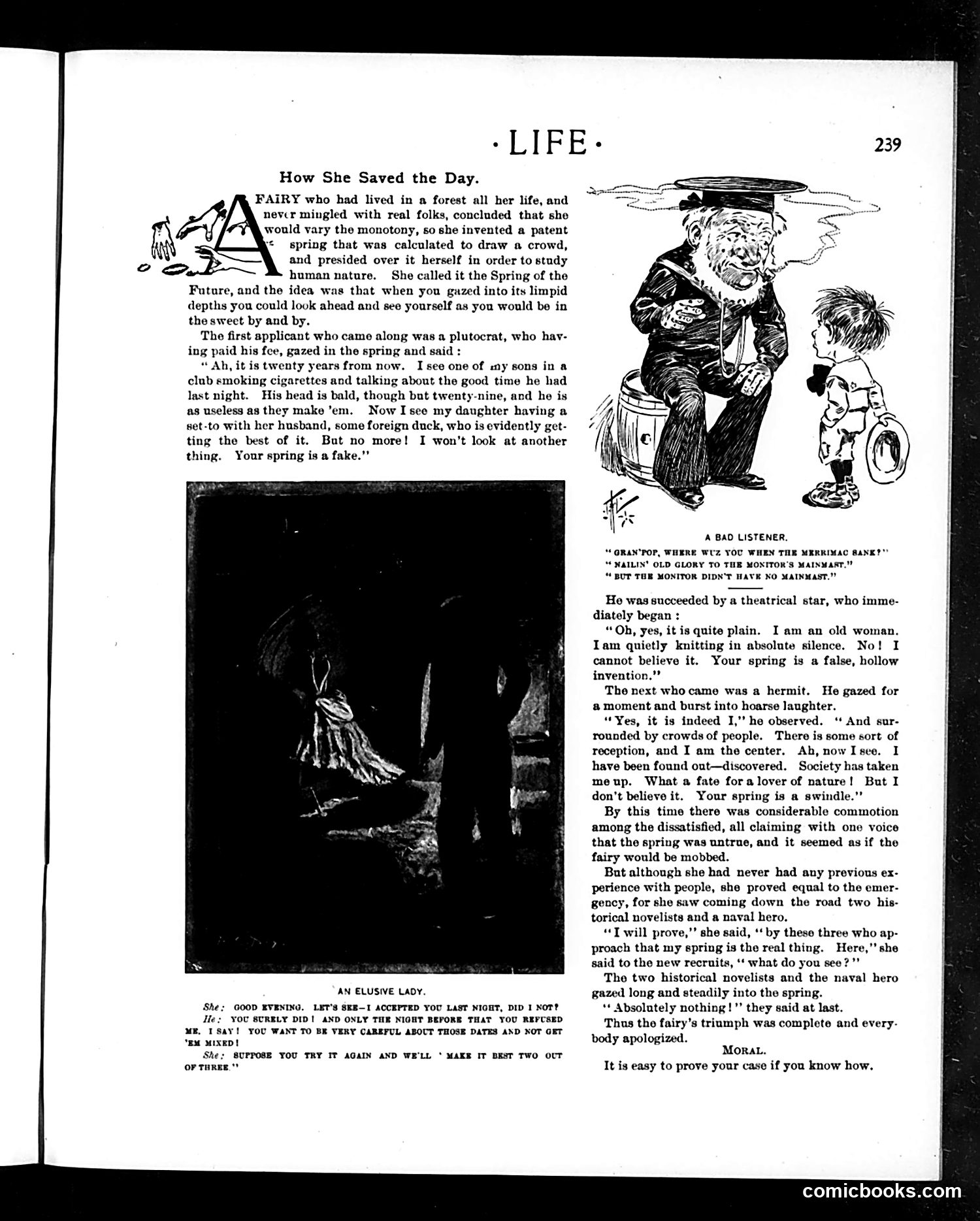
This satirical story mocks the pretensions of a fairy tale about a magical "Spring of the Future." Various skeptics—a plutocrat, theatrical star, hermit, and historical novelists—dismiss the spring as fake until a small child appears and somehow convinces them otherwise through innocence or simple observation. The satire targets late-19th/early-20th-century social types: wealthy industrialists, theatrical performers, and intellectuals who fancy themselves authorities. Their cynicism is undercut by a child's uncomplicated perspective. The "moral" emphasizes that truth is provable if you know how—a dig at pseudointellectuals who overcomplicate simple matters. The accompanying illustration "An Elusive Lady" appears unrelated, depicting a romantic or mysterious female figure in period dress.
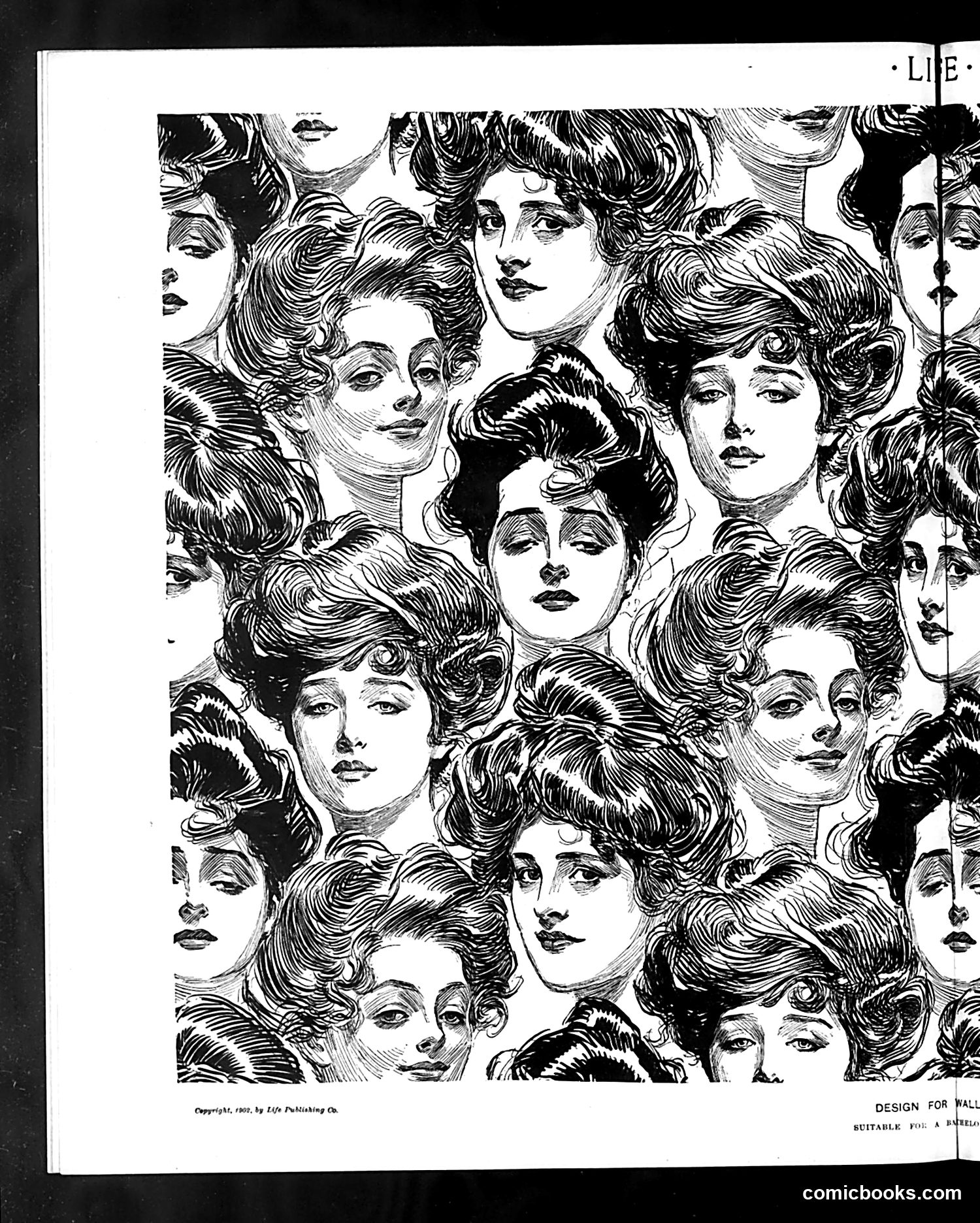
This page appears to be a **design for wallpaper** from Life magazine (copyright 1907, Life Publishing Co.), as indicated by the text "DESIGN FOR WALL" and "SUITABLE FOR A BASER[OOM]" at bottom right. The image shows a **repeating pattern of women's faces** in an Art Nouveau style—featuring elaborate wavy hair, defined features, and dramatic expressions rendered in bold black-and-white line work typical of early 1900s illustration. Rather than satirical commentary, this appears to be a **decorative design feature** demonstrating aesthetic trends of the Edwardian era. The repetition and stylization of feminine faces reflects contemporary fascination with beauty, fashion, and ornamental design. Without additional context or accompanying text, the specific satirical intent—if any—remains unclear.
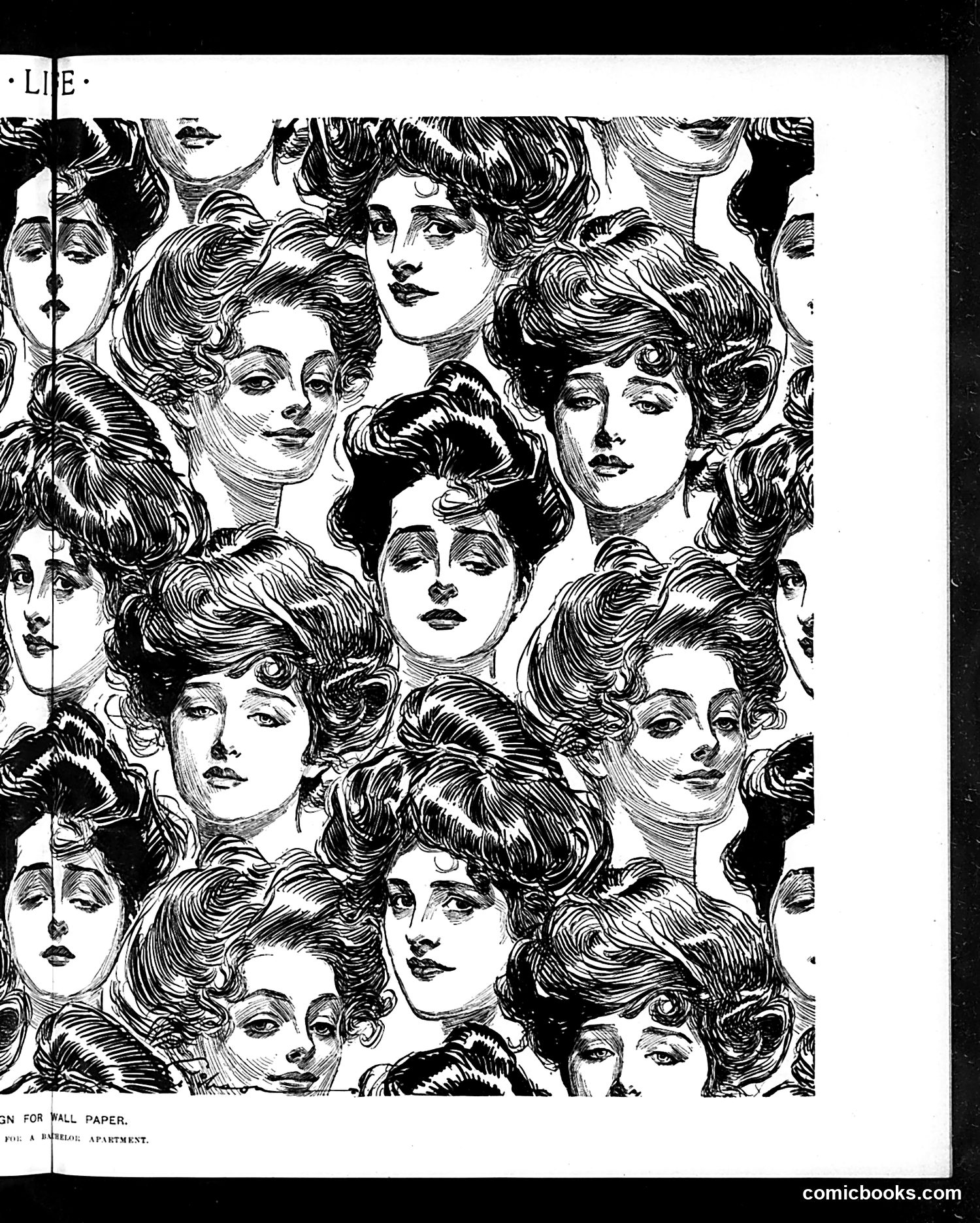
This appears to be a **wallpaper design** rather than a political cartoon or satirical commentary. The page shows a repeating pattern of roughly two dozen illustrated female faces in a 1920s-30s style—characterized by wavy hair, defined features, and art deco aesthetics. The faces are rendered in bold black ink with cross-hatching technique. The partial text visible at bottom references "WALL PAPER" and mentions "APARTMENT," confirming this is a decorative textile or wallpaper design rather than editorial content. There is no apparent political satire or social commentary visible. The "LIFE" header suggests this appeared in the magazine, likely as a design feature or advertisement for interior decoration products of the era.
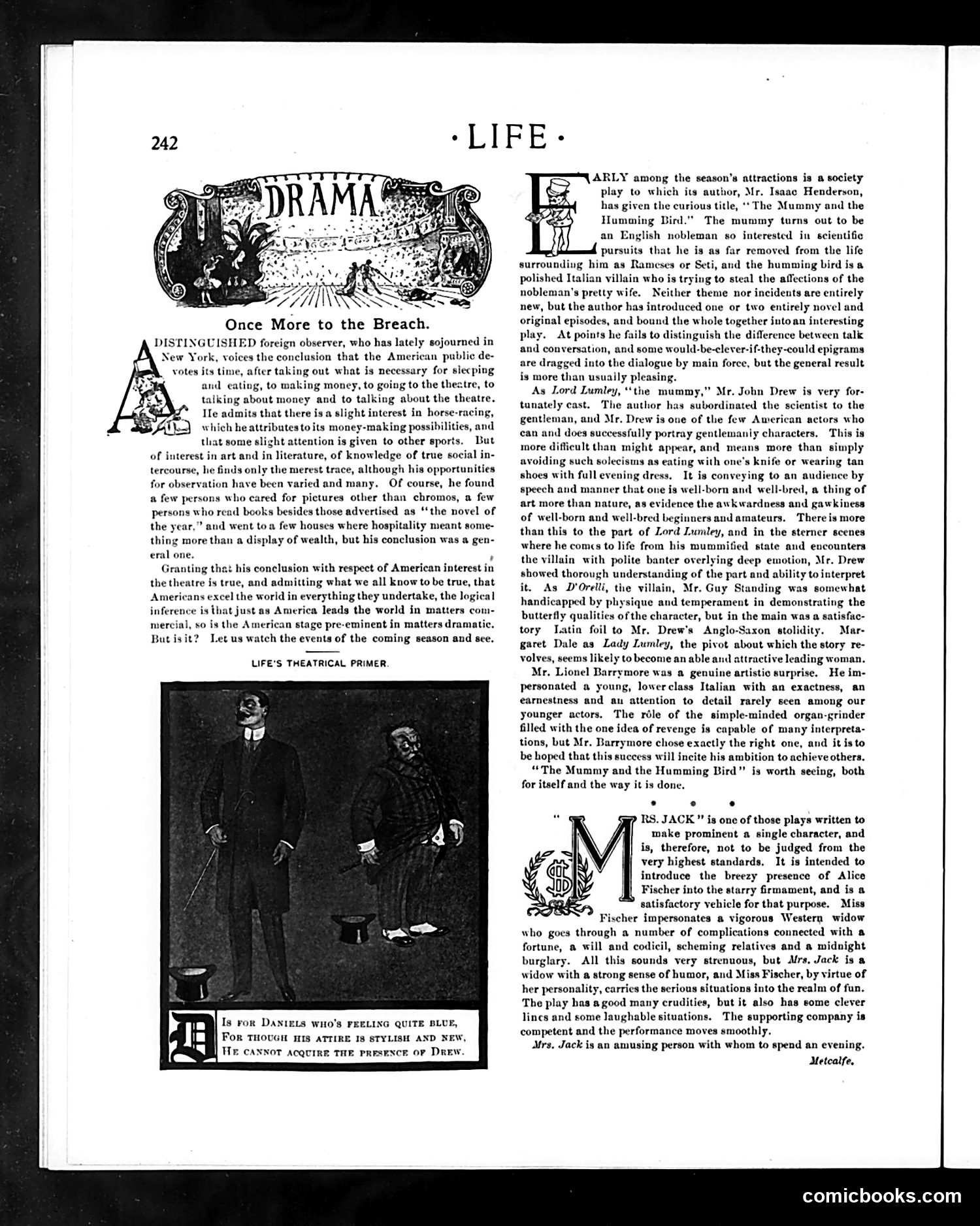
This page contains drama reviews, not political cartoons. The main illustration shows two figures in period costume, appearing to depict a scene from a theatrical production. The reviews discuss several plays: "The Mummy and the Humming Bird" (featuring English nobleman characters), "Lord Lumley" (with actor John Drew), "D'Orselli," and "Mrs. Jack" (described as introducing "the breezy presence of Alice Fischer" as a Western widow navigating complications involving fortune and a will). The ornamental drop-cap and illustrative style are typical of early 1900s magazine design. The reviews focus on acting quality, character development, and plot rather than political commentary. This appears to be straight theatrical criticism rather than satire.
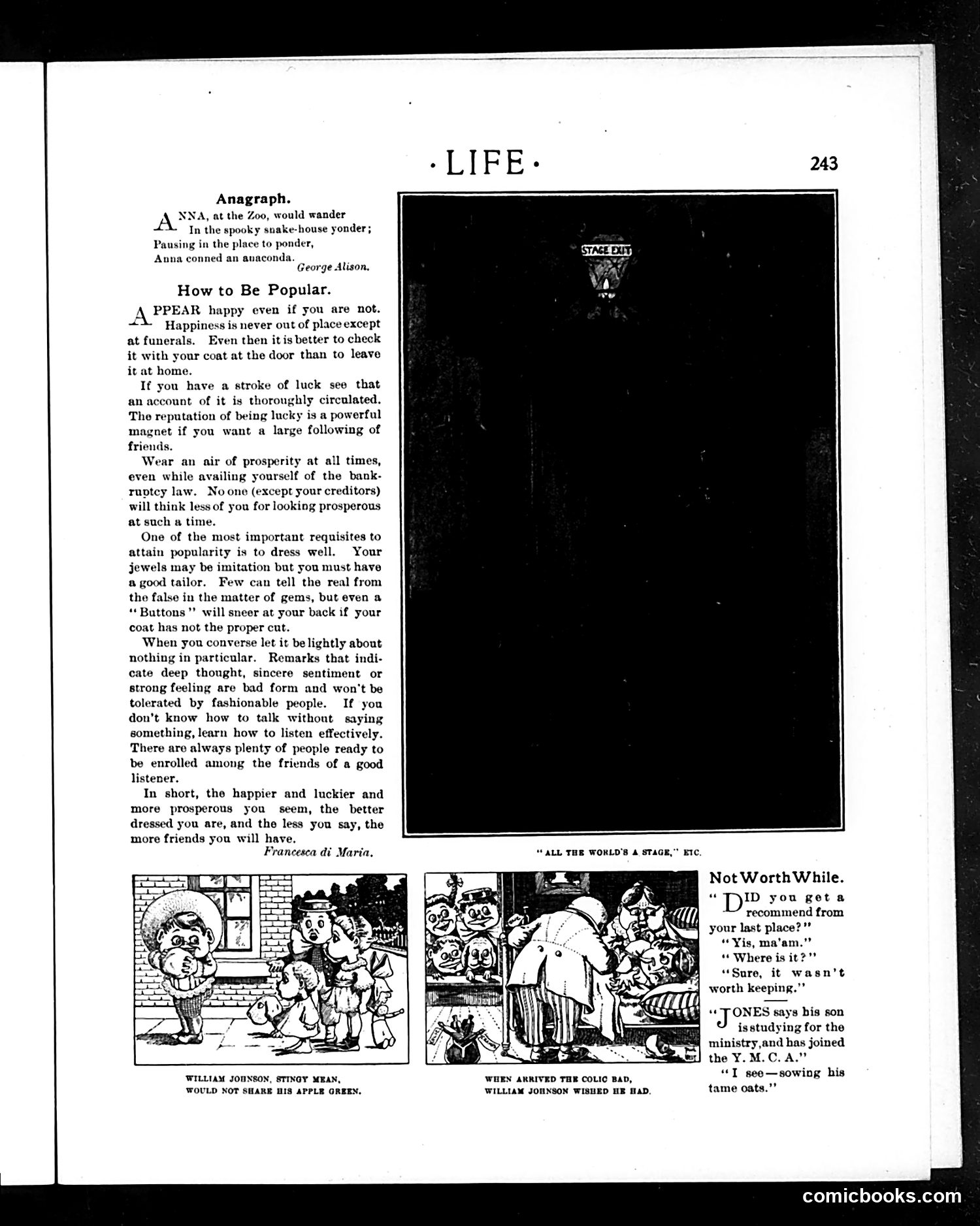
This page contains three distinct satirical pieces mocking social pretense and hypocrisy: **"How to Be Popular"** (main article by Francesca di Maria) sardonically advises readers to *appear* happy and prosperous regardless of reality—even while bankrupt. The satire targets shallow social climbing: wear fine clothes (even fake jewels), say nothing of substance, and listen passively. The point: fashionable society values appearances over authenticity. **"Not Worth While"** (short dialogue) jokes about a servant's missing reference letter—"it wasn't worth keeping"—implying her previous employer was so bad she destroyed the recommendation. **Three cartoons** illustrate moral lessons: William Johnson (stingy) refused to share his apple; when colic struck, he regretted it. The final panel shows someone "sowing tame oats"—suggesting mild, safe behavior. The page satirizes Gilded Age social pretension, servants' difficult employment situations, and consequences of selfishness—typical Life magazine fare mocking Victorian-era hypocrisy and class anxieties.
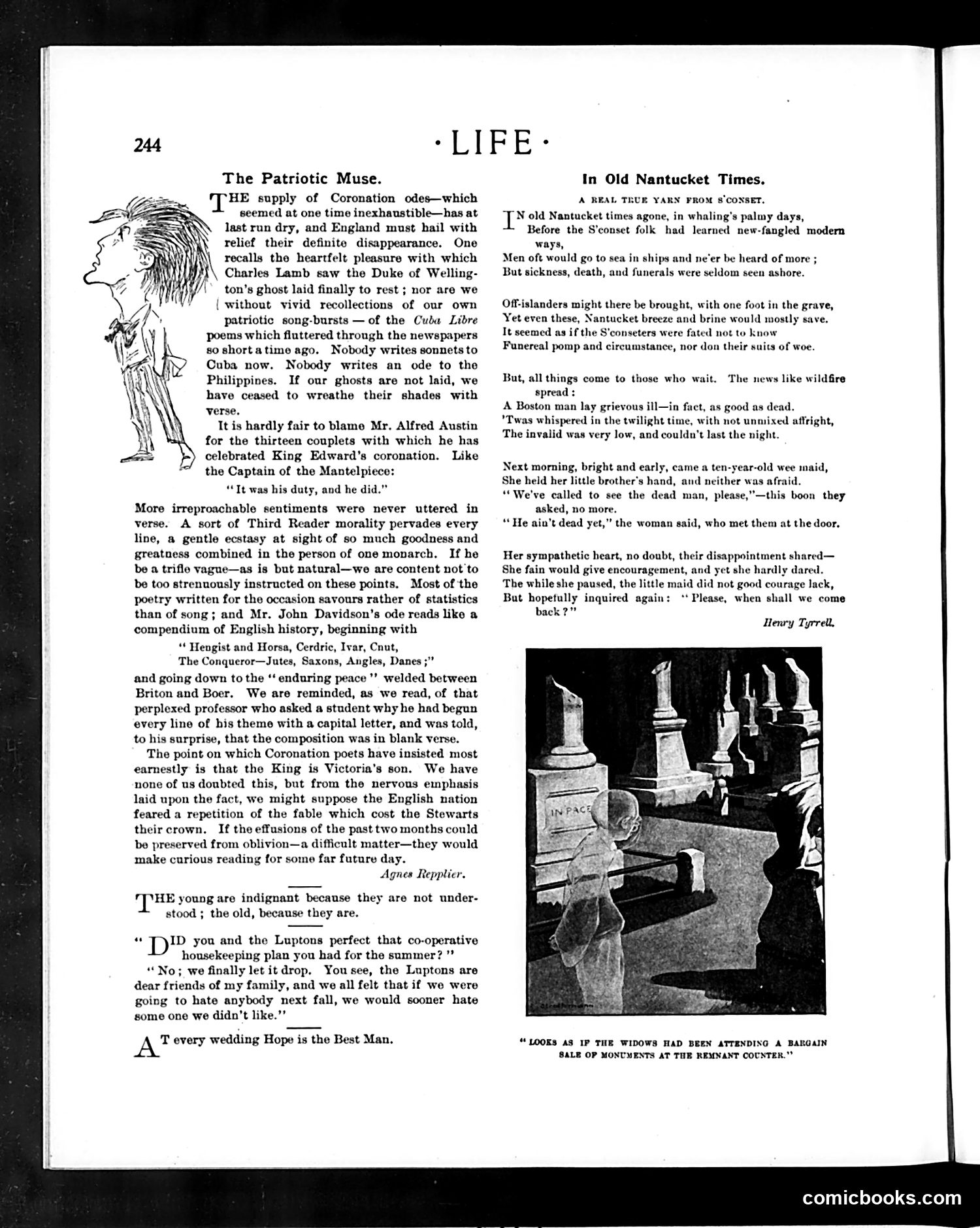
This page contains two distinct satirical pieces from *Life* magazine (undated, but context suggests early 1900s): **"The Patriotic Muse"** (left): A critique of coronation poetry written for King Edward's coronation. The cartoon caricatures a thin, dramatic figure—likely poet Alfred Austin, Britain's Poet Laureate. The essay mocks the flood of patriotic verses celebrating the coronation, comparing them unfavorably to earlier "Cuba Libre" poems. The satire targets their vapid sentimentality and statistical dullness, noting poets obsessively emphasized Edward was Victoria's son—as if questioning his legitimacy. The piece suggests such earnest, mediocre verse will eventually seem absurdly quaint. **"In Old Nantucket Times"** (right): A humorous yarn about Nantucket islanders so isolated from death that a dying Boston visitor becomes a novelty. The accompanying photograph shows gravestones, setting up the joke about funeral customs. Both pieces use gentle mockery of contemporary culture and human nature.
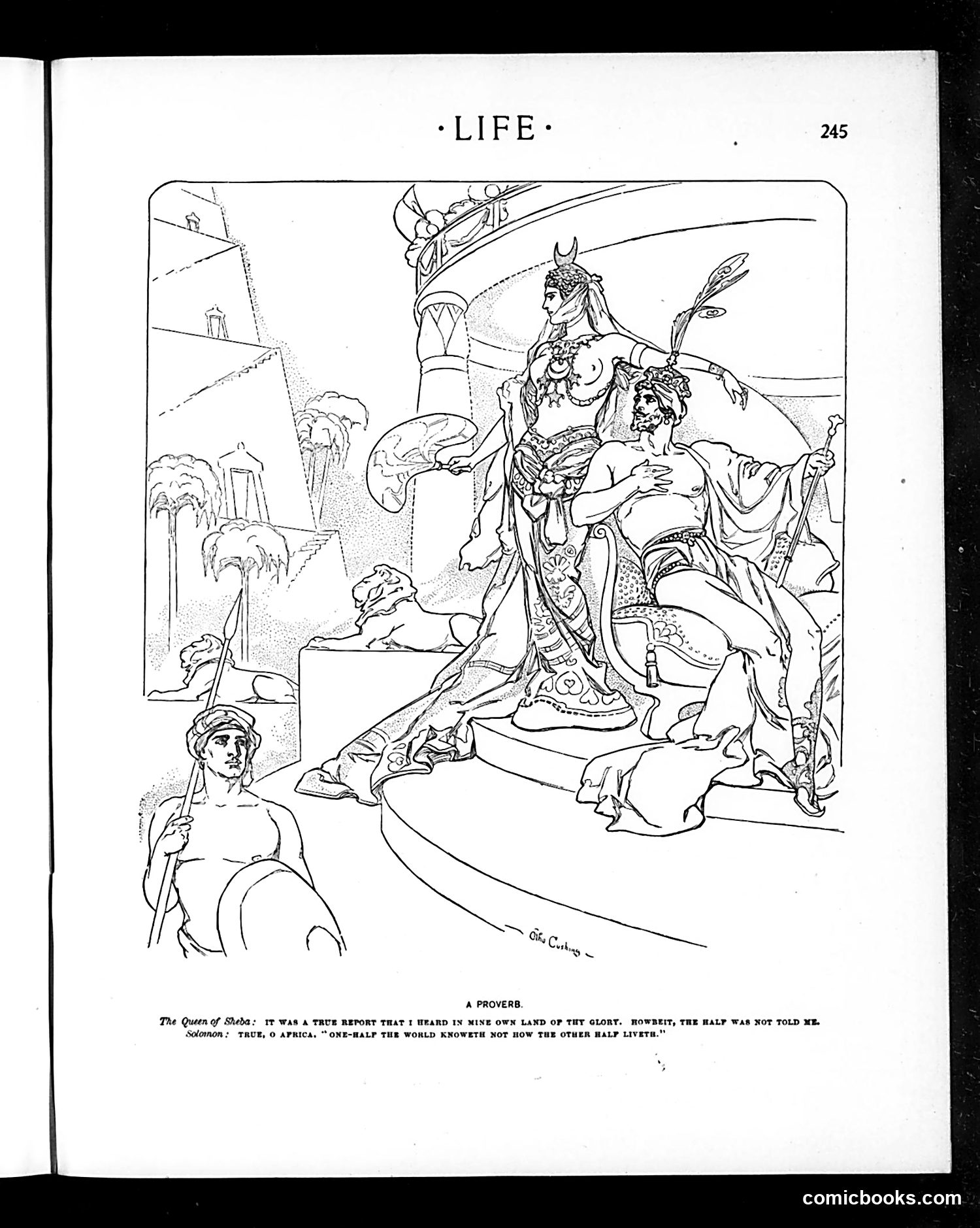
This satirical cartoon depicts the biblical Queen of Sheba visiting King Solomon. The caption presents their exchange as a "proverb" about global ignorance. The Queen remarks that reports of Solomon's glory were exaggerated—she wasn't told the half of it. Solomon responds with a twist on the famous saying "one half the world knows not how the other half lives," applying it to Africa specifically. **The satire:** This appears to criticize Western (particularly American) ignorance about Africa and African life. By invoking the biblical Queen of Sheba (associated with African wealth and sophistication), the cartoon sardonically suggests that the Western world remains willfully ignorant about African realities—a commentary on colonial-era attitudes and the limits of Western knowledge about non-Western peoples. The ornate, orientalist artistic style reinforces the exoticism with which Africa was typically depicted in early 20th-century American media.
This page from Life magazine consists primarily of **humorous anecdotes and light verse** rather than political cartoons. The content satirizes contemporary American institutions and social attitudes circa early 1900s. The main pieces target: 1. **Educational theorists** (particularly G. Stanley Hall) who advocated studying slang—mocked via parody verse suggesting such scholars are disconnected from reality 2. **Newspaper credibility**—a joke about an editor who refuses to retract a false death announcement, claiming "we never recall what is in our paper" 3. **Bureaucratic absurdity**—a pension official who declares a man insane merely for requesting a pension reduction 4. **Small-town politics**—a city councilman's joke about adjourning "on motion of City Hall" during an earthquake 5. **Irish immigrant stereotypes**—the "genial Irish woman" character speaking in exaggerated dialect The page also contains period advertisements for Wilson Whiskey, Hunter Whiskey, and Milo cigarettes. The satire reflects early 20th-century American attitudes toward education reform, press reliability, and bureaucratic incompetence.
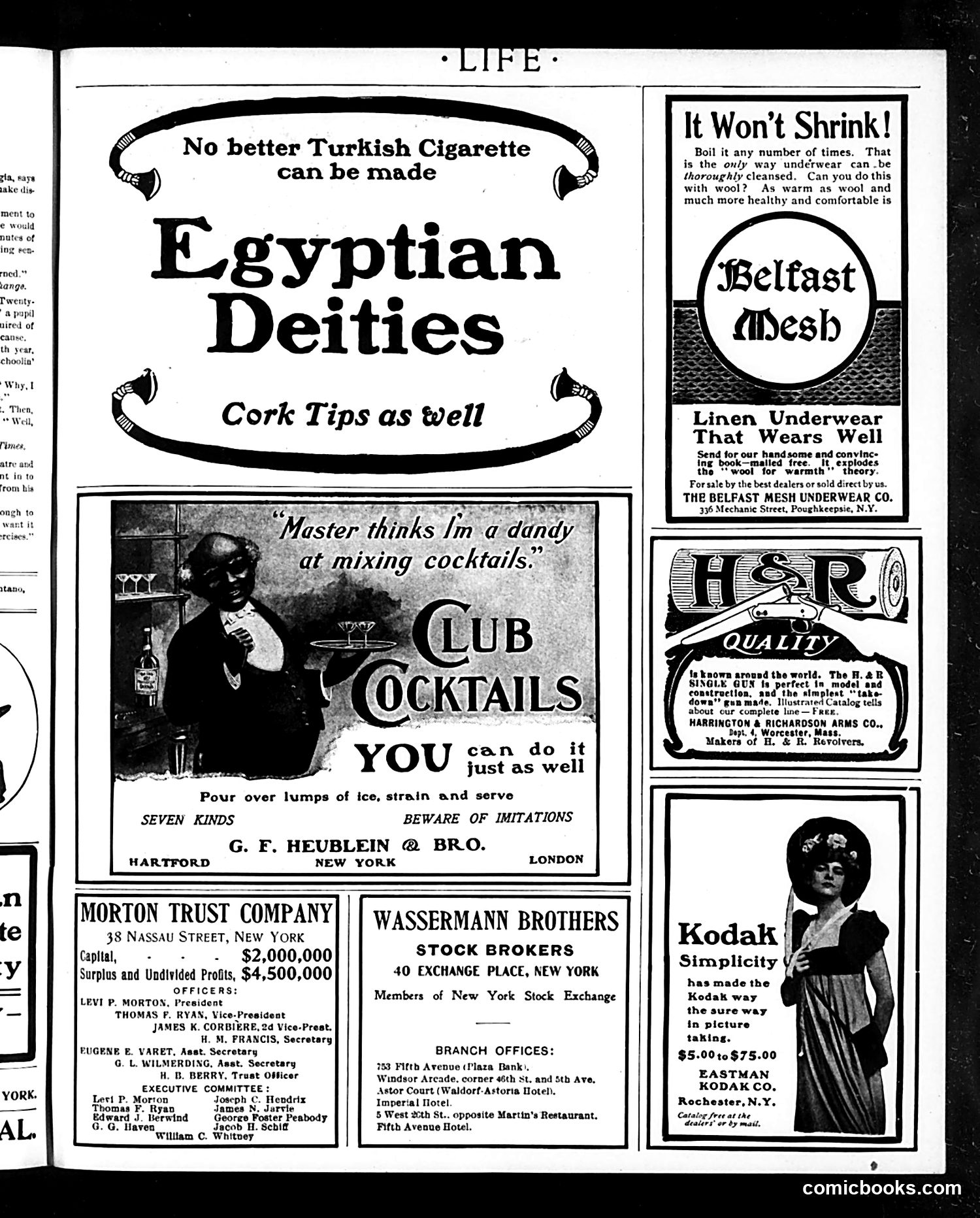
This page is primarily **advertising**, not editorial content or political cartoons. The main features are commercial advertisements from the early 1900s. The largest ad promotes **"Egyptian Deities" cigarettes** with cork tips, claiming superiority as a Turkish cigarette. Below it, a "Club Cocktails" ad shows a Black servant ("Master thinks I'm a dandy at mixing cocktails"), using racist imagery common to the era—depicting a stereotypical subservient figure to sell home bartending supplies. Surrounding ads include: **Belfast Mesh** linen underwear (emphasizing durability through boiling), **H&R revolvers**, **Kodak cameras**, financial firms (Morton Trust Company, Wassermann Brothers stock brokers), and other period products. The racist caricature in the cocktails ad reflects deeply problematic advertising practices of the time. The page otherwise showcases consumer goods and services marketed to wealthy Americans in an era before modern advertising regulations or social consciousness about representation.
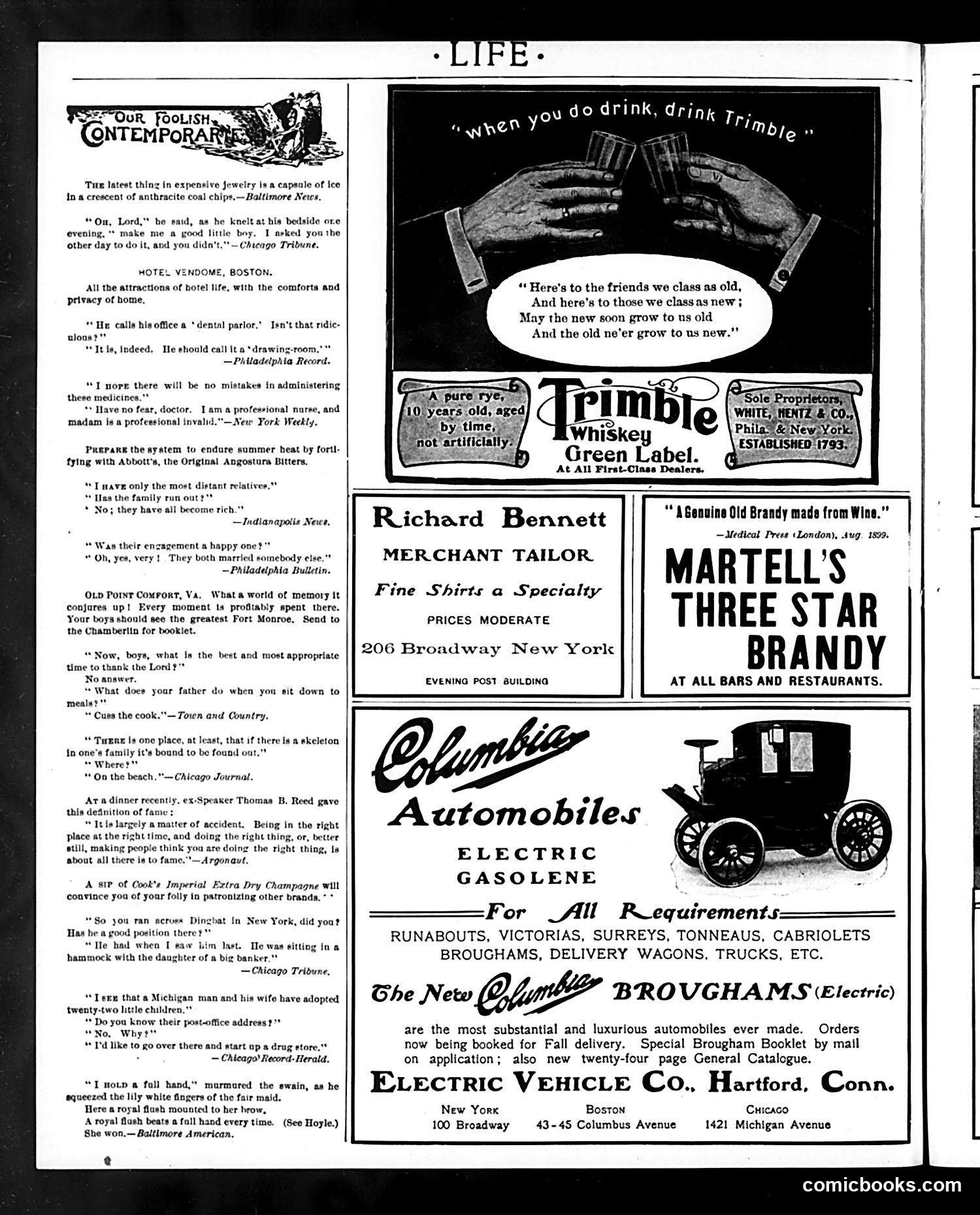
This page is primarily **advertising and humor** rather than political satire. It contains short joke excerpts from various newspapers alongside commercial ads for spirits (Trimble Whiskey, Martell's Brandy), tailoring, and automobiles. The humor pieces are conversational jokes about contemporary social life—a child asking God repeatedly to make him good, a nurse claiming to be "professionally invalid," someone thanking the Lord at meals by cursing the cook. These satirize American manners and hypocrisy without targeting specific figures. The only notable reference is **ex-Speaker Thomas B. Reed's definition of fame** as "largely a matter of accident...making people think you are doing the right thing"—a mild jab at politicians' self-presentation. The **automobiles section** notably advertises "Electric" vehicles, reflecting the early 1900s when electric cars competed seriously with gasoline engines as the superior technology for personal transport. Overall, this is a typical Life magazine page blending light social commentary with commercial content, not substantive political cartooning.
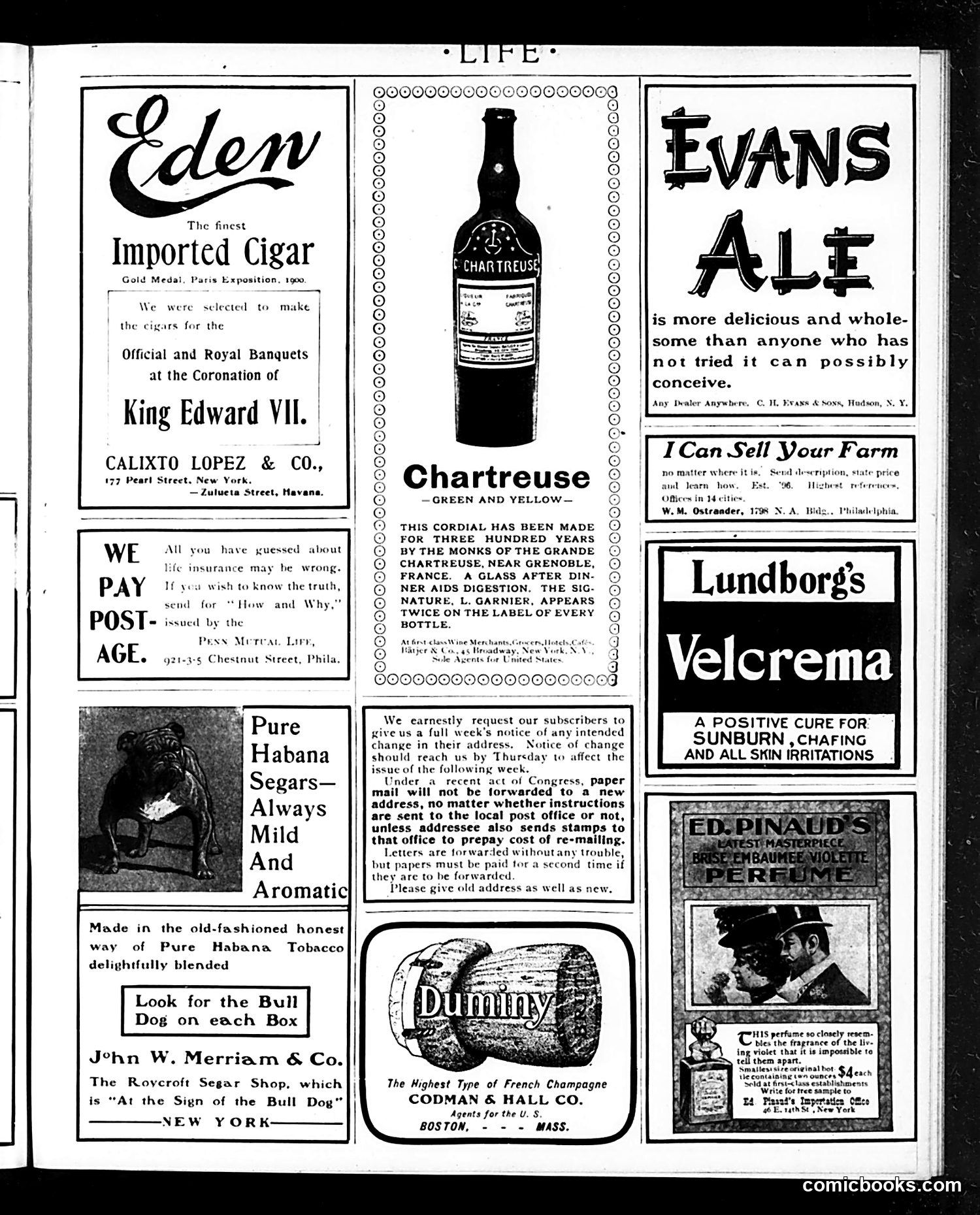
This page is **primarily advertising** from an early 1900s issue of Life magazine, with no political cartoons or satire present. The advertisements reflect the commercial products and marketing claims of the Edwardian era. Notable items include: - **Eden Cigars**: Claims prestige from King Edward VII's coronation (likely 1901-1902) - **Chartreuse liqueur**: Emphasizes its 300-year monastic heritage for digestive aid - **Evans Ale**: Makes health claims typical of period beverage marketing - **Lundborg's Velcrema**: Advertises as a "positive cure" for sunburn and skin irritation—representative of the unregulated medical claims common before FDA oversight The page also includes a **subscriber notice** about address changes and postal forwarding, indicating magazine administrative concerns. These advertisements reveal early 1900s consumer culture, brand-building strategies emphasizing heritage and health benefits, and the absence of modern advertising regulations—products made claims we would now consider misleading or false.
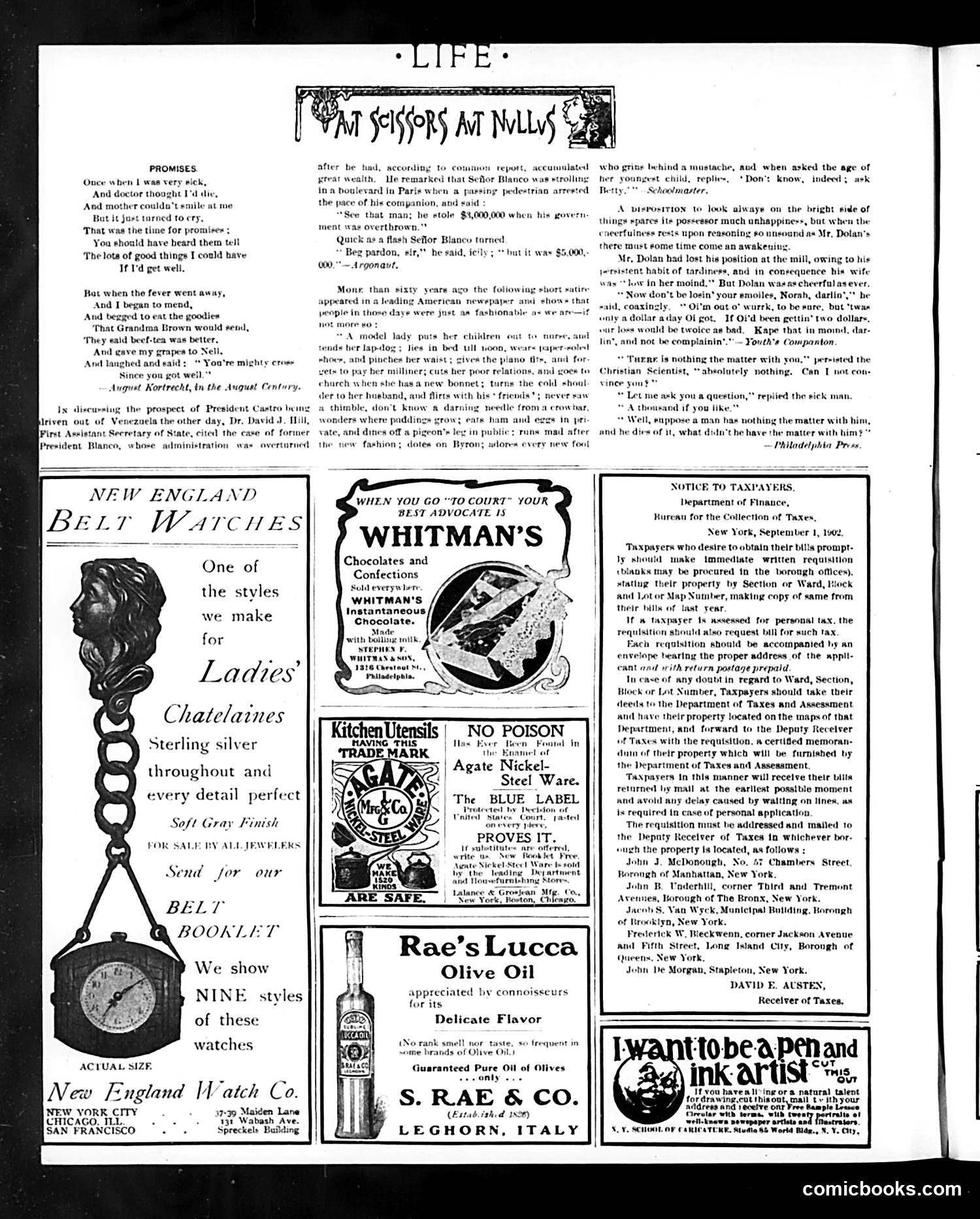
This page contains satirical content and advertisements typical of early 1900s Life magazine. **The main text piece** mocks a conversation between President Castro's forces and former Venezuelan President Blanco. When a man points out that Blanco stole $3,000,000 during his administration, Blanco cheerfully corrects him—it was actually $5,000,000. The joke satirizes political corruption and the casual attitude toward massive theft by deposed leaders. **A secondary piece** satirizes an optimistic working-class Irishman (Dolan) who's lost his job but remains cheerfully philosophical, reasoning that since he wasn't earning much anyway, unemployment isn't so bad. The satire mocks naive or willfully blind optimism in the face of real hardship. **The advertisements** (watches, chocolates, olive oil, kitchen utensils) are period product placements and reflect contemporary consumer goods. The page reflects Life's satirical focus on hypocrisy, corruption, and human folly across political and social contexts.
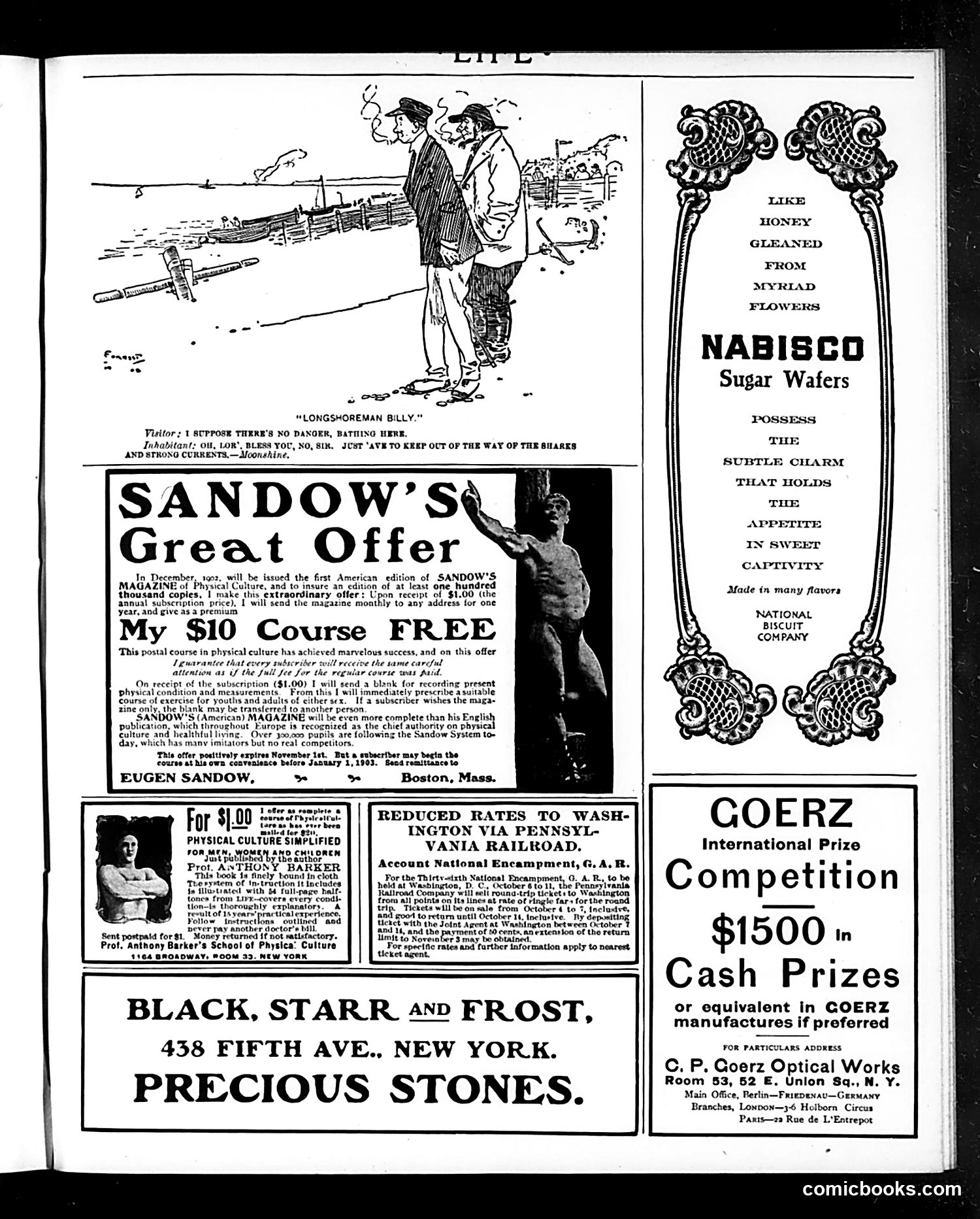
This satirical cartoon depicts a conversation between a visitor and a waterfront inhabitant named "Billy." The joke plays on class and regional dialect stereotypes common in early 1900s American humor. The visitor naively asks if swimming is dangerous at this location. Billy's response—in exaggerated working-class dialect ("OW, LOR'," "JUS' 'AVE TO KEEP")—reveals the actual hazards: sharks and strong currents. The humor derives from the contrast between the visitor's genteel concern and Billy's matter-of-fact acceptance of genuinely lethal conditions as routine workplace obstacles. The satire implicitly critiques both the upper-class visitor's obliviousness to working-class dangers and the brutal conditions longshoremen endured. The attribution to "Moonshine" suggests this is satirical commentary on labor conditions, not mere entertainment. The page itself is primarily advertising, with this cartoon serving as Life magazine's characteristic social commentary.
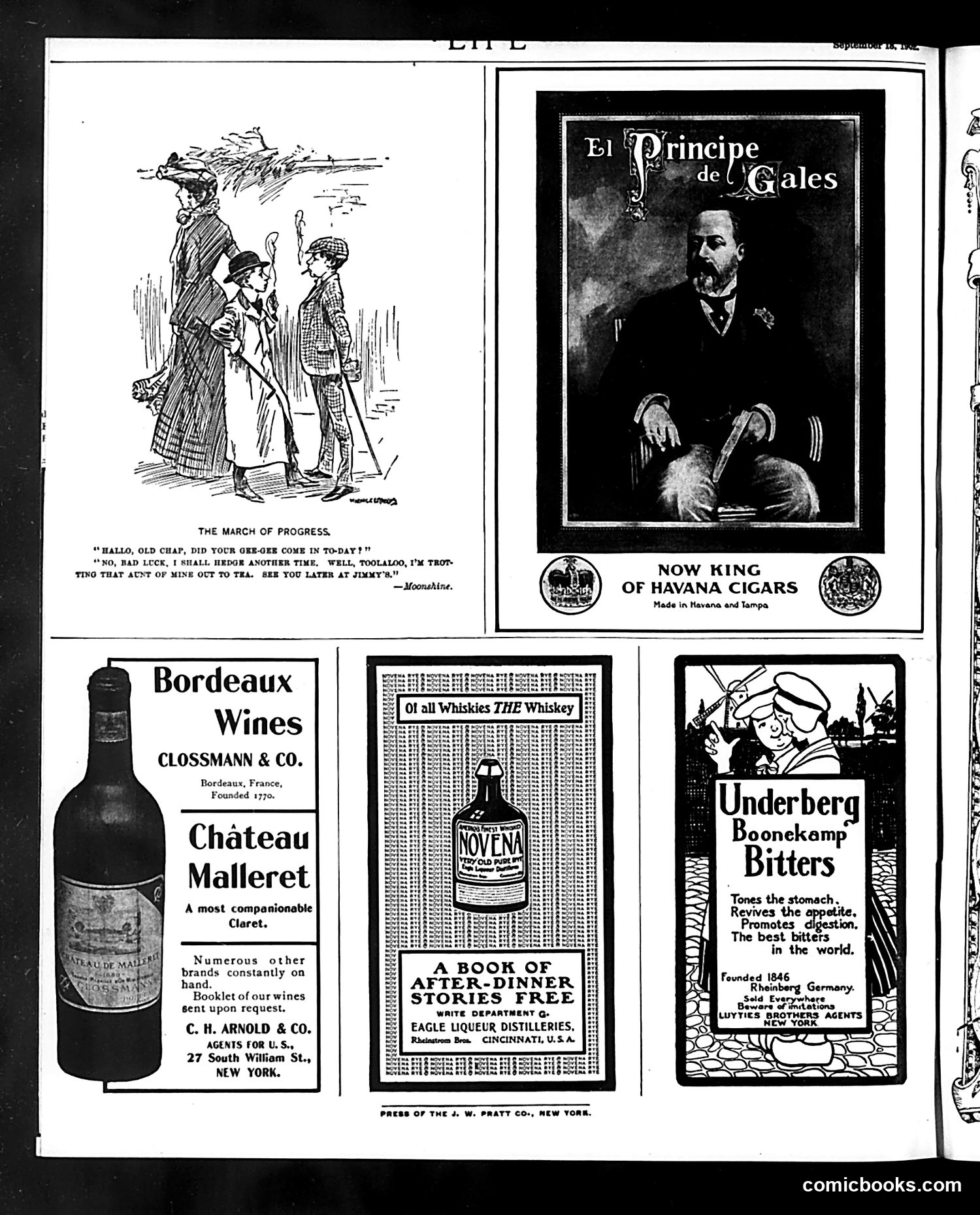
This satirical cartoon mocks upper-class British affectation and leisure pursuits. Two gentlemen converse in exaggerated slang ("gee-gee" for horse, "toolaloo," "jimmys"), discussing horse racing and social tea engagements—trivial pursuits presented as the height of civilization's "progress." The joke is ironic: despite industrial advancement and modernity, the wealthy still occupy themselves with gambling on horses and idle gossip. The archaic slang and mannered speech emphasize how removed this class is from productive society. The page is primarily advertisements for luxury imports (French wines, Cuban cigars, German bitters, whiskey) aimed at this same leisured demographic—reinforcing the satire by showing what "progress" apparently means to the affluent: access to imported luxuries and continued idle pursuits.