
Life, 1902-09-18 · page 6 of 22
Life — September 18, 1902 — page 6: what you’re looking at
What you’re looking at
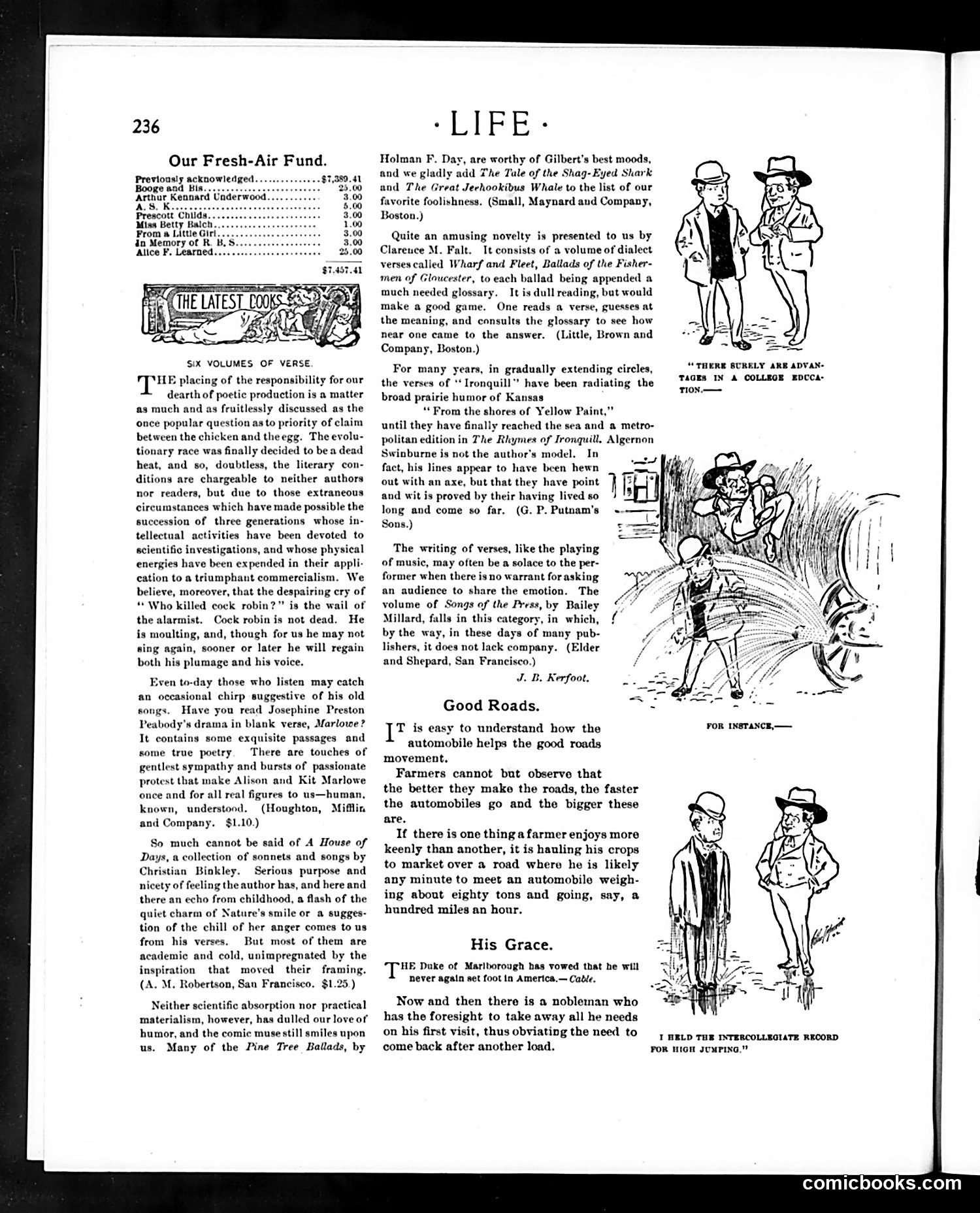
This page contains book reviews and three small cartoon illustrations unrelated to a specific political event. The cartoons depict rural/farming scenes with humorous captions: one shows a farmer being startled (captioned "THERE SURELY ARE ADVANTAGES IN A COLLEGE EDUCATION"), another features a farmer jumping with "FOR INSTANCE," and a third depicts two men with "I HELD THE INTERCOLLEGIATE RECORD FOR HIGH JUMPING." The jokes appear to mock rural/farming life versus college education—suggesting farmers encounter situations requiring quick reflexes or athletic ability that educated men might handle differently. The text reviews books on poetry and good roads, with commentary on American literature and agricultural commerce. No specific political figures or events are referenced. The humor is gentle, class-based satire typical of early 20th-century Life magazine.
📄 Transcribed text from this page (OCR, searchable)
Machine-transcribed from the original scan — historical spelling and the odd misread are preserved.
236 Our Fresh-Air Fund. Previously acknowledged Booge and Bis. Arthur Keanard Miss Betty Balch From a Little Giri. in Memory of R. B Alice F, Learned. Booreents S88sssses SIX VOLUMES OF VERSE TT HE placing of the responsibility for our dearth of poetic production is a matter as much and as fruitlessly discussed as the once popular question as to priority of claim between the chicken and theegg. The evolu- tionary race was finally decided to bea dead heat, and so, doubtless, the literary con- ditions are chargeable to neither authors nor readers, but due to those extraneous circumstances which have made possible the succession of three generations whose in- tellectual activities have been devoted to scientific investigations, and whose physical energies have been expended in their appli- cation to a triumphant commercialism. We believe, moreover, that the despairing cry of ‘Who killed cock robin?” is the wail of the alarmist. Cock robin is not dead. He is moulting, and, though for us he may not sing again, sooner or later he will regain both his plumage and his voice. Even to-day those who listen may catch an occasional chirp suggestive of his old Have you read Josephine Preston Peabody's drama in blank verse, Marlowe? It contains some exquisite passages and some true poetry. There are touches of gentlest sympathy and bursts of passionate protest that make Alison and Kit Marlowe once and for all real figures to us—human, known, understood. (Houghton, Mifflin and Company. $1.10.) So much cannot be said of A House of Days, a collection of sonnets and songs by Christian Binkley. Serious purpose and nicety of feeling the author has, and here and there an echo from childhood, a flash of the quiet charm of Nature's smile or a sugges- tion of the chill of her anger comes to us from his verses. But most of them are academic and cold, unimpregnated by the inspiration that moved their framing. (A. M, Robertson, San Francisco. $1.25.) songs. Neither scientific absorption nor practical materialism, however, has dulled our love of humor, and the comic muse still smiles upon us. Many of the Pine Tree Ballads, by : DIRE « Holman F. Day, are worthy of Gilbert's best moods, and we gladly add The Tule of the Shag-Eyed Shark and The Great Jechookibus Whale to the list of our favorite foolishness. (Small, Maynard aud Company, Boston.) Quite an amusing novelty is presented to us by Clarence M. Falt. It consists of a volume of dialect versescalied Wharf and Fleet, Ballads of the Fisher- men of Gloucester, to each ballad being appended a much needed glossary. It is dull reading, but would make a good game. One reads a verse, guesses at the meaning, and consults the glossary to see how near one came to the answer. (Little, Brown and Company, Boston.) For many years, in gradually extending circles, the verses of ‘‘Ironquill” have been radiating the broad prairie humor of Kansas “From the shores of Yellow Paint,” until they have finally reached the sea and a metro- politan edition in The Rhymes of Ironquill. Algernon Swinburne is not the author's model. In fact, his lines appear to have been hewn out with an axe, but that they have point and wit is proved by their having lived so long and come so far. (G. P. Putnam's Sons.) The writing of verses, like the playing of music, may often be a solace to the per- former when there is no warrant for asking an audience to share the emotion. The volume of Songs of the Press, by Bailey Millard, falls in this category, in which, by the way, in these days of many pub- lishers, it does not lack company. (Elder and Shepard, San Francisco.) J.B. Kerfoot. Good Roads. T is easy to understand how the automobile helps the good roads movement. Farmers cannot but observe that the better they make the roads, the faster the automobiles go and the bigger these are. If there is one thing a farmer enjoys more keenly than another, it is hauling his crops to market over a road where he is likely any minute to meet an automobile weigh- ing about eighty tons and going, say, a hundred miles an hour. His Grace. HE Duke of Marlborough has vowed that he will never again set foot in Amertca,—Cadle. Now and then there is a nobleman who has the foresight to take away all he needs on his first visit, thus obviating the need to come back after another load. “THERE SURELY ARB ADVAN- TAGES IN A COLLEGE EDCCA- POR INSTANCE, — I HELD THE INTERCOLLEGIATE RECORD POR Won JUMPIxG.”” comicbooks.com