
Life, 1902-09-18 · page 8 of 22
Life — September 18, 1902 — page 8: what you’re looking at
What you’re looking at
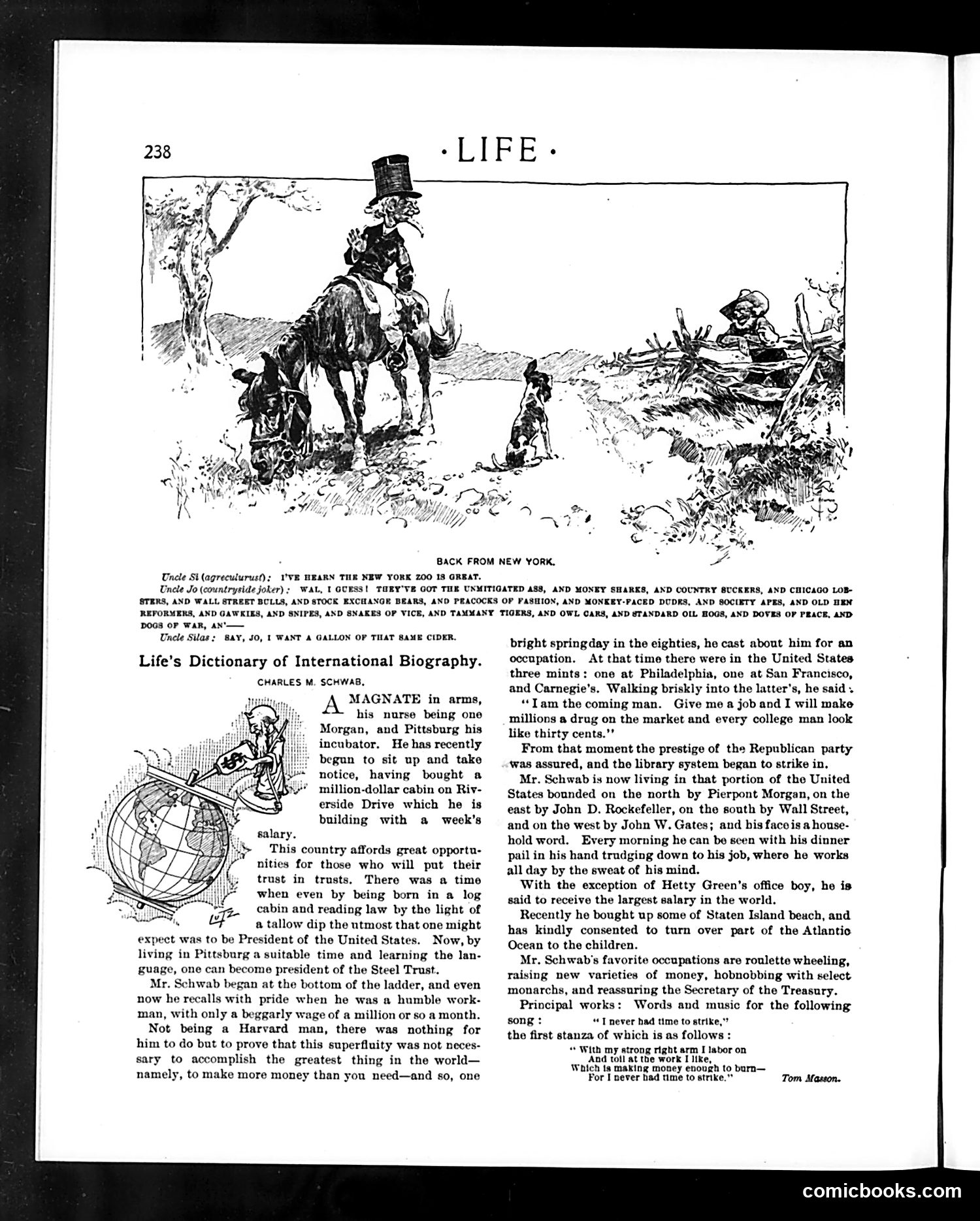
**The Main Cartoon ("Back from New York"):** A figure in a top hat rides a camel while addressing a seated dog, with another figure visible on the right. The caption references the "New York Zoo" being "great," and mentions "unashamed ass, and money sharks, and country suckers" alongside various financial and political figures—suggesting satirical commentary on wealthy New York society and its moral character. **The Biography Section:** Charles M. Schwab's profile describes his rise from log-cabin poverty to Pittsburgh steel magnate and millionaire, emphasizing his self-made success and current prominence in American business and Republican politics. The text suggests he exemplifies the era's industrial capitalist ideal while noting his wealth and cultural influence. The overall tone appears to mock both high society pretensions and robber-baron excess.
📄 Transcribed text from this page (OCR, searchable)
Machine-transcribed from the original scan — historical spelling and the odd misread are preserved.
BACK FROM NEW YORK. Uncle Si(agreculurus); I'VE HEARN THR NEW YORK 200 183 GREAT. Unele Jo (countryside joker); WAL, 1 GUESS! TORY'VE GOT THE UNMITIGATED 488, AND MONEY SHARKS, AND COUNTRY SUCKERS, AND CHICAGO LOB- STERS, AND WALL STREET BULLS, AND STOCK EXCHANOR BEARS, AND PEACOCKS OP FASHION, AND MONKEY-PACED DUDS, AND SOCLETY APES, AND OLD IRN REPORMERS, AND GAWKIES, AND SNIPES, AND SNAKES OP VICE, AND TAMMANY TIGERS, AND OWL CARS, AND STANDARD OIL 1008, AND DOVES OF PRACE, AND DOGS OF WAR, AN'— Uncle Silas: BAY, JO, 1 WANT A GALLON OP THAT 8AME CIDER. Life’s Dictionary of International Biography. CHARLES M. SCHWAB, MAGNATE in arms, his nurse being one Morgan, and Pittsburg his incubator. He has recently begun to sit up and take notice, having bought a million-dollar cabin on Riv- erside Drive which he is building with a week's s} This country affords great opportu- nities for those who will put their trust in trusts. There was a time when even by being born in a log cabin and reading law by tho light of a tallow dip the utmost that one might expect was to be President of the United States. Now, by living in Pittsburg a suitable time and learning the lan- guage, one can become president of the Steel Trust. Mr. Schwab began at the bottom of the ladder, and even now he recalls with pride when he was a humble work- man, with only a beggarly wage of a million or so a month. Not being a Harvard man, there was nothing for him to do but to prove that this superfluity was not neces- sary to accomplish the greatest thing in the world— namely, to make more money than you need—and so, one bright springday in the eighties, he cast about him for an occupation. At that time there were in the United States three mints: one at Philadelphia, one at San Francisco, and Carnegie’s. Walking briskly into the latter's, he said . “Tam the coming man. Give me a job and I will make millions a drug on the market and every college man look like thirty cents.’" From that moment the prestige of the Republican party ‘was assured, and the library system began to strike in, Mr. Schwab is now living in that portion of the United States bounded on the north by Pierpont Morgan, on the east by John D. Rockefeller, on the south by Wall Street, and on the west by John W. Gates; and his facois a house- hold word. Every morning he can be seen with his dinner pail in his hand trudging down to his job, where he works all day by the sweat of his mind. With the exception of Hetty Green’s office boy, he is said to receive the largest salary in the world. Recently he bought up some of Staten Island beuch, and has kindly consented to turn over part of the Atlantio Ocean to the children. Mr. Schwab's favorite occupations are roulette wheeling, raising new varieties of money, hobnobbing with select monarchs, and reassuring the Secretary of the Treasury. Principal works: Words and music for the following song: “Tnever had time to strike,” the first stanza of which is as follows : “With my strong right arm I labor on And toll at the work I like, Which ts making money enough to burn— For I never had time to strike." Tom Masson. comicbooks.com