
Life, 1902-09-18 · page 4 of 22
Life — September 18, 1902 — page 4: what you’re looking at
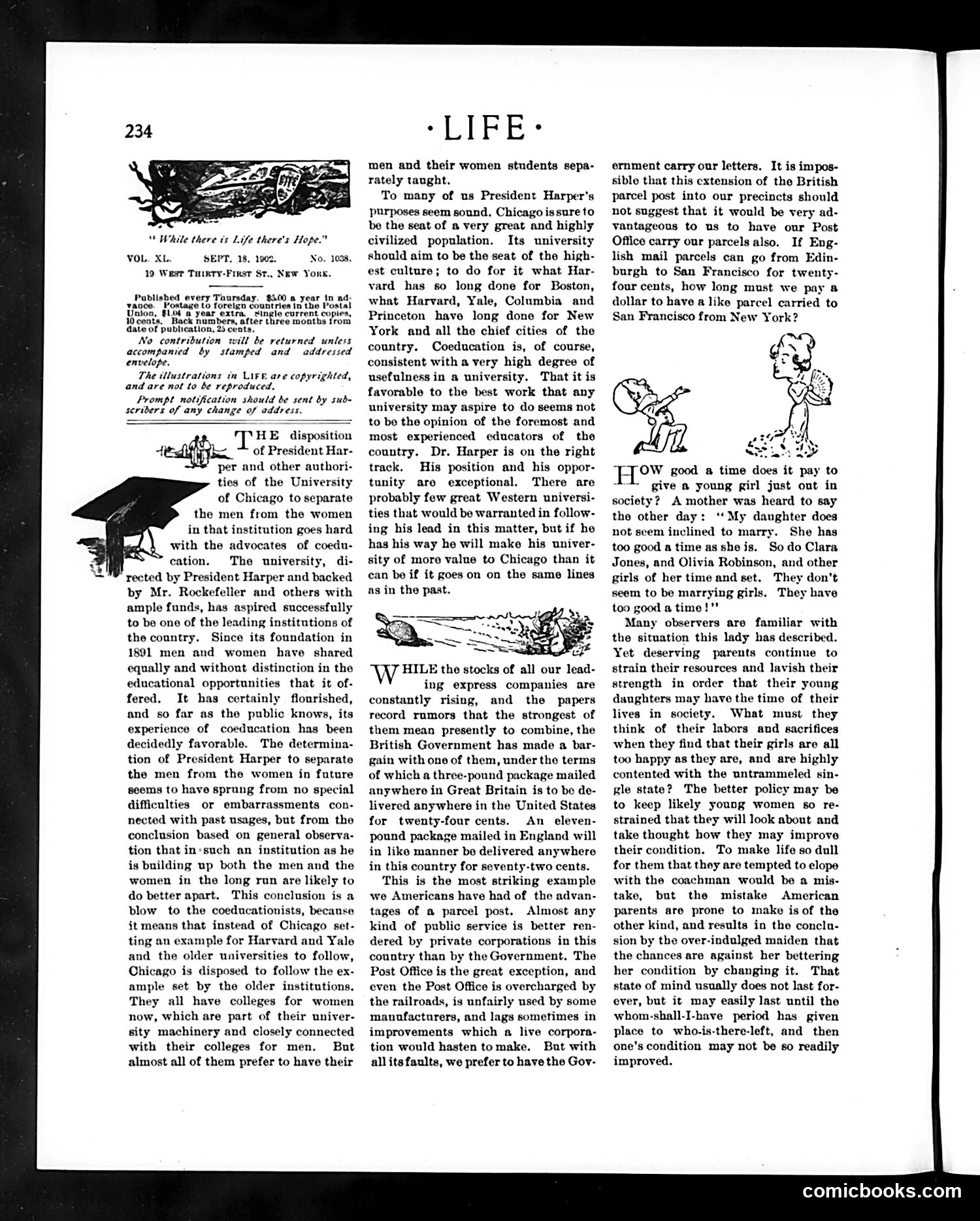
A restored page from Life, 1902-09-18. Page through the whole issue in the reader above.
📄 Transcribed text from this page (OCR, searchable)
Machine-transcribed from the original scan — historical spelling and the odd misread are preserved.
“* While there is Life there's Hope.” VOL. XL. SEPT, 18, 1902. 19 West TuiRty-First Published every Thursday. $500 a year tn ad: ce. © to foreign countries in the Postal glo current copies, ree months {rom No. 1098. New Yous. oa date of ‘publieation. 25 cc nts, No contribution will be returned untess accompanied by stamped and addressed envelope. The illustrations in LiFe are copyrighted, and are not to be reproduced. Prompt notification should be sent by sub- scribers of any change of address. T HE disposition esi of President Har- per and other authori- ties of the University of Chicago to separate the men from the women in that institution goes hard with the advocates of coedu- cation. The university, di- rected by President Harper and backed by Mr. Rockefeller and others with ample funds, has aspired successfully to be one of the leading institutions of the country. Since its foundation in 1891 men and women have shared equally and without distinction in the educational opportunities that it of- fered. It has certainly flourished, and so far as the public knows, its experience of coeducation has been decidedly favorable. The determina- tion of President Harper to separate the men from the women in future seems to have sprung from no special difficulties or embarrassments con- nected with past usages, but from the conclusion based on general observa- tion that in-such an institution as he is building up both the men and the women in the long run are likely to do better apart. This conclusion is a blow to the coeducationists, because it means that instead of Chicago set- ting an example for Harvard and Yale and the older universities to follow, Chicago is disposed to follow the ex- ample set by the older institutions. They all have colleges for women now, which are part of their univer- sity machinery and closely connected with their colleges for men. But almost all of them prefer to have their LIFE men and their women students sepa- rately taught. To many of us President Harper's purposes seem sound. Chicago issure to be the seat of a very great and highly civilized population. Its university should aim to be the seat of the high- est culture; to do for it what Har- vard has so long done for Boston, what Harvard, Yale, Columbia and Princeton have long done for New York and all the chief cities of the country. Coeducation is, of course, consistent with a very high degree of usefulness in a university. That it is favorable to the best work that any university may aspire to do seems not to be the opinion of the foremost and most experienced educators of the country. Dr. Harper is on the right track. His position and his oppor- tunity are exceptional. There are probably few great Western universi- ties that would be warranted in follow- ing his lead in this matter, but if he has his way he will make his univer- sity of more value to Chicago than it can be if it goes on on the same lines as in the past. HILE the stocks of all our lead- ing express companies are constantly rising, and the papers record rumors that the strongest of them mean presently to combine, the British Government has made a bar- gain with one of them, under the terms of which a three-pound package mailed anywhere in Great Britain is to be de- livered anywhere in the United States for twenty-four cents. An eleven- pound package mailed in England will in like manner be delivered anywhere in this country for seventy-two cents. This is the most striking example we Americans have had of the advan- tages of a parcel post. Almost any kind of public service is better ren- dered by private corporations in this country than by the Government. The Post Office is the great exception, and even the Post Office is overcharged by the railroads, is unfairly used by some mannfacturers, and lags sometimes in improvements which a live corpora- tion would hasten tomake. But with allits faults, we prefer to have the Gov- ernment carry our letters. It is impos- sible that this extension of the British parcel post into our precincts should not suggest that it would be very ad- vantageous to us to have our Post Office carry our parcels also. If Eng- lish mail parcels can go from Edin- burgh to San Francisco for twenty- four cents, how long must we pay a dollar to have a like parcel carried to San Francisco from New York? FE OW good a time does it pay to “give a young girl just ont in society? A mother was heard to say the other day: ‘*My daughter does not seem inclined to marry. She has too good a time as she is. So do Clara Jones, and Olivia Robinson, and other girls of her time and set. They don't seem to be marrying girls. They have too good a time !'" Many observers are familiar with the situation this lady has described. Yet deserving parents continue to strain their resources and lavish their strength in order that their young daughters may have the time of their lives in society. What must they think of their labors and sacrifices when they find that their girls aro all too happy as they are, and are highly contented with the untrammeled sin- gle state? The better policy may be to keep likely young women 50 re- strained that they will look about and take thought how they may improve their condition. To make life so dull for them that they are tempted to elope with the coachman would be a mis- take, but the mistake American parents are prone to make is of the other kind, and results in the conclu- sion by the over-indulged maiden that the chances are against her bettering her condition by changing it. That state of mind usually does not last for- ever, but it may easily last until the whom-shall-I-bave period has given place to who-is-there-left, and then one’s condition may not be so readily improved. comicbooks.com