
A complete issue · 20 pages · 1902
Life — July 24, 1902
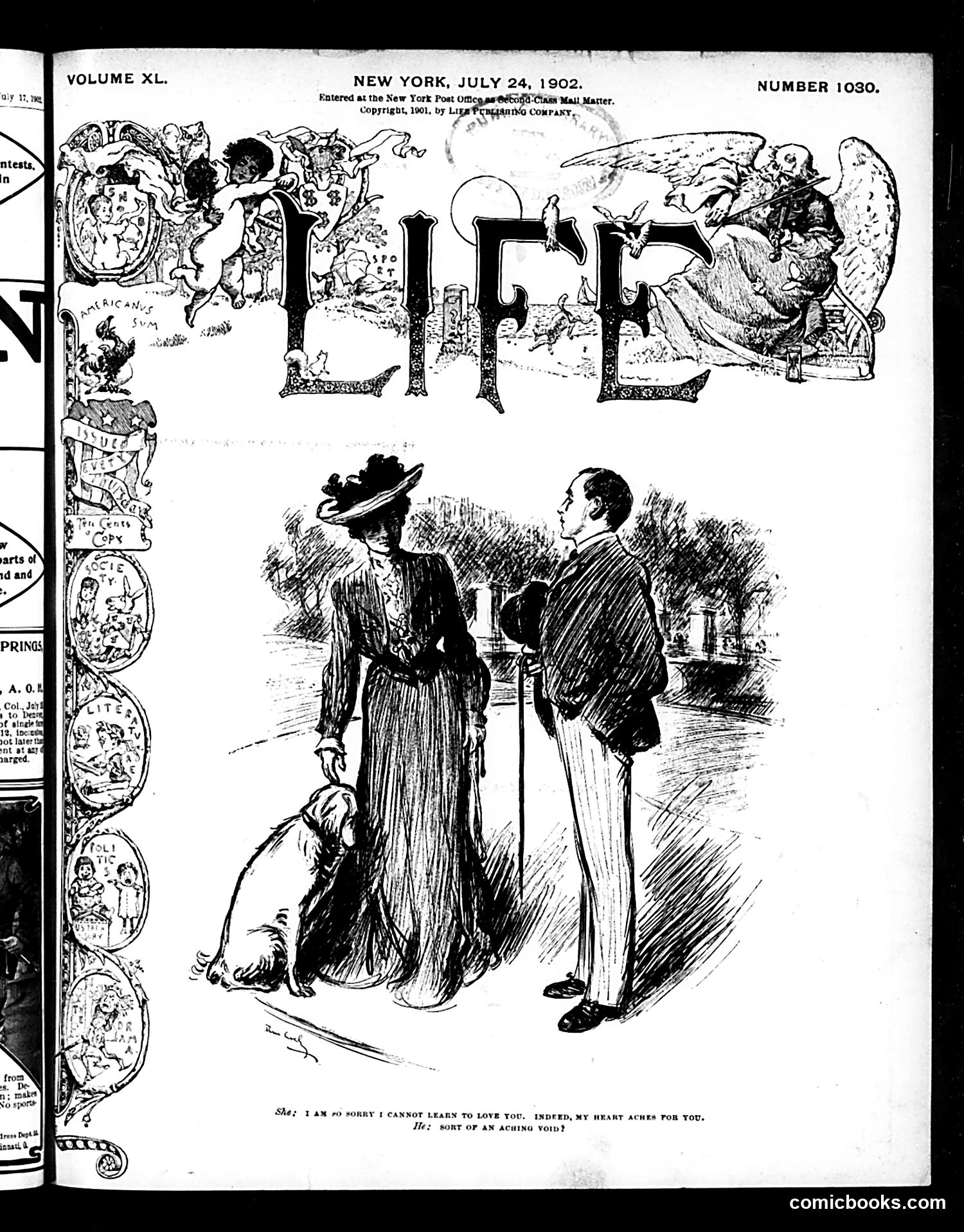
**Main Illustration:** This page features a romantic scene between a well-dressed man and woman with a small dog. The dialogue reads: "She: I am so sorry I cannot learn to love you. Indeed, my heart aches for you. He: Sort of an aching void?" **The Joke:** This is a play on words—a romantic rejection softened by the woman's sympathy. The man misinterprets her expression of emotional pain ("heart aches") as referring to a literal "aching void" (empty space/absence), creating an awkward, somewhat humorous moment. The cartoon satirizes the affected sentimentality and verbal miscommunication common in early-1900s romantic discourse. The elaborate decorative header reading "LIFE" and the ornamental borders are typical of Life magazine's design during this Edwardian era.
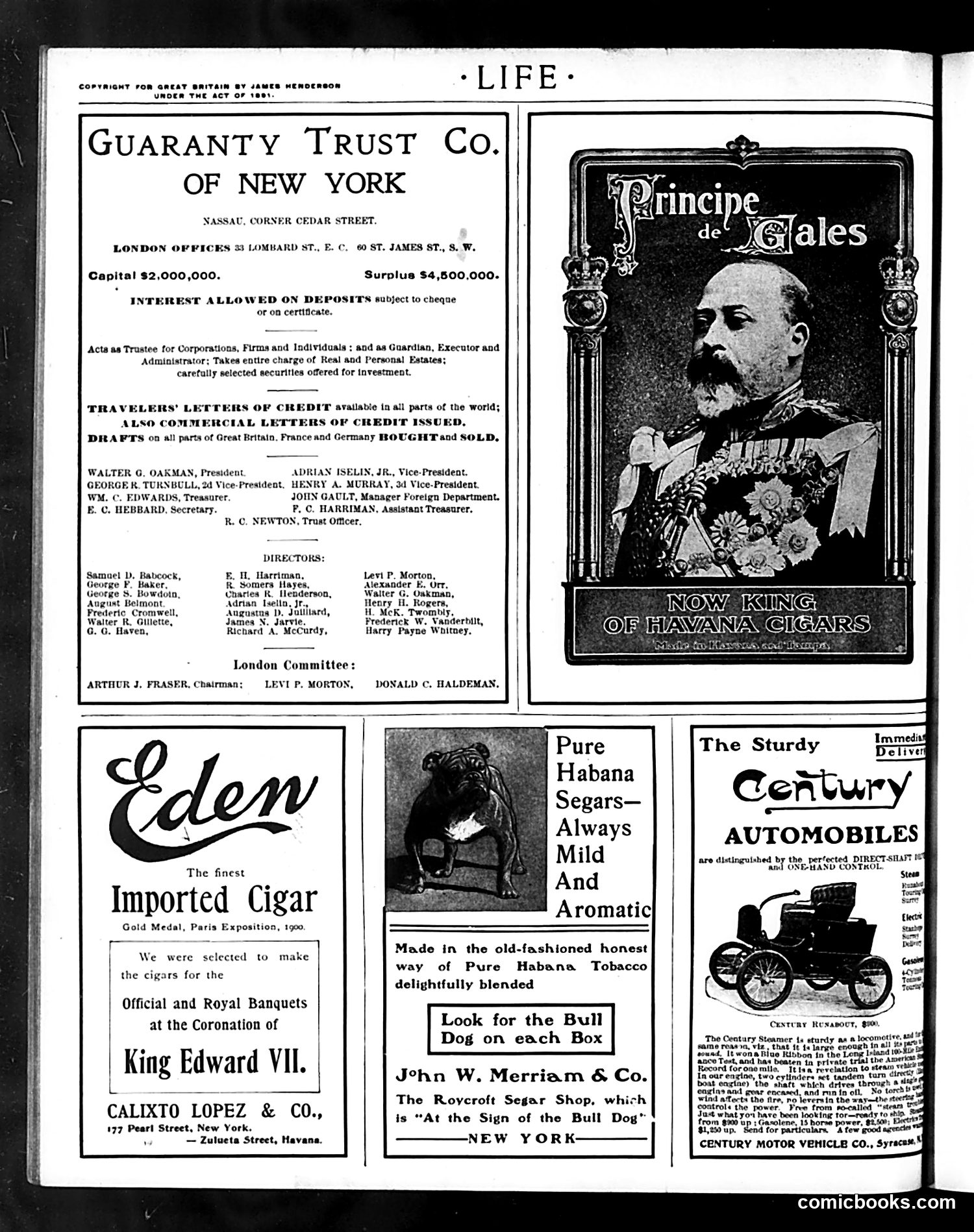
This page is **primarily advertising**, not satire or political commentary. The main content consists of commercial advertisements for financial services and consumer products popular in the early 1900s: - **Guaranty Trust Co.** (top left): Banking services advertisement - **Principe de Gales** (top right): Advertisement for cigars featuring a mustachioed gentleman identified as "Now King of Havana Cigars" - **Eden Imported Cigar** (bottom left): Premium cigar ad referencing King Edward VII's coronation - **Pure Habana Segars** (center): Cigar advertisement with bull dog imagery - **Century Automobiles** (bottom right): Early automobile advertisement The page reflects early 1900s consumer culture and commercial messaging rather than political satire. References to King Edward VII suggest this is from around 1901-1910.
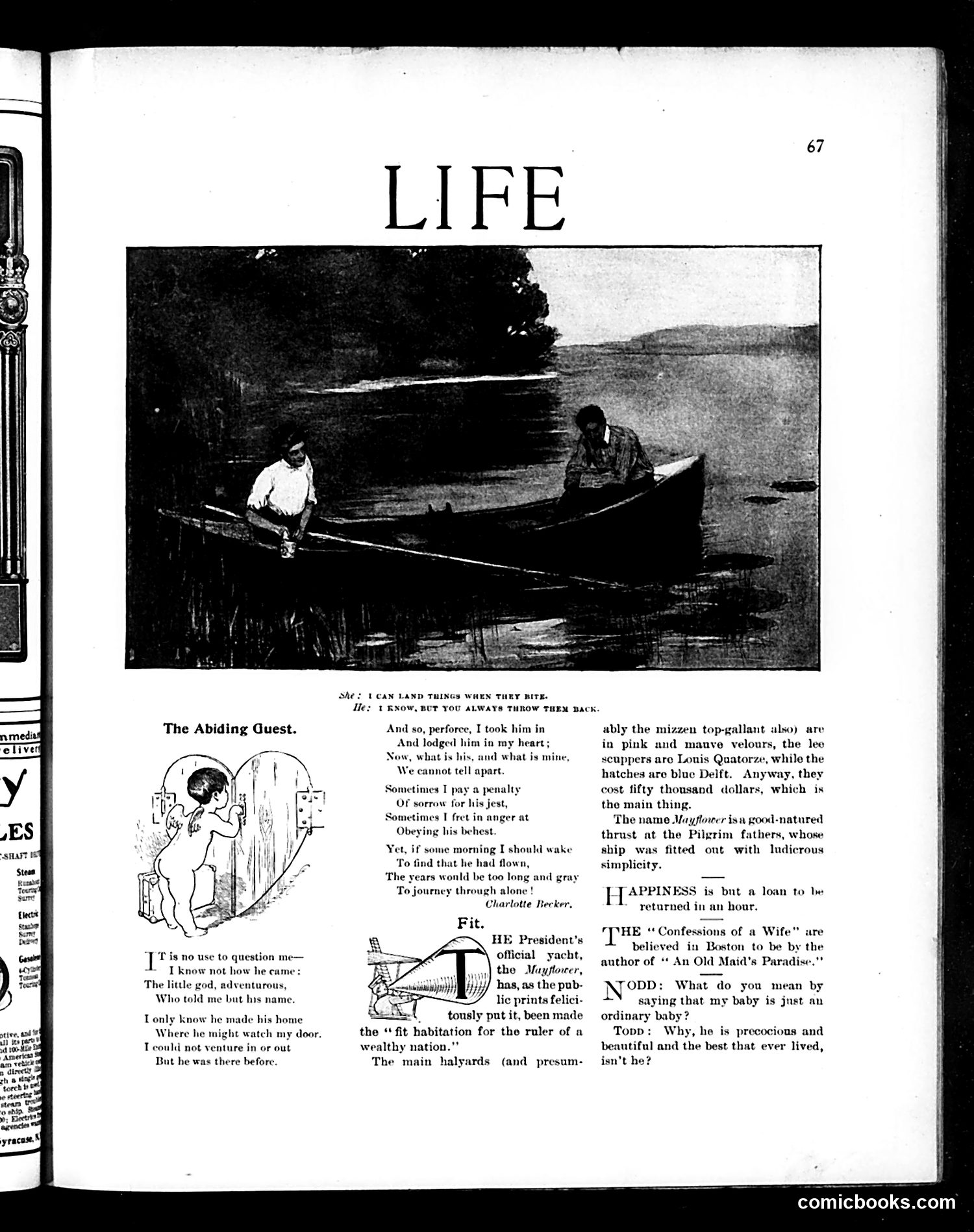
The page contains literary content rather than political satire. At top is a photograph of two fishermen with boats on a river, illustrating "The Abiding Guest," a poem by Charlotte Becker about hospitality and an uninvited houseguest. Below is a small illustration accompanying "Fit," a humorous verse about a man who "loves not his name" and fears venturing out—depicting domestic anxiety rather than political commentary. The right column includes a dialogue snippet about the President's yacht and shipbuilding costs, plus a brief exchange between characters "Nodd" and "Topp" debating whether a baby is "precocious" or merely ordinary. This appears to be a **humor and literature page** rather than political satire—typical of Life magazine's mixed editorial content from this era.
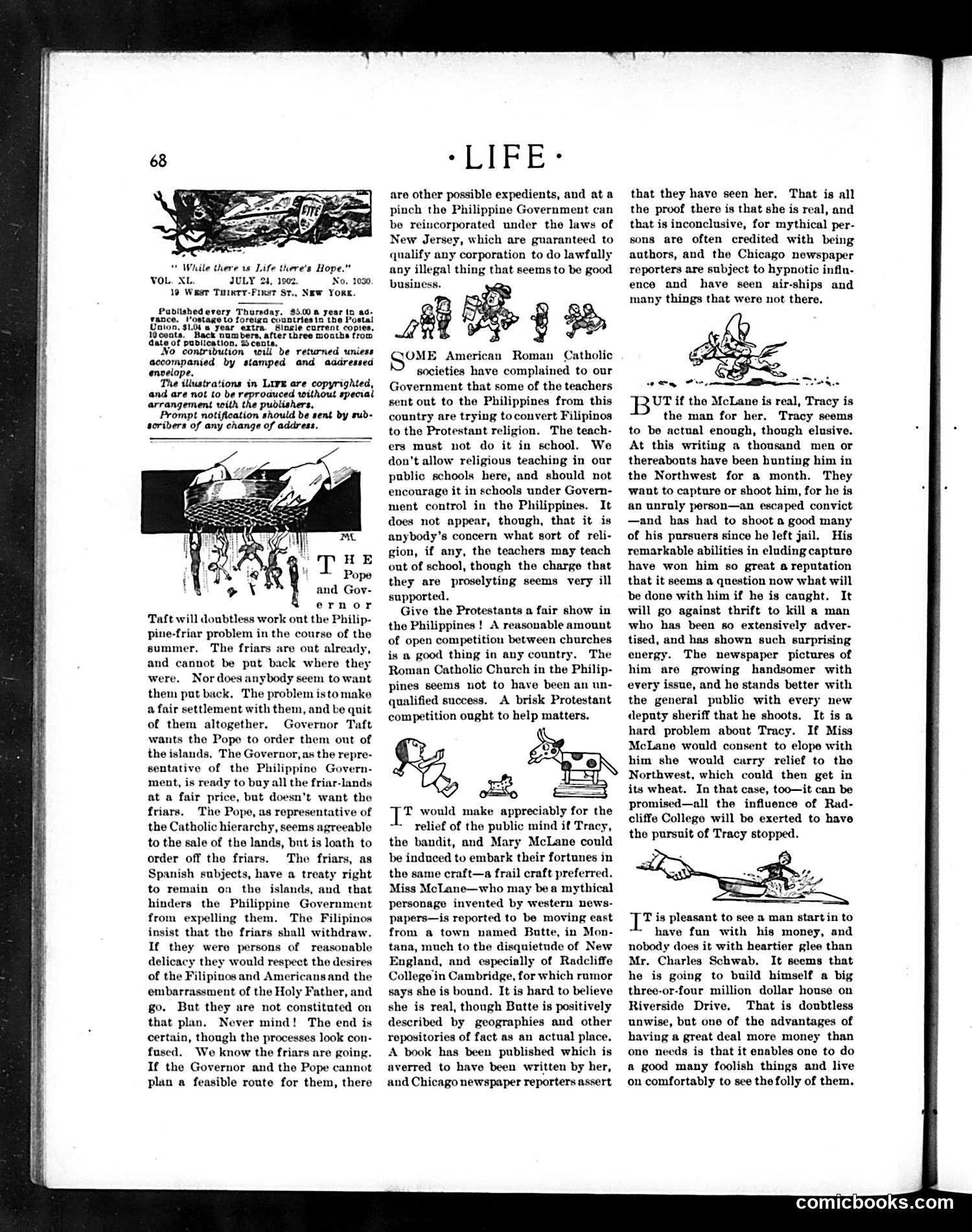
This page discusses controversies surrounding American activities in the Philippines following the Spanish-American War. The text addresses: 1. **Religious tension**: Catholic organizations complained that American Protestant teachers were attempting to convert Filipinos, violating principles of secular public education. 2. **The "Tracy" scandal**: References to a fugitive escaped convict reportedly hiding in the Northwest, whom newspapers sensationalized as a subject of pursuit and capture. 3. **Colonial administration**: Debate over whether American governors should order Catholic friars (Spanish religious authorities) to leave the islands, and whether the U.S. could legally purchase friar lands. The satirical illustrations (small cartoons throughout) comment on these imperial and religious conflicts. The piece critiques both excessive newspaper sensationalism and the practical complications of American colonial governance.
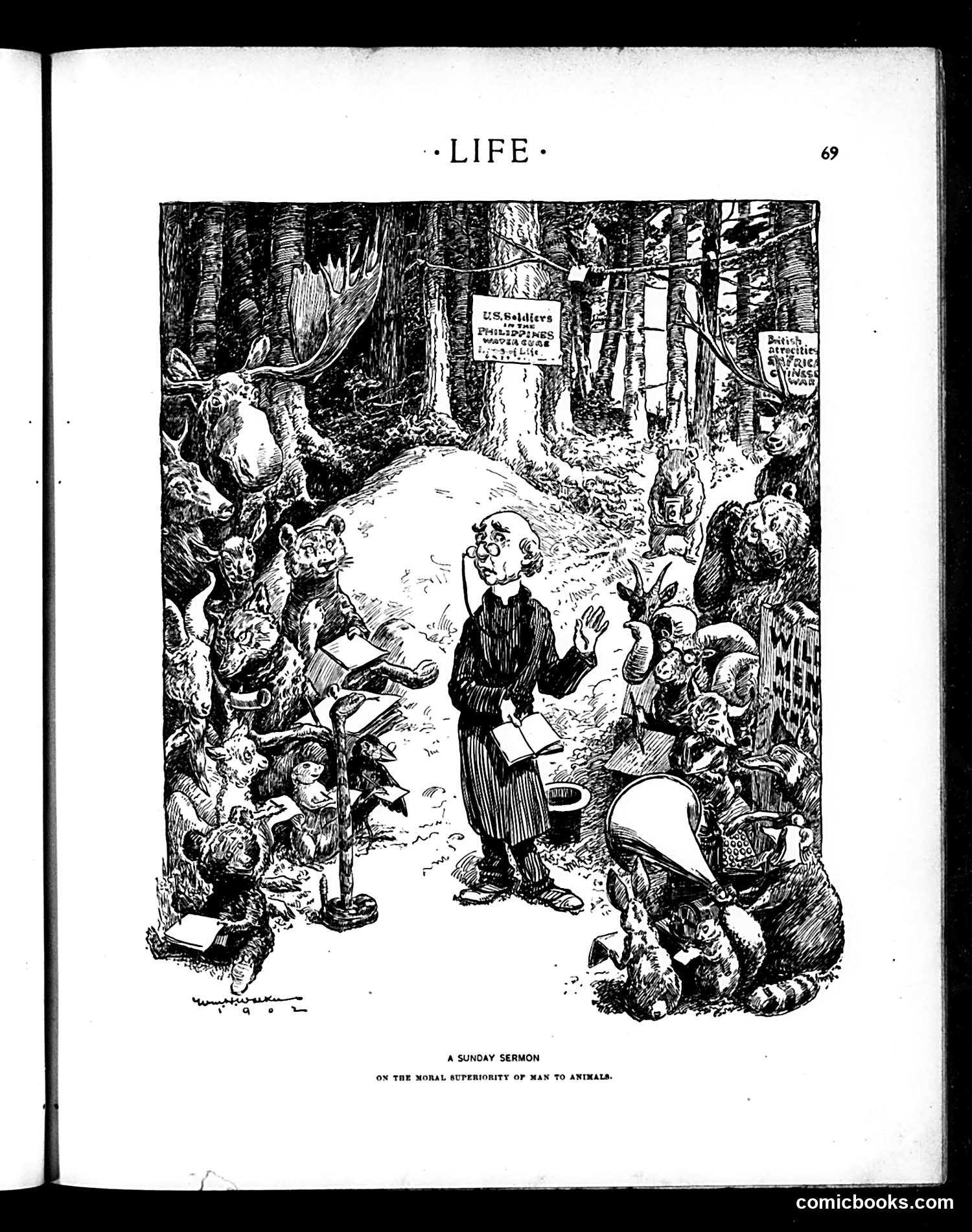
This satirical cartoon depicts a clergyman preaching to an assembled congregation of animals in a forest setting. The joke inverts the stated sermon title through visual irony: rather than demonstrating man's moral superiority, the image shows animals appearing more organized and attentive than typical human congregations might be. The sign visible in the background appears to reference U.S. soldiers, though details are unclear. The cartoon likely critiques either organized religion's hypocrisy, human pretensions of superiority over animals, or possibly contemporary social/military issues. The artist uses anthropomorphized animals listening respectfully to a human authority figure to satirize humanity's presumptions—suggesting we're not actually morally superior despite our claims.
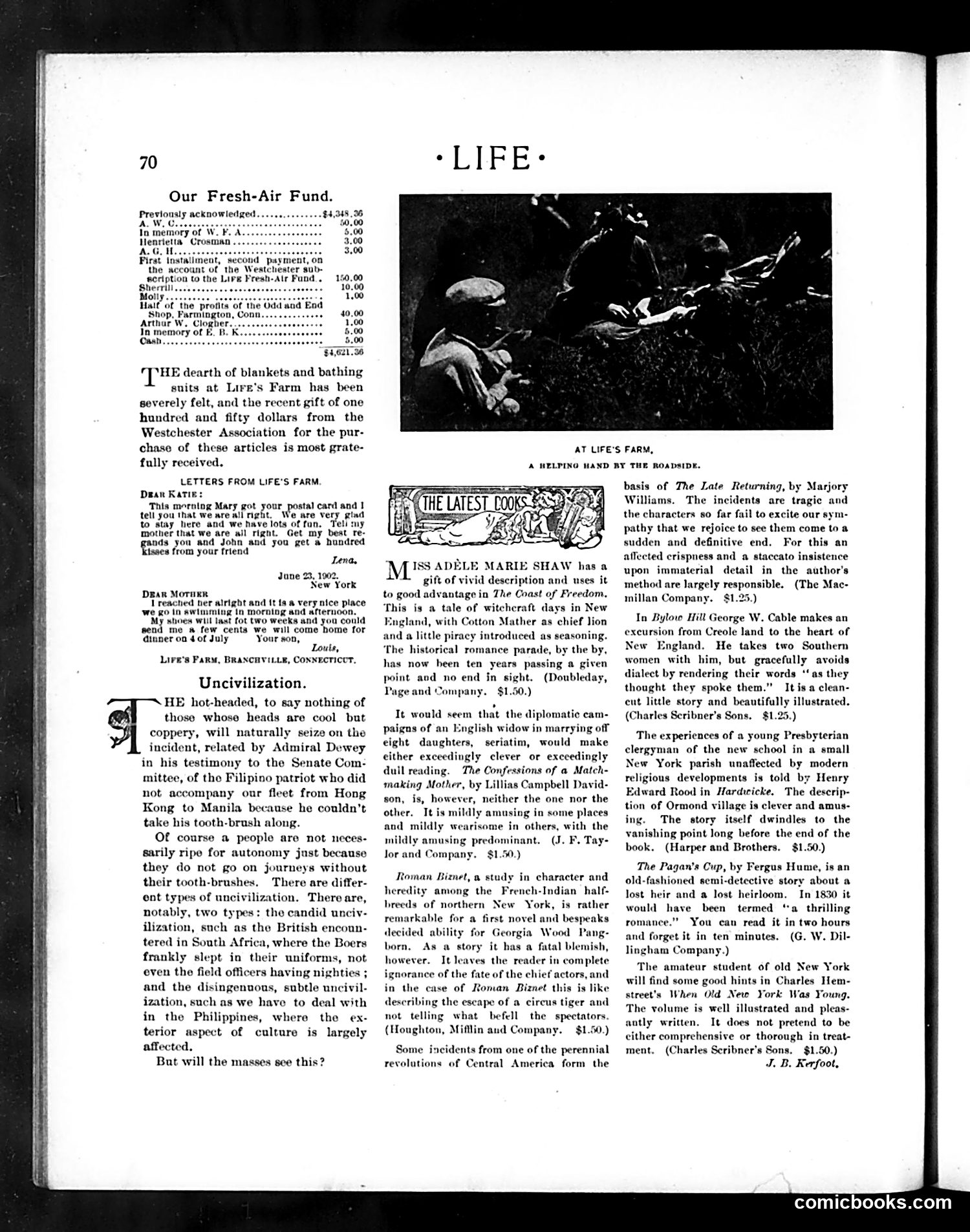
The main editorial content critiques Western military conduct, specifically addressing why "hot-headed" British forces in Hong Kong and Manila couldn't leave their toothbrushes behind during fleet deployments. The author sarcastically argues that people shouldn't need "autonomy" for journeys without proper toiletries, distinguishing between necessary and unnecessary "uncivilization." The piece then pivots to examining actual uncivilized behavior: the British in South Africa, where soldiers "slept in their uniforms" and engaged in "subtle uncivilization," and Europeans in the Philippines, where colonial occupation itself was largely "affected." The satire suggests that British imperialism's claim to civilization rings hollow given their actual conduct—the irony being that supposedly civilized powers behave unethically in colonial contexts.
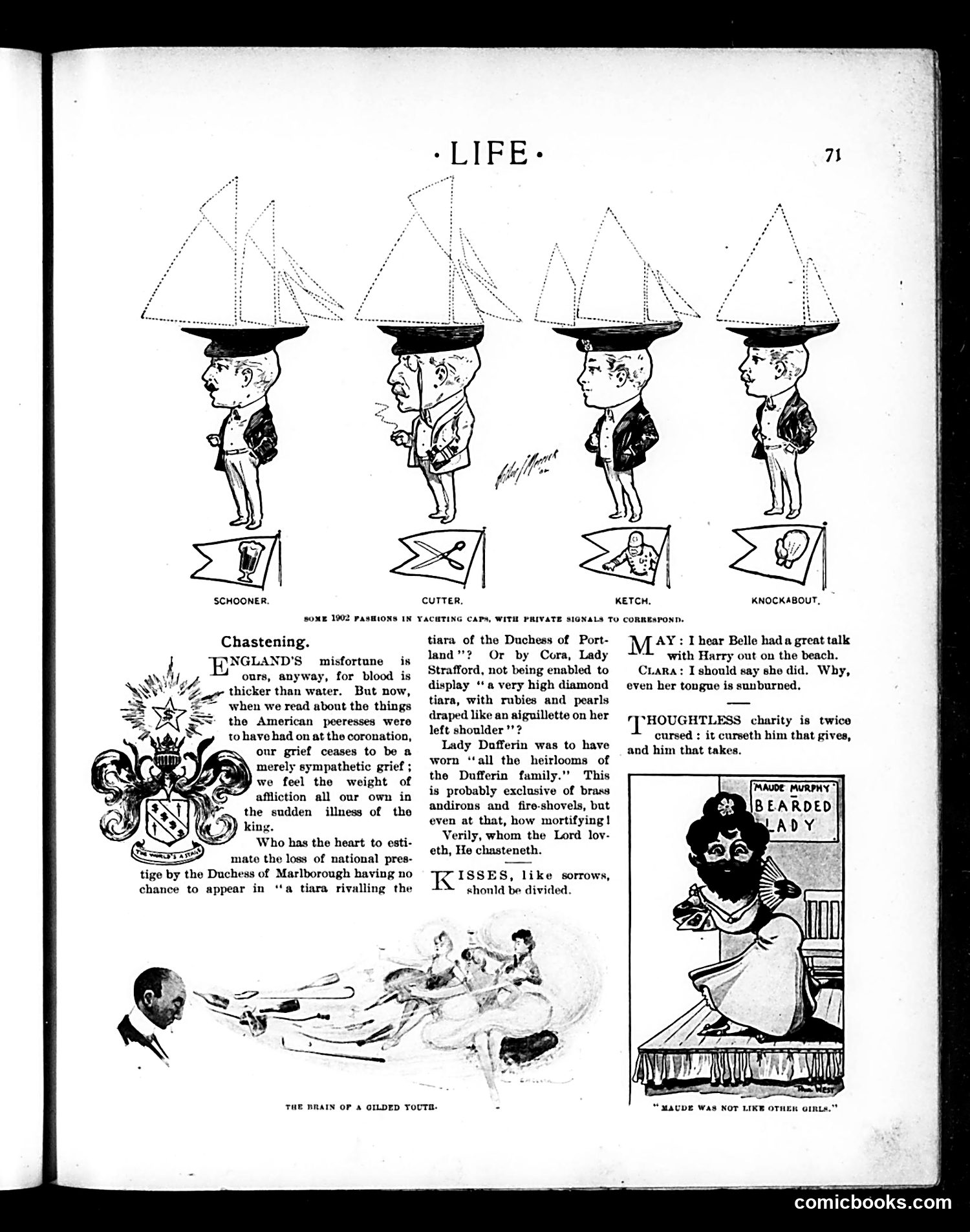
**Top Illustration: "Some 1902 Fashions in Yachting Caps"** Four caricatured men wearing sailboats as hats, labeled "Schooner," "Cutter," "Ketch," and "Knockabout." This satirizes wealthy yacht-club society and the pretentious fashion accessories of the upper class during the Edwardian era. **"Chastening" Section:** Text mocks the American upper classes' sympathetic grief over the Duchess of Marlborough's misfortune (unclear which specific incident), suggesting their concern is merely performative. The criticism targets aristocratic affectation. **"The Brain of a Gilded Youth":** A sketch depicting an idle, wealthy young man, humorously suggesting the emptiness of privileged leisure-class life. **"Maude Murphy, Bearded Lady":** An advertisement or illustration accompanying society gossip, typical of Life's blend of satire and scandal coverage.
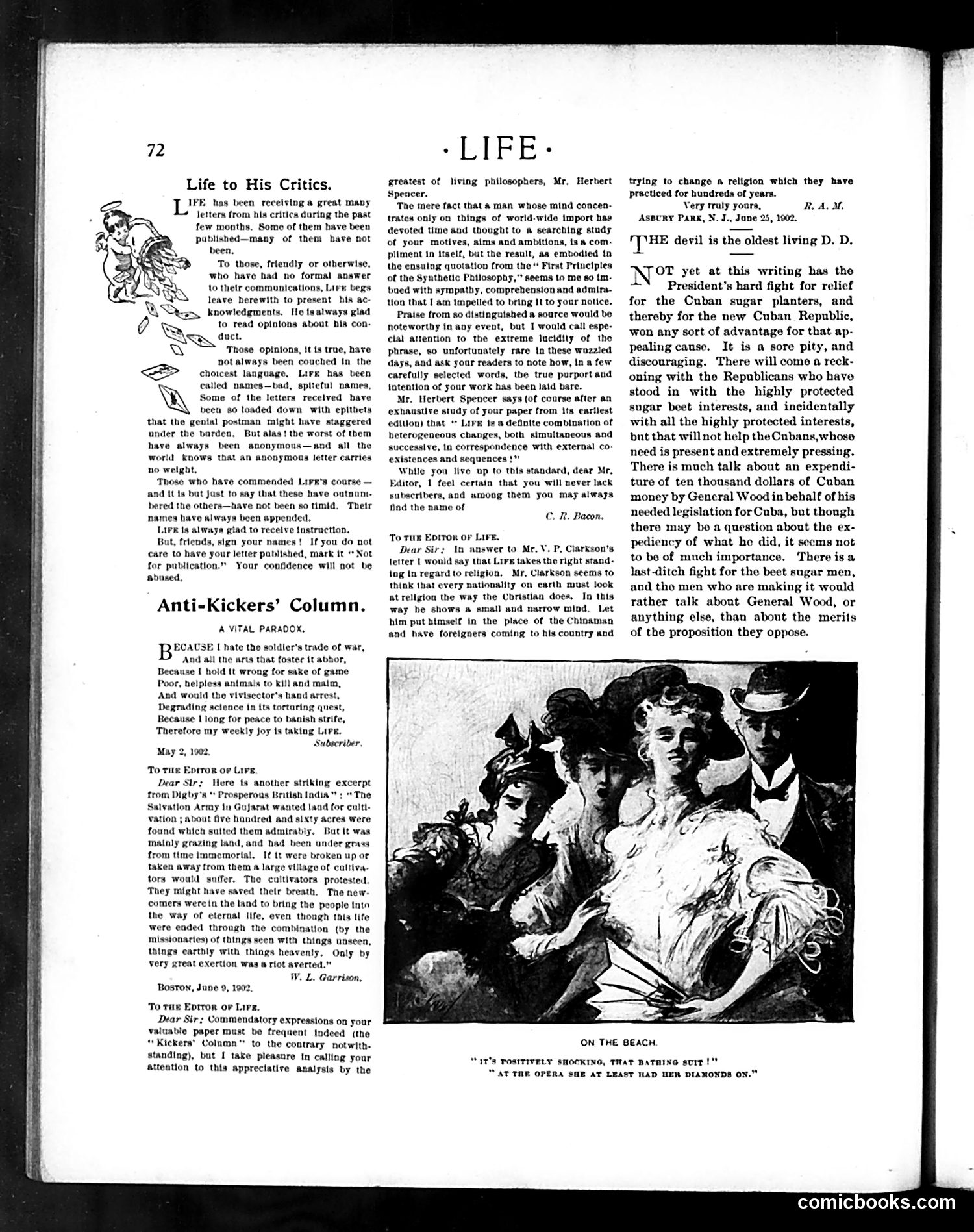
This page contains reader letters to the editor rather than political cartoons. The main illustration, titled "On the Beach," depicts fashionably dressed figures and includes a caption about "bathing suits" and "diamonds." The letters discuss Life magazine itself—its editorial standards, religious perspectives, and approach to satire. One letter criticizes the "soldier's trade of war" and Life's coverage of conflict. Another addresses Life's stance on religion, with the editor responding that Life "takes the right standing in regard to religion." There's a section titled "Anti-Kickers' Column" that sarcastically responds to critical readers. The overall page reflects Life's role as a satirical magazine engaging with readers about its editorial philosophy and social commentary, rather than presenting standalone political cartoons for analysis.
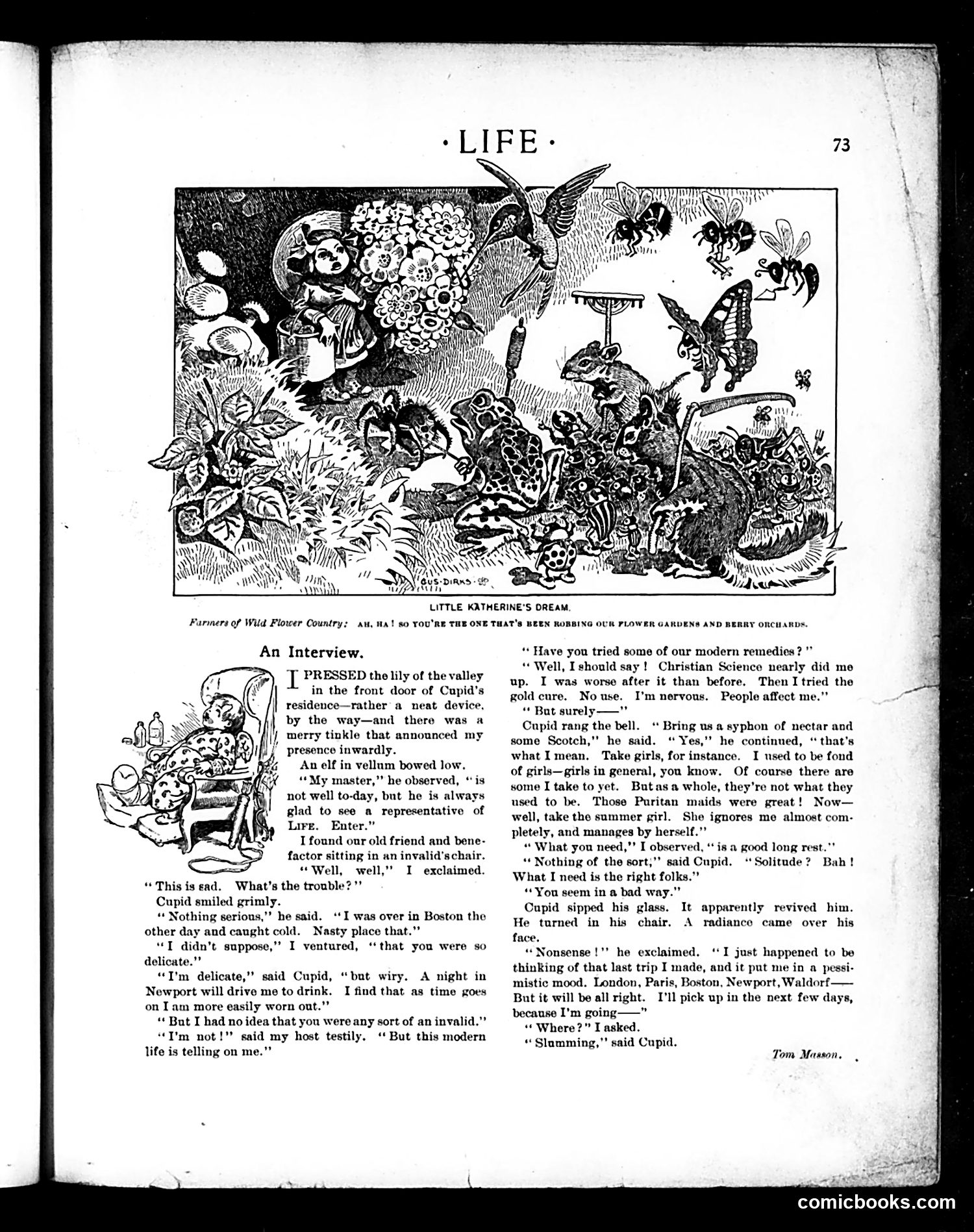
The top illustration depicts a whimsical garden scene where insects and creatures converse—a fairy-tale pastiche titled "Little Katherine's Dream," with a caption about pests "robbing our flower gardens and berry orchards." Below, "An Interview" satirizes modern life through dialogue between a sickly character and Cupid. The invalid complains that Boston's cold made him ill, and that modern life exhausts him. Cupid dismisses these concerns, claiming a change of scenery—mentioning London, Paris, Boston, Newport, and Waldorf—will cure him. The joke mocks wealthy Americans' assumption that constant travel and fashionable destinations solve health problems, while satirizing the vapid, leisure-focused lifestyle of the affluent classes who jet between prestigious cities seeking rejuvenation.
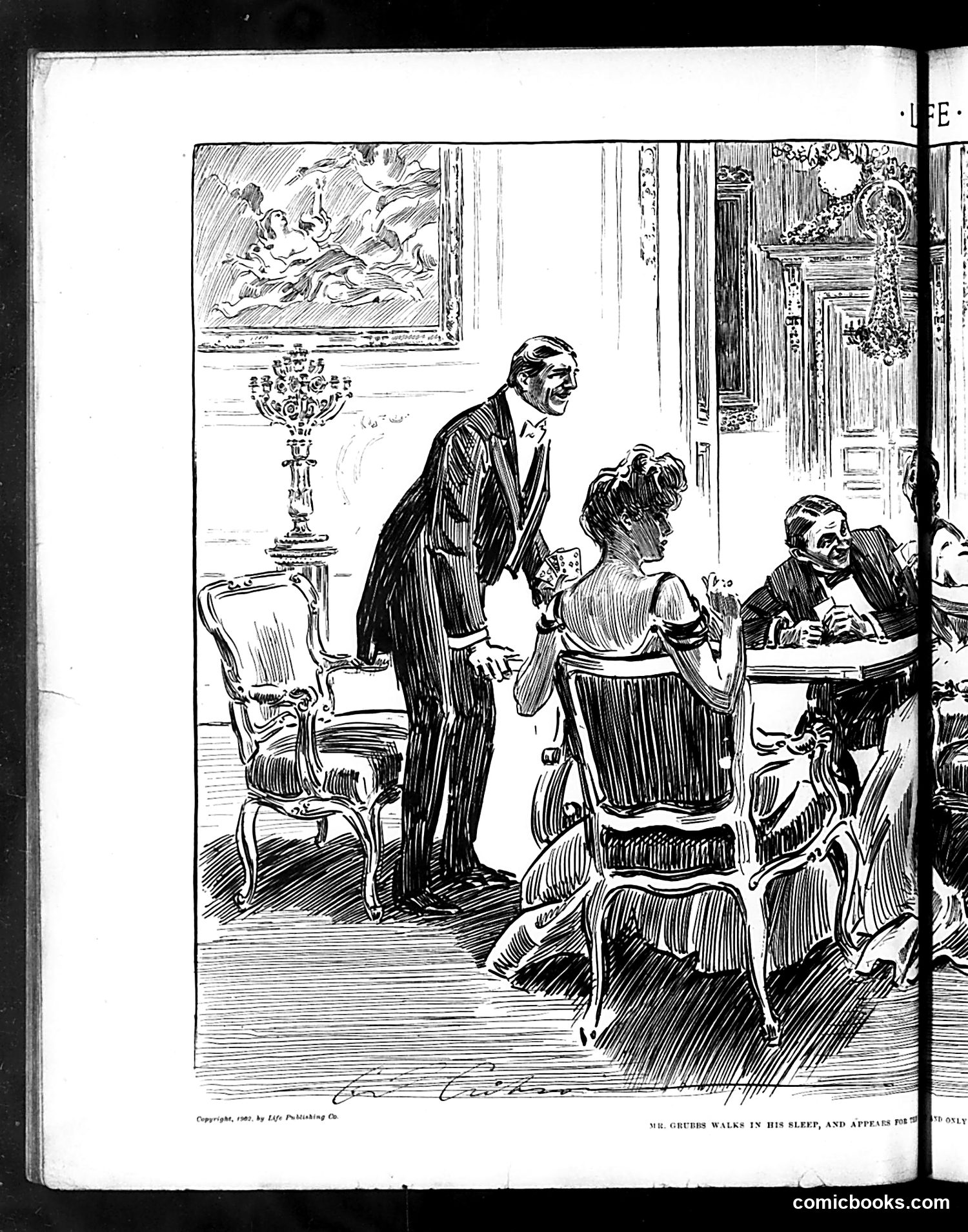
This appears to be a satirical illustration from Life magazine (copyright 1902, per visible text). The caption reads "MR. GRUERS WALKS IN HIS SLEEP, AND APPEARS FOR—ONLY." The cartoon depicts a well-dressed man standing among seated women in an elegant interior, apparently sleepwalking or in some altered state. The satire likely mocks a prominent figure of the era—possibly a politician or social figure named Gruers—portraying him as acting inappropriately or foolishly in public while "asleep," a common metaphor for unconsciousness or obliviousness. The refined setting and female audience suggest commentary on social pretense or embarrassing public behavior among the upper classes. Without additional context about "Mr. Gruers," the specific target remains unclear, though the joke relies on 1900s readers' recognition of this contemporary figure.
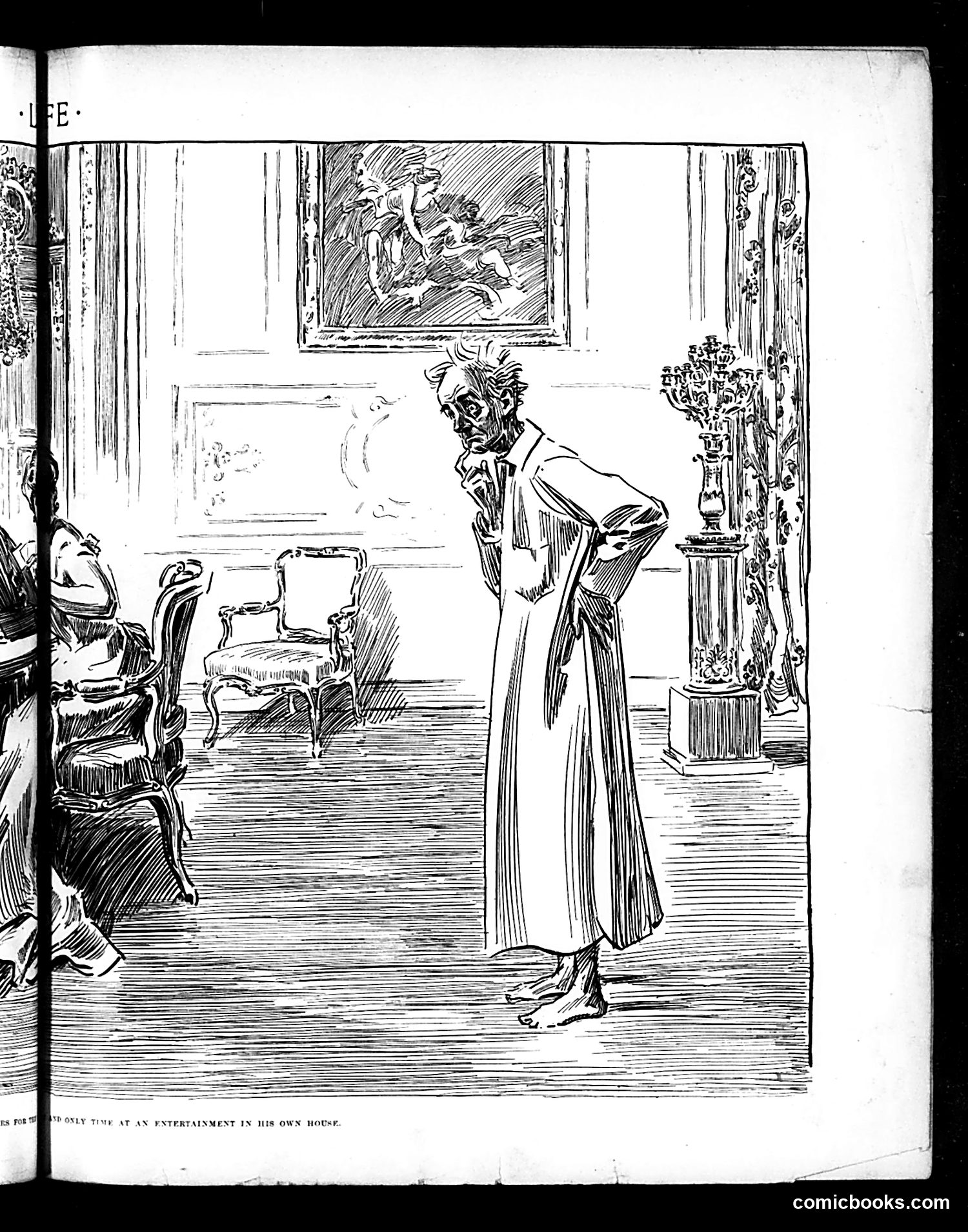
This appears to be a satirical illustration from Life magazine showing a gaunt, exaggerated male figure in formal attire standing alone in an elegant room. The caption at the bottom reads (partially visible): "...ONLY TIME AT AN ENTERTAINMENT IN HIS OWN HOUSE." The cartoon likely satirizes a wealthy or socially prominent man who is so absorbed in his own affairs—or perhaps so unpopular or misanthropic—that he never entertains guests in his home. The elaborate interior (with decorative pillar, framed artwork, fine furniture) contrasts sharply with the figure's solitary, uncomfortable posture, suggesting irony: despite possessing the means and space for entertaining, he remains isolated. The specific identity of the figure is unclear from the image alone, but the satire targets antisocial behavior among the upper classes.
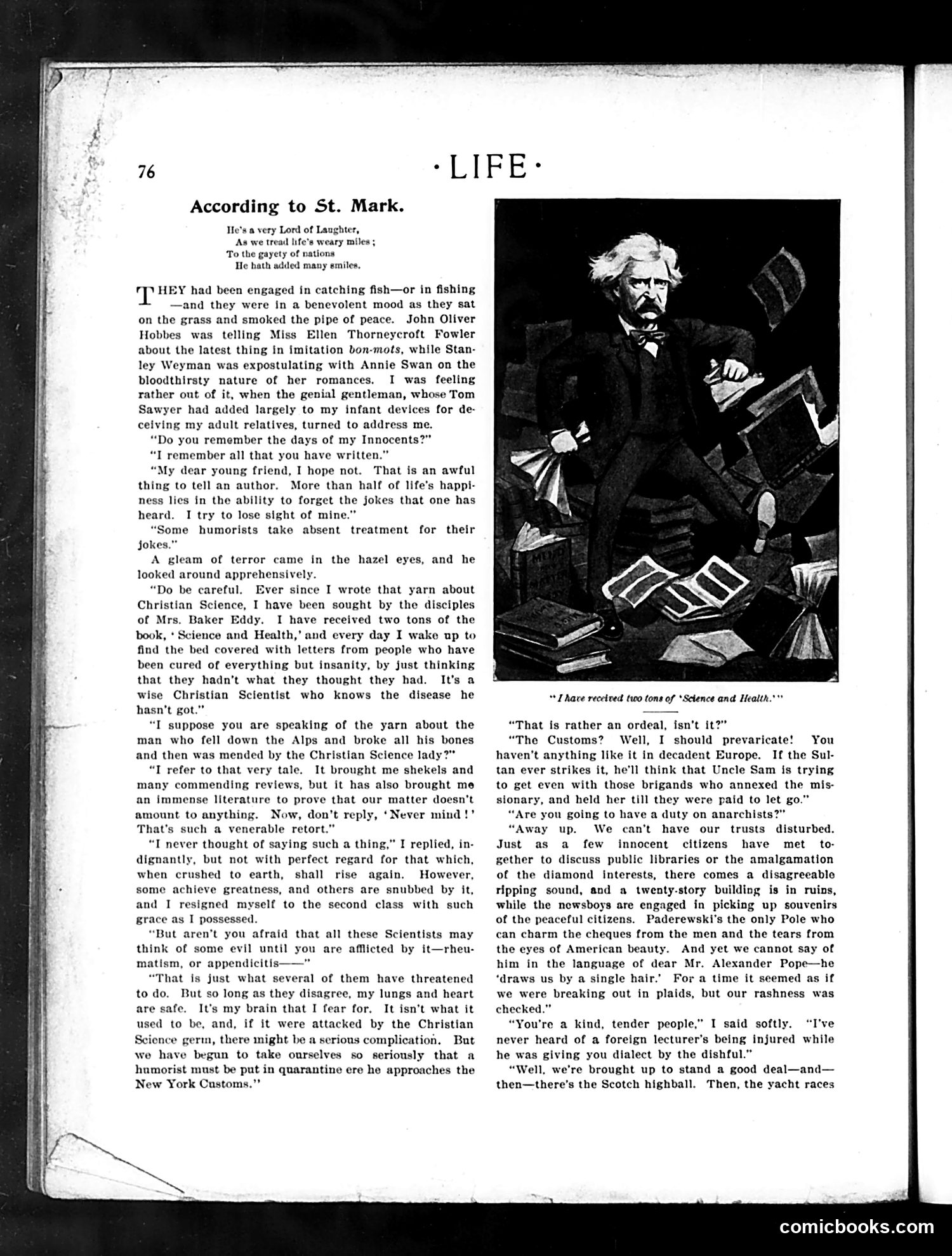
This page contains a short story titled "According to St. Mark" rather than a political cartoon. The illustration depicts an elderly bearded man (likely Mark Twain, based on the distinctive appearance and the satirical context of Life magazine) holding papers, appearing troubled or contemplative. The accompanying text discusses literary criticism and the author's frustration with unsolicited health advice from readers following publication of a yarn about Christian Science. The piece satirizes both overzealous Christian Science advocates and readers who presume to correct or advise famous authors based on their writings. The humor targets the gap between authorial intent and reader interpretation, as well as the presumption of amateur critics—a timeless satirical subject that requires no historical context to understand.
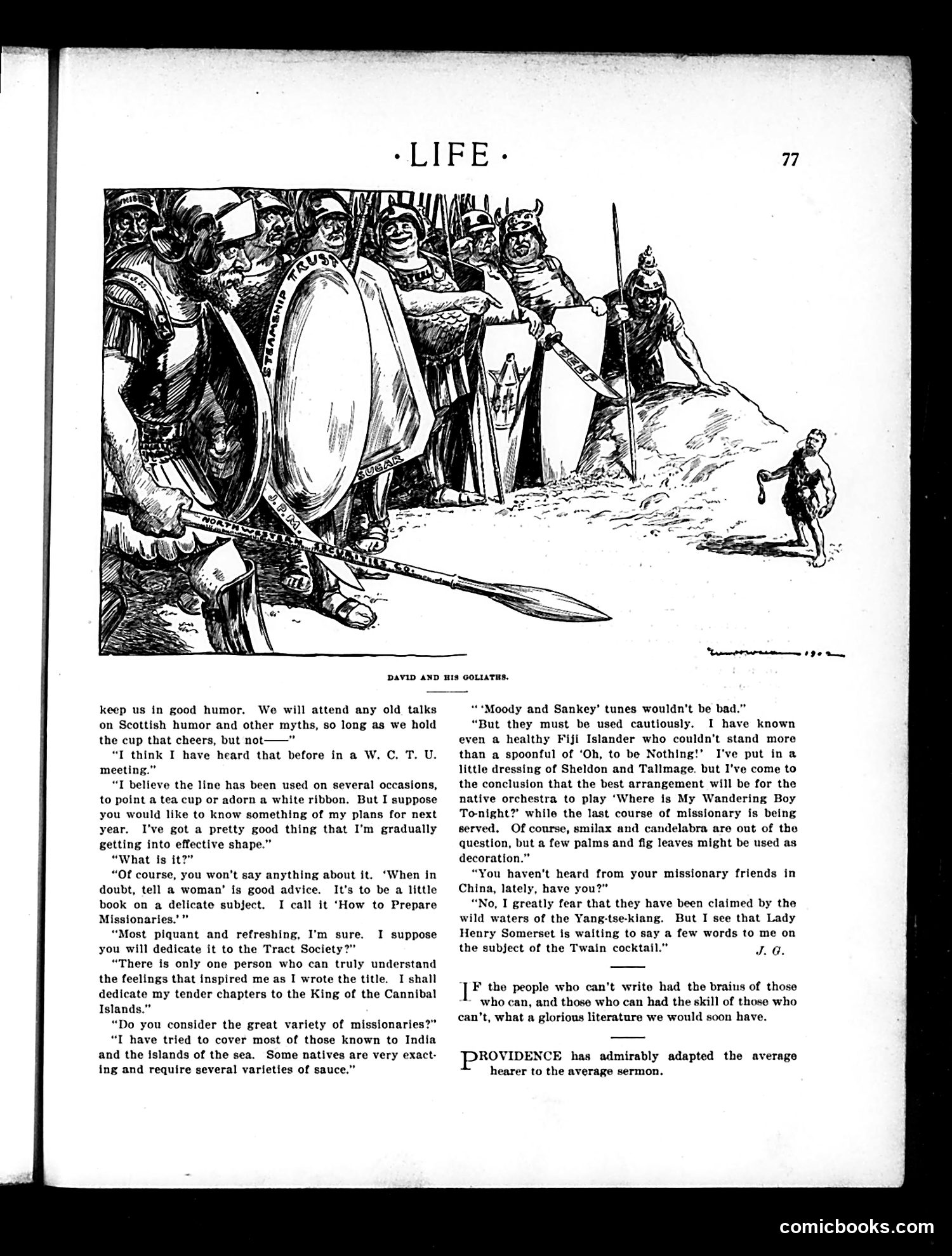
This satirical piece mocks 19th-century Christian missionaries and their zealous expansion efforts. The illustration "David and His Goliath" depicts armed soldiers/colonizers towering over a small native figure—inverting the biblical David story to suggest Western imperial power. The dialogue is a darkly comic conversation between two characters discussing a satirical book titled "How to Prepare Missionaries." The humor relies on grotesque cannibalism jokes: missionaries are portrayed as food to be "prepared" with various "sauces," accompanied by hymns and decorations. References to Fiji Islanders, China's Yang-tse River, and "Cannibal Islands" reinforce period stereotypes about non-Western peoples. The satire targets both missionary zeal (portrayed as presumptuous and condescending) and imperialist attitudes. The final quote about "Providence" adapting "the average hearer to the average sermon" suggests missionary preaching is ineffectual—another jab at religious pretension. This reflects Gilded Age skepticism toward missionary movements and colonial ventures dressed in religious language.
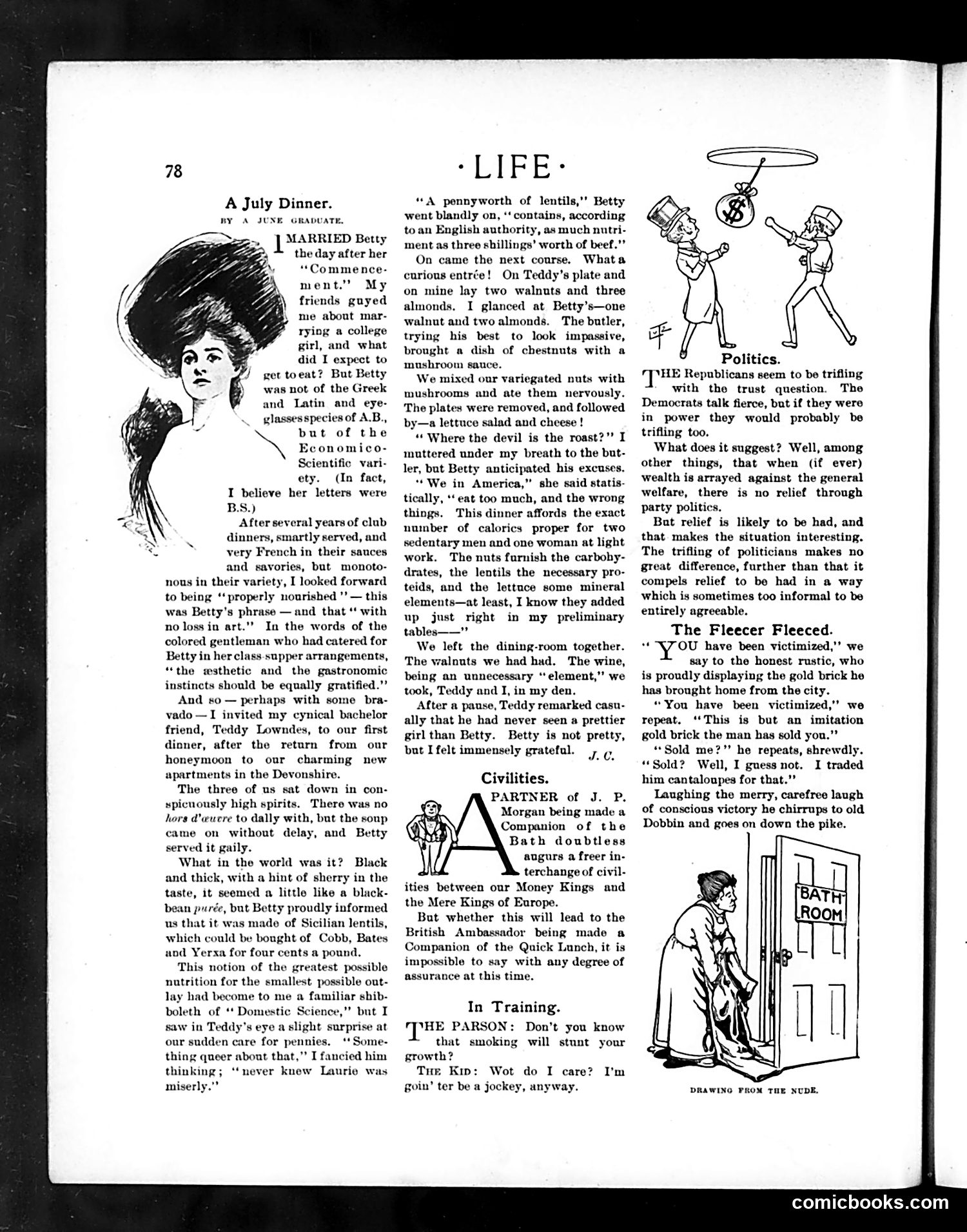
This humorous piece mocks the then-fashionable "Domestic Science" movement—scientific approaches to nutrition and household management promoted in women's colleges. The narrator marries Betty, a graduate of an economics/science program (B.S. degree) rather than classics. At their first dinner party, Betty serves an absurdly sparse meal: lentil soup, walnuts, almonds, chestnuts, and lettuce—all scientifically calculated for maximum nutrition at minimum cost. The joke targets both Betty's pedantic application of calorie science (she recites nutritional data) and the broader anxiety about educated women. The bachelor friend Teddy is shocked—this seems miserly, not romantic. Betty's efficiency wins the day: she's attractive despite being plain, and the men retreat to drink wine (the one "unnecessary element"). The satire cuts both ways: mocking both the pretentious scientification of housekeeping and the implied gender anxieties about educated wives.
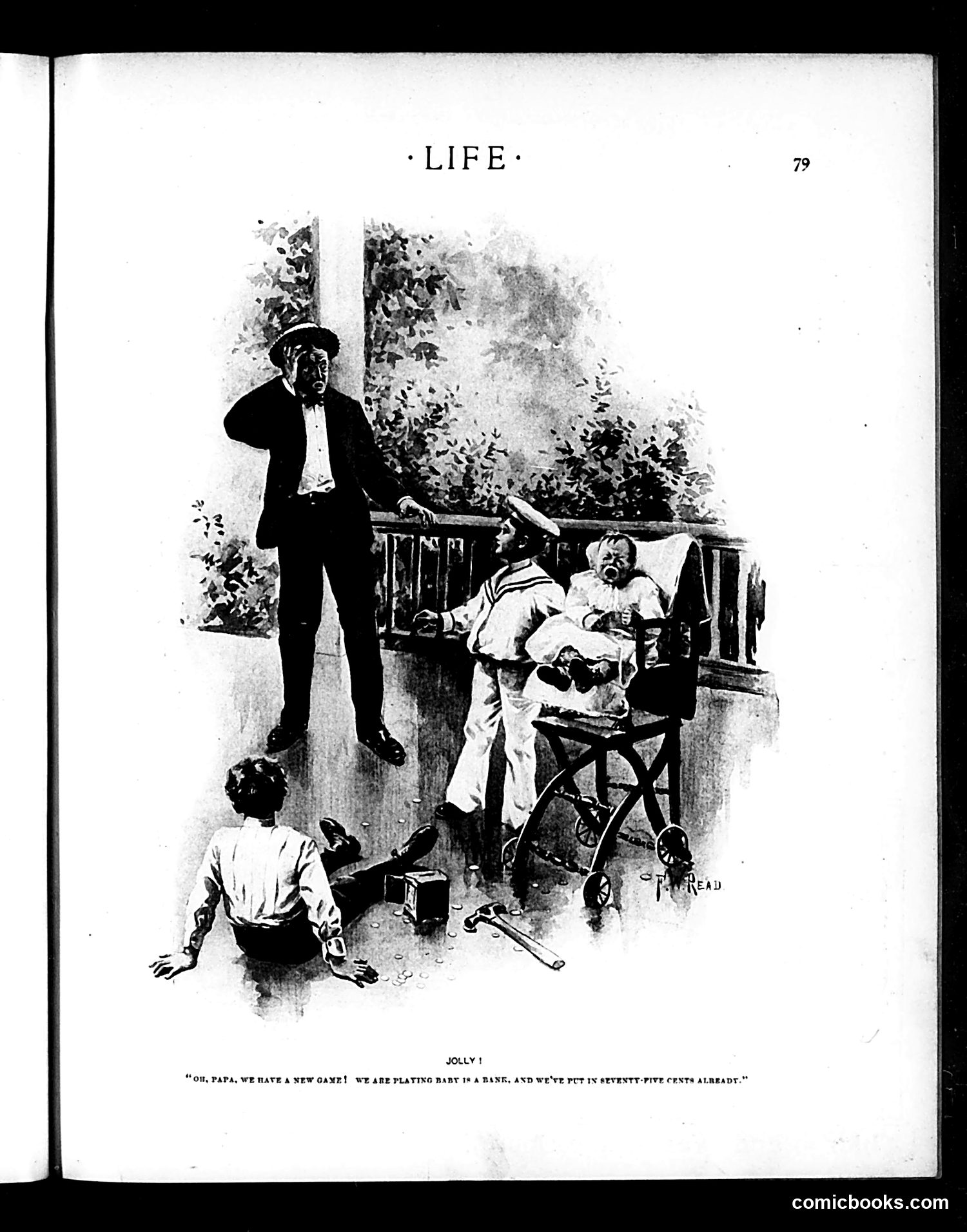
This cartoon satirizes parental indulgence and children's financial naivety. An well-dressed man (the father) stands observing while children play a game where they're treating a baby carriage as a "bank," having already deposited seventy-five cents. The humor targets two things: parents who allow their children to "play" with real money rather than teaching proper financial discipline, and children's innocent misunderstanding of banking as a game. The "jolly" tone in the caption suggests the father finds this amusing rather than concerning—a critique of negligent parenting that permits wasteful, frivolous handling of money. The satire likely reflects early 20th-century anxieties about wealth, proper financial training, and generational values.
This page contains three satirical pieces and advertisements, primarily addressing early automobile culture and social hypocrisy. **"The Chauffeur's Song"** mocks reckless drivers who kill pedestrians with impunity. The poem's repeated refrain—"Which is the proper attitude"—ironically validates callous indifference to traffic deaths as acceptable "automobilist" behavior. It satirizes society's tolerance of wealthy drivers who face minimal legal consequences for killing "woman or man or tot." **The court anecdote** ridicules bureaucratic absurdity: a registration officer refuses to remove a dead man from records without definitive proof, despite testimony of his burial. **Bishop Underwood's story** uses a drummer's misunderstanding for gentle humor—the salesman mistakes the Bishop's "house" (God's church) for a commercial firm, confusing spiritual with commercial enterprise. The advertisements (Wilson Whiskey, Milo Cigarettes, precious stones) suggest this magazine's audience: affluent men with leisure time and disposable income—the same people criticized in the automobile satire.
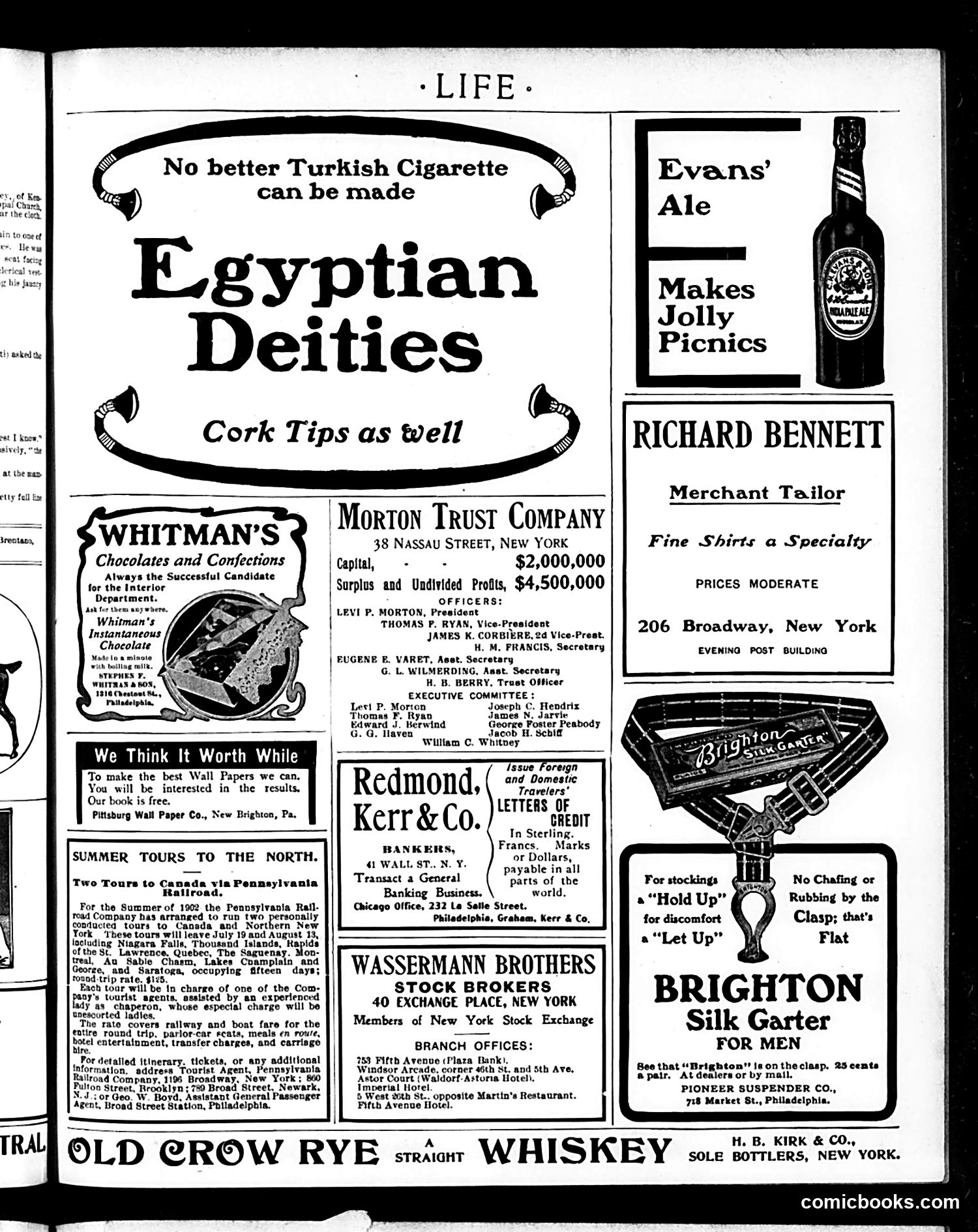
This is primarily an **advertising page** rather than a satirical editorial section. It contains no political cartoons or editorial commentary—only commercial advertisements typical of early-1900s print media. The ads feature products of that era: Egyptian Deities Turkish cigarettes, Evans' Ale, Whitman's chocolates, investment firms (Morton Trust Company, Wassermann Brothers stock brokers), menswear services (Richard Bennett's tailoring), and novelty items (Brighton silk garters for men). One exception: Whitman's chocolate ad includes a small joke—the caption "Always the Successful Candidate for the Interior Department"—which appears to mock political patronage through candy, though the specific reference is unclear without more historical context about Department appointments circa 1902. The page primarily represents commercial publishing as it funded magazines like LIFE, rather than editorial content.
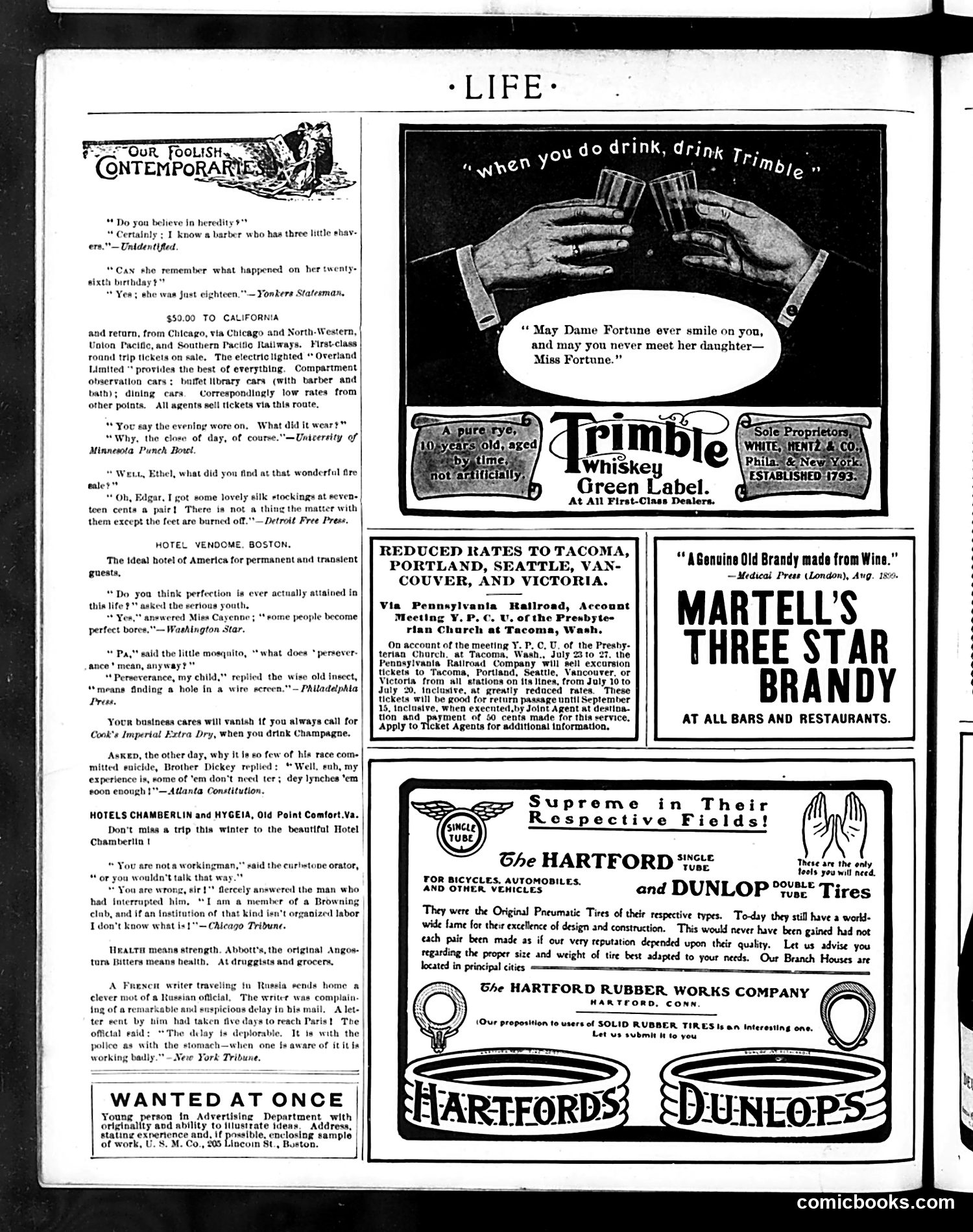
This page is primarily **advertising and humor snippets**, not political cartoons. The content consists of: **Humor Section ("Our Foolish Contemporaries"):** Brief jokes mocking various targets—a barber with three sons (heredity joke), a woman buying burned stockings cheaply, a mosquito's persistence, and racial violence (a dark joke about lynching in the Atlanta Constitution excerpt). **Advertisements:** The dominant content features liquor ads (Trimble Whiskey, Martell's Brandy), Hartford and Dunlop tires, and railroad/hotel promotions. The Trimble ad depicts two hands toasting with text encouraging drinking. **Social Commentary:** The scattered jokes reflect period attitudes—casual racism, gender stereotypes, and working-class mockery. The lynching reference reveals how casually violent racism appeared in mainstream publications. No identifiable political figures or caricatures are present. This is representative early-1900s American magazine content: commercial advertising mixed with genteel satire targeting everyday foibles.
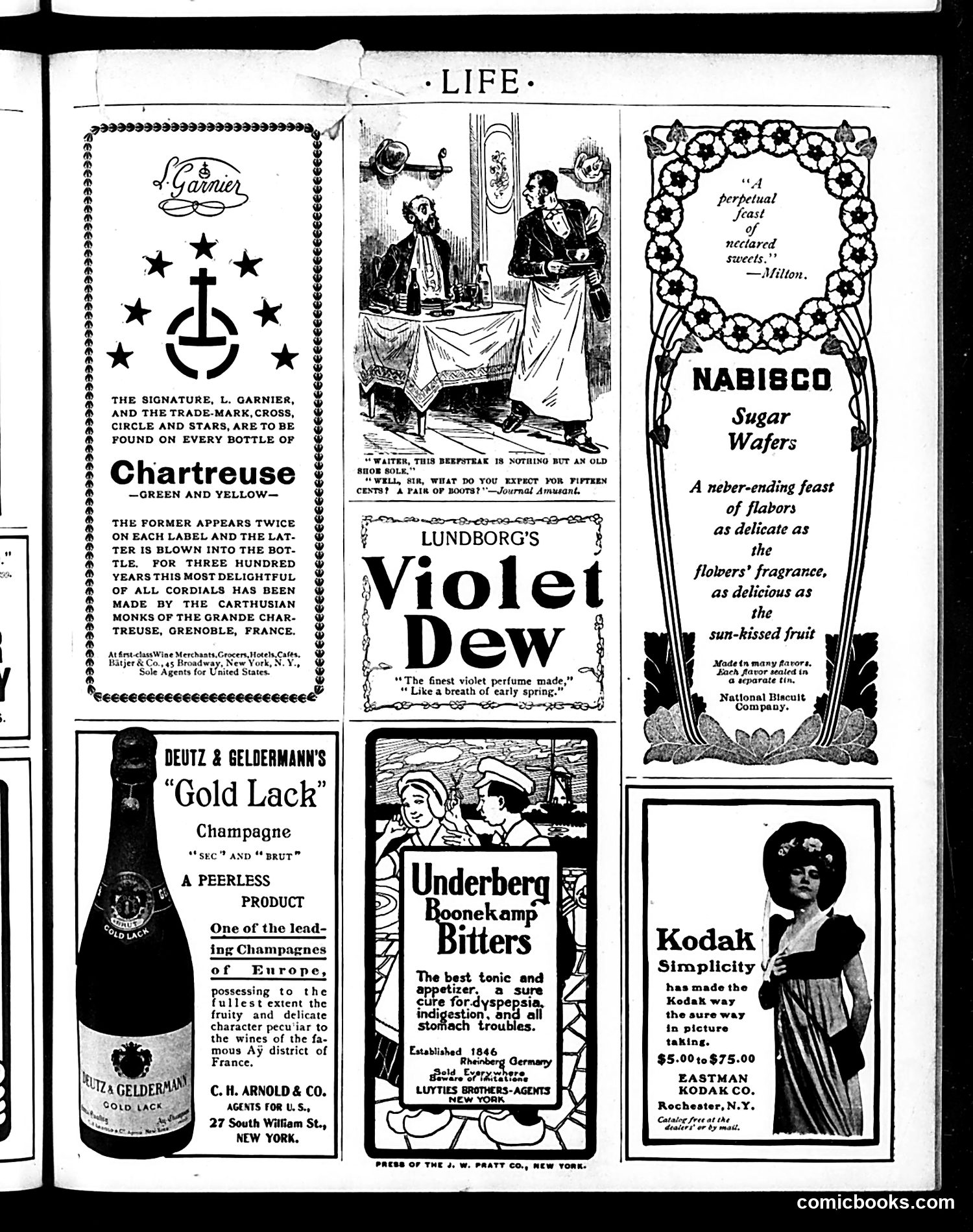
This is primarily a **advertisements page**, not editorial content. It showcases luxury goods and patent medicines popular in the early 20th century. The central cartoon (credited to *Journal Amusant*) is a mild joke about restaurant value: a diner complains his beefsteak is actually old shoe sole, and the waiter sarcastically responds that for fifteen cents, what does he expect—boots? The surrounding ads promote: - **Chartreuse liqueur** (made by Carthusian monks for 300 years) - **Violet Dew perfume** (Lundborg brand) - **Gold Lack champagne** (Deutz & Geldermann) - **Underberg Boonekamp Bitters** (a digestive/medicinal tonic) - **Nabisco Sugar Wafers** - **Kodak cameras** ($5–$75) The advertisements reflect turn-of-the-century consumer culture emphasizing imported European luxury goods and early photographic technology. The patent medicine (Underberg) was typical of an era before FDA regulation, when such products made unsubstantiated health claims.
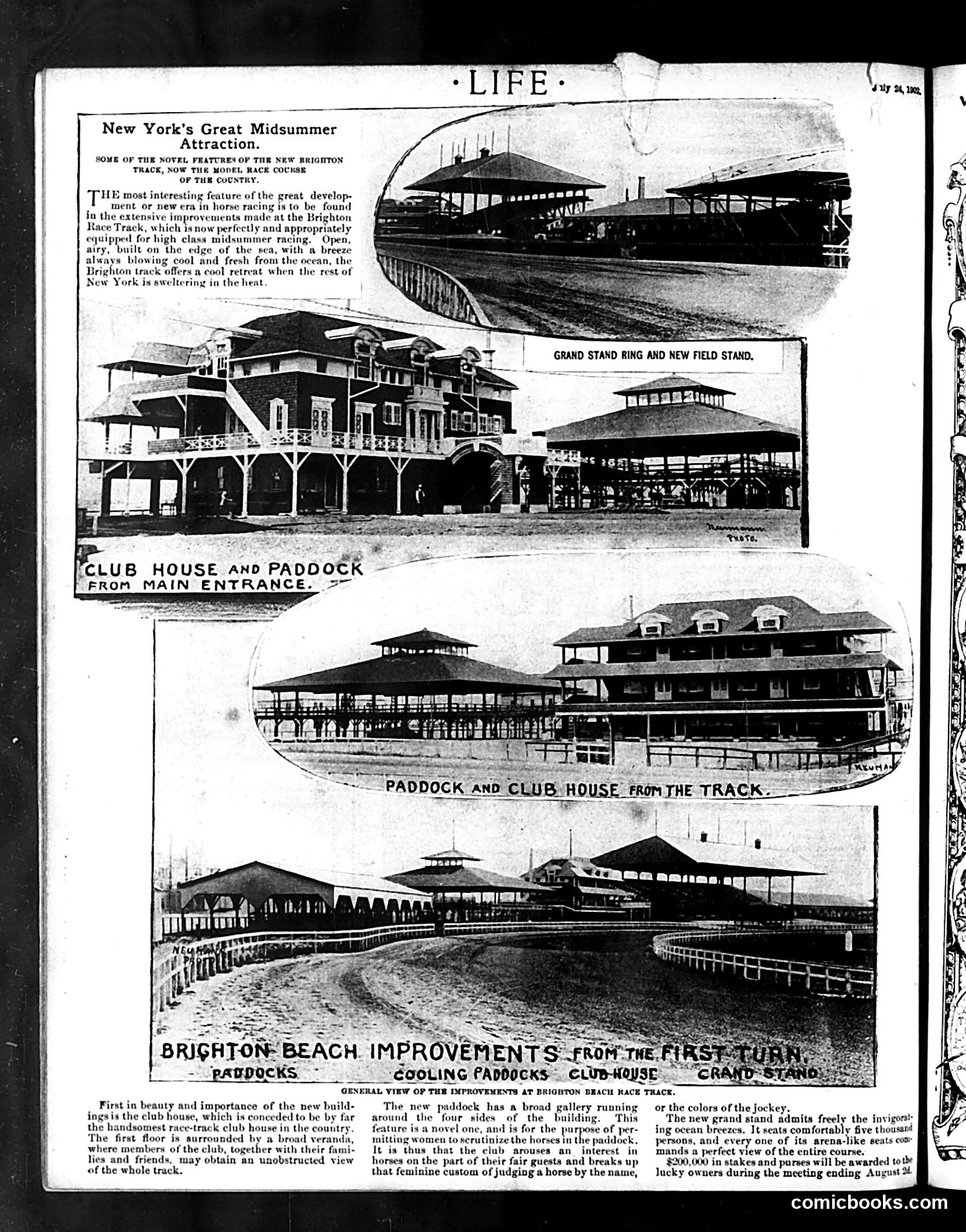
This is not political satire but rather promotional journalism disguised as news. The page presents architectural drawings and photographs of the newly renovated Brighton Beach Race Track in New York, highlighting its facilities as "the model race course of the country." The article emphasizes amenities designed to attract wealthy patrons during summer: ocean breezes for cooling, an elegant club house with veranda views, and notably, a novel paddock gallery "for the purpose of permitting women to scrutinize the horses." This detail reveals the article's social angle—it's promoting the track as a fashionable destination where respectable women could participate in horse racing culture, breaking from "that feminine custom of judging a horse by the name, or the colors of the jockey." The substantial prize purses ($200,000) underscore the track's prestige and importance to New York's racing establishment.