
Life, 1902-07-24 · page 8 of 20
Life — July 24, 1902 — page 8: what you’re looking at
What you’re looking at
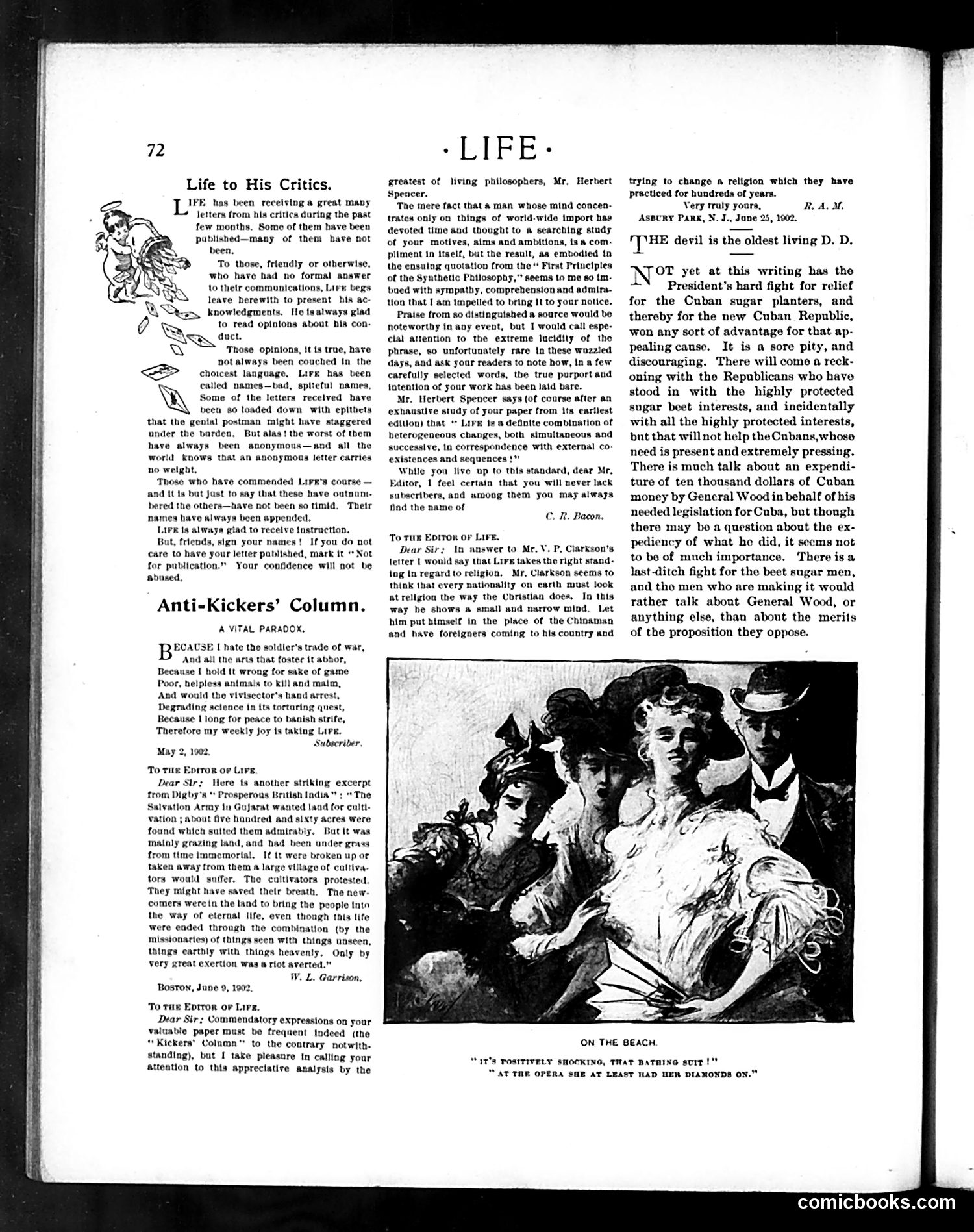
This page contains reader letters to the editor rather than political cartoons. The main illustration, titled "On the Beach," depicts fashionably dressed figures and includes a caption about "bathing suits" and "diamonds." The letters discuss Life magazine itself—its editorial standards, religious perspectives, and approach to satire. One letter criticizes the "soldier's trade of war" and Life's coverage of conflict. Another addresses Life's stance on religion, with the editor responding that Life "takes the right standing in regard to religion." There's a section titled "Anti-Kickers' Column" that sarcastically responds to critical readers. The overall page reflects Life's role as a satirical magazine engaging with readers about its editorial philosophy and social commentary, rather than presenting standalone political cartoons for analysis.
📄 Transcribed text from this page (OCR, searchable)
Machine-transcribed from the original scan — historical spelling and the odd misread are preserved.
Life to His Critics. IFE has been recetving a great many letters from bis critics during the past few months. Some of them have been published—many of them have not been. To those, friendly or otherwise, is who have had no formal answer aw to thelr communications, Lirx begs ~® leave herewith to present his ac- Awe knowledgments. He tsalways giad 0 to read opinions about his con- Raq inet Q Those opinions, it is true, have not always been couched tn the <GE> choicest language. Lire has been called names—bad, aplteful names, DW Some of the letters received have been 80 loaded down with epithets that the genial postman might have staggered under the barden, But alas! the worst of them have always been anonymons—and all the world knows that an anonymons letter carries no weight, Those who have commended LirR’s course — and It 1s but Just to say that these have outnam- hered the others—have not been so timid. Thetr names bave always been appended, Live Is always giad to recelve tastractton. Bat, friends, sign your names! If you do not care to have your letter pablished, mark it ** Not for publication.” Your confidence will not be abused. Anti-Kickers’ Column. A VITAL PARADOX, ECAUSE I hate the soldier's trade of war, And ail the arts that foster {t abhor, Becauso { hold tt wrong for sake of game Poor, helpless antmais to kill and maim, And would the vivisector's hand arrest, Degrading actence In its tortaring quest, Because | long for peace to banish strife, Therefore my Weekly Joy ts taking Live. Subscriber. May 2, 1902, To Tue EprTor op Lire Dear Sir; Mere 13 another striking excerpt from Digby's “ Prosperous British India : “The Salvation Army tu Gujarat wanted land for cultl- vation ; about five hundred and sixty acres were found which suited them admirably, Bat tt was mainly grazing land, and bad been under grass from time immemorial, If {t were broken up oF taken away from them a large village of caltiva- tors would suffer. The cultivators protested. ‘They might have saved thelr breath. The new- comers were in the land to bring the people into the way of eternal iife, even though thts life were ended through the combination (by the missionartes) of things seen with things unseen, things earthly with things heavenly. Only by Very great exertion was a riot averted.” W. L. Garrison, Boston, June 9, 1902, ‘To THe Eprror oP Live. Dear Sir; Commendatory expressions on your valuable paper must be frequent indeed (the “ Kickers’ Column” to the contrary notwith- standing), but [ take pleasure tn calling your Attention to this appreciative analysis by the -LIFE: greatest of living philosophers, Mr, Herbert Spencer. ‘The mere fact that a man whose mind concen- trates only on things of world-wide tmport has devoted time and thought to a searching study of your motives, alms and ambitions, is a com- plilment tn Itself, but the result, as embodied tn the ensuing quotation from the" First Principles of the Synthetic Philosophy,” seems to me eo tm- boed with sympathy, comprehension and admina- tion that I am Impelled to bring It to your notice. Praise from so distinguished a source would be noteworthy in any event, but I would call espe- clal attention to the extreme lucidity of the phrase, so unfortunately rare in these wazzied days, and ask your readers to note how, In a few carefally selected words, the true purport and intention of your work bas been latd bare. Mr. Herbert Spencer says (of course after an exhaustive study of your paper from Its earilest edition) that * Lire 1# a definite combination of heterogeneous changes, both simultaneous and successive, in correspondence with external co- existences and sequences!" While yon live up to this standard, dear Mr. Editor, I feel certain that you will never lack subscribers, and among them you may always find the name of To Tue Eptrox or Lire. nar Sir; \n answer to Mr. V. P. Clarkson's letter | would say that Lig takes the right stand- tog in regard to religion. Mr. Clarkson seems to think that every nationality on earth must look at religion the way the Christian does, In this way he shows a small and narrow mind. Let him put himself in the place of the Chinaman have foreigners coming to his country and trying to change a religion which they bave practiced for hundreds of years. Very truly yours, Aspcny Pans, N. J., June 25, 1902, THE devil is the oldest living D. D. NOT vet at this writing has the +\ President's hard fight for relief for the Cuban sugar planters, and thereby for the new Cuban Republic, won any sort of advantage for that ap- pealing cause. It is a sore pity, and discouraging. There will come a reck- oning with the Republicans who have stood in with the highly protected sugar beet interests, and incidentally with all the highly protected interests, but that will not help the Cubans,whose need is present and extremely pressing. There is much talk about an expendi- ture of ten thousand dollars of Cuban money by General Wood in behalf of his needed legislation forCuba, but though there may be a question about the ex- pediency of what he did, it seems not to be of much importance. There is a RAM. last-ditch fight for the beet sugar men, and the men who are making it would rather talk about General Wood, or anything else, than about the merits of the proposition they oppose. ON THE BEACH. “IT'S POSITIVELY SHOCKING, THAT BATHING scIT !" ATTHE OPERA SHE AT LEAST NAD HER DIAMONDS ON.” comicbooks.com