
Life, 1902-07-24 · page 6 of 20
Life — July 24, 1902 — page 6: what you’re looking at
What you’re looking at
The main editorial content critiques Western military conduct, specifically addressing why "hot-headed" British forces in Hong Kong and Manila couldn't leave their toothbrushes behind during fleet deployments. The author sarcastically argues that people shouldn't need "autonomy" for journeys without proper toiletries, distinguishing between necessary and unnecessary "uncivilization." The piece then pivots to examining actual uncivilized behavior: the British in South Africa, where soldiers "slept in their uniforms" and engaged in "subtle uncivilization," and Europeans in the Philippines, where colonial occupation itself was largely "affected." The satire suggests that British imperialism's claim to civilization rings hollow given their actual conduct—the irony being that supposedly civilized powers behave unethically in colonial contexts.
📄 Transcribed text from this page (OCR, searchable)
Machine-transcribed from the original scan — historical spelling and the odd misread are preserved.
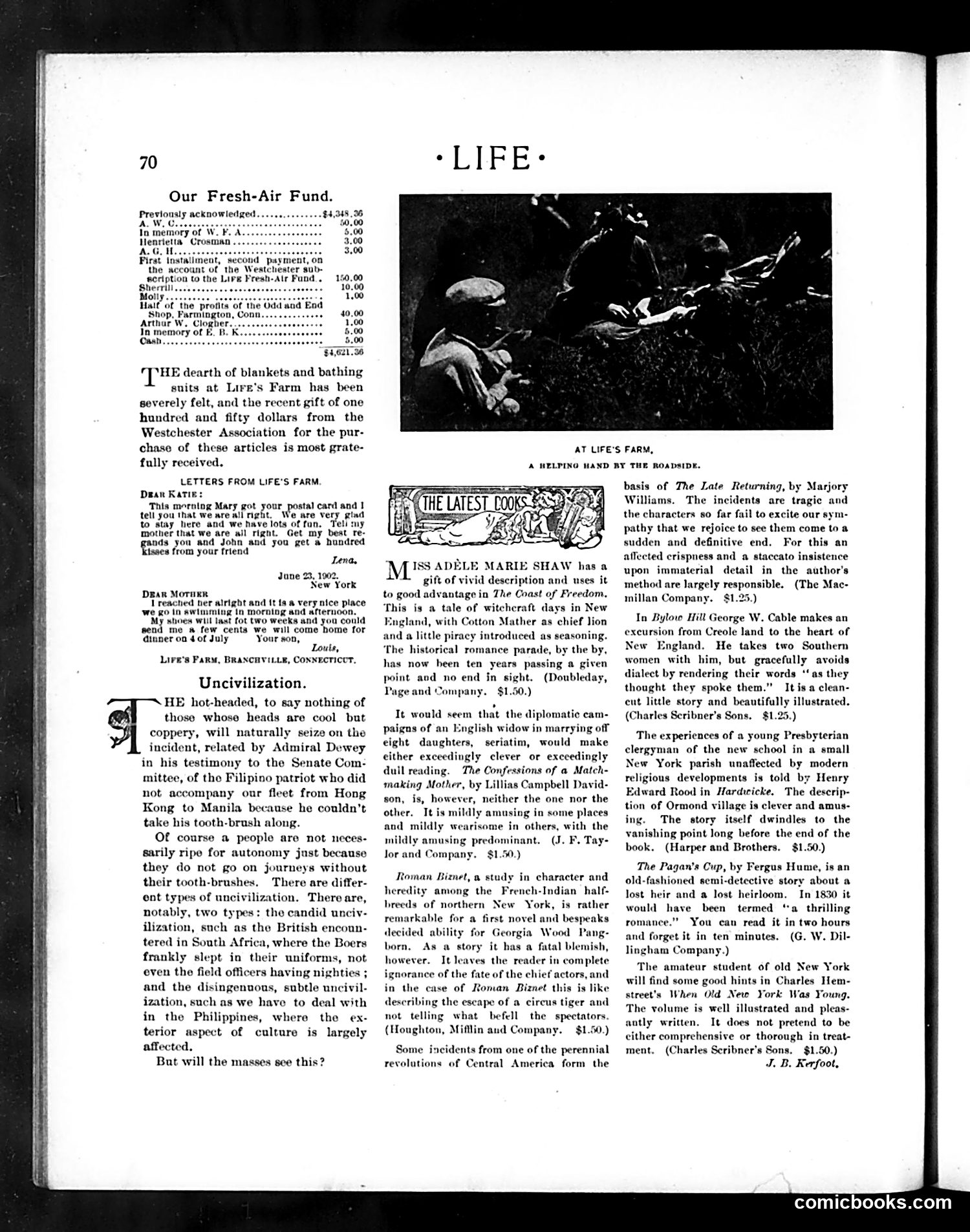
70 Our Fresh-Air Fund. Previously acknowledged 4 A.W, In memory of W. F Henrietta’ Crosman. AGL Firat instalimeot, second payment, on the account of the Westchester sub- scription to the Lire Fresh-alr Fund. Sherri Molly : Half of the profits’ of the Odd wad End Shop, Farmington, Conn. Arthur W, Cloghe: In memory of E. B. geet? B8sse eS 38 S888 8ss $4, ‘THE dearth of blankets and bathing suits at Lire’s Farm has been severely felt, and the recent gift of one hundred and fifty dollars from the Westchester Association for the pur- chase of these articles is most grate- fully received. LETTERS FROM LIFE’S FARM. Dean Katie: Thls morning Mary got your postal card and 1 tell you that we are all right. We are very giad to stay here and we have lots of fun. Teli my mother that we are ail right. Get my best re- nds you and John and you get a hundred tases from your friend Lena, Jane 2, 1902. New York Daan Morne I reached her alright and {t {sa very nice place we go in swimming in morning and afternoon, My shoes wiil last fot two Weeks and yon could send me # few cents we will come home for GinnerondofJuly Your son, Live's Pars, BRANCHVILL Uncivilization. HE hot-headed, to say nothing of those whose heads are cool but coppery, will naturally seize on the incident, related by Admiral Dewey in his testimony to the Senate Com- mittee, of the Filipino patriot who did not accompany our fleet from Hong Kong to Manila because he couldn't take his tooth-brash along. Of course a people are not neces- sarily ripe for autonomy just because they do not go on journeys without their tooth-brushes, There are differ- ent types of uncivilization. There are, notably, two types: the candid unciv- ilization, such as the British encoun- tered in South Africa, where the Boers frankly slept in their uniforms, not even the field officers having nighties ; and the disingenuous, subtle uncivil- ization, such as we have to deal with in the Philippines, where the ex- terior aspect of culture is largely affected. But will the masses see this? AT LIFE’S FARM, A HELPING MAND BY THE ROADSIDE. age LATEST ISS ADELE MARIE SHAW has a i gift of vivid description and uses it to good advantage in The Coast of Freedom, This is a tale of witchcraft days in New England, with Cotton Mather as chief lion and a little piracy introduced as seasoning. ‘The historical romance parade, by the by, has now been ten years passing a given point aod no end in sight. (Doubleday, Page and Company. $1.50.) It would seem that the diplomatic cam- paigns of an English widow in marrying off eight daughters, seriatim, would make cither exceedingly clever or exccedingly dull reading. The Confessions of « Match- making Mother, by Lillias Campbell David- son, is, however, neither the one nor the other. Tt is mildly amusing in some places and mildly wearisome in others, with the mildly amusing predominant. (J. F. Tay- Jor and Company, $1.50.) Roman Biznet, a study in character and heredity among the French-Indian half- Ireeds of northern New York, is rather remarkable for a first novel and bespeaks decided ability for Georgia Wood Pang- born, As a story it has a fatal blemish, however. It leaves the reader in complete ignorance of the fate of the chief actors, and in the case of Roman Biznet this is like describing the escape of a circus tiger and not telling what befell the spectators. (Houghton, Miflin aud Company. $1.50.) Some incidents from one of the perennial revolutions of Central America form the basis of The Late Returning, by Marjory Williams. The incidents are tragic and the characters 8o far fail to excite our sym- pathy that we rejoice to see them come to a sudden and definitive end. For this an affected crispness and a staccato insistence upon immaterial detail in the author's method are largely responsible. (The Mac- millan Company. $1.25.) In Bylow Hilt George W. Cable makes an excursion from Creole land to the heart of New England. He takes two Southern women with him, but gracefully avoids dialect by rendering their words “as they thought they spoke them.” It is a clean- cut little story and beautifully illustrated. (Charles Scribner’s Sons. $1.25.) The experiences of a young Presbyterian clergyman of the new school in a small New York parish unaffected by modern religious developments is told by Henry Edward Rood in Hardiicke. The deserip- tion of Ormond village is clever and amus- ing. The story itself dwindles to the vanishing point long before the end of the book. (Harper and Brothers. $1.50.) The Pagan’s Cup, by Fergus Hume, is an old-fashioned semi-detective story about a lost heir and a lost heirloom. In 1830 it would been termed ‘a thrilling You can read it in two hours and forget it in ten minutes. (G. W. Dil- lingham Company.) have romance.” The amateur student of old New York will find some good hints in Charles Hem- street's When Old New York Was Young. The volume is well illustrated and pleas- antly written. It does not pretend to be cither comprehensive or thorough in treat- ment. (Charles Scribner's Sons. $1.50.) J.B. Kerfoot, comicbooks.com