
A complete issue · 20 pages · 1902
Life — June 19, 1902
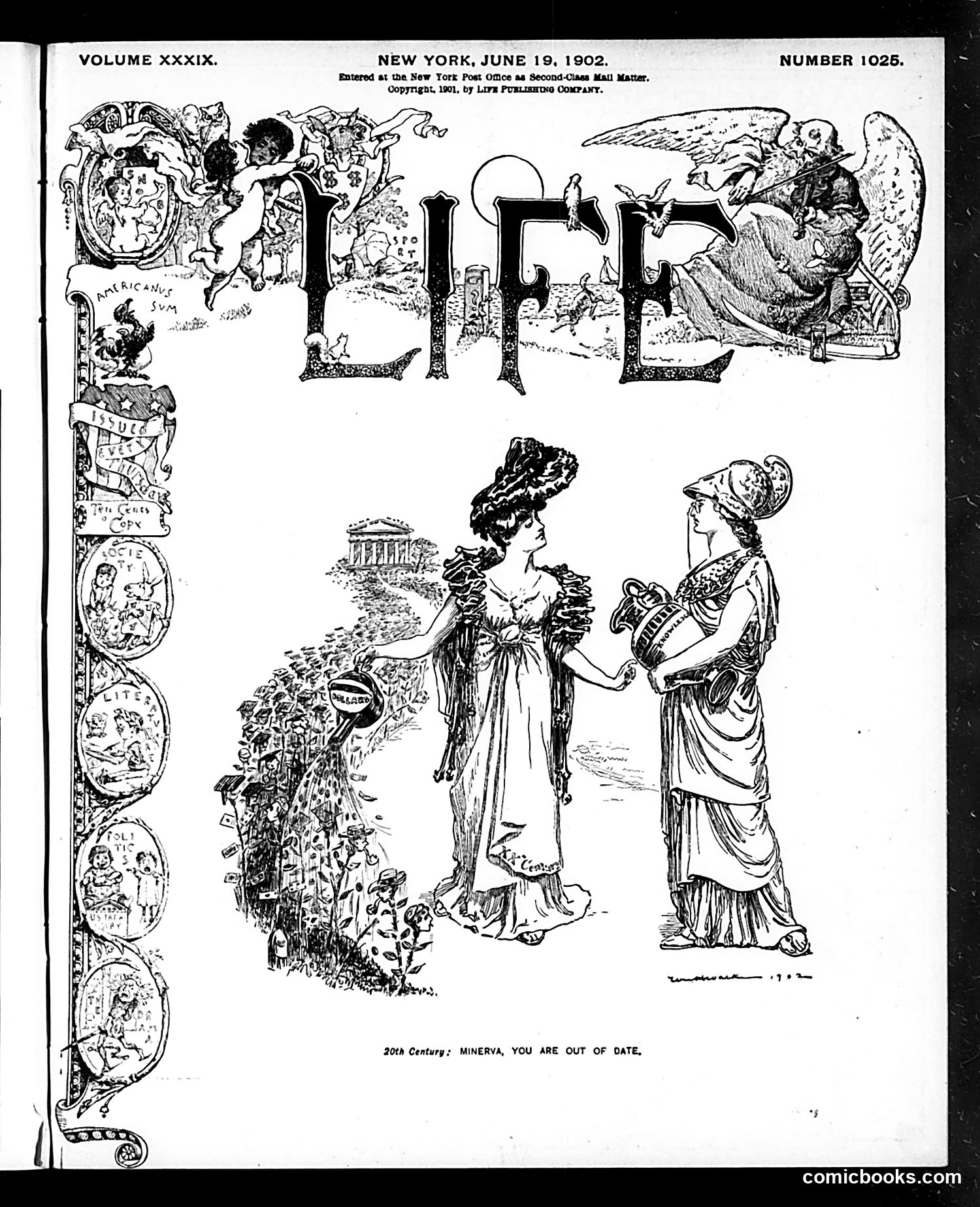
The main cartoon shows two classical female figures—one representing Minerva (Roman goddess of wisdom) and another figure in classical dress—exchanging what appears to be a heart or decorative object. The caption reads: "20th Century: MINERVA, YOU ARE OUT OF DATE." This is a satire on the decline of classical wisdom and traditional values in the modern age. Minerva, symbol of learning and reason, is being told she's obsolete—suggesting that early 20th-century society is moving away from classical education and traditional intellectual values. The ornamental left border contains classical medallions, reinforcing the contrast between ancient wisdom and contemporary dismissal of it. The satire critiques modernism's rejection of classical culture.
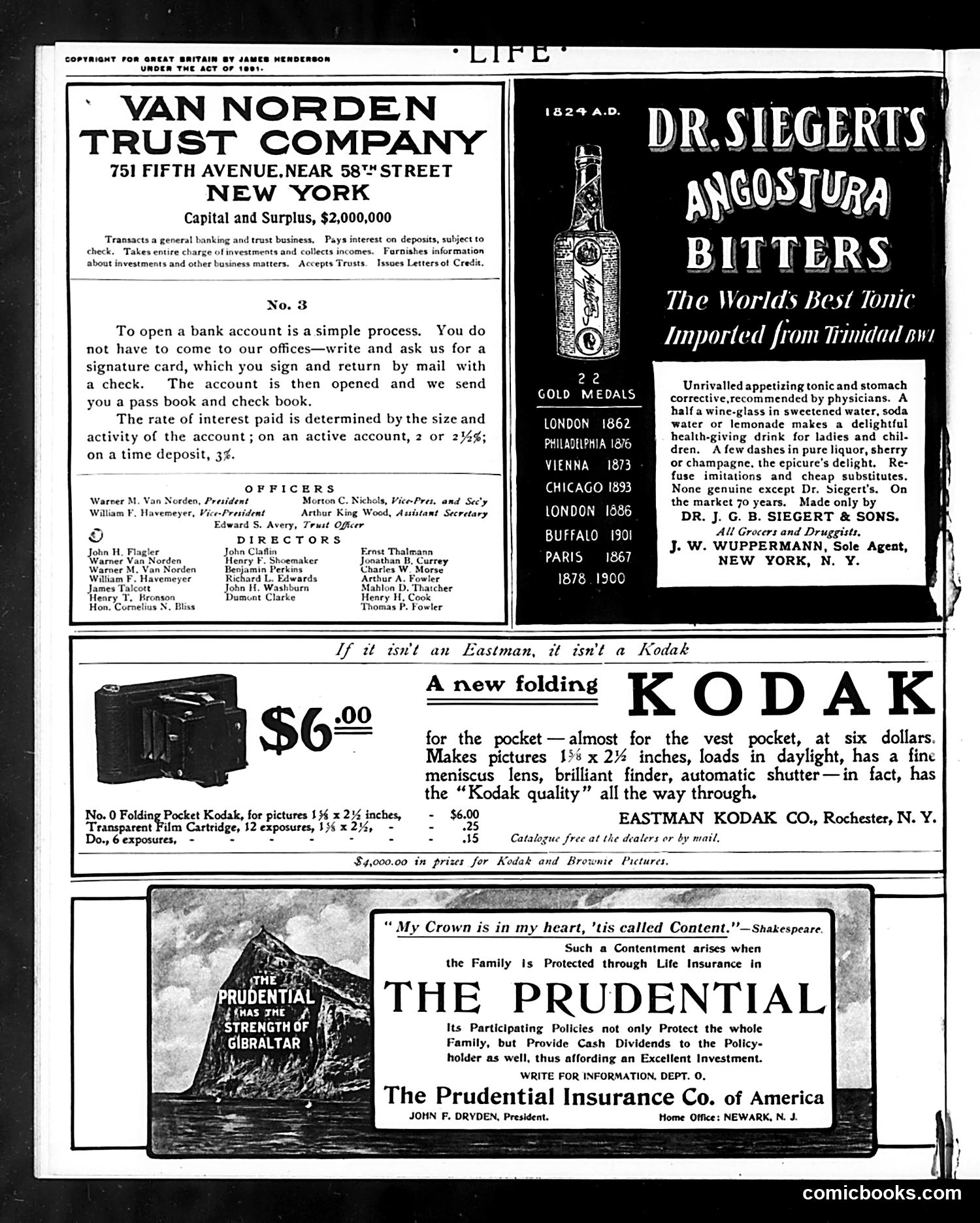
This page is primarily **advertising**, not satirical content. It contains four distinct ads: 1. **Van Norden Trust Company** (top left) — banking services advertisement 2. **Dr. Siegert's Angostura Bitters** (top right) — a medicinal tonic from Trinidad, promoted with gold medal awards dating to 1862 3. **Kodak folding camera** (center) — a $6 pocket camera advertisement, playing on the slogan "If it isn't an Eastman, it isn't a Kodak" 4. **Prudential Insurance** (bottom) — life insurance ad featuring the Rock of Gibraltar logo, quoting Shakespeare There is **no political cartoon or satire** on this page. It represents typical early 20th-century magazine advertising for financial services, patent medicines, consumer goods, and insurance products.
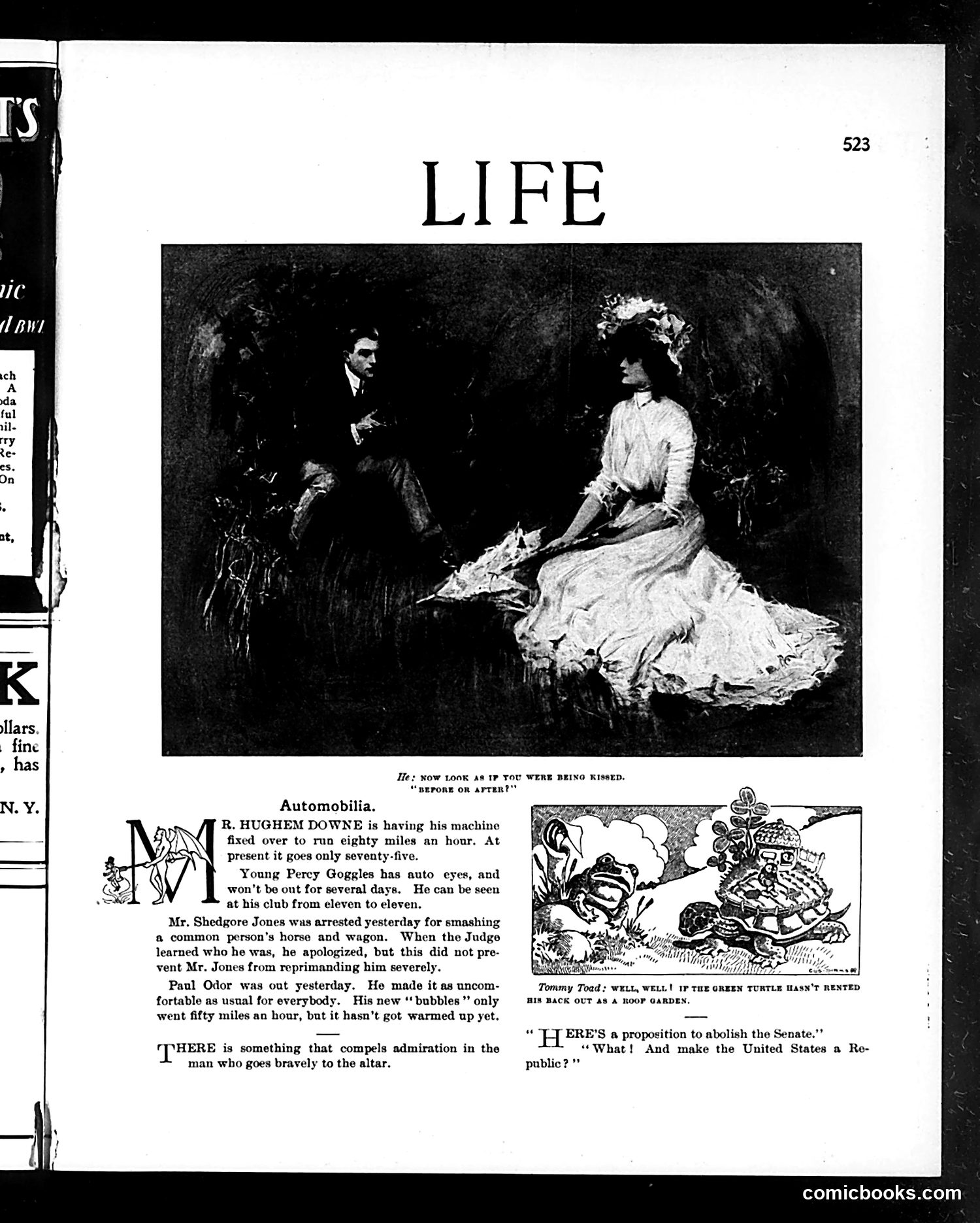
The main illustration depicts a romantic scene with the caption "He: now look as if you were being kissed. 'Before or after?'" This is a visual joke about photography—the man instructs the woman to look kissed, and she responds by asking whether he means her expression before or after being kissed, implying she's uncertain which look is more flattering or authentic. The "Automobilia" section contains brief satirical notes about early motorcar culture: mentions of high-speed machines, auto-enthusiasts like "Young Percy Goggles," and Paul Odor's uncomfortable "bubbles" car. The humor targets the nascent automobile craze and its eccentric devotees. The final quote about "something that compels admiration in the man who goes bravely to the altar" is a cynical jest about marriage.
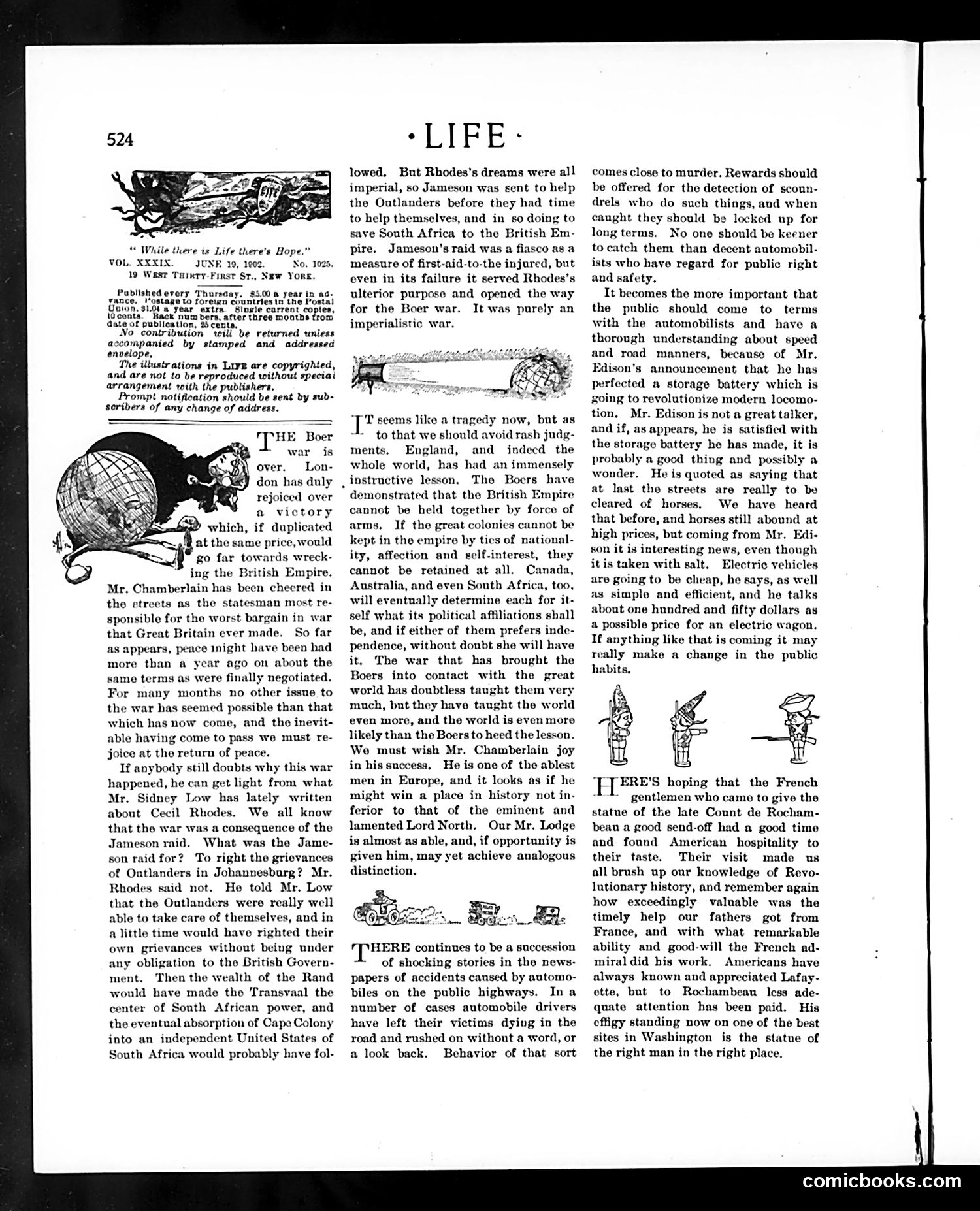
This page from Life (June 19, 1902) contains editorial commentary on the recently concluded Boer War, particularly criticizing British Colonial Secretary Joseph Chamberlain's role in the conflict. The text argues that Chamberlain bears responsibility for "the worst bargain in war that Great Britain ever made." It suggests the Boers demonstrated that colonies cannot be held by military force alone, and predicts this lesson will lead colonial territories toward independence. The small cartoon figures at the bottom appear to be illustrative vignettes rather than specific caricatures, likely depicting soldiers or colonial subjects. The editorial advocates for understanding between Britain and its colonies through mutual interest rather than force—a progressive position for 1902, foreshadowing 20th-century decolonization debates.
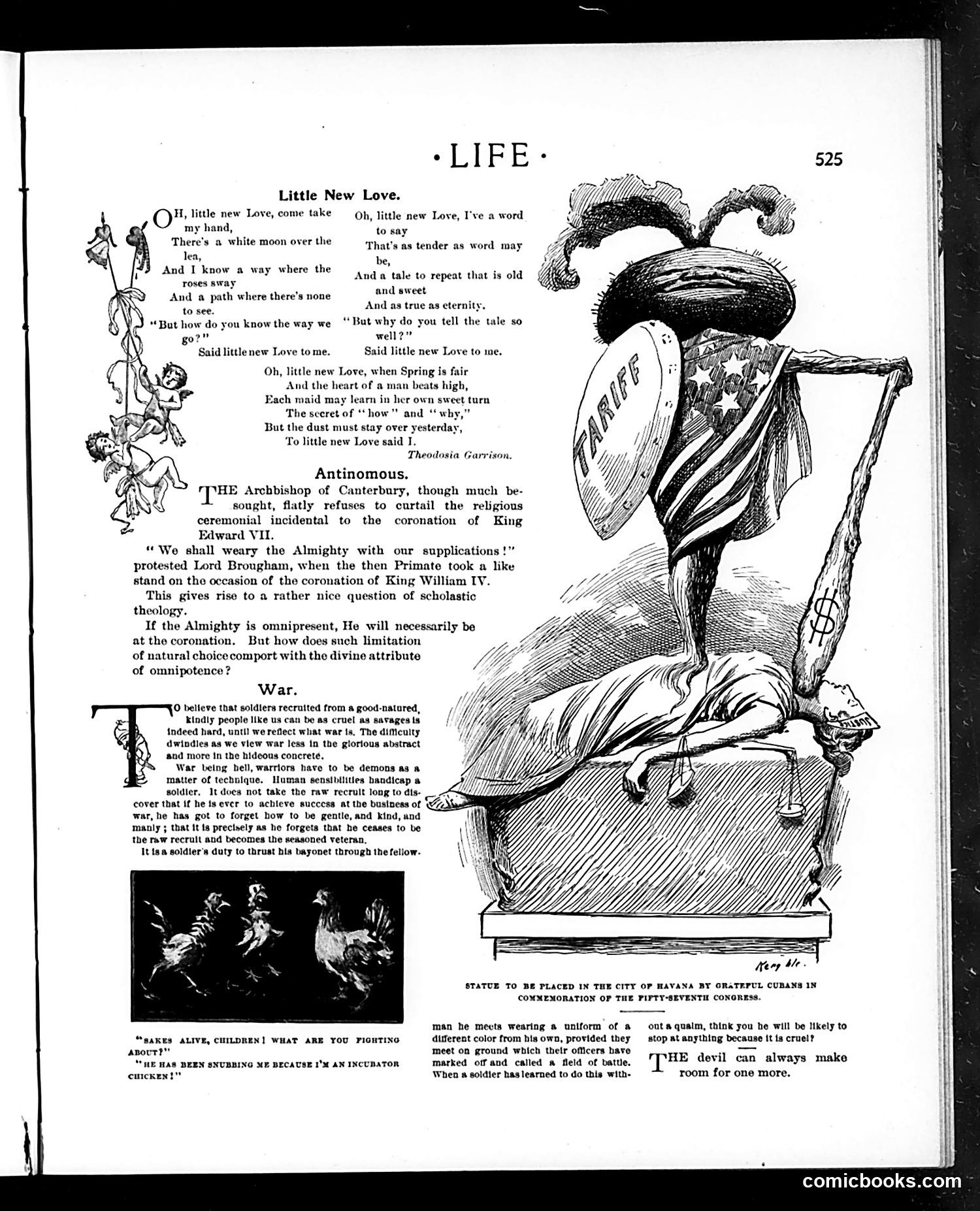
The main illustration depicts a statue intended for Havana, Cuba, commemorating the 57th Congress. The caricatured figure appears to be a political leader (likely American) in an exaggerated, unflattering pose suggesting hubris or imperialism. The "War" section critiques military recruitment and the transformation of civilians into soldiers. It argues that raw recruits must suppress their natural gentleness to become effective warriors—a commentary on the moral cost of militarization. The "Antinomous" piece satirizes religious hypocrisy, specifically the Archbishop of Canterbury's objections to ceremonial elements at King Edward VII's coronation, questioning theological consistency about divine omnipotence. The page exemplifies *Life* magazine's satirical approach to turn-of-century American imperialism, militarism, and institutional contradictions through both visual caricature and philosophical argument.
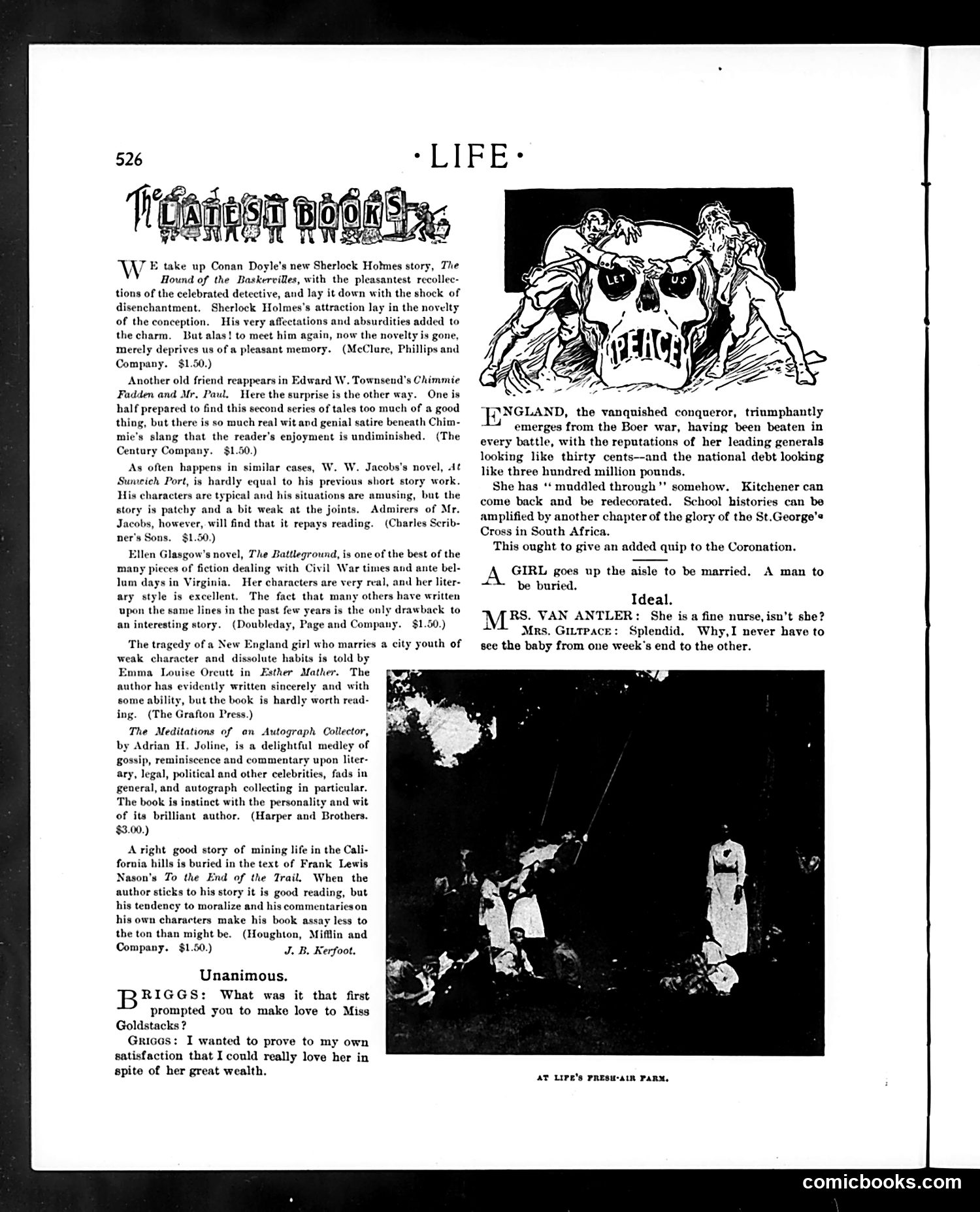
This page primarily contains **book reviews** rather than political cartoons. The main illustrated element shows a skull with two figures flanking it, labeled "At Life's Fresh-Air Farm." The skull imagery appears to be **satirical commentary on the Boer War** (referenced in the text above the illustration). The accompanying text discusses England emerging from the conflict "beaten in every battle" with damaged reputation and massive national debt of "three hundred million pounds." The "Fresh-Air Farm" caption suggests the skull represents the consequences of war itself—likely mocking the conflict's devastating human and financial costs to Britain. The figures around it appear to personify aspects of post-war recovery or national hardship. The page's primary purpose is literary criticism, with the war reference serving as dark political satire typical of Life's editorial approach.
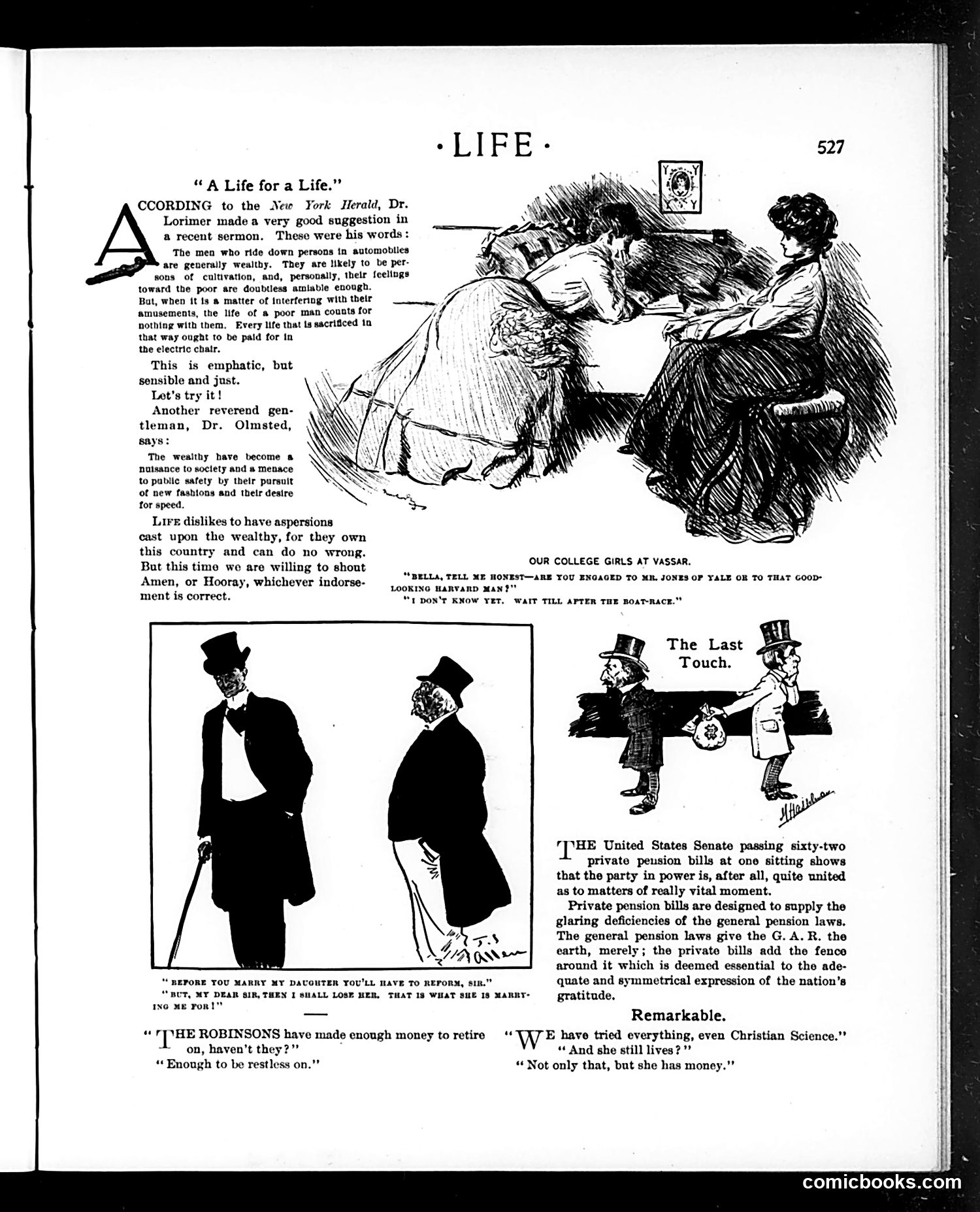
This page satirizes wealth and social responsibility. The opening article, citing Dr. Lorimer and Dr. Olmsted, debates whether wealthy people have moral obligations to the poor. The text argues the wealthy have "become a nuisance to society" through frivolous pursuits like fashion and speed. The upper sketch shows college girls at Vassar discussing eligible Harvard men—satirizing wealthy young women's superficial concerns. "The Last Touch" cartoon depicts the U.S. Senate passing private pension bills, suggesting the government rewards political allies with special benefits. The final joke about the Robinsons—"made enough money to retire...enough to be restless on"—mocks wealthy idleness and boredom, implying that money alone cannot buy meaningful purpose or contentment.
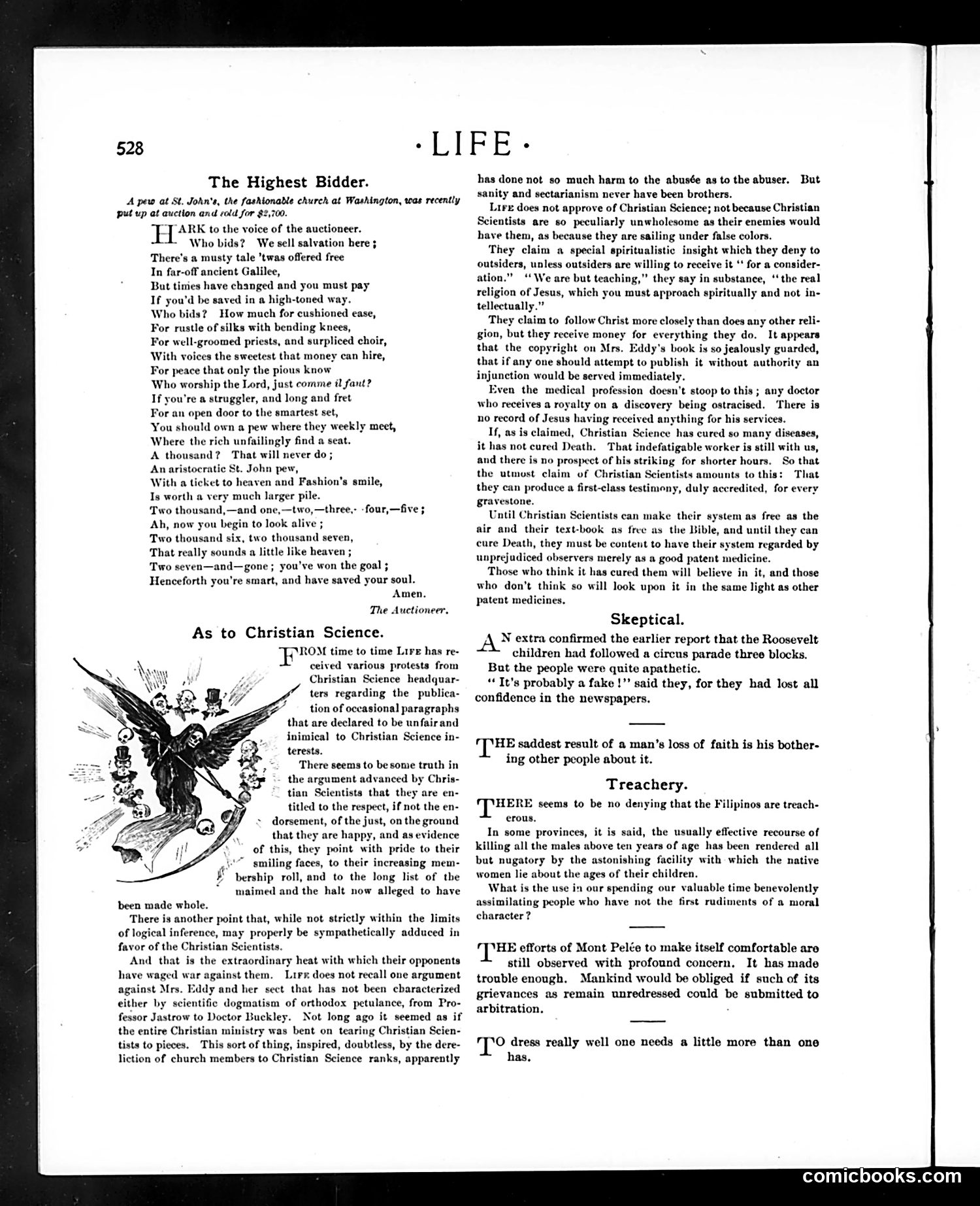
This page contains three satirical sections critiquing Christian Science and related topics. The central cartoon depicts a winged figure surrounded by various symbols, illustrating criticism of Christian Science's claims and practices. The accompanying text "As to Christian Science" argues that Christian Science practitioners are unfairly attacking their critics while claiming exemption from scrutiny—a charge the author finds hypocritical. Other sections mock "Treachery" in the Philippines (likely referencing colonial-era atrocities) and criticize Mont Pelée's volcanic disasters as divine punishment. The opening poem "The Highest Bidder" satirizes church auctions where parishioners bid for prominent seating—mocking materialism disguised as piety. The overall theme targets hypocrisy: institutions claiming moral authority while engaging in questionable practices.
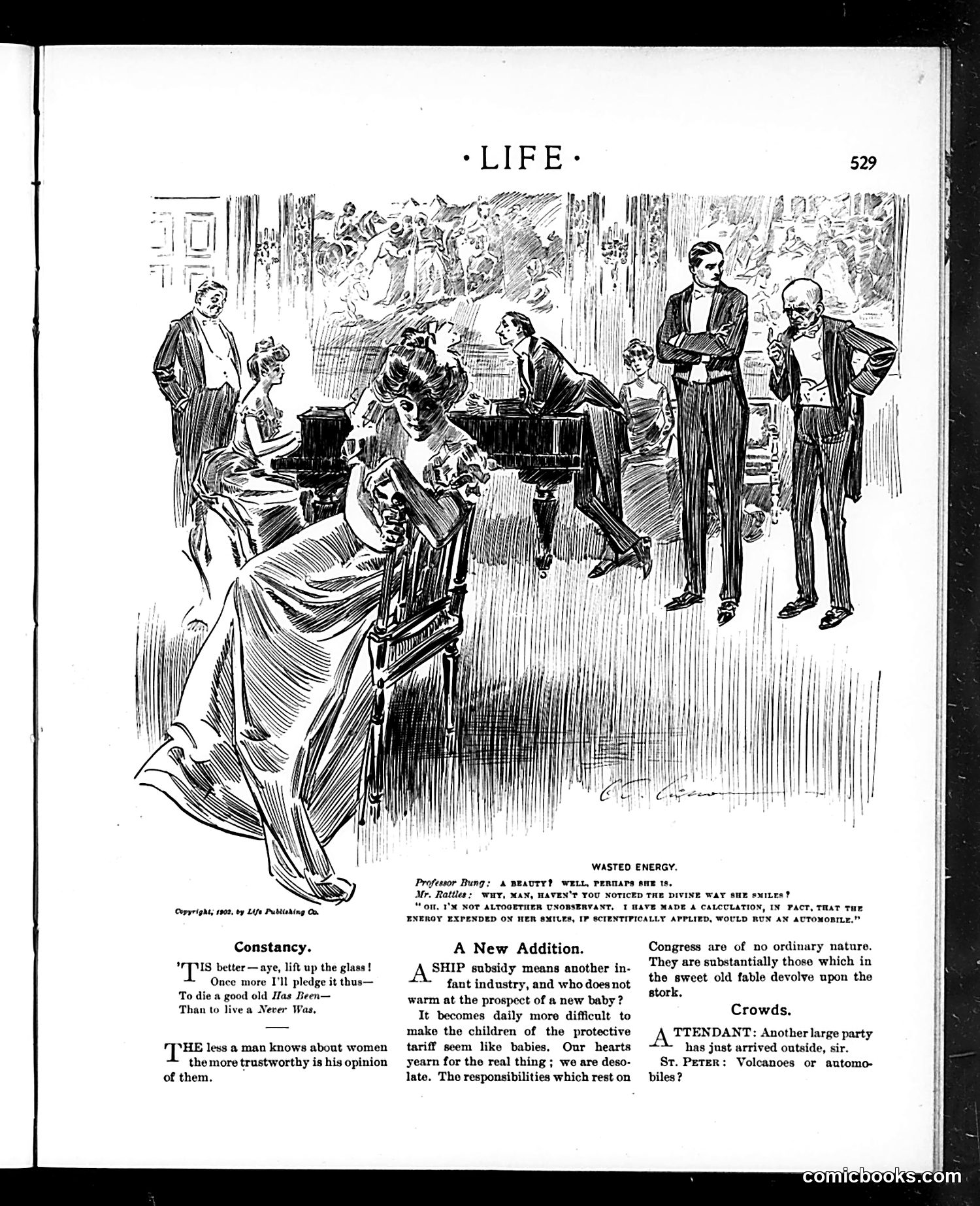
This is a satirical page from *Life* magazine (page 529) featuring social commentary rather than political cartooning. The main illustration titled "Wasted Energy" depicts a formal social gathering where a professor addresses a woman about beauty and scientific principles. The satire mocks pseudo-intellectual mansplaining: the professor pedantically explains that beauty would be "scientifically applied" to women's smiles, while the woman appears unimpressed by his condescension. Below are three brief humor pieces: "Constancy" jokes about pledging never to drink again, "A New Addition" comments on the difficulty of naming children in a protective tariff economy, and "Crowds" references volcanos or automobiles. The overall tone ridicules pretentious male intellectualism attempting to "improve" women through science and logic.
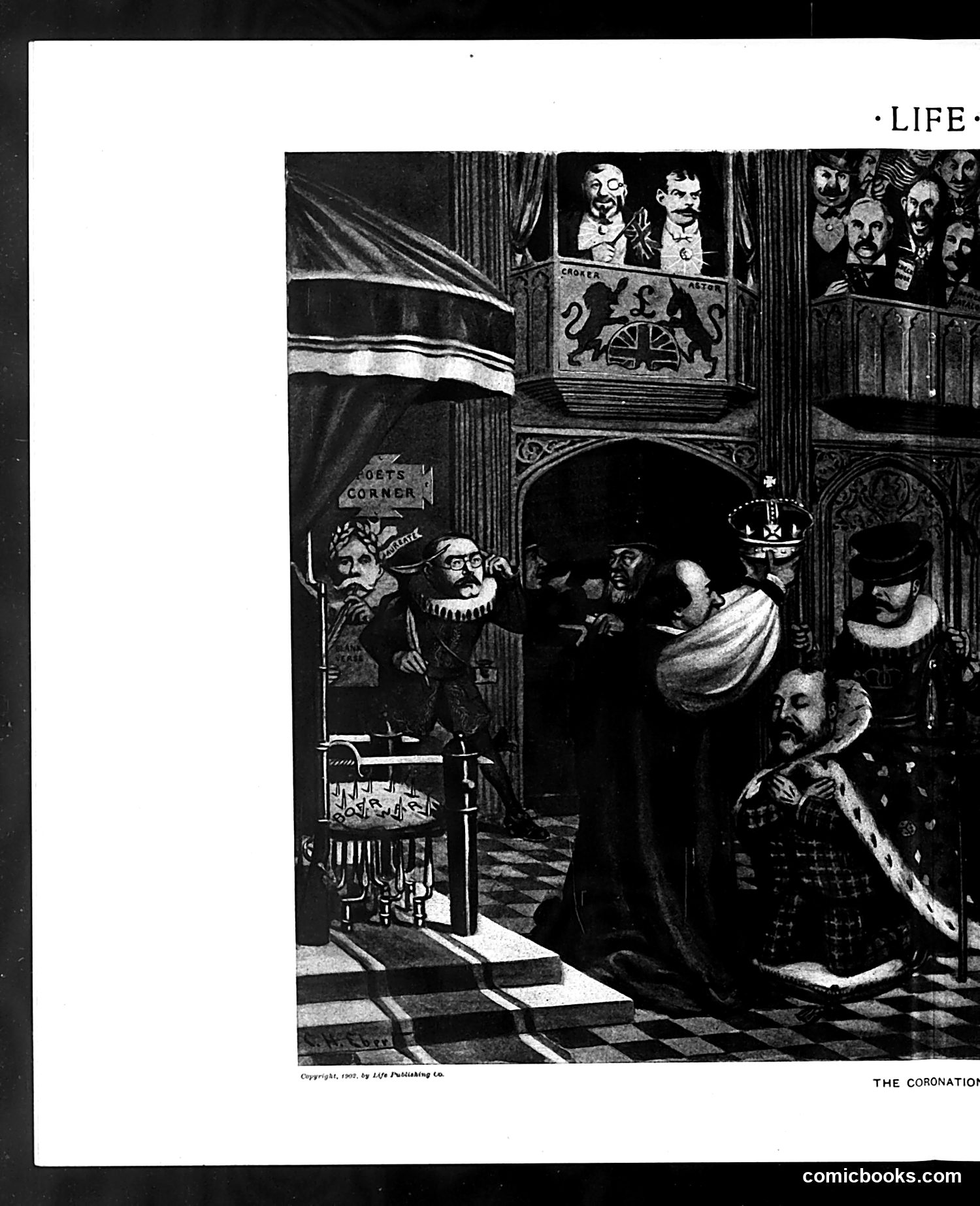
This satirical cartoon depicts a formal coronation ceremony set in a grand hall with checkered flooring and ornate architecture. Multiple figures wearing crowns and royal regalia are present, suggesting a commentary on political leadership or power transfer. The scene appears to mock formal government proceedings or the elevation of political figures to positions of authority. The gathering of multiple crowned figures—some observing from balconies above—suggests satire about competing claims to power or the ritualistic nature of political succession. Without visible date or caption text in the image itself, the specific political figures or historical event referenced remain unclear. However, the elaborate staging and multiple authority figures suggest this critiques the pageantry and complexity of governmental power structures during the magazine's publication period.
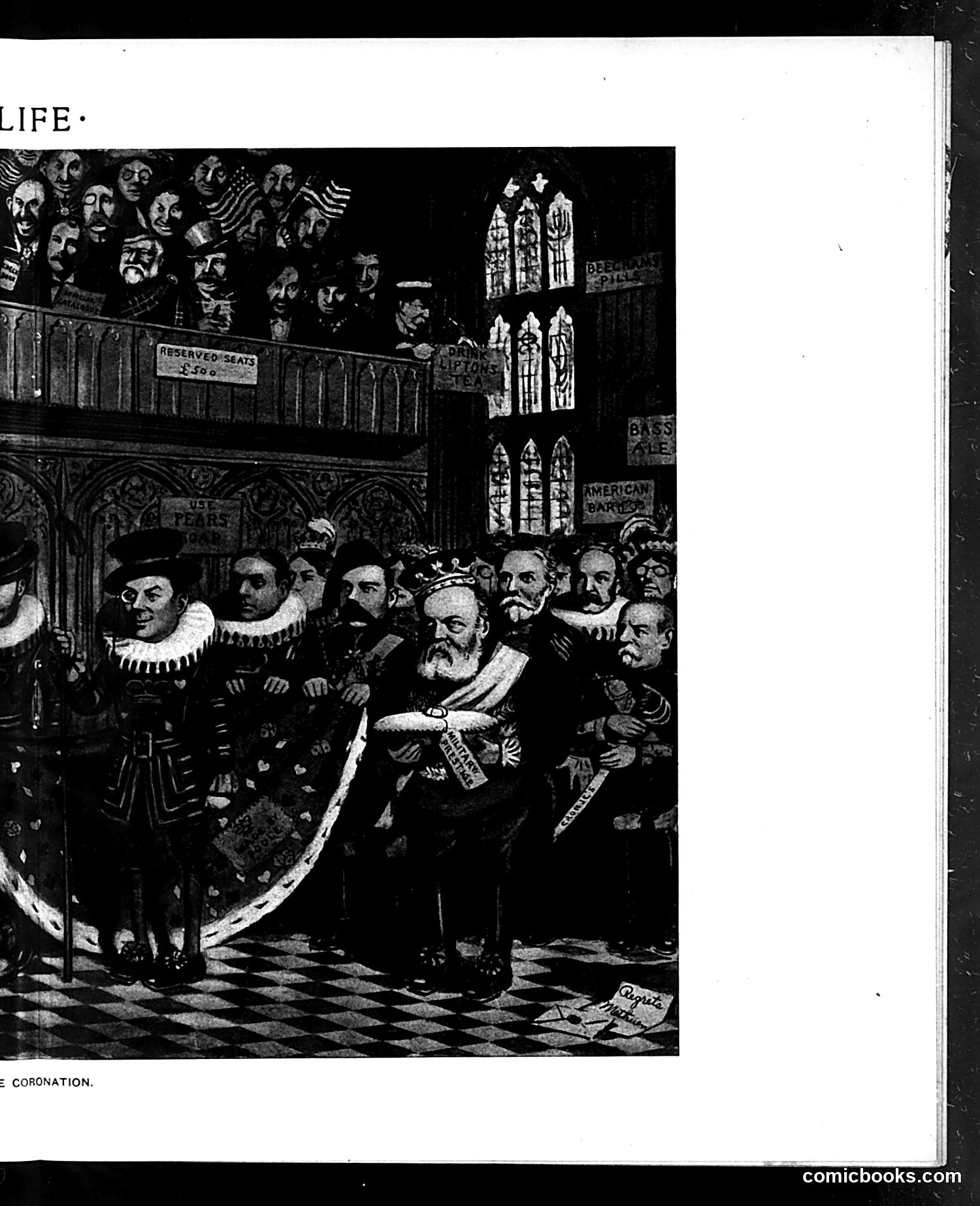
This appears to be a satirical coronation scene set in a church, depicting what looks like a royal or ceremonial investiture. The central figure wears a crown and formal regalia, surrounded by courtiers and officials in period dress with elaborate ruffs and decorative clothing. The visible signage includes "RESERVED SEATS" and references to "BASS," "AMERICAN BEER," and other commercial establishments—suggesting this satirizes the commercialization of what should be a sacred or solemn ceremonial event. The juxtaposition of high ceremonial pageantry with crass commercial advertising appears to mock either the degradation of traditional institutions through commercialism or the spectacle-driven nature of public events. Without more context about *Life* magazine's date or specific political moment, the exact target remains unclear, though it likely critiques American culture's commodification.
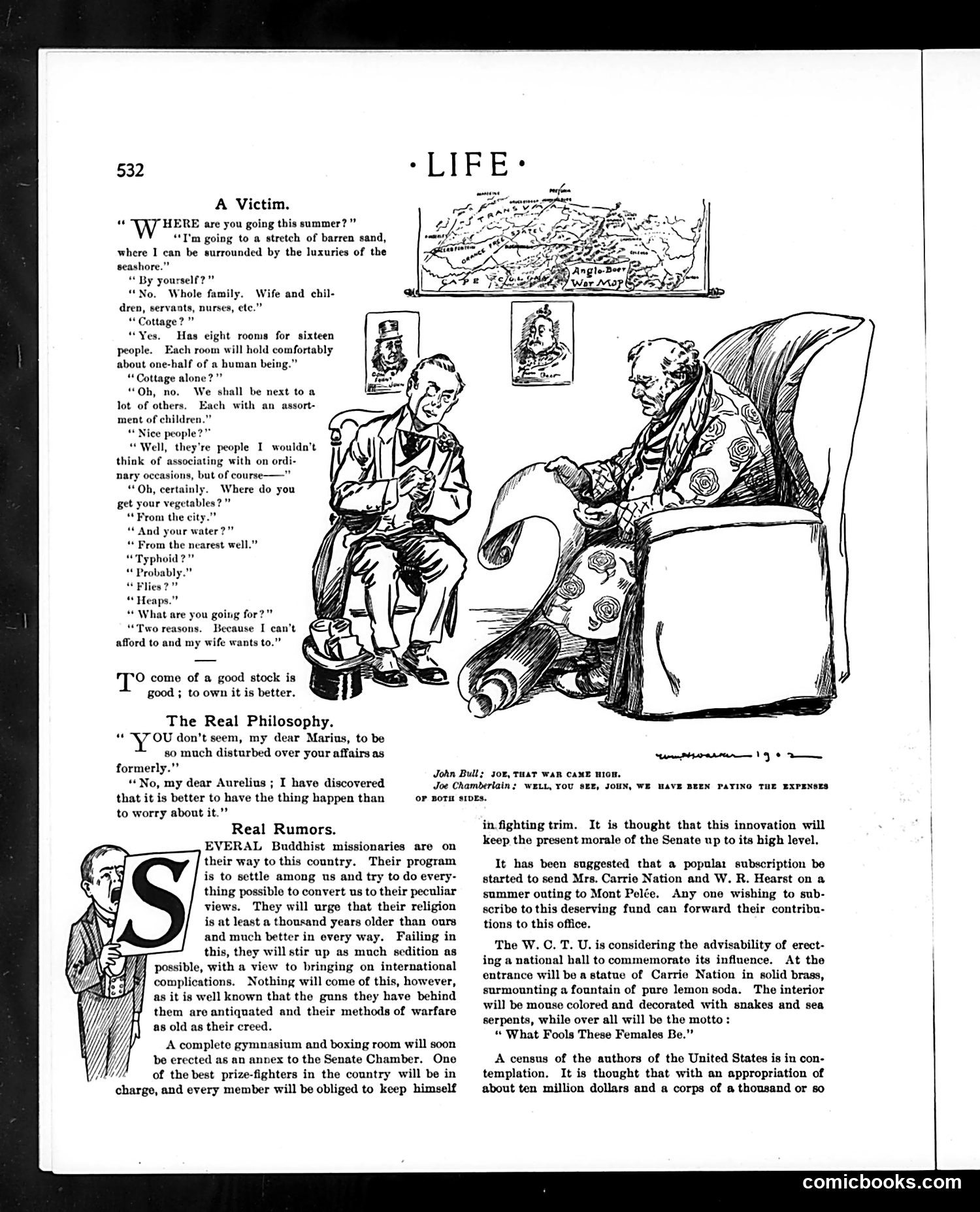
**"A Victim"** (top cartoon): A working-class man complains to someone about his summer plans—he can't afford luxuries, only basic necessities like vegetables and water. He sarcastically responds "I can't afford to" when asked what he's doing. This satirizes the economic struggles of ordinary people unable to afford leisure activities. **"The Real Philosophy"** (middle section): Two men discuss philosophy, suggesting that understanding life's realities is more practical than abstract philosophy. **"Real Rumors"** (lower section): Text discusses Buddhist missionaries, Senate improvements including a gymnasium/boxing room, and mentions of women's organizations and a census of U.S. authors. The page combines social commentary on class economics with institutional gossip and news items typical of Life's satirical format.
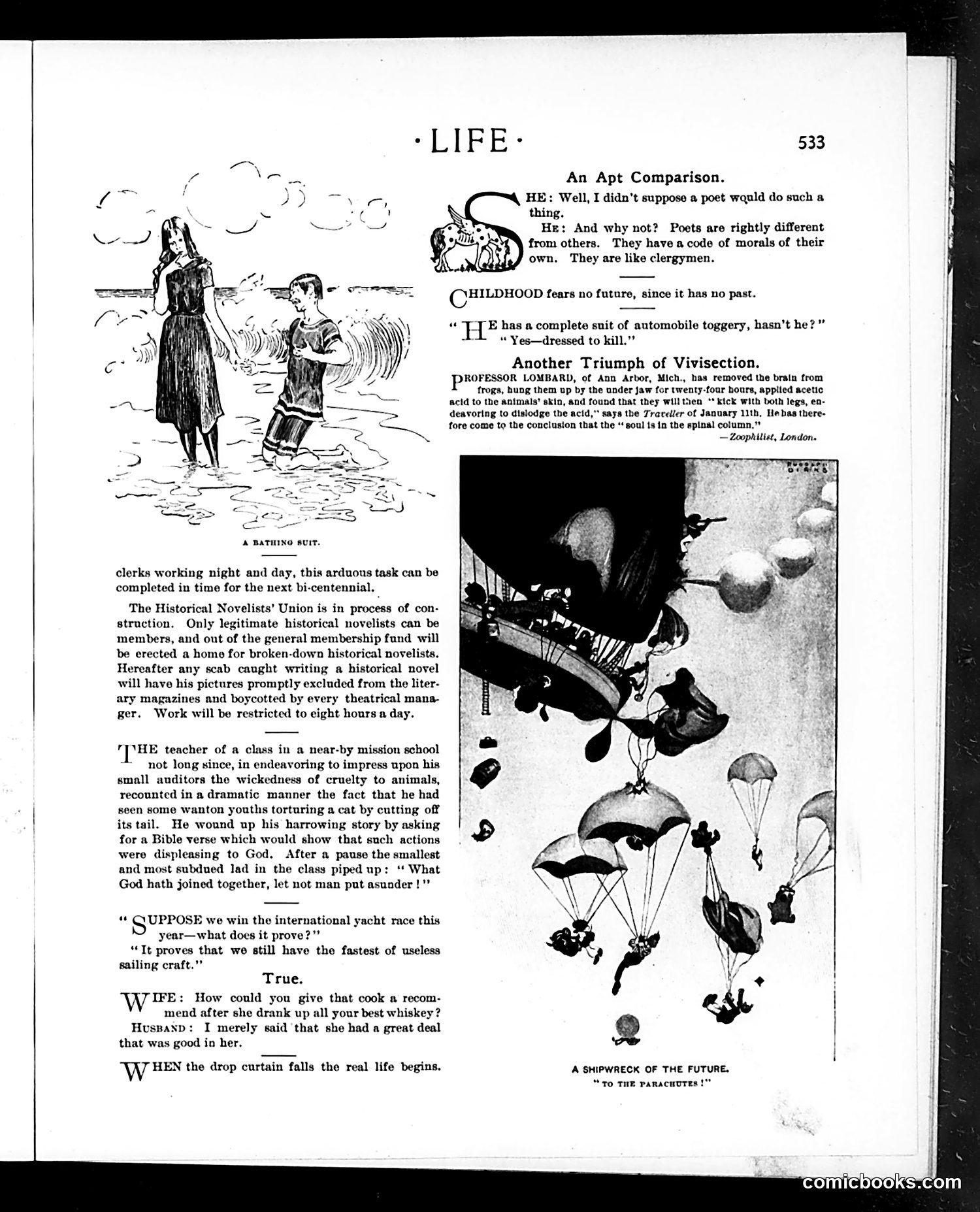
This page from *Life* magazine (a 19th-century American humor publication) contains several unrelated satirical pieces: **"An Apt Comparison"** mocks poets as morally exempt figures comparable to clergy—suggesting society grants them special ethical privileges. **"Another Triumph of Vivisection"** ridicules animal experimentation, specifically Professor Lombard's frog brain removal study. The satire attacks vivisectionists' pseudo-scientific conclusions about animal souls residing in spinal cords—treating their reasoning as absurdly circular. **"A Bathing Suit"** is a simple visual joke about a woman and child at the beach. **"Historical Novelists' Union"** satirizes guild-like professional exclusivity, mocking plans to create housing for "broken-down" novelists and boycott non-union writers. The remaining short pieces employ ironic humor: the child misapplying scripture about marriage to a cat's tail; the cook's employer praising her moral character despite her theft; and a yacht race proving only useless extravagance. The final illustration depicts parachutists, captioned "A Shipwreck of the Future"—likely commenting on emerging aviation technology.
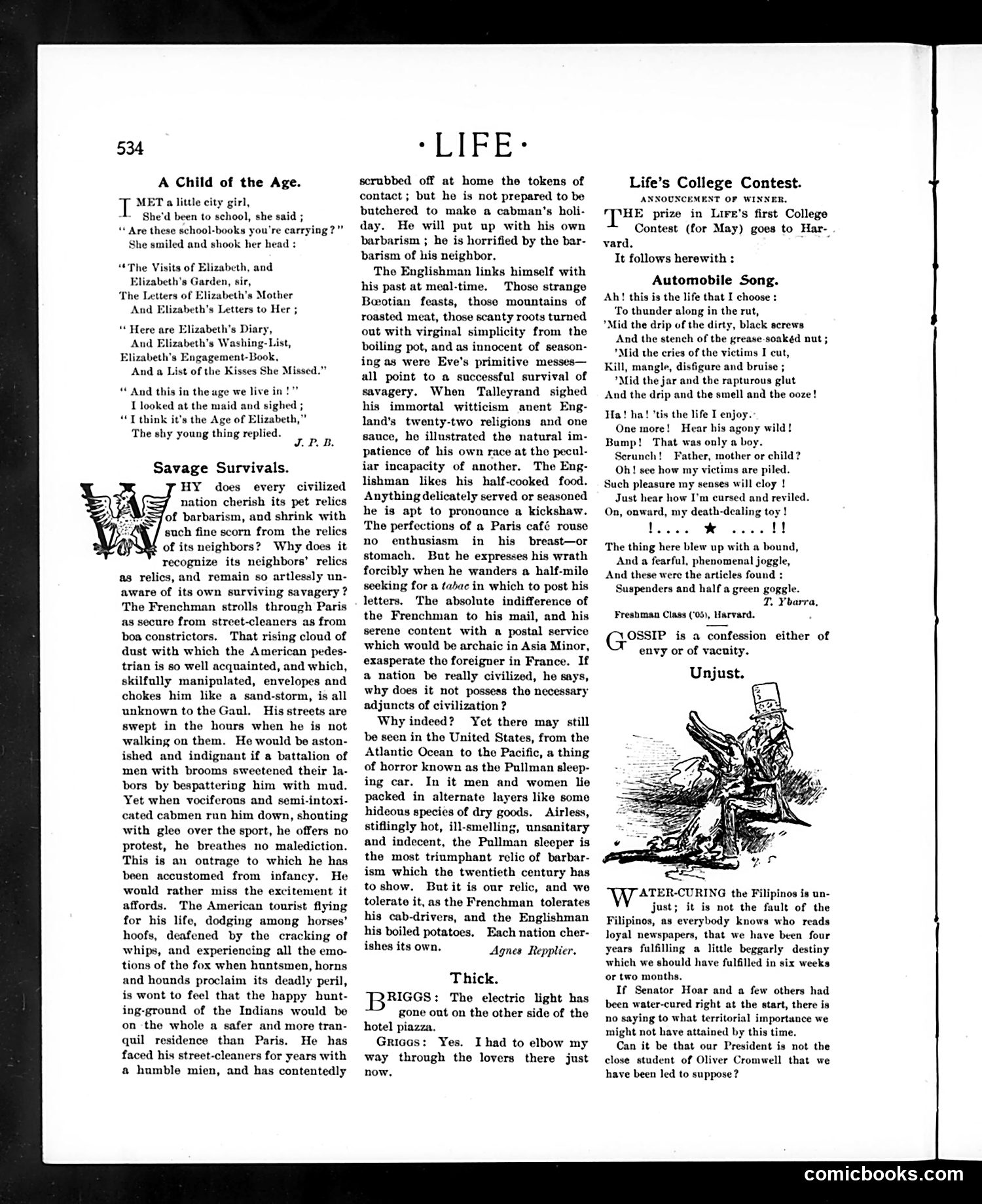
This article mocks how "civilized" nations criticize each other's backward customs while ignoring their own. The author uses three examples: **France vs. America**: Americans complain about Paris's chaotic, whip-cracking cab drivers endangering pedestrians, yet accept their own "savage" dusty streets as normal. **England vs. France**: The English mock French cuisine's sophistication as fussy, preferring bland, under-cooked meat—a "survival of savagery." Yet the French equally mock English indifference to postal service efficiency. **All nations vs. America**: The piece culminates by noting that the U.S.—claiming to be advanced—tolerates the Pullman sleeping car (packed conditions, poor sanitation), the "most triumphant relic of barbarism." The satire's point: every nation cherishes its own barbarisms while self-righteously condemning others' as primitive. Civilized societies are hypocritical about what constitutes progress.
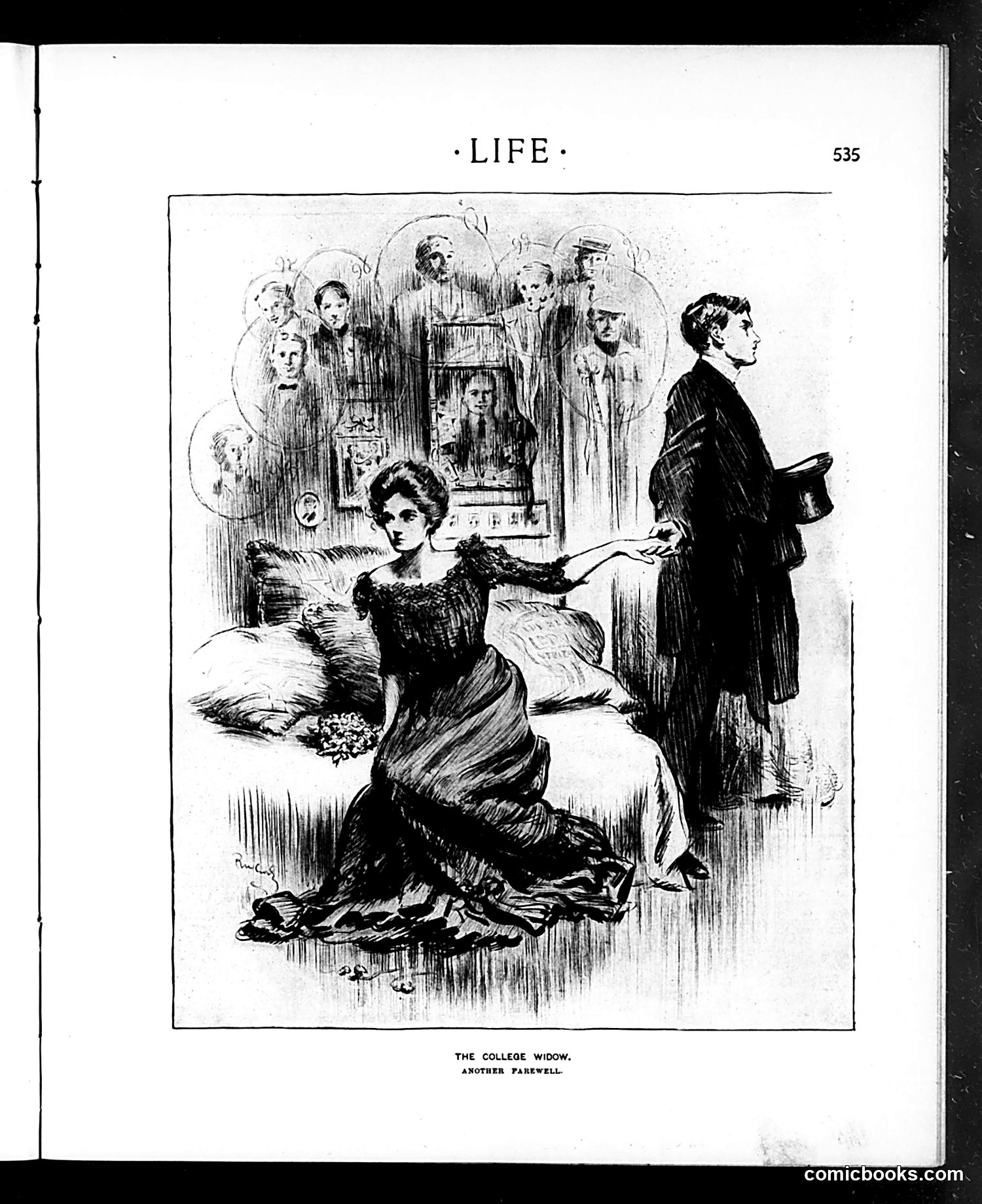
This satirical illustration depicts a farewell scene centered on a woman seated on a bed, gesturing expressively toward a man departing on the right. The scene includes ghostly or ethereal figures in the background, suggesting memories or previous encounters. The caption references "The College Widow," a stock character in early 20th-century American comedy—typically a young woman associated with college life who accumulated romantic conquests. The "Another Farewell" subtitle implies this is yet another in a series of romantic partings. The satire likely mocks both the character type and the sentimental melodrama of farewell scenes. The ghostly background figures suggest multiple past suitors or previous goodbye scenes, emphasizing the repetitive, serial nature of such romantic entanglements—a joke about her relationship history.
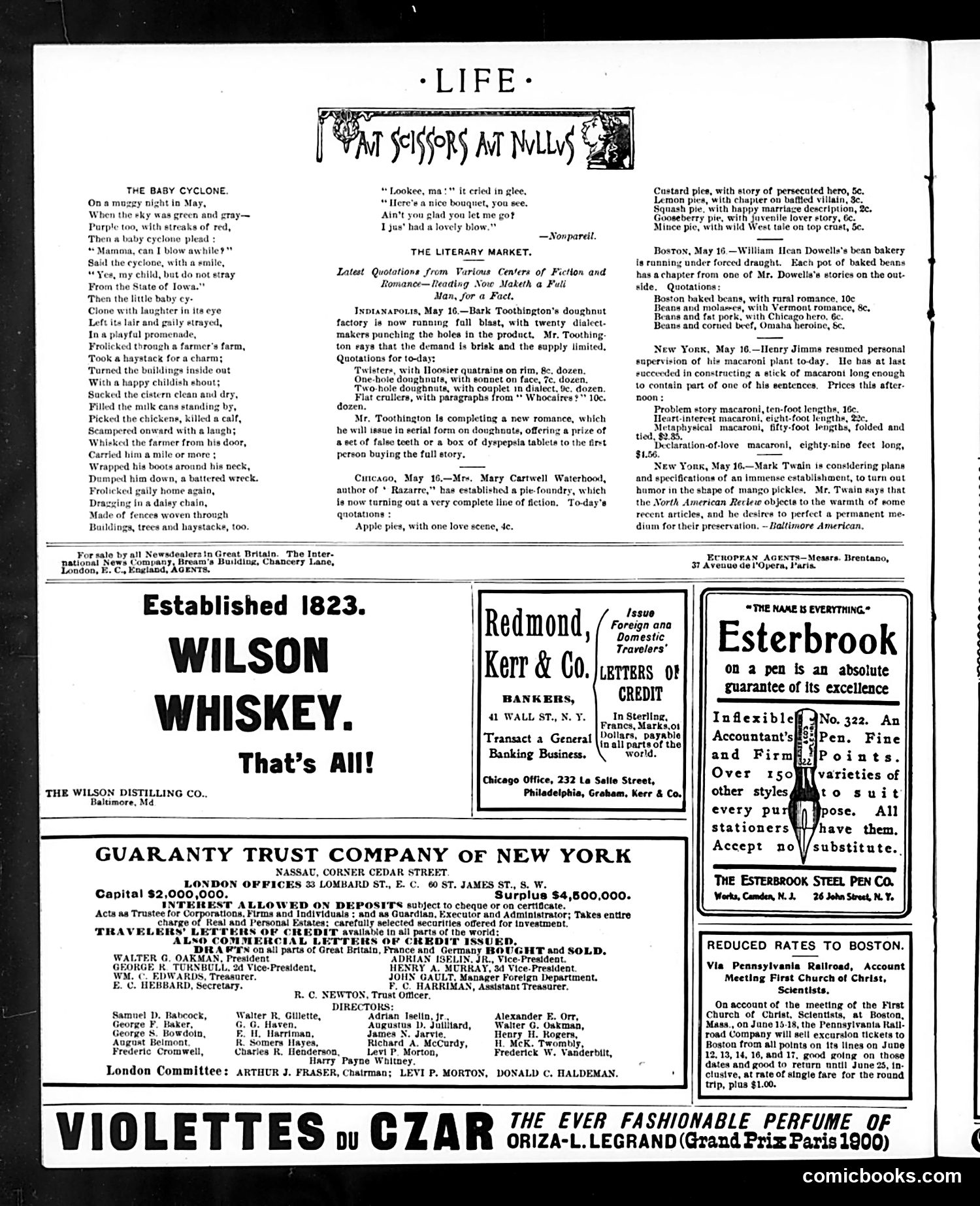
This page contains two satirical pieces mocking American literature and authors of the era. **"The Baby Cyclone"** is a humorous poem about a destructive tornado treated as a mischievous child. It's not political satire but rather lighthearted comedy about natural disaster, presented as a cautionary tale told in verse. **"The Literary Market"** is the sharper satire. It ridicules famous contemporary American authors by imagining their work literally embedded in food products—doughnuts, pies, beans, macaroni—sold by quantity. The targets appear to be Hamlin Garland ("Hoosier quatrains"), William Dean Howells (bean bakery), and Mark Twain (mango pickles for humor). The joke mocks both the authors' prolific output and the era's view of literature as mass-produced commodity. It suggests their writing is repetitive, formulaic, and ultimately as forgettable as packaged food. The satire critiques both literary pretension and commercialization of American letters.
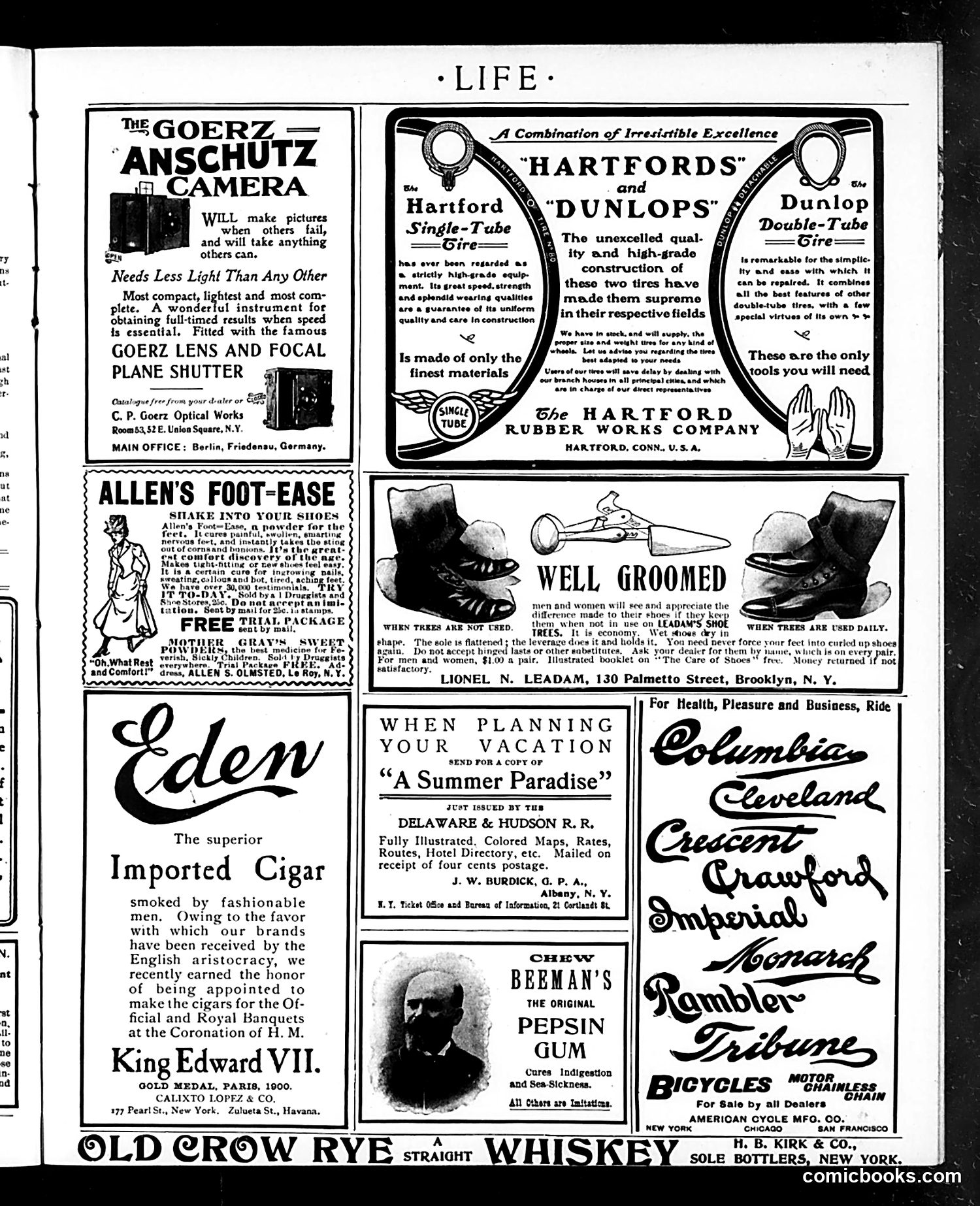
This is primarily an **advertising page** from *Life* magazine, not a political cartoon. It contains no satire or political commentary. The page features early 1900s consumer product advertisements, including: - **Photography equipment** (Goerz camera) - **Automobile tires** (Hartford and Dunlop brands) - **Foot powder** (Allen's Foot-Ease) - **Shoe trees** (Leadam brand) - **Cigars** (Eden brand, notably claiming appointment to supply King Edward VII's coronation banquets) - **Travel literature** (Delaware & Hudson Railroad vacation guide) - **Chewing gum** (Beeman's Pepsin Gum, claiming digestive benefits) - **Bicycles** (Columbia, Cleveland, Crescent, Crawford, Imperial, Monarch, Rambler, Tribune brands) - **Whiskey** (Old Crow Rye) The advertisements reflect contemporary consumer culture and product claims typical of the early 1900s, including dubious health benefits now recognized as misleading.
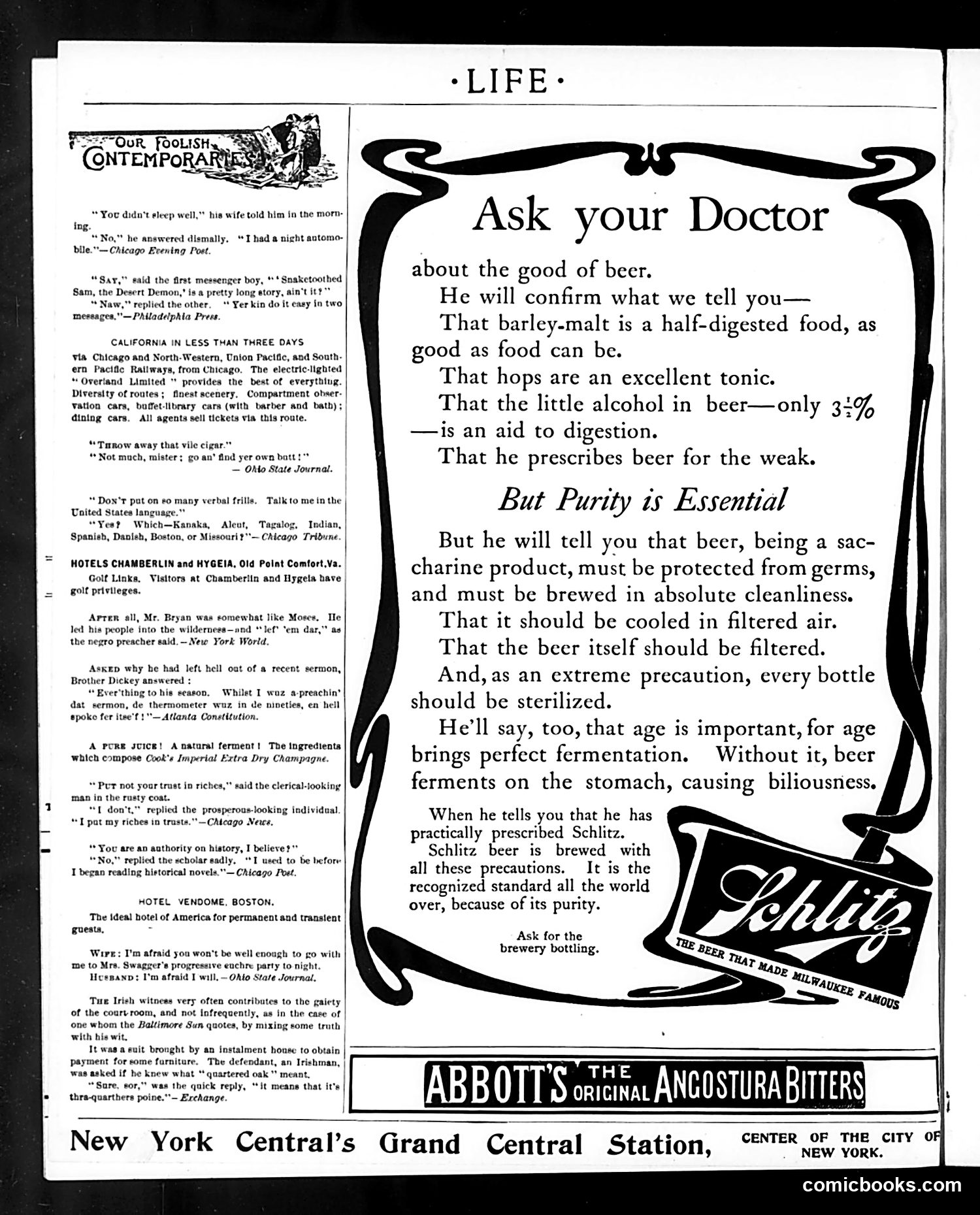
This page combines satirical commentary with period advertising, typical of early 20th-century Life magazine. **Left Column ("Our Foolish Contemporaries"):** A humor section featuring brief jokes mocking contemporary absurdities—messy automobile ownership, long serialized stories, linguistic diversity in America, and William Jennings Bryan's political leadership. The references suggest post-1896 context when Bryan was a prominent figure. **Right Column (Schlitz Beer Advertisement):** A deceptive health-promotion advertisement claiming doctors endorse beer as digestive aid and tonic, emphasizing "purity" through sterilization and filtration. This reflects the pre-Prohibition era (pre-1920) when alcohol was marketed with pseudo-scientific health claims to counter temperance movements. **The Satire:** The page juxtaposes lighthearted mockery of modern confusion with an advertisement making dubious medical claims. The beer ad's insistence on purity and doctor approval appears to address growing public health concerns, yet the entire premise—that alcohol aids digestion—would later be thoroughly debunked. The page captures American culture during industrial modernization's chaos and marketing's emerging manipulation of science for commercial ends.
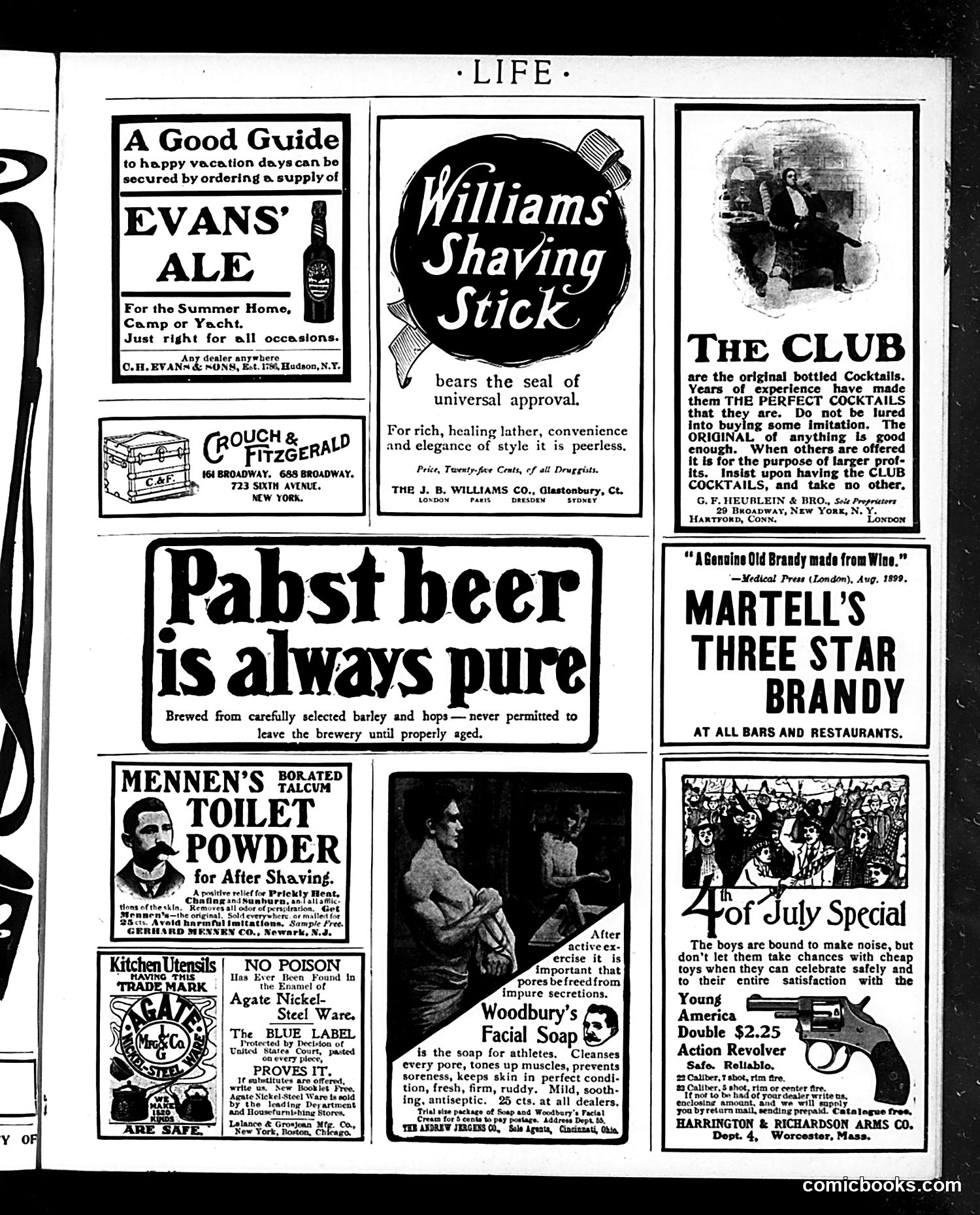
This page is almost entirely advertising, not satire or political commentary. It contains period advertisements for consumer goods typical of early 20th-century Life magazine: beer (Evans' and Pabst), spirits (Williams Shaving Stick, Martell's Brandy, The Club Cocktails), toiletries (Mennen's Powder, Woodbury's Soap), kitchen products (Agate Nickel Steel Ware), and firearms (Harrington & Richardson toy revolvers). There is no identifiable cartoon, political satire, or social commentary visible. The page reflects contemporary advertising practices and consumer culture of the era. The firearms advertisement ("Young America Double Action Revolver") represents a now-dated marketing approach to children's toys that would be unthinkable today, but this itself isn't satirized—it's presented straightforwardly as product marketing.
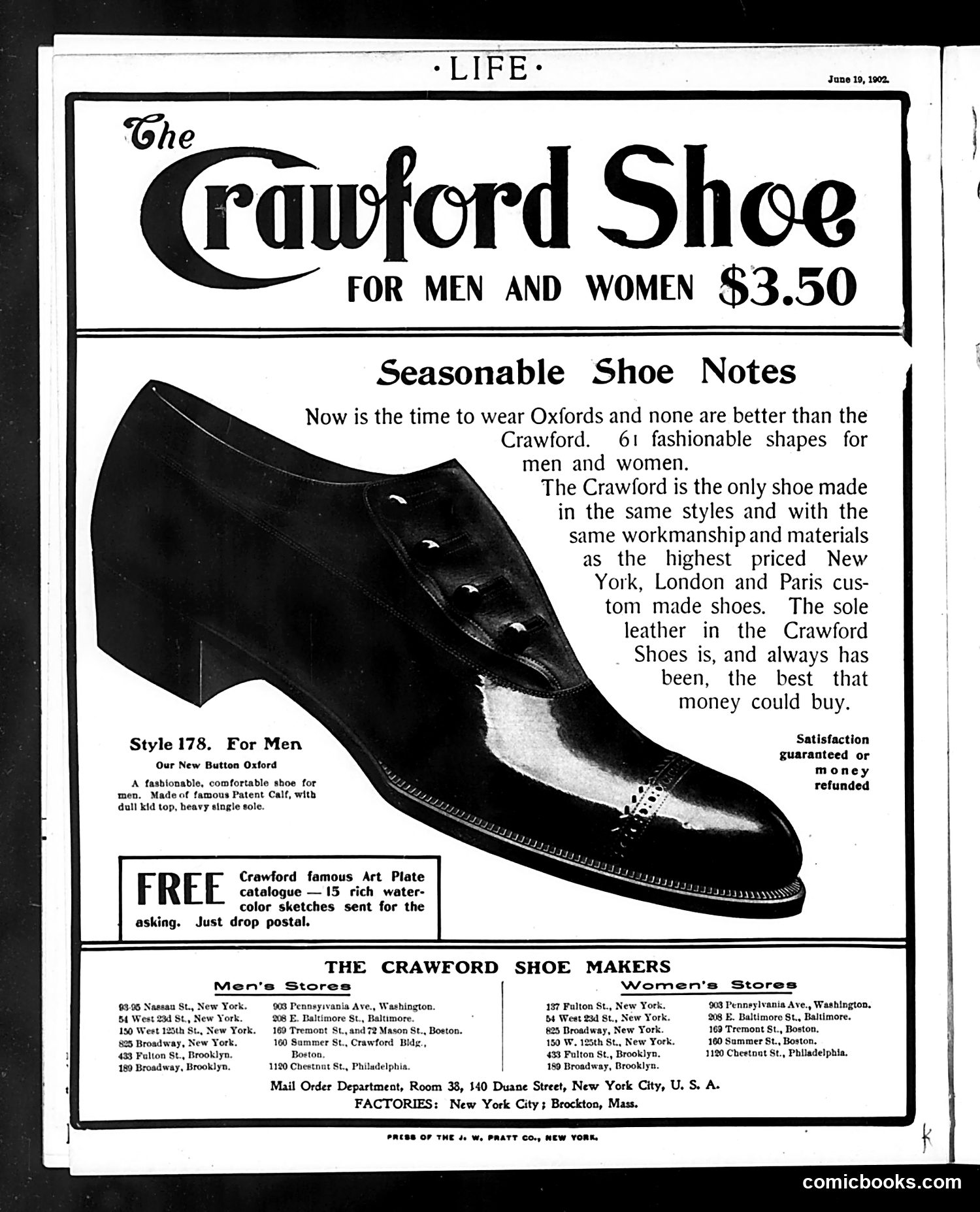
This is **not a cartoon or satire**—it's a straightforward product advertisement from *Life* magazine (June 19, 1902). The page promotes Crawford brand shoes for men and women at $3.50, positioning them as affordable alternatives to expensive custom-made footwear from New York, London, and Paris. The ad emphasizes value: same styles, workmanship, and materials as high-end shoes at a fraction of the cost. Style 178, a "Button Oxford" for men made of patent calf leather, is featured prominently. The company offers a free art catalogue and guarantees satisfaction with a money-back promise. The appeal is to middle-class consumers seeking quality footwear without luxury pricing—a common marketing strategy of the Gilded Age. The multiple store locations (New York, Baltimore, Boston, Philadelphia, Brooklyn) and mail-order option reflect growing retail modernization.