
Life, 1902-06-19 · page 4 of 20
Life — June 19, 1902 — page 4: what you’re looking at
What you’re looking at
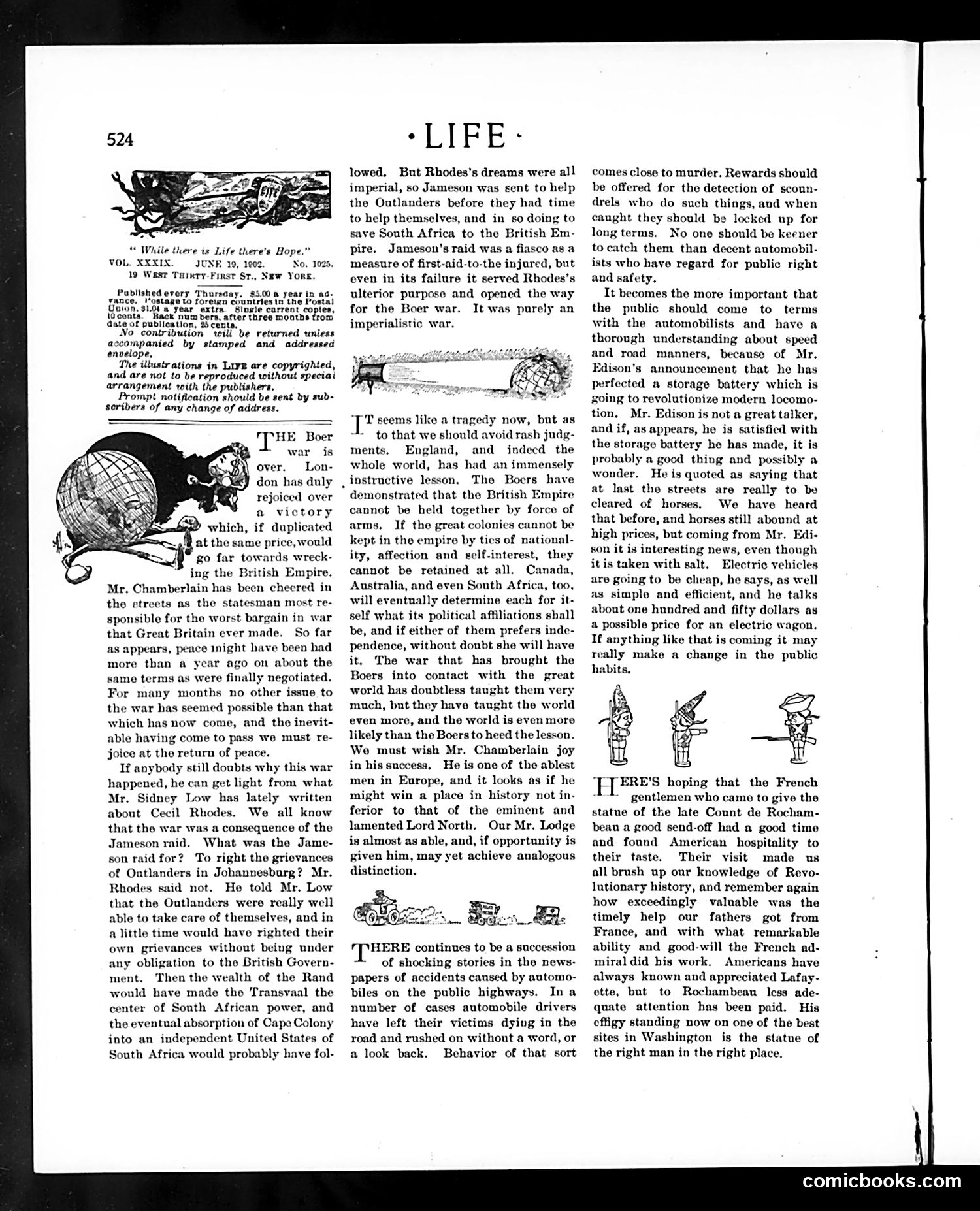
This page from Life (June 19, 1902) contains editorial commentary on the recently concluded Boer War, particularly criticizing British Colonial Secretary Joseph Chamberlain's role in the conflict. The text argues that Chamberlain bears responsibility for "the worst bargain in war that Great Britain ever made." It suggests the Boers demonstrated that colonies cannot be held by military force alone, and predicts this lesson will lead colonial territories toward independence. The small cartoon figures at the bottom appear to be illustrative vignettes rather than specific caricatures, likely depicting soldiers or colonial subjects. The editorial advocates for understanding between Britain and its colonies through mutual interest rather than force—a progressive position for 1902, foreshadowing 20th-century decolonization debates.
📄 Transcribed text from this page (OCR, searchable)
Machine-transcribed from the original scan — historical spelling and the odd misread are preserved.
Life there's Hoy x. 19, 1902. . 19 Wast Taiery-Finst St., New YorE. ry ‘Thursday. $5.00 a year in ad 0 10 foreign countries ta the Postal ri ear extra. Single current copies, Woonts. “Back numbers, after three moathe from date of publication, a cents. No contribution will be returned unless accompanied by stamped and addressed envelope, The illustrations in Liye are copyrighted, and are not to be reproduced without special arrangement with the publishers, Prompt notification should be sent by sub- soribers of any change of address. THE Boer war is over. Lon- don has duly rejoiced over a victory LD which, if duplicated 2 at the same price, would go far towards wreck- ing the British Empire. Mr. Chamberlain has been checred in the etreets as the statesman most re- sponsible for the worst bargain in war that Great Britain ever made. So far as appears, peace night have been had more than a year ago on about the same terms as were finally negotiated. For many months no other issue to the war has seemed possible than that which has now come, and the inevit- able having come to pass we must re- joice at the return of peace. If anybody still doubts why this war happened, he can get light from what Mr. Sidney Low has lately written about Cecil Rhodes. We all know that the war was a consequence of the Jameson raid. What was the Jame- son raid for? To right the grievances of Ontlanders in Johannesburg? Mr. Rhodes said not. He told Mr. Low that the Outlanders were really well able to take care of themselves, and in alittle time would have righted their own grievances without being under any obligation to the British Govern- ment. Then the wealth of the Rand would have made the Transvaal the center of South African power, and the eventual absorption of Capo Colony into an independent United States of South Africa would probably have fol- . instructive lesson. LIFE * lowed. But Rhodes’s dreams were all imperial, so Jameson was sent to help the Outlanders before they had time to help themselves, and in so doing to save South Africa to the British Em- pire. Jameson’s raid was a fiasco asa measure of first-aid-to-the injured, but even in its failure it served Rhodes’s ulterior purpose and opened the way for the Boer war. It was purely an imperialistic war. Lelie I T seems like a tragedy now, but as - to that we should avoid rash judg- ments. England, and indecd the whole world, has had an immensely The Boers have demonstrated that the British Empire cannot be held together by force of arms. If the great colonies cannot be kept in the empire by tics of national- ity, affection and self-interest, they cannot be retained at all. Canada, Australia, and even South Africa, too, will eventually determine each for it- self what its political affiliations shall be, and if either of them prefers inde- pendence, without doubt she will have it. The war that has brought the Boers into contact with the great world has doubtless taught them very much, but they have taught the world even more, and the world is even more likely than the Boers to heed the lesson, We must wish Mr. Chamberlain joy in his success, He is one of the ablest men in Europe, and it looks as if he might win a place in history not in- ferior to that of the eminent and lamented Lord North. Our Mr. Lodge is almost as able, and, if opportunity is given him, may yet achieve analogous distinction, a ‘THERE continues to be a succession of shocking stories in the news- papers of accidents caused by automo- biles on the public highways. Ina number of cases automobile drivers have left their victims dying in the road and rushed on without a word, or a look back. Behavior of that sort comes close to murder. Rewards should be offered for the detection of scoun- drels who do such things, and when caught they should be locked up for long terms. No one should be keener to catch them than decent automobil- ists who have regard for public right and safety. It becomes the more important that the public should come to terms with the automobilists and have a thorough understanding about speed and road manners, because of Mr. Edison's announcement that he has perfected a storage battery which is going to revolutionize modern locomo- tion, Mr. Edison is not a great talker, and if, as appears, he is satisfied with the storage battery he has made, it is probably a good thing and possibly a wonder. He is quoted as saying that at last the streets are really to be cleared of horses. We have heard that before, and horses still abound at high pri but coming from Mr. Edi- son it is interesting news, even though itis taken with salt. Electric vehicles are going to be cheap, he says, as well as simple and efficient, and he talks about one hundred and fifty dollars as a possible price for an electric wagon. If anything like that is coming it may really make a change in the public habits, E “ERE’S hoping that the French gentlemen who camo to give the statue of the late Count de Rocham- bean a good send-off had a good time and found American hospitality to their taste. Their visit made us all brush up our knowledge of Revo- lutionary history, and remember again how exceedingly valuable was the timely help our fathers got from France, and with what remarkable ability and good-will the French ad- miral did his work. Americans have always known and appreciated Lafay- ette, but to Rochambeau less ade- quate attention has been paid. His effigy standing now on one of the best sites in Washington is the statue of the right man in the right place. comicbooks.com