
Life, 1902-06-19 · page 14 of 20
Life — June 19, 1902 — page 14: what you’re looking at
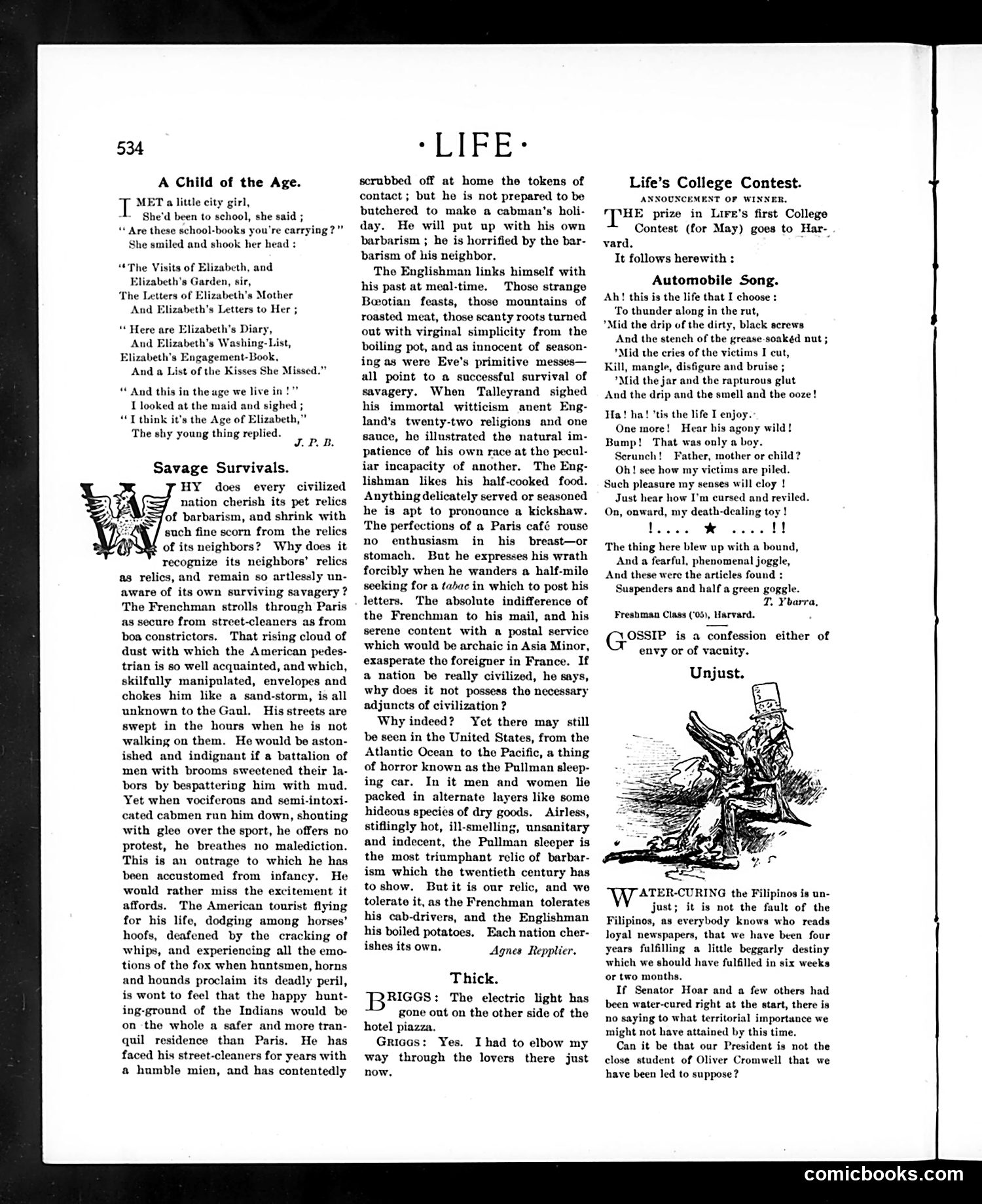
What you’re looking at
This article mocks how "civilized" nations criticize each other's backward customs while ignoring their own. The author uses three examples: **France vs. America**: Americans complain about Paris's chaotic, whip-cracking cab drivers endangering pedestrians, yet accept their own "savage" dusty streets as normal. **England vs. France**: The English mock French cuisine's sophistication as fussy, preferring bland, under-cooked meat—a "survival of savagery." Yet the French equally mock English indifference to postal service efficiency. **All nations vs. America**: The piece culminates by noting that the U.S.—claiming to be advanced—tolerates the Pullman sleeping car (packed conditions, poor sanitation), the "most triumphant relic of barbarism." The satire's point: every nation cherishes its own barbarisms while self-righteously condemning others' as primitive. Civilized societies are hypocritical about what constitutes progress.
📄 Transcribed text from this page (OCR, searchable)
Machine-transcribed from the original scan — historical spelling and the odd misread are preserved.
534 A Child of the Age. MET a litte city girl She'd been to school, she said ; “ Are these school-books you're carr She smiled and shook her head : “The Visits of Elizabeth, and Elizabeth's Garden, sir, The Letters of E beth's Mother And Elizabeth's Letters to Her ; “ Here are Elizabeth's Diary, And Elizabeth's Washing-List, Elizabeth's Engagement-Book, And a List of the Kisses She Missed.” “And this in the age we live in I looked at the maid and sighed ; “T think it’s the Age of Elizabeth,” The shy thii eplied. he shy young thing replied.» Savage Survivals. HY does every civilized nation cherish its pet relics of barbarism, and shrink with such fine scorn from the relics Kk of its neighbors? Why does it recognize its neighbors’ relics as relics, and remain so artlessly un- aware of its own surviving savagery ? ‘The Frenchman strolls through Paris as secure from street-cleaners as from boa constrictors. That rising cloud of dust with which the American pedes- trian is so well acquainted, and which, skilfully manipulated, envelopes and chokes him like a sand-storm, is all unknown to the Gaul. His streets are swept in the hours when he is not walking on them. He would be aston- ished and indignant if a battalion of men with brooms sweetened their la- bors by bespattering him with mud. Yet when vociferous and semi-intoxi- cated cabmen run him down, shouting with glee over the sport, he offers no protest, he breathes no malediction. This is an outrage to which he has been accustomed from infancy. He would rather miss the excitement it affords. The American tourist flying for his life, dodging among horses’ hoofs, deafened by the cracking of whips, and experiencing all the emo- tions of the fox when huntsmen, horns and hounds proclaim its deadly peril, is wont to feel that the happy hunt- ing-ground of the Indians would be on the whole a safer and more tran- quil residence than Paris. He has faced his street-cleaners for years with a humble mien, and has contentedly >» LITRE « scrubbed off at home the tokens of contact; but he is not prepared to be butchered to make a cabman’s holi- day. He will put up with his own barbarism ; he is horrified by the bar- barism of his neighbor. The Englishman links himself with his past at meal-time. Those strange Beeotian feasts, those mountains of roasted meat, those scanty roots turned out with virginal simplicity from the boiling pot, and as innocent of season- ing as were Eve's primitive messes— all point to a successful survival of savagery. When Talleyrand sighed his immortal witticism anent Eng- land’s twenty-two religions and one sauce, he illustrated the natural im- patience of his own race at tho pecul- iar incapacity of another. The Eng- lishman likes his half-cooked food. Anything delicately served or seasoned. he is apt to pronounce a kickshaw. The perfections of a Paris café rouse no enthusiasm in his breast—or stomach. But he expresses his wrath forcibly when he wanders a half-mile seeking for a tabac in which to post his letters, The absolute indifference of the Frenchman to his mail, and his serene content with a postal service which would be archaic in Asia Minor, exasperate the foreigner in France. If a nation be really civilized, he says, why does it not possess the necessary adjuncts of civilization ? Why indeed? Yet there may still be seen in the United States, from the Atlantic Ocean to the Pacific, a thing of horror known as the Pullman sleep- ing car. In it men and women lie packed in alternate layers like some hideous species of dry goods. Airless, stiflingly hot, ill-smelling, unsanitary and indecent, the Pullman sleeper is the most triumphant relic of barbar- ism which the twentieth century has to show. But it is our relic, and we tolerato it, as the Frenchman tolerates his cab-drivers, and the Englishman his boiled potatoes. Each nation cher- ishes its own. Agnes Repplier. Thick. RIGGS: The electric light has = gone out on the other side of the hotel piazza. Griccs: Yes. I had to elbow my way through the lovers there just now. Life’s College Contest. ANNOUNCEMENT OF WINNER. (HE prize in Lire’s first College Contest (for May) goes to Har- vard, It follows herewith : Automobile Song. Ah! this is the life that I choose : ‘To thunder along in the rut, ’Mid the drip of the dirty, black screws And the stench of the grease-soakéd nut ; ’Mid the cries of the victims I cut, Kill, mangle, disfigure and bruise ; ’Mid the jar and the rapturous glut And the drip and the smell and the ooze! Ha! ha! ‘tis the life I enjoy. One more! Hear his agony wild! Bump! That was only a boy. Scrunch! Father, mother or child? Oh! see how my victims are piled. Such pleasure my senses will cloy ! Just hear how I’m cursed and reviled. On, onward, my death-dealing toy ! ‘The thing here blew up with a bound, And a fearful, phenomenal joggle, ‘And these were the articles found : Suspenders and half a green goggle. T. Ybarra, Freshman Class (05), Harvard. . OSSIP is a confession either of envy or of vacuity. Unjust. a ATER-CURING the Filipinos is un- just; it is not the fault of the Filipinos, as everybody knows who reads Joyal newspapers, that we have been four years fulfilling a little beggarly destiny which we should have fulfilled in six weeks or two months. If Senator Hoar and a few others had been water-cured right at the start, there is no saying to what territorial importance we might not have attained by this time. Can it be that our President is not the close student of Oliver Cromwell that we have been led to suppose? comicbooks.com