
A complete issue · 20 pages · 1902
Life — April 3, 1902
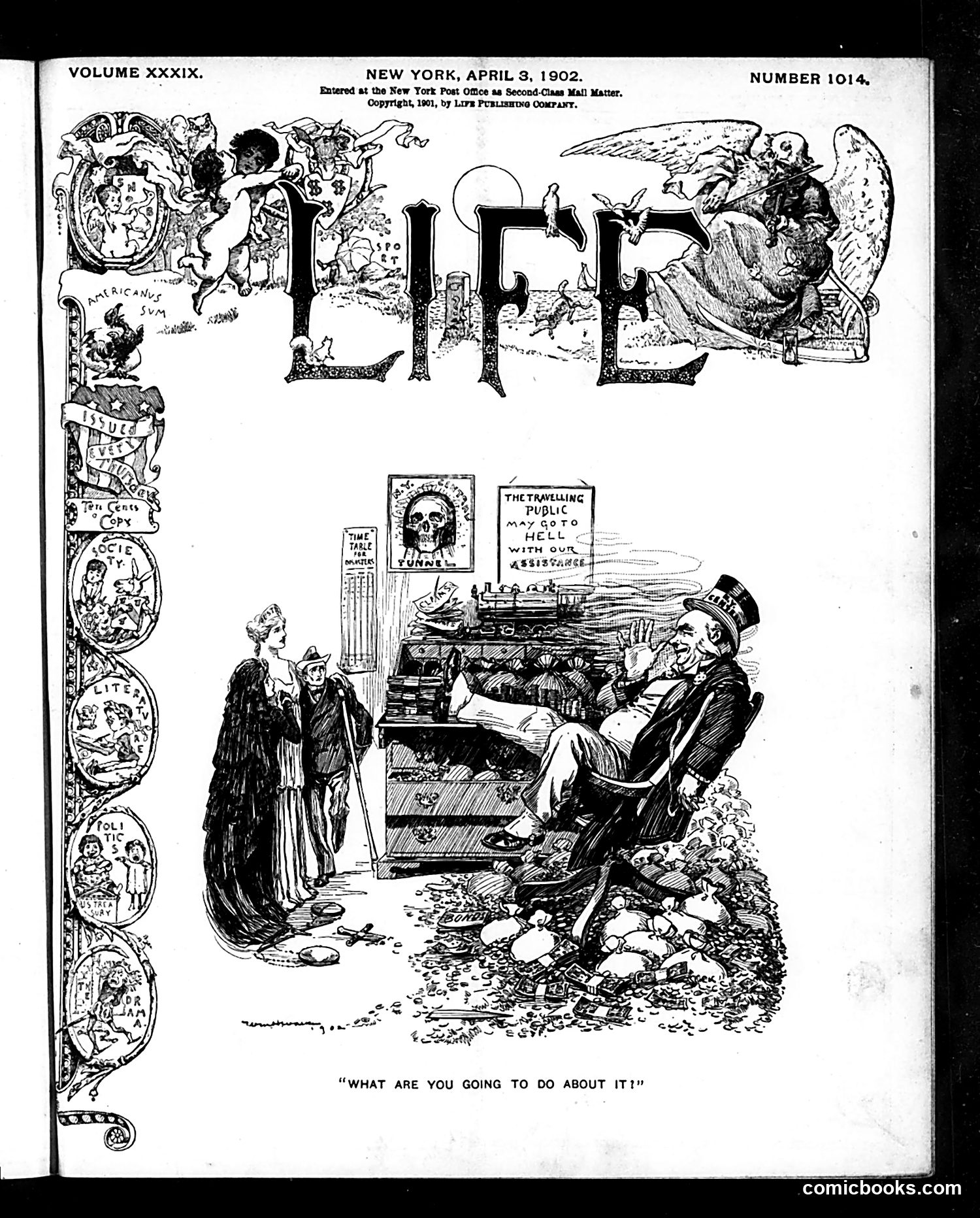
This satirical cover depicts a well-dressed gentleman seated at a desk labeled "The Travelling Public May Go to Hell With Our Assistance," addressing two visitors. The sign above references railroad service complaints. The main cartoon's caption—"What are you going to do about it?"—satirizes railroad companies' indifference to passenger complaints during the Gilded Age. The gentleman's dismissive posture and the hellish imagery suggest railroad magnates treated public concerns with contempt. The left sidebar contains decorative vignettes labeled with various satirical topics common to Life magazine's format. The cartoon critiques corporate arrogance during an era of rapid railroad expansion, when companies wielded enormous power and faced growing public criticism over safety, service, and pricing practices.
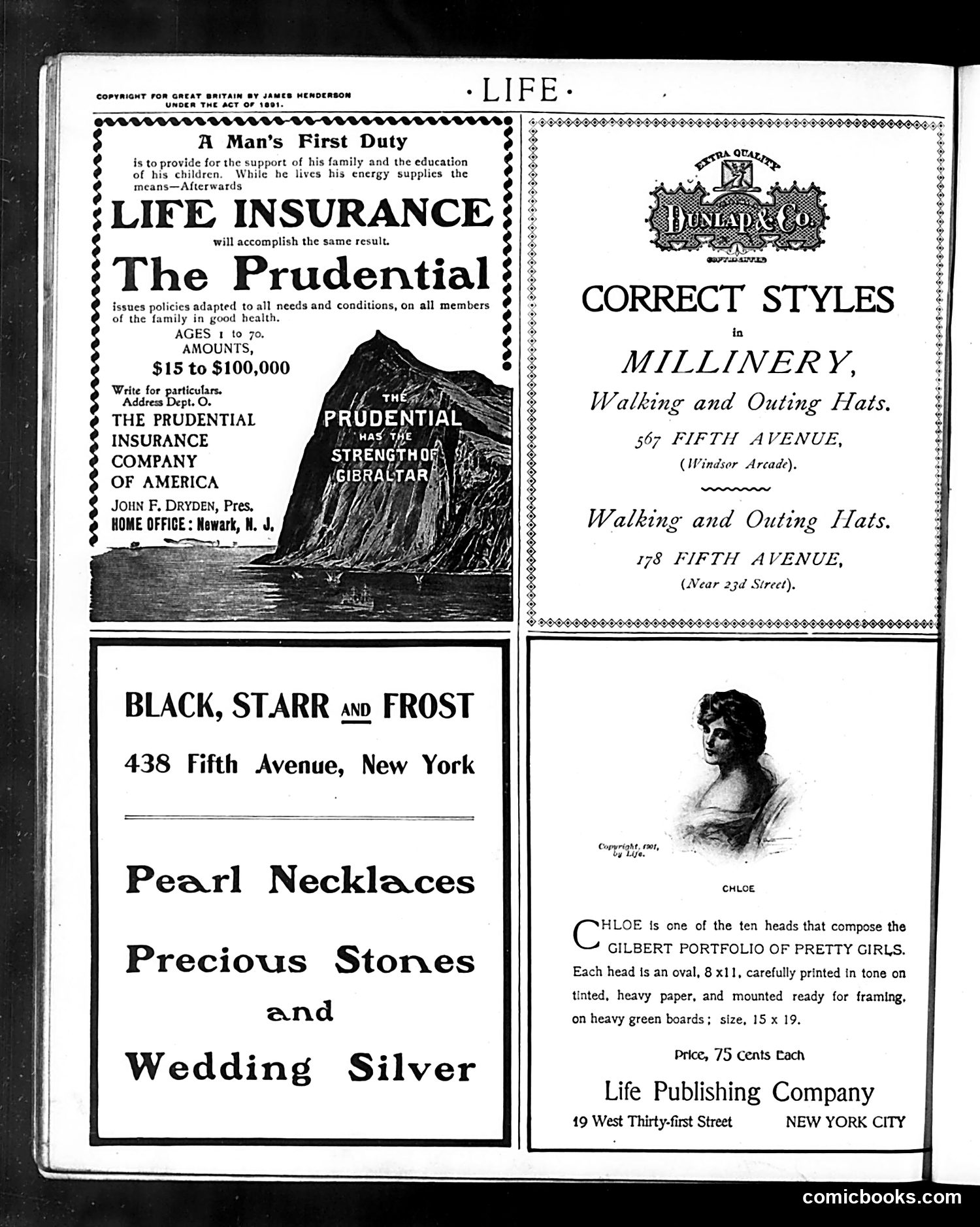
This page is **primarily advertising**, not satirical content. It contains four commercial advertisements from what appears to be an early 1900s Life magazine issue: 1. **The Prudential Insurance Company** - Uses the Rock of Gibraltar as its logo/symbol, promoting life insurance as a man's family duty 2. **Dunlap & Co.** - Advertisement for millinery (hats) at two Fifth Avenue locations 3. **Black, Starr and Frost** - Jewelry store advertising pearl necklaces, precious stones, and wedding silver 4. **Life Publishing Company** - Promotes a portrait series called "Gilbert Portfolio of Pretty Girls," selling individual prints of women's heads at 75 cents each The page demonstrates how Life magazine, while known for satire, relied heavily on advertising revenue. The content is straightforward commercial promotion with no discernible political or social satire.
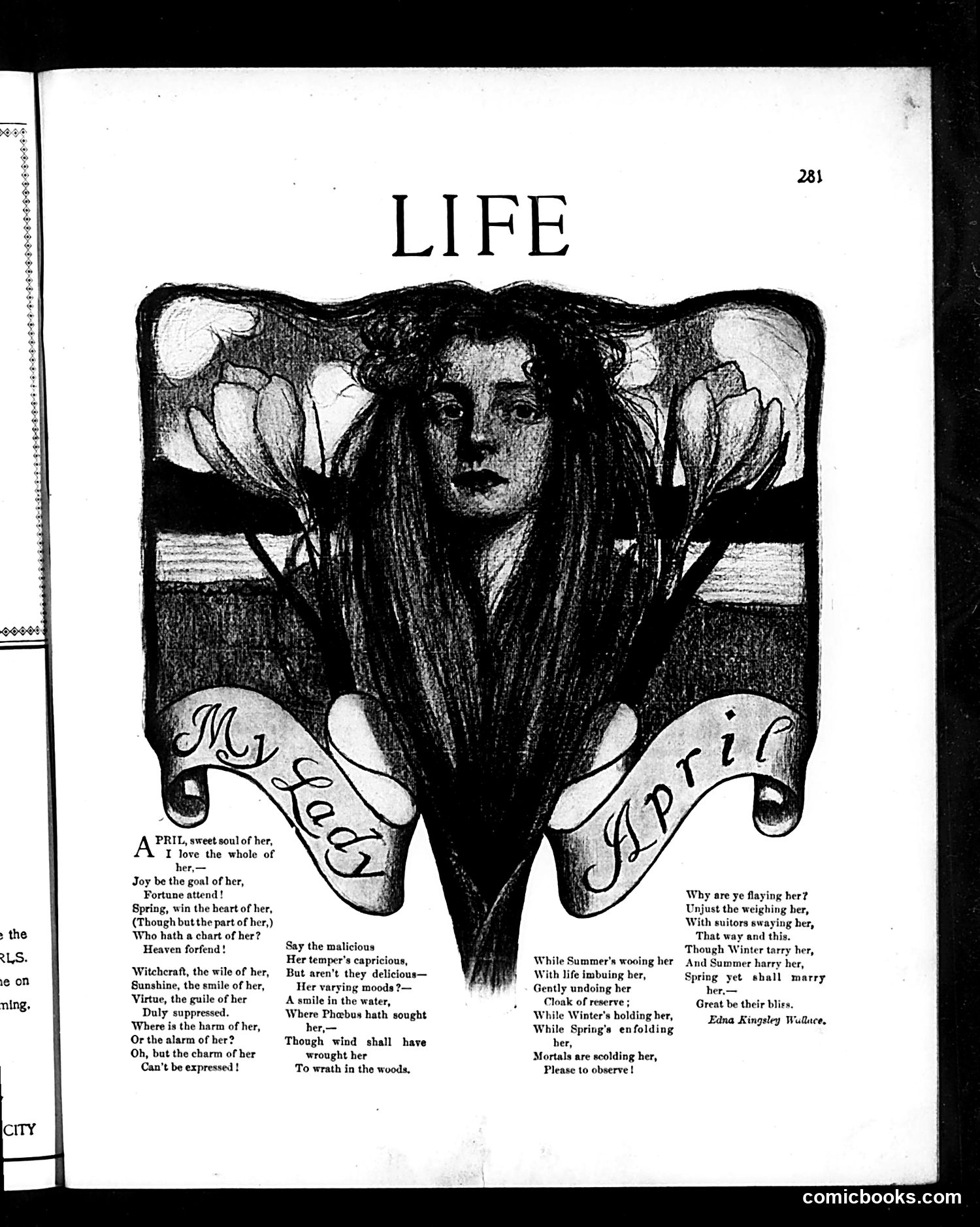
This page features a symbolic illustration of a woman's face surrounded by spring flowers, labeled "My Sweet April" and "April." The accompanying poem addresses the personification of April as a female figure, celebrating her various qualities—joy, fortune, sunshine, and charm. The text references classical mythology (Phoebus, the sun god) and uses seasonal metaphors common to 19th-century Romantic poetry. Rather than political satire, this appears to be sentimental, nature-themed verse typical of Life magazine's literary content. The elaborate art nouveau-style illustration and flowery language reflect early 20th-century aesthetic preferences for allegorical representations of seasons and months as idealized female figures. This is literary/artistic content rather than political commentary.
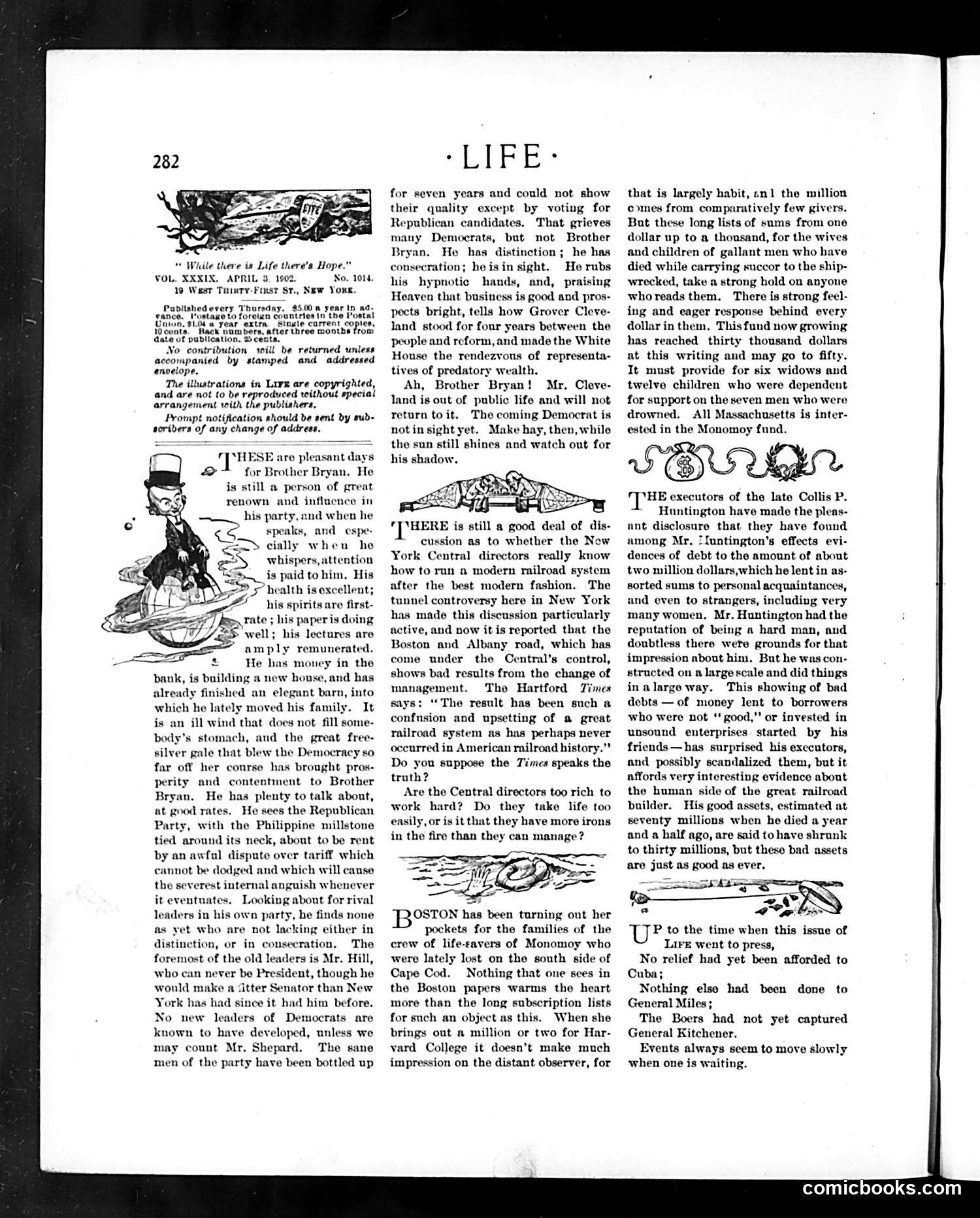
The main illustrated figure on the left depicts a well-dressed gentleman in a top hat, likely representing a wealthy industrialist or politician of the Gilded Age period. The cartoon satirizes the disconnect between the elite and working classes—a common Life magazine theme. The text discusses Brother Bryan (William Jennings Bryan), the three-time presidential candidate, and Grover Cleveland, who had recently left office. It critiques Cleveland's association with wealthy figures like Collis P. Huntington, a railroad magnate, highlighting the hypocrisy of Democratic reformers accepting railroad money while claiming to oppose monopolistic wealth concentration. The references to railroad management disputes and the Boer War context date this to 1902.
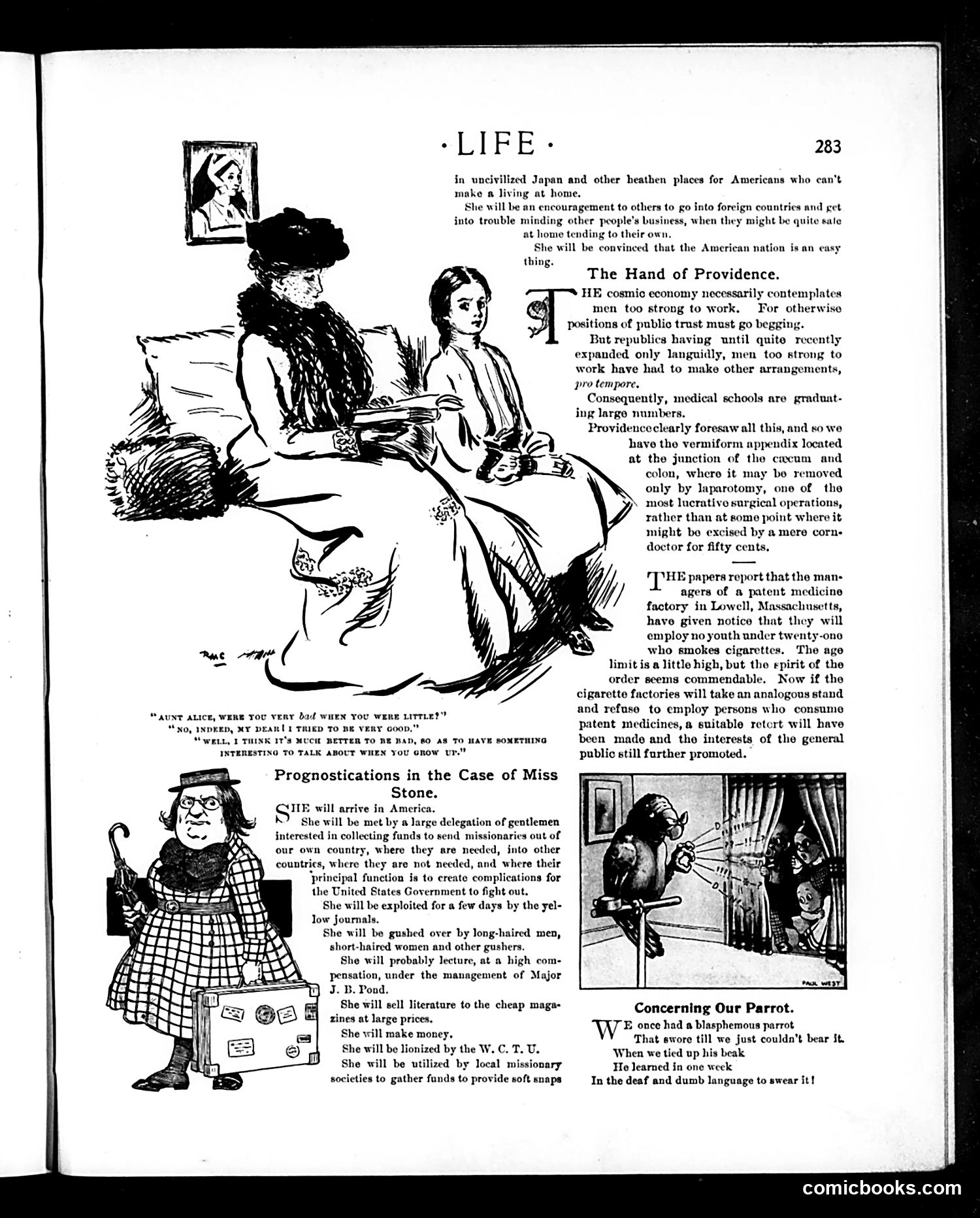
The page contains satirical commentary on American society circa early 1900s. **Top Cartoon:** Shows a woman ("Aunt Alice") being questioned about her youth, with text suggesting she was "very good" but "had something interesting to tell about when you grow up" — mocking Victorian hypocrisy about propriety. **"Prognostications in the Case of Miss Stone":** References Lucy Stone (though the figure may depict another female activist). The caricature mocks a woman missionary or reformer, predicting she'll be exploited for fundraising, lecture circuits, and cheap magazine publication. The satire targets how activist women were commodified and sensationalized by media and institutions. **"The Hand of Providence":** Discusses medical schools graduating many doctors, with satirical commentary on "Providence" ensuring sufficient surgical cases. The overall tone mocks women reformers and American institutional hypocrisy.
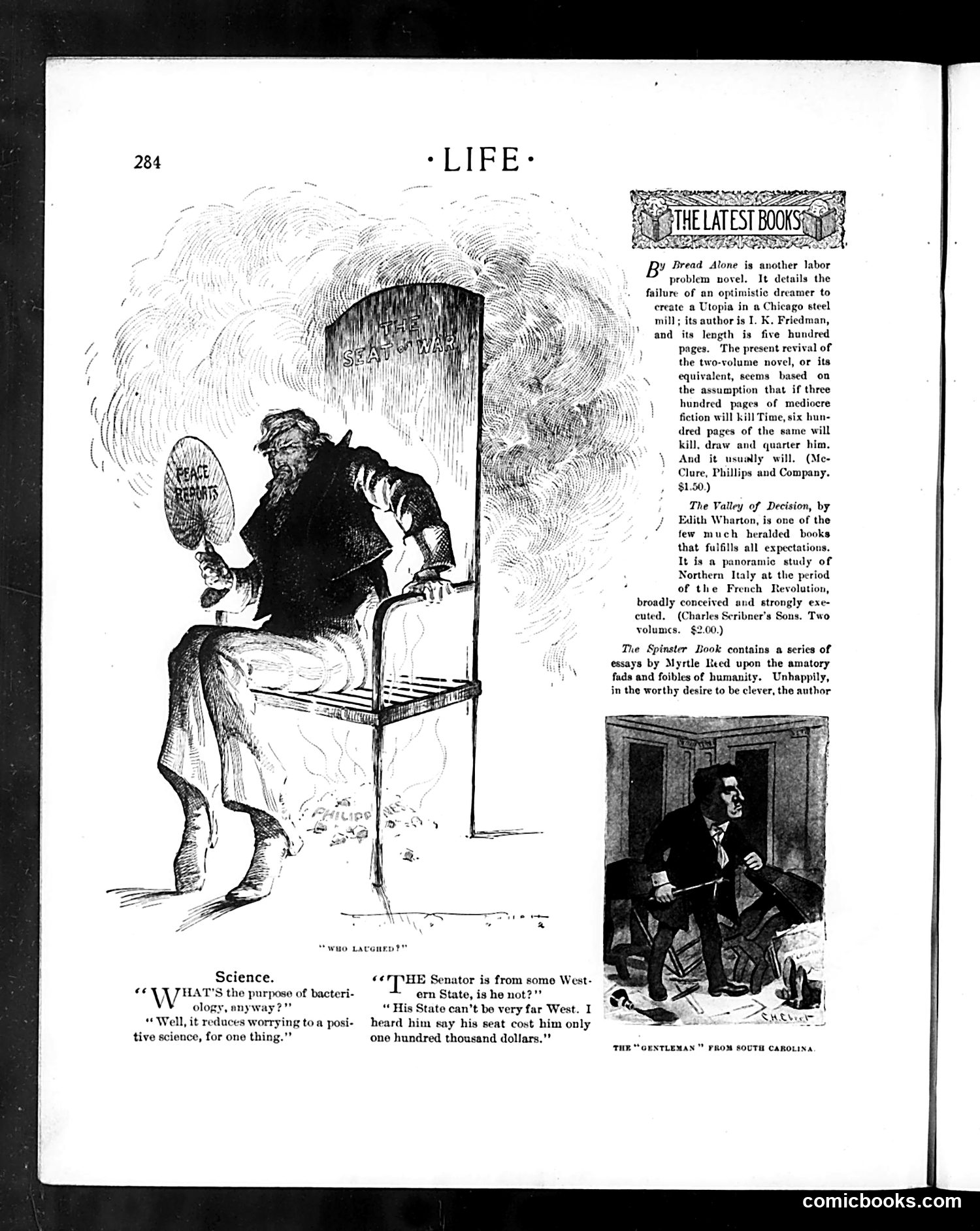
The main cartoon depicts a figure emerging from a large box labeled "PANDORA'S WAR," with a woman holding a mirror beside it. The satire suggests that opening the "Pandora's Box" of war unleashes unforeseen consequences and evils—a classical reference to the Greek myth where opening a forbidden box releases troubles into the world. Below, a dialogue between two figures discusses bacteriology and "positive science," where one character claims reducing worry is the purpose of science—likely satirizing how people misuse scientific concepts to justify troubling policies or rationalize concerning situations. The page also includes book reviews in "The Latest Books" section, making this a mixed content page combining political satire with literary commentary.
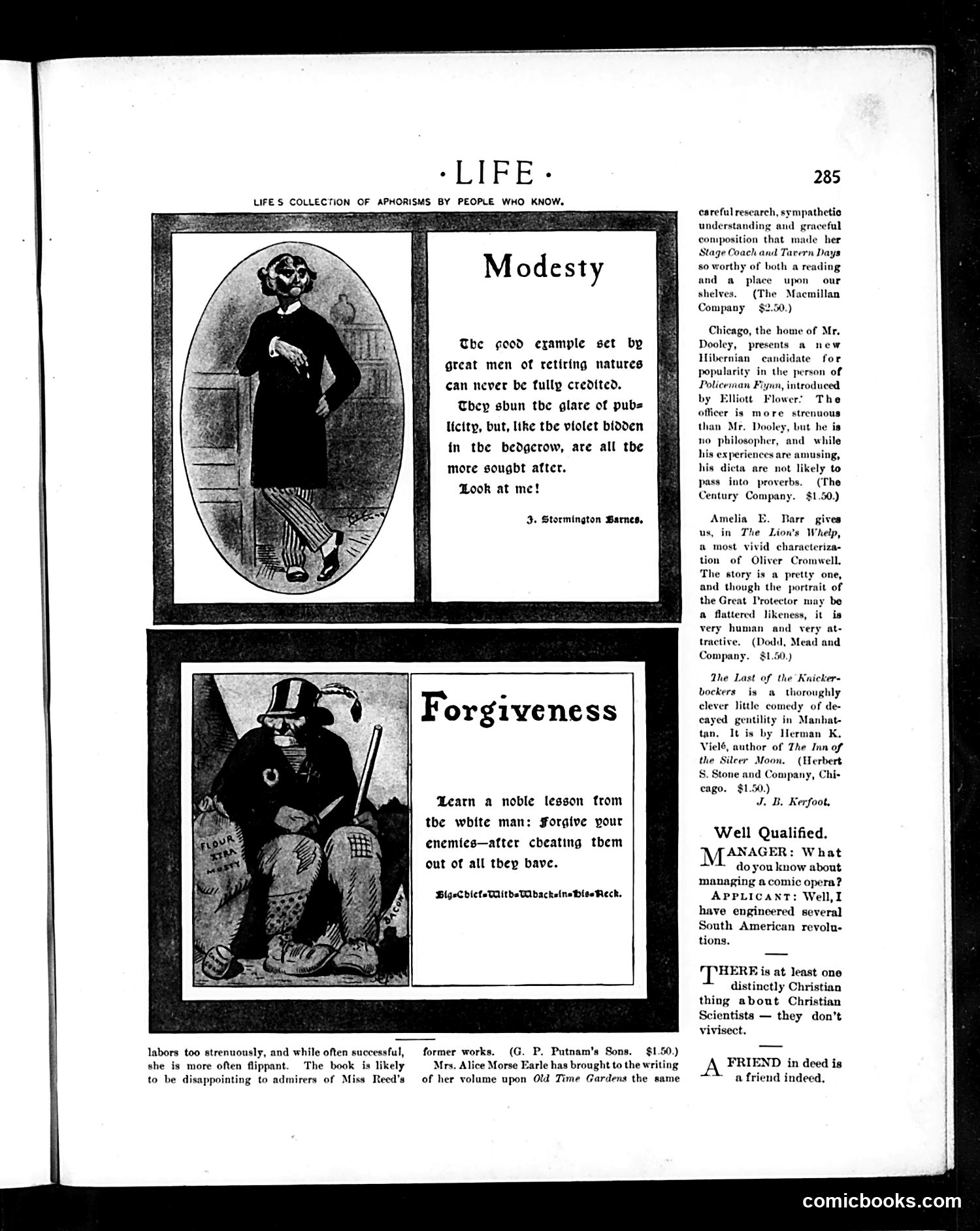
This page presents two aphoristic cartoons with accompanying quotes about virtue. **"Modesty"** features a portrait of a woman in elegant dress with the quote attributed to J. Stormington Barnes: "The good example set by great men of retiring natures can never be fully credited. They shun the glare of publicity, but, like the violet hidden in the hedgerow, are all the more sought after. Look at me!" The satire is obvious: the statement contradicts itself—someone loudly proclaiming their own modesty while demanding attention ("Look at me!") demonstrates the opposite of genuine humility. This mocks hypocritical self-promotion disguised as virtue. **"Forgiveness"** shows a caricatured figure with the lesson: "Learn a noble lesson from the white man: forgive your enemies—after cheating them out of all they have." This appears to critique colonial or imperialist hypocrisy, suggesting Western claims to moral superiority ring hollow given exploitative practices.
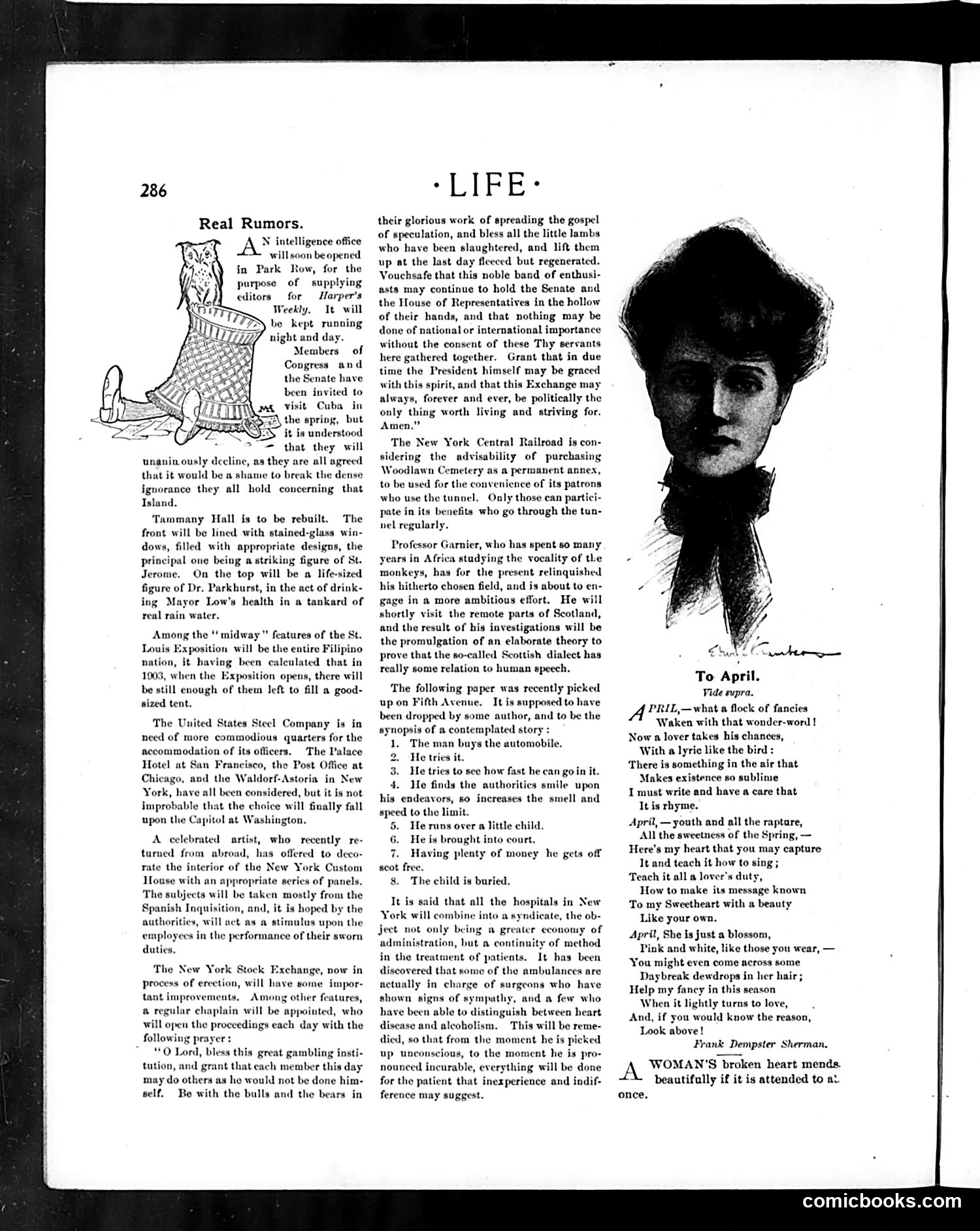
The main cartoon features an owl perched on what appears to be a legislative seat or pedestal, satirizing Congress. The accompanying "Real Rumors" column mocks contemporary political gossip, including a joke prayer blessing members of Congress and the Senate as "Thy servants" gathered to serve the nation. The satire targets the pretensions of politicians who claim noble motives while engaging in self-interested behavior. The owl—traditionally a symbol of wisdom—appears ironic given the column's portrayal of Congress as driven by rumor and speculation rather than principled governance. The page also includes literary content ("To April"), suggesting Life mixed political satire with cultural commentary. The overall message criticizes Congressional vanity and the gap between lawmakers' stated ideals and actual conduct.
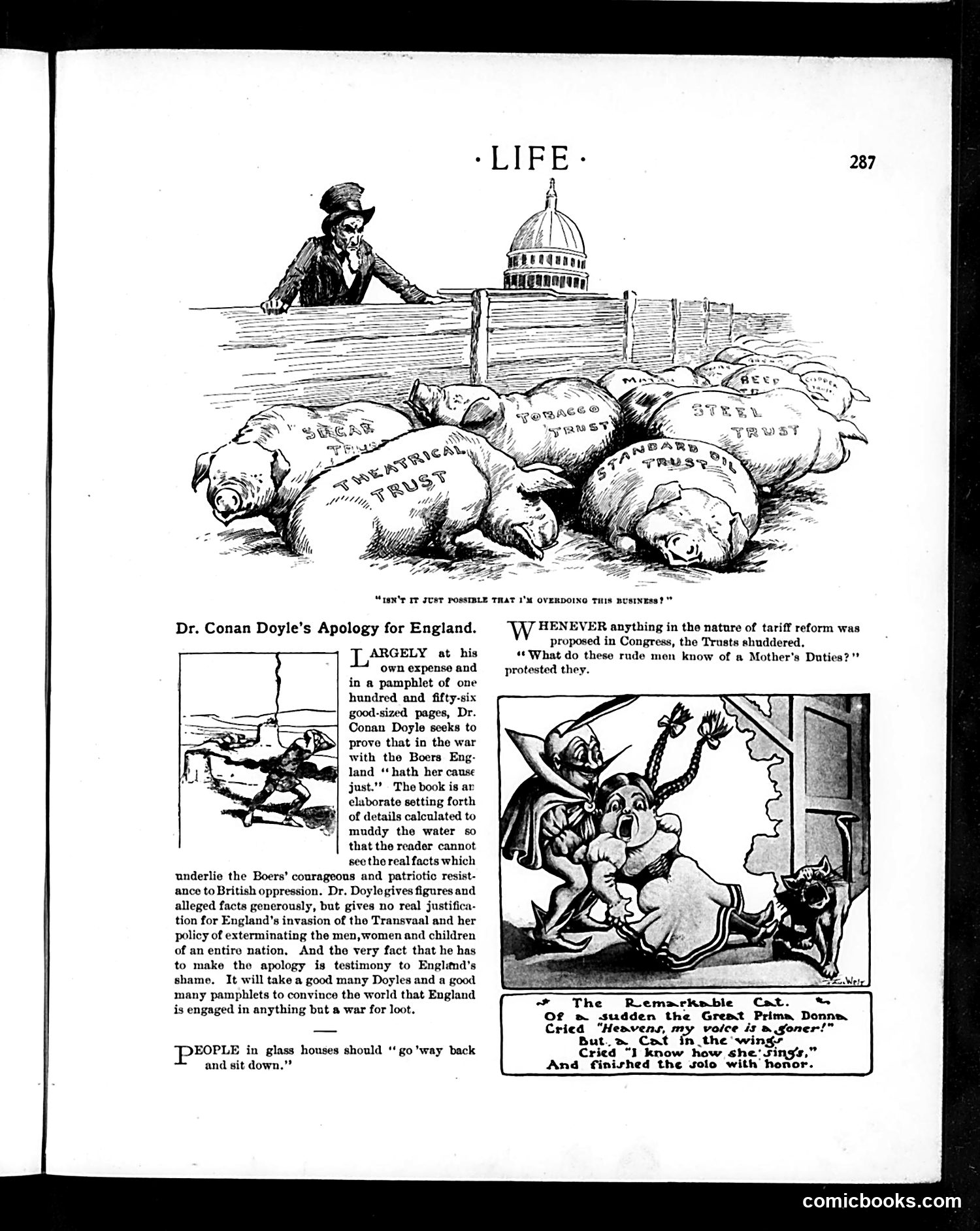
**Top Cartoon:** A man (likely a politician or businessman) stands waist-deep in water beside the U.S. Capitol, surrounded by dead pigs labeled with trusts: "Great Trust," "Steel Trust," "Standard Trust," etc. The caption asks: "Isn't it just possible that I'm overdoing this business?" This satirizes concerns that large monopolistic trusts are "dead weight" on the economy, and suggests whoever is "doing business" with them may be complicit in their harmful practices. **Bottom Section:** The article discusses Dr. Conan Doyle's defense of England's conduct in the Boer War, along with a separate cartoon mocking complaints about tariff reform. The overall page critiques both imperial wars and corporate monopolies as serious threats to national integrity.
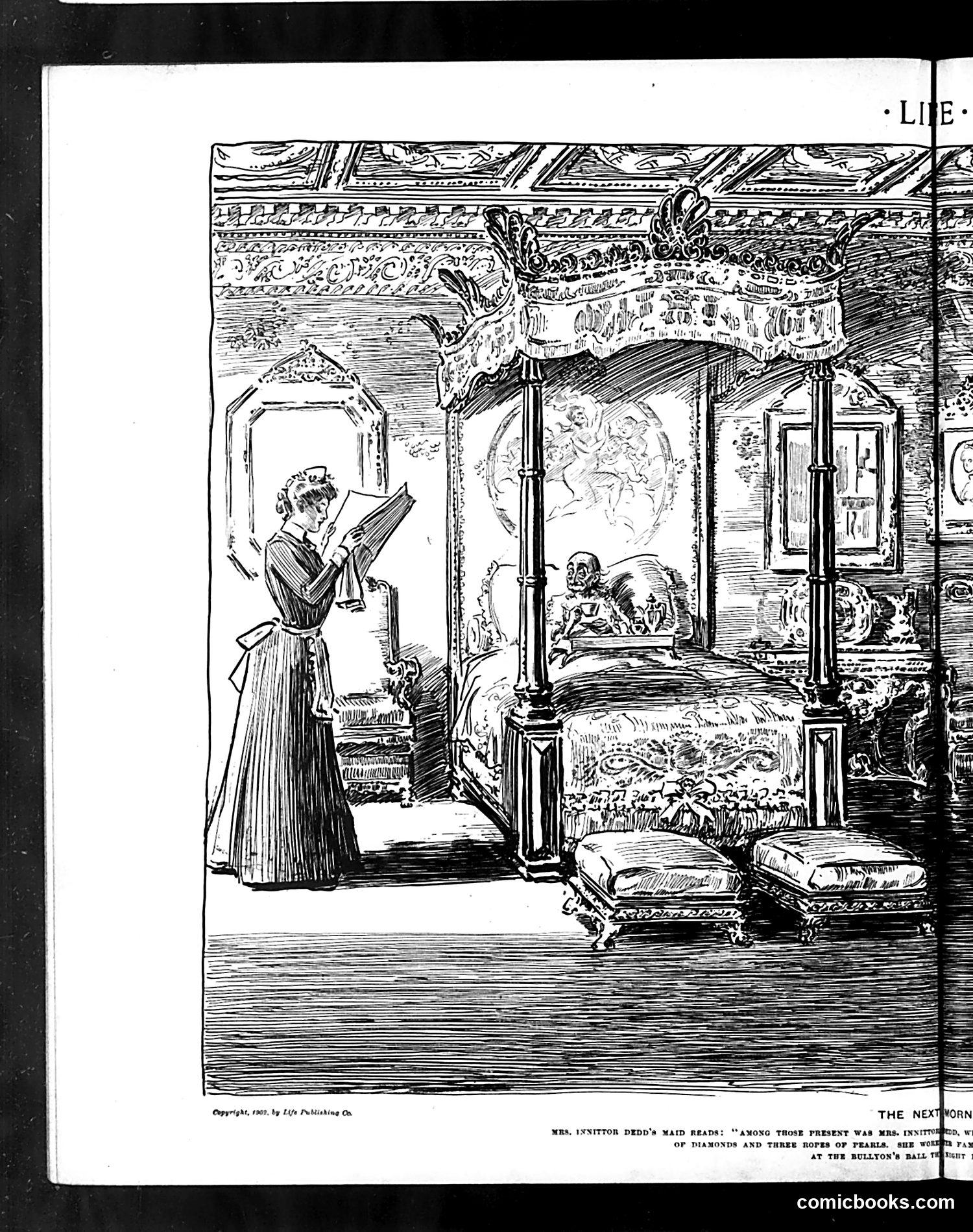
This is an illustration from *Life* magazine showing a woman in an elegant Edwardian-era dress examining what appears to be jewelry or valuables in an ornate bedroom. The caption references "Mrs. Innitor Dedd's maid" and mentions "diamonds and three ropes of pearls," suggesting commentary on wealthy households and their servants. The detailed interior setting—with its decorative bed canopy, fine furnishings, and palatial bedroom—emphasizes the luxury being discussed. The illustration likely satirizes either the servant's perspective on the employer's wealth, or perhaps critiques conspicuous consumption among the wealthy during this period. Without the full caption text being entirely legible, the specific satirical point remains somewhat unclear, though it appears to address class dynamics and material excess in Edwardian high society.
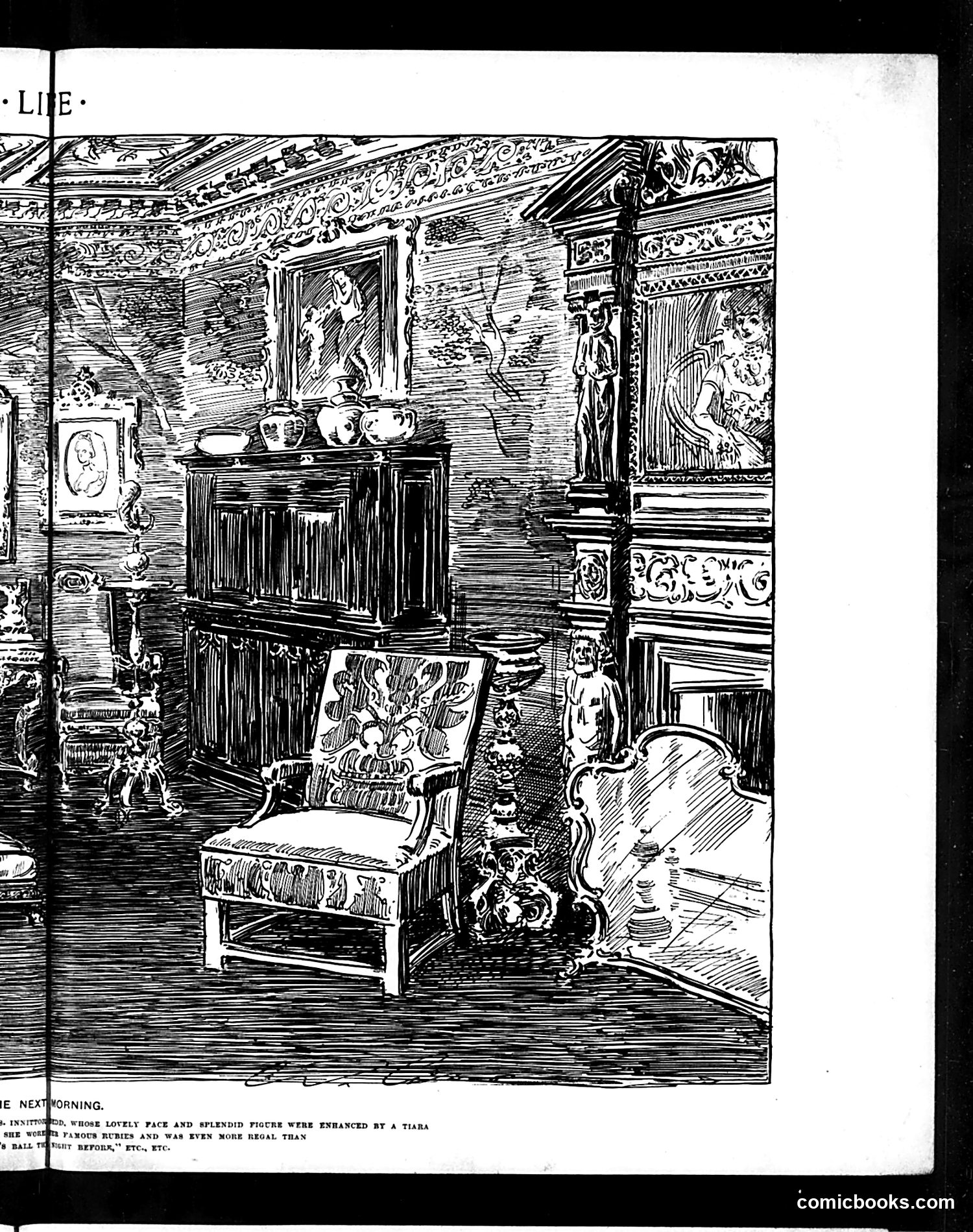
This is an ornate interior design illustration labeled "LIFE" at the top. The image shows an elaborately decorated room featuring: - Ornamental wall panels and decorative ceiling molding - An elaborate cabinet with Asian-inspired artwork - A decorative chair with ornate upholstery - A curved settee or chaise lounge - Various decorative objects and artwork on walls The partially visible caption at bottom mentions "THE NEXT MORNING" and references someone whose "LOVELY FACE AND SPLENDID FIGURE WERE ENHANCED BY A TIARA" and "FAMOUS RUBIES" being "EVEN MORE REGAL THAN" something (text cuts off). The illustration appears to satirize excessive wealth, luxury, and ostentatious interior decoration—likely mocking wealthy society figures or their pretensions. However, without complete caption text, the specific satire target remains unclear. This appears to be a society or lifestyle commentary rather than overtly political satire.
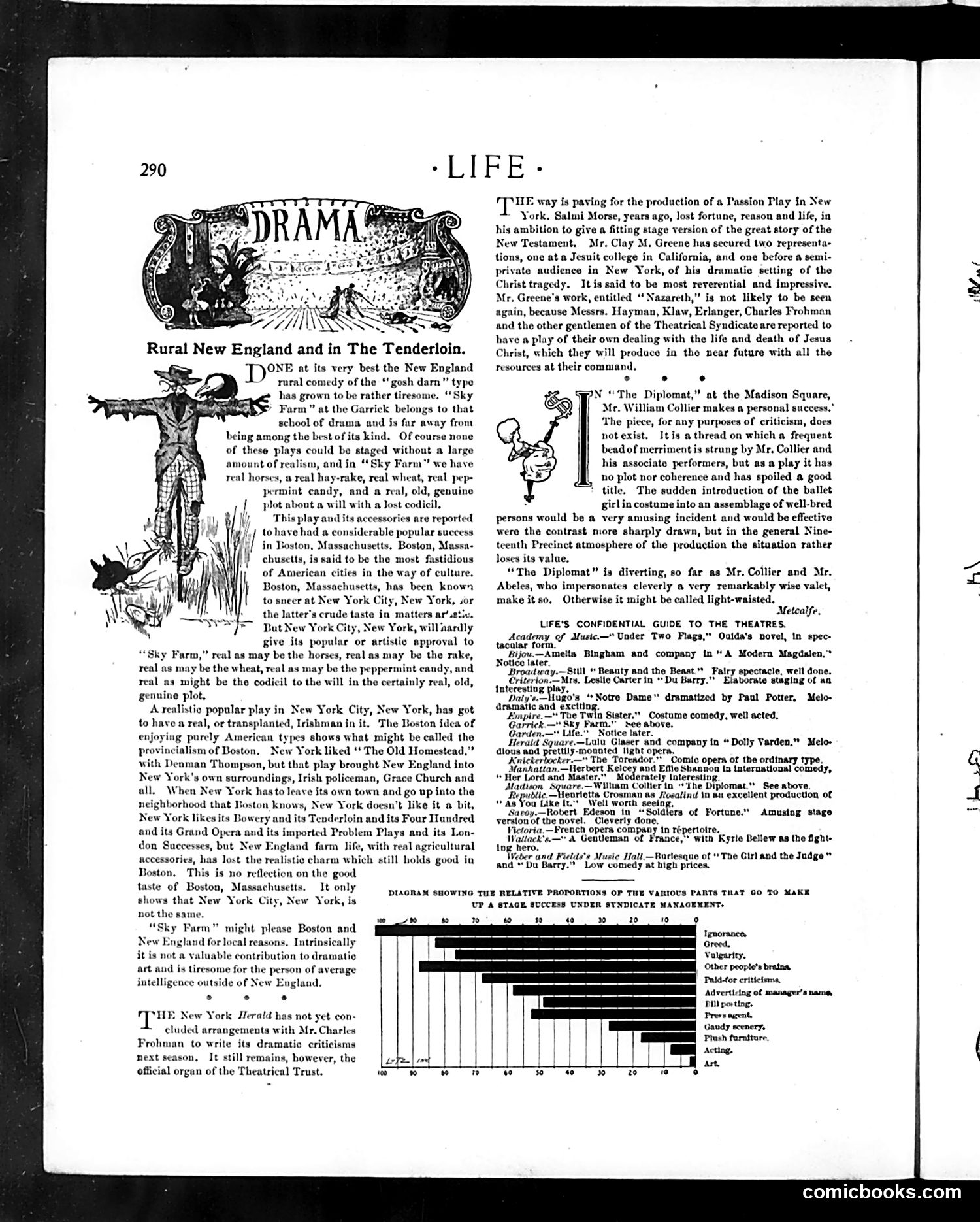
This page from *Life* magazine discusses American dramatic productions, focusing on rural New England plays. The main illustration depicts a scarecrow in a rural setting, accompanying text about "Sky Farm," described as a play featuring "real horses, real hay-rakes, real wheat, real peppermints" and other authentic rural props. The satire targets the *theatrical trend* of mounting increasingly elaborate, realistic rural productions for urban audiences—particularly New York City theatergoers. The scarecrow cartoon humorously emphasizes this obsession with authenticity and rural aesthetics. The text suggests such plays, while popular, represent questionable artistic merit compared to sophisticated dramatic work, mocking the appeal of manufactured "Americana" to city audiences seeking entertainment through rustic nostalgia and elaborate physical production rather than genuine theatrical artistry.
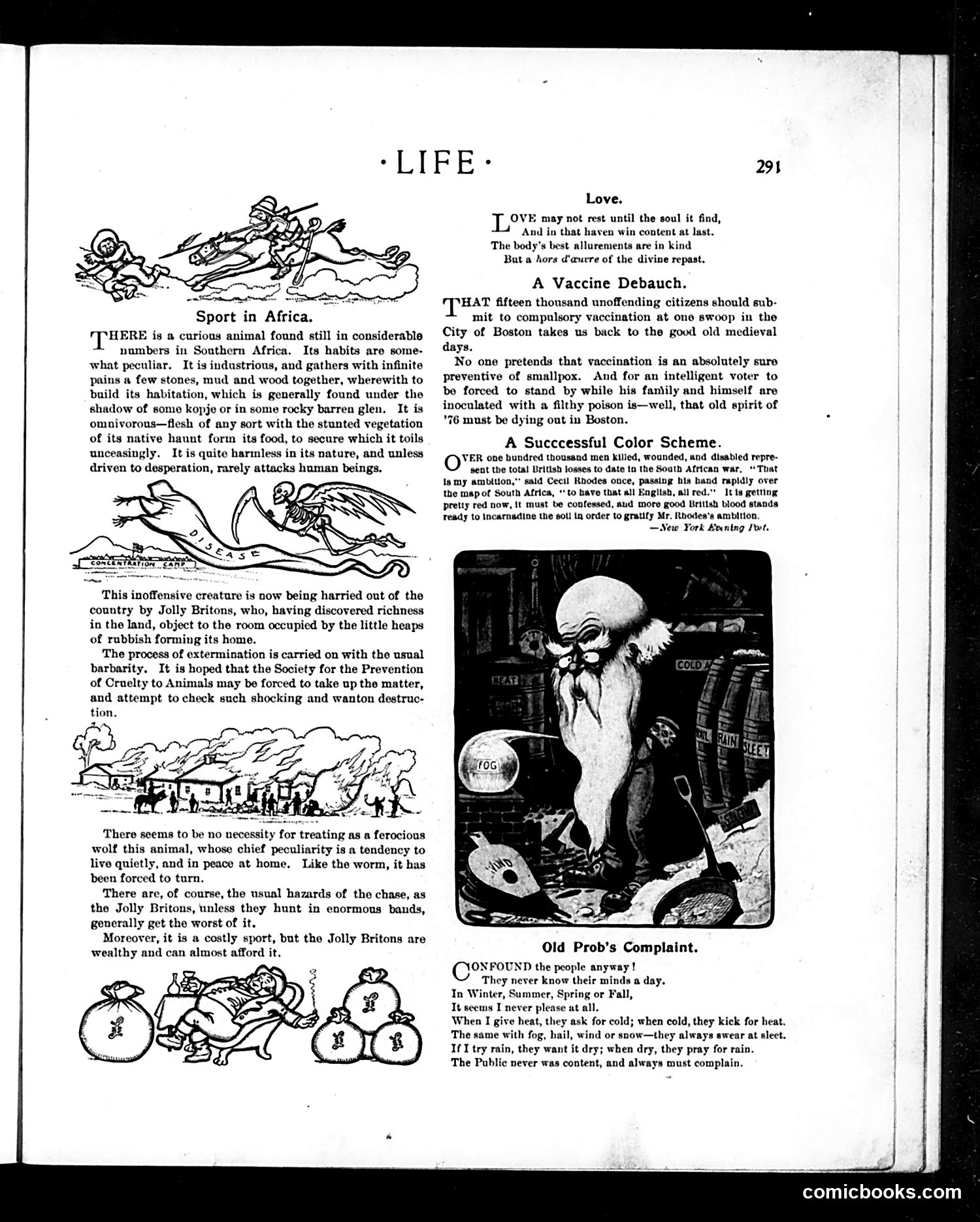
This page contains three distinct satirical pieces: **"Sport in Africa"** uses mock-serious language to mock British colonialism in South Africa. The "curious animal" is actually a metaphor for the native Boer population—described as industrious and peaceful, but being systematically hunted and exterminated by "Jolly Britons" seeking land wealth. The satire criticizes the violence and injustice of British imperial expansion as a "costly sport" for the wealthy. **"A Vaccine Debauch"** attacks compulsory vaccination laws in Boston as authoritarian overreach, comparing them to medieval tyranny and invoking Revolutionary War ("spirit of '76") ideals of individual liberty against government coercion. **"Old Prob's Complaint"** (prob = probability/weather) personifies weather/fate as perpetually criticized by an ungrateful public—a lighthearted complaint that people always complain regardless of conditions. The accompanying illustration shows an elderly bearded man, likely representing "Old Prob" or general misfortune.
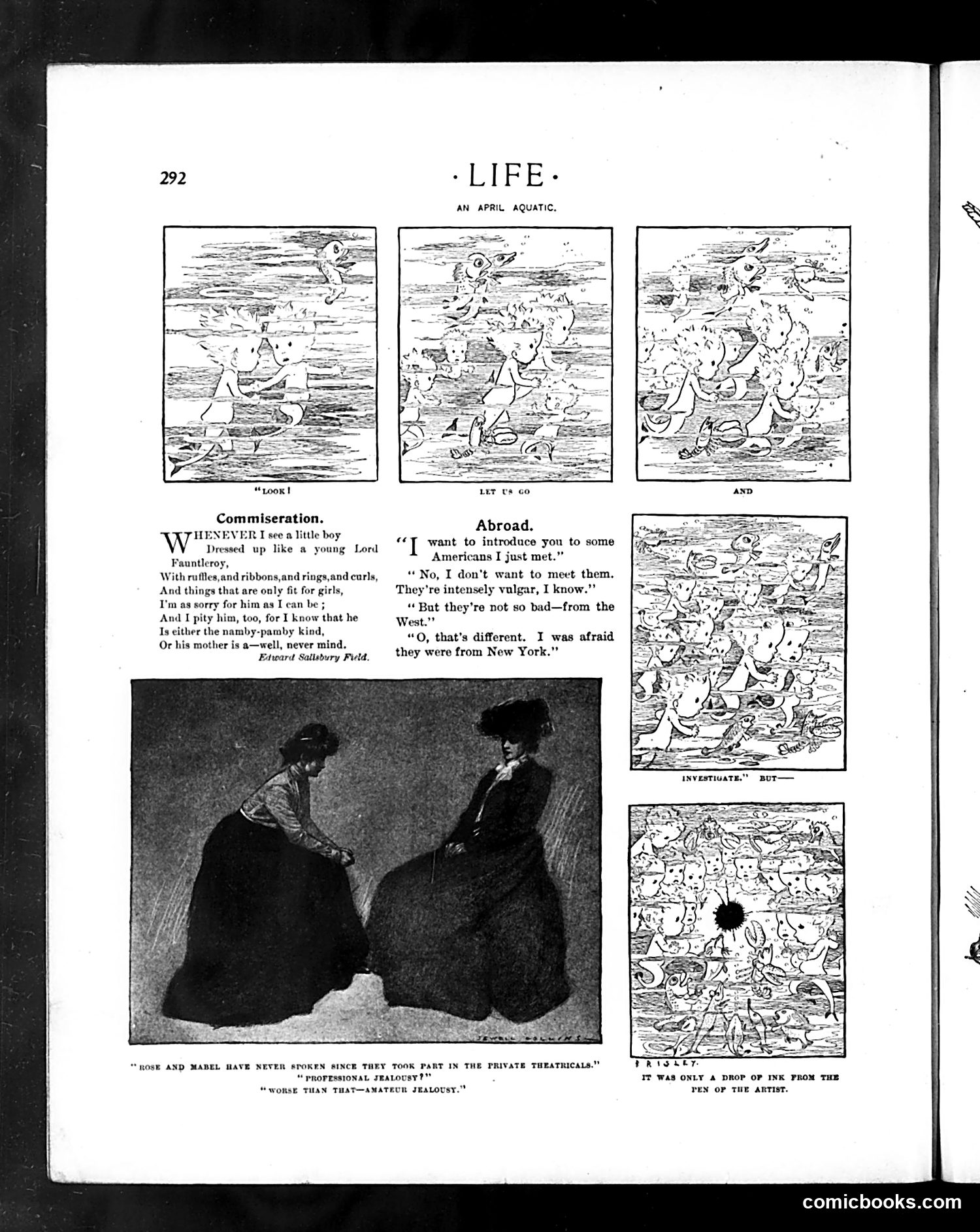
This page contains three distinct satirical pieces: **"Commiseration"** (left): A poem mocking mothers who dress young boys in "Lord Fauntleroy" style—frilly, feminine clothing with ruffles and curls. The satire targets both the fashion trend and the mothers who impose it, suggesting such dress reflects poorly on the child's character or the mother's judgment. **"Abroad"** (center): A dialogue joke about American snobbery. A character refuses to meet Americans because they're "vulgar," but agrees once told they're from the West rather than New York—satirizing the East Coast assumption that New Yorkers (urban Americans) are worse than Westerners, inverting typical regional prejudices. **Photograph caption** (bottom left): A quip about two women who've stopped speaking after acting together in amateur theatricals, with the caption suggesting amateur jealousy is worse than professional jealousy. **"April Aquatic"** (right): Comic illustrations of people at water/swimming, with a final panel joke about an inkblot from the artist's pen. The page reflects turn-of-century American anxieties about class, gender presentation, and regional/urban identity.
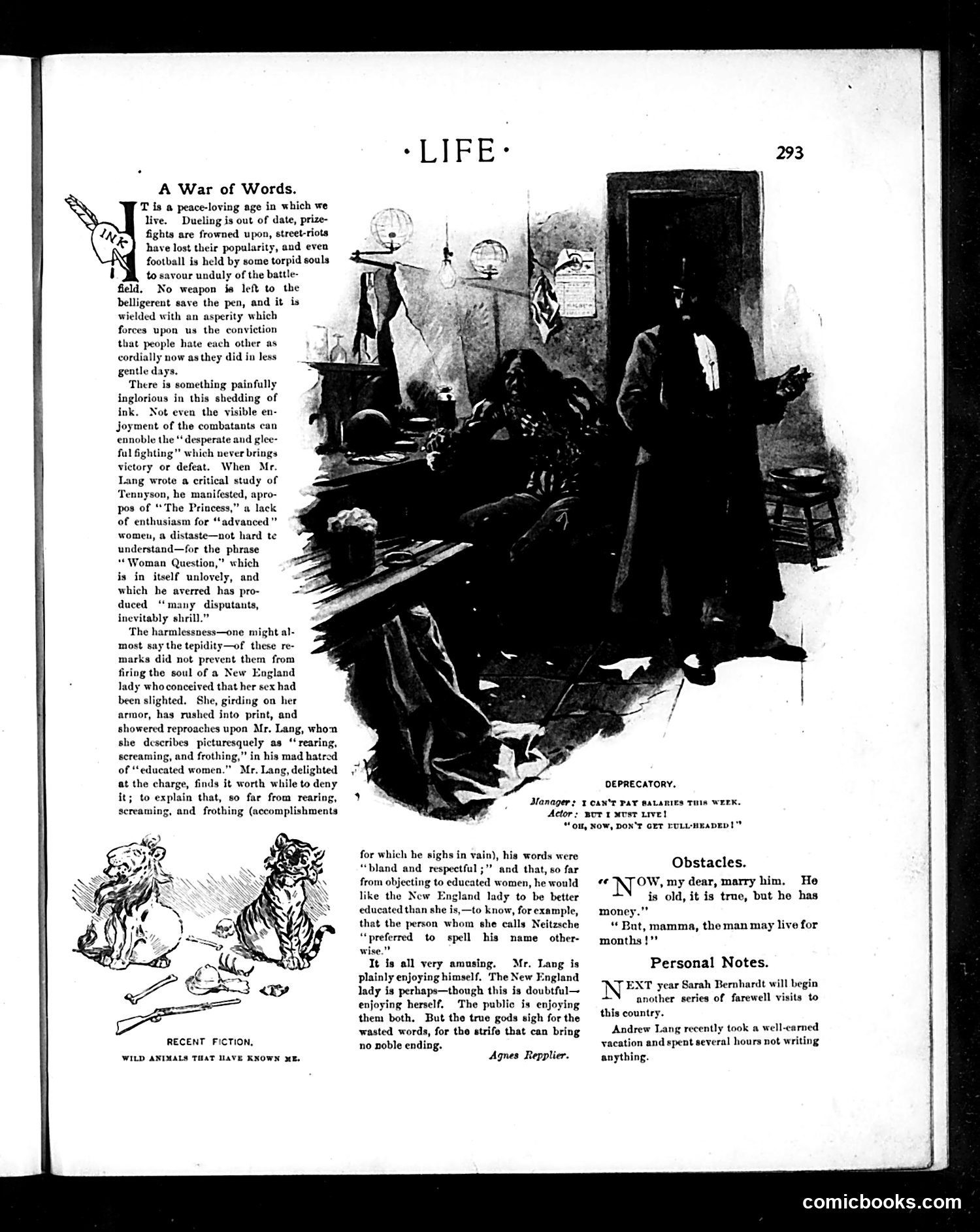
This page satirizes intellectual literary feuding of the late 19th century. The main article critiques a written argument between critic **Andrew Lang** (a real literary figure) and an unnamed New England woman regarding his critical remarks about Tennyson's "The Princess" and "advanced women." Lang had criticized the phrase "Woman Question," prompting the woman to attack him in print, describing him as "rearing, screaming, and frothing." Lang then publicly defended himself, correcting her spelling of Nietzsche's name. The satire's point: while society has abandoned physical violence, people now wage vicious ink-based battles over trivial matters with equal passion—yet these wordy conflicts produce no meaningful victor or resolution, only wasted words and public amusement at both combatants' expense. The lower cartoons mock contemporary absurdities: an actor's financial anxiety and a woman prioritizing a wealthy suitor's imminent death over his age.
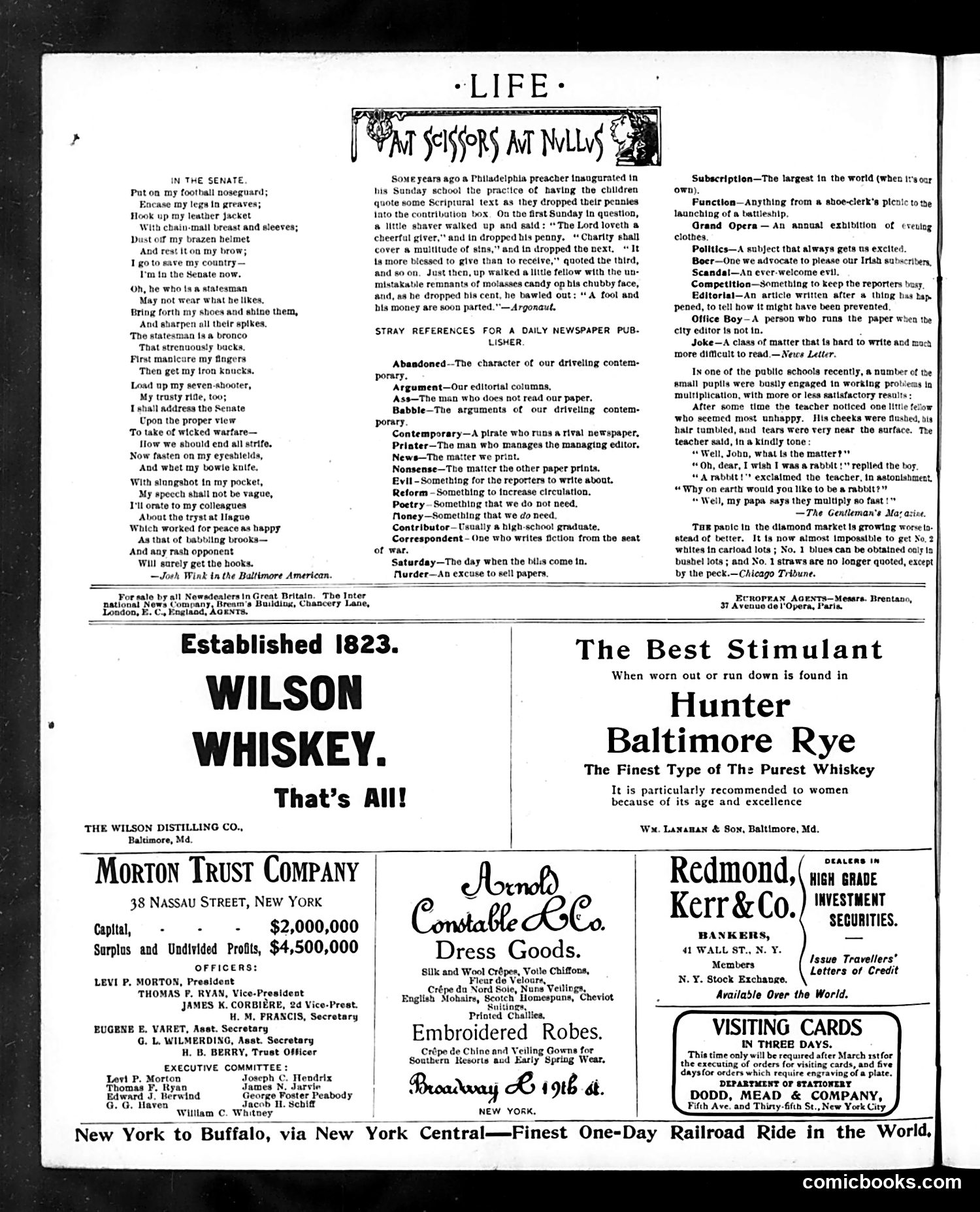
This poem mocks U.S. Senators as ineffectual peacemongers who arm themselves like medieval warriors before spouting empty rhetoric about ending conflict. The speaker ironically prepares for "battle" with absurd weapons (slungshot, iron knuckles, bow and knife) before delivering a Senate speech about peace—suggesting Senators are simultaneously aggressive yet accomplish nothing meaningful. The satire likely targets early 20th-century Senate debates over American military intervention and peace conferences (the "tryst at Hague" references peace negotiations). The joke: Senators pose as serious statesmen while their actual legislative output resembles children's posturing. The accompanying definitions mock newspaper editorial pretension—describing newspapers as self-serving, dishonest enterprises that celebrate scandals for circulation and define "news" as whatever *they* print while dismissing competitors' content as "nonsense." Both pieces exemplify *Life* magazine's satirical stance: exposing institutional hypocrisy and self-importance in government and media.
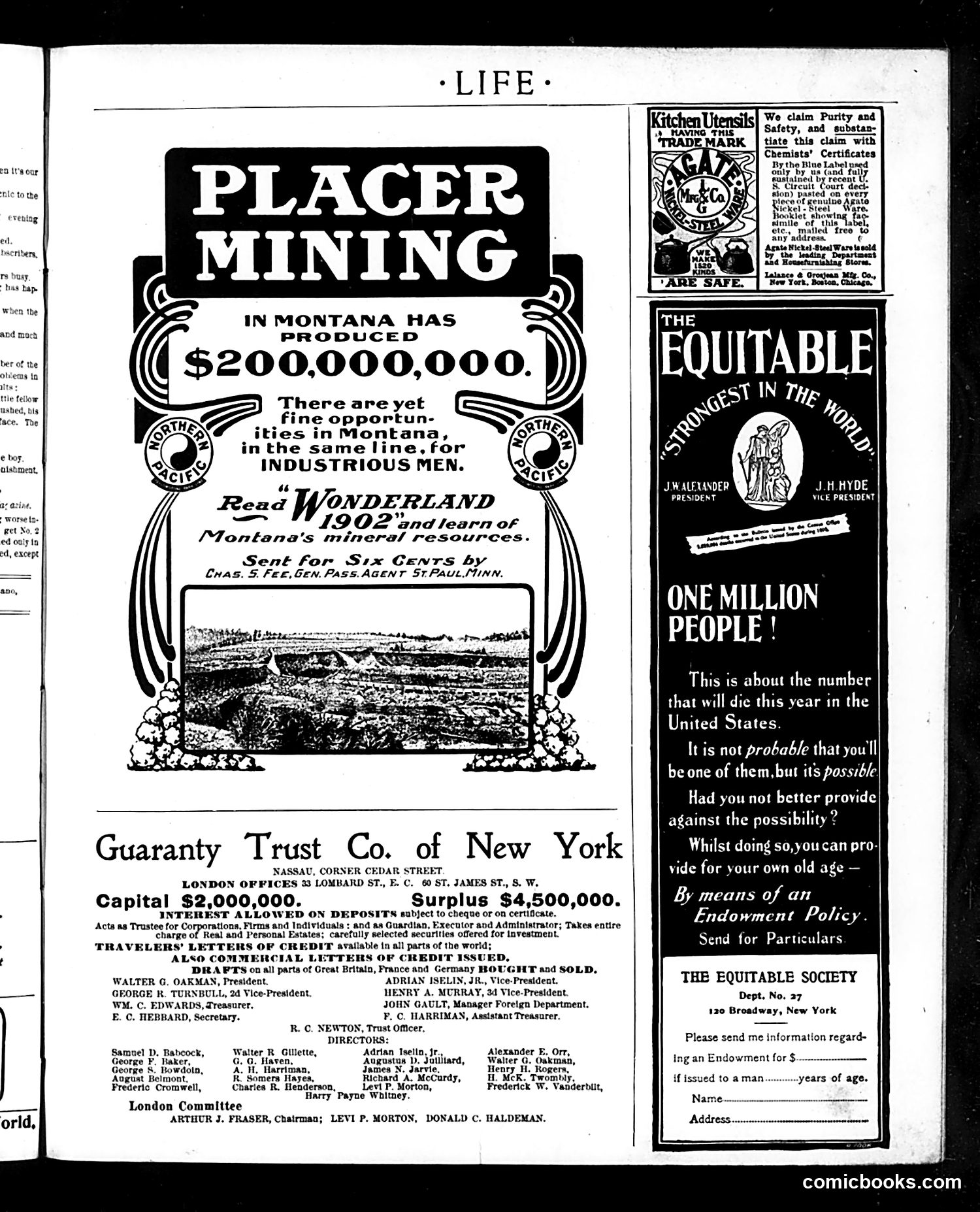
This page contains primarily **advertisements** rather than political satire or editorial cartoons. The dominant ad promotes **placer mining opportunities in Montana**, claiming the state has produced $200 million in gold from such mining. It promises "fine opportunities" remain for industrious men, inviting readers to purchase a promotional booklet called "Wonderland 1902" for six cents. Below this is an ad for **Guaranty Trust Co. of New York**, a financial institution offering banking services, trustee arrangements, and letters of credit. The right column advertises **kitchen utensils** (Agate brand), a **life insurance endowment policy** from The Equitable Society, and a **publication about mortality** claiming one million Americans would die that year. These ads reflect early 1900s concerns: western economic expansion, financial security, household goods, and life insurance—not satirical commentary. The page serves primarily as commercial advertising revenue for the magazine.
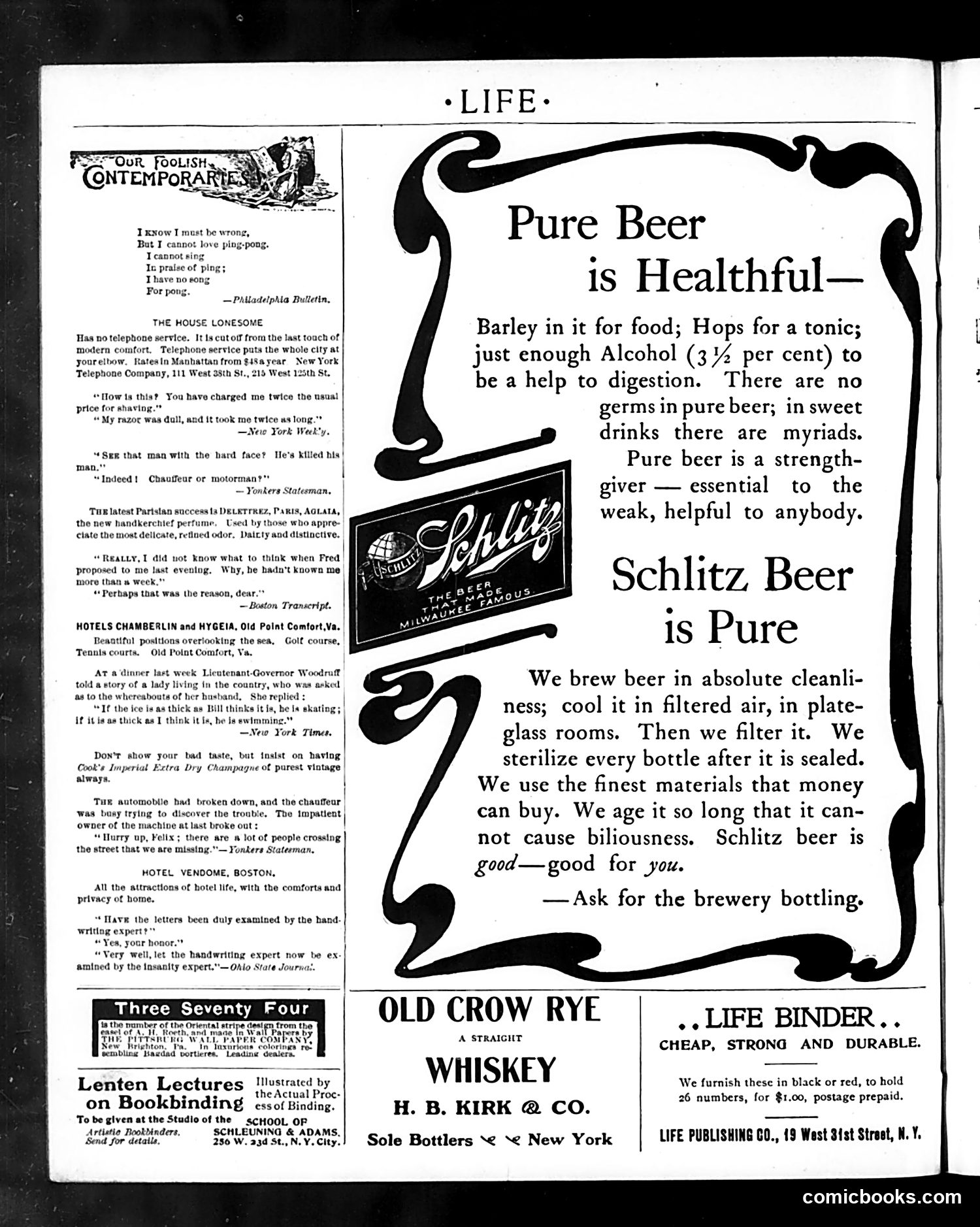
This page from Life magazine features primarily **advertisements and humorous short anecdotes** rather than political cartoons. The "Our Foolish Contemporaries" section collects brief jokes from newspapers mocking everyday absurdities—a dull razor charged at double price, a man's "hard face" suggesting he's a killer, and a Lieutenant-Governor's joke about a husband's whereabouts depending on ice thickness. The dominant content is **product advertising**, notably Schlitz Beer's prominent claim that "Pure Beer is Healthful," promoting its alcohol content (3½%) as digestive aid with no germs—a striking contrast to modern understanding. Other ads hawk hotels, champagne, perfume, and a "Life Binder." The satire is mild and domestic rather than political. The magazine targets contemporary social pretension and everyday foolishness through newspaper excerpts—reflecting Life's role as a genteel satirical publication for educated readers. The beer advertisement exemplifies early-20th-century marketing that presented alcohol as medicinal and healthful.
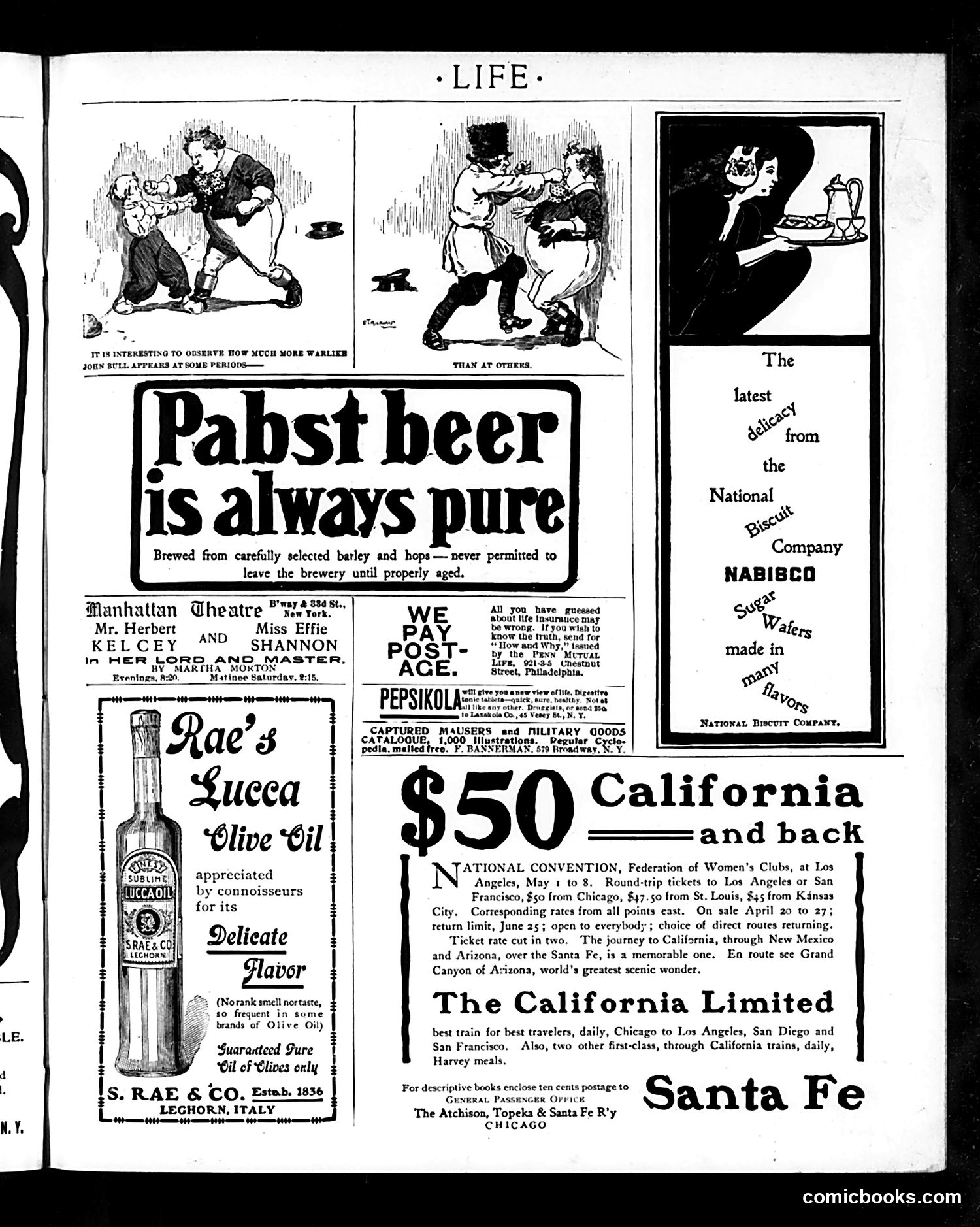
The top cartoon satirizes British military aggression. "John Bull" (the personified British Empire) is shown engaged in physical combat in two scenes, illustrating the caption's observation that Britain appears "more warlike" at certain periods than others. The cartoonist uses this anthropomorphic figure to comment on Britain's inconsistent foreign policy—sometimes aggressive, sometimes restrained—likely referencing contemporary imperial conflicts or diplomatic tensions of the era. The rest of the page is advertising: Pabst beer, theater listings, olive oil, Pepsi-Cola, National Biscuit Company products, and Santa Fe Railway travel promotions to California. These ads provide period context but contain no political content.
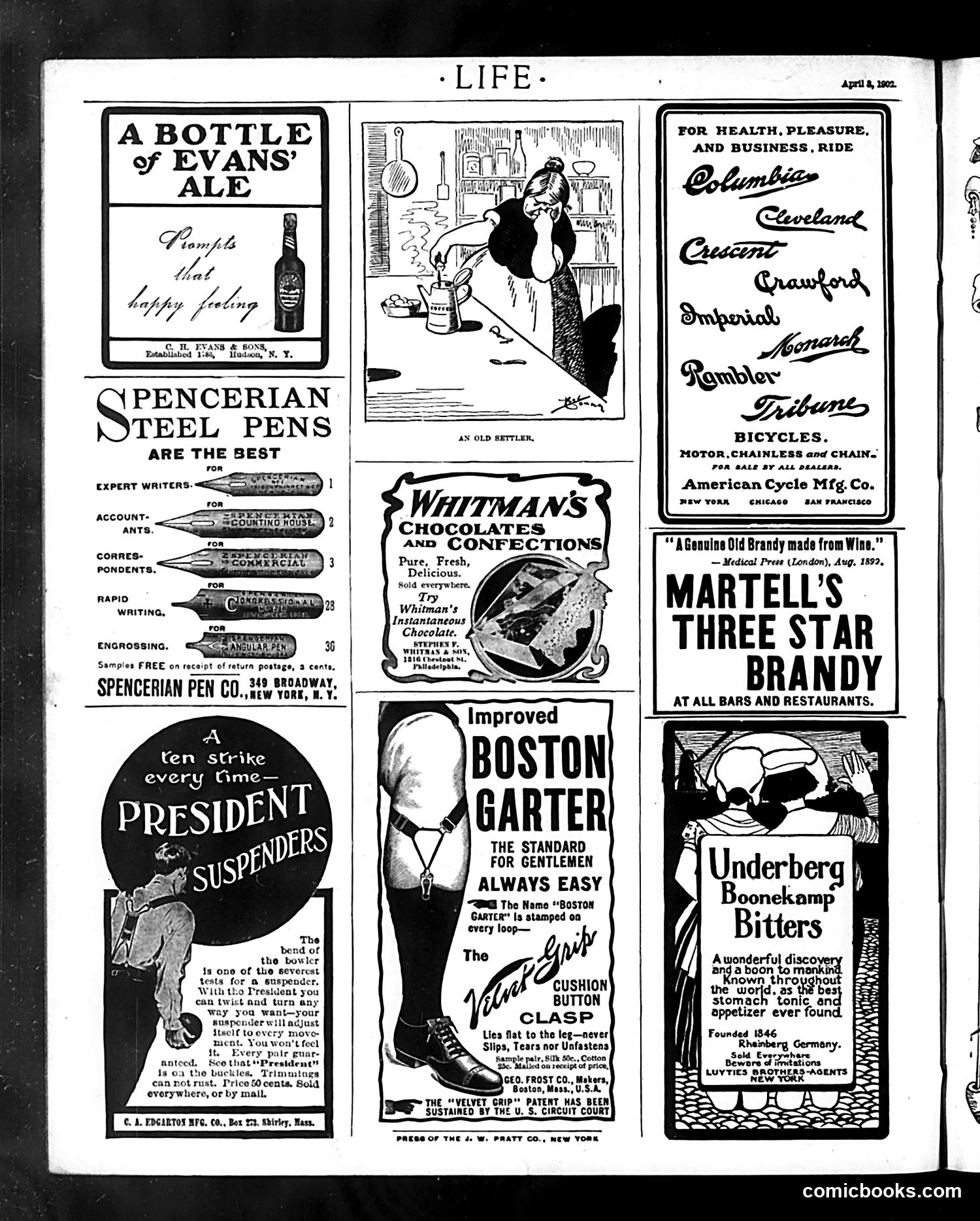
This page is primarily **advertising**, not editorial content or cartoons. The single illustrated element—labeled "AN OLD SETTLER"—shows a figure in period costume (appears to be 19th-century dress) struggling with what looks like a kitchen or household task, likely meant humorously. The illustration's purpose and specific satirical point are unclear from context alone. The rest of the page contains product advertisements typical of early 1900s Life magazine: writing instruments (Spencerian Pens), beverages (Evans' Ale, Martell's Brandy, Underberg Bitters), clothing (President Suspenders, Boston Garter), bicycles, and other consumer goods. These ads reflect period consumer culture and were the magazine's revenue source. Without additional editorial context, the cartoon's meaning cannot be reliably determined.