
Life, 1902-04-03 · page 7 of 20
Life — April 3, 1902 — page 7: what you’re looking at
What you’re looking at
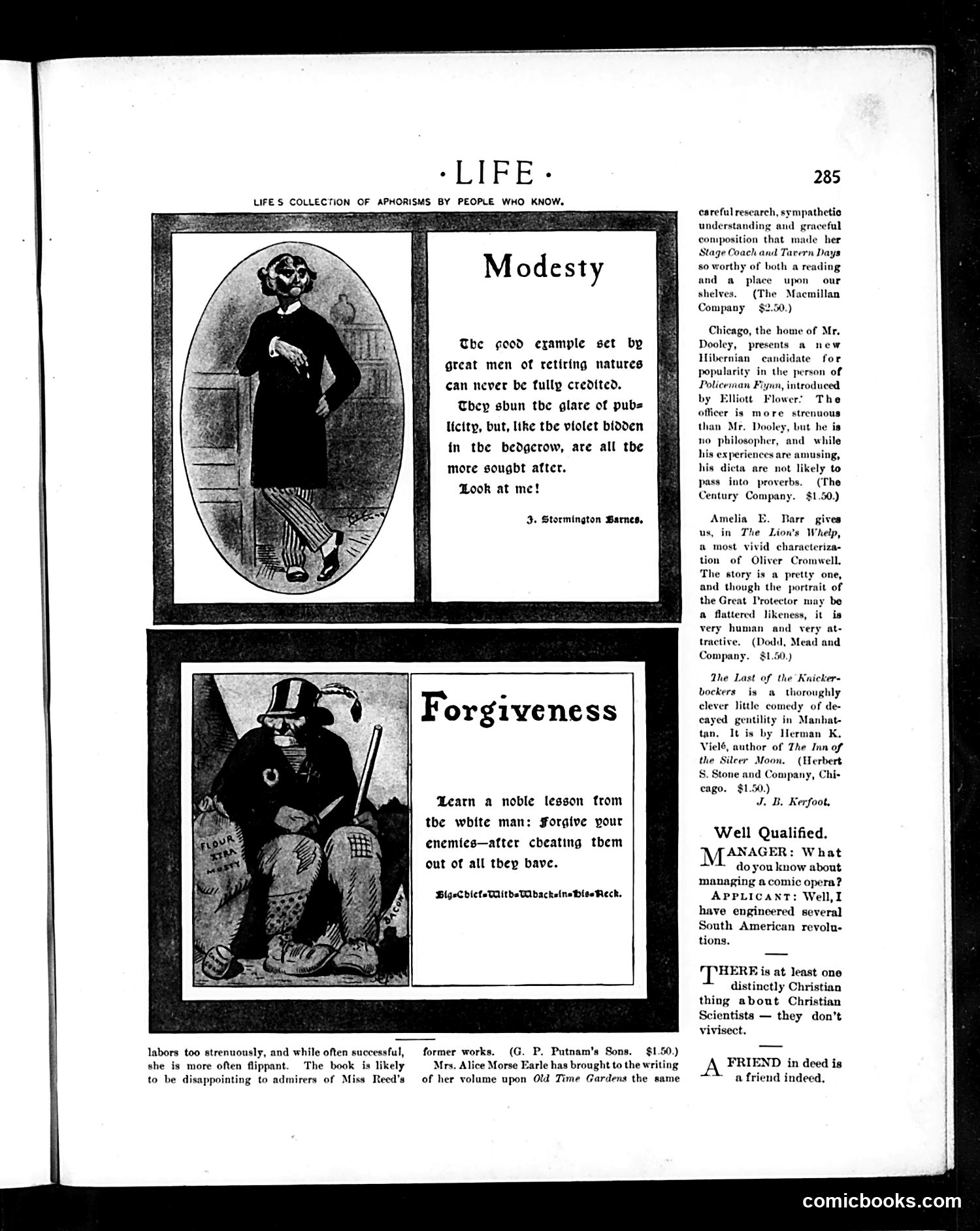
This page presents two aphoristic cartoons with accompanying quotes about virtue. **"Modesty"** features a portrait of a woman in elegant dress with the quote attributed to J. Stormington Barnes: "The good example set by great men of retiring natures can never be fully credited. They shun the glare of publicity, but, like the violet hidden in the hedgerow, are all the more sought after. Look at me!" The satire is obvious: the statement contradicts itself—someone loudly proclaiming their own modesty while demanding attention ("Look at me!") demonstrates the opposite of genuine humility. This mocks hypocritical self-promotion disguised as virtue. **"Forgiveness"** shows a caricatured figure with the lesson: "Learn a noble lesson from the white man: forgive your enemies—after cheating them out of all they have." This appears to critique colonial or imperialist hypocrisy, suggesting Western claims to moral superiority ring hollow given exploitative practices.
📄 Transcribed text from this page (OCR, searchable)
Machine-transcribed from the original scan — historical spelling and the odd misread are preserved.
-LIFE.- 285 LIFES COLLECTION OF APHORISMS BY PEOPLE WHO KNOW. Rides careful research, sympathetic understanding and graceful composition that made her 3 Stage Coach and Tavern Days M ode sty H soworthy of both a reading and a place upon our shelves, (The Macmillan Company $2.50.) 4 Chicago, the home of Mr. The good example set by } = Dooley, presents a new Hibernian candidate for gteat men of retiring natures Me popolaiiiy Gn the person of can never be fully credited. Ha} Policeman Fiyun, introduced by Elliott Flower? The They shun the glare of pub= HI iicce ig more strenuous licity, but, like tbe violet bidden than Mr. Dooley, but he no philosopher, and while in tbe bedgcrow, are all the his a iertedces re’ anil ng, mote sougbt after. his dicta are not likel pass into proverbs. (The Look at me! Century Company. $1.50.) 9. Stormington Barnes, Amelia E. Barr gives us, in The Lion's Whelp, a most vivid characteriza- tion of Oliver Cromwell, The story is a pretty one, and though the portrait of the Great Protector may be a flattered likeness, it is very human and very at- (Dodd, Mead and Company. $1.50.) The Last of the Knicker- 3 bockers is a thoroughly Forgive ness clever little comedy of de- cayed gentility in Manhat- tan. It is by Herman K, Vielé, author of The Inn of the Silcer Moon. (Herbert S. Stone and Company, Chi- cago. $1.50.) earn a noble lesson trom J. B. Kerfoot, the white man: Forgive pour enemies—after cbeating tbem out of all thep bave. Well Qualified. ANAGER: What M do you know about. managing a comic opera? BlgeC dictaWiitbsWibacksinebiseReck. APPLICANT: Well, I have engineered several South American revola- y tions. a | “Go Vb See — Ss A ae TPHERF is at 1 mS) Sis at least one Ee siaaeein Eee distinctly Christian thing about Christian Scientists — they don’t vivisect. labors too strenuously, and while often successful, former works. (G. P. Putnam's Sons, $1.50.) = she is more often flippant. ‘The book is likely Mrs. Alice Morse Earle has brought to the writing FRIEND in deed ia to be disappointing to admirers of Miss Reed's of her volume upon Old Time Gardens the same a friend indeed. comicbooks.com