
Life, 1902-04-03 · page 4 of 20
Life — April 3, 1902 — page 4: what you’re looking at
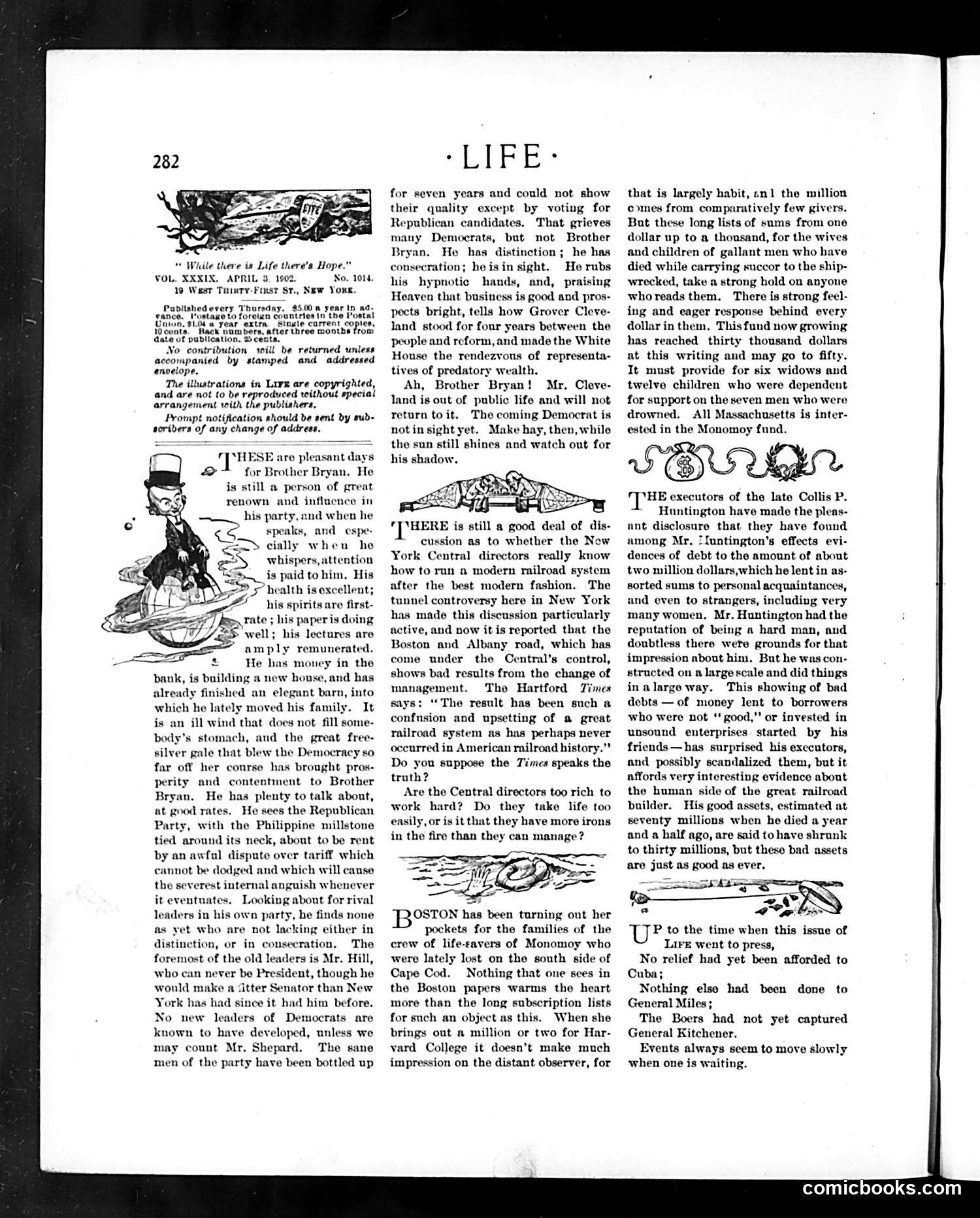
What you’re looking at
The main illustrated figure on the left depicts a well-dressed gentleman in a top hat, likely representing a wealthy industrialist or politician of the Gilded Age period. The cartoon satirizes the disconnect between the elite and working classes—a common Life magazine theme. The text discusses Brother Bryan (William Jennings Bryan), the three-time presidential candidate, and Grover Cleveland, who had recently left office. It critiques Cleveland's association with wealthy figures like Collis P. Huntington, a railroad magnate, highlighting the hypocrisy of Democratic reformers accepting railroad money while claiming to oppose monopolistic wealth concentration. The references to railroad management disputes and the Boer War context date this to 1902.
📄 Transcribed text from this page (OCR, searchable)
Machine-transcribed from the original scan — historical spelling and the odd misread are preserved.
While there is Life there's Hope.” VOL. XXXIX. APRIL 3, 1902. No. 1014. 19 Wasr Tuiety-Finst St., NEW YORK. lished every Thursday. $5.00 a year in ad. axe to foreign countries tn the Postal $lian year extra. Siugle current coples, Uni 1Oconts. “Rack numbers, after three months from date of publication, % centa, No contribution will be returned unless accompanied by stamped and addressed envelope. The illustrations in Lrve are copyrighted, and are not to be reproduced without special arrangement with the publishers. Prompt notification should be sent by sub- soribers of any change of address. ([HESE aro pleasant days 2 for Brother Bryan. He is still a person of great renown and influence in his party, and when he “Se peas, and. espe. <> cially when he whispers, attention >~_ is paid to him, His \S <> health is excellent; spirits are first- paper is doing ; his lectures are amply remunerated. He has money in the ing a new house, and has already finished an elegant barn, into which he lately moved his family. It is an ill wind that does not fill some- body’s stomach, and the great free- silver gale that blew the Democracy so far off her course has brought pros- perity and contentment to Brother Bryan. He has plenty to talk about, at good rates. He sees the Republican Party, with the Philippine millstone tied around its neck, about to be rent by an awfal dispute over tariff which cannot be dodged and which will cause the severest internal anguish whenever it eventuates. Looking about for rival leaders in his own party, he finds none as yet who are not lacking either in distinction, or in consecration. The foremost of the old leaders is Mr. Hill, who can never be President, though he would make a ‘itter Senator than New York has had since it had him before. No new leaders of Democrats are known to have developed, unless we may count Mr. Shepard. The sane men of the party have been bottled up LIFE for seven years and could not show their quality except by voting for Republican candidates. That grieves many Democrats, but not Brother Bryan. He has distinction; he has consecration; he isin sight. He rubs his hypnotic hands, and, praising Heaven that business is good and pros- pects bright, tells how Grover Cleve- land stood for four years between the people and reform, and made the White House the rendezvous of representa- tives of predatory wealth, Ah, Brother Bryan! Mr. Cleve- land is out of public life and will not return toit, The coming Democrat is notinsightyet. Make hay, then, while the sun still shines and watch out for his shadow. [HERE is still a good deal of dis- cussion as to whether the Now York Central directors really know how to run a modern railroad system. after the best modern fashion. The tunnel controversy here in New York has made this discussion particularly active, and now it is reported that the Boston and Albany road, which has come under the Central’s control, shows bad results from the change of management. Tho Hartford Times says: “The result has been such a confusion and upsetting of a great railroad system as has perhaps never occurred in American railroad history.”” Do you suppose the Times speaks the truth? Are the Central directors too rich to work hard? Do they take life too easily, or is it that they have more irons in the fire than they can manage? OSTON has been turning out her pockets for the families of the crew of life-avers of Monomoy who were lately lost on the south side of Cape Cod. Nothing that one sees in the Boston papers warms the heart more than the long subscription lists for such an object as this. When she brings out a million or two for Har- vard College it doesn’t make much impression on the distant observer, for that is largely habit, cn1 the million comes from comparatively few givers. But these long lists of sums from one dollar up to a thousand, for the wives and children of gallant men who have died while carrying succor to the ship- wrecked, take a strong hold on anyone whoreads them, There is strong feel- ing and eager response behind every dollar in them. This fund now growing has reached thirty thousand dollars at this writing and may go to fifty. It must provide for six widows and twelve children who were dependent for support on the seven men who were drowned. All Massachusetts is inter- ested in the Monomoy fund. SESE [T= executors of the late Collis P. Huntington have made the pleas- ant disclosure that they have found among Mr. [Iuntington’s effects evi- donces of debt to the amount of about two million dollars,which he lent in as- sorted sums to personal acquaintances, and even to strangers, including very many women. Mr. Huntington had the reputation of being a hard man, and doubtless there were grounds for that impression about him. But he was con- structed on a large scale and did things in alargoway. This showing of bad debts — of money lent to borrowers who were not ‘ good,” or invested in unsound enterprises. started by his friends —has surprised his executors, and possibly scandalized them, but it affords very interesting evidence abont the human side of the great railroad builder. His good assets, estimated at seventy millions when he died a year and a half ago, are said to have shrunk to thirty millions, but these bad assets are just as good as ever. te" Ca e < > P to the time when this issue of Lire went to press, No relief had yet been afforded to Cuba; Nothing elso had been done to General Mil The Boers had not yet captured General Kitchener. Events always seem to move slowly when one is waiting. comicbooks.com