
A complete issue · 20 pages · 1902
Life — February 27, 1902
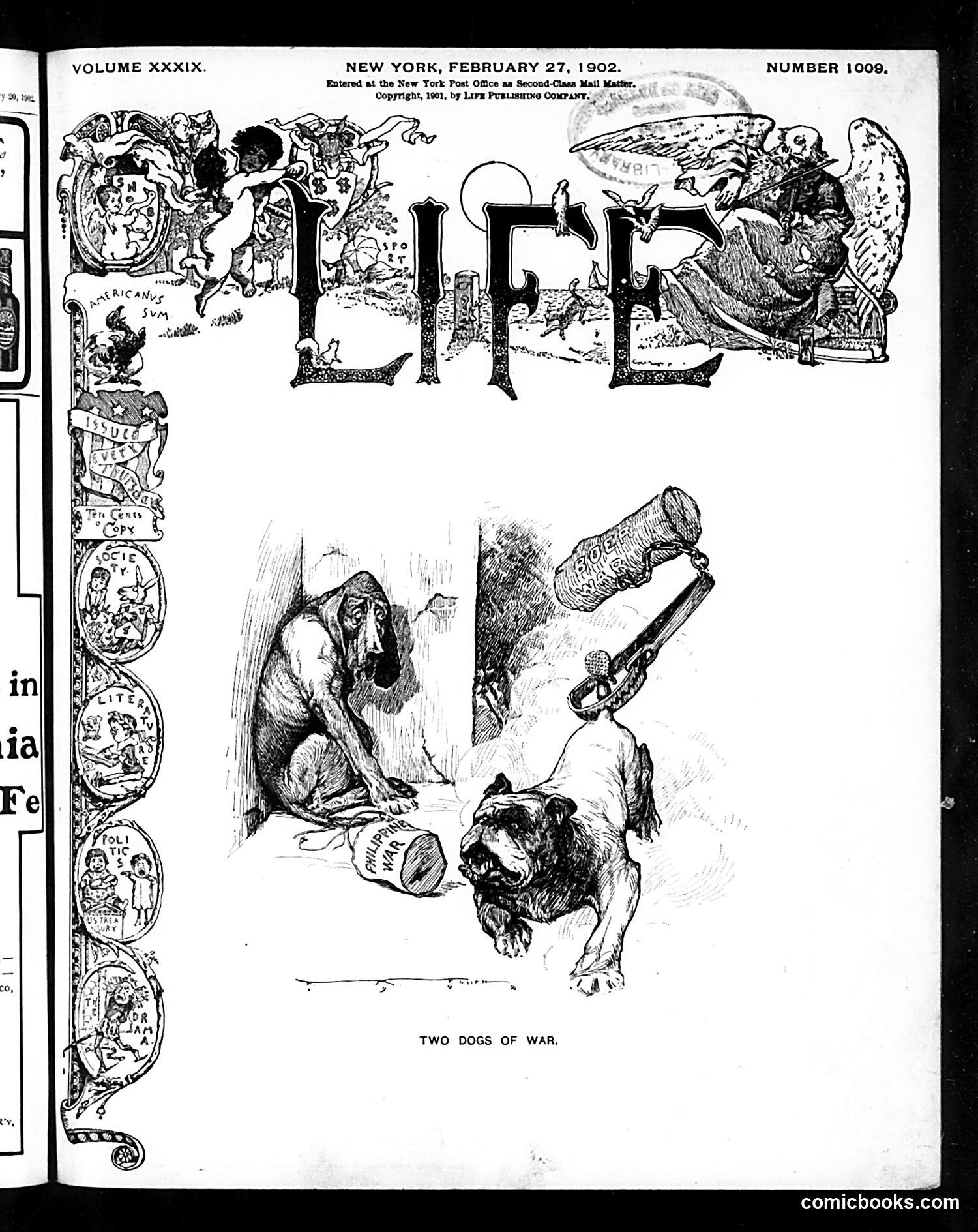
This cartoon satirizes the Boer War (1899-1902) in South Africa. The two dogs represent competing imperial powers fighting over colonial territory. One dog holds a telescope labeled "BRITISH," while the other clutches a barrel marked "FRENCH." They're snarling at each other over what appears to be a colonial prize or resource. The satire mocks how European nations competed ruthlessly for imperial dominance and resources in Africa, using military force ("war dogs") as their instruments. The dogs' animalistic behavior—fighting like beasts over scraps—comments on the brutality and irrationality of imperial conquest. The elaborate decorative border featuring classical mythology and the ornate "LIFE" masthead typical of the magazine's style frames this political commentary.
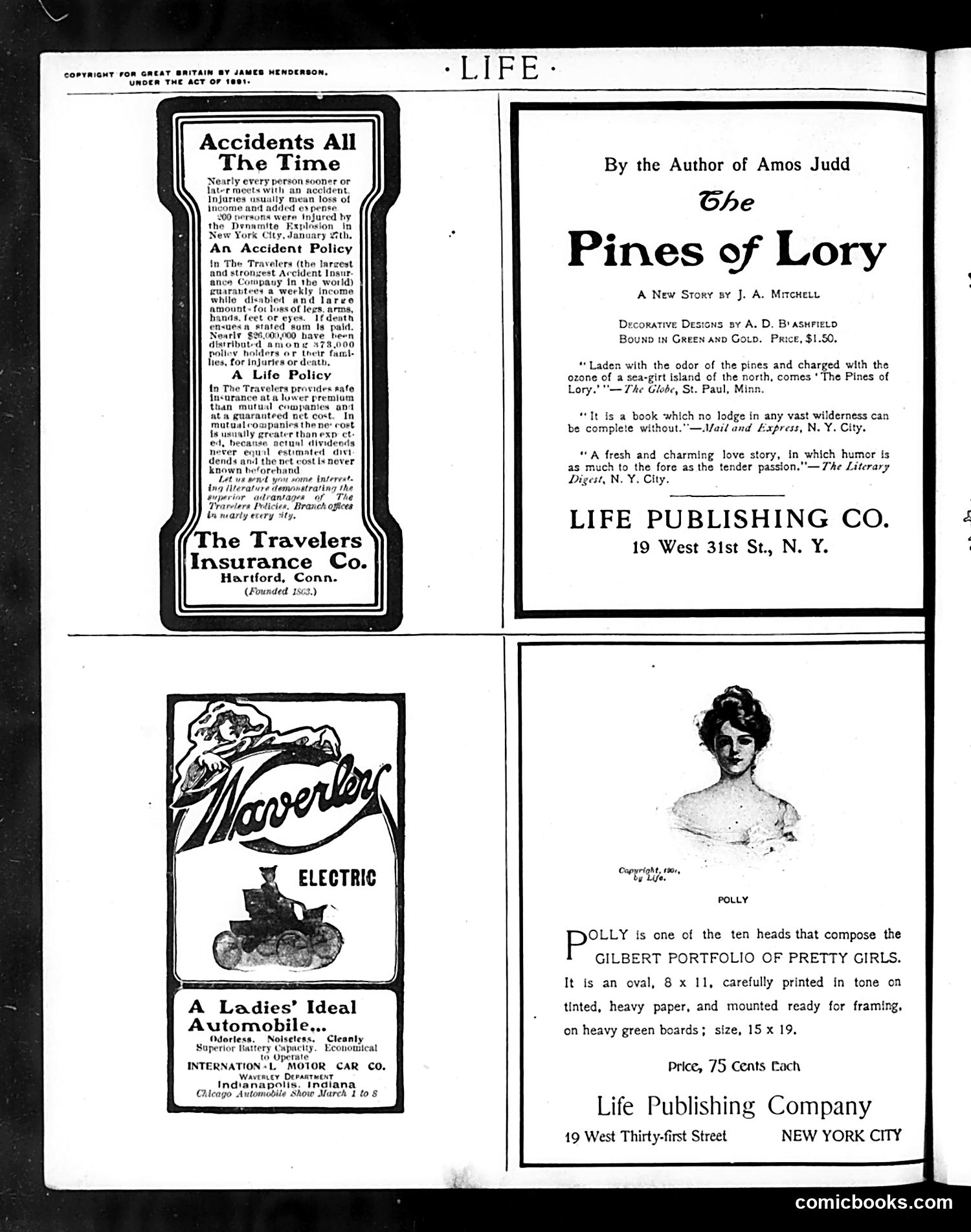
This page is predominantly **advertising** rather than satirical content. It contains three advertisements: 1. **The Travelers Insurance Co.** (top left) — promoting life insurance, emphasizing accident coverage and payouts to policyholders' families. 2. **"The Pines of Lory"** (top right) — a book advertisement for a new story by J.A. Mitchell, published by Life Publishing Co. 3. **Waverly Electric automobile** (bottom left) — promoting a "Ladies' Ideal Automobile" marketed as odorless, noiseless, and clean. 4. **Gilbert Portfolio of Pretty Girls** (bottom right) — advertising portrait prints called "Polly," priced at 75 cents each. The page reflects early 20th-century consumer culture targeting middle-class readers, with particular emphasis on products marketed specifically to women (automobiles, beauty portraits).
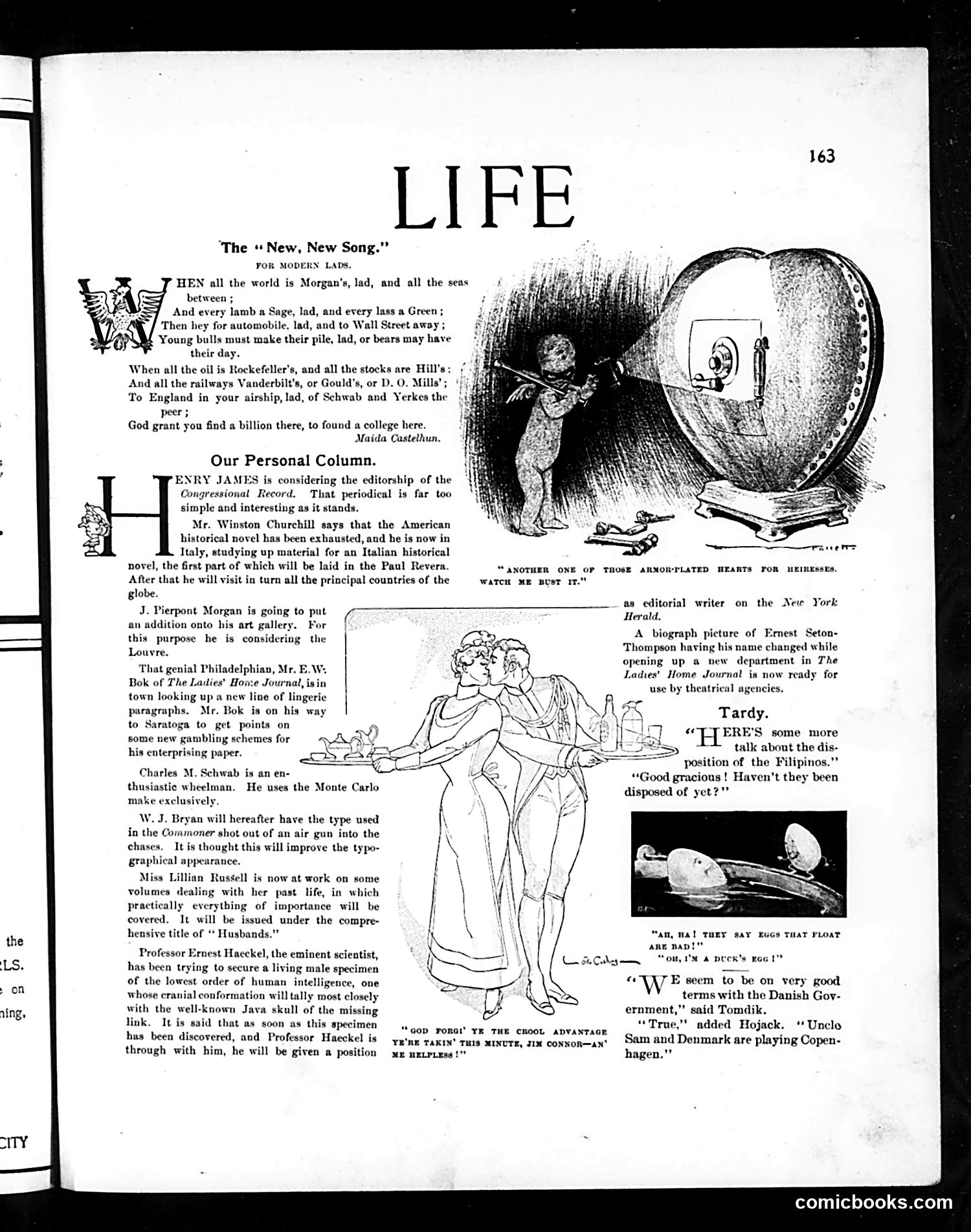
The page features satirical commentary on contemporary figures and events. The top cartoon shows a large, armor-plated heart labeled "Another one of those armor-plated hearts for heiresses. Watch we bust it."—mocking wealthy women's romantic defenses. The center illustration depicts a couple in an embrace, captioned "God forgive the crook, advantage we're taking this minute, Jim Connor—an' we helpless!"—suggesting ironic commentary on moral hypocrisy. The "Tardy" section includes a small photograph of eggs with dialogue "Ah, ha! They say eggs that float are bad!" / "Oh, I'm a duck's egg!"—a pun-based joke about egg quality. The "Personal Column" provides gossipy updates about literary and cultural figures, including references to Winston Churchill and various editors and journalists of the era. Overall, this is satirical commentary on high society, romance, and contemporary cultural figures.
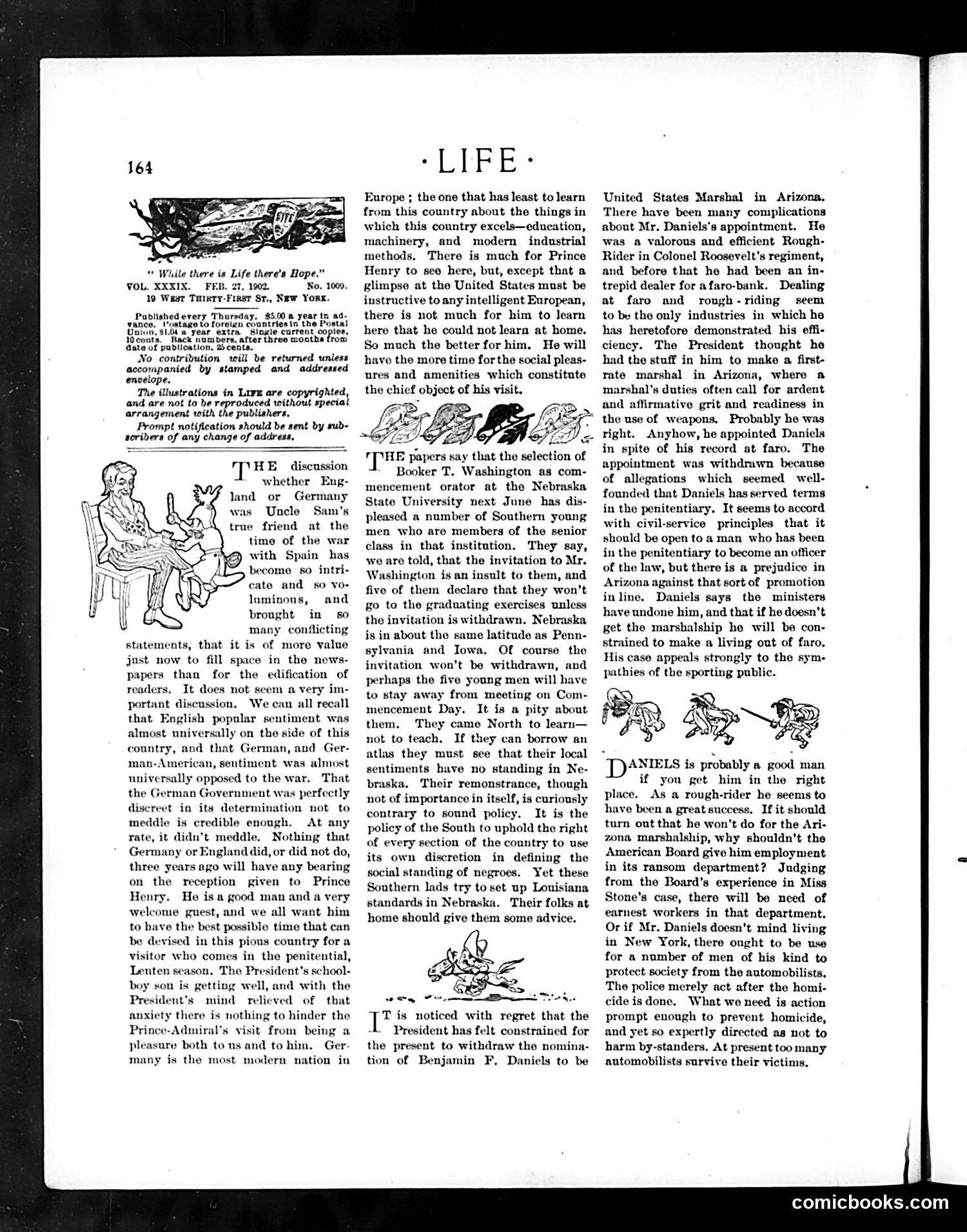
The page contains three editorial cartoons addressing contemporary political issues: 1. **Top cartoon** ("While there is Life there's Hope"): Appears to satirize European attitudes toward American industrial superiority and education. 2. **Middle cartoon**: Depicts a discussion about England and Germany as "Uncle Sam's true friends" during wartime, mocking European relations with the U.S. 3. **Bottom cartoon**: Criticizes President Theodore Roosevelt's withdrawal of Benjamin F. Daniels' nomination as United States Marshal in Arizona, apparently due to Daniels' questionable reputation as a faro dealer and his alleged involvement in penitentiary issues. The satire questions whether the President should protect society from such morally dubious appointments. The cartoons employ caricature and satirical commentary typical of Life magazine's political criticism of the Roosevelt era.
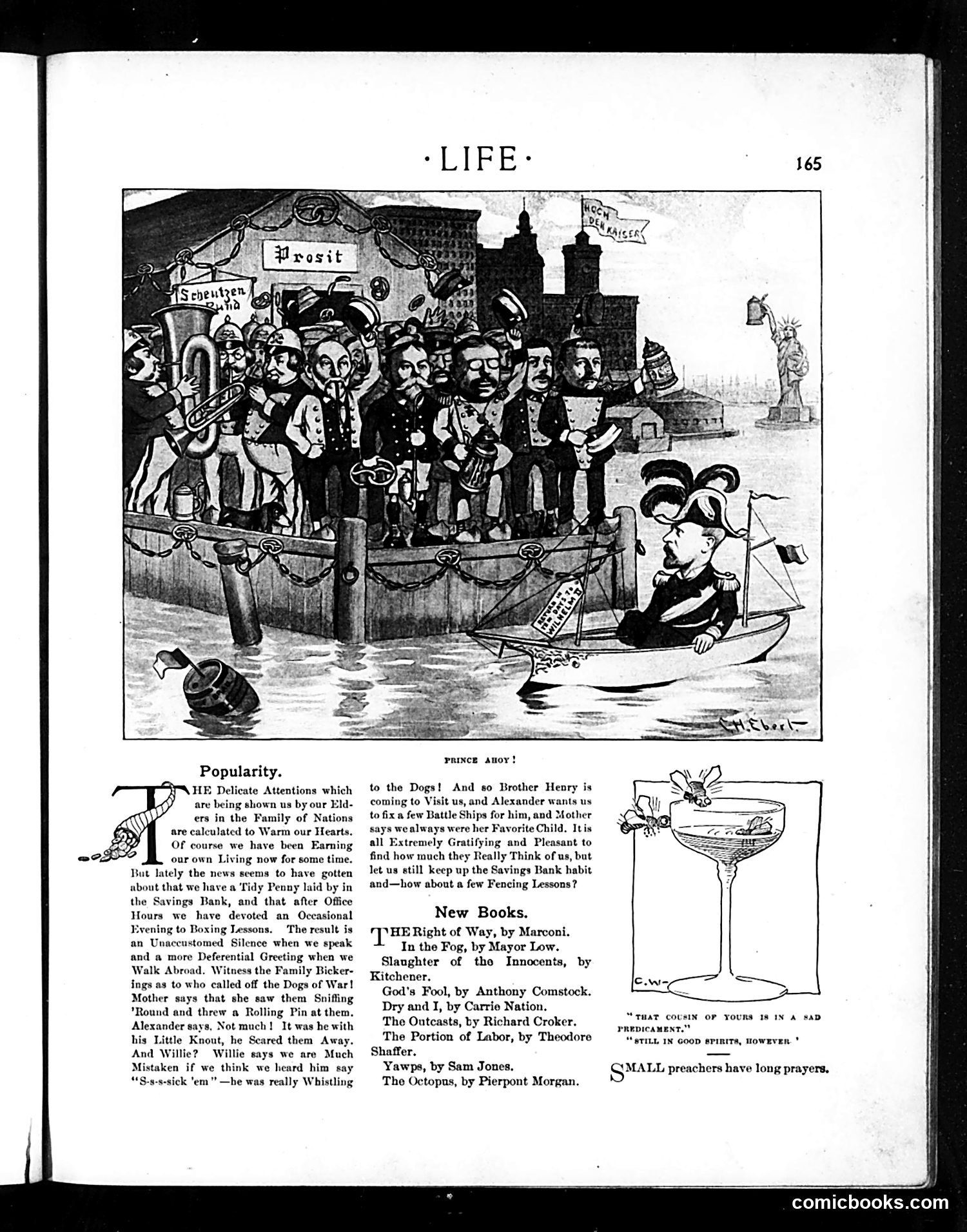
This political cartoon satirizes royal visits to Britain. The crowded boat labeled "Posit" contains caricatured dignitaries watching proceedings, while a solitary figure in a small boat below represents the common person observing from the water. The text references "Prince Ahoy" and mentions visits from "the Dogs" (likely political opponents), "Brother Henry," and "Alexander," suggesting multiple royal or political figures arriving. The satire mocks how Britain's upper classes enthusiastically welcome these visitors while common citizens remain marginalized observers. The accompanying text discusses the "Savings Bank" and "Boxing Lessons"—satirizing how working-class improvements are promoted while actual power and attention flow toward elite social visits. The overall point criticizes the disparity between public pageantry for the privileged versus genuine concern for ordinary people's welfare.
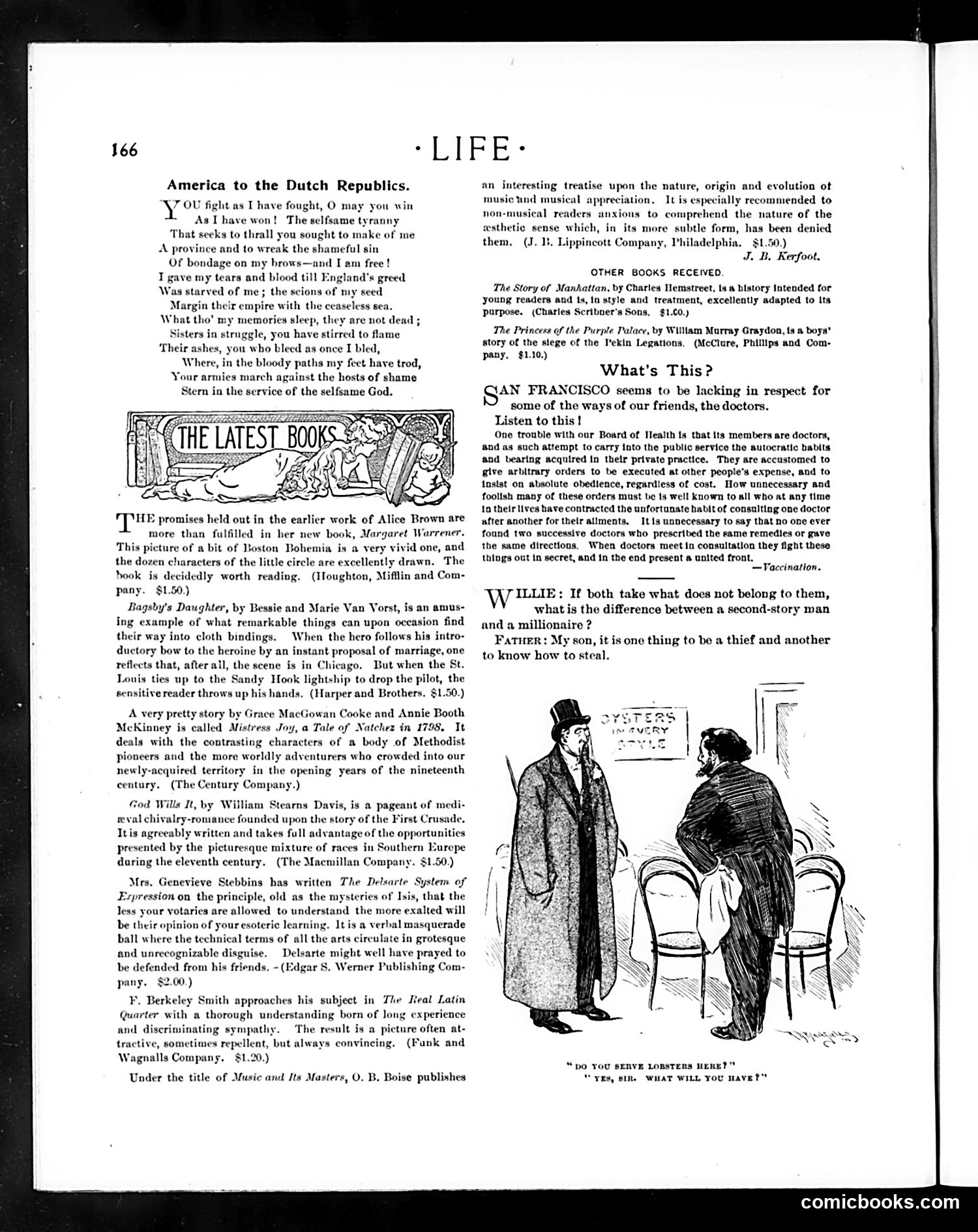
This cartoon satirizes San Francisco's medical profession through a dialogue about restaurant service. A well-dressed man asks a waiter about lobsters; the waiter responds evasively: "Yes, sir. What will you have?" The accompanying text "What's This?" criticizes San Francisco's Board of Health, alleging that its doctors routinely give conflicting medical advice based on private interests rather than patient welfare. The cartoon uses the lobster exchange as a metaphor: just as the waiter deflects the customer's question, the doctors allegedly evade responsibility by giving contradictory prescriptions, forcing patients to consult multiple physicians and enriching individual practitioners. The satire targets medical corruption and lack of professional accountability in early 20th-century San Francisco.
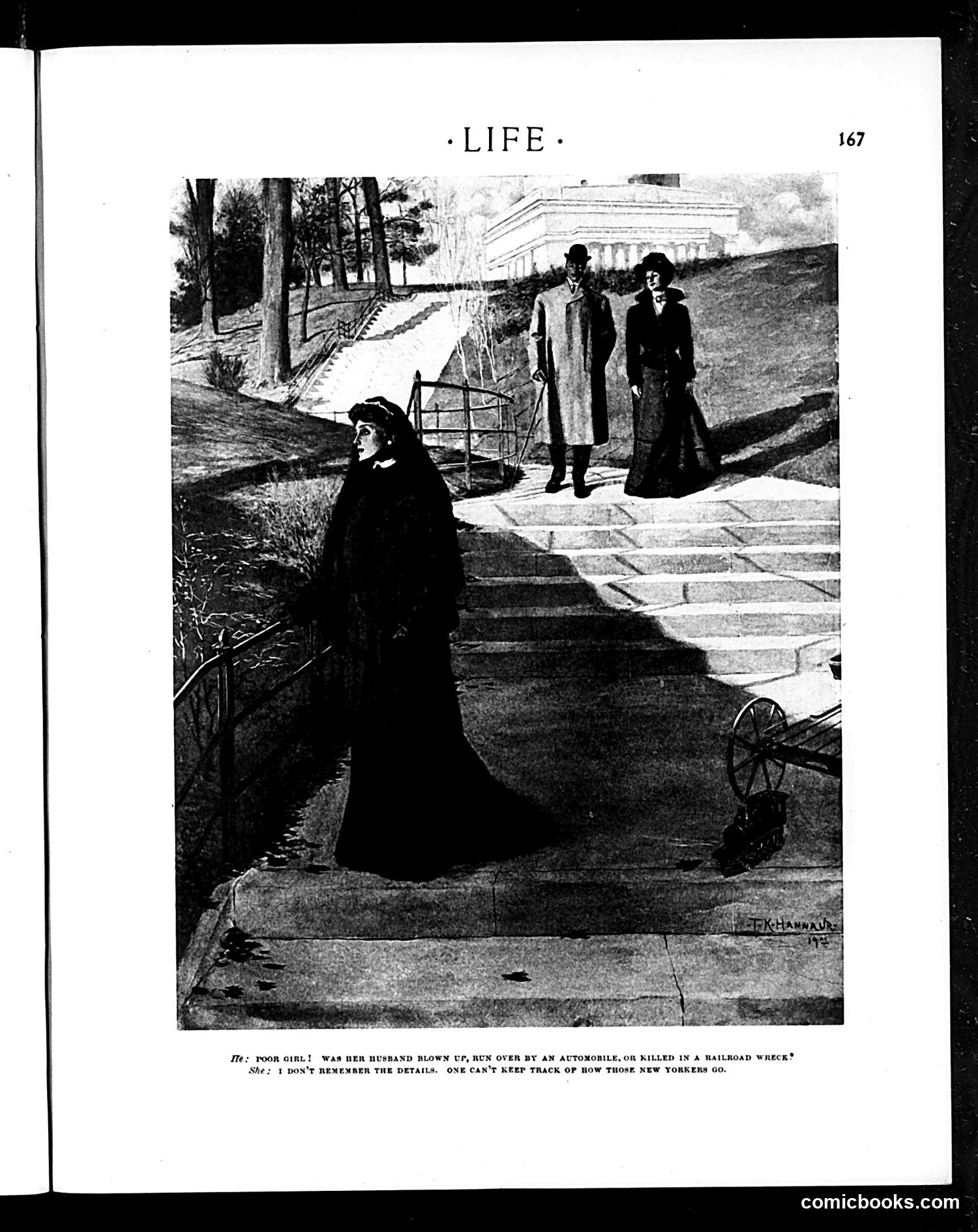
This illustration depicts a social commentary on urban poverty and working-class tragedy. A woman in dark clothing stands in the foreground near a baby carriage, while three figures observe from the background near what appears to be a grand institutional building (possibly government or civic). The caption presents a dialogue about a "poor girl" whose husband met an unspecified violent death—either struck by an automobile or killed in a railroad accident. The speaker claims not to remember details, concluding with sarcasm: "One can't keep track of how those new yorkers go." The satire targets class indifference: wealthy or middle-class observers remain emotionally distant from the tragedies afflicting poor workers in an industrializing city, treating such deaths as unremarkable occurrences too common to remember individually. The contrast between the grand architecture and the woman's apparent destitution reinforces this critique.
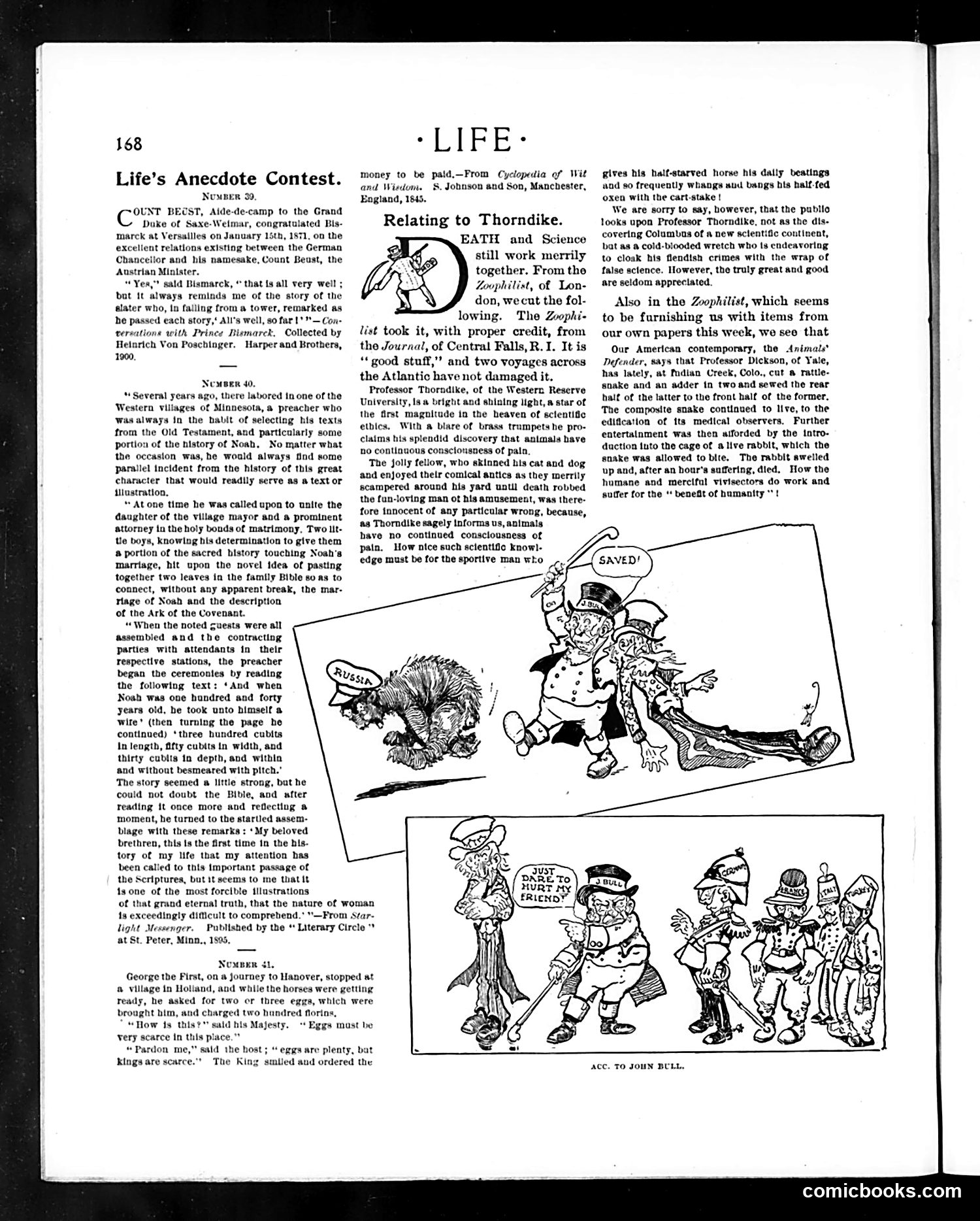
This page from *Life* magazine features cartoons by John Bull satirizing World War I diplomacy. The top cartoon depicts a confrontation between a figure labeled "RUSSIA" and a military officer saying "SAVED!" — likely referencing Russia's precarious position in the war or peace negotiations around 1917-1918. The lower cartoon shows military and political figures in discussion, with one asking "HOW DO YOU DO, GOOD FRIENDS?" This appears to satirize diplomatic negotiations or alliance-building during WWI, mocking the formal courtesies exchanged between nations engaged in brutal conflict. The cartoons use exaggerated caricature and ironic dialogue to critique the disconnect between diplomatic niceties and wartime realities. Without clearer identification of specific figures, the exact political figures targeted remain uncertain.
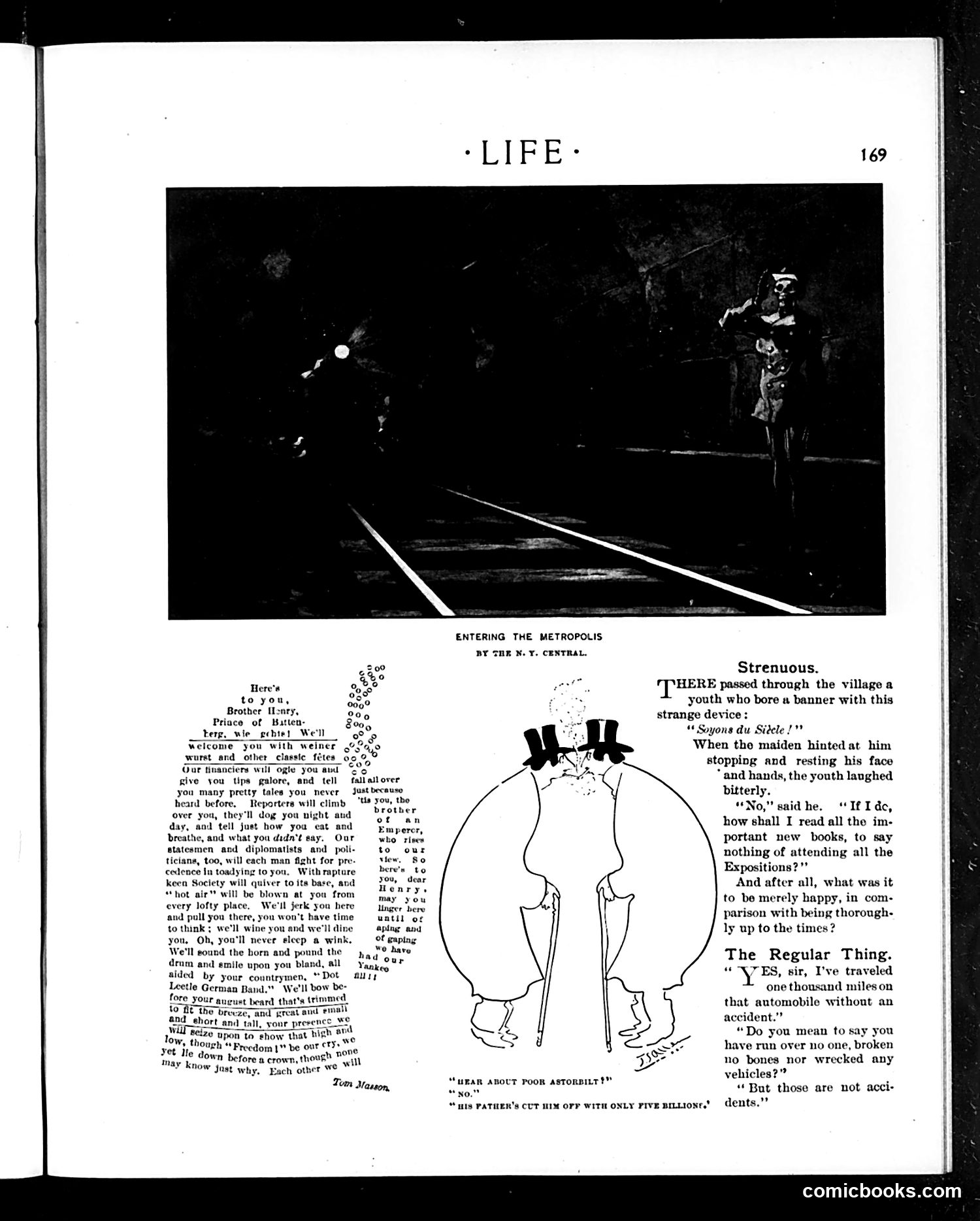
This page contains two separate satirical pieces targeting early 20th-century urban life. **Top Image:** "Entering the Metropolis by the N.Y. Central" depicts a railroad scene with a figure encountering a youth carrying a banner reading "Signes du Siècle!" ("Signs of the Century"). The youth mocks the newcomer's amazement at city life, suggesting that modern urban experiences—attending expositions and cultural events—are overrated compared to simple happiness. **Bottom Cartoon:** "Hear About Poor Automobiles!" ridicules wealthy automobile owners. The caption reveals the joke's target: a father cutting off his son with only five billion dollars due to automobile accidents. This satirizes both the nouveau riche's extravagant wealth and their reckless spending habits, particularly regarding expensive automobiles—then luxury items symbolizing wasteful excess. Both pieces mock contemporary urban pretension and wealth.
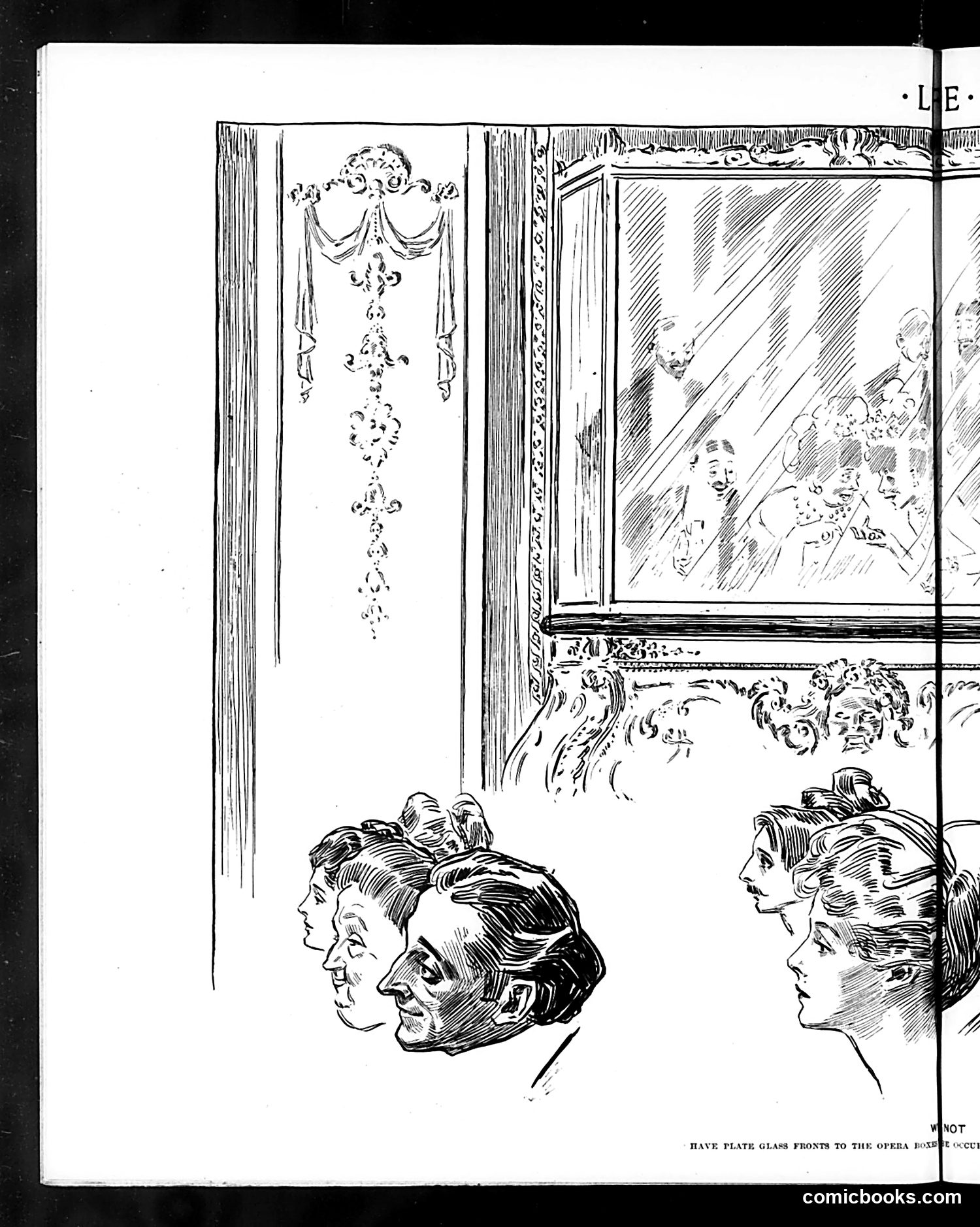
This page shows a satirical cartoon about opera-goers. The visible text fragment reads "HAVE FLATE GLASS FRONTS TO THE OPERA BOXES" (likely "FLAT GLASS FRONTS"). The image depicts three profile sketches of women's faces at the bottom, apparently representing society ladies attending the opera. Above them is an ornate opera box interior with decorative architectural elements and what appears to be other patrons visible through a window or opening. The joke appears to criticize wealthy opera attendees—specifically suggesting that opera boxes should have "flat glass fronts" so the audience could better see the fashionably-dressed patrons. This satirizes the social performance aspect of opera attendance among the elite, where being seen was as important as watching the performance itself. The caricatured female profiles emphasize their prominent noses, a common satirical technique.
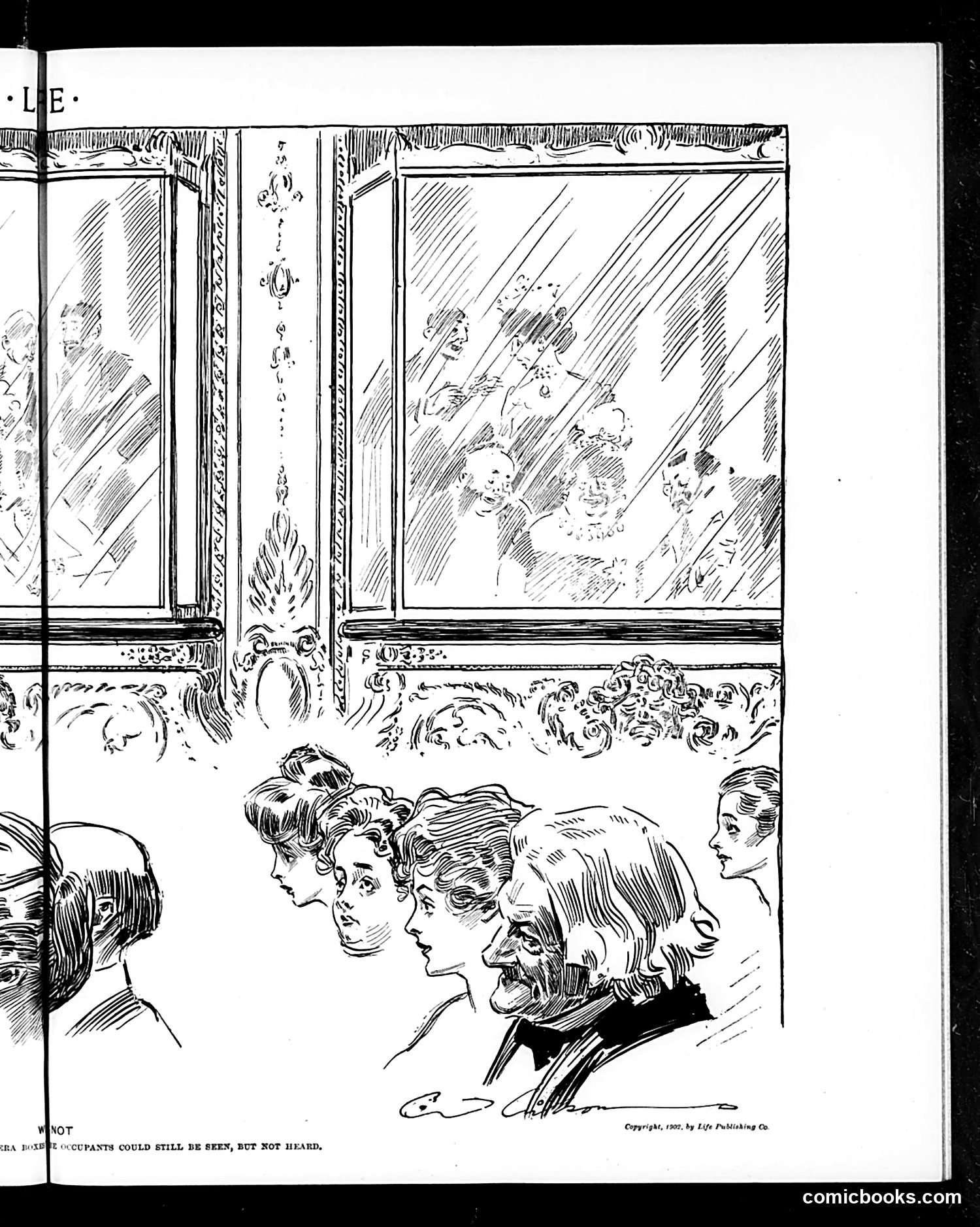
This appears to be a satirical cartoon from *Life* magazine showing well-dressed women observing a rainstorm through a window. The caption reads: "OCCUPANTS COULD STILL BE SEEN, BUT NOT HEARD." The joke targets the social pretense of the women in the foreground—they're fashionably dressed and composed while watching figures (visible through the rain-streaked window above) who appear to be caught in bad weather. The humor likely plays on the contrast between indoor comfort and outdoor misery, or satirizes how the wealthy insulated themselves from others' hardships while maintaining social appearances. The style and "Life Publishing Co." credit date this to the early 20th century. Without clearer identifying details, the specific targets remain unclear, though the satire appears directed at class dynamics and social indifference.
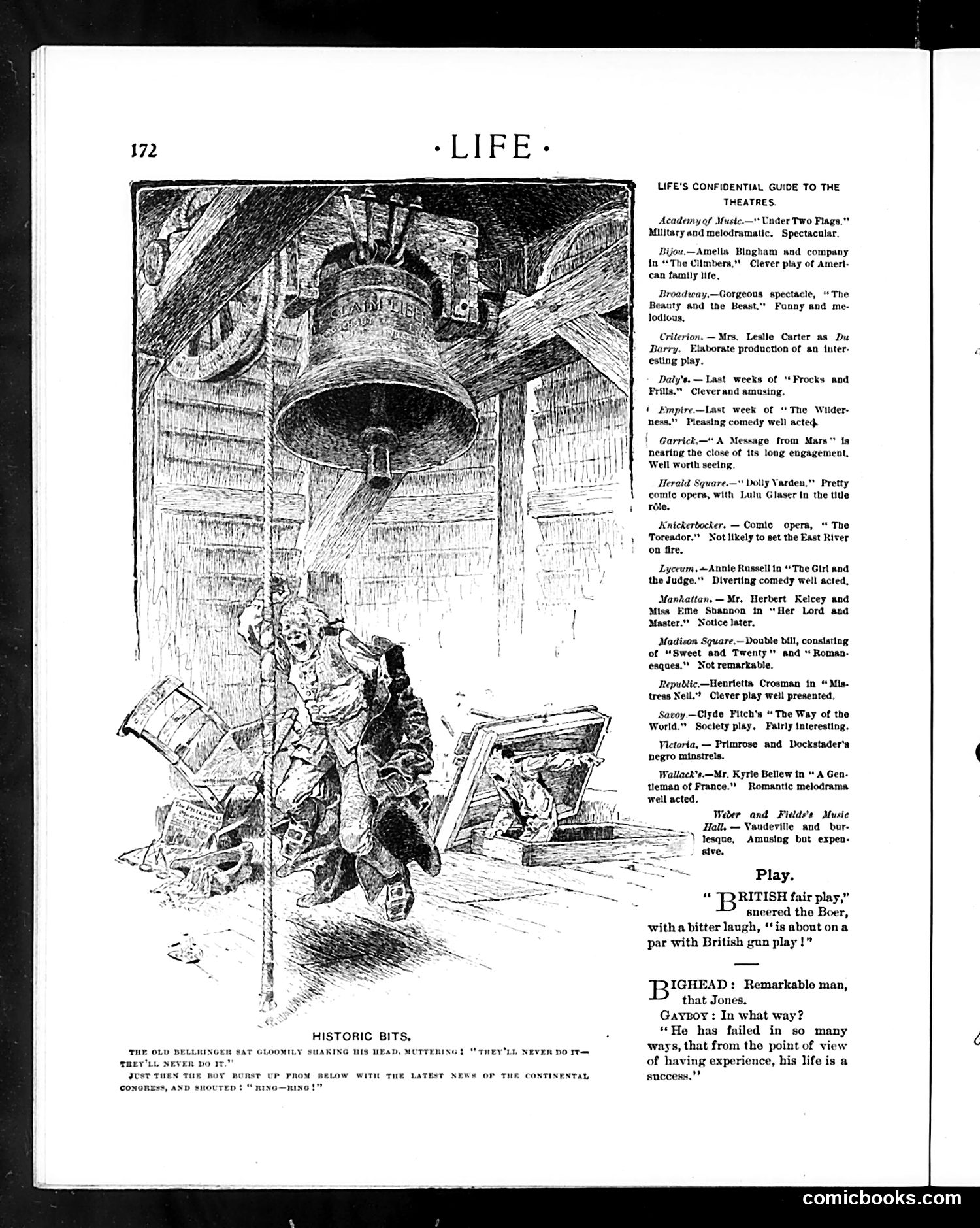
This page contains theater reviews rather than political satire. The main illustration depicts "Historic Bits" — showing an old bellringer sharing news about Continental Congress proceedings, with a boy rushing to spread word via "ding-ring" of a bell. The cartoon's humor relies on historical contrast: it imagines how news traveled in colonial America (via church bells and word-of-mouth) versus the magazine's present era. The bellringer's exclamation about Continental Congress references American Revolutionary history, but the satire targets no specific political figure or event — instead it's gentle comedic nostalgia about communication methods. The right column lists current Broadway productions with brief critical reviews, making this primarily an entertainment guide page rather than political commentary.
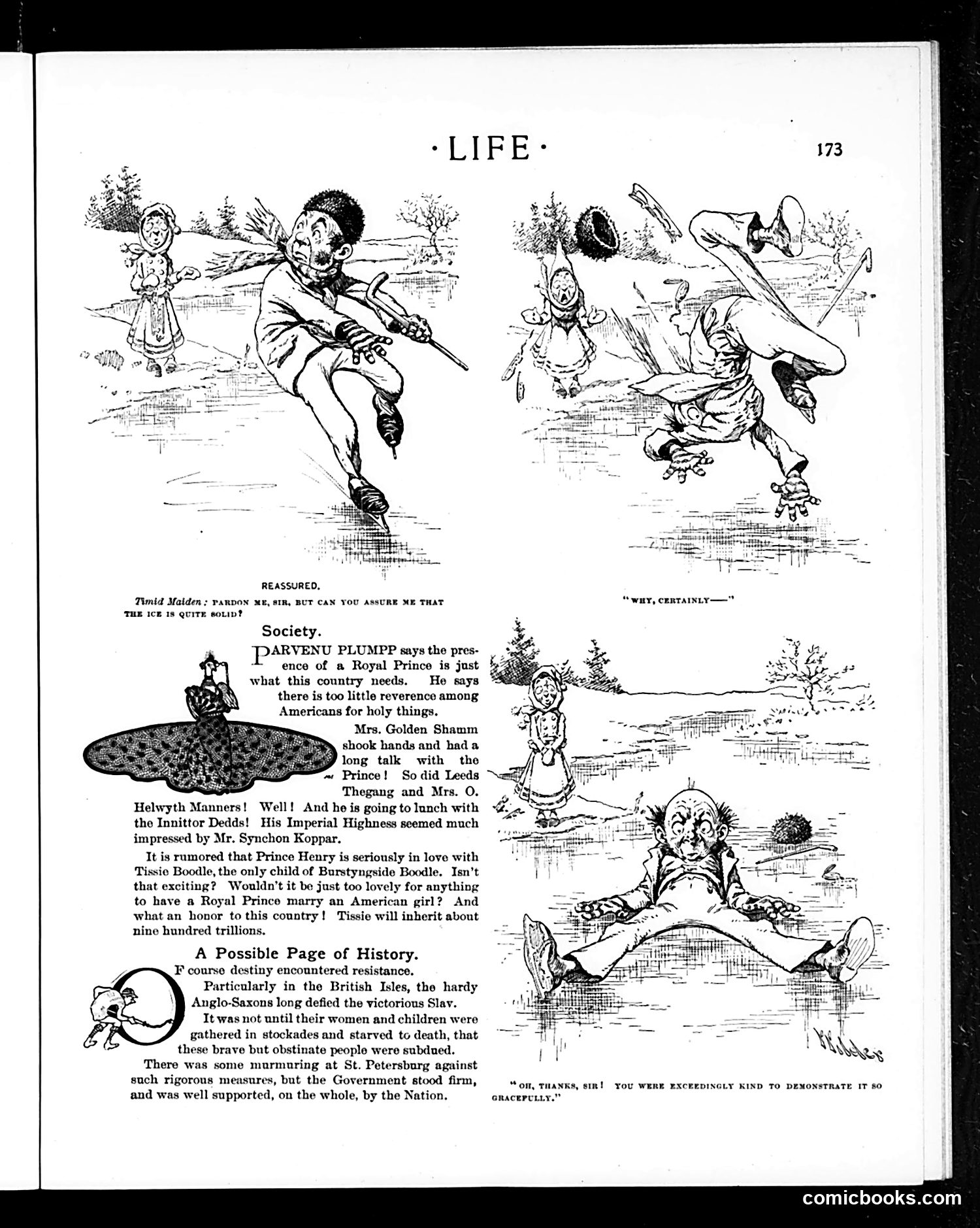
This *Life* magazine page satirizes American social pretension and deference to European royalty, likely from the early 1900s when foreign princes visited America. **The cartoons mock:** 1. **Upper sketches**: American socialites' fawning over a visiting "Royal Prince"—the "Timid Maiden" asking if ice is solid, and scenes of people slipping on ice while trying to impress him. The joke: Americans' embarrassing desperation to appear refined. 2. **Society section**: Named figures like "Parvenu Plumpp" and "Mrs. Golden Shamm" represent newly rich Americans obsessing over royal connections. The rumor that the prince will marry "Tissie Boodle" (worth "nine hundred trillions") mocks both class-climbing and the absurd wealth fantasies of the era. 3. **"A Possible Page of History"**: This darker section imagines future British-Slav conflict ending with Anglo-Saxon defeat—a cautionary fantasy about European power struggles, likely reflecting contemporary anxieties about imperial competition. **The satire's point**: American reverence for foreign nobility is ridiculous and undignified.
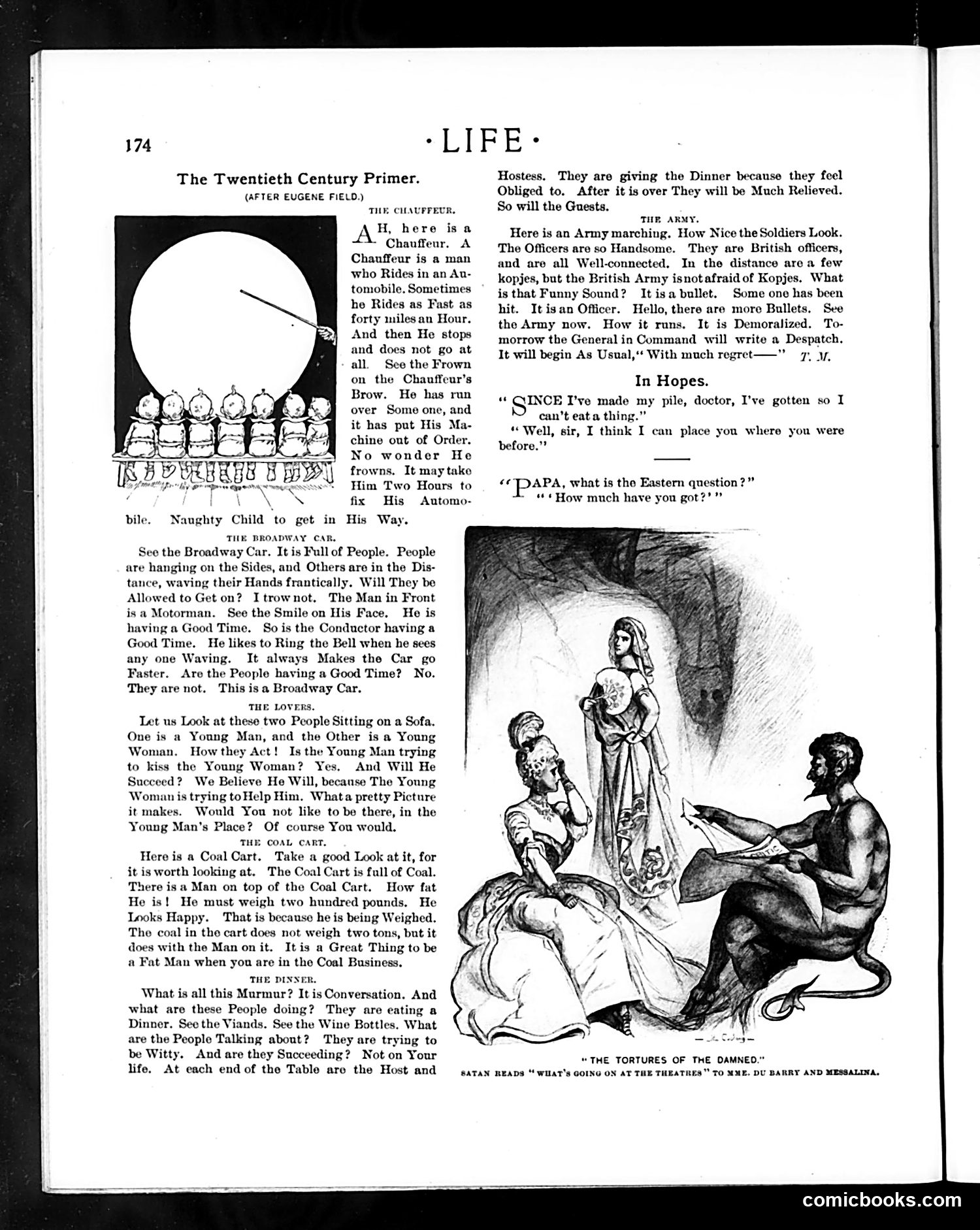
This is a parody of children's primers, mocking early-1900s society through exaggerated observations of modern life. Each section uses simple declarative sentences with ironic commentary: **The Chauffeur**: Mocks the new automobile and careless drivers who run people over. **The Army**: Likely satirizes British military confidence during the Boer War (referenced by "Kopjes"—South African hills). The army "runs" when bullets appear, undermining military prestige. **Broadway Car**: Criticizes overcrowded public transit where conductors enjoy ringing bells while passengers suffer. **The Lovers/Dinner**: Social observation humor about courtship and obligatory dinner parties where guests are bored. **The Coal Cart**: Jokes about weighing a fat man alongside coal for profit. **Bottom Illustration**: "The Tortures of the Damned" depicts Satan reading theater reviews to historical figures (du Barry, Messalina), suggesting contemporary theater is hellish entertainment. The satire targets modern urban life's discomforts, social pretense, and technological disruption presented in innocently deadpan primer language.
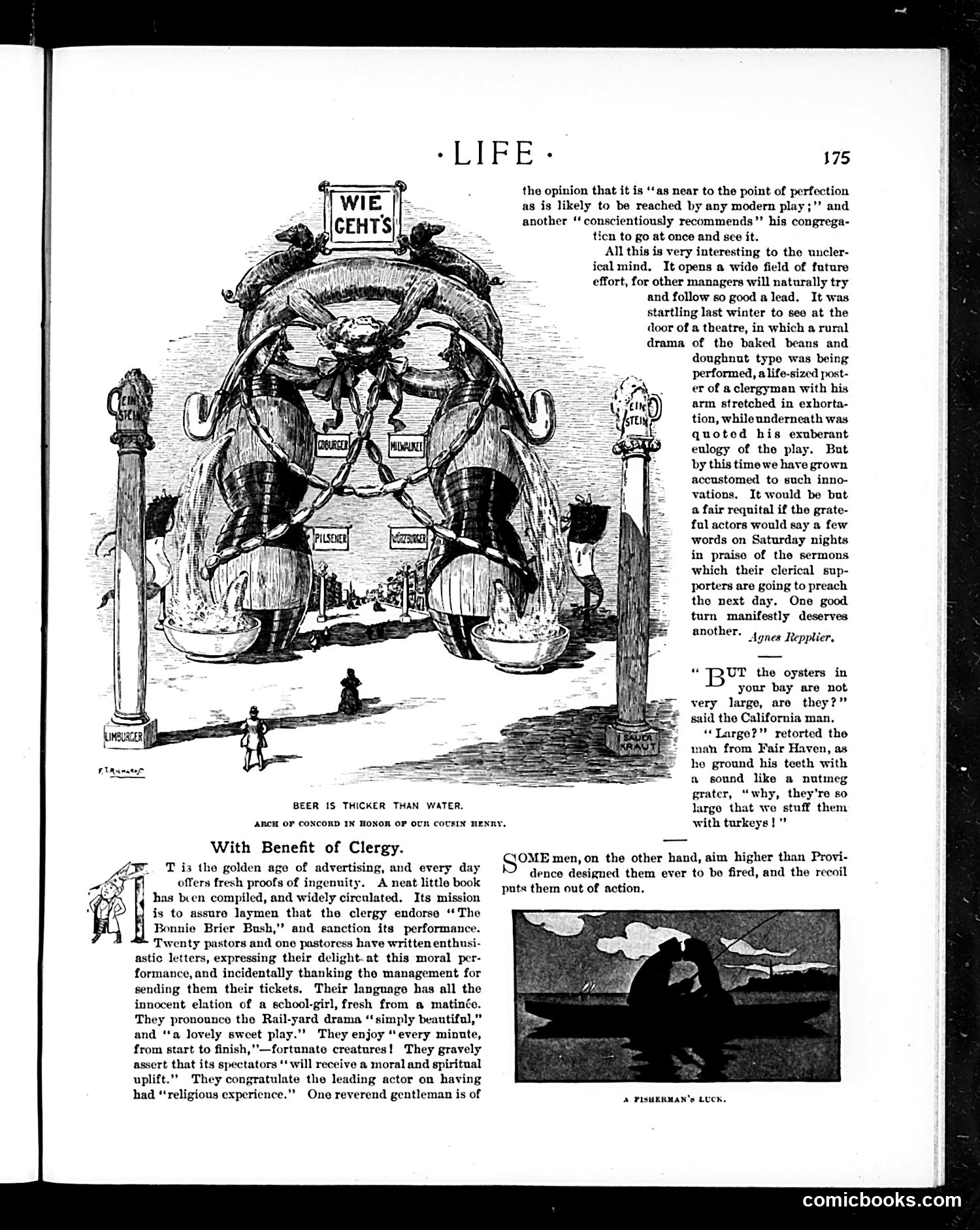
This page satirizes clergy endorsements of theatrical productions. The main article, "With Benefit of Clergy," mocks clergymen who publicly praise plays like "The Bonnie Brier Bush," writing enthusiastic letters recommending performances to their congregations. Life ridicules their naive language ("simply beautiful," "lovely sweet play") and their claims that theater provides "moral and spiritual uplift." The satire suggests this clergy endorsement trend will inspire theater managers to seek similar religious validation, creating absurd reciprocal arrangements. One reverend even quotes clergy praising a rural drama with exaggerated testimonials. The top cartoon depicts a massive figure labeled "BEER IS THICKER THAN WATER" with an "Arch of Concord in Honor of Our Cousin Henry"—likely referencing Henry Gould or similar, though the specific reference is unclear. Two smaller anecdotes about oysters and turkeys appear below, unrelated to the main satire. The page demonstrates Life's characteristic mockery of American social pretension and commercialism.
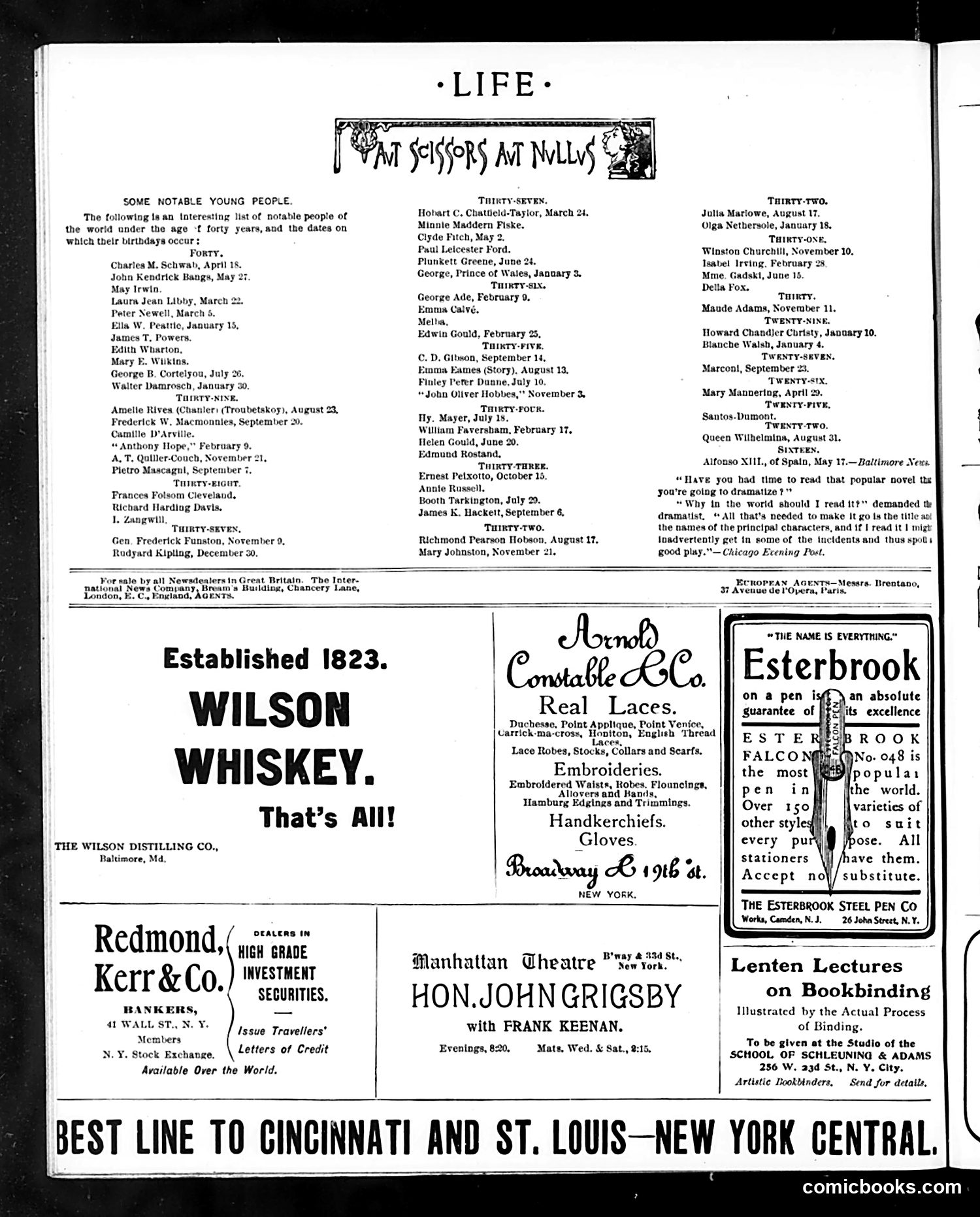
This page from *Life* magazine is primarily a **directory and advertisement compilation** rather than a satirical cartoon. The main content lists "Some Notable Young People" under age forty, organized by birth year. The list includes celebrities, writers, performers, and public figures of the era—Winston Churchill, Queen Wilhelmina, the Prince of Wales, Mary Mannering, and others—establishing who America's prominent young people were circa 1908. The only **actual humor** appears in a small dialogue at bottom center: A dramatist refuses to read the popular novel he's adapting, claiming reading it might accidentally include actual plot incidents that would "spoil" his play. This satirizes theatrical hack work and the low standards of stage adaptations of the period. The remainder is **period advertising**—Wilson Whiskey, Esterbrook pens, real laces, banking services, and theater listings—typical of *Life's* revenue model.
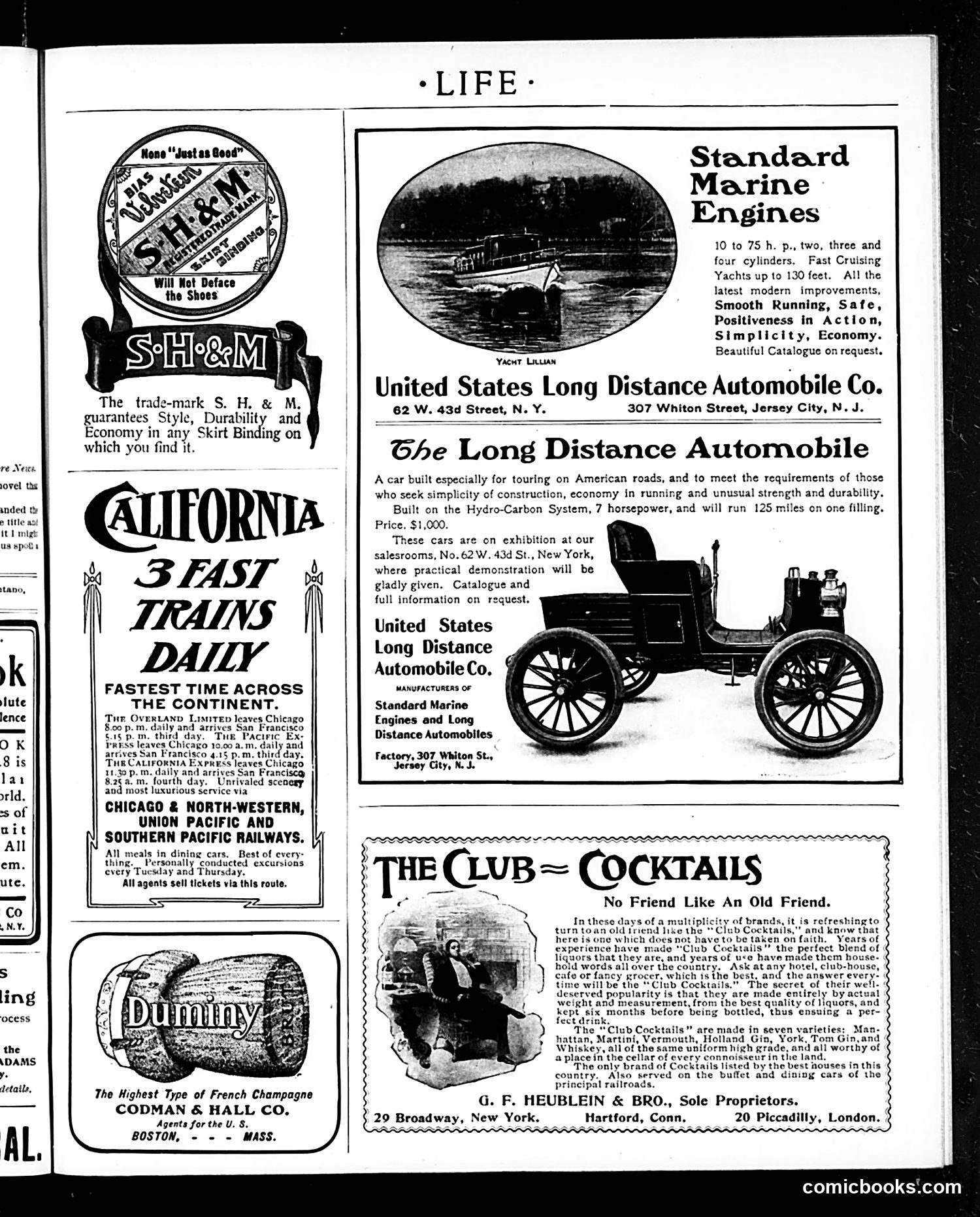
This is primarily an **advertising page** from an early 1900s issue of Life magazine, containing no political cartoons or satire. The content reflects period commercial interests: **Main advertisements:** - **S.H. & M. Skirt Binding** — a fashion/clothing product - **United States Long Distance Automobile Co.** — promoting a $1,000 touring car with 7 horsepower, capable of 125 miles per filling - **Standard Marine Engines** — for yachts and boats - **California Fast Trains** — railroad service via Union Pacific, claiming "fastest time across the continent" - **Club Cocktails** — a pre-mixed cocktail brand, emphasizing quality and consistency - **Codman & Hall Co.** — French champagne The page illustrates the **commercial landscape of early automotive and transportation history**, when automobiles were luxury items and railroads dominated long-distance travel. The ads emphasize modern convenience, reliability, and economy — key selling points for emerging technologies.
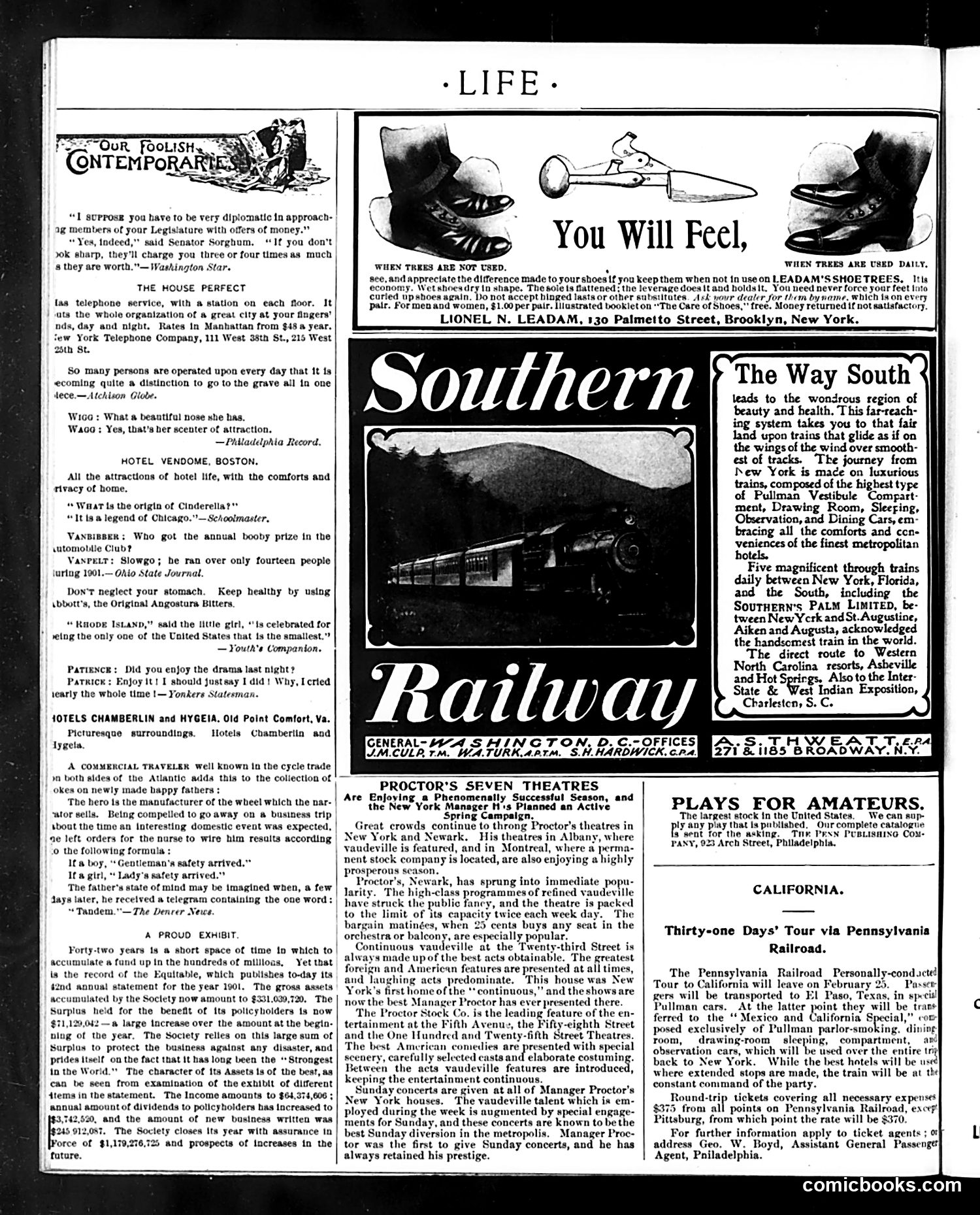
This page collects brief satirical jokes from other newspapers, lampooning American political and social corruption of the early 1900s. The lead cartoon mocks **bribery of legislators**: Senator Sorghum admits that politicians "charge you three or four times as much" as honest bribes are worth—satirizing widespread legislative corruption as routine business negotiation. Other jokes target contemporary absurdities: doctors performing so many surgeries it's "quite a distinction to go to the grave all in one piece"; a motorist winning a "booby prize" for hitting only fourteen people in 1901; and a father receiving the telegram "Tandem" (a two-seater bicycle) when expecting news of his child's birth—playing on new safety bicycle terminology. The page also includes advertisements for hotels, telephone service, and Leadam's Shoe Trees, typical of Life's mixed editorial-commercial format. The humor assumes readers recognize references to current events, corruption scandals, and the rapid industrialization transforming American life.
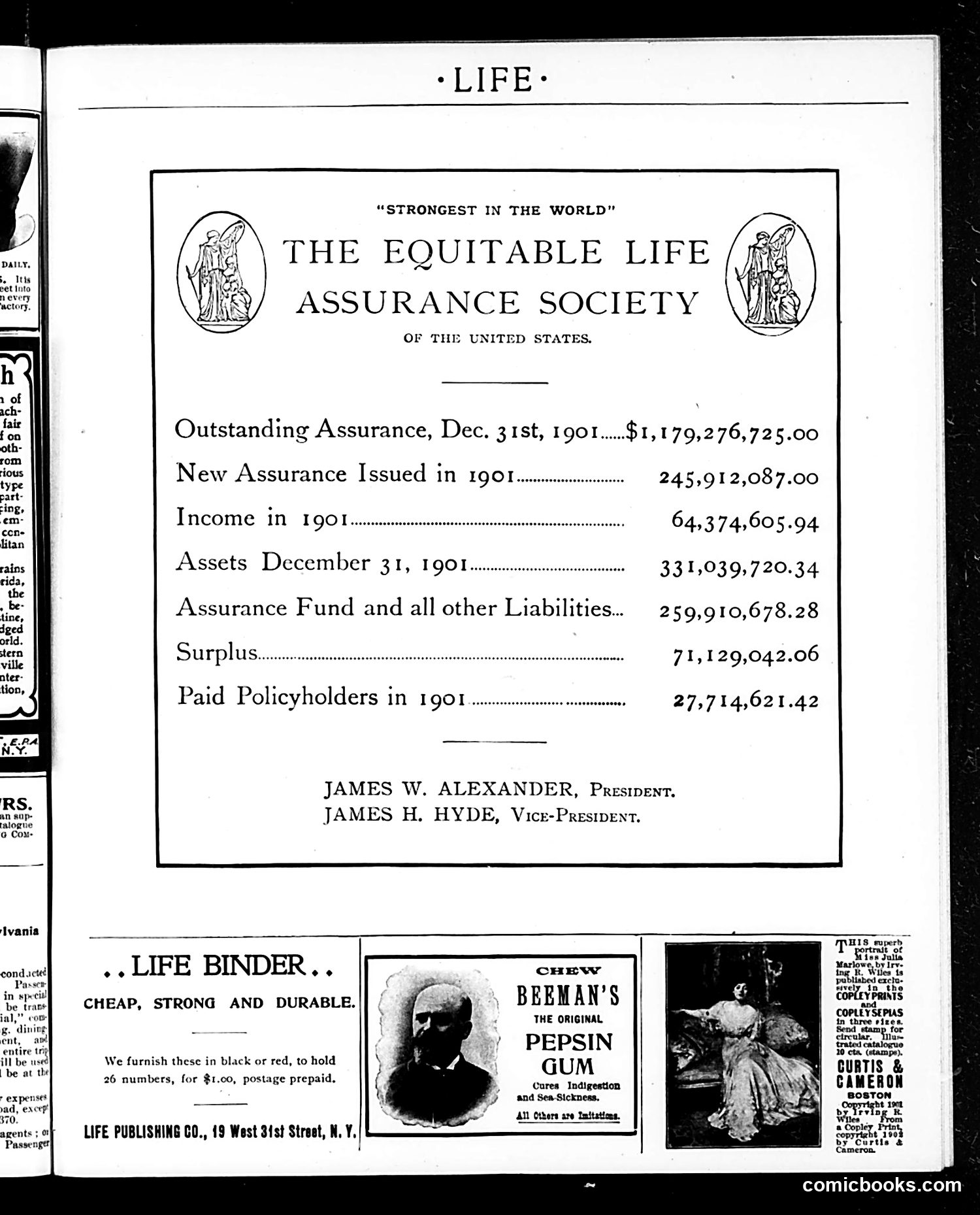
This page is primarily **advertising and financial reporting**, not satire or political commentary. The dominant content is a full-page advertisement for **The Equitable Life Assurance Society**, showcasing its 1901 financial results with the slogan "Strongest in the World." The figures display impressive assets ($331 million) and surplus ($71 million), presenting the company as financially robust. The executives listed are James W. Alexander (President) and James H. Hyde (Vice-President). Below are smaller advertisements for unrelated products: a "Life Binder" filing system, Beeman's Pepsin Gum (marketed for digestion and seasickness), and what appears to be a Curtis & Cameron publication. There is **no visible cartoon or satire** on this page. It functions as a corporate advertisement disguised within the magazine's content, a common early-20th-century practice of using editorial space for paid institutional promotion.
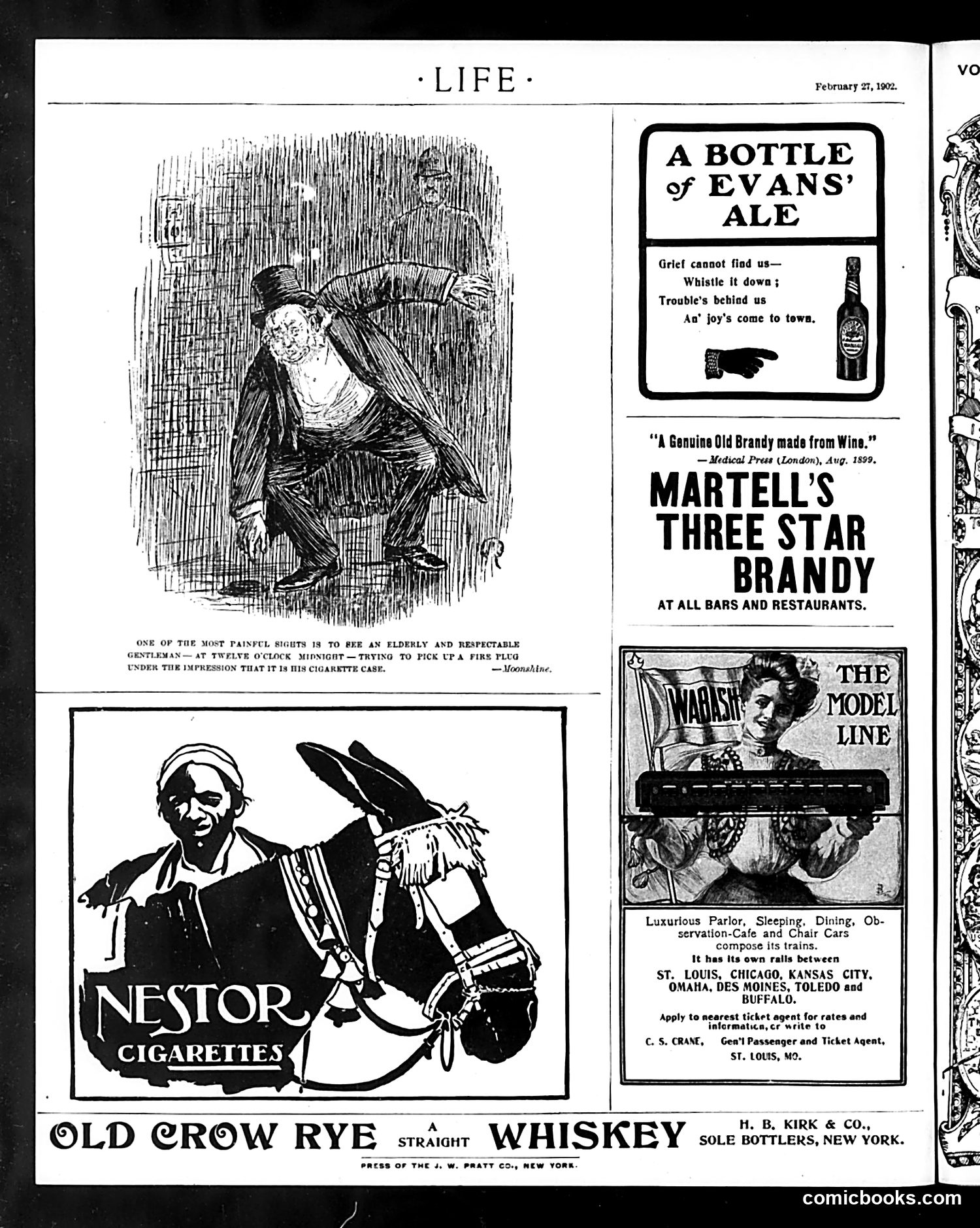
This page is primarily **advertising**, not editorial content. It features four liquor/beverage advertisements and one cigar ad, typical of early 1900s magazines. The top cartoon appears to be a social commentary piece (caption references an elderly gentleman trying to pick up a "fino" at midnight), but the satirical point is unclear without fuller context. The main advertisements promote: - **Evans' Ale** and **Martell's Three Star Brandy** (with medical endorsements) - **Old Crow Rye Whiskey** - **Nestor Cigarettes** (featuring a man on horseback) - **The Model Line** railway cars The recurring theme emphasizes **alcohol as a cure or comfort** ("Grief cannot find us—Whistle it down"), reflecting turn-of-the-century attitudes toward drinking. Medical claims validate the products, a common advertising practice before FDA regulation. No specific political figures or events are identifiable on this page.