
Life, 1902-02-27 · page 4 of 20
Life — February 27, 1902 — page 4: what you’re looking at
What you’re looking at
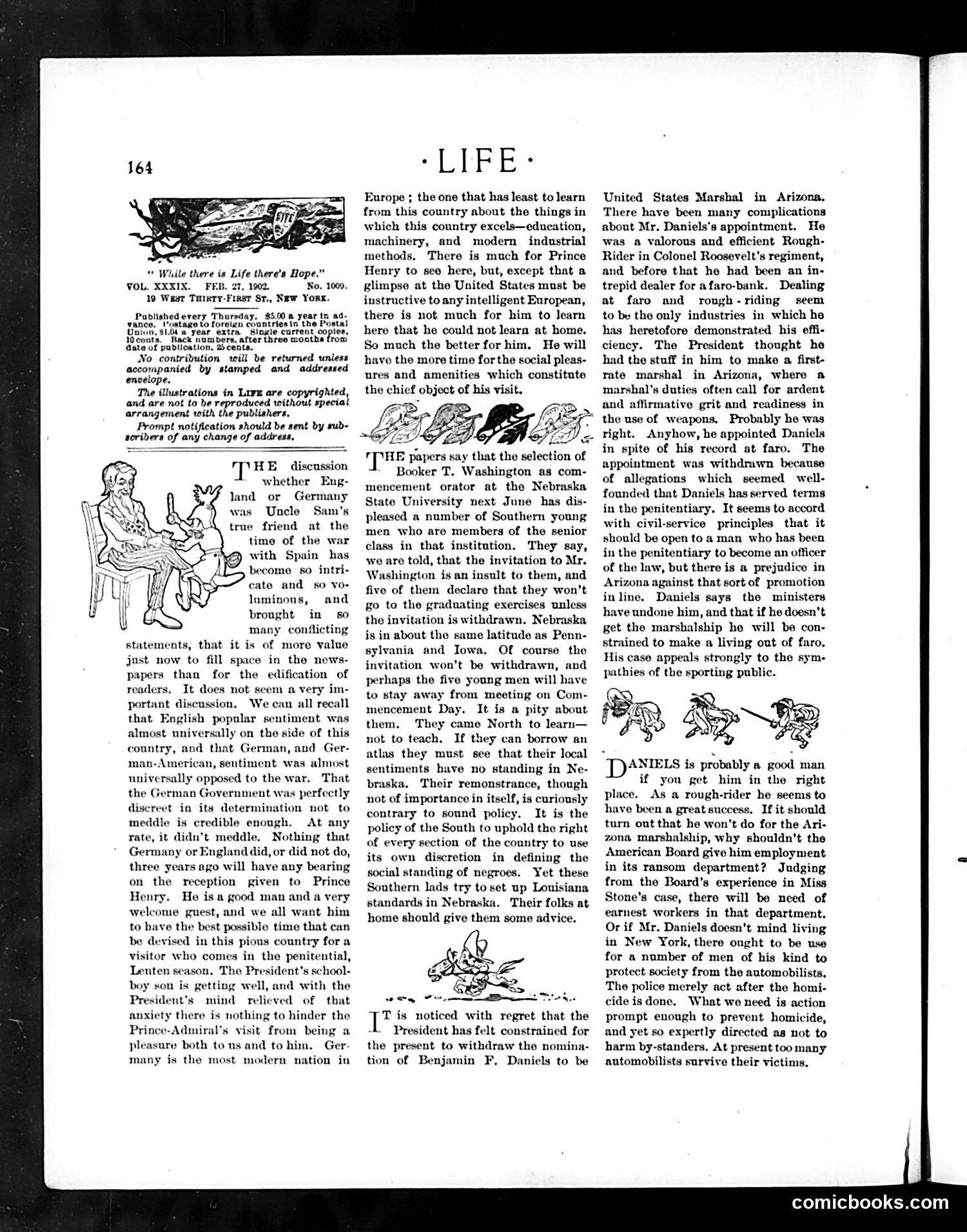
The page contains three editorial cartoons addressing contemporary political issues: 1. **Top cartoon** ("While there is Life there's Hope"): Appears to satirize European attitudes toward American industrial superiority and education. 2. **Middle cartoon**: Depicts a discussion about England and Germany as "Uncle Sam's true friends" during wartime, mocking European relations with the U.S. 3. **Bottom cartoon**: Criticizes President Theodore Roosevelt's withdrawal of Benjamin F. Daniels' nomination as United States Marshal in Arizona, apparently due to Daniels' questionable reputation as a faro dealer and his alleged involvement in penitentiary issues. The satire questions whether the President should protect society from such morally dubious appointments. The cartoons employ caricature and satirical commentary typical of Life magazine's political criticism of the Roosevelt era.
📄 Transcribed text from this page (OCR, searchable)
Machine-transcribed from the original scan — historical spelling and the odd misread are preserved.
“ While there is Life there’s Hope.” VOL. XXXIX. FEB. 27, 1902. No, 1009. 19 Wasr Taiery-First St., New York. Published every Thursday. 35.00 a year tn ad. vance, Irostage to forelu countries ta the Postal Union, $1.06 a year extra. Single current co; 1conts. “Rack numbers, after three months ate of publication, 2 cents No contribution will be returned uniess accompanied by stamped and addressed envelope. The illustrations in Lyre are copyrighted, and are not to be reproduced without special arrangement with the publishers. Prompt notification should be sent by sub- soribers of any change of address, 8 rom HE discussion whether Eng- land or Germany was Uncle Sam's true friend at the time of the war with Spain has become s0 intri- cate and so yo- luminous, and brought in 80 many conflicting statements, that it is of more value just now to fill space in the news- papers than for the edification of readers. It does not seem a very im- portant discussion. We can all recall that English popular sentiment was almost universally on the side of this country, and that German, and Ger- man-American, sentiment was almost universally opposed to the war. That the German Government was perfectly discreet in its determination not to meddle is credible enough. At any rate, it didn't meddle. Nothing that rmany or England did, or did not do, three years ago will have any bearing on the reception given to Prince Henry. He is a good man and a very welcome guest, and we all want him to bave the best possible time that can be devised in this pious country for a visitor who comes in the penitential, Lenten season. Tho President's school- boy son is getting well, and with the Preside’ t's mind relieved of that anxiety there is nothing to hinder the Prince-Admiral’s visit from being a pleasure both to us and to him. Ger many is the most modern nation in LIFE Europe ; the one that has least to learn from this country about the things in which this country excels—education, machinery, and modern industrial methods. There is much for Prince Henry to see here, but, except that a glimpse at the United States must be instructive to any intelligent European, there is not much for him to learn here that he could not learn at home. So much the better for him. He will have the more time for the social pleas- ures and amenities which constitute the chief object of his visit. "PHE papers say that the selection of Booker T. Washington as com- mencement orator at the Nebraska State University next June has dis- pleased a number of Southern young men who are members of the senior class in that institution, They say, we are told, that the invitation to Mr. Washington is an insult to them, and five of them declare that they won’t go to the graduating exercises unless the invitation is withdrawn. Nebraska is in about the same latitude as Penn- sylvania and Iowa. Of course tho invitation won’t be withdrawn, and perhaps the five young men will have to stay away from meeting on Com- mencement Day. It is a pity about them, They came North to learn— not to teach, If they can borrow an atlas they must see that their local sentiments have no standing in Ne- braska, Their remonstrance, though not of importance in itself, is curiously contrary to sound policy, It is the policy of the South to uphold the right of every section of the country to use its own discretion in defining the social standing of negroes. Yet these Southern lads try to set up Louisiana standards in Nebraska. Their folks at home should give them some advice. & Oe la Tk T is noticed with regret that the President has felt constrained for the present to withdraw the nomina- tion of Benjamin F, Daniels to be wee United States Marshal in Arizona. There have been many complications about Mr. Daniels’s appointment. He was a valorous and efficient Rough- Rider in Colonel Roosevelt's regiment, and before that he had been an in- trepid dealer for afaro-bank. Dealing at faro and rough-riding seem to be the only industries in which he has heretofore demonstrated his effi- ciency. The President thought he had the stuff in him to make a first- rate marshal in Arizona, where a marshal's duties often call for ardent and affirmative grit and readiness in the use of weapons. Probably he was right. Anyhow, he appointed Daniels in spite of his record at faro. The appointment was withdrawn because of allegations which seemed well- founded that Daniels has served terms. in the penitentiary. It seems to accord with civil-service principles that it should be open to a man who has been in the penitentiary to become an officer of the law, but there is a prejudice in Arizona against that sort of promotion inline. Daniels says the ministers have undone him, and that if he doesn’t get the marshalship he will be con- strained to make a living out of faro, His case appeals strongly to the sym- pathies of the sporting public. f re eve ANIELS is probably a good man if you get him in the right place. As a rough-rider he seems to have been a great success. If it should turn out that he won't do for the Ari- zona marshalship, why shouldn’t the American Board give him employment in its ransom department? Judging from the Board’s experience in Miss Stone’s case, there will be need of earnest workers in that department. Or if Mr. Daniels doesn’t mind living in New York, there ought to be use for a number of men of his kind to protect society from the automobilists. The police merely act after the homi- cide is done. What we need is action prompt enough to prevent homicide, and yet so expertly directed as not to harm by-standers. At present too many automobilists survive their victims, comicbooks.com